
Judge, 1884-05-03 · page 10 of 16
Judge — May 3, 1884 — page 10: what you’re looking at
What you’re looking at
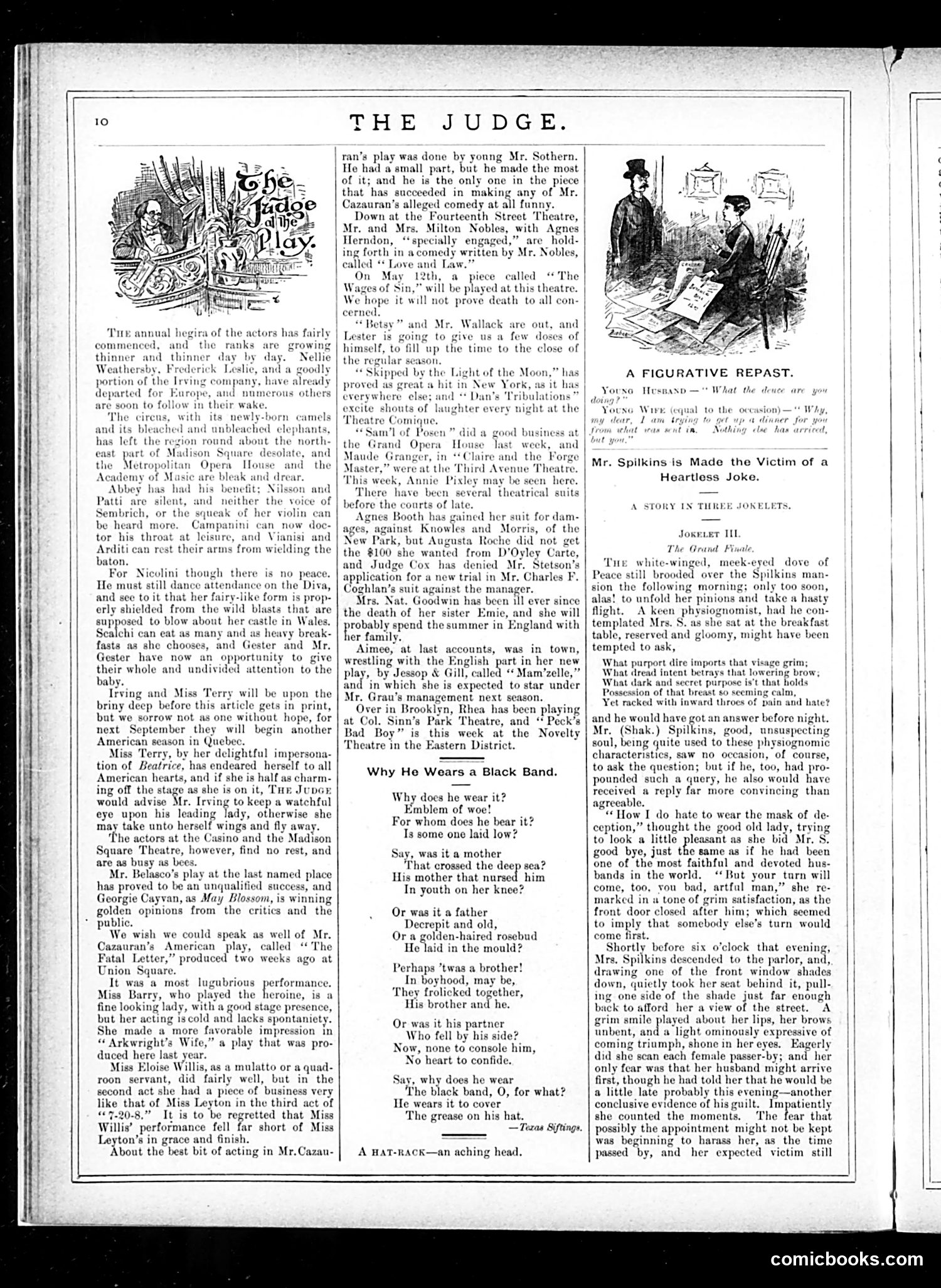
This page from *Judge* magazine contains theater reviews and gossip covering the 1880s Broadway season. The main content discusses departing actors (Nellie Weathersby, Frederick Leslie) and current theatrical productions at venues like the Metropolitan Opera House, Casino, and Madison Square Theatre. The satirical focus centers on **Henry Irving and Ellen Terry**, leading Shakespearean actors. The review warns Irving to "keep a watchful eye" on his leading lady Terry, joking that she might "take unto herself wings and fly away"—a veiled suggestion that he should monitor her fidelity while they're away from home. The page also critiques **David Belasco's play** (praised) and **Cazauran's "The Fatal Letter"** (harshly criticized as "lugubrious"). Young actor **E.A. Sothern** receives praise for salvaging scenes with humor. The accompanying jokelet about **Mr. Spilkins** and a "black band" appears to be domestic humor unrelated to theater. Overall, the page reflects *Judge's* gossipy coverage of theatrical personalities and productions.
📄 Transcribed text from this page (OCR, searchable)
Machine-transcribed from the original scan — historical spelling and the odd misread are preserved.
ira of the ; ranks are. growing thinner hinner day by day. Nellie Weathersby, Frederick Leslie, and a goodly portion of the Irving company, departed for Eu and nu ‘Tue annual he commence: actors and the its newly-born camels nb and its bleached anc has left the re gion round about north- east part of Madison Square desolate, and Metropolitan Opera House and the ademy of Mi are bleak and drear. pbey has had his benefit; Nilsson and ti are silent, and neither the voice of Sembrich, or the squeak of her violin can be heard more. Campanini can now doc- tor his throat at leisure, and Vianisi and Arditi baton. For Nicolini though there is no peace. He must still dance attendance on the Diva, and see to it that her fairy-like form is pre erly shielded from the wild b supposed to blow about her castle in calchi can eat as many and fasts as she cho and ( Gester have now an opportunity to their whole and undivided attention to the baby. Irving and Miss Terry will be upon the briny deep before this article gets in print, but we sorrow not as one without hope, for next September they will begin another American season in Quebec. Miss Terry, by her delightful impersona- tion of Beatrice, has endeared herself to all American hearts, and if she is half as charm- ing off the stage as she is on it, Tur JupGe would advise Mr. Irving to keep a watchful eye upon his leading lady, otherwise she may take unto herself wings and fly away ‘The actors at the Casino and the Madison Square Theatre, however, find no rest, and are as busy as bees. Mr. Belasco’s play at the last named place has proved to be an unqualified success, and Georgie Cayvan, as May Blossom, is winning golden opinions from the critics and the publi We wish we could speak as well of Mr. Cazauran’s merican play, called ‘ The Fatal Letter,” produced two weeks ago at Union Square. It was a most lugubrious performance. Miss Barry, who played the feraiherniss fine looking lady, with a good stage presence but her acting iscold and lacks spontanie She made a more favorable impre: “ Arkwright’s Wife duced here last ) Miss Eloise Willis, as a mulatto or a quad- roon servant, did fairly well, but in the second act she had a piece of business very an rest their arms from wielc ing the It is to be regretted that Miss is’ performance fell far short of Miss Leyton’s in grace and finish. About the best bit of acting in Mr.Ca au ched elephants, | | excite shouts of | THE JUDGE. ran’s play was done by young Mr. Sothern. aamall part, but he made the most of it; and he is the only one in the piece that has succeeded in making any of Mr. Cazauran’s alleged comedy at all funn: | Down at the Fourteenth Street Theatre, | Mr. and Mrs. Milton Nob! with Agnes | Herndon, “specially engaged,” are_hold- ing forth in acomedy written by Mr. Nobles, called ‘* Love and Law. On May 12th, a pce is a Wages of Sin,” will be ed at this the We hope JEWill Hot poove Gentil to all eon: cerned. | "und M Wallack are out, and | joing to e us a few doses of hims elf, to fill up the time to the close of | the regular season. «Skipped by the Light of th proved us gre: 1 New York, as it hi everywhere el Dan’s ‘Tribulations revery night at the Moon,” has Theatre Comiqu “Sam’l of Posen” did a good business at the Grand Opera House last week, and » Granger, in **Claire and the Fo: »” were at the Third Avenue Theatre. his week, Annie Pixley may be seen here. There have been several theatrical suits before the courts of late. | es Booth has gained her suit for dam- against Knowles and Morris, of the New Park, but Augusta Roche did not get the $100 she nted from D’Oyley Carte, and Judge Cox has denied Mr. Stetson’s application for a new trial in Mr. Charles F. Coghlan’s suit against the manager. Mrs. Nat. Goodwin has been ill ever since the death of her sister Emie, and she will probably spend thesummer in England with ner family. Aimee, at last punts, wrestling with the English play, by Jessop & Gill, called “ Mam’zelle,” and in which she is expected to star under Mr. Grau’s management next season. Over in Brooklyn, Rhea has been playing at Col. Sinn’s Park Theatre, and ‘ Peck’s Bad Boy” is this week at the Novelty Theatre in the Eastern District. was in town, ah in her new Why He Wears a Black Band. does he wear it? mblem of woe! For whom does he bear it? Is some one laid low? y, was it a mother ‘That crossed the deep sea? His mother that nursed him In youth on her knee? Or was it a father Decrepit and old, Or a golden-haired rosebud He laid in the mould? Perhaps ‘twas a brother! In boyhood, may be, They frolicked together, His brother and he. Or was it his partner Who fell by his side? Now, none to console him, No heart to confide. Say, why does he wear ‘The black band, O, for what? He wears it to cover The grease on his hat. was Siftings. A HAT-Rack—an aching head. A FIGURATIVE REPAST. Youxa Hesnaxp —"* What the deuce are you Youno Wire (equal to the oceasi trata sent in. Mr. Spilkins is Made the Victim of a Heartless Joke. A STORY IN THREE JOKELETS, Let IL Th tnd Finale ‘Tne white-winged, meek-eyed dove of Peace still brooded over the Spilkins man- sion the following mornin. soon, to unfold her pinions and take ah n physiognomist, had he « tat the br ht have been us she nd gloomy templated Mrs. table, reserved tempted to ask, What purport dire imports that visage grim; What dread intent betrays that lowering brow; What dark and secret purpose is't tha nd hatet Yet racked with inward throes of pain ve got an answer before night. pilkins, good, unsuspecting nomic characteristi aw no occasion, of course, to ask the question; but if he, too, had pro- pounded such a query, he also would have received a reply far more convincing than agreeable. “How I do hate to wear the mask of de- ception,” thought the good old lady, trying to look a little pleasant as she bid Mr. S. good bye, just the same as if he had been one of the most faithful and devoted hus- bands in the world. ‘But your tarn will come, too, you bad, artful man,” she re- marked in a tone of grim faction, as the front door closed after him; which seemed to imply that somebody e turn would come first Mr. (Shak.) soul, being quite used to these physi Shortly before six o’clock that evening, Mrs. Spilkins descended to the parlor, and, drawing one of the front window shades down, quietly took her seat behind it, pull- ing one side of the shade just far enough back to afford her a view of the street. A grim smile 1 about her lips, her brows unbent, and a light ominously expressive of coming triumph, shone in her did she scan each female passe only fear was that her husband might arrive first, though he had told her that he would be a little late probably this evening—another conclusive evidence of his guilt. Impatiently she counted the moments. ‘The fear that possibly the appointment might not be kept as beginning to harass her, as the time passed by, and her expected victim still comicbooks.com