
Judge, 1884-05-03 · page 4 of 16
Judge — May 3, 1884 — page 4: what you’re looking at
What you’re looking at
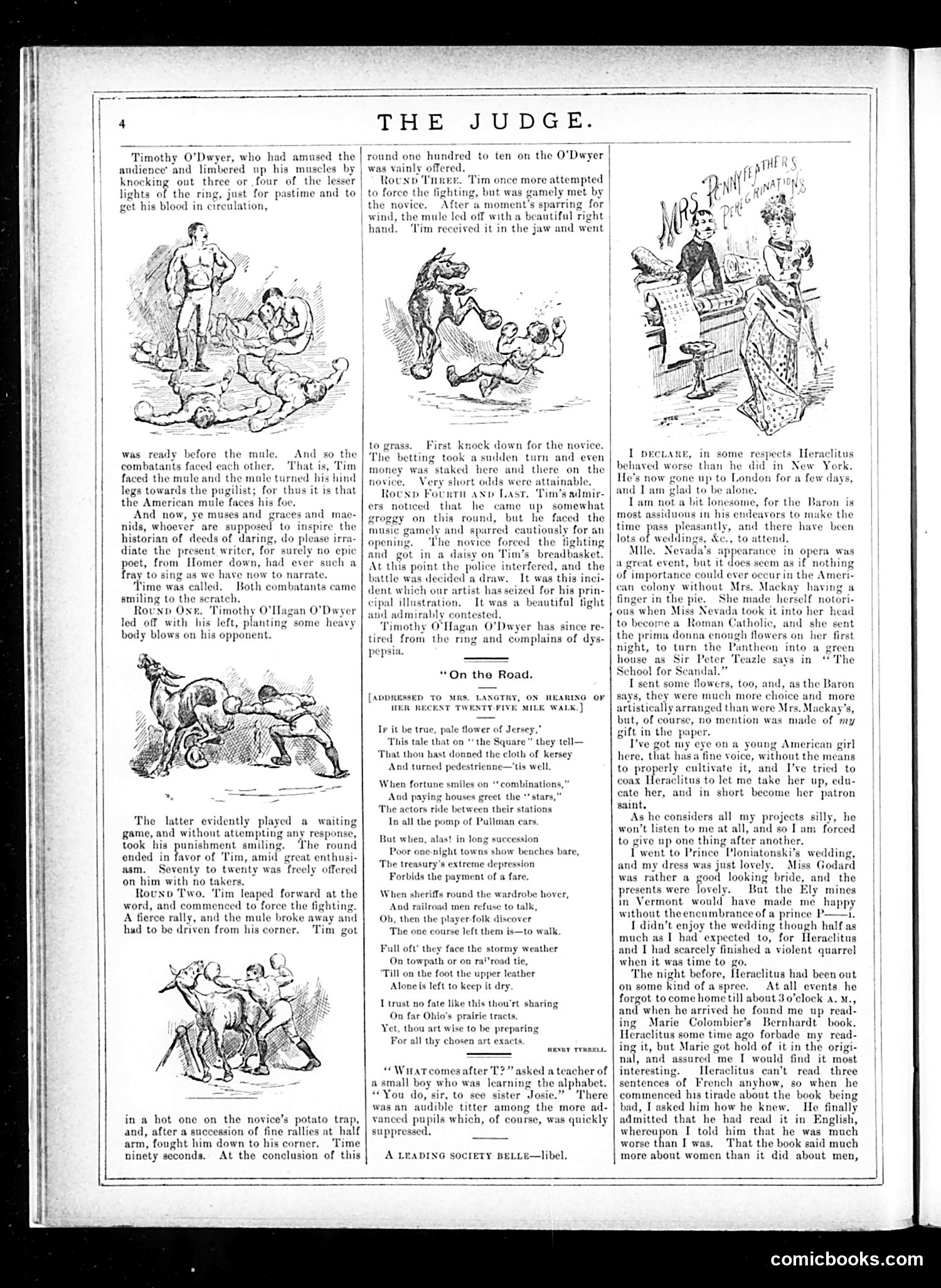
This page contains a humorous boxing match story between "Timothy O'Hagan O'Dwyer" and a mule—a satire of Irish-American bare-knuckle fighting culture. The detailed round-by-round account mocks both the sport's brutality and flowery newspaper coverage of fights. O'Dwyer's exaggerated Irish name and the mule as opponent suggest ridicule of Irish immigrant boxers and their working-class audiences who bet heavily on such matches. The second section, "On the Road," comments on actress Lillie Langtry's recent 25-mile walk, likely a publicity stunt. The verse humorously contrasts theatrical actors' usual luxury travel via Pullman cars with desperate circumstances forcing performers to walk when touring shows fail financially—a jab at the entertainment industry's economic precarity and theatrical self-promotion. A brief joke about a schoolboy follows. Overall, the page satirizes Irish-American pugilism, theater industry instability, and Victorian-era social pretension through comic verse and illustrations.
📄 Transcribed text from this page (OCR, searchable)
Machine-transcribed from the original scan — historical spelling and the odd misread are preserved.
Timothy O'Dw d the | andi and limbered up his muscles by knocking out three or four of the le lights of the ring, just for pastime and to get his blood in circulation, was ready before the mule. combatants faced each other. faced the mule and the mule tu legs towards the pugilist; for thus it is that the American mule faces his foe And now, ye muses and graces and mae- nids, whoever are supposed to inspire the historian of deeds of daring, do please irra- diate the present writer, for surely no epic poet, from Homer down, had ever such a ave now to narrate. Both combatants came smiling to the scratch, Rounp Oxe. Timothy O'Hagan O'Dwyer ome heavy And so the That is, Tim | ned his hind led off with his left, plantin body blows on his opponent. The latter evidently played game, and without attempting an. mse, took his punishment smiling. ound ended in favor of Tim, amid great enthusi asm. Seventy to twenty was freely offer on him with no taker: Rounp Two. word, and c waiting re ped forward at the need to force the fighting. nd the mule broke a had to be driven from his corner. Tim got in a hot one on the novice’s potato trap, and, after a succession of fine rallies at half arm, fought him down to his corner. ‘Time ninety seconds. At the conclusion of this THE JUDGE. round one hundred to ten on the O'Dwyer was vainly offered. Rounp Taner to force the fighting, but wa: the novice. After a moment's sparring for wind, the mule led off with a beautiful right hand. ‘Tim received it in the jaw and went ‘Tim once more attempted nock down for the novice. took a sudden turn and even was staked here and there on the Very short odds were attainable. ‘ourTH AND Last. Tim’s admir- ers noticed that he came up somewhat groggy on this round, but he faced the music gamely and sparred cautiously for an opening. ‘The novice forced the fighting and in a sy on Tim's breadbasket. At this point the police interfered, and the ttle was decided a draw. It was this inci- dent w our artist has seized for his prin- ipal illustration, It was a beautiful fight nd admirably contested. Timothy O'Hagan O'Dwyer h tired from the ring and con pep mon novice. Rounp got since re- lains of dys- “On the Road. [ADDRESSED TO MRS. LANGTRY, ON HEARING OF HER RECENT TWENTY-FIVE SMILE WALK.) Ir it be true, pale flower his tale that on “* the Square” they tell— t thou hast donned the cloth of And turned pedestrienne—'tis well. When fortune And paying houses greet the ** The actors ride between their stati “combinations, In all the pomp of Pullman cars. But when, alas! in long succession ht towns show benches bare, The treasury's extreme depression Forbids the payment of a fare. When sheriffs round the wardrobe hover, And railroad men refuse to talk, Oh, then the player-folk discover The one course left them is—to walk 1 oft’ they face the stormy w On towpath or on rai’road tie, ‘Till on the foot the upper leather Aloneis left to keep it dry. ather I trust no fate like this thou'rt sharing On far Ohio’s prairi Yet, thou all thy chosen ar racts, art wise to be preparing “ Witarcomesafter'l?” asked a teacher of asmall boy who was learning the alphabe “You do, sir, to sce sister Jc There was an audible titter among the more ad- vanced pupils which, of course, was quickly suppre A LEADING SOCIETY BELLE umely met by | | | I in some respects Heraclitus behaved wo han he did in New Yor He’s now gone up to London for a few day and Tam glad to be alone. Tam not a bit lonesome, for the most assiduous inh time pass Baron is ndeavors to make the wntly, and there have been lots of weddings, Xc., to uttend. Mlle. Nevada’s appearance in opera was a great event, but it does seem as if nothin of importance could ever occur in the Ameri- an colony without Mrs. Mac finger in the pie. She made herself noto ous when Miss Nevada took it into her h 4 Roman Catholic, and sh the prima donna enough flowers on her night, to turn the Pantheon into a house as Sir Peter Teazle says in “ The School for Scandal.” I sent some flowers, too, and the Baron says, they were much more choice and more artistically arranged than were Mrs. Mackay’s, but, of course, no mention was made of my gift in the pape I've got my eye on a young American girl here, that hasa fine voice, without the means to properly cultivate it, and I’ve tried to coax Heraclitus to let me take her up, edu- cate her, and in short become her patron saint. As he considers all my project won’t listen to me at all to give up one thing I went to Prince Plor and my dress just lovely, Miss Godard was rather a good looking bride, and the presents were lovely. But the Ely mines in Vermont would have made me happy without theencumbri of a prince P—i. I didn’t enjoy the wedding though half as much as I had expected to, for Heraclitus and I had scarcely finished a violent quarrel when it was time to go. The night before, Heraclitus had been out on some kind of a spree. At all events he forgot tocome home till about 30’clock a. o., and when he arrived he found me up read- i Marie Colombier’s Bernhardt book. litus some time Je my read- ing it, but Maric got hold of it in the origi- nal, and assured me I would find it most interesting. Heraclitus can’t read three sentences of French anyhow, so when he commenced his tirade about the book being | bad, I asked him how he knew. He finally admitted that he had read it in English, whereupon I told him that he was much worse than I was. That the book said much more about women than it did about men, to becor comicbooks.com