
A complete issue · 16 pages · 1883
Judge — August 18, 1883
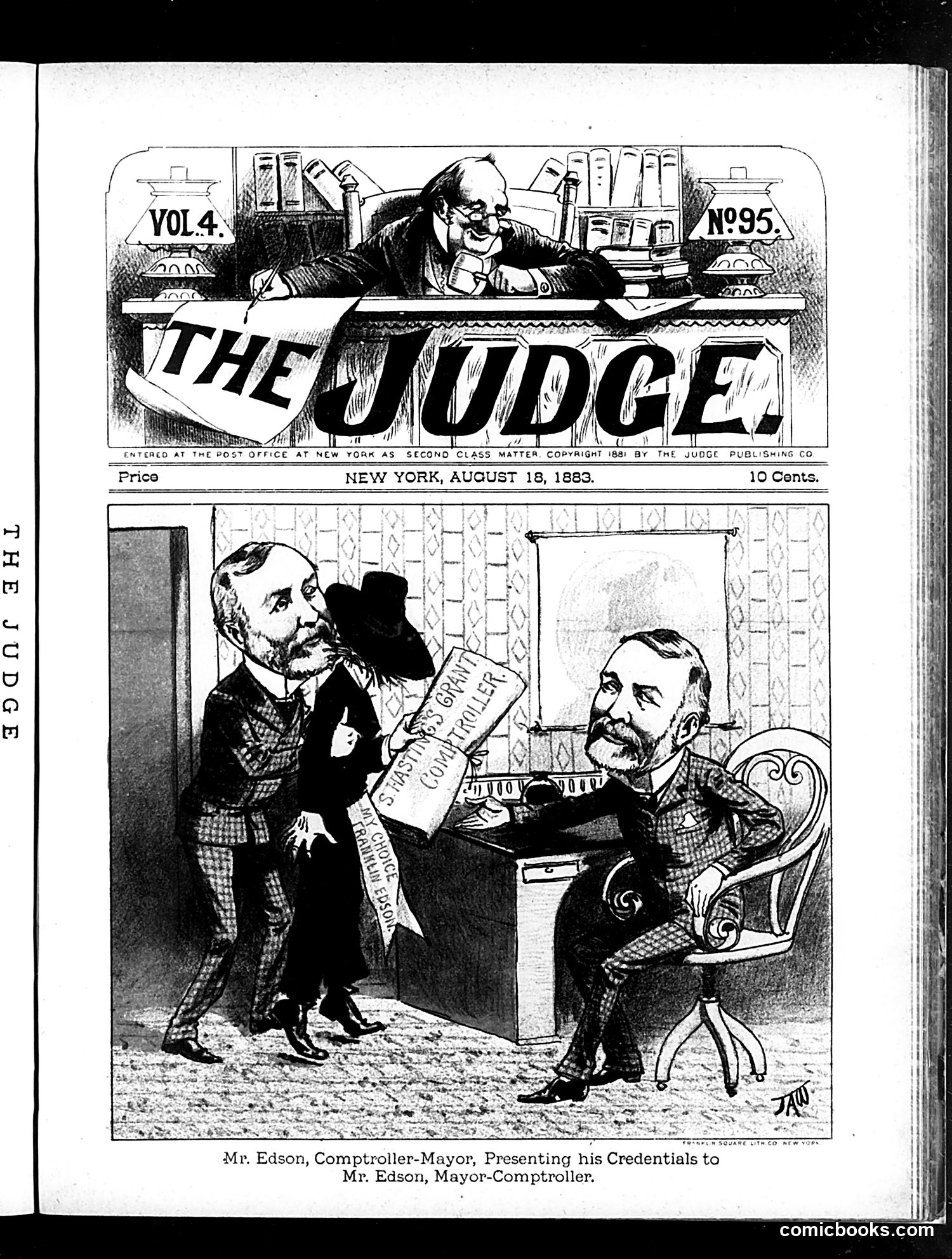
This cartoon satirizes a political absurdity: **Mr. Edison appearing twice in the same scene**—once as "Comptroller-Mayor" presenting credentials, and once as "Mayor-Comptroller" receiving them. The joke appears to be about **confusion or duplication in New York City municipal positions** in 1885. The cartoonist mocks what seems to be either a bureaucratic muddle or political role reversal involving Thomas Edison or someone with that name in city government. The exaggerated, nearly identical figures underscore the ridiculousness of the situation—presenting credentials to oneself. Without specific historical context about NYC politics that year, the exact incident remains unclear, but the satire targets municipal incompetence or political theater around overlapping mayoral/comptroller duties.
This page contains two editorial pieces rather than political cartoons. **"Off Duty"** satirizes government inefficiency during summer vacations. The author mocks how federal departments function smoothly without their appointed officials present—suggesting their actual labor is minimal. The jab at "Sambo, the porter" filling the Secretary's role reveals period racial attitudes while advancing the satire. The piece sardonically praises officials' well-earned rest, implying they don't deserve it. **"Cremation"** advocates for cremation over traditional burial, attacking sentimental objections as illogical. The argument emphasizes practical benefits: reduces disease risk, saves cemetery space in crowded cities, and provides cleaner remains for remembrance. This reflects late-19th-century progressive attitudes toward modernizing burial practices against entrenched custom. Both pieces exemplify *Judge*'s satirical approach: mocking government ineffectiveness and championing rational reform over tradition.
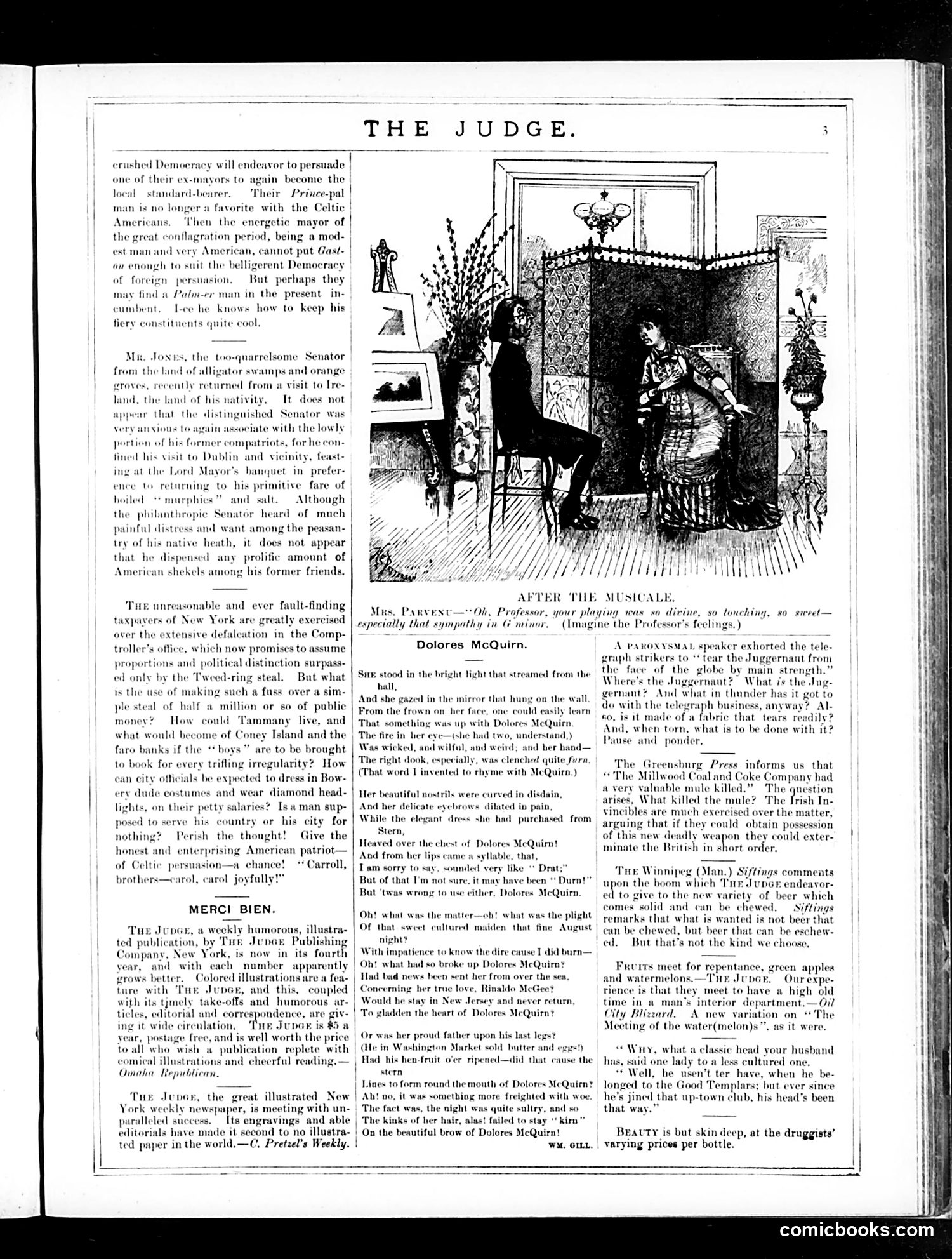
This page satirizes pretentious cultural aspirations and social climbing among the wealthy. The main cartoon depicts a woman, Dolores McQuirn, visibly upset after hosting a musical performance where a professor played for her guests. The accompanying poem mocks her distress: despite her carefully cultivated refined taste (the "elegant dress" purchased from Stern, a luxury store), something has gone wrong. The satire targets the gap between *performing* sophistication and actual contentment—she's invested in the trappings of high society but remains fundamentally unhappy. The text below offers crude humor about trivial domestic concerns ("beauty is but skin deep"), underlining Judge's skeptical view of fashionable New York society's hollow pretensions. The satire suggests that wealth and cultural affectation cannot guarantee happiness or authenticity.
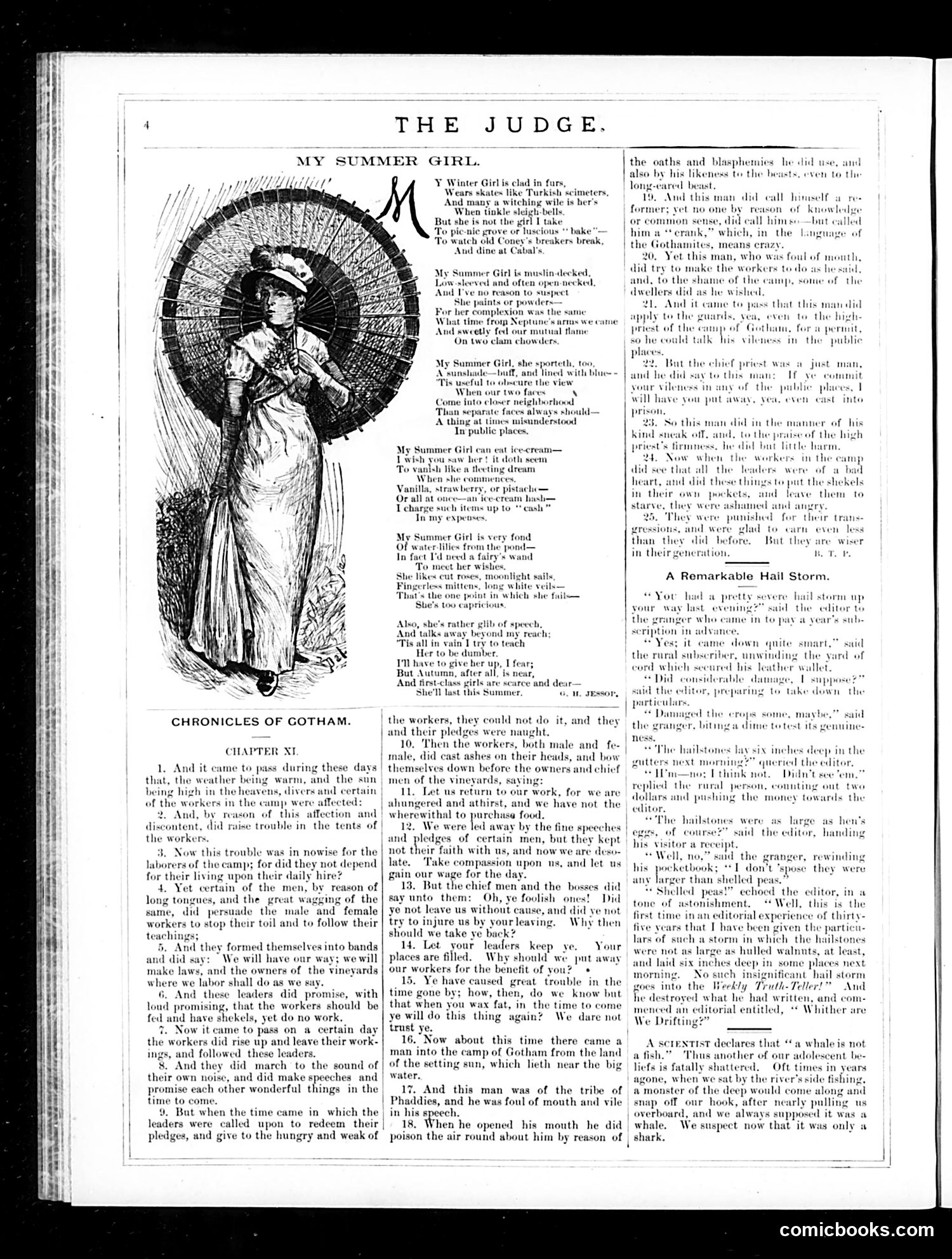
This page contains two distinct pieces: **"My Summer Girl"** (left): A humorous poem with illustration about a man's romantic disappointment. His winter girlfriend was elegant and refined; his summer girlfriend is vain, talkative, and common. The joke is the narrator's resignation—he'll tolerate her flaws because "first-class girls are scarce and dear" and she'll "last this Summer." It's light satire on male compromise in relationships. **"Chronicles of Gotham, Chapter XI"** (right): Presented in biblical language, this appears to be labor-dispute satire. Workers strike after leaders promise food and wages without work; employers refuse to rehire them, citing past trouble. A foul-mouthed agitator from the "land of the setting sun" (the West) arrives to incite them further but is expelled. The workers ultimately lose and accept worse terms. The satire mocks both labor organizers (as demagogues) and possibly corrupt employers. The biblical parody style was Judge magazine's signature approach to contemporary social conflicts.
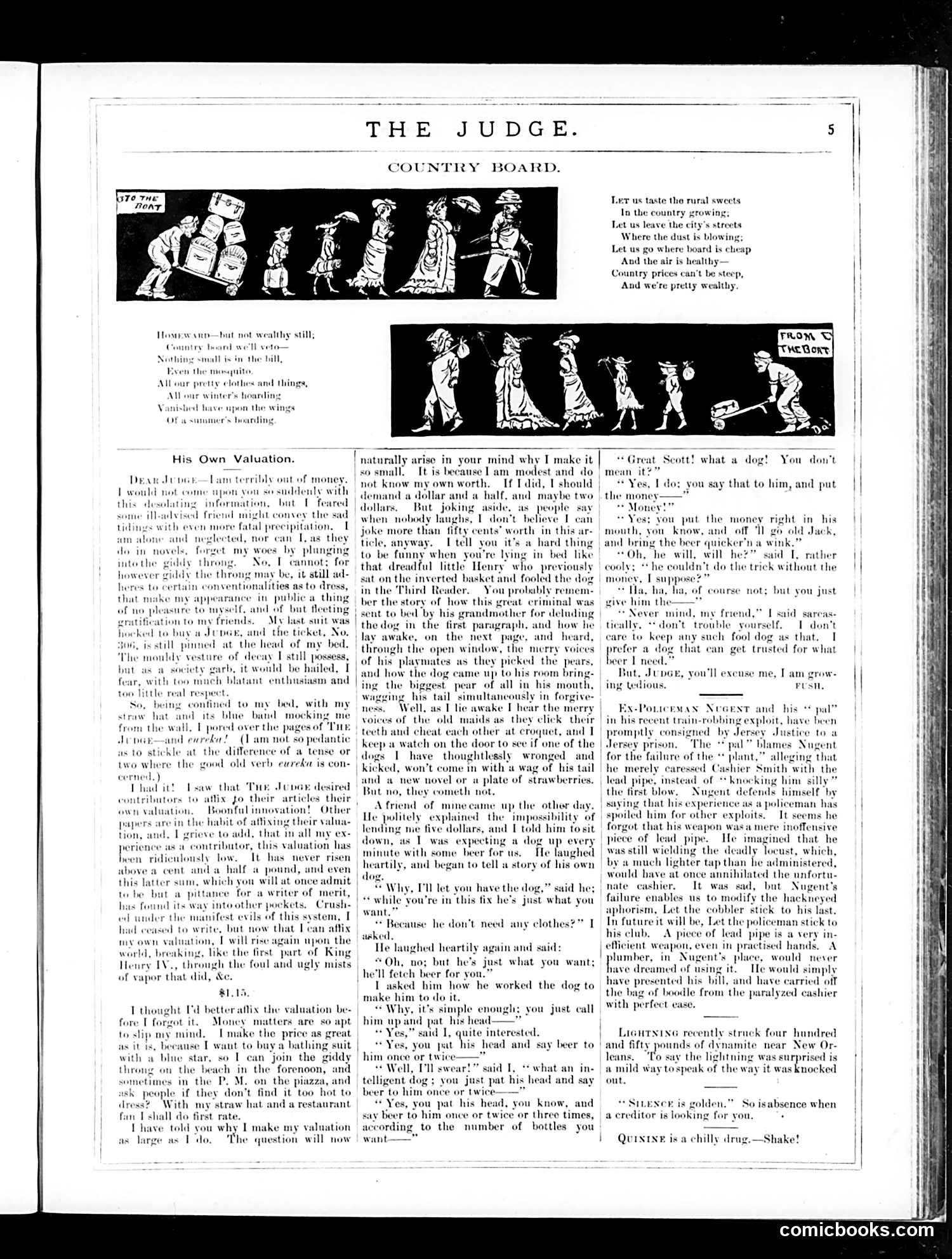
This page satirizes the economic struggles of a struggling writer/contributor. The author, financially desperate and confined to bed in worn-out clothes, discovers that *Judge* magazine allows contributors to set their own payment rates for articles. The satire lies in the absurdity: the writer, too modest and self-deprecating to value his own work fairly, sets an impossibly low price (fifty cents) for his contribution. He then fantasizes about using this pittance to buy a bathing suit, imagining himself joining the leisure class at the beach. The extended anecdote about a child named Henry—lured to misbehavior and confined to bed as punishment—mirrors the writer's own predicament: trapped indoors, watching others enjoy freedom and plenty while he remains impoverished. The joke critiques both the writer's lack of self-worth and the absurdity of allowing contributors to price their own labor, which inevitably results in exploitation. It's social commentary wrapped in self-deprecating humor about literary poverty.
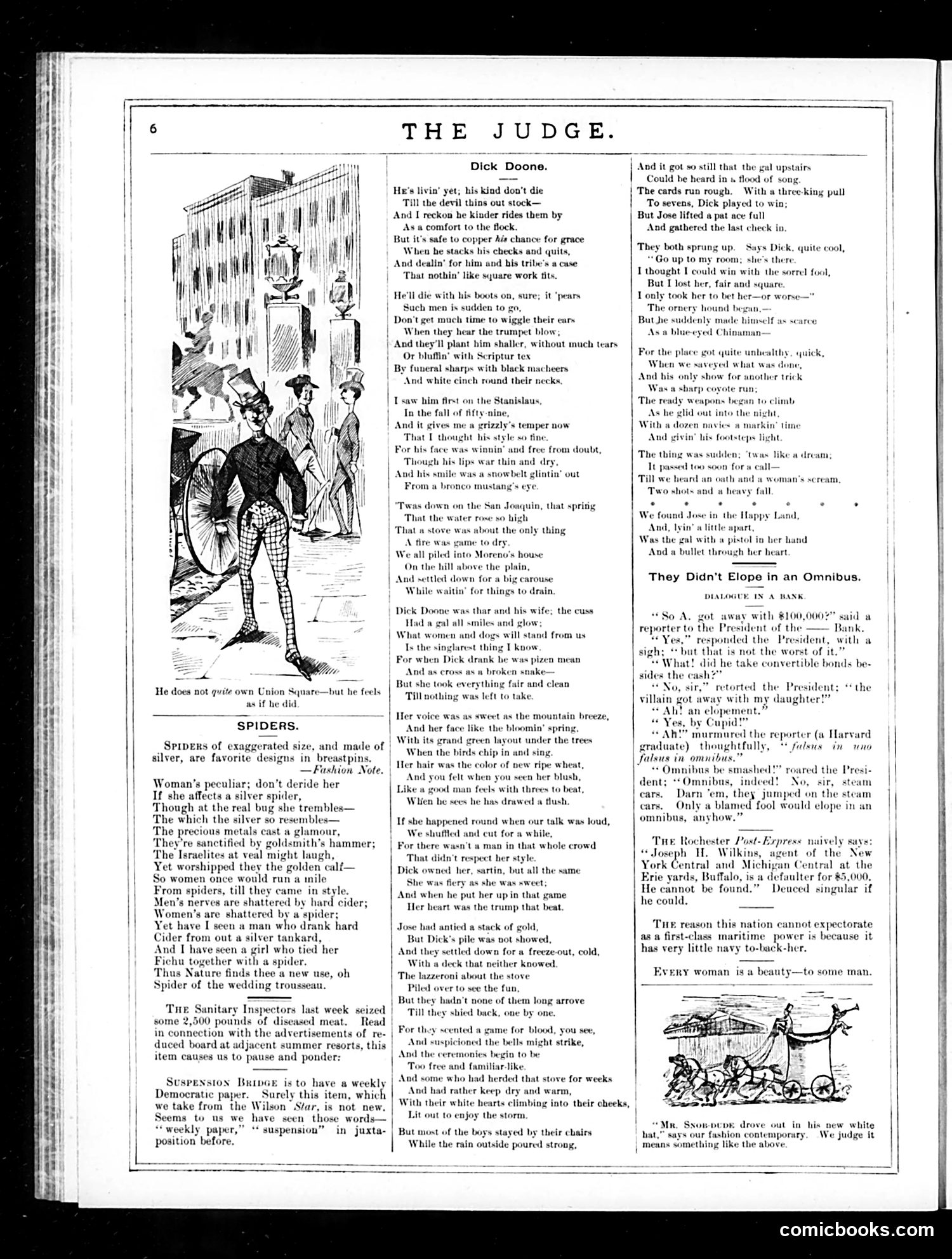
This page features a lengthy narrative poem titled "Dick Doone," a Western frontier tale rendered in vernacular verse. The poem tells the story of a rough, dissolute gunslinger named Dick Doone who lives by violent means and dies by them. The narrative depicts Doone's character arc: a once-handsome, charming young man on the Stanislaus River circa 1859 who becomes brutal and abusive when drinking. He marries a virtuous, beautiful woman who endures his cruelty. The climax involves a high-stakes card game where Doone bets his wife against Jose's gold. During the tense game, the woman's singing voice carries upstairs—a poignant contrast to the violence about to unfold. The poem employs Judge magazine's typical satirical lens on American character and morality, using the frontier setting to explore themes of degradation, violence, and the corruption of decent people. The sentimental yet rough dialect reinforces the magazine's working-class perspective on frontier life.
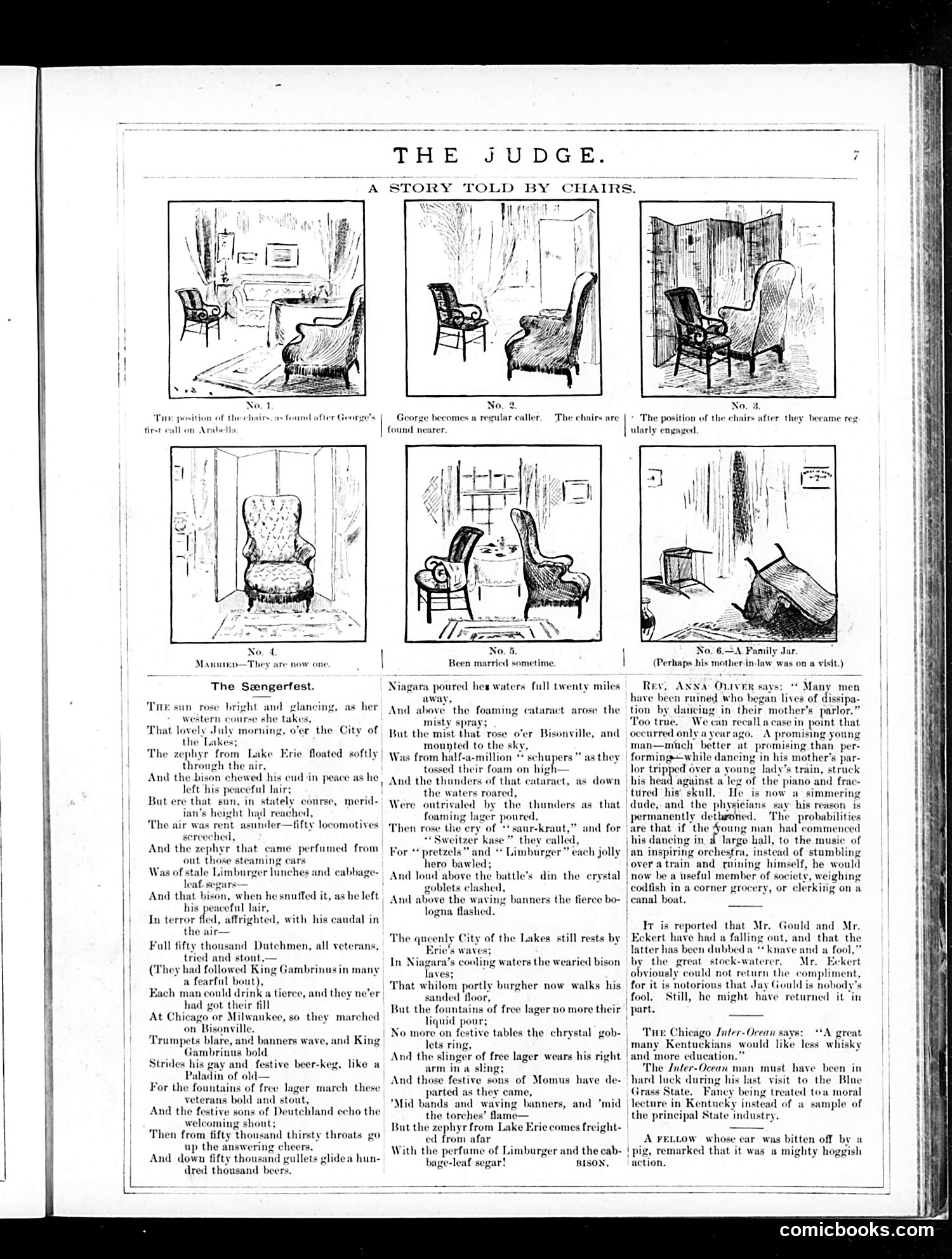
This page contains two distinct pieces: **"A Story Told by Chairs"** (top): A six-panel visual narrative where anthropomorphic chairs tell a domestic story. The captions suggest a romantic or domestic situation—a man visits, the chairs move closer together, they become "regularly engaged," then "married," and finally are found in a compromising position ("perhaps his mother-in-law was on a visit"). This is visual humor about courtship and marriage told through furniture's perspective. **"The Sangerfest"** (bottom): A satirical poem mocking a German-American beer festival. It describes fifty thousand German immigrants arriving by train, their overwhelming consumption of lager beer and German foods (sauerkraut, pretzels, Limburger cheese), and the sensory chaos they create—culminating in a bison fleeing from the smell. The satire targets German-American culture stereotypes: heavy drinking, loud behavior, and pungent food odors. The remaining text includes brief anecdotes on unrelated topics (dancing accidents, Jay Gould business disputes).
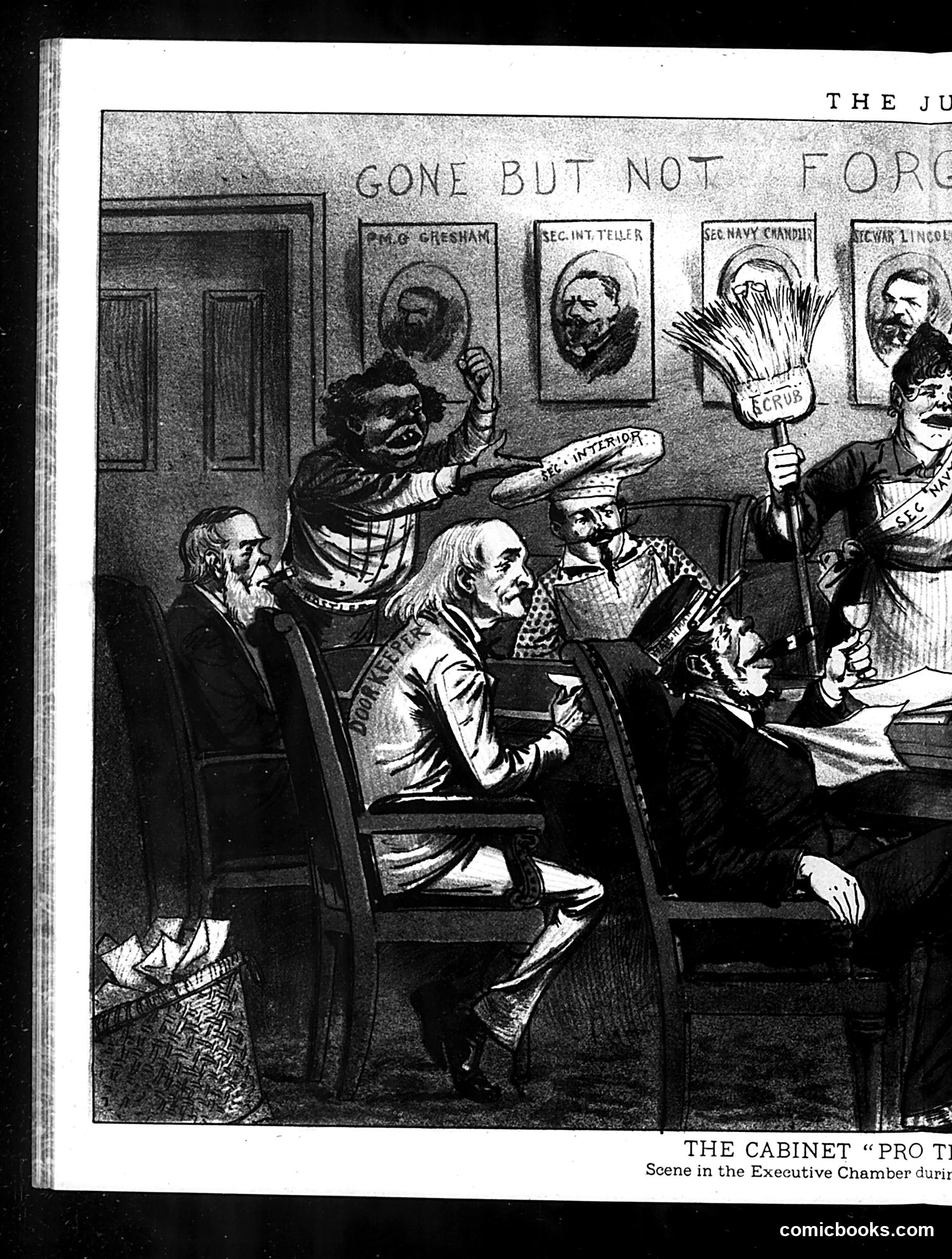
This satirical illustration depicts a chaotic scene in the Executive Chamber titled "THE CABINET 'PRO T[EMPORARILY?]'" The cartoon shows several figures engaged in what appears to be a heated debate or confrontation. Portrait frames on the wall are labeled with titles including "P.M.G. GRESHAM," "SEC. INT. TELLER," "SEC. NAVY CHANDLER," and "SEC'Y. LINCOLN." One figure stands elevated, wielding what appears to be a broom or brush labeled "SEC. INT. PRIOR," while others hold signs reading "SCRUB." The scene satirizes internal Cabinet conflicts, likely criticizing incompetence, corruption, or policy disputes within the presidential administration. Without the complete OCR text and specific date, I cannot definitively identify which administration is targeted, though the visible names suggest a late 19th-century context. The "scrubbing" metaphor suggests reformist criticism.
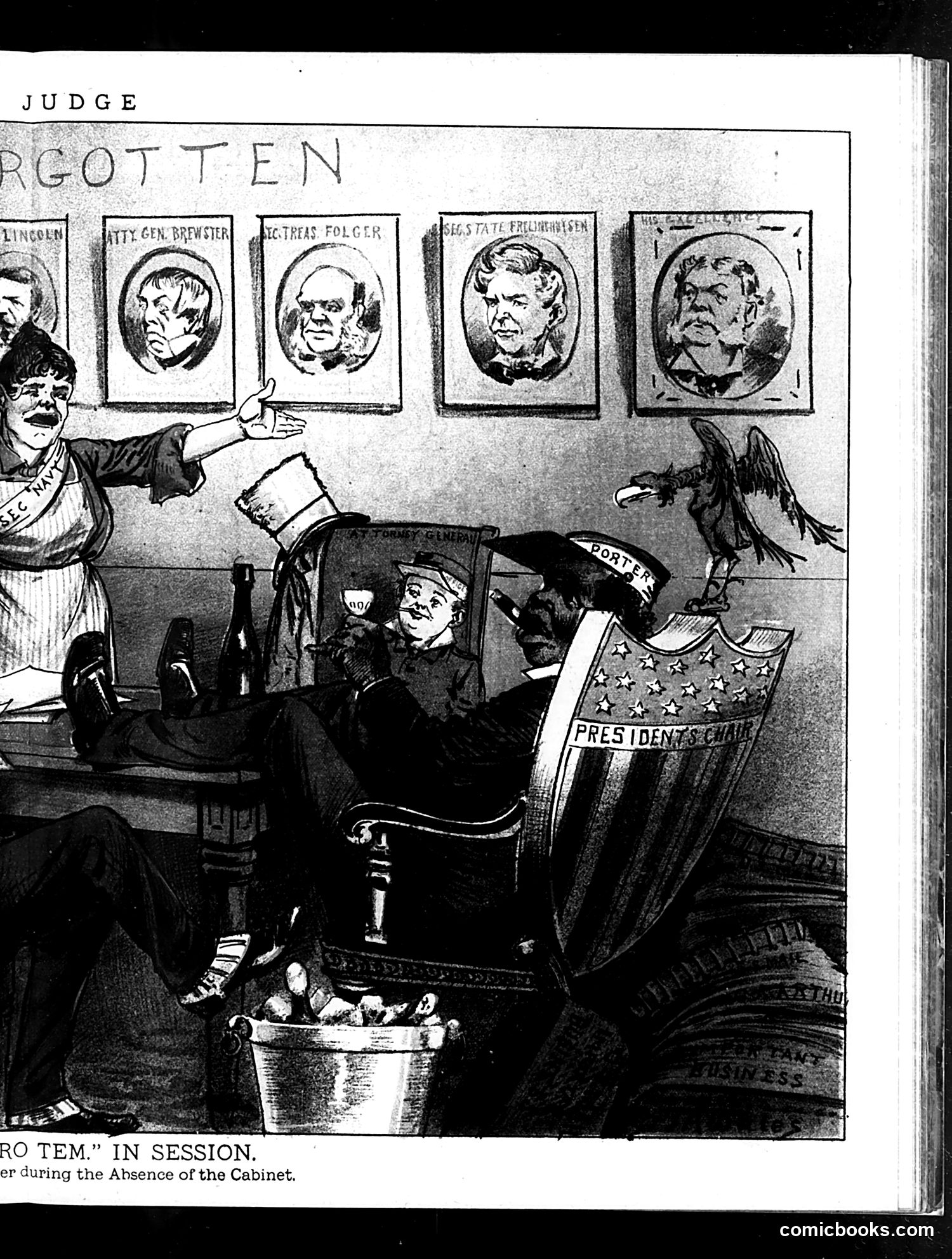
This appears to be a political cartoon titled "Forgotten" showing a satirical scene where a figure sits in the President's Chair during the Cabinet's absence. Four portrait frames on the wall above are labeled with names (partially visible: "Lincoln," "Pitt Gen. Brewster," "Vic-Tras Folger," and others). The cartoon mocks governmental dysfunction, suggesting incompetent or forgotten leadership when key officials are away. The sleeping or lounging figure in the presidential seat, surrounded by scattered papers and an eagle emblem, implies negligence or absurdity in executive operations. The exact historical moment is unclear without a date, but this represents typical Gilded Age *Judge* satire targeting political incompetence and the contrast between past dignified leaders (the portraits) and current inadequate governance.
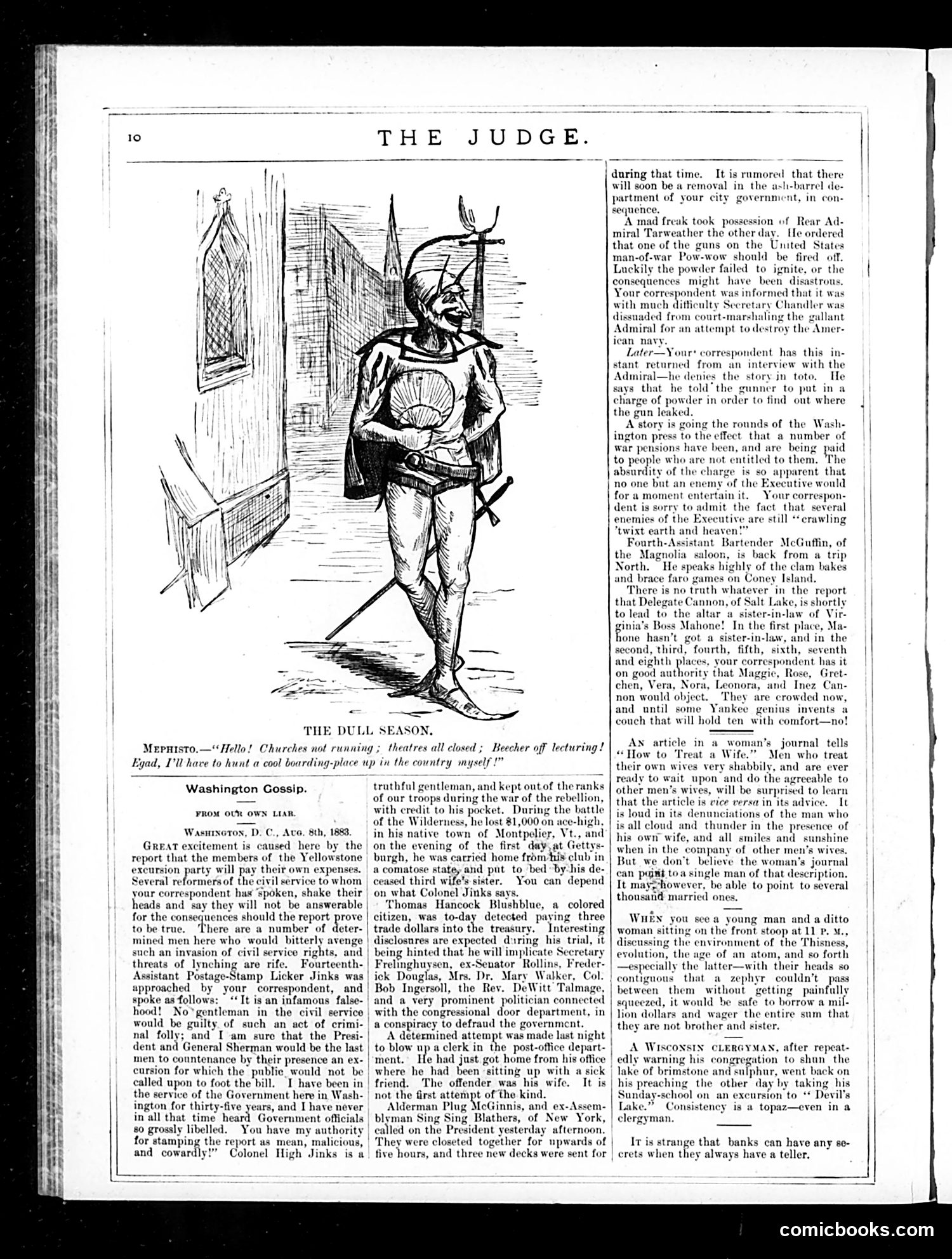
This is an 1883 satirical column parodying "Washington Gossip" — a then-popular form of political commentary. **The Main Cartoon**: Shows a devilish figure (Mephistopheles, representing Satan or corruption) commenting that the "dull season" persists because churches aren't running, theaters are closed, and preacher Henry Ward Beecher is away lecturing. The joke: without normal diversions, there's nothing to distract from Washington's political scandals. **The Column's Content**: Mock "reports" from Washington that satirize federal government incompetence and corruption: - Civil service reforms feared as revolutionary - A colored man caught allegedly paying "trade dollars" (worthless currency), with hints he implicates prominent politicians - Failed assassination attempts (the wife joke) - Ambiguous military incidents **The Satire**: This lampooned the Grant/Arthur administrations' reputation for patronage, corruption, and inefficiency. References to specific figures (like Frelinghuysen, Ingersoll, Beecher) suggest real controversies contemporary readers would recognize, while fictional details (like "Postage-Stamp Licker Jinks") exaggerate governmental absurdity.
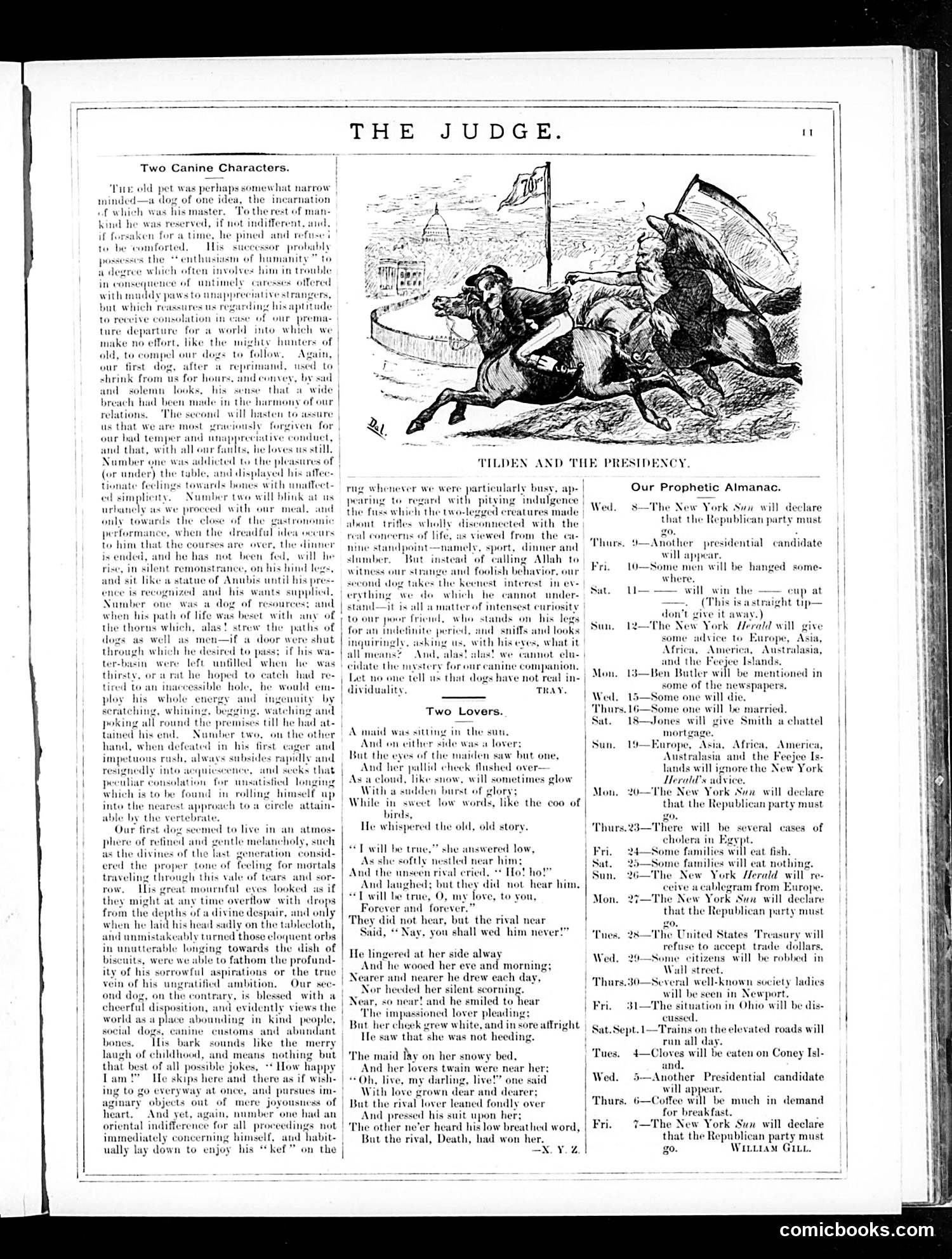
This page from *Judge* satirizes American politics and social life circa the 1880s-90s through two main pieces: **"Two Canine Characters"** uses dogs as political metaphors. The first dog represents the old guard—narrow-minded, resistant to change, emotionally distant. The second embodies newer politicians or parties: opportunistic, eager to please, easily consoled when defeated, and sentimental. The piece critiques both temperaments in governance. **"Tilden and the Presidency"** cartoon depicts a figure (likely Samuel Tilden, the disputed 1876 presidential candidate) apparently fleeing or being chased near the Capitol building. This references the contested 1876 election and Tilden's failed presidency ambitions. **"Our Prophetic Almanac"** mocks political predictions—declaring the Republican party must go, mentioning presidential candidates, Ben Butler (controversial Union general-turned-politician), and various social upheavals. It satirizes both partisan politics and sensationalist news predictions. The cumulative effect ridicules American political instability, partisan posturing, and media sensationalism of the Gilded Age.
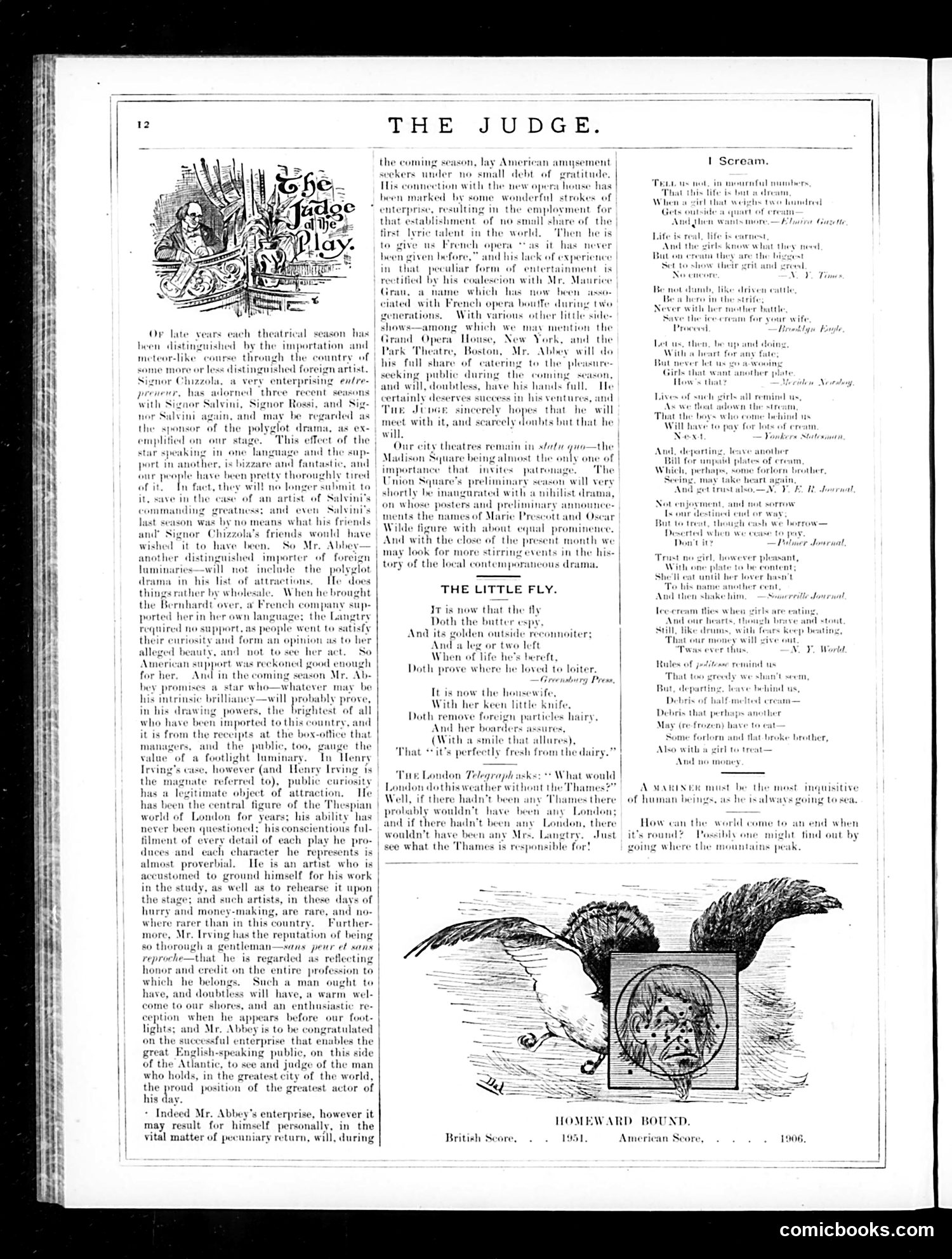
This page discusses Henry Irving, a celebrated English actor being imported to America for theatrical performances. The text praises Irving as a gentleman "sans peur et sans reproche" (without fear or reproach) and anticipates his warm American reception. The main cartoon, "Homeward Bound," depicts a exhausted, disheveled figure (likely representing Irving or theatrical ambition itself) being carried away by flying creatures—suggesting the grueling nature of transatlantic theatrical tours. The satirical point targets American theater impresario Abbey, who imports foreign performers wholesale. Judge gently mocks this reliance on European talent while acknowledging Irving's exceptional reputation and work ethic. The text contrasts Irving favorably with previous imports like Bernhardt, implying American audiences were sometimes gullible about foreign celebrities. Secondary content includes "The Little Fly," a poem about life's struggles, and commentary on New York theater's stagnation, with only Madison Square Theatre offering novelty.
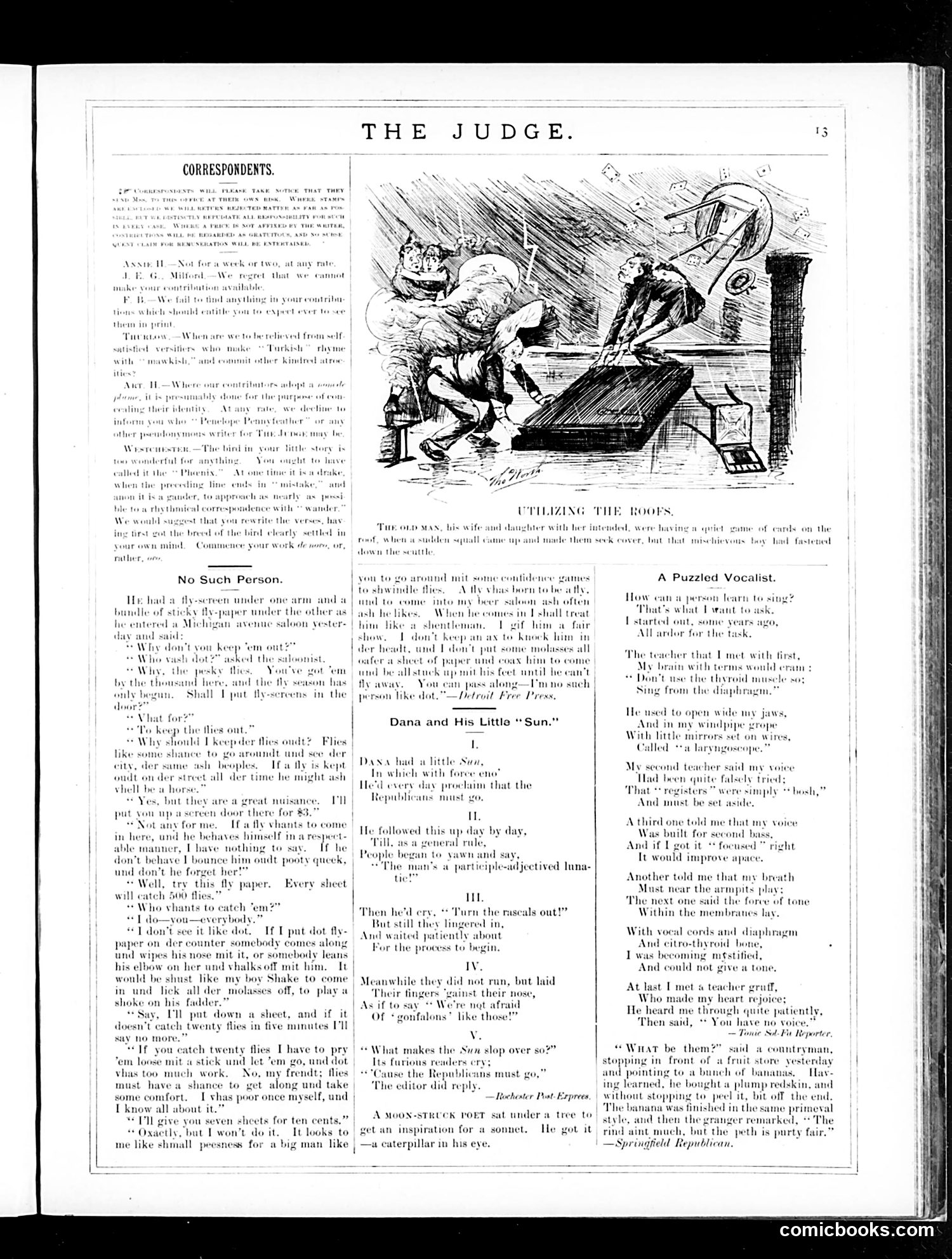
This page contains three unrelated satirical pieces typical of Judge magazine's humor: **"No Such Person"** is a dialect comedy sketch mocking a German-immigrant saloon keeper's resistance to buying fly-paper. The humor relies on ethnic stereotyping—exaggerated German accent and working-class logic ("If a fly wants comfort, let him have it"). **"Dana and His Little 'Sun'"** appears to be political satire about a newspaper editor (likely James Gordon Bennett of the New York Herald, though the name "Dana" suggests Charles Dana) repeatedly crying about Republicans and "gonfalons" (medieval Italian banners/symbols). The joke is that citizens ignore his increasingly shrill warnings. **"A Puzzled Vocalist"** satirizes vocal instruction by presenting multiple contradictory teaching methods—one tells the student to use the thyroid, another the diaphragm, others focus on breath placement or membrane force. The humor mocks the pseudoscientific, contradictory nature of early 20th-century vocal pedagogy. The centerpiece illustration shows chaotic scene related to "Utilizing the Roofs," though context is unclear from this page alone.
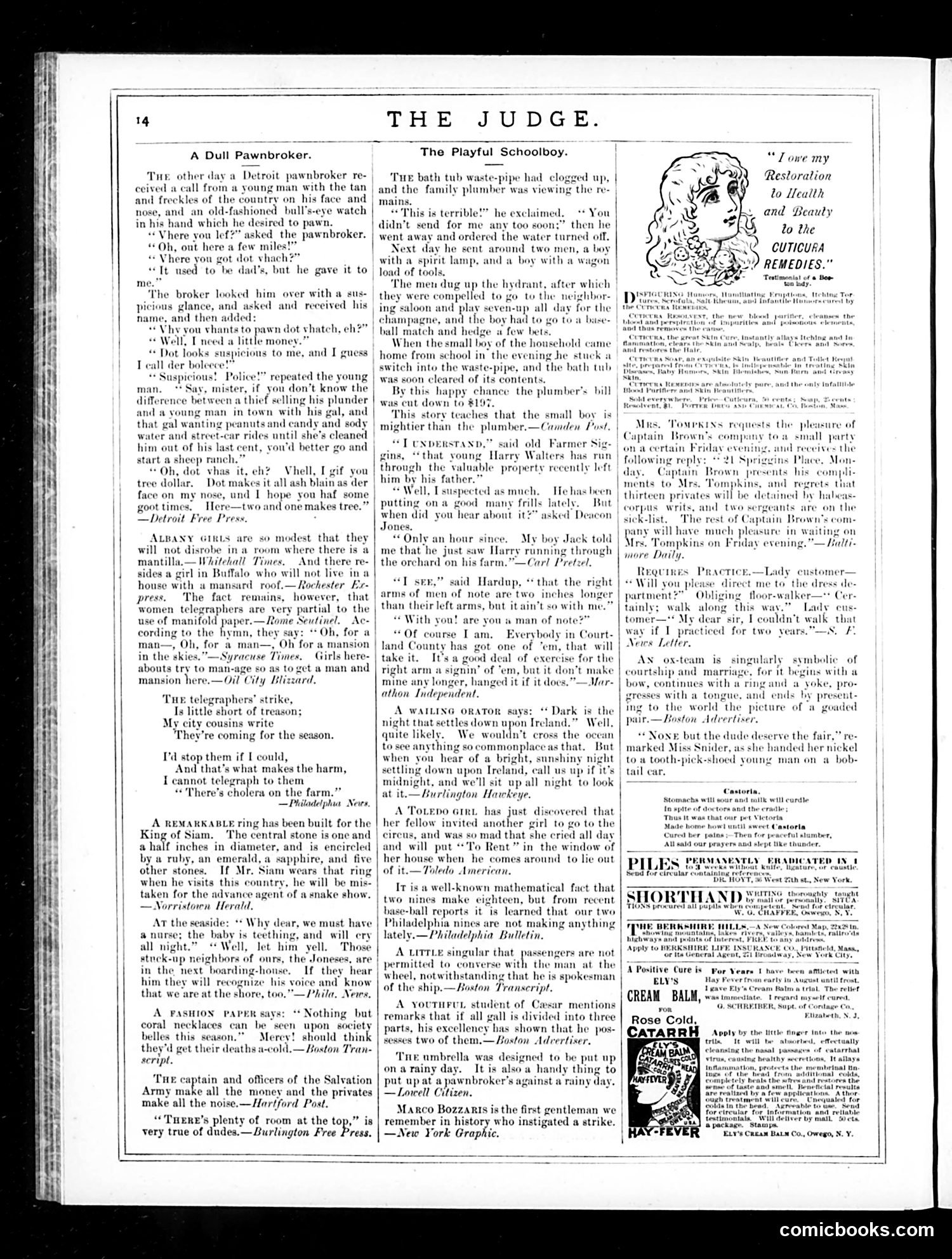
This page from *Judge* magazine contains several brief humorous anecdotes rather than a single political cartoon. **"A Dull Pawnbroker"** (main story): A young rural man tries to pawn his father's watch. The suspicious pawnbroker, speaking with a German accent (indicated by "vhere," "vhatch," "vhy"), nearly calls police, suspecting theft. The humor lies in the pawnbroker's absurd logic: he calculates the watch's value by adding numbers irrelevantly ("two and one makes tree"), revealing his incompetence despite his paranoia. **"The Playful Schoolboy"**: A plumber charges exorbitantly to unclog a bathtub, sending multiple workers and expensive equipment. A child simply uses a stick to clear the drain, making the professional intervention ridiculous and unnecessary. The satire mocks immigrant stereotypes (the pawnbroker's accent suggesting foolishness) and criticizes tradespeople's inflated pricing and unnecessary complexity. These are gentle, domestic humor pieces typical of *Judge's* appeal to middle-class readers.
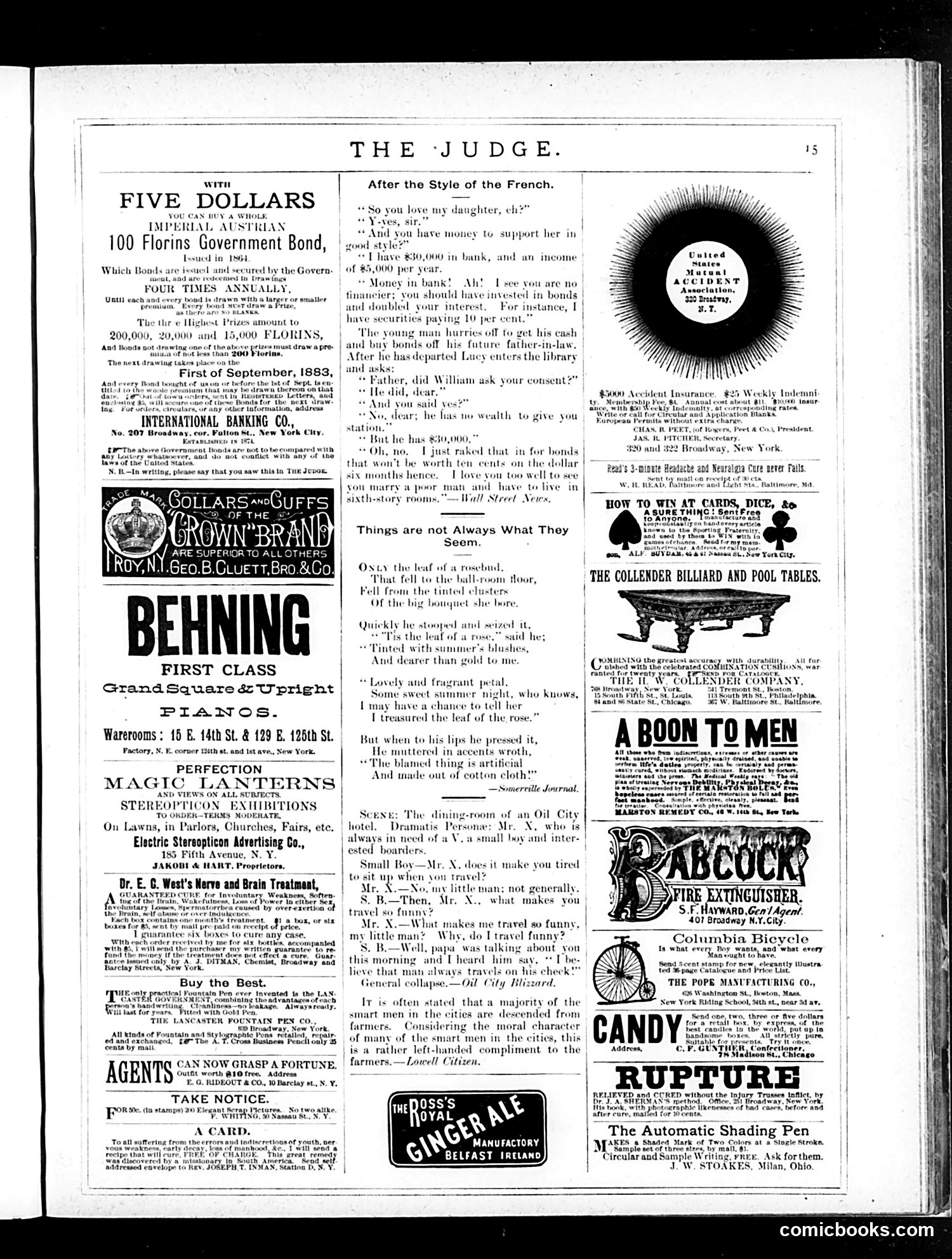
This page from *Judge* (a prominent 19th-century American satirical magazine) contains two main pieces: **The primary cartoon** depicts a father-in-law scamming his prospective son-in-law. The young man seeks approval to marry the daughter; the father falsely claims the suitor lacks wealth, then—after the suitor leaves to raise money—reveals to his daughter that he fabricated this to trick the young man into buying worthless Austrian government bonds. The satire mocks financial manipulation and warns against the poor returns on foreign securities, likely referencing late-19th-century economic instability. **The secondary poem, "Things Are Not Always What They Seem,"** uses a rose leaf as metaphor: a man finds what appears beautiful but discovers it's artificial—reinforcing the page's theme about deceptive appearances. The page is primarily **advertising**, featuring pianos, financial instruments, and consumer goods typical of the era. The overall message: beware of financial schemes and false representations.
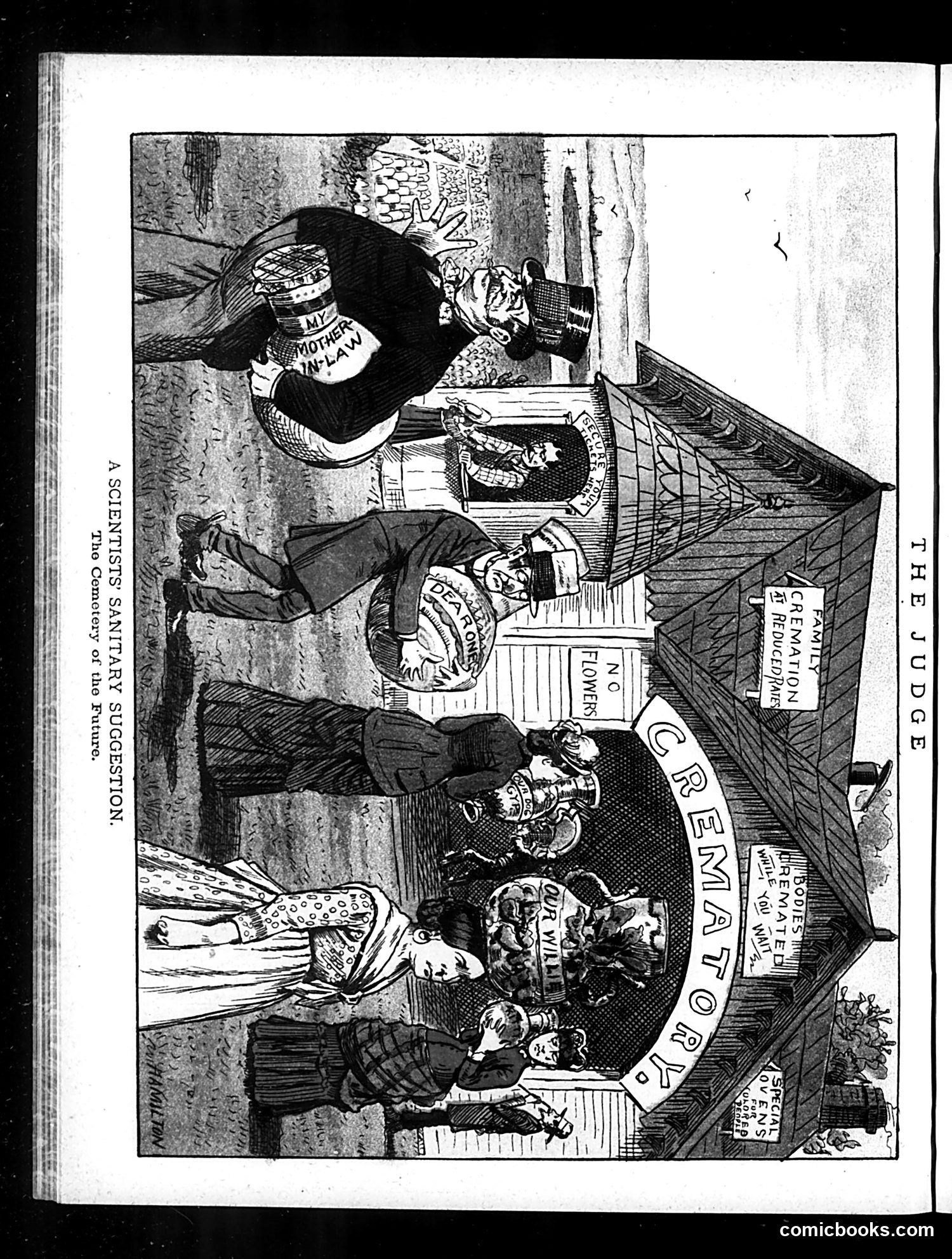
This Judge cartoon satirizes a proposal for cremation as a modern, sanitary alternative to traditional burial. The image depicts "The Cemetery of the Future" as an industrial crematorium facility, showing multiple figures feeding bodies into a large furnace-like structure labeled "CREMATION & REDUCED RATE." The cartoon mocks what appears to be a contemporary scientific or public health movement advocating cremation. The "sanitary suggestion" in the title suggests this was pitched as progressive, hygienic reform. The Judge's satirical treatment implies skepticism about this trend—depicting it as cold, mechanized, and somewhat grotesque rather than dignified. This likely reflects early 20th-century American anxieties about industrialization, scientific rationalism challenging traditional practices, and class concerns (the "reduced rate" suggests cost-cutting). The cartoon employs dark humor to critique both the proposal and modernity's dehumanizing effects.