
Judge, 1883-08-18 · page 2 of 16
Judge — August 18, 1883 — page 2: what you’re looking at
What you’re looking at
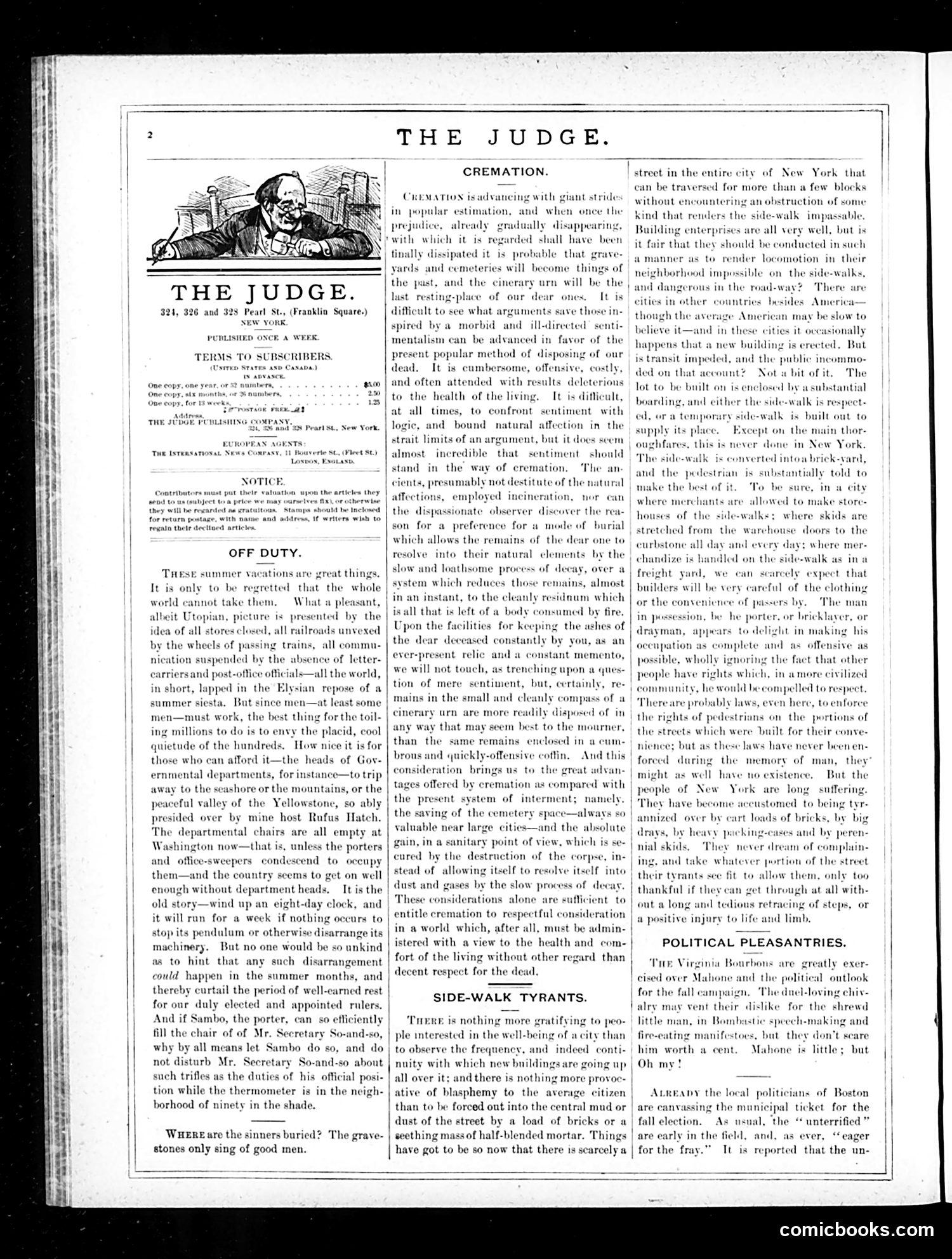
This page contains two editorial pieces rather than political cartoons. **"Off Duty"** satirizes government inefficiency during summer vacations. The author mocks how federal departments function smoothly without their appointed officials present—suggesting their actual labor is minimal. The jab at "Sambo, the porter" filling the Secretary's role reveals period racial attitudes while advancing the satire. The piece sardonically praises officials' well-earned rest, implying they don't deserve it. **"Cremation"** advocates for cremation over traditional burial, attacking sentimental objections as illogical. The argument emphasizes practical benefits: reduces disease risk, saves cemetery space in crowded cities, and provides cleaner remains for remembrance. This reflects late-19th-century progressive attitudes toward modernizing burial practices against entrenched custom. Both pieces exemplify *Judge*'s satirical approach: mocking government ineffectiveness and championing rational reform over tradition.
📄 Transcribed text from this page (OCR, searchable)
Machine-transcribed from the original scan — historical spelling and the odd misread are preserved.
Se sat een Se a Se oe anes THE JUDGE. 324, 326 and 328 Pearl St., (Franklin Square.) NEW YOR PUBLISHED ONCE A WEEK. TERMS TO SUBSCRIBERS. One copy. ¢ One copy. atx One cops, fe OFF DUTY. THESE summer vacati It is only to be regretted that th What a pl presented by tl AS Ue world cannot take th albeit Utopian, picture a «l, all railroads unvexed ng trains, all commu- nication suspended by the absence of letter- id post-office officials—all the world, pped in the Elysian repose of a But since in short, summer sic en—at least some for the toil- ing millions to do is to envy the | men—must work, the best thin; id, cool quietude of the hundreds. “How nice it is for those who can afford it—the heads of Go ernmental departments, for instance—to trip away to the seashore or the mountains, or the peaceful valley of the Yellowstone, so ab presided over by mine host Rufus Hatch. ‘The departmental chairs are all empty at It is the lock, and occurs to h without department h old story—wind up an eight- it will run for a week if nothin stop its pendulum or otherwise disarrange its machinery. But no one would be so unkind as to hint that any such disarrangement could happen in the summer months, and thereby curtail the period of well-earned rest for our duly elected and appointed rulers. And if Sambo, the porter, can_ so etliciently | mains in the small and ¢ fill the chair of of Mr. Secret So-and-so, | why by all means let Sambo do 80, i not disturb Mr. Secretary S tion while the thermomet borhood of ninety in the shade. in the ne 1 do | to observe the frequ nd-so about | nnity with which new buildi such trifles as the duties of his official posi- | all over it; and there is nothing i igh-| ative of blasphemy to the ave THE JUDGE. CREMATION. Chem atios isadvaneing with giant stride in popular estimation, and when once the prejudice, already gradually disappearing, with which it is regarded shall have been lly dissipated it is probable that grave- and cemeteries will become things of cinerary urn will be the g-pluce of our dear ones. It is what arguments save those in- spired by a morbid and ill-directe mentalist senti- an be advanced in favor of the present popular method of disposing of our dead. It is cumbersome, offensive, costly, and often attended with results deleterions to the health of the living, It is difficult, at all times, to confront sentiment with bound natural affection in the imits of an argument, but it does incredible that sentiment nd in the’ way logic, and strait almost should f cremation, ‘The an ly not destitute of the natural smployed incineration, ner ean observer discover the rea- son for a preference for a mode of burial which allows the remains of the dear one to resolve into their natural elements by the slow and loathsome process of decay, over system which reduces those remains, a un instant, to the cleanly residnum which isall that is left of a Upon the facilities fe lear dec nt rel and a constant memento, we will not touch, as trenching upon tion of mere sentiment, but, certainly, re- ody ec keepin, ed constantly sumed by fire. the ash y you, ily compass of a Lof in seem best to the mourner, than the same remains enclosed in a cum- d quickly-offen: And this consideration bri at udvan- cinerary urn are 1 any way that ¢ readily diay ve coffin, sus to the g yffered by cremation as compared with » present system of interment; namely aving of the cemetery space—als valuable near large cit and the absolute nitary point of view, which is se- cured by the destruction of the corpse, in- stead of allowing itself to resolve itself into dust and g These considerations alone are sufficient to entitle cremation to respectful consideration in a world which, after all, must be admin- istered with a view to the health and com- fort of the living without other regard than decent respect for the dead, SIDE-WALK TYRANTS. ‘Tene is nothing more gratifying to peo- city than ed conti- oing up ore provoc- than to be forced ont into the central mud or dust of the street by a load of bricks or a Wuercare the sinners buried? The grave- | seething mass of half-blended mortar. Thi stones only sing of good men. | have got to be so now that there is scarcely a | for the fray.” s by the slow process of decay. | | street in the entire city of New York that can be traversed for more than a few blocks without encountering an obstruction of some kind that ren Building enterpr all very well, but is it fair that they should be le-walk impassable ducted in such a manner as to render locomotion in their neighborhood impossible on the Tks, and danger the road-way? ‘There are ntries besides America American may be slow to believe it—and in these cities it oveasionally happens that a new building is erected. But is transit impeded, and the public incommo- ded on that account? Not a bit of it, lot to be built on is enclosed by a substantial boarding, and either the side-walk is respeet- ed, ora temporary side-walk is built out to supply its place. 1 the main thor- ghfares, this is never done in New The sid and the ntially told make the b t. ‘To be sure, in a city where merc allowed to make stor skids warehouse doors to t houses of the : where stretched from the curbstone all day and every day: where mer- chandize is handled on th freight yard, we ean leewalk as ina cely expect that builders will be very careful of the elothir of yn 1 ion, be he porte | or the convenien he ms or bricklayer, or to delight in making his mplete and as offensive as wholly ignoring the fact that ether people have rights whic amore civilized | community, he would be compelled to respect re probably laws, even here, to its of pedestrians on the portions of reets which were built for their conve- laws have never been en- foreed during the might as well ha people of New memory of man, they . But the York are long. suffering. | ‘They have become accustomed to being tyr- t loads of bricks, by big and by | annized over by ea . by heavy pach nial skids, ‘They never dream of complain- | ing, and take whatever portion of the street their tyrants sce fit to allow them, only too all with- out a long and tedious retracing of steps, or nd limb, thankful if they can get through al a positive injury to lif | POLITICAL PLEASANTRIES. | ‘Tie Virginia Bourbes © greatly exe cised over Mahone and the political onto | for the fall ex !alry m r the shrewd little and ating manif him worth a cent. Oh my! loving chiv- Mahone is little; ALREADY the local politicians of Boston are can al ticket for the fall election. As usual, the ‘ unterrified ” are early in the field, and, er, It is reported that the un- ing the man comicbooks.com