
Judge, 1883-08-18 · page 4 of 16
Judge — August 18, 1883 — page 4: what you’re looking at
What you’re looking at
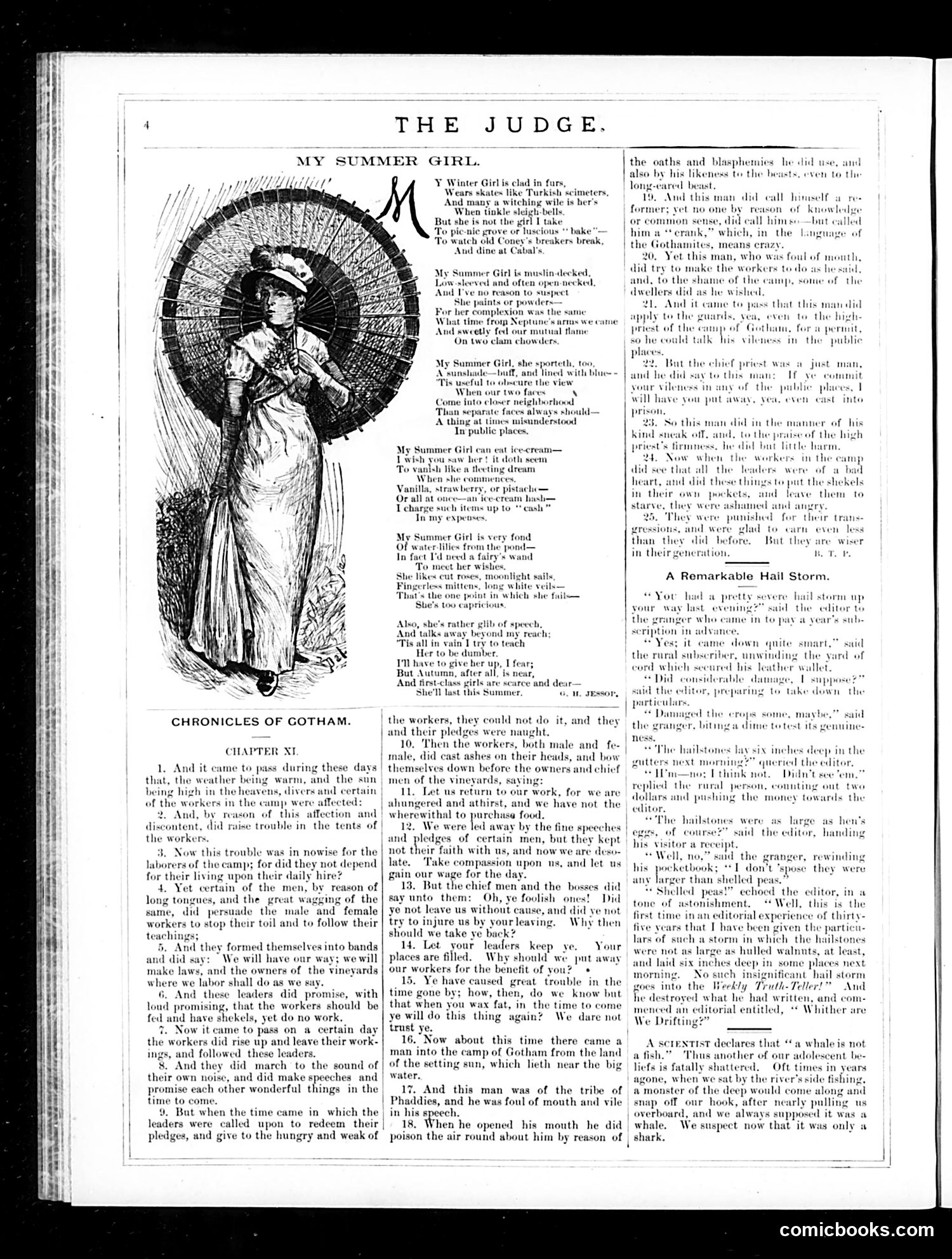
This page contains two distinct pieces: **"My Summer Girl"** (left): A humorous poem with illustration about a man's romantic disappointment. His winter girlfriend was elegant and refined; his summer girlfriend is vain, talkative, and common. The joke is the narrator's resignation—he'll tolerate her flaws because "first-class girls are scarce and dear" and she'll "last this Summer." It's light satire on male compromise in relationships. **"Chronicles of Gotham, Chapter XI"** (right): Presented in biblical language, this appears to be labor-dispute satire. Workers strike after leaders promise food and wages without work; employers refuse to rehire them, citing past trouble. A foul-mouthed agitator from the "land of the setting sun" (the West) arrives to incite them further but is expelled. The workers ultimately lose and accept worse terms. The satire mocks both labor organizers (as demagogues) and possibly corrupt employers. The biblical parody style was Judge magazine's signature approach to contemporary social conflicts.
📄 Transcribed text from this page (OCR, searchable)
Machine-transcribed from the original scan — historical spelling and the odd misread are preserved.
I ae CHAPTE ee it came to pass ih in the he: of the workers in the cu : 2. And, by reason of this affection and discontent, did ra rouble in the tents of the workers. 3. Now this trouble was in nowise for the | laborers of the camp; for did they not depend for their living upon their daily hire 4. Ye in of the men, by long ton, nd the great w same, did persuade the male and female workers to stop their toil and to follow their rings; And they formed themselves into bands and did We will have our way; we will d the owners of the vineyards e labor shall do as we say. se leaders did promise, with loud promis ing, that the workers should be fed and have shekels, yet do no work, 7. “ame to pass on a certain day the workers did rise up and leave their work- ings, and followed these leade 8. And they did ch to the sound of their own promise each other wonderful things in the time to come. But when the time came in which the ders were called upon to redeem their | , and give to the hungry and weak of - and did make speeches and | THE JUDGE, MY SU MMER GIRL. Y Winter Girl is cl Wears skates like T nalecked, »pen-neckel, son to suspect ‘She paints or powders — For her ¢ 2 Neptune's arms we came And sweetly fed our mutual tan On two clam chowders. alway’ shi isunderstood tov capricious Also, she’s rather glib of speceb, And ‘talks away beyond my reac “Tis all in vain T try to teach be dumber, give her up, I fe But Autumi " And tirst-class girls are scarce and dear ‘She'll last this Summer, Go, JESSOF, the workers, they could not do it, and they | and their pledg : Then the workers, both male and. fe- F t ashes on their heads, and bow themselves down b e dchief men of th ro thirst, and we have not the withal 1 to purchase food. 2 led away by the fine spe en, but they not their faith with-x us, late. Take compassion upon us, and let us gain our wage for the 3. But the chief mer unto them: 5 yo not leave us without try to injure us by your le: should we take ye back? 14. Let your leaders keep ye. Your places are filled. Why should. we put away our workers for the benefit of you? ©” Ye have caused great trouble in the time gone by; how, then, do we know but that when you wax fat, in. the time to come ye will do this thing again? We dare not . Now about this time there came a man into the camp of Gotham from the land of the setting sun, which lieth near the big water, 17. And this man was of the tribe of Phaddies, and he was foul of mouth and vile in his speech. 18. When he opened his mouth he did poison the air round about him by reason of | phemies he die r to the beasts, even to the long-cared beast, Amd this man did call he ison of knowler did call himese —but eal which, in the language of thamites, means crazy. 20. Yet this man, who wis foul of mouth, did try to make the workers todo as he sie, and, to the dwellers And it came to px E aun slid apply to the priest of th wna permit, so he « Vileness in the public inp. sone of the But the chief priest was st man, and he did say to this mi ye commit your vileness in amy of the public places, 1 Will have you put away, yea, even east into i. So this man did in the manner of his kind sneak off, and, to the praise of the high firmness, he did but litte harm: Now when the workers in the camp all the leaders were of a bad heart, and did these things to put the shekels in their own pockets, and leave them. to ashamed and angry They were punished for their trans and were glad to carn even less did bef Sut they are wiser in their generation, oe A Remarkable Hail Storm. “You had a pretty severe hail storm up your way last he editor te veame in to pay a year wen quite smart unwinding the y cord whieh secured his leather walled “Did considerable damage, [ suppe saidd the . preparing to tike down the | particuld r, bitnga dime totest its genuine- ie hailstones lay six inches deep in the gutters next morning?” queried the editor. “1m think not. Didn't see’em.” rural person, counting ent two rs aul pushing the money towards the s hen's » handing rewinding eel hed the a hment. Well, this is. the first time in an editorial experience of thirty five years that T have been given the particit- lars ‘of such a storm in which the hailstones were not as and laid six inche morning. : s into the Truth: fic destroyed what ho had written, and com- menced ain editorial entitled, “* Whither are We Drifting A serentist declares that ‘a whale is not a fish.” ther of our adolescent be- Oft times in years at by the river's side fishing, a monster of the deep would come alon; snap off our hook, after nearly pulling us overboard, and we always supposed it was a whale. We suspect now that it was only a hark. comicbooks.com