
A complete issue · 16 pages · 1882
Judge — November 25, 1882
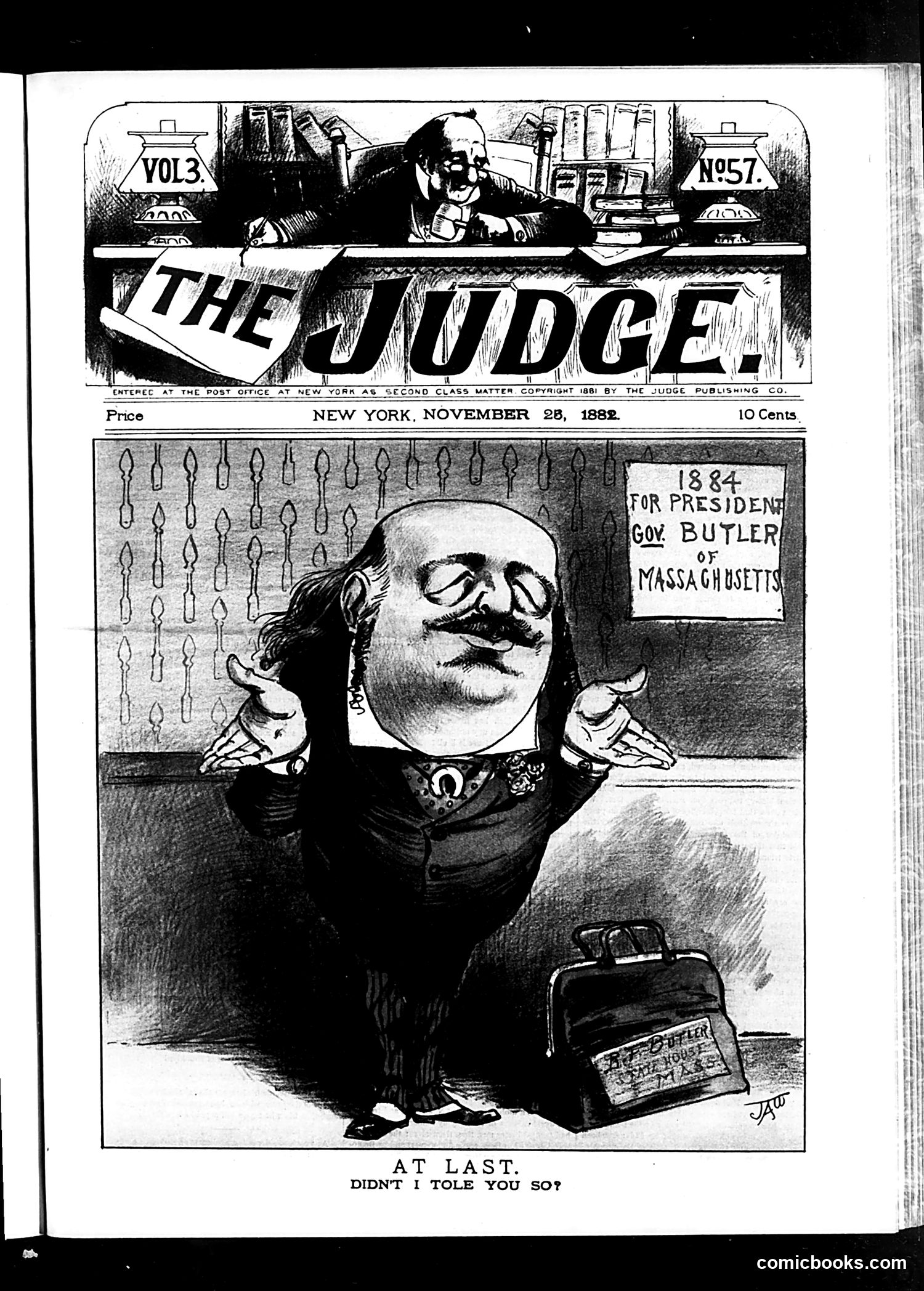
This cartoon satirizes the 1884 presidential campaign, specifically promoting Governor Butler of Massachusetts as a candidate. The caricatured figure displays exaggerated features—particularly a prominent mustache—and holds a briefcase labeled "Butler for President." The caption "At Last. Didn't I Tole You So?" suggests vindication or triumph, likely mocking either Butler's emergence as a serious candidate or his supporters' persistence in promoting him despite previous skepticism. The background pattern of repeated objects (possibly torches or implements) may reference political movements or activism, though the exact symbolic meaning is unclear. The overall tone is satirical commentary on American electoral politics and regional political ambitions during this period.
This page from *Judge* magazine contains political commentary on Democratic Party leadership in New York after an electoral victory. The main cartoon, "Who Will Carve?" uses the metaphor of carving a turkey to ask which Democratic leader—Samuel Tilden, John Kelly, Hubert Thompson, or Grover Cleveland—will control the party going forward. The satire suggests these figures cannot work together harmoniously and that Republican victories have historically resulted from Democratic infighting. The text argues that Republicans didn't lose because of superior Democratic principles, but because Republicans themselves rejected corruption in their own party (likely referencing President Arthur's administration and "knaves" appointed to control New York). The piece celebrates Republican voters' principled opposition to wrongdoing, while mocking Democratic leadership's inability to unite beyond elections. The "turkey carving" metaphor satirizes how Democrats will likely squabble over spoils rather than govern effectively.
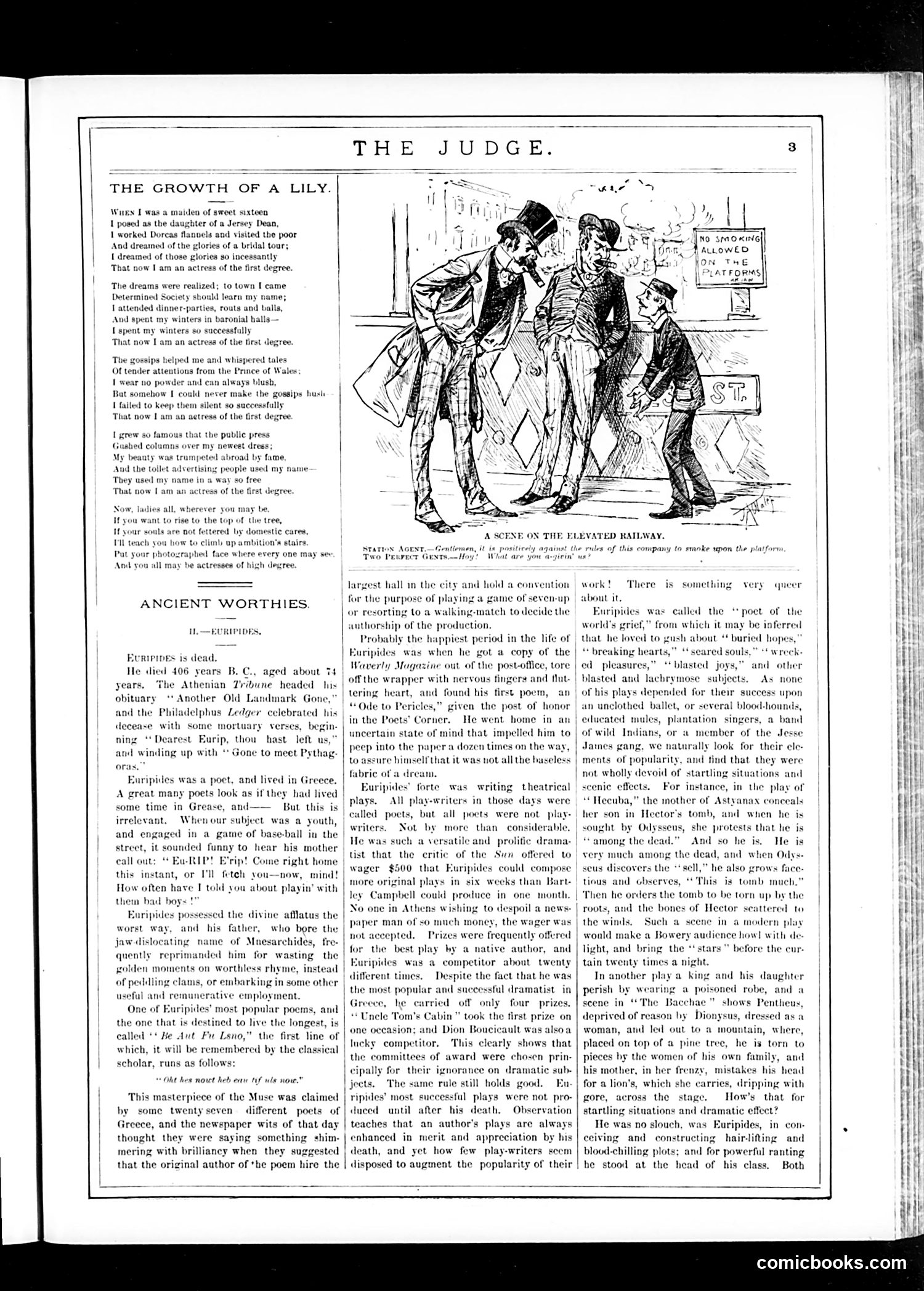
This page from the satirical magazine *Judge* contains two distinct pieces mocking different targets. **"The Growth of a Lily"** is a poem satirizing ambitious young women seeking fame and respectability through theatrical careers. The accompanying illustration shows a well-dressed man (likely a theater agent or promoter) with an eager young woman on an elevated railway platform. The poem's speaker traces her trajectory from pious "maiden of sweet sixteen" to celebrated actress, suggesting she achieved fame through shameless self-promotion rather than talent. The final stanza directly addresses other women, coaching them on how to climb "ambition's stairs"—the satire implies actresses succeed through calculated image-building and exploitation of their appearance rather than merit. **"Ancient Worthies: Euripides"** is a humorous biographical sketch of the ancient Greek playwright, mixing genuine classical knowledge with absurdist humor. It mocks both the historical over-attribution of classical works and contemporary pretensions to literary scholarship. Both pieces reflect late-19th-century anxieties about women's ambition, theatrical culture, and commercialized fame.
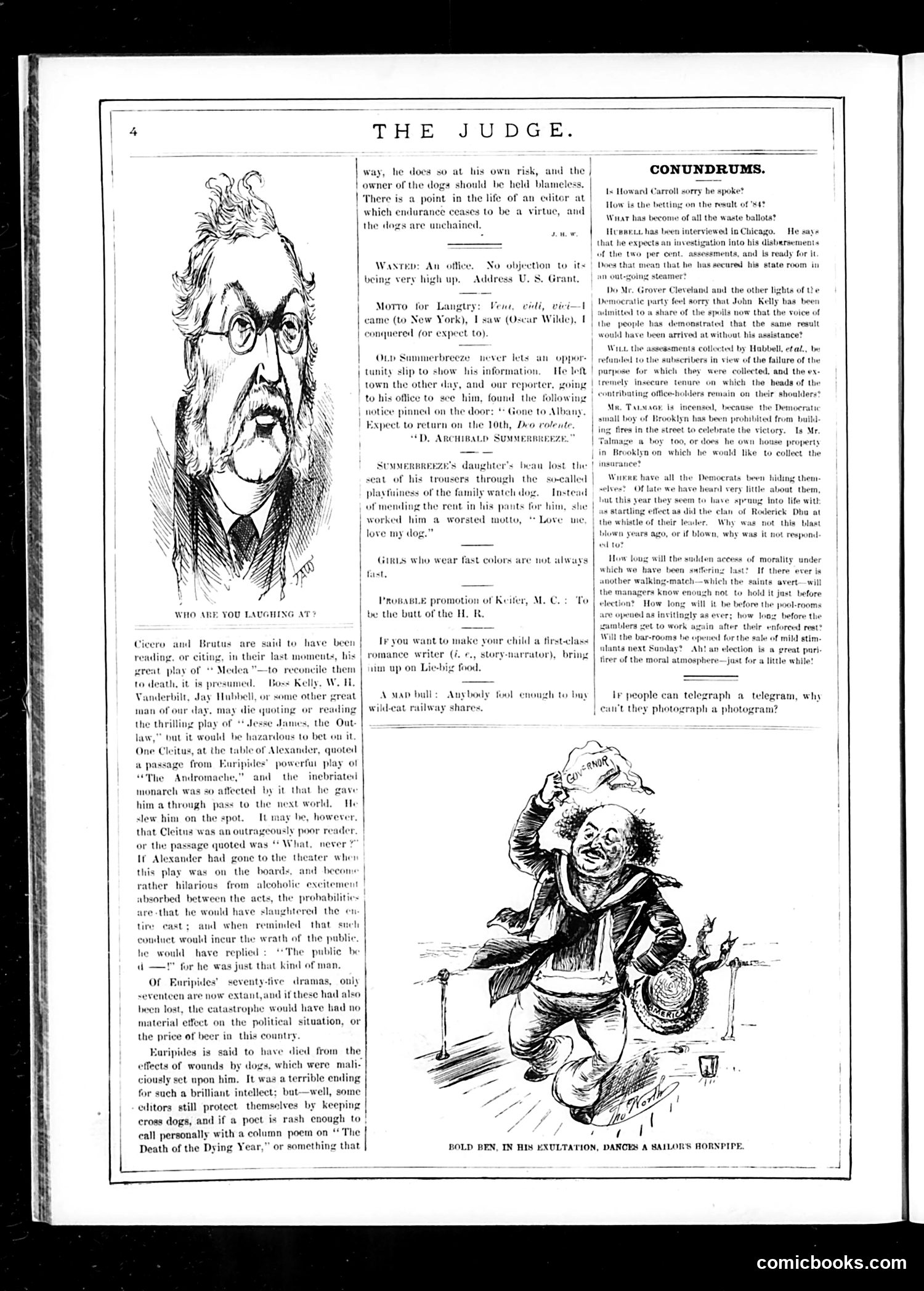
This page from *Judge* magazine contains satirical commentary on contemporary American politics and society, likely from the 1880s-1890s. **The Cartoons:** - "Who Are You Laughing At?" depicts a disheveled man (appears to be a satirized intellectual or editor) discussing classical literature references - "Bold Ben, In His Exultation, Dances a Sailor's Hornpipe" shows a caricatured figure in celebratory pose **The "Conundrums" Section:** This contains political jabs, likely referencing: - Howard Carroll and betting scandals - Grover Cleveland's administration and patronage politics - Assessment collection controversies in Brooklyn - Democratic Party infighting **The Satire:** The page mocks editors who pretentiously cite classical literature, Democratic politicians over disputed elections and patronage, and various urban absurdities (burning victory fires, wild-cat railway schemes). The humor relies on readers recognizing contemporary political figures and local scandals—details now obscure without additional historical context.
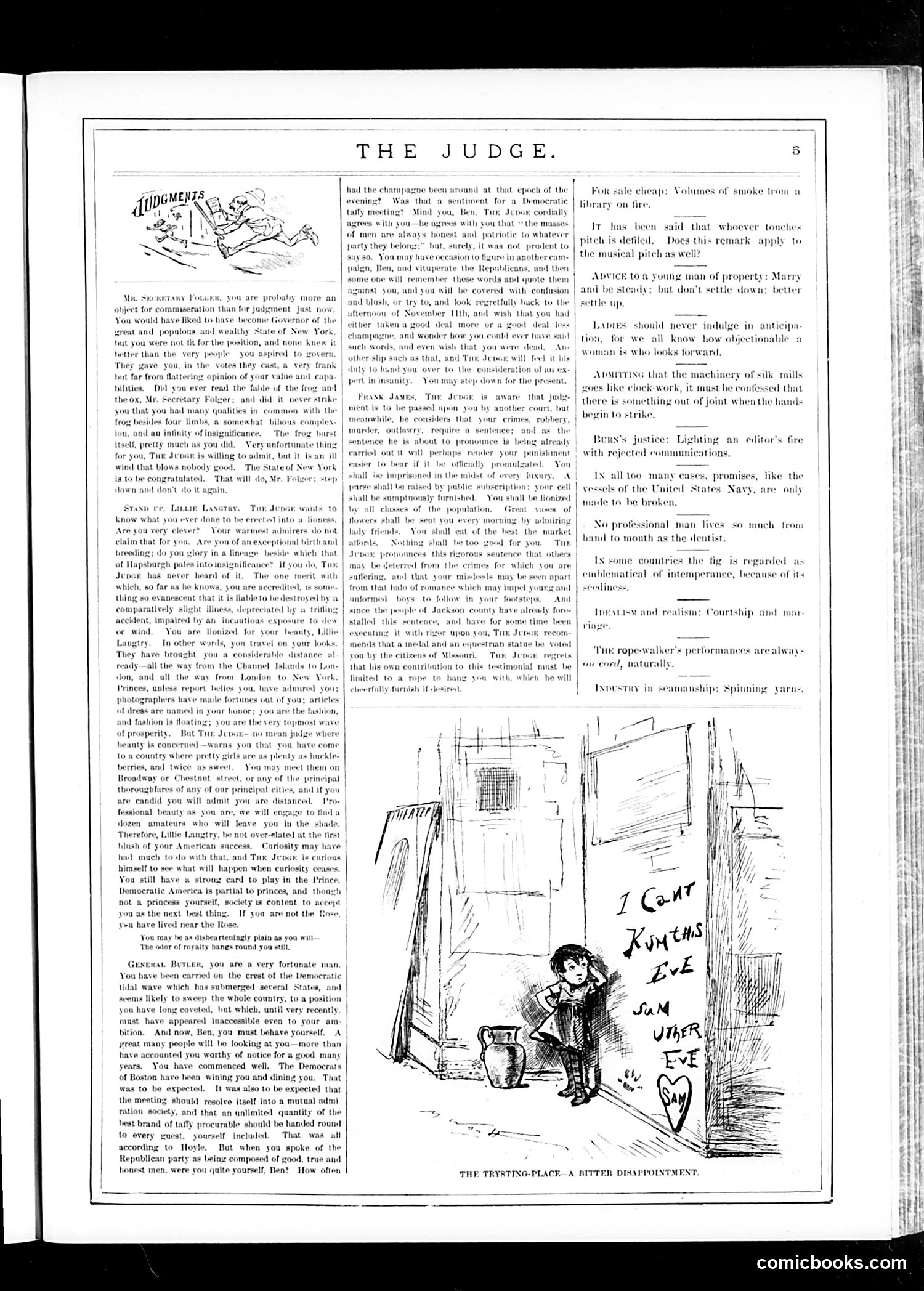
This page from *Judge* magazine satirizes **Lillie Langtry**, the famous British actress and society figure who toured America in the 1880s. The cartoon depicts her disillusionment upon arriving in America—she expected grand receptions but found instead a cramped, disappointing "trying-place" (a theatrical term). The text, addressed to Langtry, mocks her inflated expectations. It acknowledges her European celebrity and royal associations, but warns her that American audiences care less about aristocratic pedigree than she imagines. The satire suggests that her fame, built on fashion and scandal-mongering rather than genuine talent, won't translate to lasting American success. The cartoon illustrates this deflation visually: Langtry sits dejected in a sparse room, surrounded by crude furnishings and disappointed inscriptions ("I can't know this," "jam," "other eye," "saw"). The message: American curiosity is fickle, and she'll soon be forgotten.
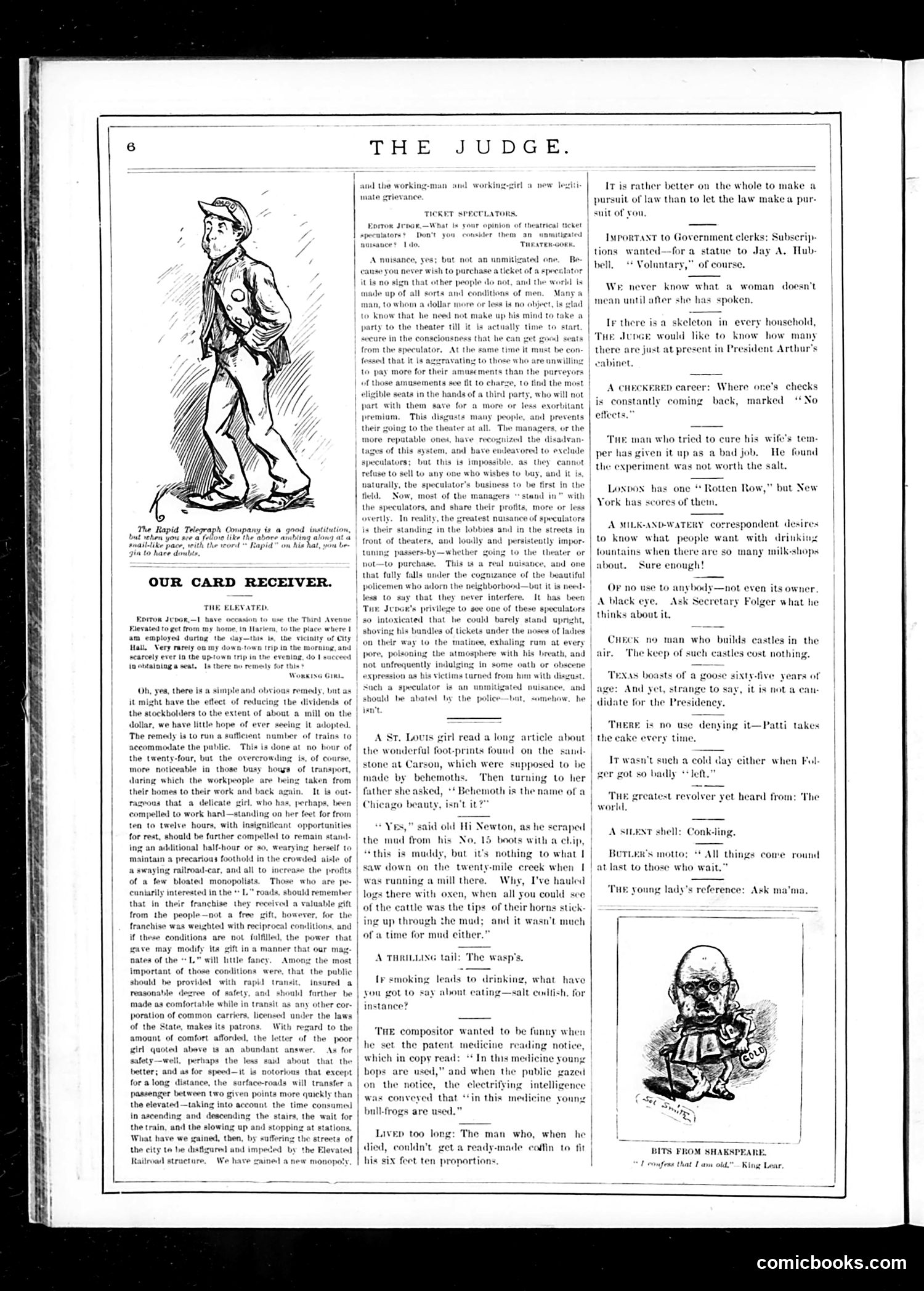
This page from *Judge* magazine addresses two major urban grievances of the era through editorial commentary and satirical illustrations. **"The Elevated"** section critiques New York's elevated railway system. A working girl writes complaining about severe overcrowding during commute hours—she must stand for 10-12 hours despite already working hard. The editorial argues that while the Elevated reduced street congestion, it created a new monopoly that prioritizes profit over passenger comfort. The remedy demanded: run sufficient trains to accommodate workers, particularly women laborers, or modify the franchise agreement granted by the city. **"Ticket Speculators"** attacks scalpers who monopolize theater tickets. Theater managers recognize the problem but profit from speculators' resale markups, discouraging ordinary people from attending. The satire highlights collusion between venues and scalpers against the public interest. Both pieces exemplify *Judge*'s muckraking approach: exposing how corporate monopolies and profiteering harm working-class New Yorkers, particularly working women—a notably progressive focus for the period.
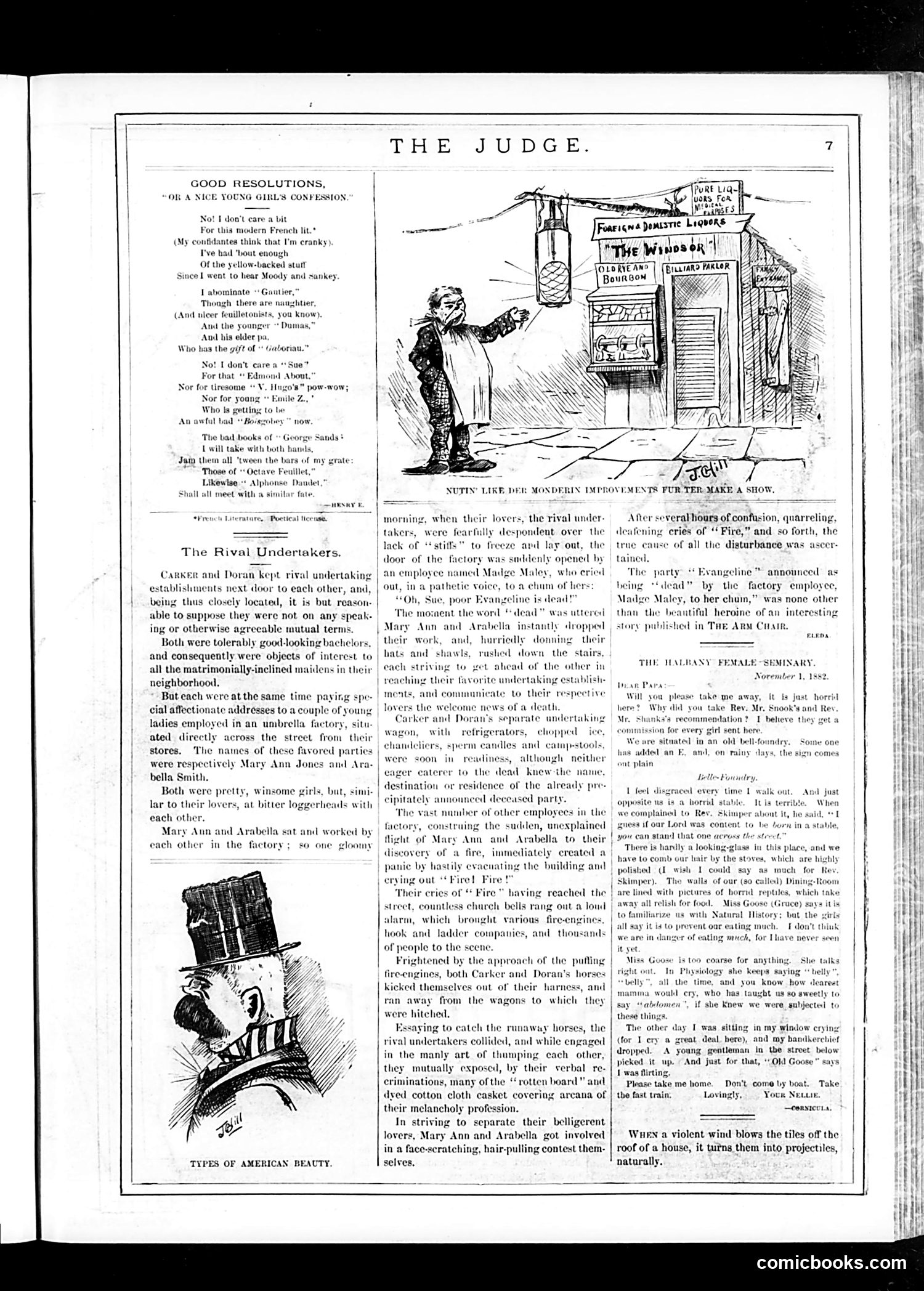
This page contains two separate satirical pieces from Judge magazine: **"Good Resolutions"** (left): A poem mocking a young woman's claimed moral reforms. She vows to reject French novels, yellow-backed sensational literature, and works by authors like George Sand and Balzac after attending a Moody and Sankey revival meeting. The satire suggests her resolutions are insincere—she'll likely return to reading these "immoral" books. This reflects Victorian anxiety about women readers consuming supposedly corrupting fiction. **"The Rival Undertakers"** (main story): A comedic tale of two competing undertakers, Carker and Doran, both courting factory girls Mary Ann and Arabella. When a false fire alarm causes panic, the rivals' hearses collide, exposing the shoddy construction of their coffins ("rotten boards," cheap cloth coverings). The joke satirizes both undertakers' dishonesty and the absurd chaos that ensues. The accompanying illustrations mock both the melodramatic undertaking business and American facial features ("Types of American Beauty").
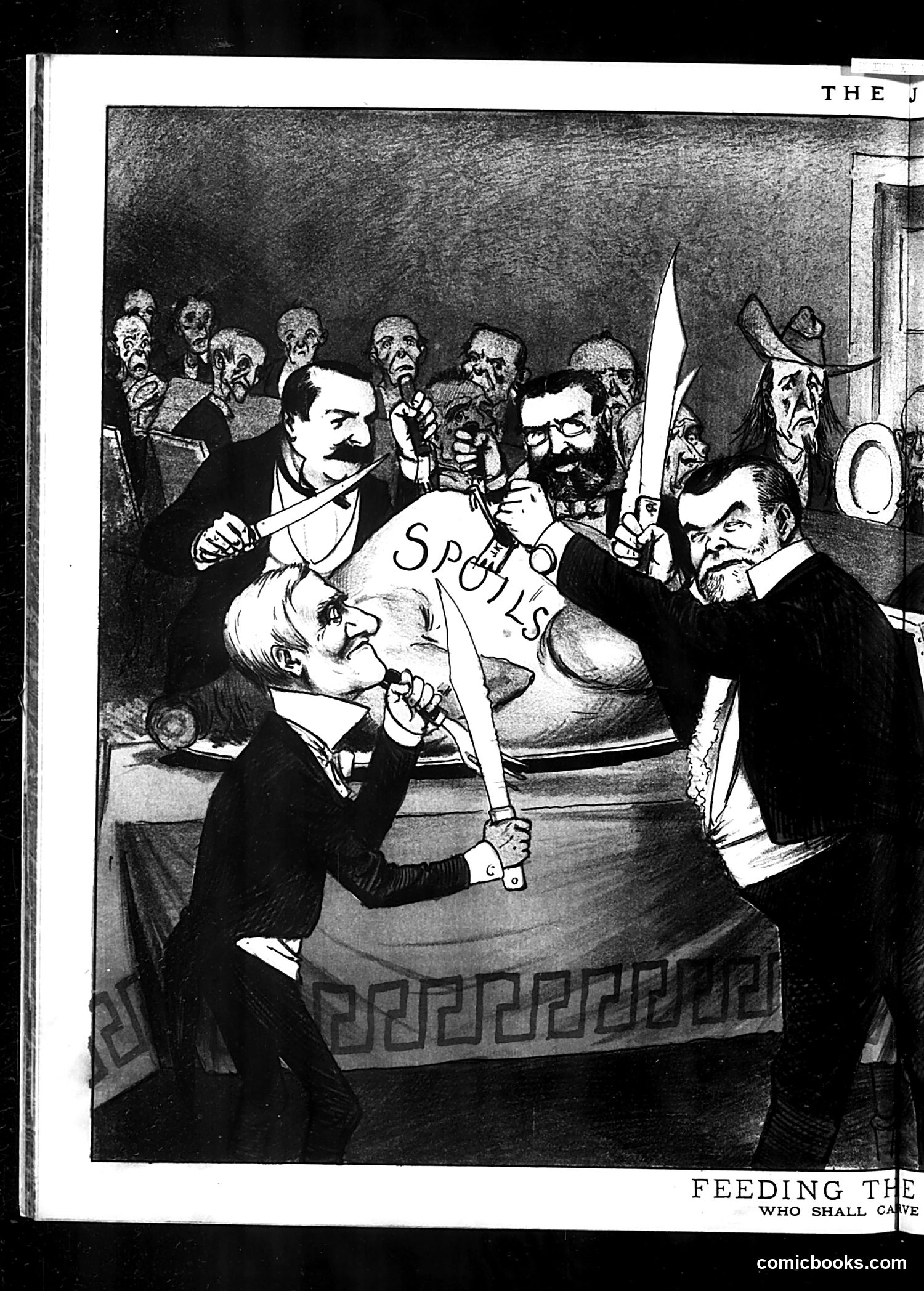
This appears to be a satirical cartoon from *Judge* magazine depicting a violent political struggle over what's labeled "SPOILS" (visible on the object being fought over). Two men in formal dress wielding swords dominate the foreground, while numerous caricatured figures crowd behind them, suggesting competing political factions. The incomplete caption reads "FEEDING THE... WHO SHALL CA[RVE]," likely referring to dividing political spoils or patronage positions—a reference to the spoils system in American politics. The violent imagery and crowded composition suggest satire about political corruption, infighting over government benefits, and the unseemly scramble for power among politicians. Without a date, the specific political figures remain unclear, but the theme reflects widespread *Judge* criticism of American political corruption.
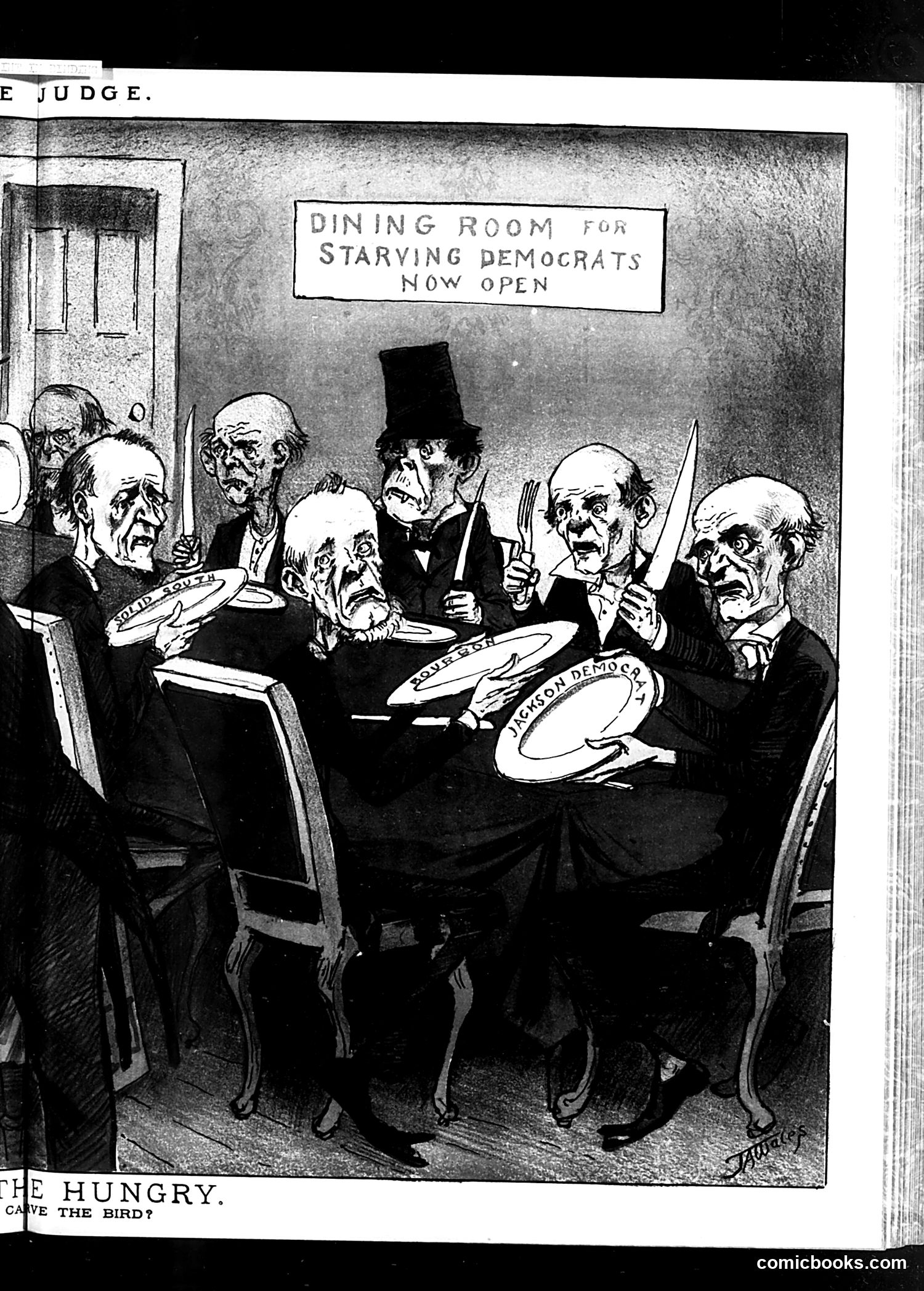
This satirical cartoon mocks Democratic Party leadership during what appears to be a period of political hardship or electoral defeat. The sign reads "DINING ROOM FOR STARVING DEMOCRATS NOW OPEN," suggesting Democrats are in financial or political distress. The caricatured figures, dressed formally but with exaggerated, gaunt features, sit at a table with empty plates labeled "MORGAN DEMOCRATS"—likely referencing J.P. Morgan or Wall Street connections. They hold cutlery but have no food, illustrating the joke: despite the dining room's opening, the Democrats remain hungry and without sustenance. The bottom caption, "THE HUNGRY. / CAVE THE BIRD?" (possibly "GAVE THE BIRD?"), suggests mockery of Democratic electoral prospects or their ability to provide for themselves.
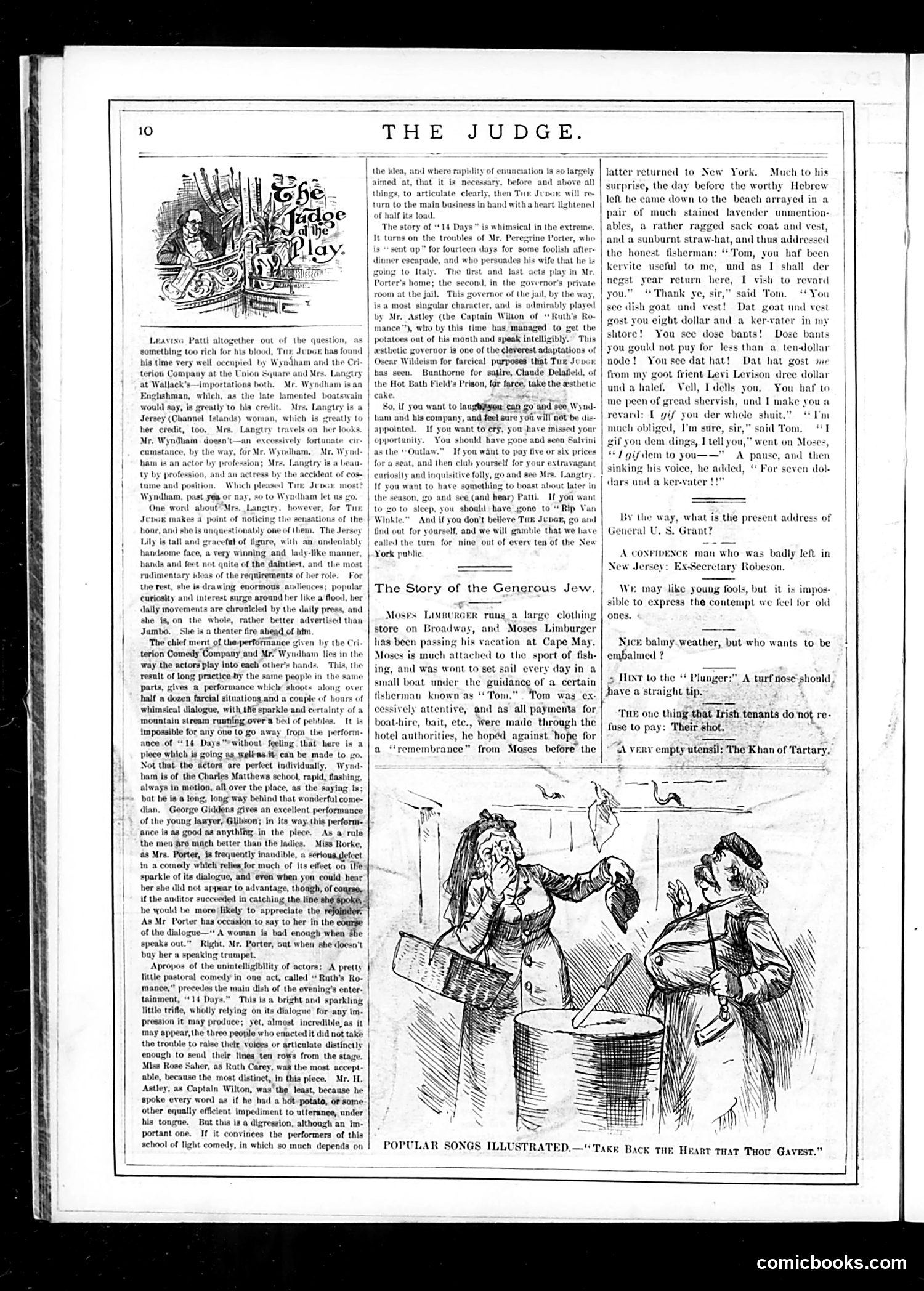
This page from *Judge* magazine contains theatrical criticism and a satirical story about Lillie Langtry, the famous British actress and society figure of the 1880s-90s. **Main Content:** The left column reviews "14 Days," a farce at the Union Square Theatre, praising actor Astley's performance. The right contains "The Story of the Generous Jew," mocking a wealthy Jewish character (Moses Lindberger) through crude stereotypical dialect. Moses returns a poor fisherman's (Tom's) borrowed clothing with ostentatious gifts—goat, vest, pants, hat—while boasting about their cost and extracting gratitude. **The Satire:** The piece ridicules nouveau-riche Jewish businessmen as pretentious and condescending, using exaggerated Yiddish-inflected English. The fisherman's gratitude for expensive items he never wanted satirizes both working-class deference and perceived Jewish materialism. **Social Context:** This reflects period anti-Semitic caricature common in American satirical magazines, presenting Jewish immigrants/wealthy Jews as vulgar, ostentatious, and exploitative.
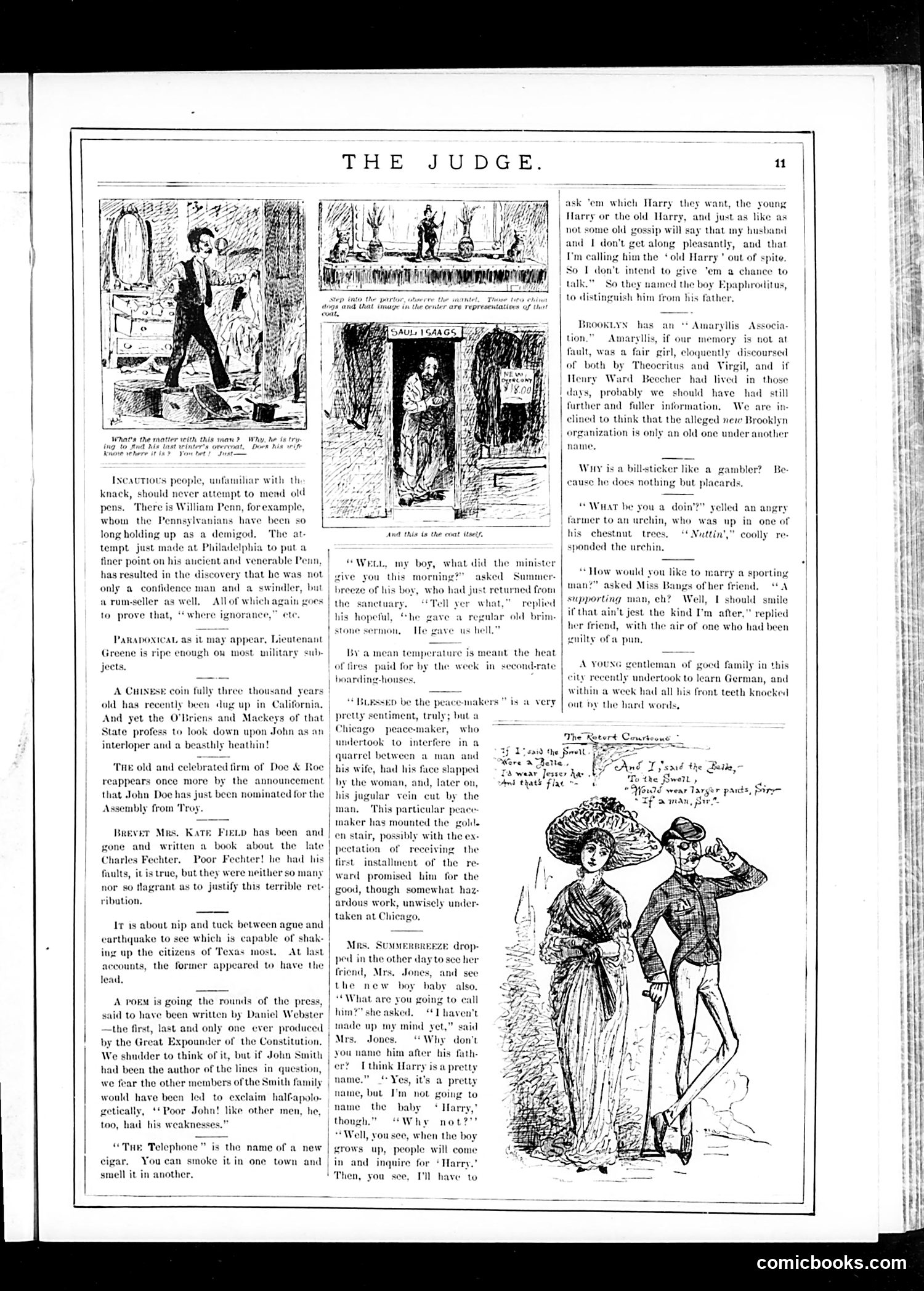
This page contains several short satirical pieces and illustrations typical of Judge's humor: **Main Content:** The page features social commentary on naming practices, particularly a humorous anecdote about parents naming their son "Epaphroditus" to avoid gossip. There's also satire about a "peace-maker" in Chicago who interfered in a marital dispute and got slapped by the woman, then had his jugular vein cut—darkly mocking his failed intervention. **Key References:** - Criticisms of Pennsylvania's William Penn and Philadelphia's "ancient and venerable" reputation as being overstated - A Chinese coin found in California, mocking Californians' prejudice against Chinese immigrants as "heathens" - References to Daniel Webster and the Constitution - Complaints about Texas being shaken by "ague and earthquake" **The Illustrations:** Show Victorian-era scenes of daily life and social interaction, rendered in characteristic wood-cut style. **Overall Tone:** The satire targets hypocrisy, prejudice, and pretension in American society while employing the era's casual racism and social stereotypes.
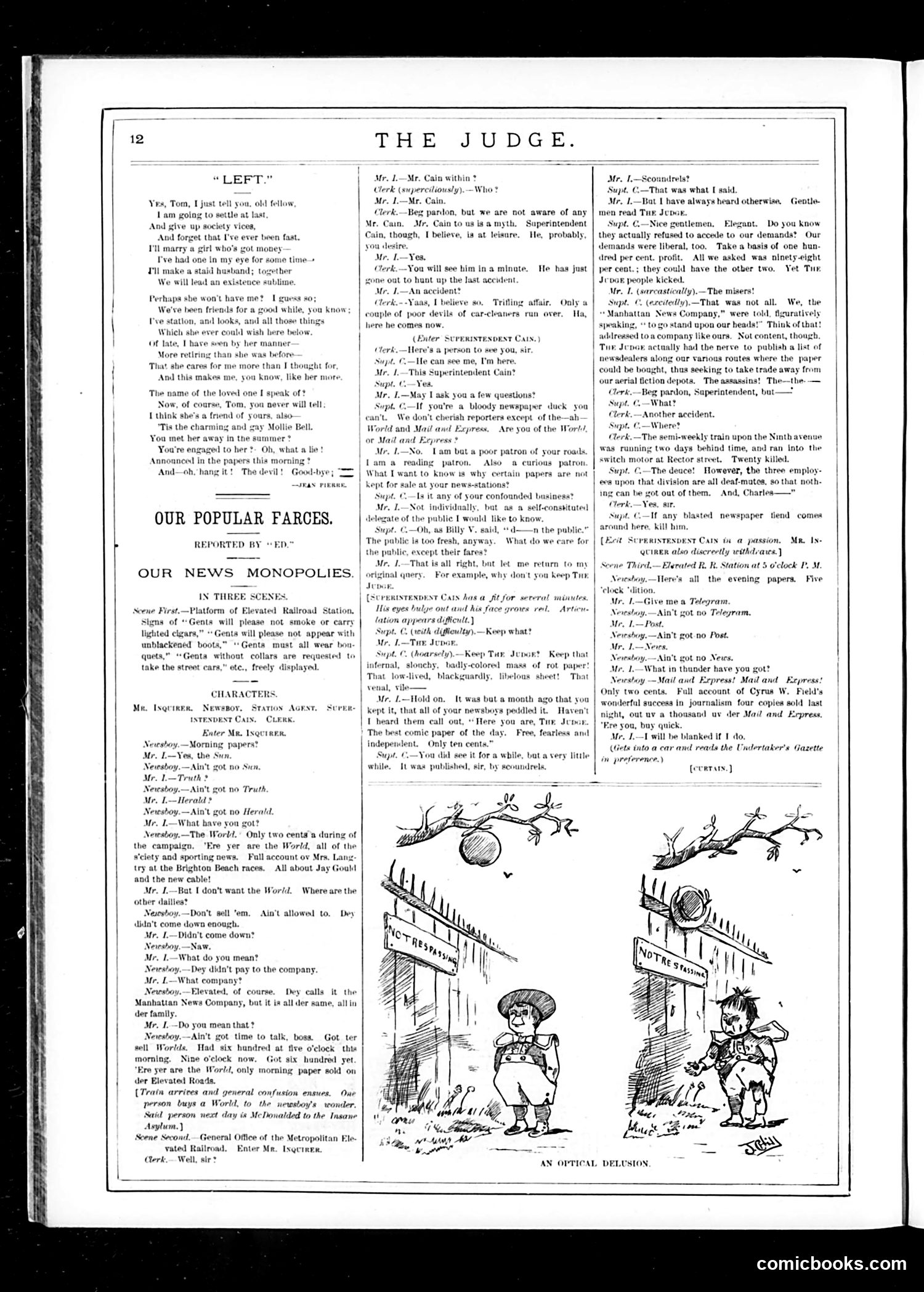
This page satirizes corruption and indifference in New York's transit systems, likely from the 1880s-90s based on references to the "Manhattan News Company" and elevated railways. The main cartoon depicts two newspaper vendors outside competing newsstands. The accompanying dialogue reveals the satire's target: a Superintendent Cain dismisses complaints from a newspaper patron about unfair vendor placement and trade practices. When accidents occur (car-cleaners run over; a train collision killing twenty), Cain remains callously indifferent, noting the victims on his division "are all deaf-mutes, so that nothing can be got out of them." The satire exposes transit company management's casual disregard for worker safety and public welfare. The "optical delusion" title suggests the public's naive belief that such companies operate honestly—when reality shows systemic negligence masked by bureaucratic dismissal. The page primarily features this dialogue-driven farce rather than visual political cartooning.
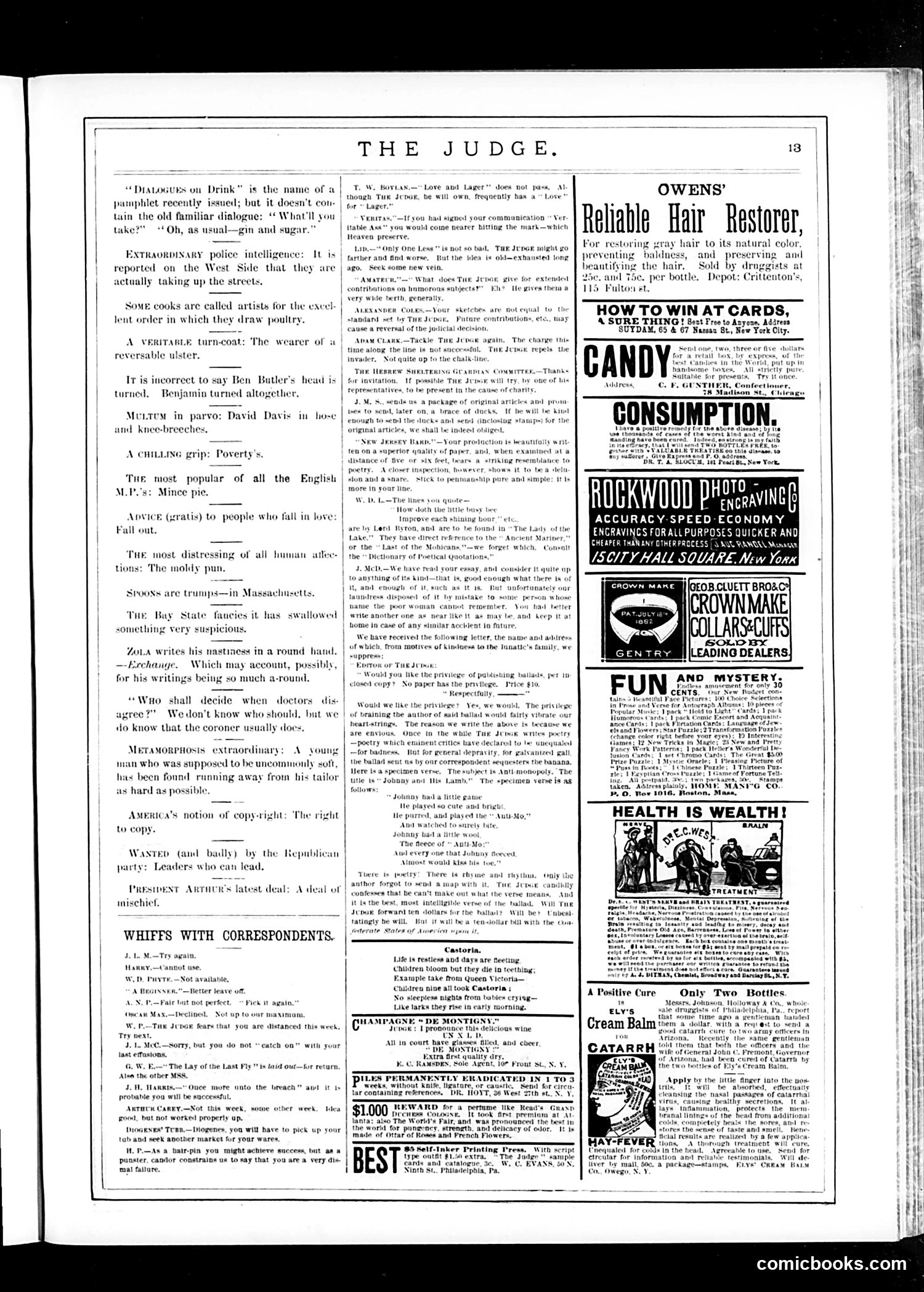
This page is primarily **humor commentary and advice columns** ("Whiffs with Correspondents"), not political cartoons. The text consists of brief satirical jabs at contemporary American life and responses to reader submissions. Key satirical observations include jabs at: - **Ben Butler** (Civil War general/politician), mocked for being a "turncoat" - **David Davis** (likely the politician/judge), ridiculed in absurdist fashion - General social commentary on poverty, doctors, copyright law, and romantic relationships The "Whiffs" section shows editors rejecting submitted poems and articles, providing caustic feedback—typical Judge magazine practice of mocking amateur writers. The right side features **period advertisements** (hair restorer, candy, photo engraving), not editorial content. **Context for modern readers**: This represents Judge's trademark style—short, punchy satire targeting public figures and social foibles, alongside reader correspondence that allowed mockery of submissions. The political references assume readers knew contemporary politicians; the jokes rely on wordplay and absurdist humor common to 1880s-era satirical magazines.
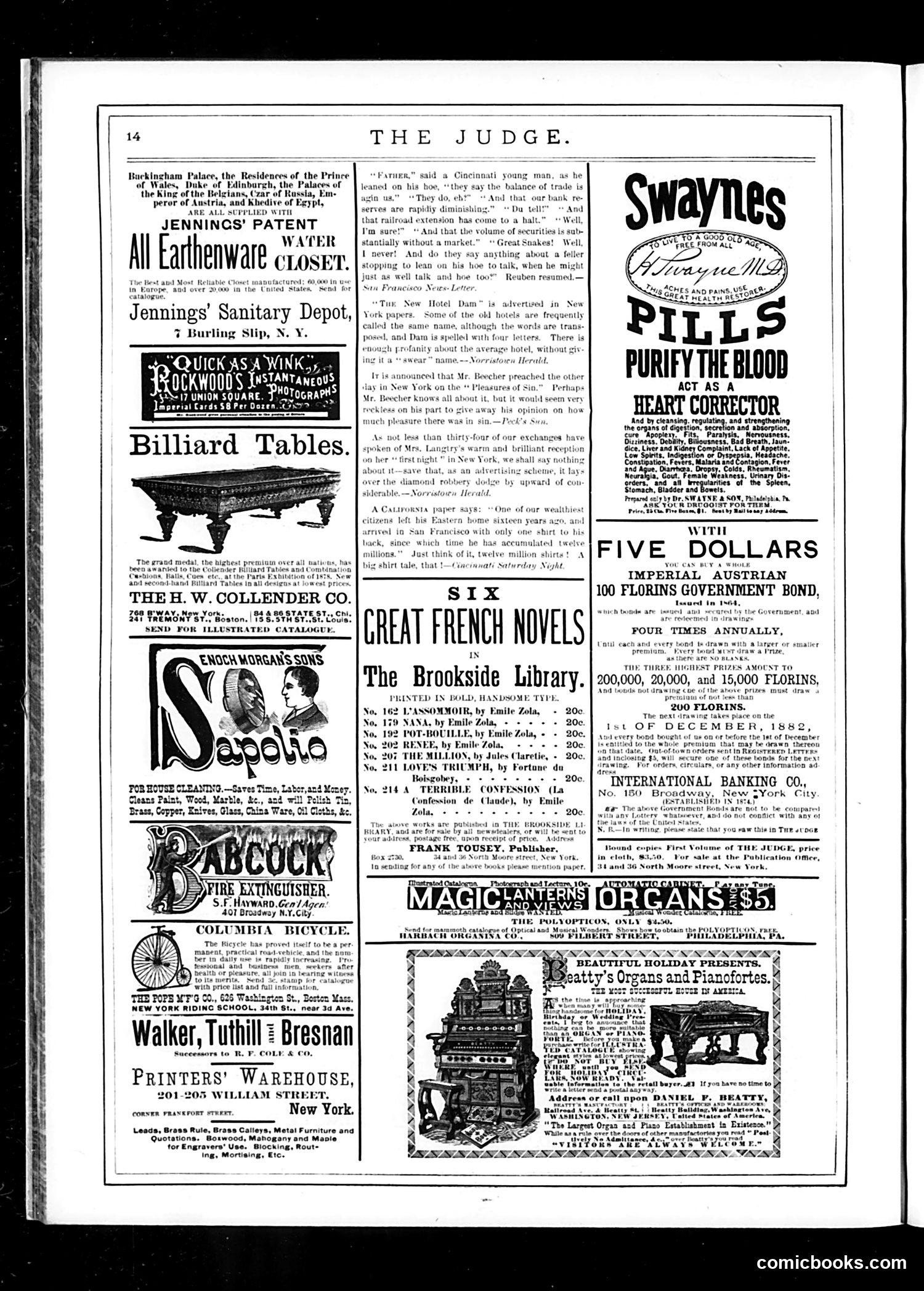
This appears to be primarily an **advertising page** from Judge magazine rather than a satirical cartoon page. The page is dominated by commercial advertisements for various products and services popular in the late 19th century. The one **editorial cartoon** visible ("The Judge") depicts a dialogue between what appears to be a farmer and an urban businessman discussing financial matters—railroad extensions, securities markets, and stock speculation. The satire appears to mock the disconnect between rural and urban economic concerns, with the farmer represented as simple and practical while the city man obsesses over abstract financial instruments. The bulk of the page advertises products including sanitary fixtures, billiard tables, bicycles, French novels, organs and pianofortes, patent medicines (notably "Swayne's Pills" claiming to purify blood), and financial instruments like Austrian government bonds. This layout reflects Judge's business model: satirical content subsidized by paid advertising from manufacturers and service providers.
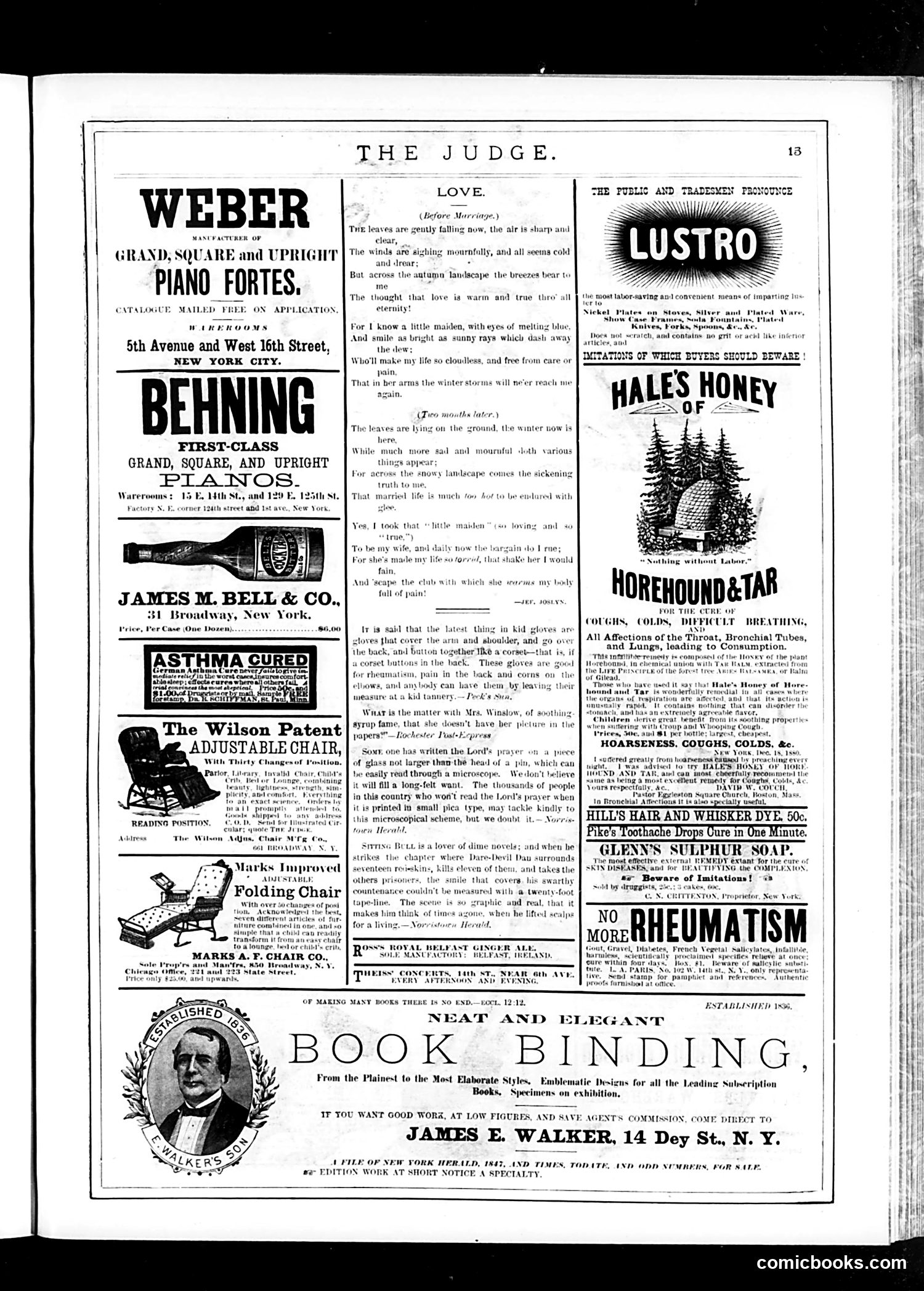
This is primarily an **advertising page** from Judge magazine, with one satirical poem ("Love") embedded among commercial notices. ## The Satire The poem "Love (Before Marriage)" uses a two-part structure to mock romantic idealization versus married reality. The "Before Marriage" section presents flowery, sentimental language about eternal love and devotion. The "(Two months later)" section brutally reverses this: the same speaker now describes his wife as a burden—her presence makes him miserable, she nags him constantly, and he regrets the marriage entirely. The final lines suggest he's trapped: "And 'scape the club with which she crowns my head full of pain." The joke targets **male disillusionment with marriage** and the gap between romantic fantasy and domestic reality—a common theme in 19th-century satirical publications. ## The Advertisements The page is dominated by piano manufacturers (Weber, Behning), patent furniture, patent medicines (asthma cures, hair dye, toothache drops), and book-binding services—typical commercial content from the era. These ads have no satirical purpose; they simply fill profitable space.
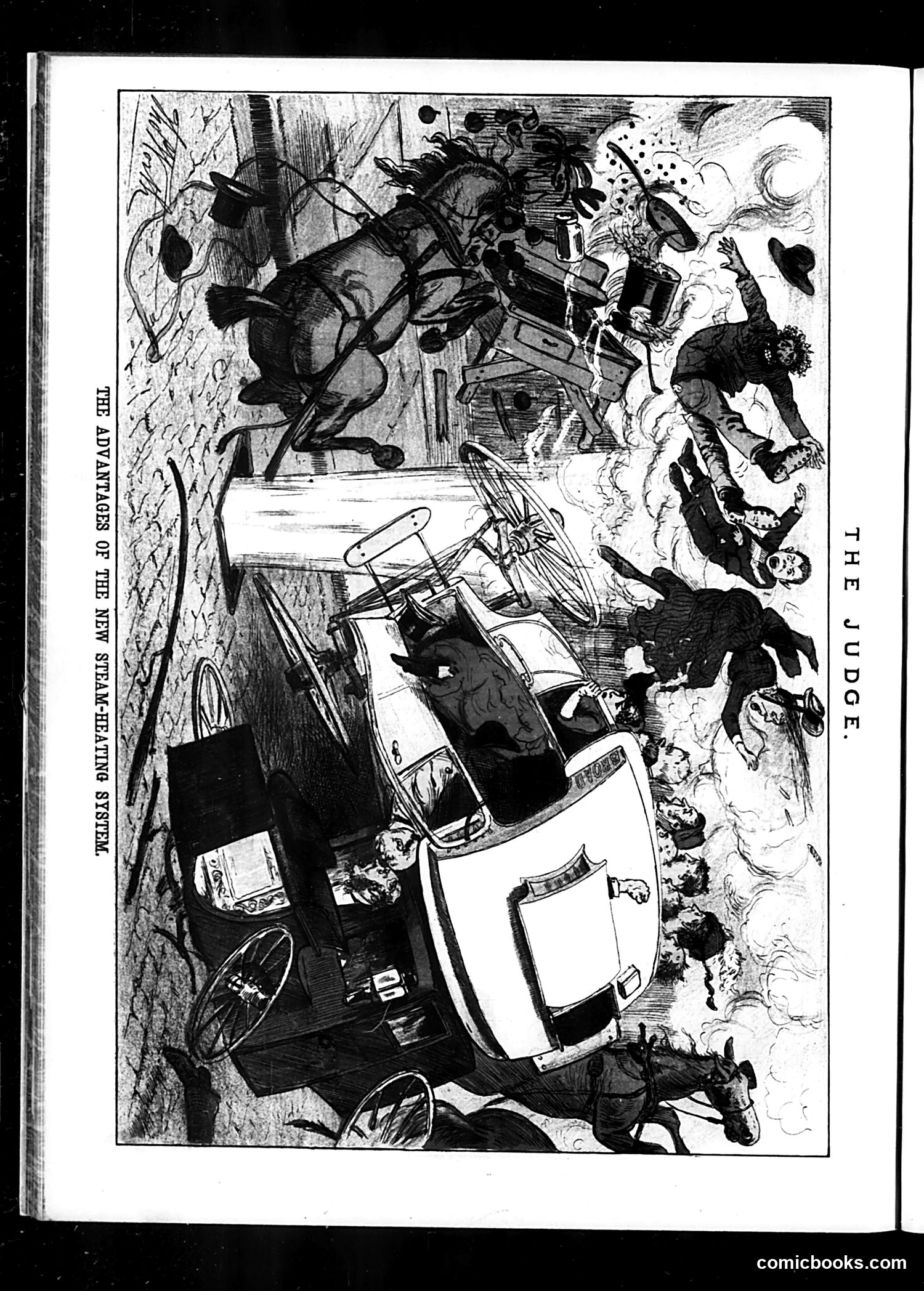
This appears to be a satirical illustration from *Judge* magazine depicting a chaotic street scene. The image shows an automobile with several figures around it in what appears to be a comedic mishap or accident scenario. There are horses, pedestrians, and various characters in apparent disarray, suggesting social commentary on early automobile culture and the disruption these vehicles caused to traditional street life. The title "THE JUDGE" appears on the right side. However, the OCR text is largely illegible, making it difficult to identify specific political figures or precise satirical targets. Based on the visual chaos and early automotive setting, this likely comments on the novelty and danger of automobiles in urban environments, a common *Judge* satirical theme from the early 20th century.