
Judge, 1882-11-25 · page 3 of 16
Judge — November 25, 1882 — page 3: what you’re looking at
What you’re looking at
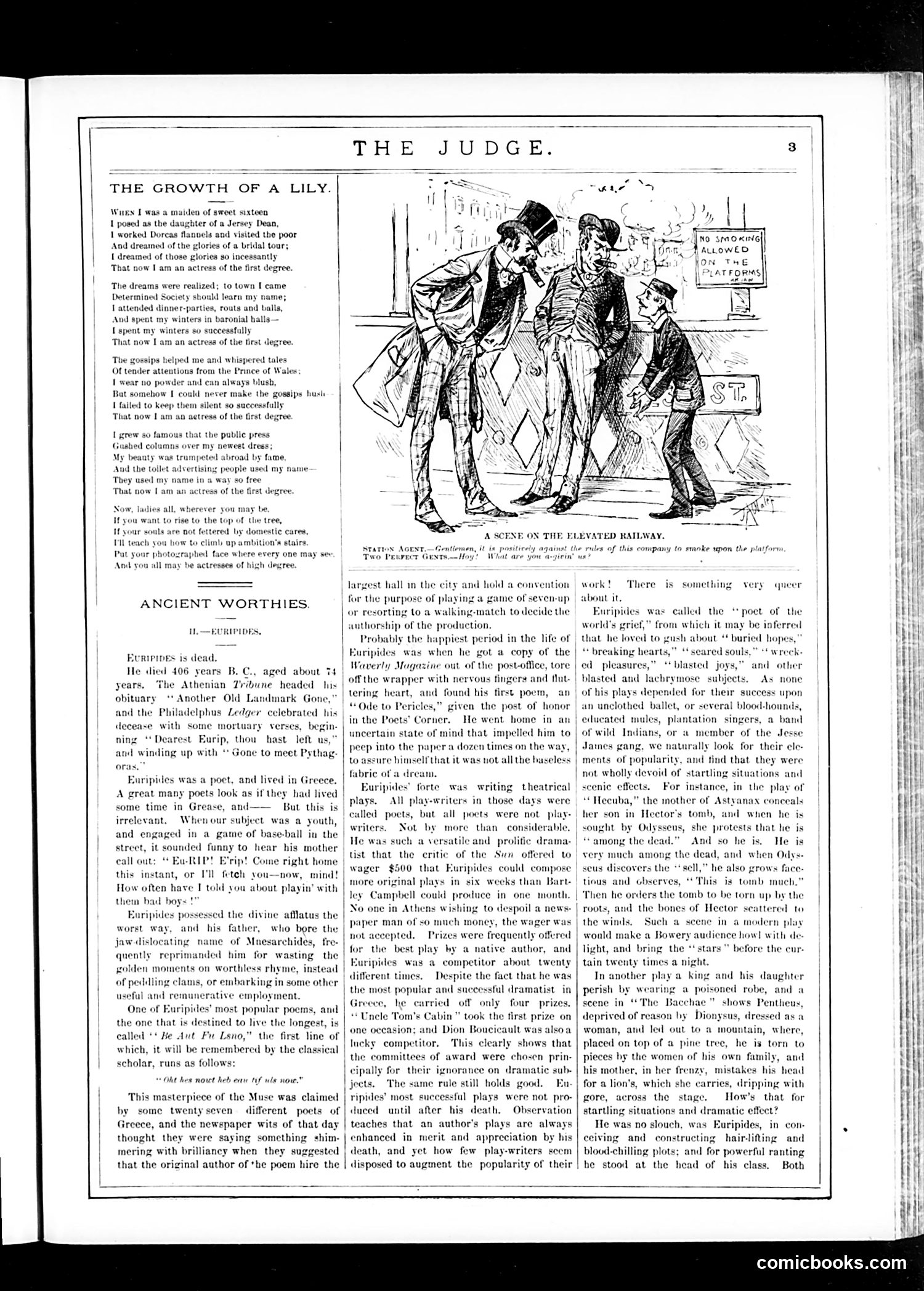
This page from the satirical magazine *Judge* contains two distinct pieces mocking different targets. **"The Growth of a Lily"** is a poem satirizing ambitious young women seeking fame and respectability through theatrical careers. The accompanying illustration shows a well-dressed man (likely a theater agent or promoter) with an eager young woman on an elevated railway platform. The poem's speaker traces her trajectory from pious "maiden of sweet sixteen" to celebrated actress, suggesting she achieved fame through shameless self-promotion rather than talent. The final stanza directly addresses other women, coaching them on how to climb "ambition's stairs"—the satire implies actresses succeed through calculated image-building and exploitation of their appearance rather than merit. **"Ancient Worthies: Euripides"** is a humorous biographical sketch of the ancient Greek playwright, mixing genuine classical knowledge with absurdist humor. It mocks both the historical over-attribution of classical works and contemporary pretensions to literary scholarship. Both pieces reflect late-19th-century anxieties about women's ambition, theatrical culture, and commercialized fame.
📄 Transcribed text from this page (OCR, searchable)
Machine-transcribed from the original scan — historical spelling and the odd misread are preserved.
| = = | THE GROWTH OF A LILY. | Wires 1 was a maiden of sweet sixteen I posed as the daughter of a Jersey Dean, i} 1 worked Dorcas flanovels and visited the poor And dreamed of the glories of a bridal tour; | dreamed of those glories so incessantly That now I am an actress of the first degree. The dreams were realize Determined Soc ; to town f came J learn my name; Tattended dine routs and balls, And sper in baronial balls— I spent my winters so successfully That now [am an actress of the first degree. my winte and w wh elped m: | Of tender attentions fro I wear t ways blush, Bat somehow 1 could never make the gossips hi | failed to keep them silent so successfully That now 1 ered tales Prince of Wales man agtresa of the first degree. I grew so famous that the public press Guahed columns over my newest dress; My beauty was trumpeted abroad by fame, Aud the toilet advertising peopl They used my n: That now fam an actress of the first used my name. e ina way so free Now If you want to rise to t If your 6 not f TIL teach you how to el Pat your photozray Ant you all may dies all, wherever you may be, pof the tree, red by domestic cares, up ambi jon’ stairs ml face where every one may see actresses of hij degree. ANCIENT WORTHIES. u PIDES. Evriprpes is dead. He died 406 years B. C years. The Athenian obituary ** Anot aged about 74 Tribune headed decease with Some mortua nin ry vei begi and winding up with ‘ Gone to meet Pythag Euripides was a poet, and lived in Greece. A great many poets look as if they had lived time in ¢ But irrelevant. a youth, and engaged in a game of base-ball in the some and—— When our subject How often have I told you them bad boys ! bout playin’ with Enripide: worst. way, jaw distoc quently posse: and sed the divine aflatus the his father, who bore the ting name of Mnesarehides, fre- sprimanded bim for wasting the golden moments on worthless rhyme, instead of peddling « t anis, or embarking in some other eful and remunerative employment. One of Euripides’ most popular poems, and the one that is destined to live the longest, is called ‘* Ke Aut Fu Lsno,” the first line of which, it will be remembered by the classical scholar, runs as follows: “Oht hes nowt heb enn tif ule now.” This masterpiece of the Muse was claimed some twenty seven different poets of Greece, and the newspaper wits of that day thought they were saying something shim- mering with brillianey when they suggested that the original author of the poem hire the by his Old Landmark Gone,” and the Philadelphus Ledger celebrated his Dearest Eurip, thou hast left us,” this is THE JUDGE. | | ON THE ELE Startes AorNT. Jon, it ie positieely a: Two Prarect Gexts.—Hoy? What are you largest hall in the city and hold a convention for the purpose of playing a game of seven-up | or resorting to a walking-mateh to decide the authorship of the production. | Probably the happiest period in the life of Euripides was when he got a copy of the | “br Waverly Magazine out of the postoflice, tore | ed off the wrapper with nervous fingers and fut. tering heart, and found his first poem, an “ Ode to Pericles,” given the post of honor in the Poets’ Corner. He went home in an uncertain state of mind that impelled him to peep into the paper a dozen times on the way, to: fabric of a dream, 1 days were play- ble. Euripides’ forte was writing theatrica plays. All play-writers in. thos called poets, but all poets were not writers. Not more He was such a iy than considera ; i versatile and prolific drama- strect, it sounded funny to hear his mother - : ; here zat % . tist that the critic of the Sun offered to call ont: EuwRIP! E'rip! Come right home $600 thet. Huripid ial d wager at Euripides could compos this instant, or I'll feteh you—now, mind! | “®8° senda aa os mpoes more original plays in six weeks than Bart. ley Campbell could produce in one month. No one in Athens wishing to despoil a news: paper man of so much money, the wager w 1. Prizes were frequently o' for the best play by a nativ Euripide $a competitor about twenty different times, Despite the fact that he was the most popular and successful dramatist. in Greece, he carried off only four prizes. Uncle Tom’s Cabin” took the first prize on one occasion; and Dion Boucicault was alsoa lucky competitor. 1 not accept This clearly shows that the committees of award were chosen prin- cipally for th jec | r ignorance on dramatic sub- | ‘The same rule still holds good. | ripides’ most successful plays were not pro- duced until after his death. Observation | teaches that an author's plays are always enhanced in merit and appreciation by his | death, and yet how few play-writers seem | disposed to augment the popularity of their Eu. | ure himself that it was not all the baseless | ments of popular ED RAILWAY. 1s of this company to smoke upon the platform work! about it, Euripides was called the ** poet of the world’s grief,” from which it may be inferre t There is something very queer he loved to gush about “ buric king hearts," ured soul pleasures,” ‘blasted. joys, blasted and lachrymose subjects. of his plays depended fi "wreck and other As none their suc an unclothed ballet, or several blood-hounds, educated mules, plantation singers, a band of wild Indians, or a member of the Jesse James gang, we naturally look their ele- id tind that they were 88 upon for | not wholly devoid of startling situations and author, and | light, and bring the * stars” before the ct scenic effects. ““THeeub: For instance, in the play "the mother of Astyanax cones her son in Hector’s tomb, and when he is sought by Odysseus, she protests that he is “among the dead.” An He is very much among the dead, and when Odys- seus discovers the *‘sell,” he also grows face- This is tomb much ‘Then he orders the tomb to be torn up by the roots, and the bones of Heetor Lite the winds, Sueh a scene in a modern y woald make a Bowery audience how! with « «1 so he is, tious and observes, ny tain twenty times a night. In another play a king and his daughter perish by wearing a poisoned robe, scene in ‘The deprived of re woman, and le nd a Bacchae " shows Pentheus, son by Dionysus, dressed as a out to mnountain, where, placed on top of a pine tree, he is torn to pieces by the women of his own family, and nay his mother, in her ft for a lion's, which she carries, dripping with gore, across the stage. How's that startling situations and dramatic effect? mistakes his head for He was no slouch, was Euripides, in con- ceiving and constructing hairlifting and blood-chilling plots; and for powerful ranting he stood at the head of his clas Both comicbooks.com