
A complete issue · 18 pages · 1882
Judge — October 28, 1882
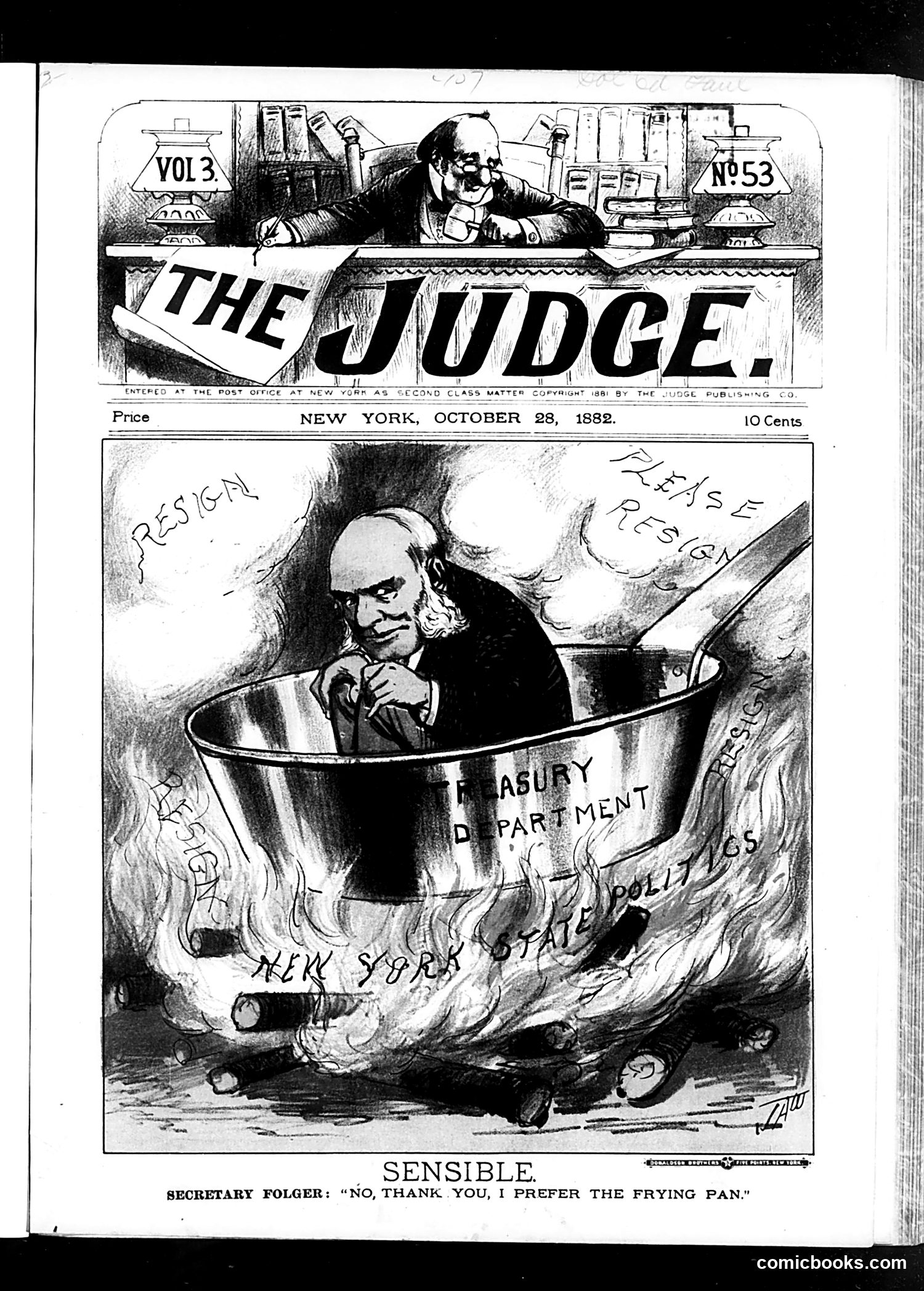
This cartoon satirizes Secretary of the Treasury Charles J. Folger during a political crisis. Folger is depicted in a large pot labeled "Asbury Department" and "New York State Police," surrounded by flames representing scandal or controversy. The caption quotes Folger refusing to jump from the "frying pan" into the fire—a metaphor meaning he won't escape one bad situation by entering another. The cartoon suggests Folger faced pressure regarding corruption or mismanagement in the Asbury Department (likely the Asbury Park Police or a similar body), and that any alternative course of action would prove equally disastrous. The satire mocks Folger's difficult political position during the Gilded Age, when administrative scandals were common. The "sensible" title is ironic—his situation offered no good options.
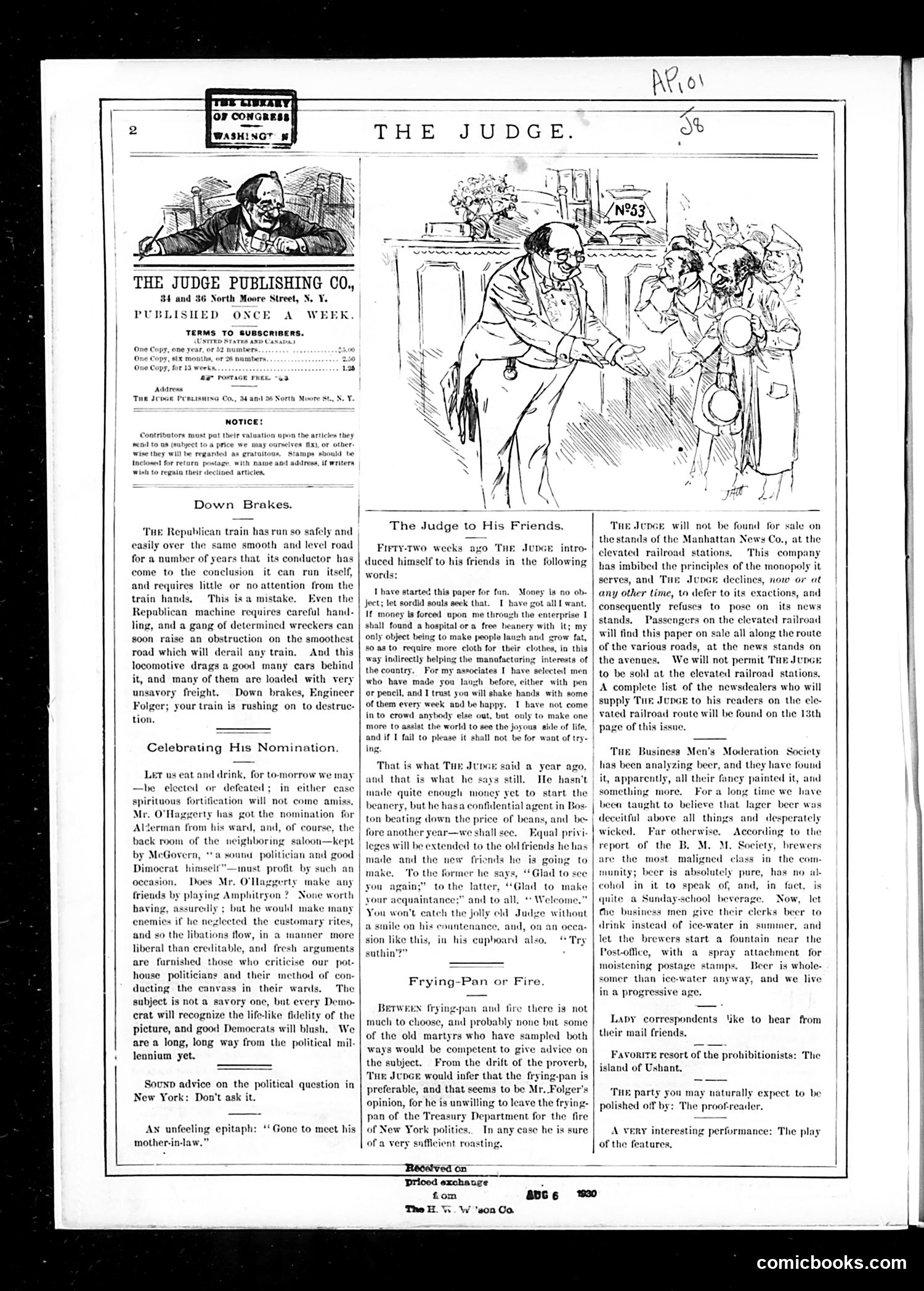
This page from Judge (likely 1880s based on style) contains political satire targeting New York Democratic politics. **Main Cartoon ("The Judge to His Friends")**: Shows the magazine's editor addressing supporters. The text reveals Judge's founding mission: satire "for fun" rather than profit, with humorous goals like making people laugh so they'd buy more clothes, and establishing a "free beanery" (soup kitchen). The accompanying cartoon depicts the editor among well-dressed associates. **Secondary Content**: - "Down Brakes" warns Republicans (via engineer metaphor) against complacency, comparing their political machine to a train needing careful handling - "Celebrating His Nomination" mocks Irish-American Democratic ward politician "O'Haggerty," satirizing the tradition of treating supporters to alcohol after nomination—depicting him treating friends at a saloon **Context**: These pieces reflect Judge's role as Republican-leaning satirical commentary on urban machine politics, ethnic Democratic politicians, and American political culture of the Gilded Age.
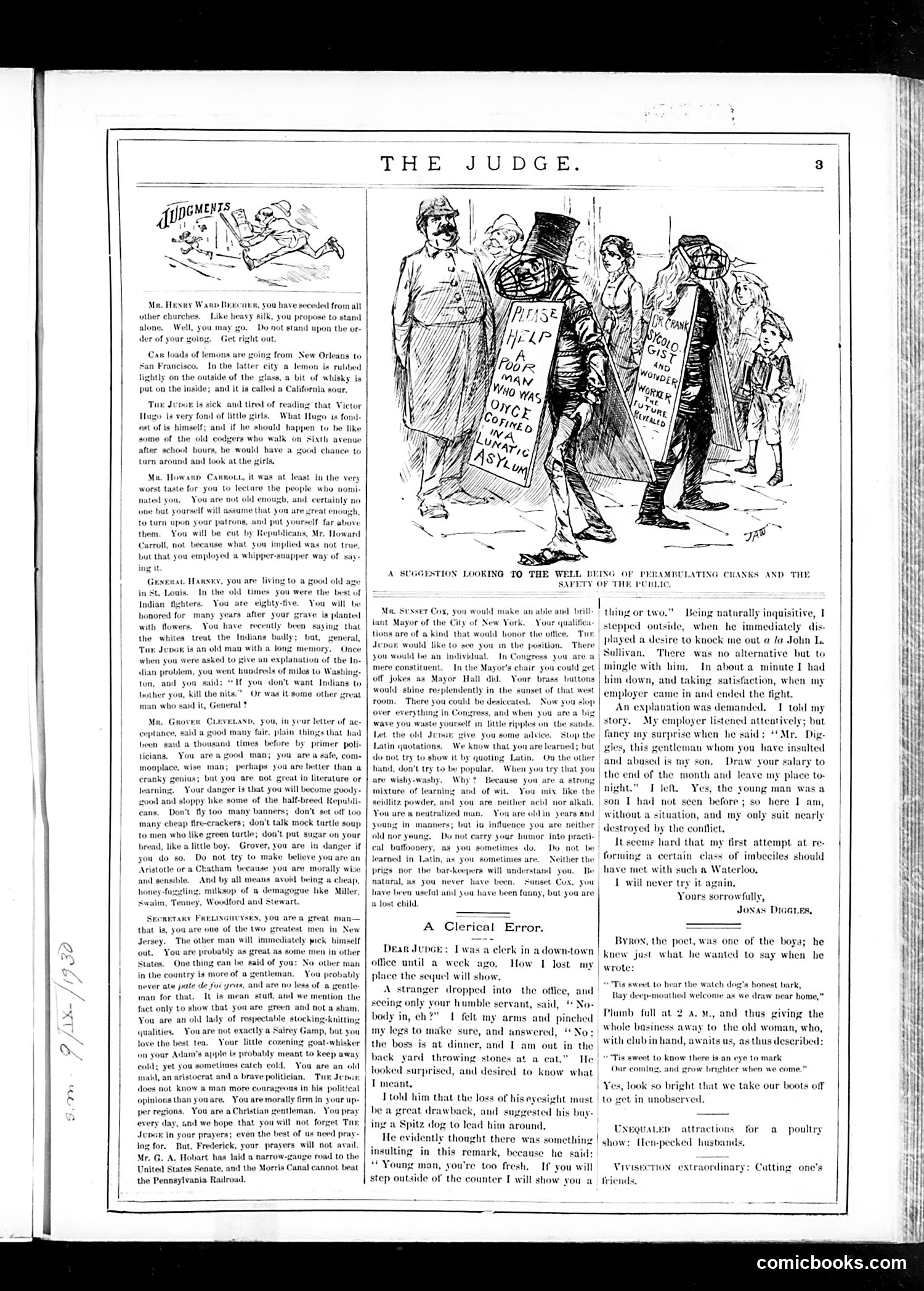
This page contains several brief satirical "letters" addressing prominent public figures of the era, delivered in Judge's characteristically blunt style. The main cartoon depicts what appears to be street protesters or petitioners surrounding officials, holding signs demanding help or reform—typical of Gilded Age labor and social agitation imagery. The text targets figures like Henry Ward Beecher (a famous preacher), General Henry (likely referencing Indian policy), Grover Cleveland, and Secretary Frelinghuysen, offering backhanded compliments mixed with sharp criticism. The satire mocks their pretensions, political hypocrisy, and personal habits while occasionally acknowledging their abilities. The tone is condescending but playful—Judge critiques these powerful men for being either too ambitious, insufficiently intellectual, or morally compromised, while treating them as subjects worthy of extended ridicule. The magazine positions itself as a arbiter of taste and propriety, judging the powerful from a position of satirical moral authority.
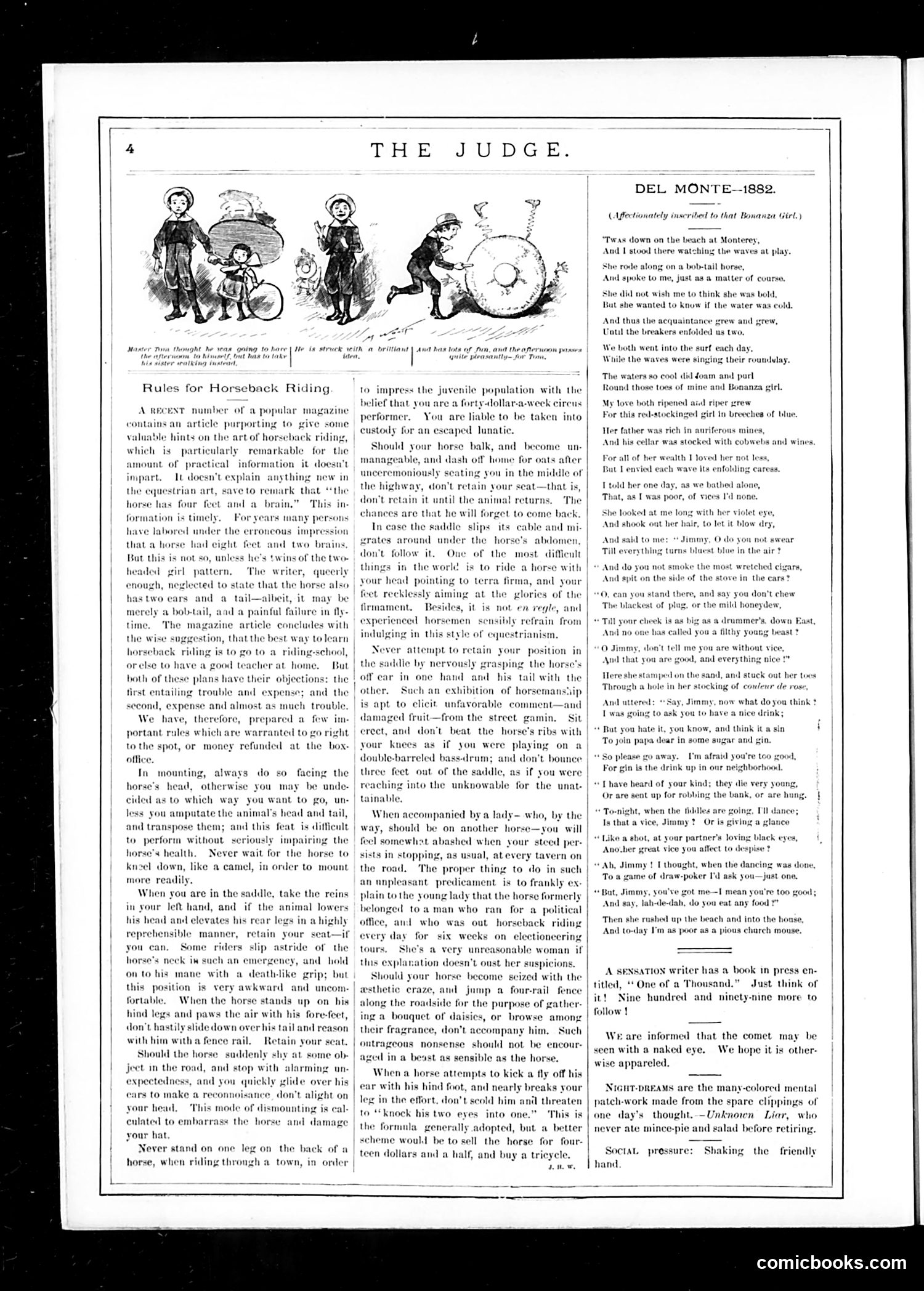
This satirical article mocks popular magazine advice on horseback riding by presenting absurdly pedantic rules that state obvious facts with mock-serious elaboration. The humor lies in treating elementary equestrian knowledge as though it requires detailed instruction. The cartoon illustrations above show children on various riding contraptions—bicycles, wheels, and hobby horses—appearing to take this mock-advice literally, their confused poses suggesting the ridiculous results of such overwrought instruction. The satire targets the era's proliferation of how-to articles in popular magazines, which often over-explained simple matters while omitting obvious practical wisdom. Judge ridicules both the magazine writers' pomposity and readers' apparent need for instruction on basics like "a horse has four feet and a brain" and not sliding down over the horse's tail in emergencies. This reflects late-19th-century anxiety about the boom in mass-market advice literature and urban audiences increasingly disconnected from rural/practical knowledge.
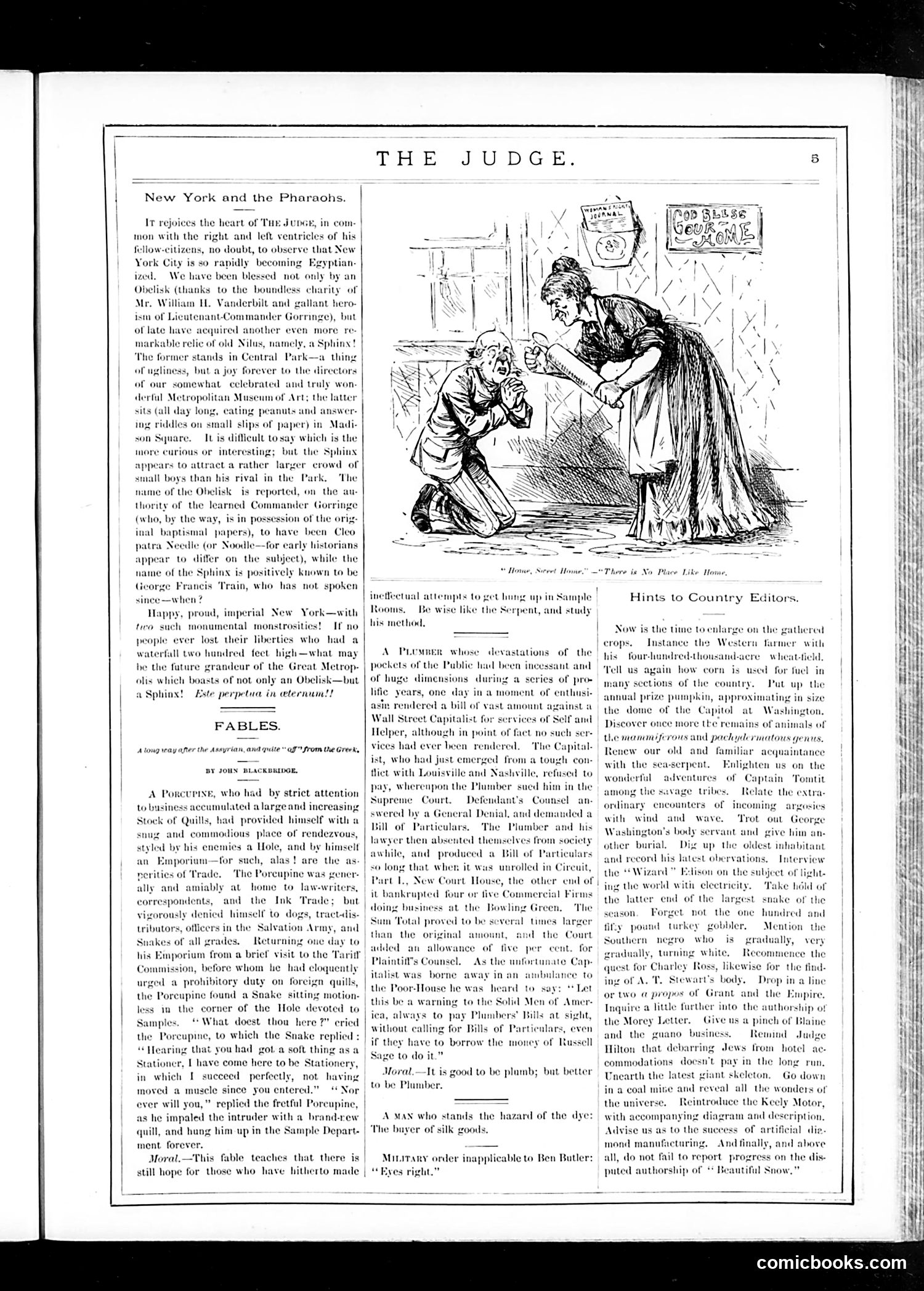
This page from *Judge* magazine satirizes New York City's rapid acquisition of Egyptian monuments and artifacts in the late 19th century. The main cartoon depicts the Sphinx and Obelisk ("Cleopatra's Needle") that had recently arrived in New York—gifts from Egypt, facilitated by wealthy patrons like William H. Vanderbilt and Lieutenant-Commander Gorringe. The satire's point: New York is becoming comically "Egyptianized," accumulating ancient relics like pharaohs hoarding treasures. The cartoonist mocks this as pretentious monument-collecting that rivals actual ancient civilizations. The Sphinx, depicted eating peanuts in Madison Square Park while answering riddles, is humorously anthropomorphized—suggesting these monuments are oddities rather than serious cultural acquisitions. Below are unrelated fables about a porcupine and a plumber's outrageous lawsuit, typical of *Judge's* satirical humor columns. The overall tone critiques wealthy New Yorkers' conspicuous cultural consumption and the absurdity of transplanting pharaonic monuments to Manhattan.
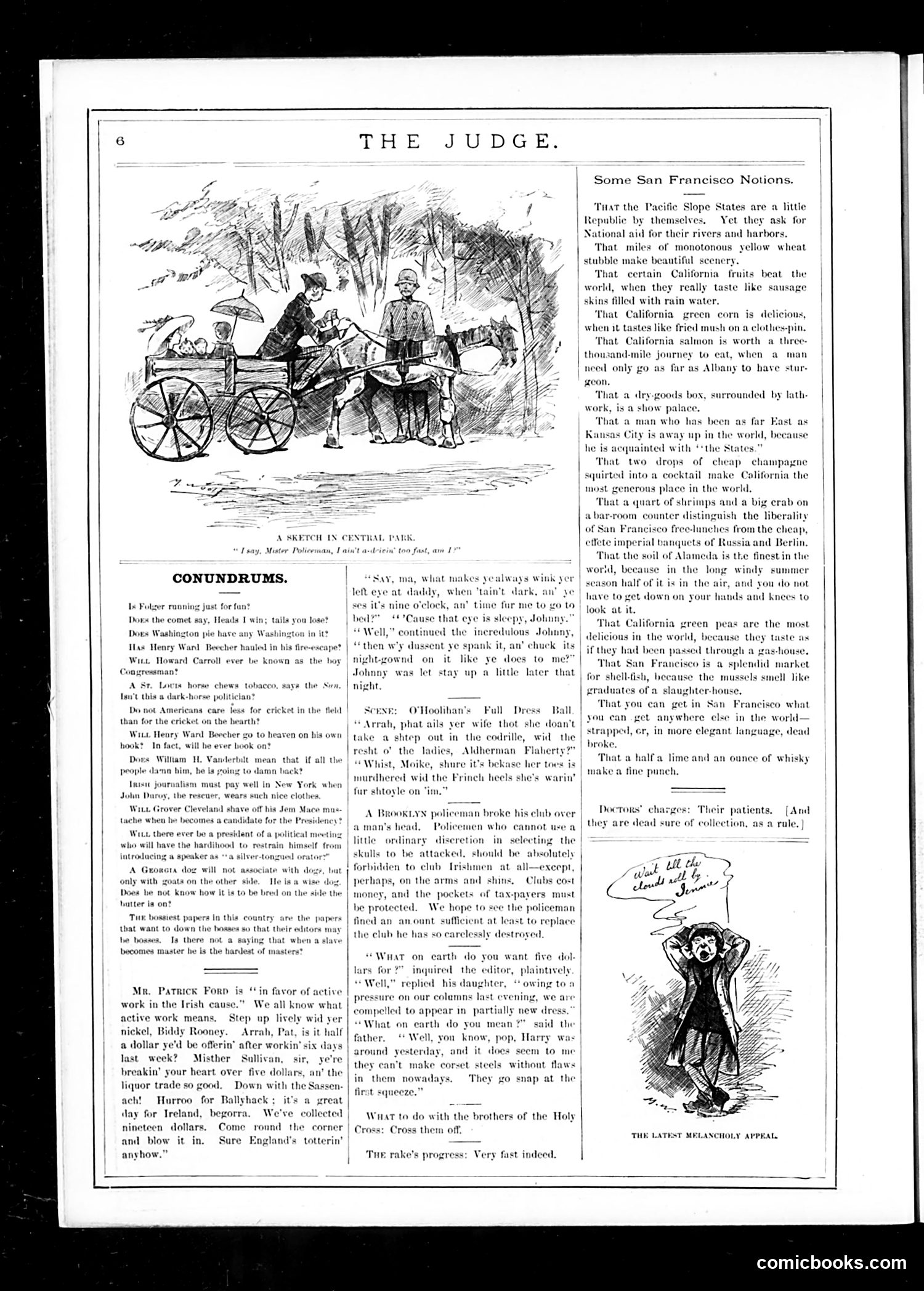
This page from *Judge* magazine contains several satirical pieces targeting Irish immigrants and American political/social figures of the era. **Main Cartoon:** "A Sketch in Central Park" depicts an Irish immigrant family in a horse-drawn carriage, likely mocking Irish-American manners and dialect through their conversation. **"Conundrums" Section:** A series of puns and jokes referencing Irish-American political figures (Henry Ward Beecher, William H. Vanderbilt) and stereotyping Irish labor activists. The repeated references to "Biddy Rooney," "Arrah," and phonetic Irish dialect mock Irish-American workers and their political engagement. **"Some San Francisco Notions":** Satirizes California boosters' exaggerated claims about the state's produce, climate, and amenities, suggesting they oversell inferior goods to easterners. The page reflects late 19th-century *Judge* editorial bias: dismissing Irish immigrant labor activism while simultaneously mocking Irish cultural stereotypes and regional American boosterism. The humor relies on ethnic caricature and class-based condescension now considered offensive.
This page from **Judge** magazine contains humorous fiction rather than political cartoons. The content includes: 1. **"An Autumn Revery"** — A satirical poem mocking a failing resort owner who advertised his property as a "paradise" in magazines but attracted no summer boarders. The joke targets deceptive tourism advertising common in the Gilded Age. 2. **"Two Versions of a Sunday-School Picnic"** — A comedic story in deliberately misspelled dialect narrated by a mischievous boy named Muggsy. The humor derives from: children's bad behavior during a supposedly wholesome church outing, the contrast between religious respectability and actual conduct, and the boy's crude vernacular. This satirizes both childhood misbehavior and the hypocrisy of Victorian moral pretense. Both pieces mock American social institutions (tourism marketing and religious propriety) through exaggeration and crude humor typical of late 19th-century satirical magazines.
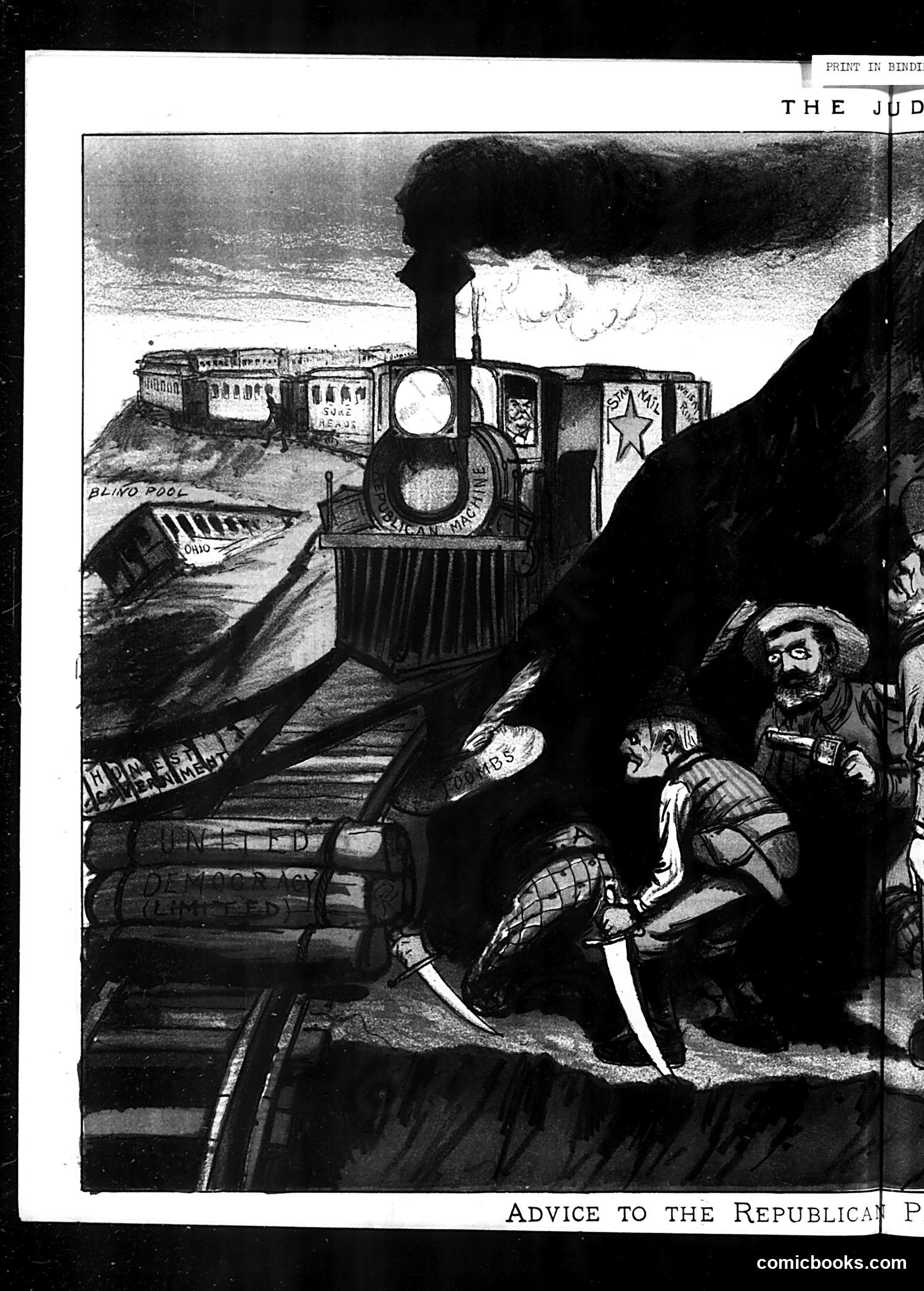
This appears to be a satirical cartoon titled "Advice to the Republican [Party]" from *Judge* magazine. The image shows a steam locomotive labeled with a star (suggesting American/Republican symbolism) approaching what appears to be "Blind Pool" — a reference to risky financial speculation. In the foreground, figures in period dress (appearing to be caricatured as Jewish or immigrant stereotypes) gesture warnings at the oncoming train. The cartoon critiques Republican economic or political policies as recklessly heading toward financial disaster ("blind pool"), while figures representing vulnerable populations attempt to warn them. The satirical "advice" suggests Republicans are ignoring warnings about the consequences of their actions. Without a visible date, the specific political crisis referenced remains unclear, though the iconography suggests late 19th or early 20th-century American politics.
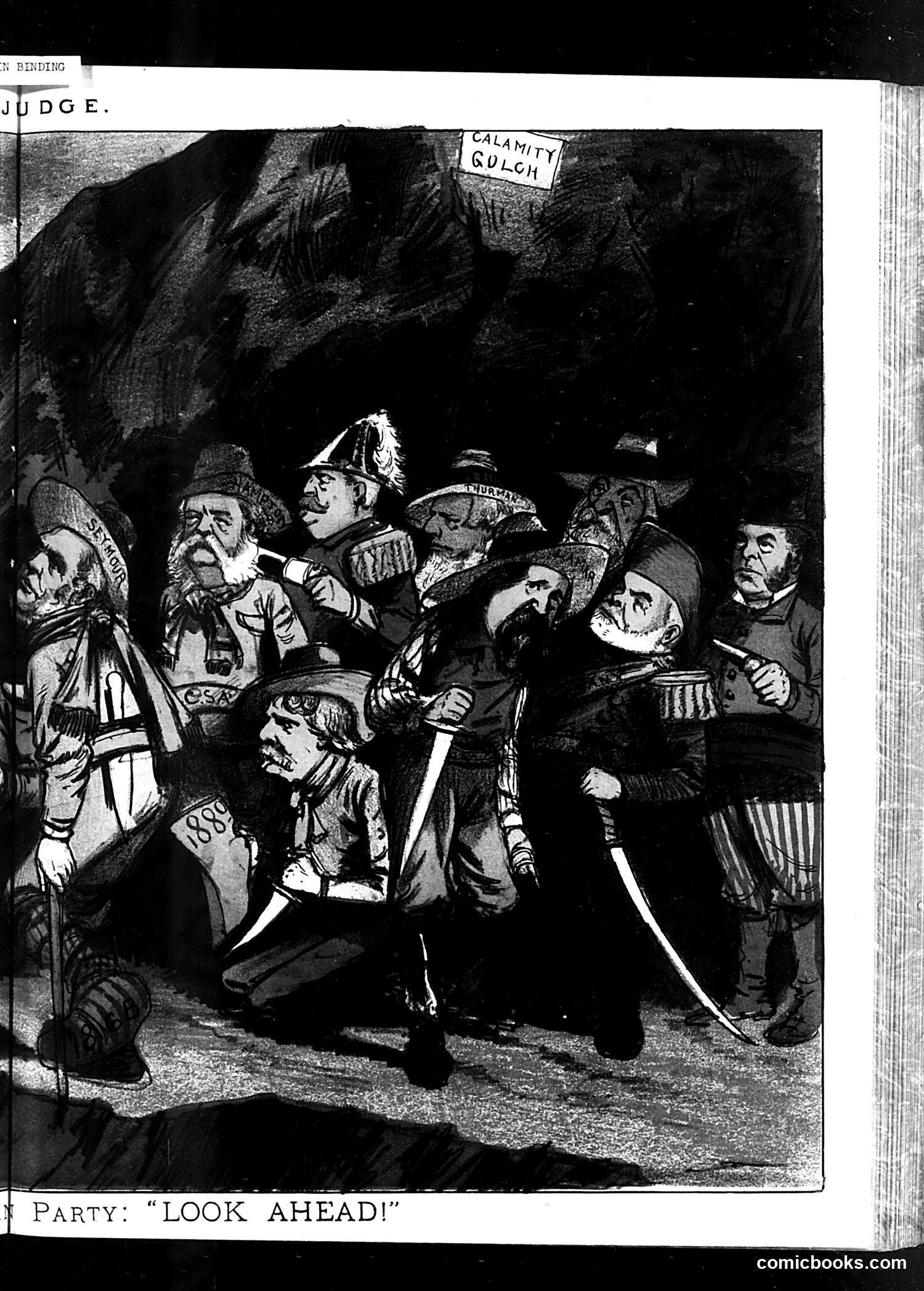
This satirical cartoon from *Judge* magazine depicts military and political figures in what appears to be "Calamity Gulch"—a reference to impending disaster or crisis. The uniformed men with military insignia seem to represent governmental or military leadership, while their worried expressions and the "look ahead" caption suggest they're being warned of danger they're either ignoring or failing to prevent. The specific identities of these caricatured figures remain unclear without additional context, but the cartoon appears to critique leadership's failure to address an obvious threat—possibly related to military preparedness, foreign policy, or domestic crisis. The dark, ominous setting reinforces the warning tone. The exact historical moment this references cannot be determined from the image alone.
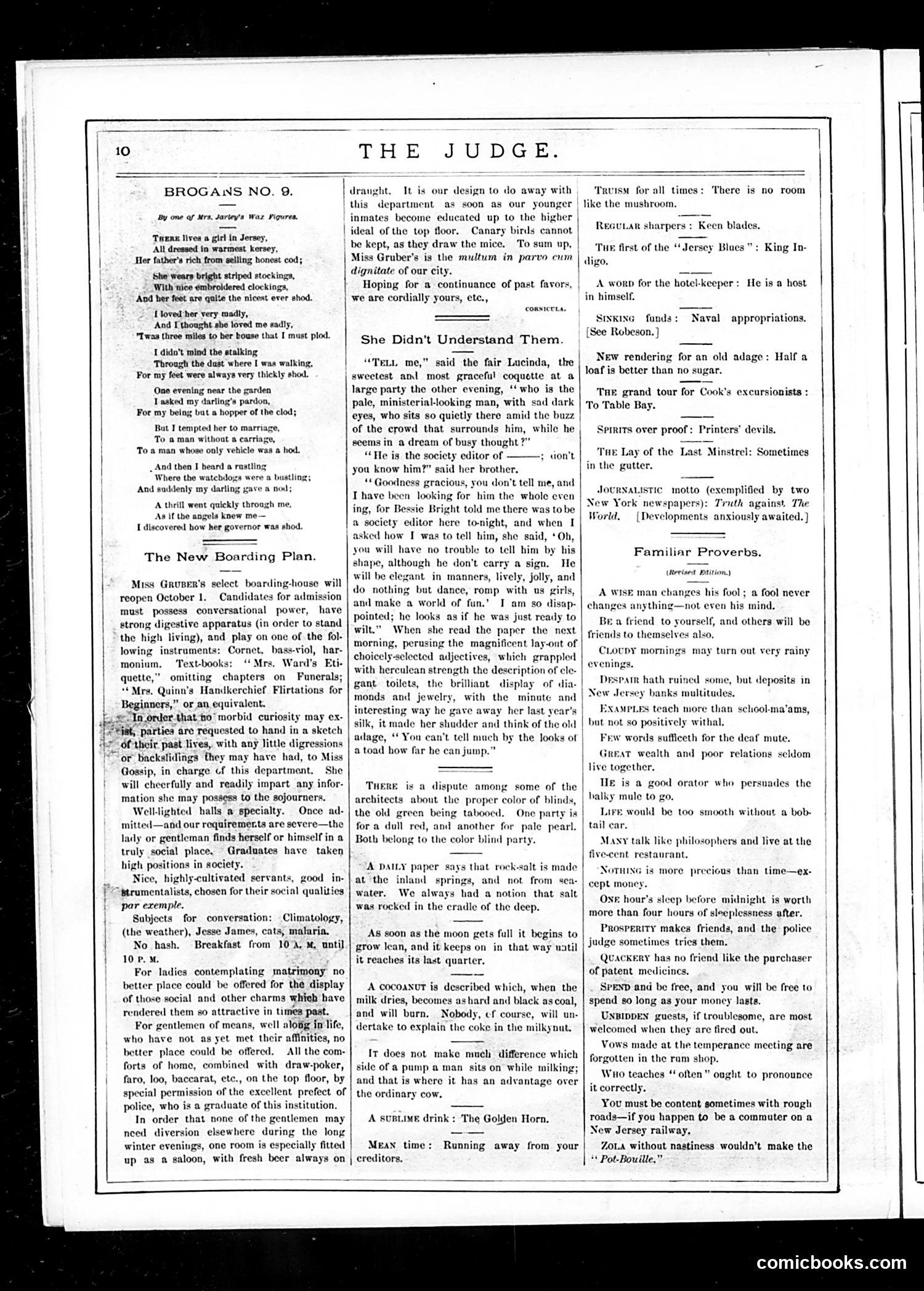
This page from Judge presents satirical content typical of late 19th-century American humor: **"Brogans No. 9"** is a comedic poem mocking class pretension. A working-class man (whose "brogans"—heavy work shoes—reveal his humble status) pursues a girl from a wealthy Jersey family. The joke centers on his embarrassment about his lowly occupation and cheap footwear, contrasted with her father's wealth from selling cod. The reveal that her father wears similarly cheap shoes undercuts the narrator's anxiety—suggesting class differences matter less than he fears. **"The New Boarding Plan"** satirizes exclusive boarding houses and their snobbish requirements. Miss Gruber's establishment demands residents possess "conversational power," musical ability, and willingness to disclose their moral failings. The satire mocks the hypocrisy: while claiming refinement, the house permits gambling (draw-poker, faro, baccarat) on upper floors with police approval. The joke exposes how such establishments conflate superficial gentility with actual morality. Both pieces mock Victorian-era social climbing and the gap between appearances and reality.
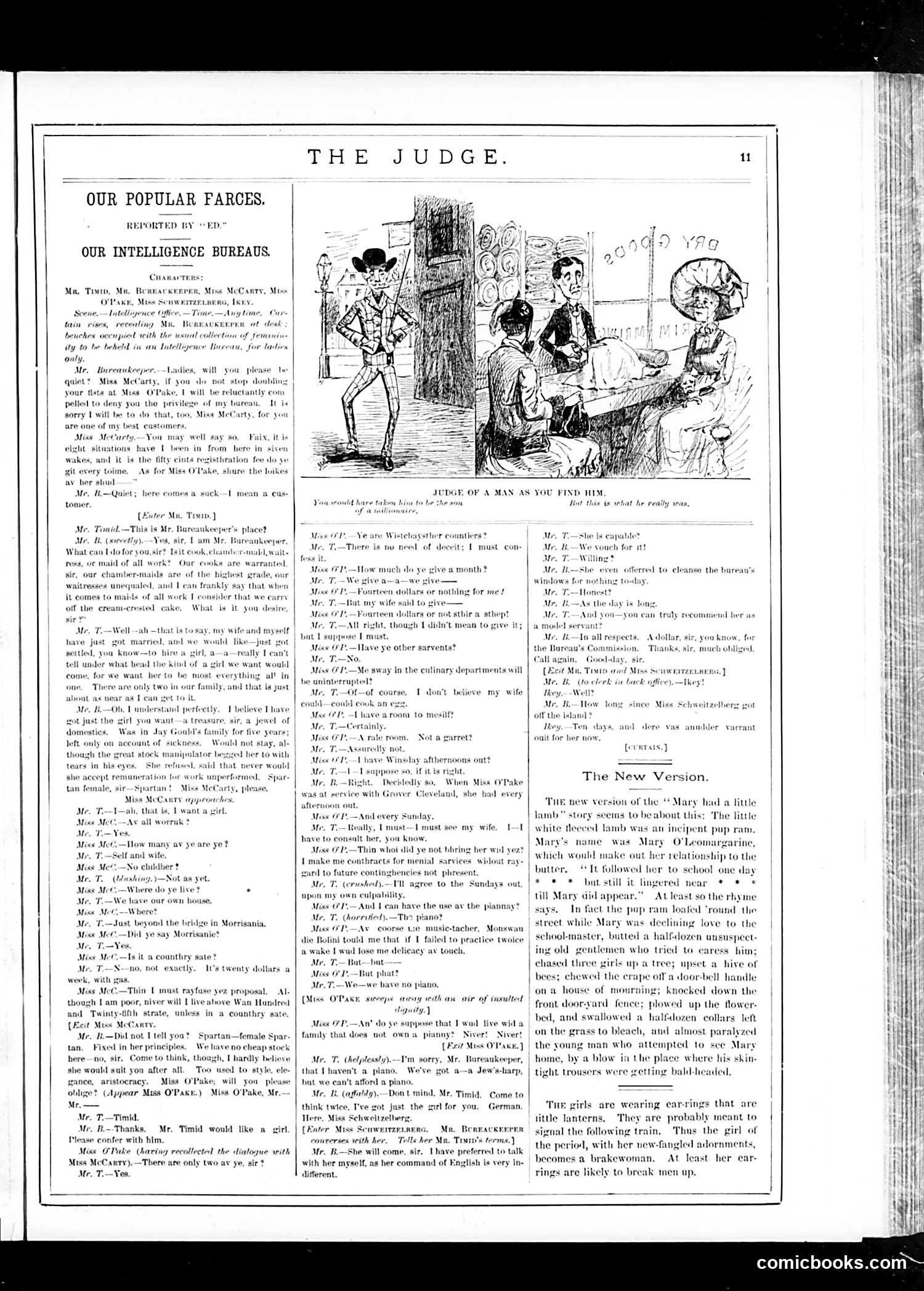
This page satirizes **employment agencies** (called "Intelligence Bureaus") that matched domestic servants with households. The cartoon depicts a comedic negotiation between Mr. Timid, a newly married man seeking a housemaid, and Miss O'Pake, a notoriously demanding servant. The joke centers on **class pretension and servant power dynamics**. Miss O'Pake—who previously worked for President Grover Cleveland—uses that credential to demand excessive wages ($14+/month), private rooms, Wednesdays off, and kitchen autonomy. The Bureaukeeper (employment agent) facilitates her demands, while the hapless Mr. Timid capitulates to each requirement. The satire mocks both the **arrogance of servants who traded on prestigious former employers** and the **powerlessness of working-class householders** trying to afford help. The reference to Cleveland suggests this is from the 1880s-90s, when such employment negotiations were genuinely contentious social issues.
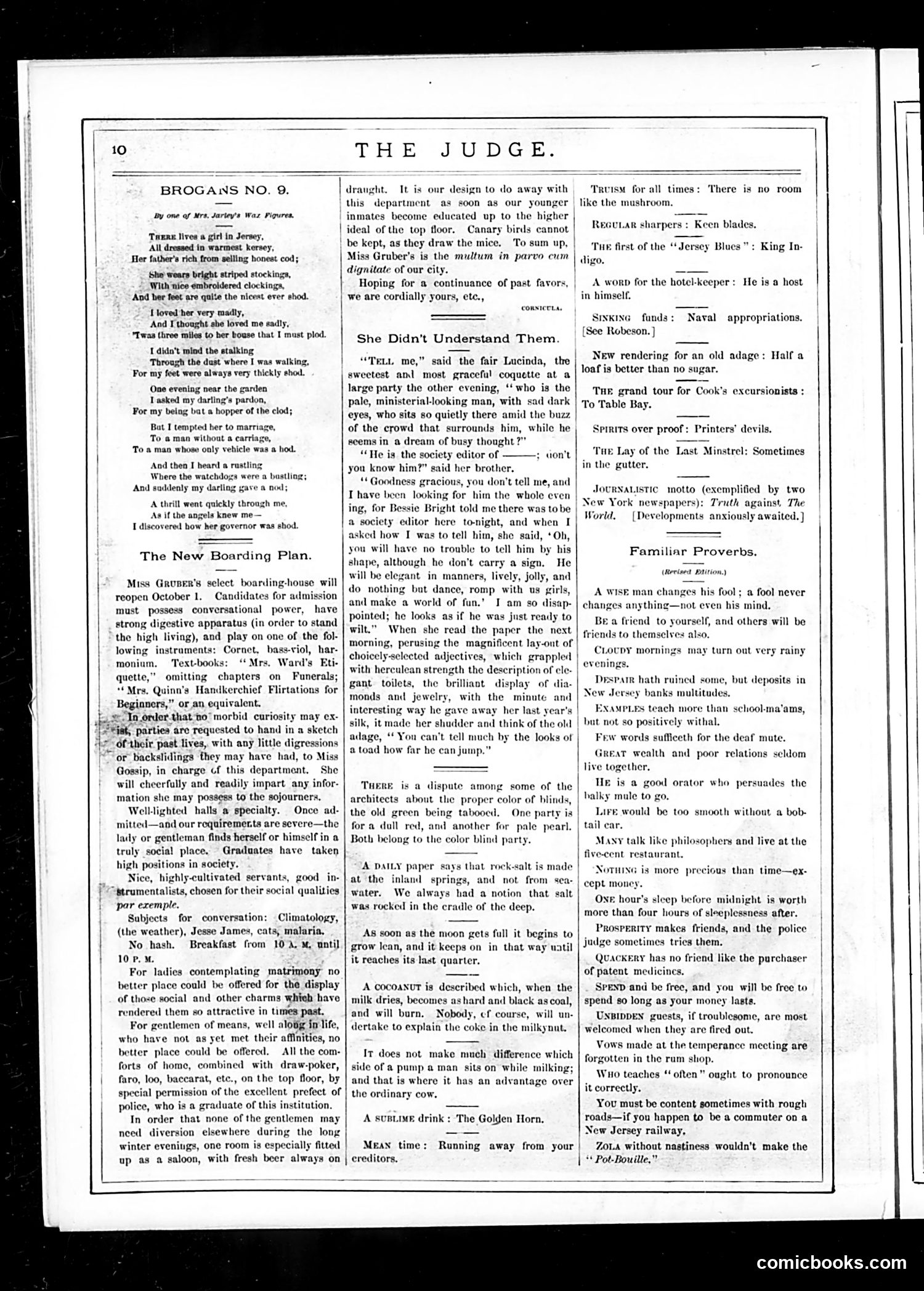
This page from the satirical magazine *Judge* contains two main pieces: **"Brogans No. 9"** is a humorous poem about a Jersey working-class man ("hopper of the clod"—a farm laborer) courting a girl from a wealthy cod-merchant family. The satire mocks class pretensions: despite his humble status and thick work boots ("brogans"), he wins her heart, but discovers her father is similarly common-born. The joke subverts romantic ideals by suggesting even the supposedly genteel are essentially working-class. **"The New Boarding Plan"** satirizes Miss Gruber's boarding house, which advertises itself as genteel but is transparently a matrimonial matchmaking scheme for wealthy men seeking wives. The mock advertisement humorously reveals its true purpose—displaying women "for gentlemen of means"—while maintaining superficial propriety. References to card games on the top floor and bribed police suggest moral laxity beneath respectable veneer. Both pieces mock social climbing and pretense in Gilded Age America, suggesting that class distinctions are flimsy and hypocrisy runs deep.
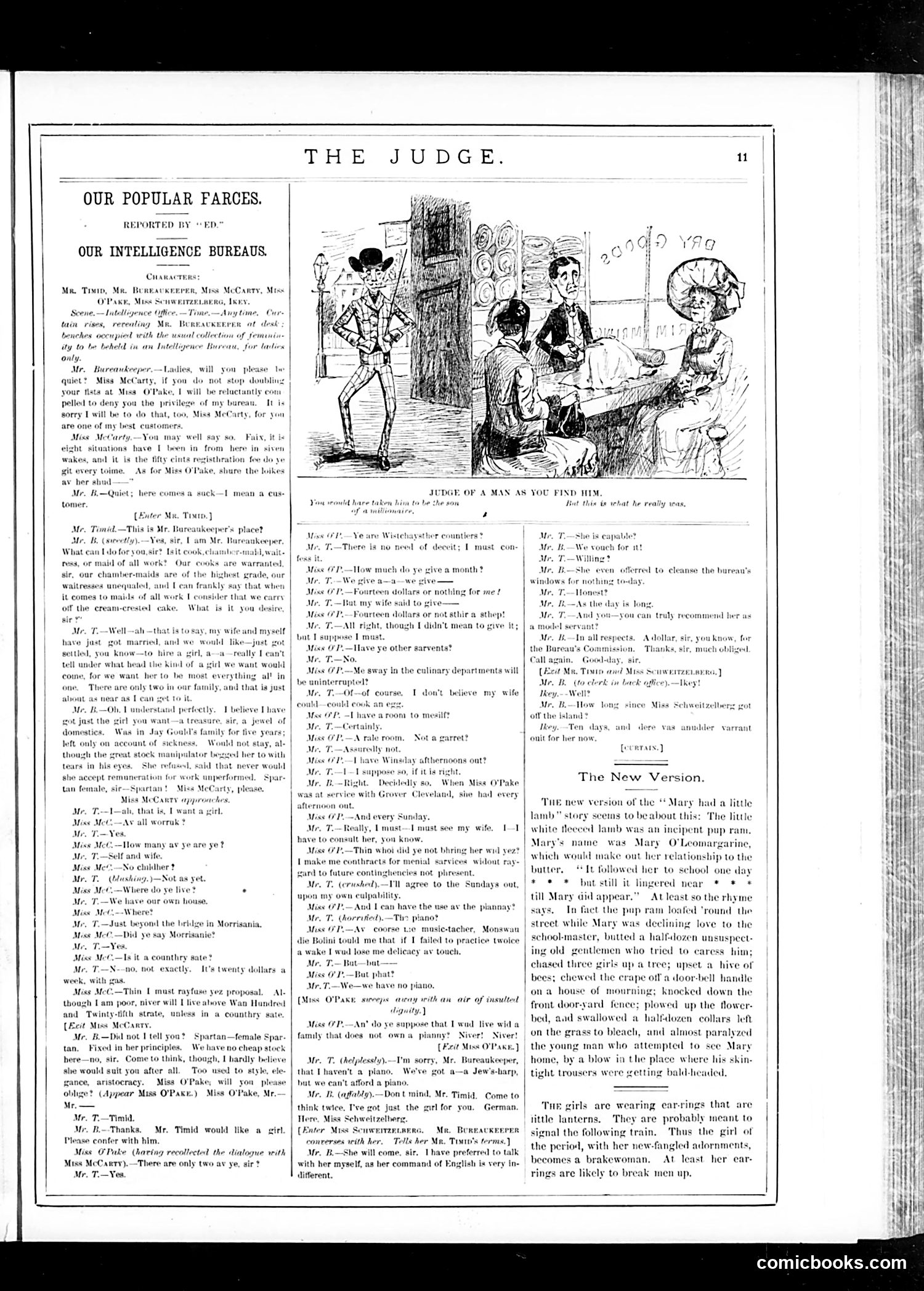
This page satirizes the absurdities of domestic-service employment agencies in late 19th-century America. The main cartoon depicts an "Intelligence Bureau" (employment office) where working-class Irish immigrant women seek household positions. The satire targets the unrealistic expectations and class pretensions of both employers and job-seekers. Mr. Timid wants a servant-of-all-work cheaply; Miss O'Pake demands high wages, Sundays off, piano access, and the ability to decline Sunday work—contradictory requirements. Miss McCarty refuses positions below certain streets, claiming principles about where she'll live. The humor derives from the characters' malapropisms, Irish dialect, and their collision of modest means with outsized demands. The cartoon mocks both the incompetent male employer fumbling through hiring and the Irish domestic workers' simultaneous desperation and obstinacy. The "farcical" nature referenced in the title suggests these employment negotiations were genuinely chaotic and comedic to contemporary readers.
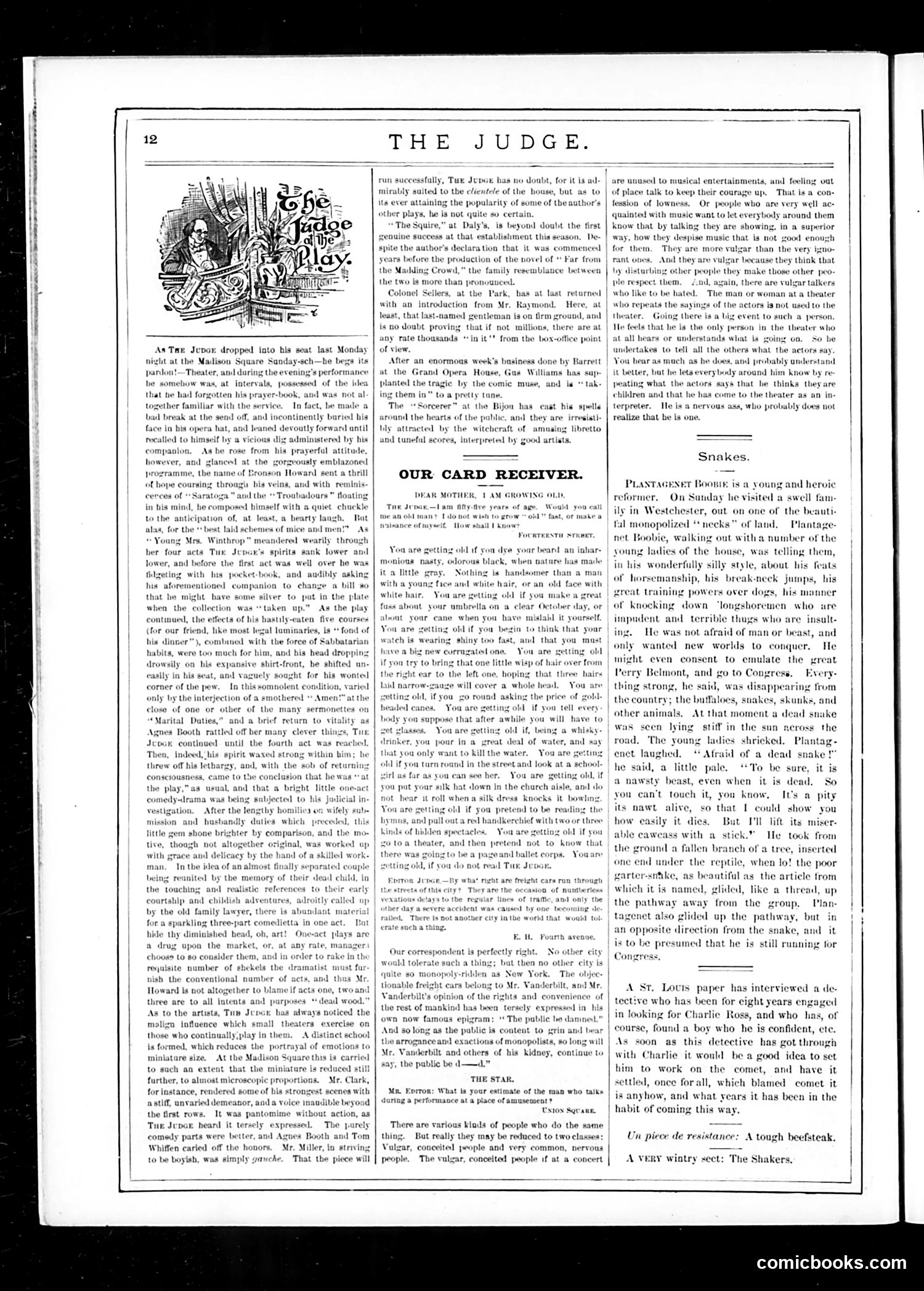
This page contains theater reviews rather than political cartoons. The main content discusses "The Judge" (a play), "The Squire," and other theatrical productions at venues like Daly's Theatre and the Park Theatre. The critic—writing under the pseudonym "Tux Jepar"—offers satirical commentary on theatrical performances and audience behavior. He mocks a wealthy attendee (presumably wealthy given references to opera hats and fidgeting with money) who falls asleep during a lengthy play, only to wake during the shorter fourth act. The satire targets both the tedious nature of contemporary theater and the inattentiveness of theater-goers. The reviews critique actors for becoming emotionally diminished by working in small theaters, and discuss dramatic construction and performance quality. The tone is distinctly sarcastic toward both playwrights and players. The page also contains brief miscellaneous items and advertisements typical of Judge magazine's format.
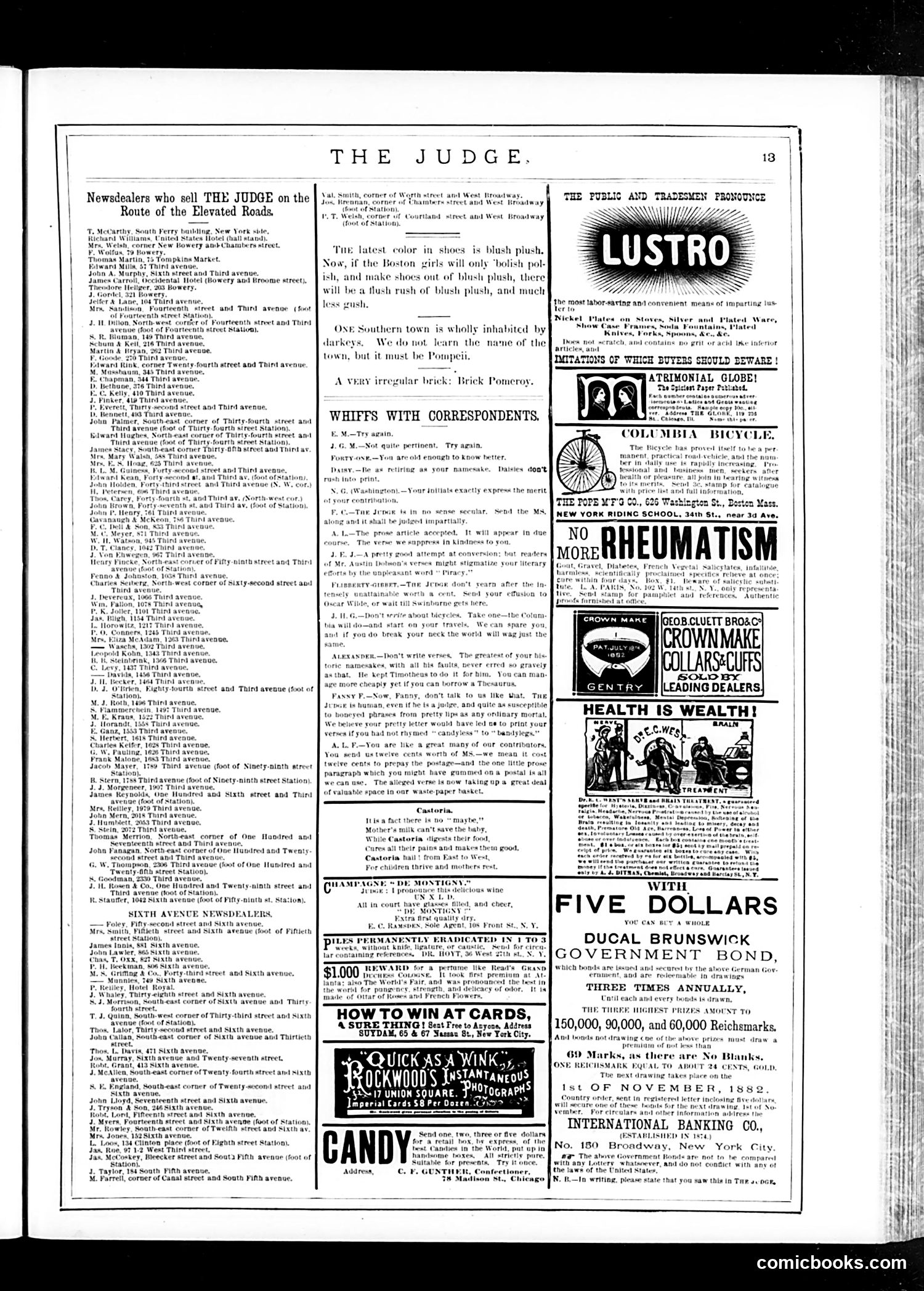
This page is primarily **advertising and notices**, not political cartooning. The dominant content includes: **Main sections:** - A list of newsdealers selling *The Judge* along elevated train routes in New York City - "Whiffs with Correspondents"—brief editorial responses to reader submissions, using sardonic humor typical of the era (rejecting poorly written poetry, suggesting contributors "break your neck," etc.) **Notable items:** - A passing joke about "blush plush" shoes from Boston girls - A reference to a Southern town being "wholly inhabited by darkies" and "must be Pompeii"—likely referencing the 1906 eruption - A quip attributing a quote to "Brick Pomeroy" (an actual 19th-century satirist) **Advertising:** Heavy promotion of bonds, bicycles, remedies ("No More Rheumatism"), and various commercial products typical of early 1900s magazines. The page contains **no major political cartoons**—it's primarily a service/classifieds page with light editorial commentary rather than visual satire.
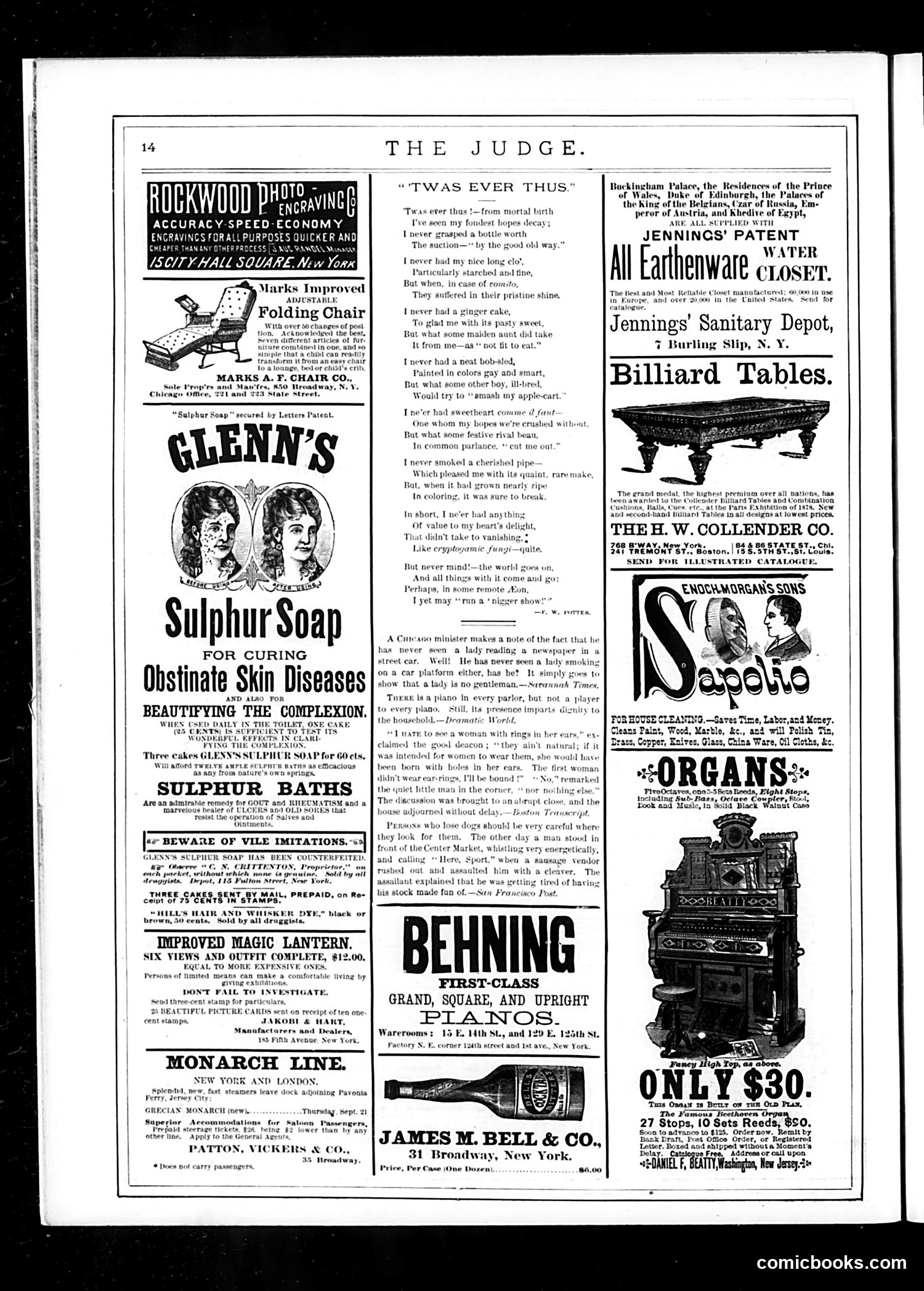
This is primarily an **advertising page** from Judge magazine, with one short satirical poem titled "Twas Ever Thus" at the center. ## The Poem's Satire The poem is a humorous lament about perpetual disappointment. The speaker catalogs a series of minor misfortunes: losing inherited clothing to an aunt, a romantic rival stealing a sweetheart, a cherished pipe breaking when newly seasoned, and possessions mysteriously disappearing. The refrain structure emphasizes the universal human experience of finally obtaining something valued, only to lose it or have it ruined. The satire is gentle and relatable rather than politically pointed—it mocks the commonplace tragedy of human life, using everyday domestic losses to comment on the inexorable way circumstances defeat our hopes. This resonates with readers regardless of era. ## Surrounding Content The page is dominated by period advertisements for household goods (Glenn's Sulphur Soap, Behning Pianos, organs, billiard tables) and services typical of late 19th-century America. These ads provide historical context about consumer products and manufacturing pride of the era.
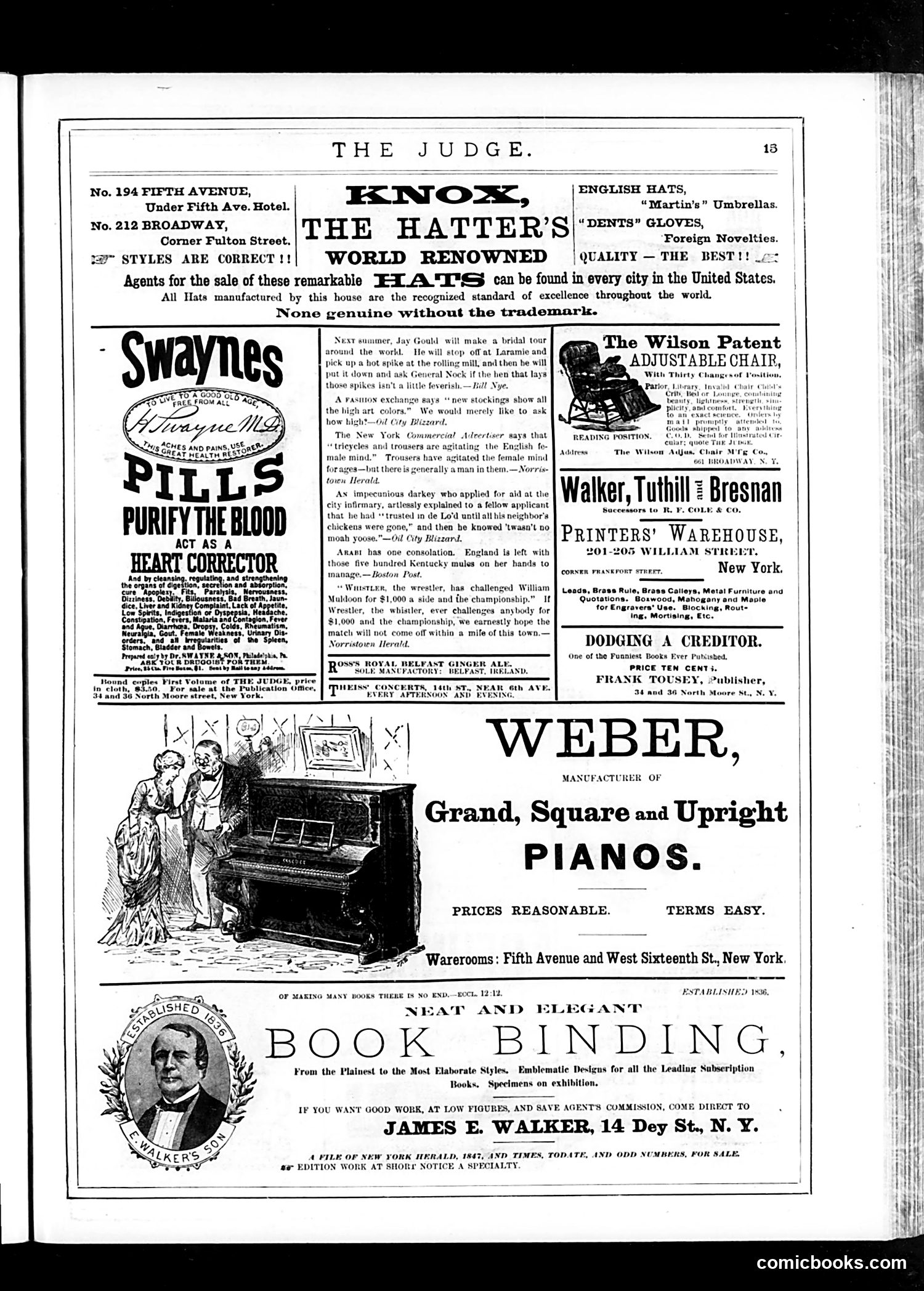
This is primarily an **advertising page** from Judge magazine, not a satirical cartoon page. The main content consists of commercial advertisements for period products: Knox hats, Swayne's Pills (blood purifier), Wilson Patent adjustable chairs, pianos, book binding services, and a printer's warehouse. The page includes brief **humor snippets** rather than full cartoons—short quips about Jay Gould (the wealthy industrialist), comments on English mules, and a wrestling match challenge between Whistler and Muldoon. These are light social observations rather than pointed political satire. The central illustration shows a piano showroom scene, likely meant to advertise Weber pianos. Overall, this represents Judge's mixed format of advertisements interspersed with brief comedic content, typical of 19th-century American magazines that relied heavily on paid advertising for revenue.
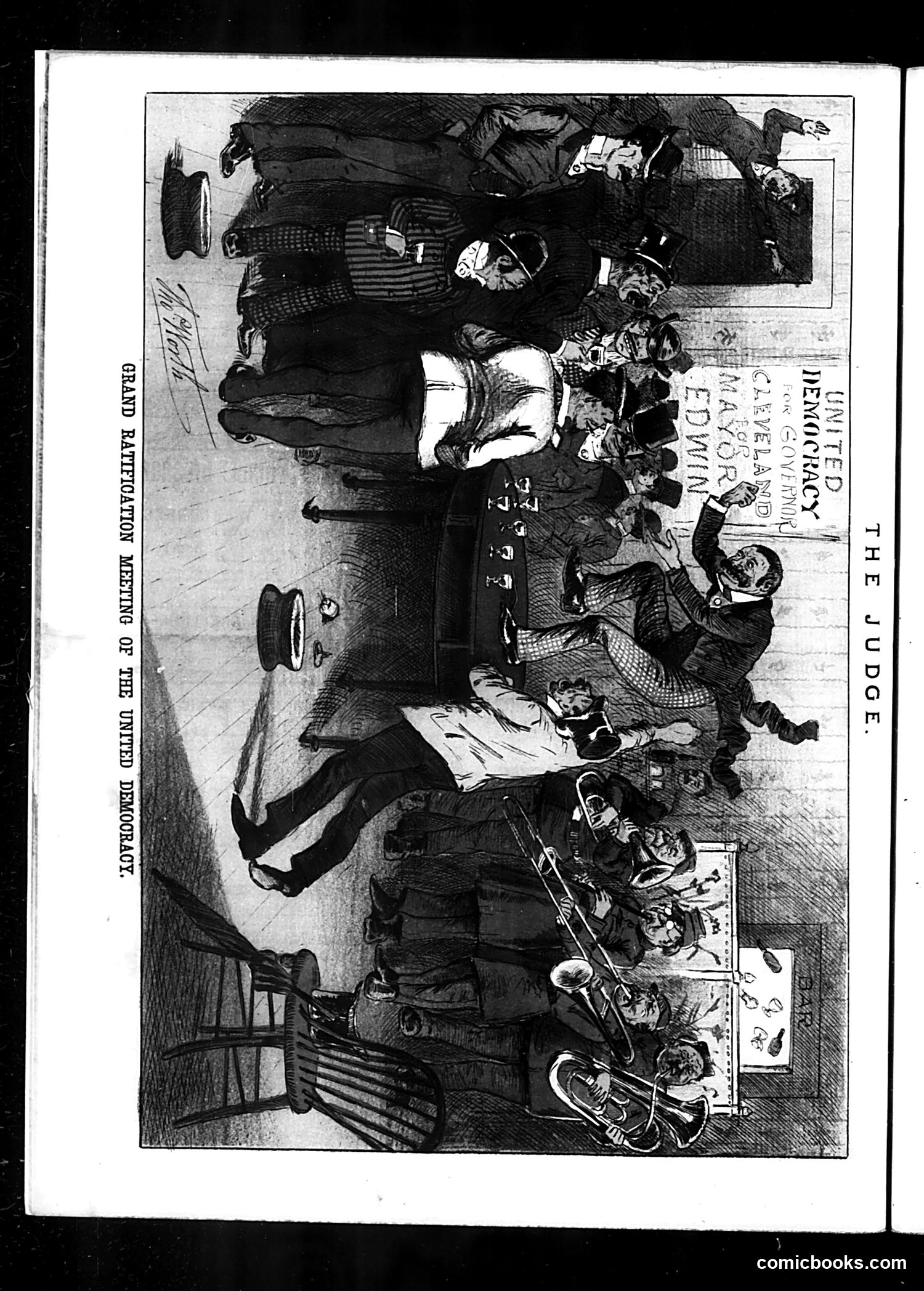
This appears to be a satirical illustration from *Judge* magazine titled "United Democracy" and "The Judge." The image, shown upside-down, depicts a courtroom or judicial scene with multiple figures in period dress (likely late 19th century based on the engraving style). The cartoon likely satirizes American democracy or judicial proceedings of its era, using the "judge" figure as a central focus. The crowded composition with multiple characters suggests commentary on chaos, competing interests, or the messy nature of democratic processes or legal judgment. However, without clearer identification of specific historical figures or events referenced, and given the OCR text's limitations, the exact political targets and satirical points remain partially unclear from this reproduction.