
A complete issue · 16 pages · 1882
Judge — October 7, 1882
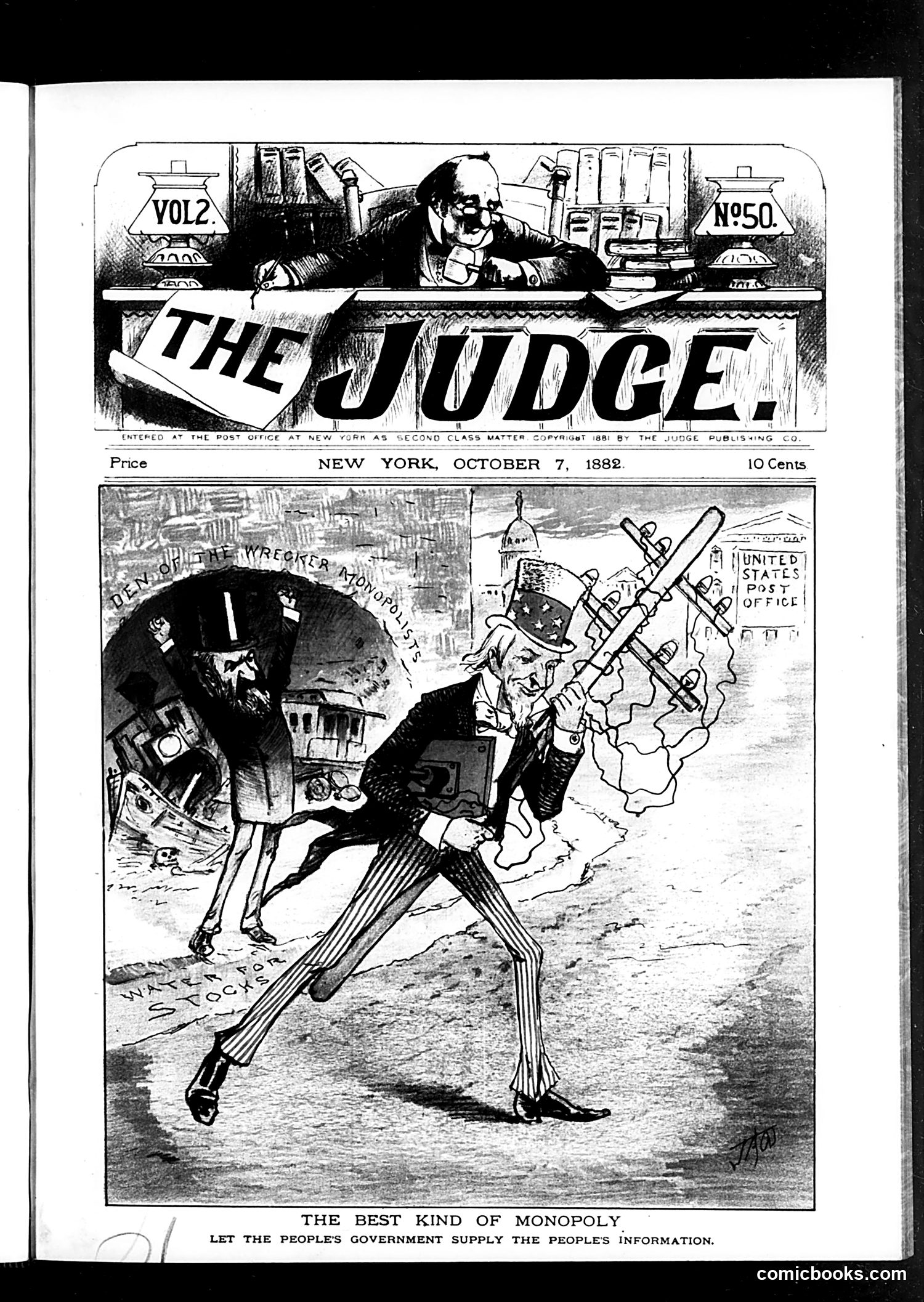
This political cartoon satirizes government control of information. Uncle Sam (the tall, thin figure with striped pants) is depicted as a postal carrier or information distributor, juggling what appears to be mail or newspapers near a U.S. Post Office. The caption argues ironically that a "monopoly" on information *by* the people's government is acceptable—contrasting with the Gilded Age's concern about private corporate monopolies strangling commerce and competition. The cartoon likely critiques either: - Government censorship or control of information flow, or - Alternatively, advocates for public postal service as preferable to private monopolies The skeletal, exaggerated figure style suggests skepticism about the proposition being made. The precise political event referenced remains unclear without additional context from the 1882 period.
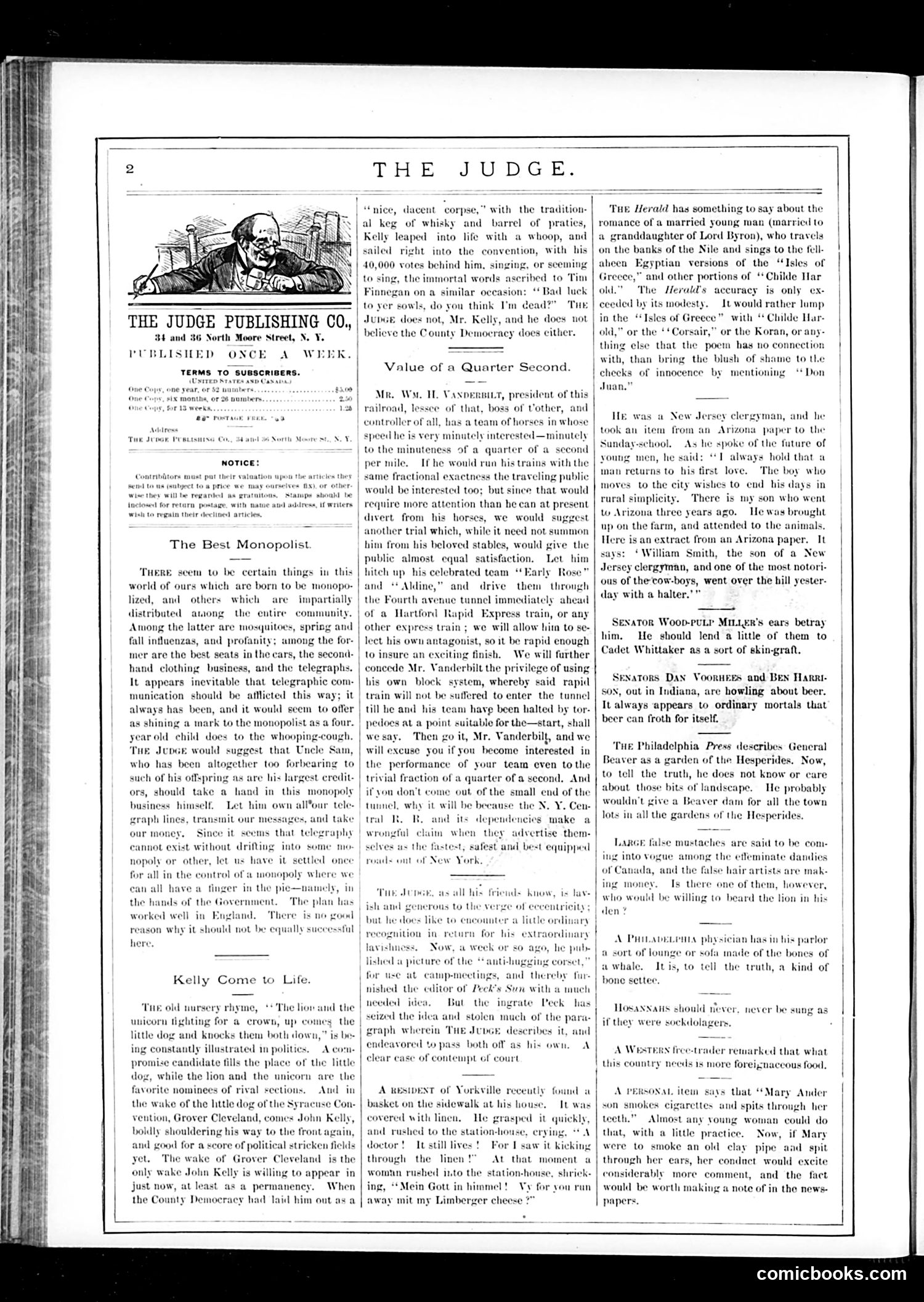
**"The Best Monopolist"** (main cartoon): This editorial attacks telegraph monopolies, arguing that the U.S. government should nationalize telegraph lines rather than allow private monopolization. The piece references how telegraphy has inevitably concentrated in monopolistic hands and advocates for public control—"a finger in the pie" for citizens through government ownership, citing successful precedent in England. **"Kelly Come to Life"**: References John Kelly's political resurrection in New York Democratic politics. Using the nursery rhyme of the lion and unicorn, it satirizes Kelly's role as a compromise candidate between rival political factions. The reference to "40,000 votes behind him" and the Irish wake imagery suggests Kelly's unexpected revival from political death during convention politics. **"Value of a Quarter Second"**: Mocks railroad president W.H. Vanderbilt's obsession with fractional-second timing differences in horse racing while allegedly neglecting precision in actual train service to paying passengers—hypocrisy between his leisure priorities and public responsibilities.
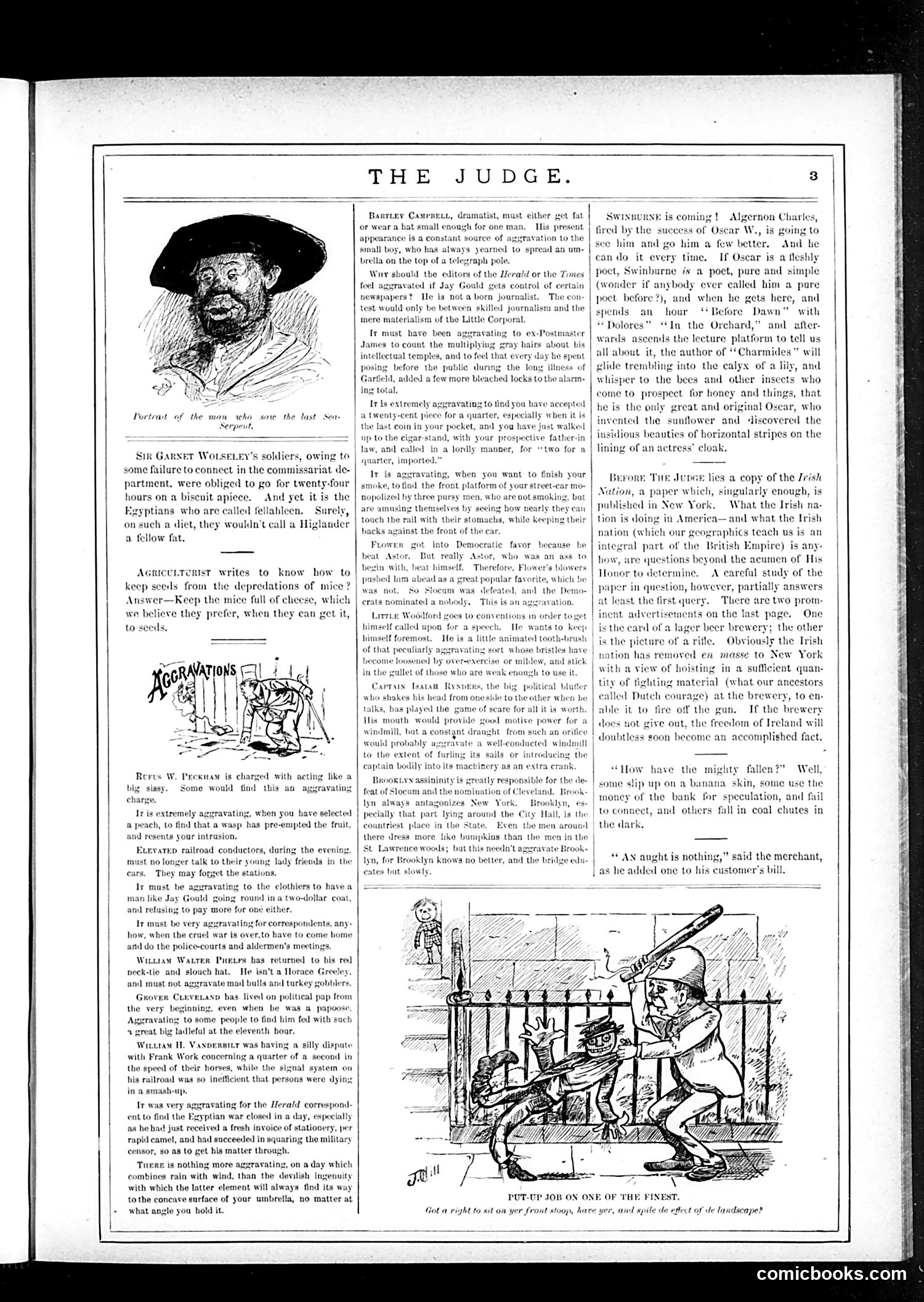
This page from *Judge* magazine contains several brief satirical commentaries on contemporary figures and events: **Main targets:** 1. **Jay Gould** (newspaper magnate): Mocked for potentially controlling major newspapers despite lacking journalism credentials. 2. **Oscar Wilde**: Referenced as influencing aestheticism; Swinburne's arrival is presented as inspiring affected artistic posturing. 3. **Swinburne** (British poet): Satirized as an overly precious aesthete whose visit will inspire ridiculous imitation among American artists. 4. **Irish-American politics**: A brief note ridicules *The Irish Nation* newspaper's advertisements for beer and rifles, suggesting Irish-Americans are more interested in drinking and armed activity than legitimate political discourse. 5. **Various minor absurdities**: Including commentary on military rations, railroad conductors, and agricultural advice. The satire targets both prominent individuals and social pretension, using exaggeration and mockery typical of 19th-century American humor magazines.
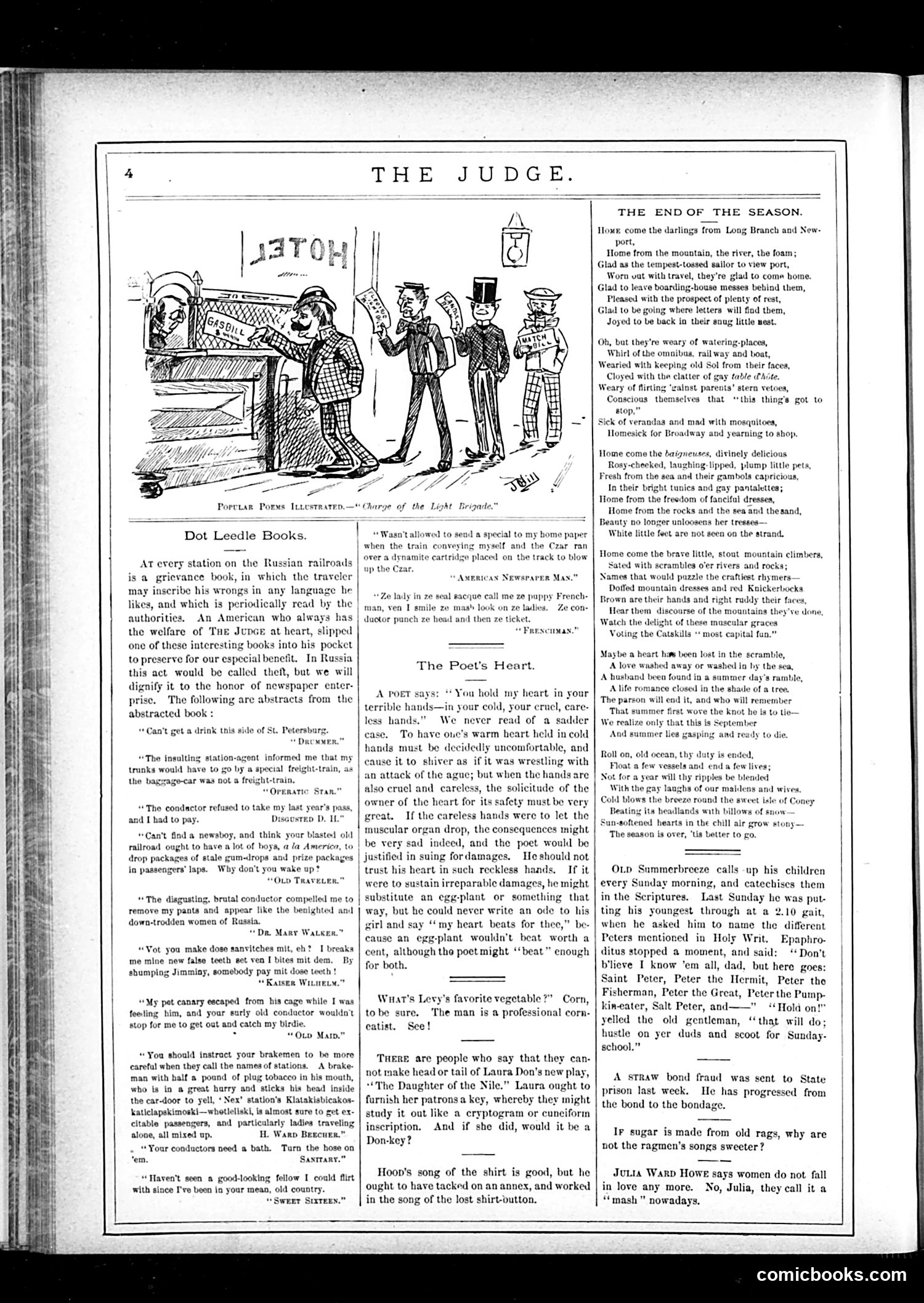
This page from Judge contains humorous pieces satirizing Russian bureaucracy and American travelers abroad. **"Dot Leedle Books"** presents fake complaints from a Russian railway grievance book, mocking both Russian inefficiency and American tourist entitlement. An American reporter allegedly smuggled out this book. The complaints range from legitimate (poor service, broken false teeth from hard food) to absurd (conductor refusing to stop for a escaped canary, complaints about unattractive fellow passengers). The satire targets Americans' expectations that foreign countries should accommodate them like home, while also poking fun at Russian railway conditions and the colorful difficulty of Russian station names to English speakers. **"The Poet's Heart"** ridicules sentimental poetry through literal interpretation—humorously imagining the physical consequences of a poet's metaphor about holding someone's heart in careless hands. These are light satirical pieces typical of Judge's style: social comedy rather than sharp political commentary. The Russian railway material reflects American fascination with and stereotypes about Russia during the late 19th/early 20th century.
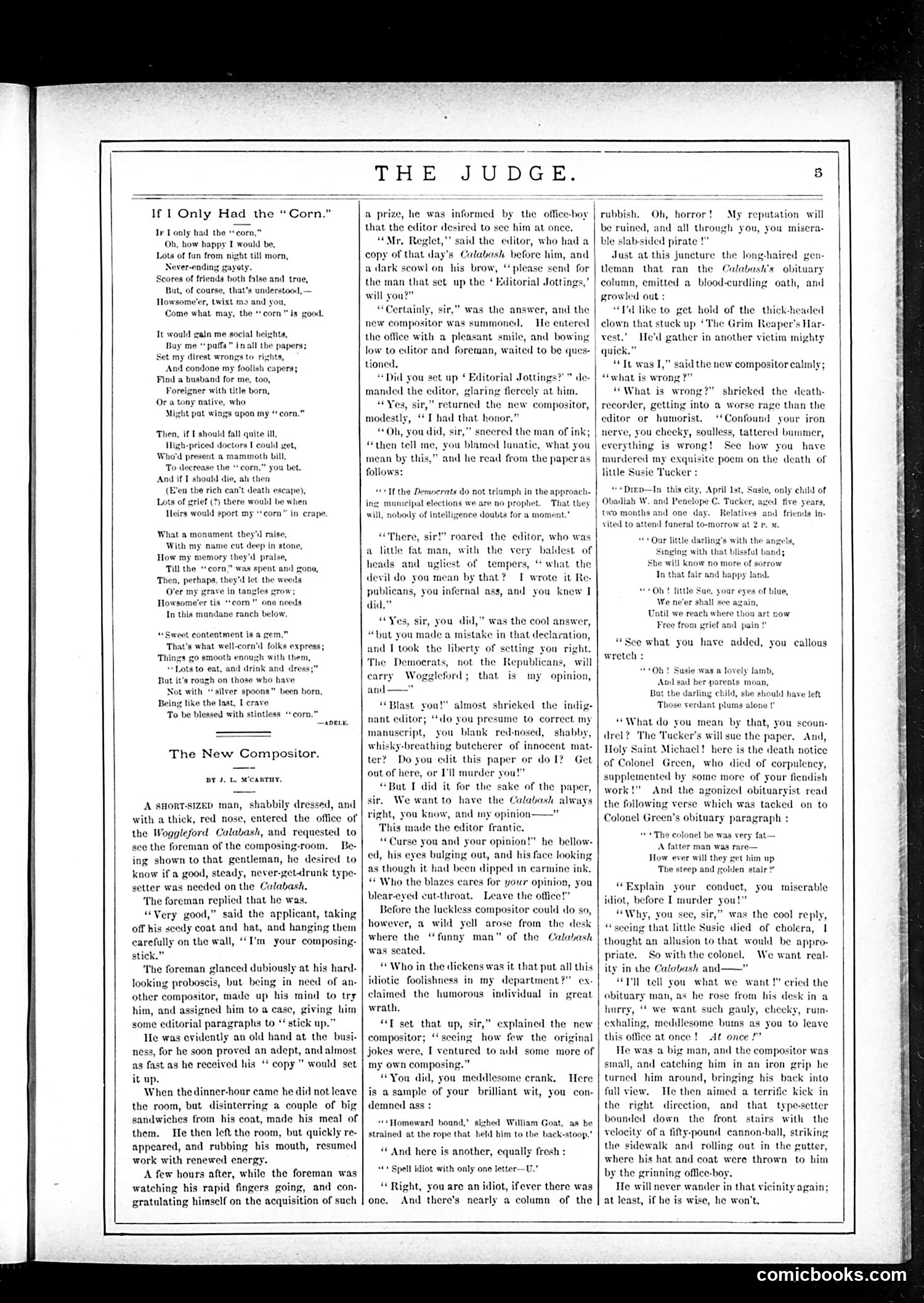
This short story satirizes incompetence and physical appearance in a humorous workplace scenario. A poorly-dressed man with a notably red nose applies as a typesetter at the *Woggleford Calabash* newspaper. Though he initially performs well, he makes a critical error setting the "Editorial Jottings" column. The editor discovers the compositor set "Democrats do not triumph" when the original read "Republicans do not triumph"—a significant political reversal that would embarrass the publication. The joke plays on the compositor's apparent incompetence, likely also mocking his shabby appearance and red nose as markers of unreliability. The satire works on multiple levels: critiquing both careless printing errors (a real concern for newspapers) and the assumption that working-class appearance correlates with incompetence. The twist ending—revealing a major political gaffe from a single misprint—underscores how easily newspapers could spread misinformation.
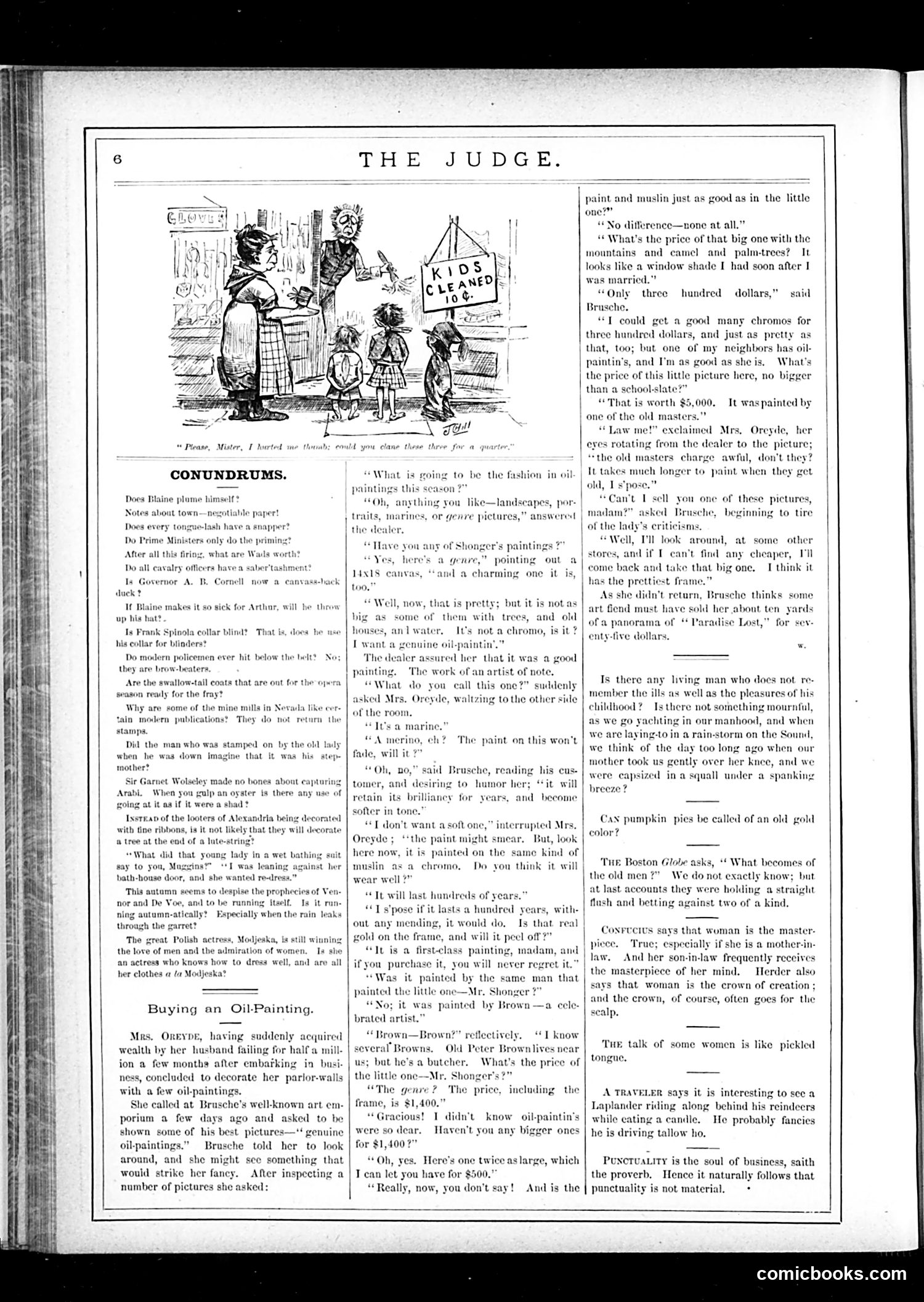
This page from Judge magazine contains two satirical pieces satirizing American wealth and pretension in the Gilded Age. **"Conundrums"** is a riddling column poking fun at contemporary political figures and social absurdities. References to "Blaine" (likely James G. Blaine, prominent politician), "Arthur" (President Chester Arthur), and "Spinola" mock prominent men. The jokes target political corruption, electoral chicanery, and the era's scandals with wordplay. **"Buying an Oil-Painting"** satirizes newly rich industrialists' lack of cultural sophistication. Mrs. Oreyde (name suggests "ore-greedy," implying sudden mineral wealth) visits an art dealer seeking paintings. She asks philistine questions—whether paint will fade or smear, if the gold frame will peel—revealing her ignorance. She confuses artist names and questions whether expensive paintings are merely "chromos" (cheap chromolithographs). The dealer's patient condescension underscores the gap between wealth and taste among the nouveau riche. Together, these pieces mock Gilded Age social climbing and the assumption that money automatically confers refinement.
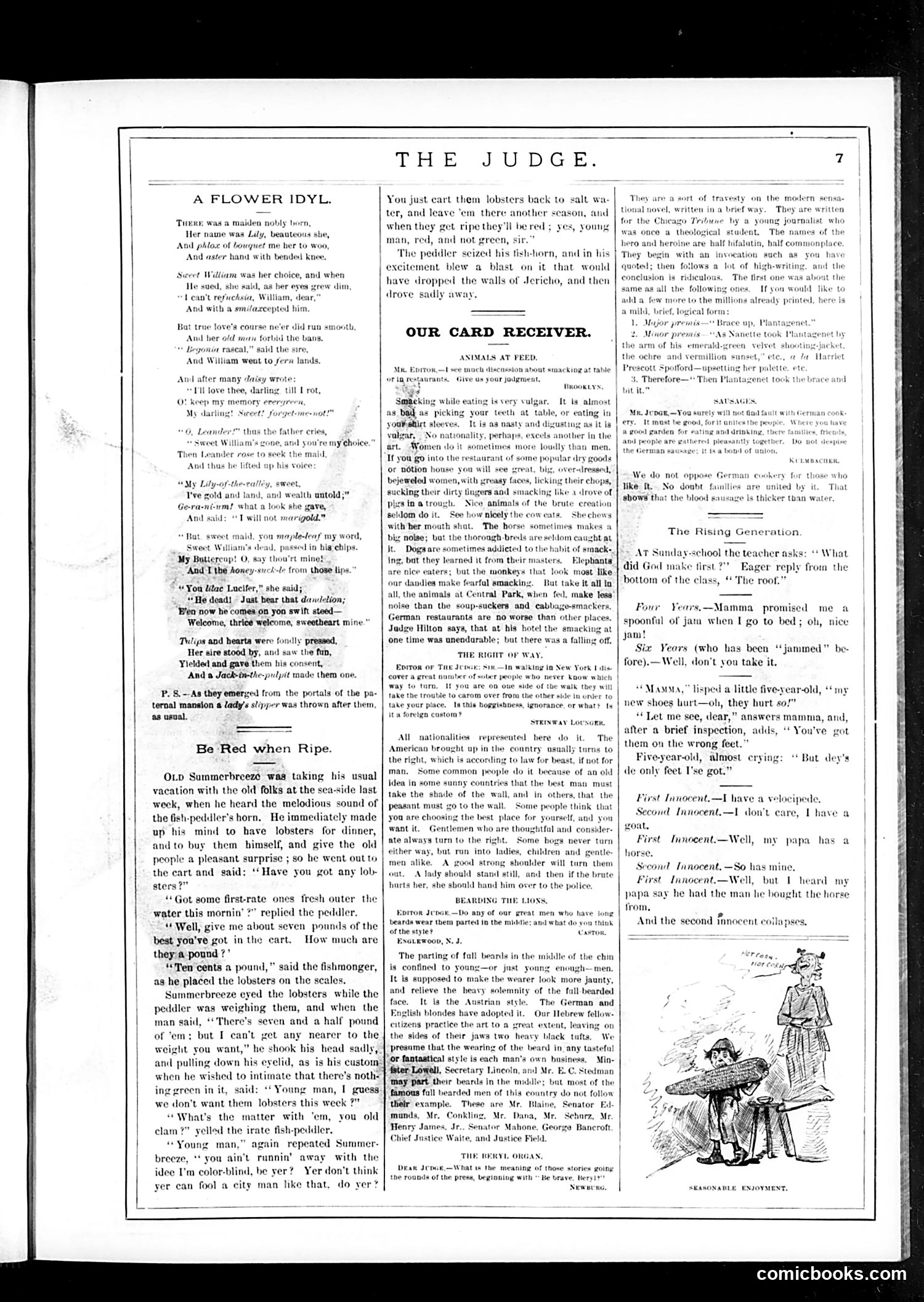
This page contains **humorous sketches rather than political cartoons**. The main content includes: **"A Flower Idyl"**: A whimsical romantic poem where all characters are flower names (Lily, Sweet William, Leander, Begonia, etc.). The joke plays on the double meaning—treating flowers as people in a melodramatic love story. It's lighthearted wordplay rather than satire. **"Be Red When Ripe"**: A comedic anecdote where an old man (Summerbreeze) refuses to buy lobsters because they're green, not red—insisting the fishmonger return them to salt water to "ripen" into their proper color. The humor relies on the man's feigned ignorance or stubbornness. **"Our Card Receiver"**: A brief advice column addressing table manners—specifically criticizing loud eating. It notes that women in fancy dress eat as messily as men, and even animals (cows) have better manners. This page is **primarily entertainment and humor**—not political satire—typical of Judge magazine's lighter content mixed with occasional social commentary on etiquette.
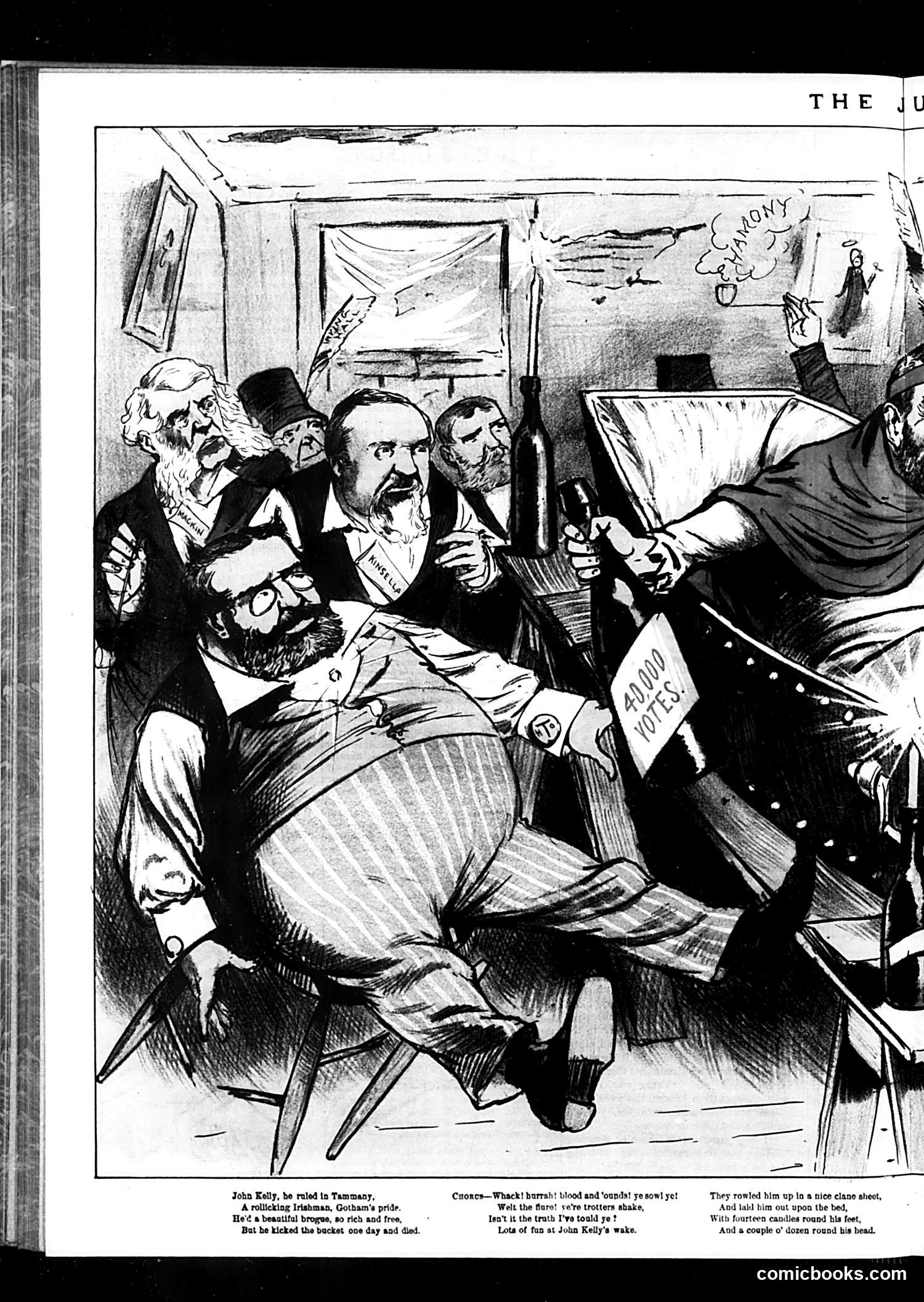
This is a satirical illustration of the funeral wake of **John Kelly**, a prominent Tammany Hall politician (the corrupt Democratic machine controlling New York City). The cartoon mocks Irish-American funeral customs and, implicitly, Tammany's hold on Irish immigrant voters. The scene depicts rowdy mourners with guns and weapons at Kelly's deathbed, accompanied by heavily Irish-accented verse celebrating his death with dark humor. The satire operates on multiple levels: it caricatures Irish cultural stereotypes (drunken wakes, exaggerated brogue), ridicules Tammany's political dominance, and suggests that Kelly's removal is cause for celebration among his critics. The weapon-bearing figures and chaotic atmosphere suggest Judge magazine's anti-Tammany, anti-Irish immigrant political stance—common among elite publications of the era. The joke assumes readers view both Tammany corruption and Irish identity as worthy targets of ridicule.
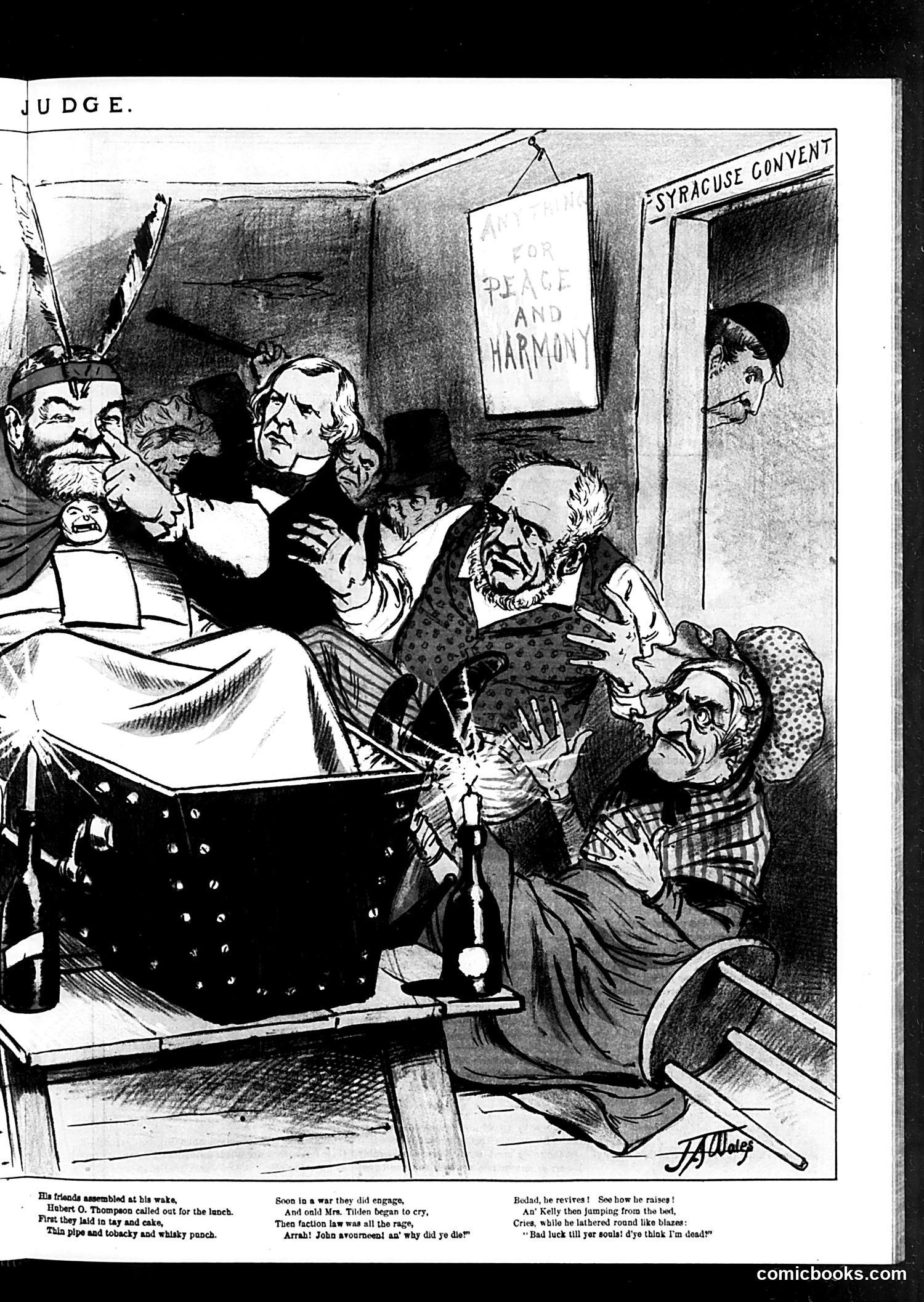
This cartoon satirizes Irish-American funeral customs and political factionalism, likely from the late 19th century. The scene depicts a wake for "Robert O. Thompson" that devolves into chaos—guests fighting, drinking whisky punch, and arguing about "faction law" (rural Irish feuds). The satire targets several overlapping subjects: Irish immigrant culture (the dialect, drinking, wake traditions), internal Irish-American political divisions ("faction"), and possibly a specific political figure or event referenced by the name "Mrs. Tilden" (likely connected to the Tilden political family). The revival scene—where the supposedly dead man suddenly springs up—is a common wake joke format, suggesting the chaos and excess of the gathering. The overall tone mocks both Irish cultural practices and political infighting among Irish Americans, presenting them as rowdy and prone to violence. The caricatured faces emphasize ethnic stereotyping typical of Judge magazine's satirical approach.
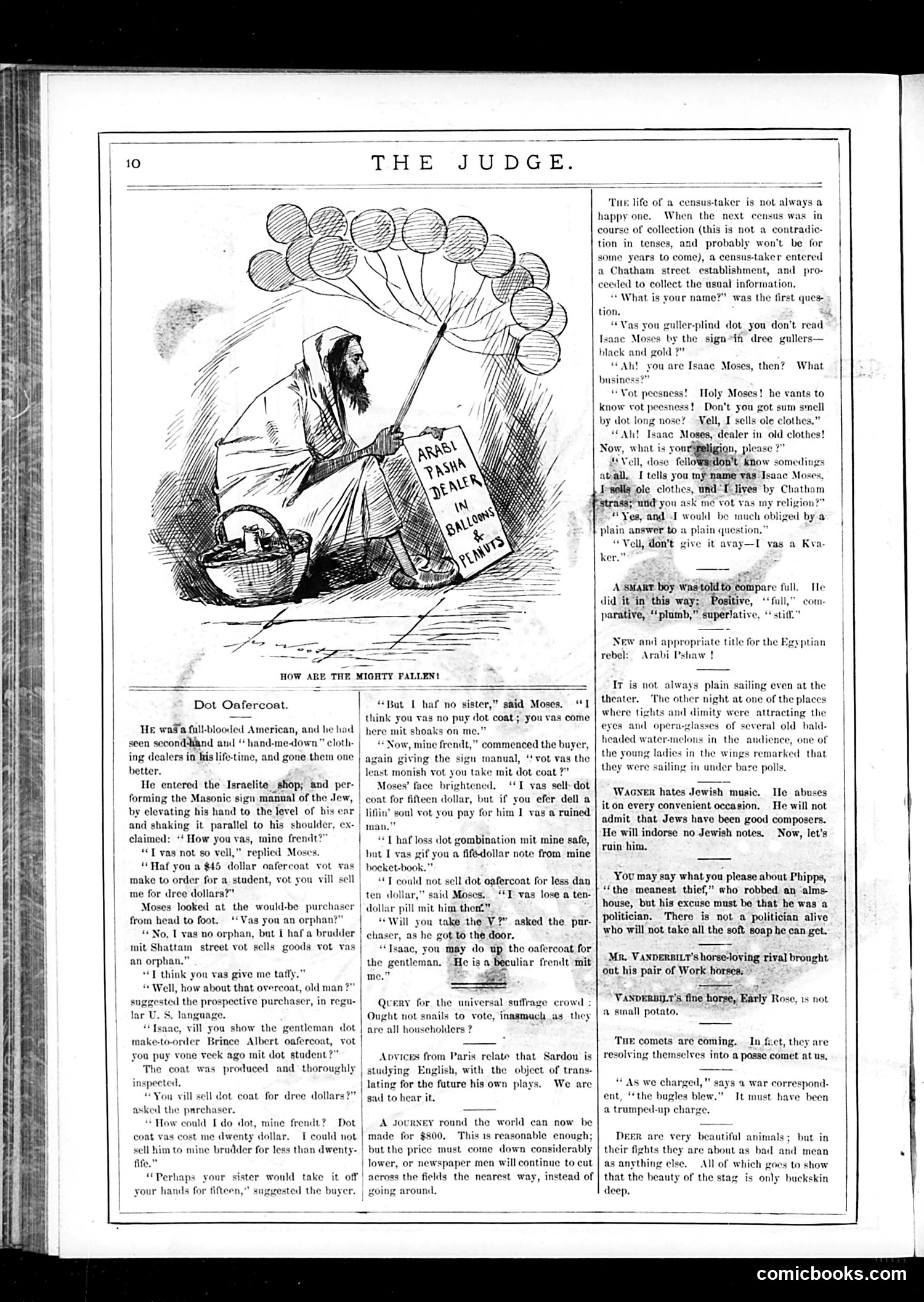
This cartoon mocks Jewish immigrant clothing dealers through heavy ethnic stereotyping. The protagonist, "Dot Oafercoat" (a German-Jewish accent rendering of "that overcoat"), depicts a young American swindler attempting to haggle with an older Jewish shopkeeper named Moses over an expensive overcoat, using exaggerated Yiddish-inflected speech. The satire targets the buyer's moral descent—a supposed "full-blooded American" reduced to petty deception and evasion. The accompanying census-taker dialogue reinforces similar ethnic caricature. The humor relies on period stereotypes portraying Jewish immigrants as shrewd merchants, their accented English as ridiculous, and their religious observance as punchlines. Judge's satire here operates through dehumanizing portraiture typical of 19th-century American periodicals, reflecting the era's casual antisemitism and xenophobia toward immigrant communities.
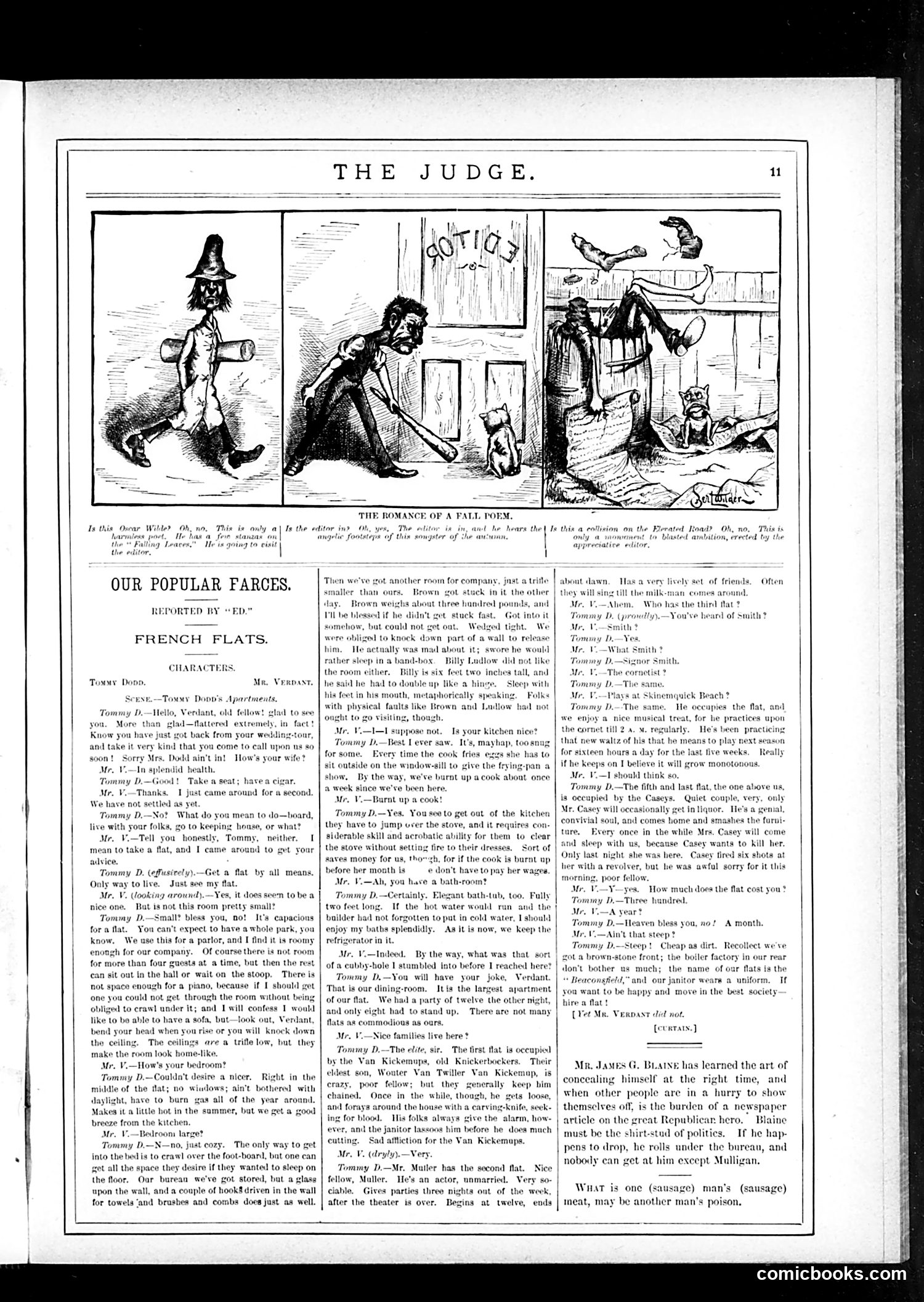
This page from *Judge* satirizes the growing trend of urban "French flats"—small, cheaply-built apartment buildings that were becoming fashionable among working-class New Yorkers in the late 19th century. ## The Main Cartoon The three-panel "Romance of a Fall Poem" depicts physical comedy involving people and animals getting stuck in confined spaces, likely mocking the impracticality of these cramped living quarters. ## The Dialogue Section "French Flats" features Tommy Doon proudly showing his friend Verdant around his absurdly tiny apartment. The satire escalates through increasingly ridiculous details: rooms so small you must crawl over furniture, ceilings so low you hit your head, a bedroom with no windows requiring constant gas lighting, a kitchen where cooks literally burn up trying to escape, and a bathtub only two feet long. The joke is that Tommy presents these miserable conditions as desirable features of modern urban living. The satire targets both the greedy developers marketing these hovels and renters desperate enough to accept them—poking fun at the contradiction between aspirational city living and the actual squalor of tenement housing.
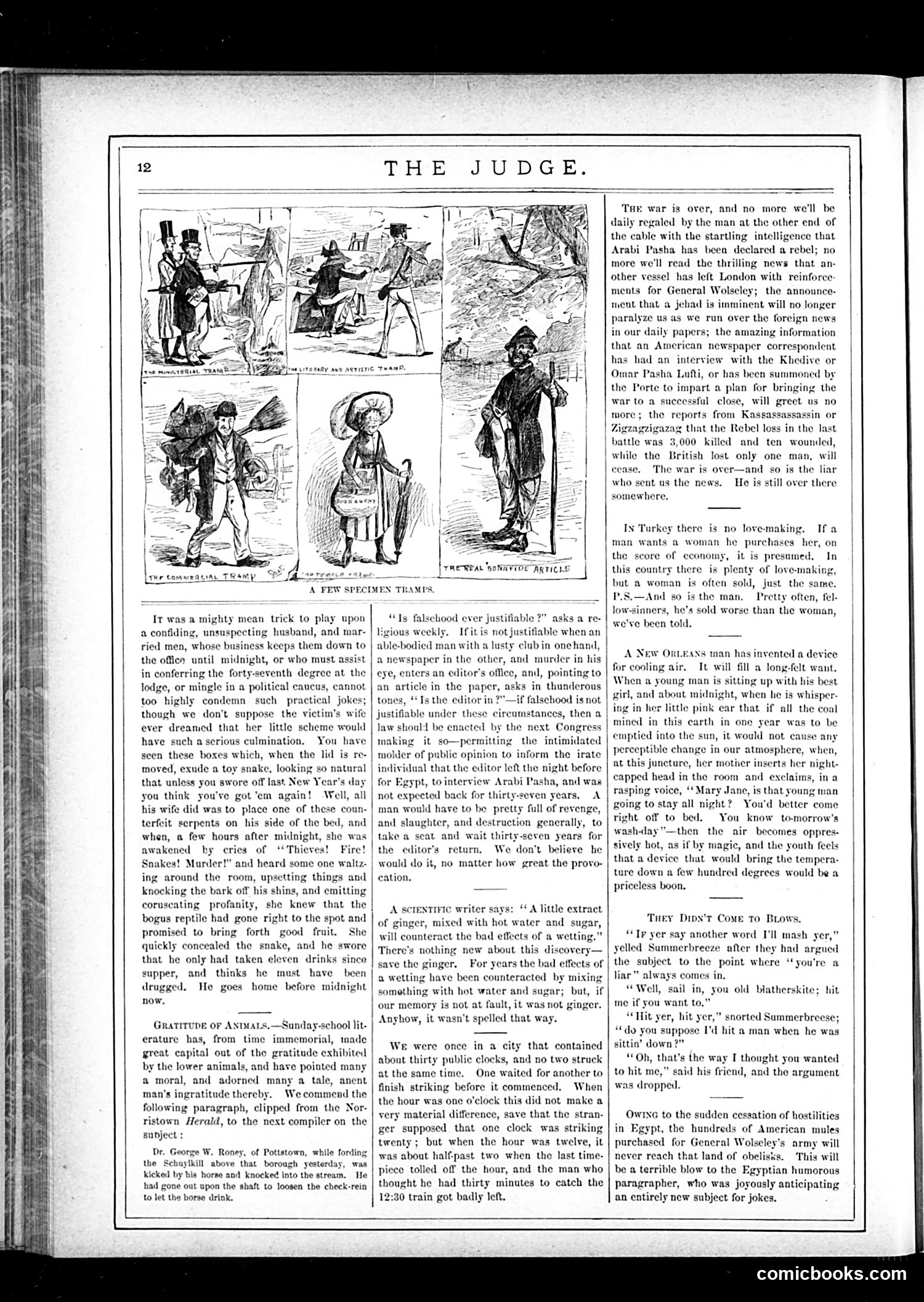
This page contains three separate satirical pieces. The main cartoon at top shows various figures labeled as "tramps" or vagrants—likely social commentary on homelessness or vagrancy in the post-Civil War era. The accompanying text describes a practical joke: a wife places a toy snake in her husband's bed, causing him to panic and flee home early, believing he's been drugged or intoxicated. The satire mocks both the prank and the husband's embarrassment. Additional short pieces ridicule: - Religious hypocrisy regarding justified falsehoods (a minister lying to avoid a violent confrontation) - Pseudo-scientific advice (ginger and hot water for colds—implying the "discovery" merely rehashes folk remedies) - Urban inefficiency (thirty clocks striking at different times) The overall tone is cynical humor aimed at American society's absurdities, domestic disputes, and pretentious respectability.
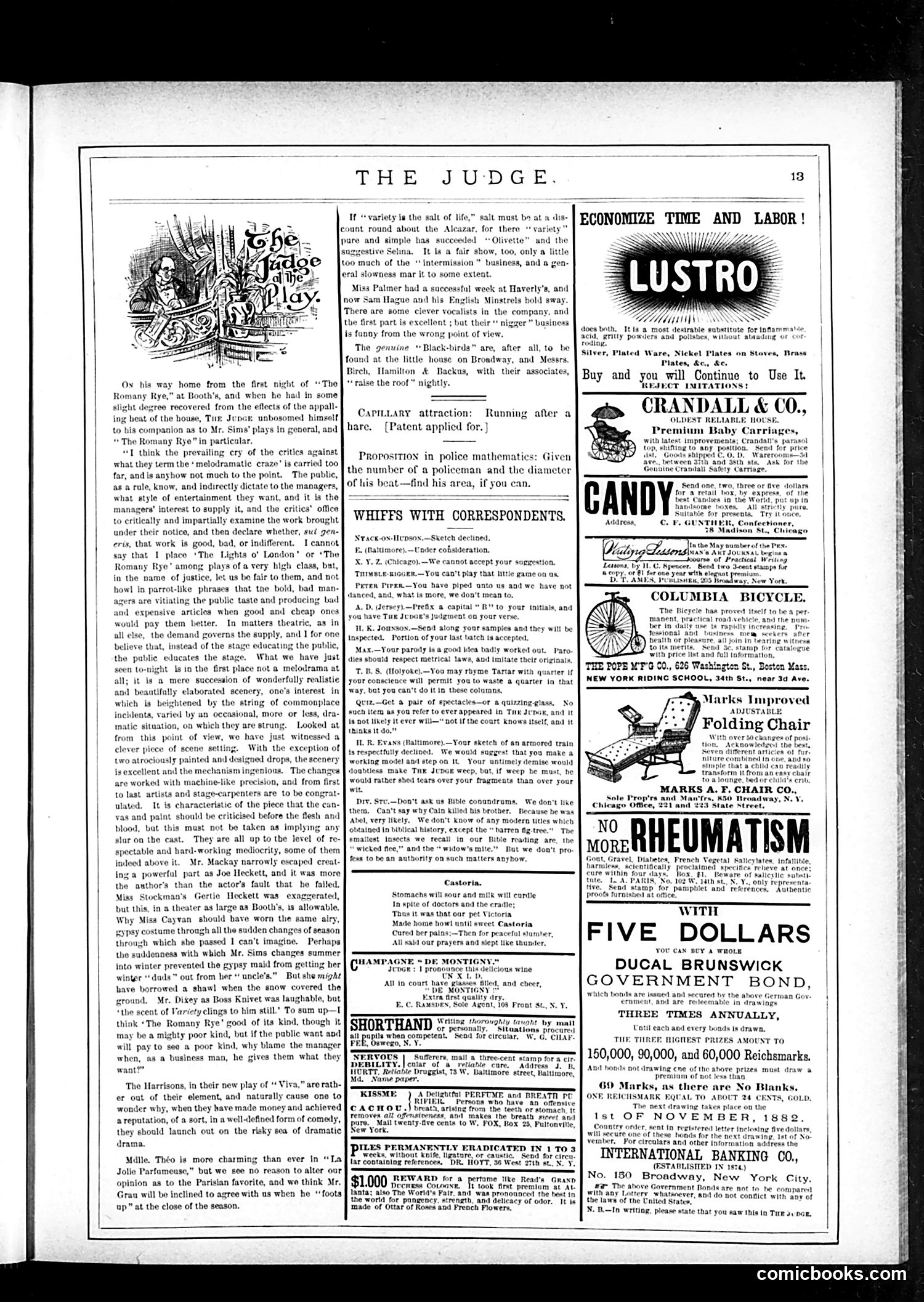
This page from Judge magazine contains theater criticism rather than political cartoons. The main article reviews "The Romany Rye," a melodrama by Mr. Sims performed at Booth's Theatre. The critic defends melodramas against fellow critics' dismissal of them as artistically low. He argues that public demand, not critical taste, should dictate theatrical offerings—managers produce what audiences will pay to see. Rather than condemn the play, he praises its scenery and stage mechanics as "wonderfully realistic," though he acknowledges the plot and acting are merely competent mediocrity. The piece exemplifies Victorian-era theater criticism's tension between artistic standards and commercial realities. The critic essentially concedes the play is artistically weak but defends it as legitimate entertainment because audiences want it. The page also includes brief mentions of other theatrical productions and standard period advertisements for commercial products.
This page is primarily **advertising with interspersed humor columns**, not political satire. The advertisements dominate—Glenn's Sulphur Soap (for skin diseases), magic lanterns, organs, and beauty cream occupy most space. The small text pieces are brief comedic anecdotes typical of the era: - A joke about Vennor (a weather prophet) having a "weather-beaten look" - Rural humor about a policeman's hen laying an oversized egg - An Arkansas minister story about a man wanting to leave church after stealing a mule, only to rejoin revivals before being caught - A joke about a man seeking divorce from his fiancée before she sues him for breach of promise These represent common **late-19th-century American humor**: rural/frontier absurdity, clergy hypocrisy, and legal peculiarities. The humor relies on incongruity and moral irony rather than political commentary. Modern readers would mainly note the casual attitudes toward theft and the quaint legal scenarios.
This is primarily an **advertising page** from Judge magazine with minimal editorial content. The page consists almost entirely of commercial advertisements for consumer goods and services popular in the late 19th century: pianos, billiard tables, hats, chairs, printing services, and book binding. The only apparent editorial content is a brief anecdote near the middle mocking government compensation claims. It suggests the government paid Colonel Baden of Wisconsin $195 for horses killed in battle twenty years prior, sarcastically implying Congress might eventually compensate for all Civil War animal losses—a jab at wasteful government spending and bureaucratic absurdity. The rest comprises business advertisements typical of the era, including Knox hats (claiming world-renowned quality), Weber pianos, and various New York-based service providers. **This page demonstrates Judge's business model**: the magazine relied heavily on paid advertising to fund operations, with commercial content dominating editorial space.
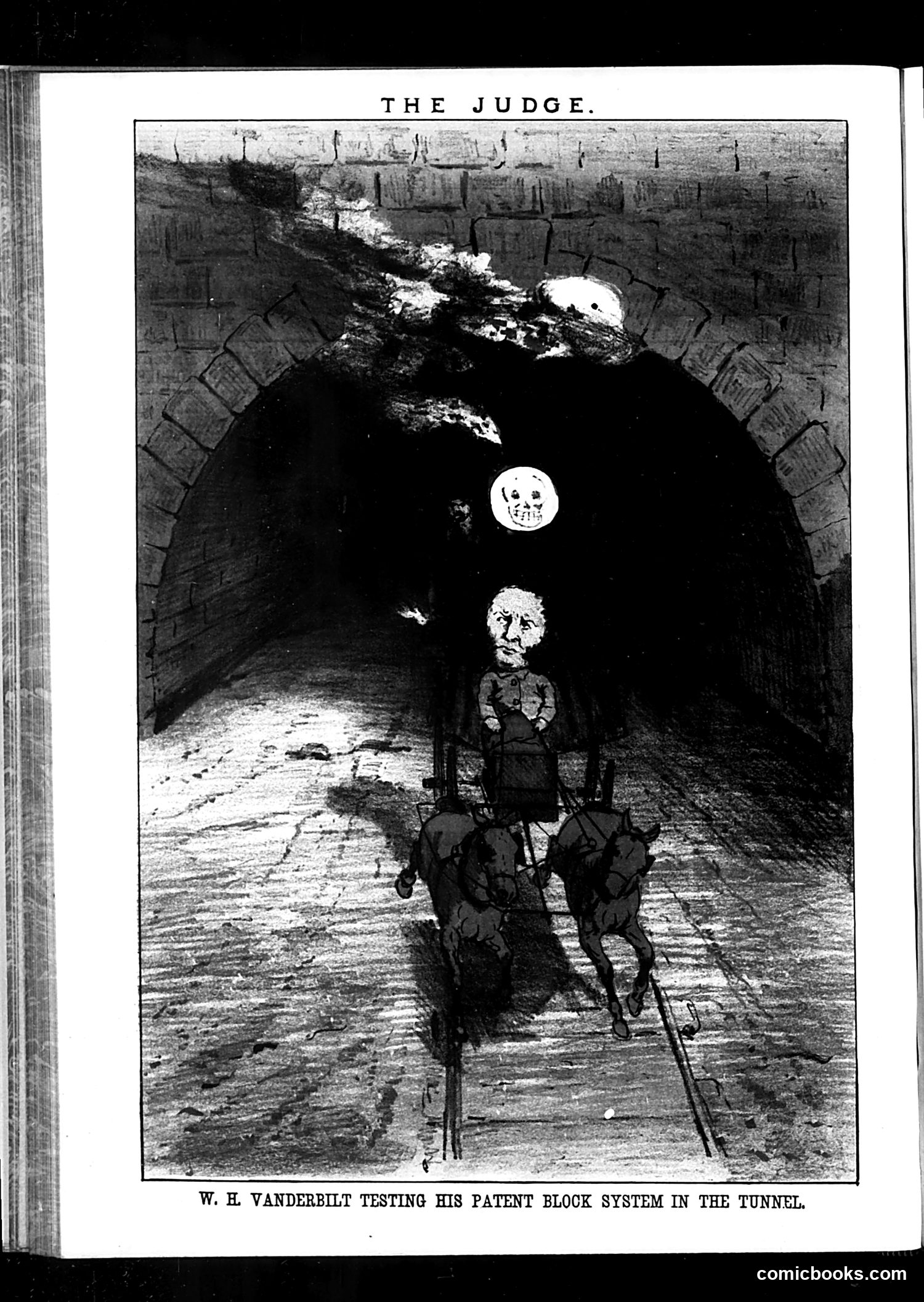
This satirical cartoon depicts **W.H. Vanderbilt** (a prominent railroad magnate) testing a patent "block system" in a tunnel. The image shows a skeletal, death-like figure looming above him, suggesting the cartoon critiques Vanderbilt's safety innovations—or mocks their inadequacy. The **skeleton with a grinning face** appears to represent death or danger lurking in railroad tunnels, implying that Vanderbilt's patented safety system offers false protection against the real hazards of rail travel. The cartoon likely satirizes both Vanderbilt's technological claims and broader concerns about railroad safety in this era, when such accidents were frequent and deadly. The tone is darkly humorous, using macabre imagery to question whether corporate innovations genuinely protected workers and passengers or merely served as publicity stunts.