
A complete issue · 16 pages · 1882
Judge — September 30, 1882
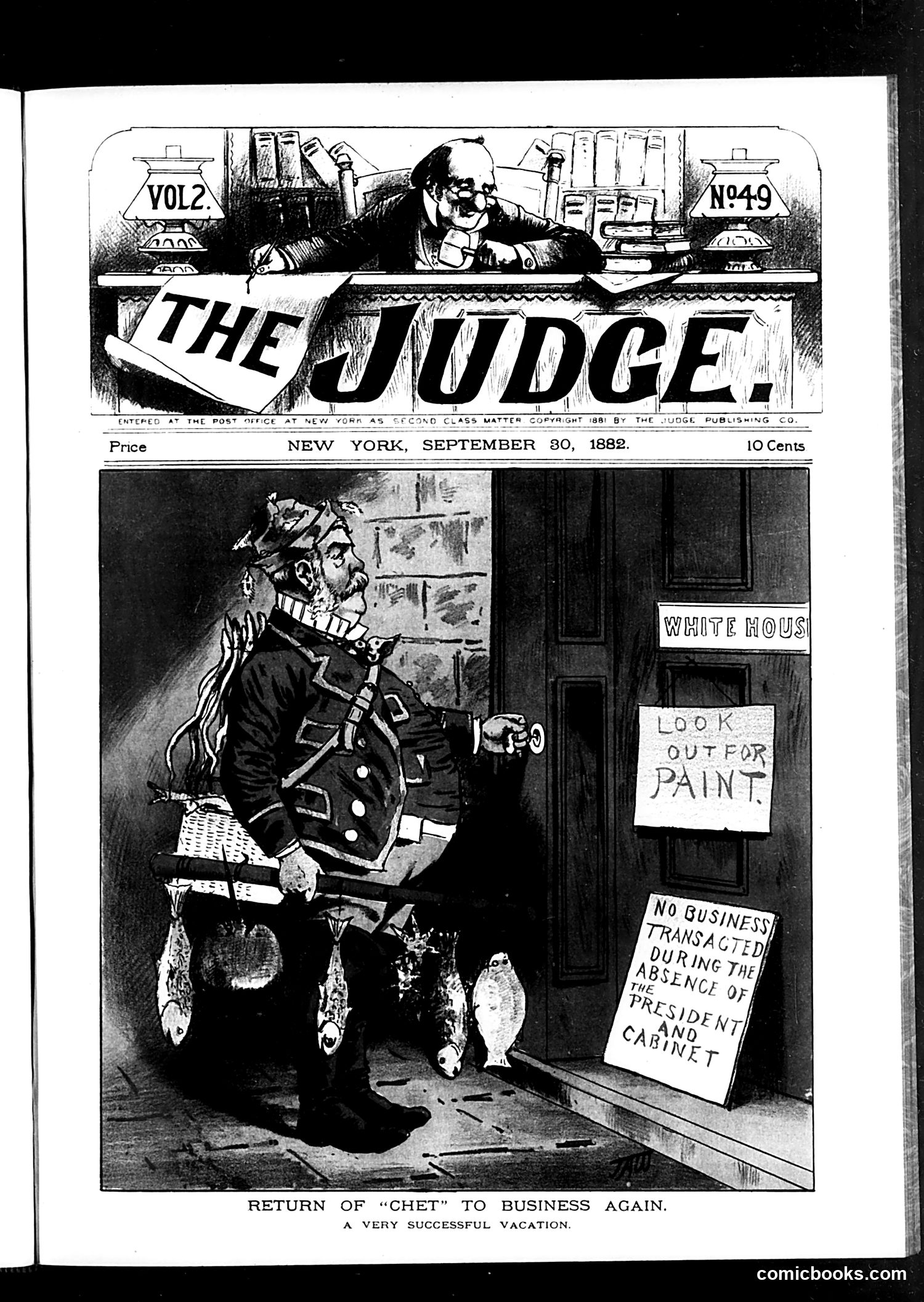
This *Judge* magazine cover from September 30, 1882 depicts a military officer (likely Secretary of War Robert "Chet" Lincoln, son of Abraham Lincoln) returning to work at the White House after a vacation. The satire plays on the phrase "a very successful vacation"—the White House door displays signs indicating it was closed for business during the President and Cabinet's absence. The caricatured officer in full dress uniform, laden with hunting trophies, suggests the vacation involved leisure activities rather than urgent government work. The joke appears to critique the extended absence of executive leadership, implying the government functioned fine without them—a commentary on either administrative inefficiency or the irrelevance of certain officials during the administration of President Chester Arthur.
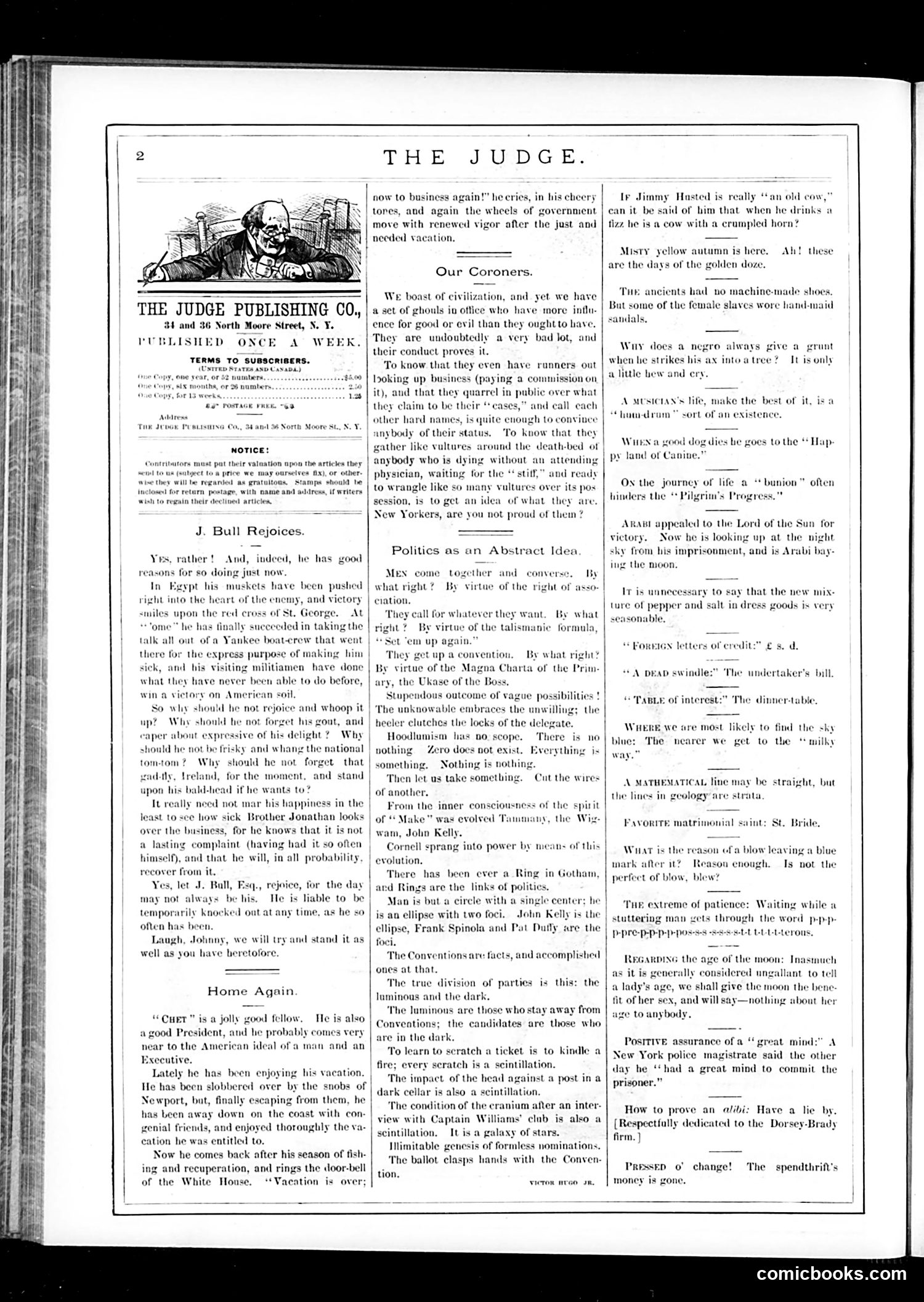
This page from Judge (America's leading satirical magazine) contains three main articles mocking contemporary politics and government: **"J. Bull Rejoices"** satirizes British satisfaction after military successes in Egypt and a victory over American sailors. The article drips with sarcasm, suggesting Brother Jonathan (America personified) shouldn't mind Britain's triumphs since America always recovers from defeats anyway. **"Home Again"** celebrates President Cleveland's return from vacation, portraying him as energized and ready to restore government efficiency—typical celebratory political commentary. **"Our Coroners"** and **"Politics as an Abstract Idea"** attack corruption in New York government, particularly mocking coroners who drum up business and squabble over cases like "vultures," and politicians who invoke grand principles (Magna Carta, democratic conventions) while actually serving "the Boss"—a reference to urban political machines and their corrupt bosses. The cartoon (top left) appears to show a sleeping or dejected figure, likely representing political exhaustion or failure, though specifics are unclear from the image alone.
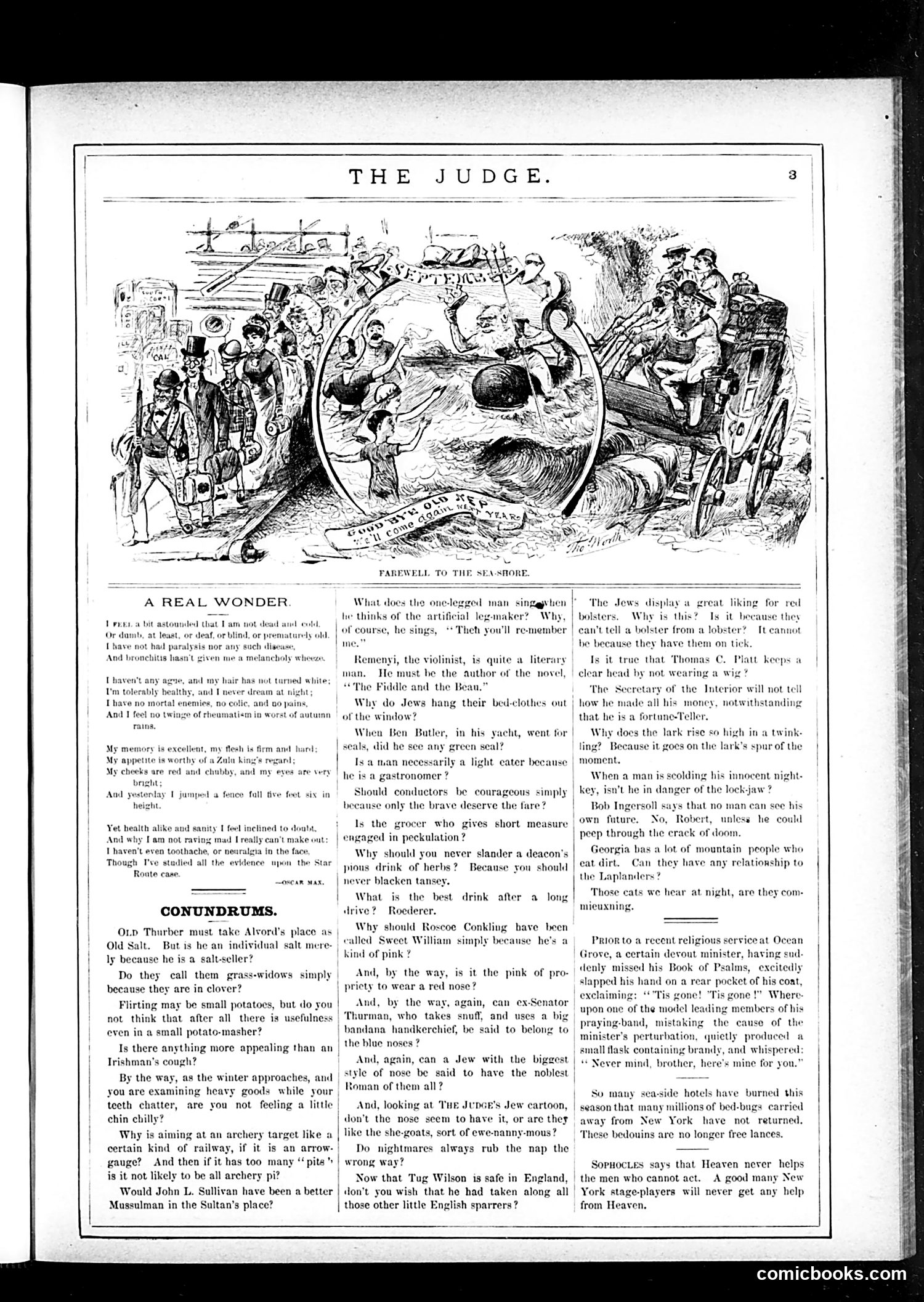
This page from *Judge* magazine contains two sections of satirical humor typical of 19th-century American comedy. **"A Real Wonder"** is a humorous poem about a man amazed at his own good health—he lacks common ailments (paralysis, rheumatism, toothaches) and wonders why he hasn't gone mad. It's gentle social satire about hypochondria and the human tendency to complain. **"Conundrums"** is a lengthy collection of puns and riddles poking fun at contemporary political figures and social topics. References include: - **Roscoe Conkling** (called "Sweet William") - **John L. Sullivan** (boxer) - **ex-Senator Thurman** - **Ben Butler** and **Tug Wilson** (unclear context) The jokes rely on wordplay—puns about "peckulation" (peculation/peck), "ewe-nanny-mous" (unanimous), and ethnic stereotypes about Jews. The cartoons at top illustrate some conundrums visually. The humor is primarily linguistic wordplay rather than sophisticated political commentary, reflecting *Judge*'s popular entertainment function.
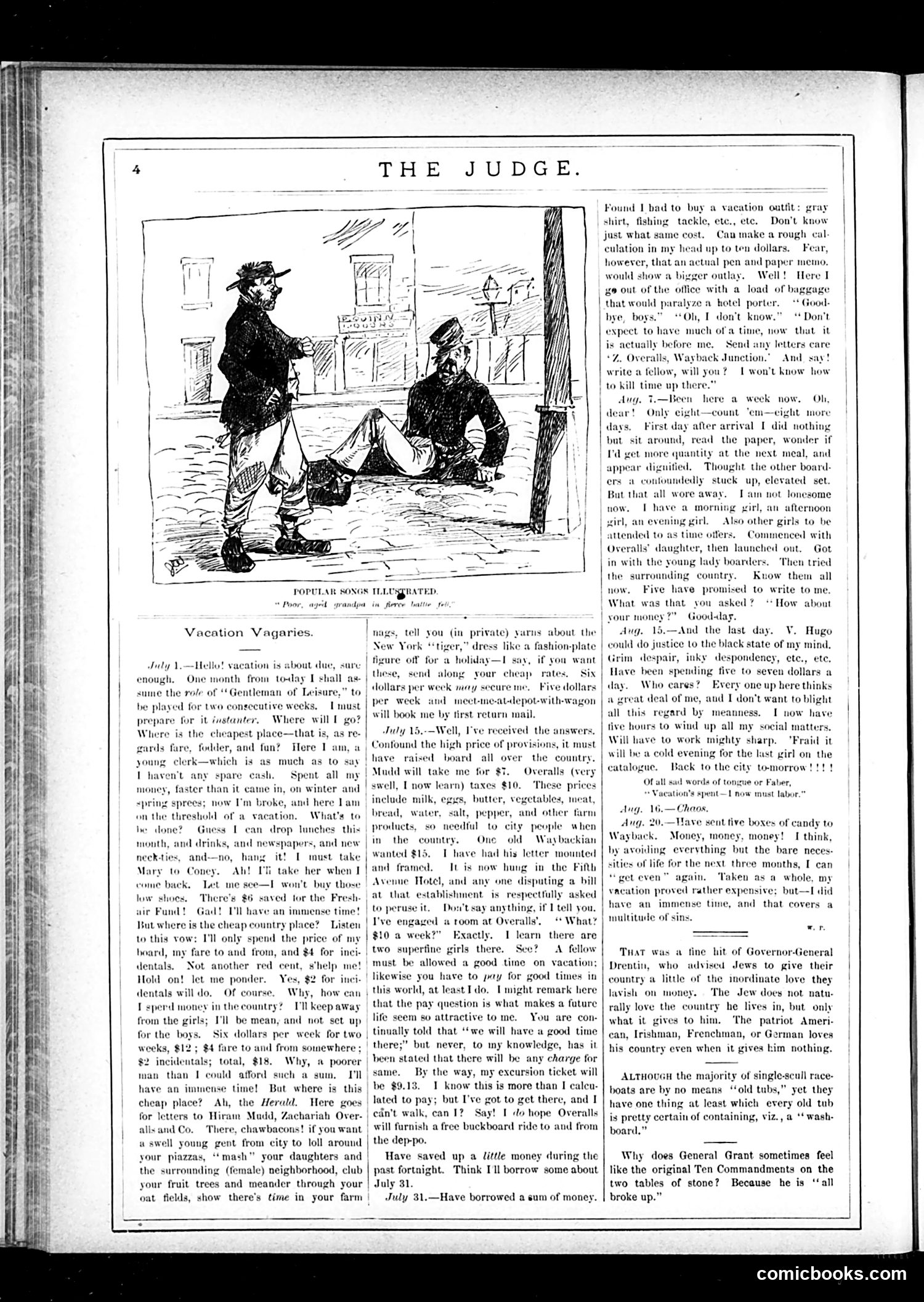
This page from *Judge* magazine presents "Vacation Vagaries," a satirical account of a middle-class clerk planning a budget vacation in the 1880s-90s. **The Satire:** The humor targets the tension between aspiring to leisure and actual financial constraint. The unnamed narrator obsesses over saving money for a country vacation while simultaneously spending it—on transportation, lodging ($7-10/week), and social activities with young women at his destination. He's caught between wanting to impress others ("mash" the daughters) and his meager budget. **The Social Context:** The piece mocks the clerk class's pretensions to gentility and leisure, a relatively new concept for working-class Americans. References to the "Fresh-air Fund" and specific boarding houses suggest real vacation culture emerging for non-wealthy urbanites. **The Cartoon:** The illustration (bottom left) shows two shabby men, likely depicting the clerk and a fellow visitor, embodying the humor—the vacation outfit likely looks more worn than fashionable. The overall joke: even small-wage earners tried desperately to maintain appearances of leisure and romance, often unsuccessfully.
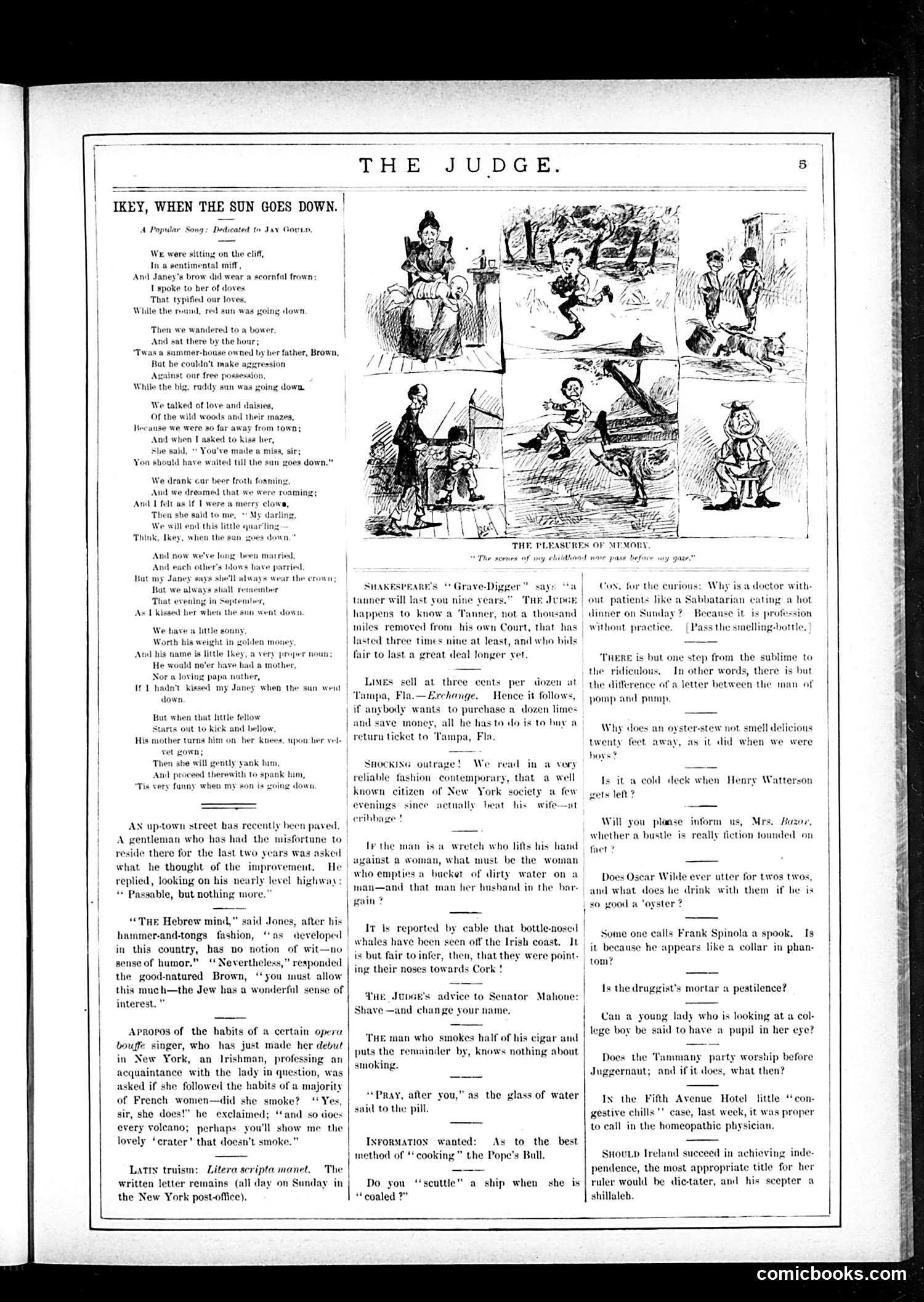
This page primarily features a sentimental popular song dedicated to Jay Gould (likely misspelled as "Gorn"), a prominent Gilded Age industrialist and financier. The song humorously traces a romantic narrative—from courtship through marriage to parenthood—using the recurring image of sunset as a romantic/temporal marker. The accompanying illustrations depict scenes from this sentimental story: courting couples, a summer house encounter, and domestic life with a child. Below the song are miscellaneous satirical quips typical of Judge's humor: observations about paving stones, Jewish humor, opera singers, tanners' durability, and various absurdist social commentary. The overall effect parodies both Victorian sentimentality and contemporary society figures, though the specific topical references (beyond Gould) are difficult to pin down without additional context.
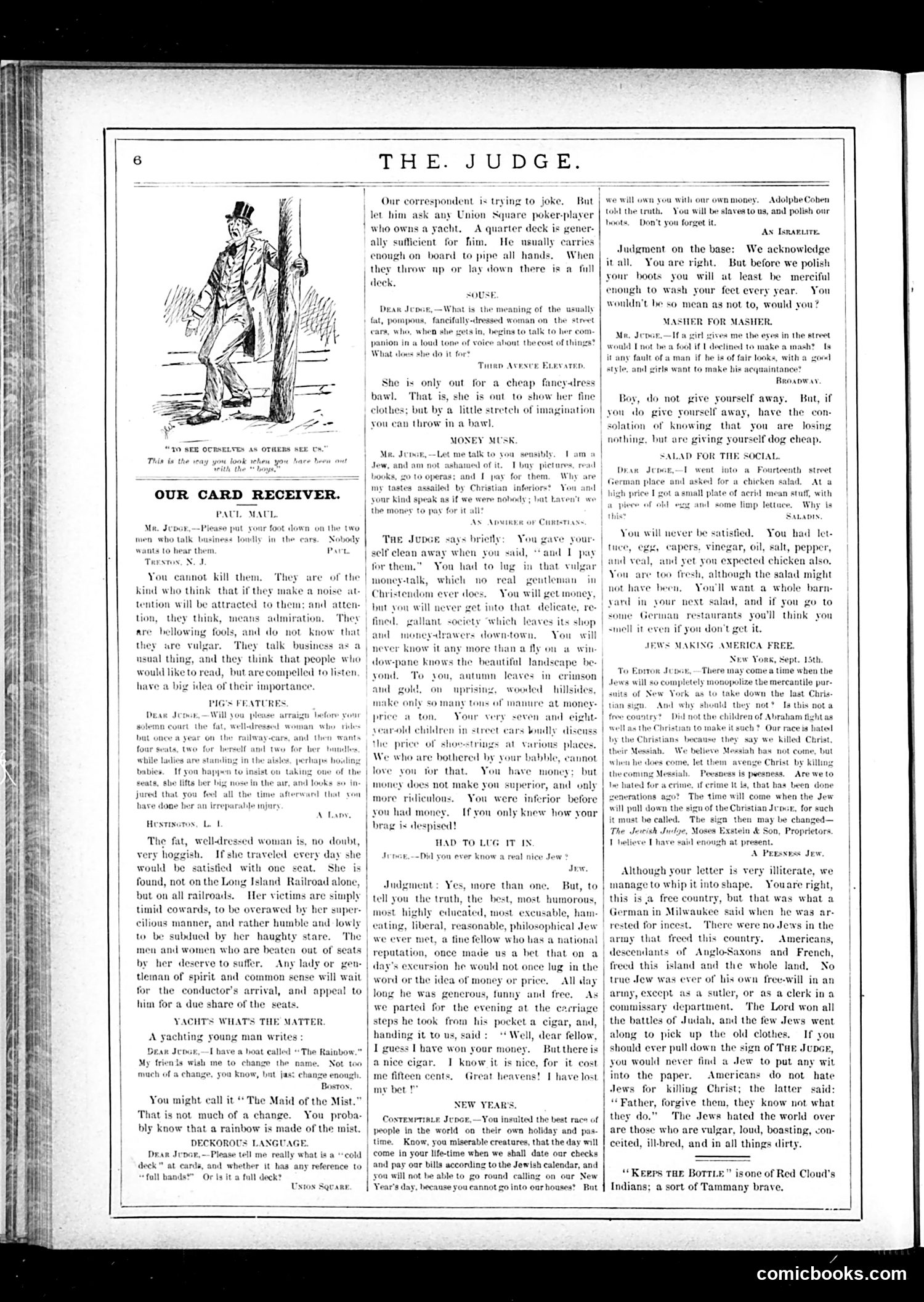
This page from *Judge* magazine contains several satirical advice-column style pieces mocking social behavior: **"Our Card Receiver"** ridicules self-important men who dominate railroad car conversations, believing their noise constitutes charm. **"Pig Features"** criticizes obese, well-dressed women who monopolize multiple train seats while remaining blissfully unaware of their rudeness—the satire suggesting they're intentionally selfish rather than merely inconsiderate. **"Yachts: What's the Matter"** makes a pun: renaming a boat "The Rainbow" offers little improvement, since rainbows are made of mist anyway. **"Decorous Language"** debates naval terminology ("full deck" vs. other terms). **"Money Musk"** satirizes nouveau-riche Jews who ostentatiously display wealth through vulgar language about money, contrasting them with refined gentlemen who would never mention payment directly—reflecting period antisemitic stereotypes about Jewish materialism. The cartoons target pretentious urbanites and social climbers, common *Judge* targets during this era.
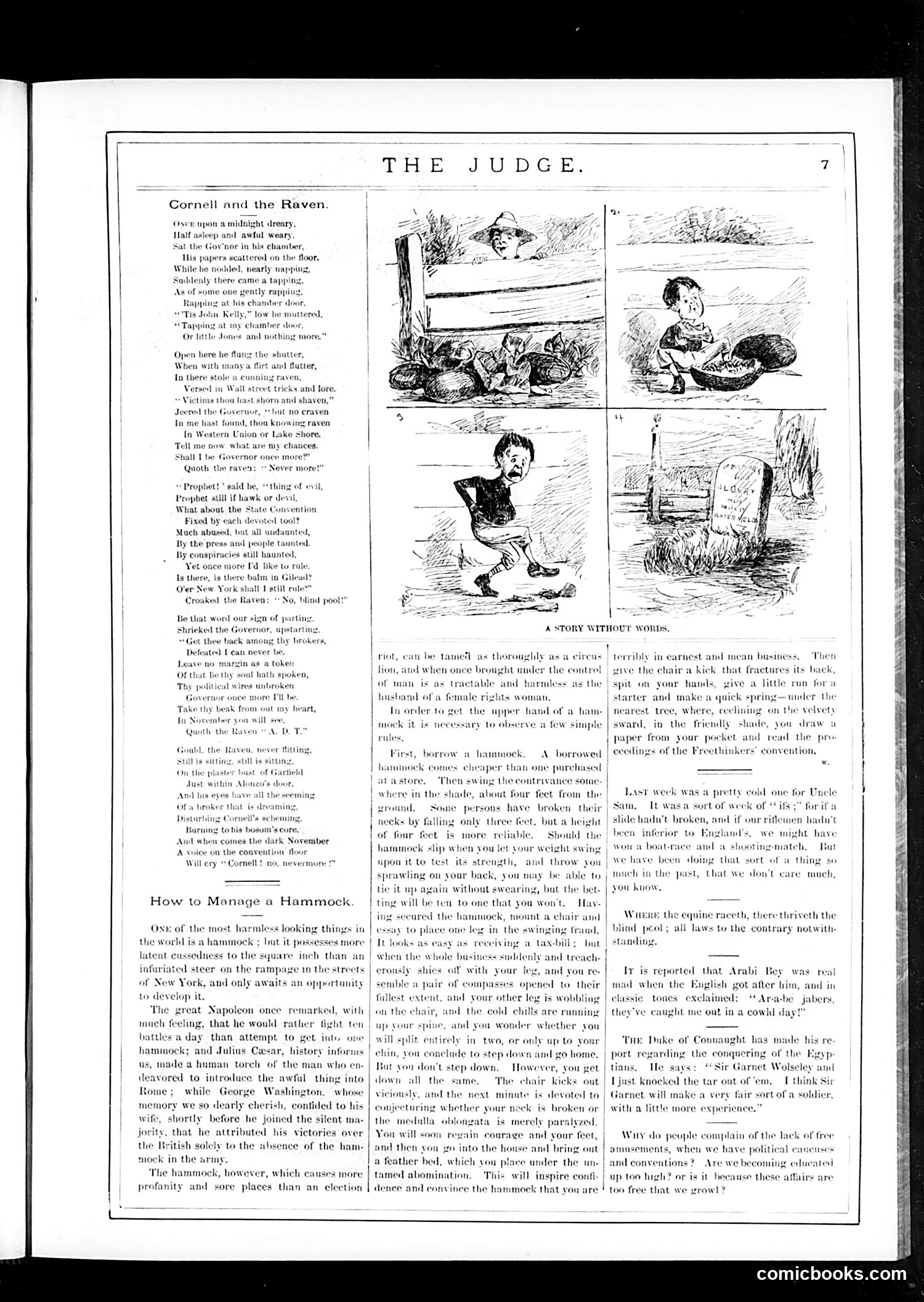
This page contains two distinct pieces: **"Cornell and the Raven"** (left): A political parody of Edgar Allan Poe's "The Raven," featuring Governor Cornell receiving a visit from a raven representing bad news or prophecy. The poem mocks Cornell over New York political scandals—likely referencing corruption involving Western Union and Lake Shore Railroad, major financial institutions of the era. The raven cryptically predicts Cornell's political fate, with references to "the State Convention" and whether he'll remain "Governor." This satirizes contemporary New York political turmoil and potential corruption scandals affecting Cornell's governorship. **"How to Manage a Hammock"** (right): Humorous practical advice on using hammocks, presented as absurdist instruction. It jokes about the hammock's difficulty and danger—comparing attempts to use one with historical military defeats and implying users will injure themselves despite best efforts. This is lighter satirical commentary on a mundane domestic frustration.
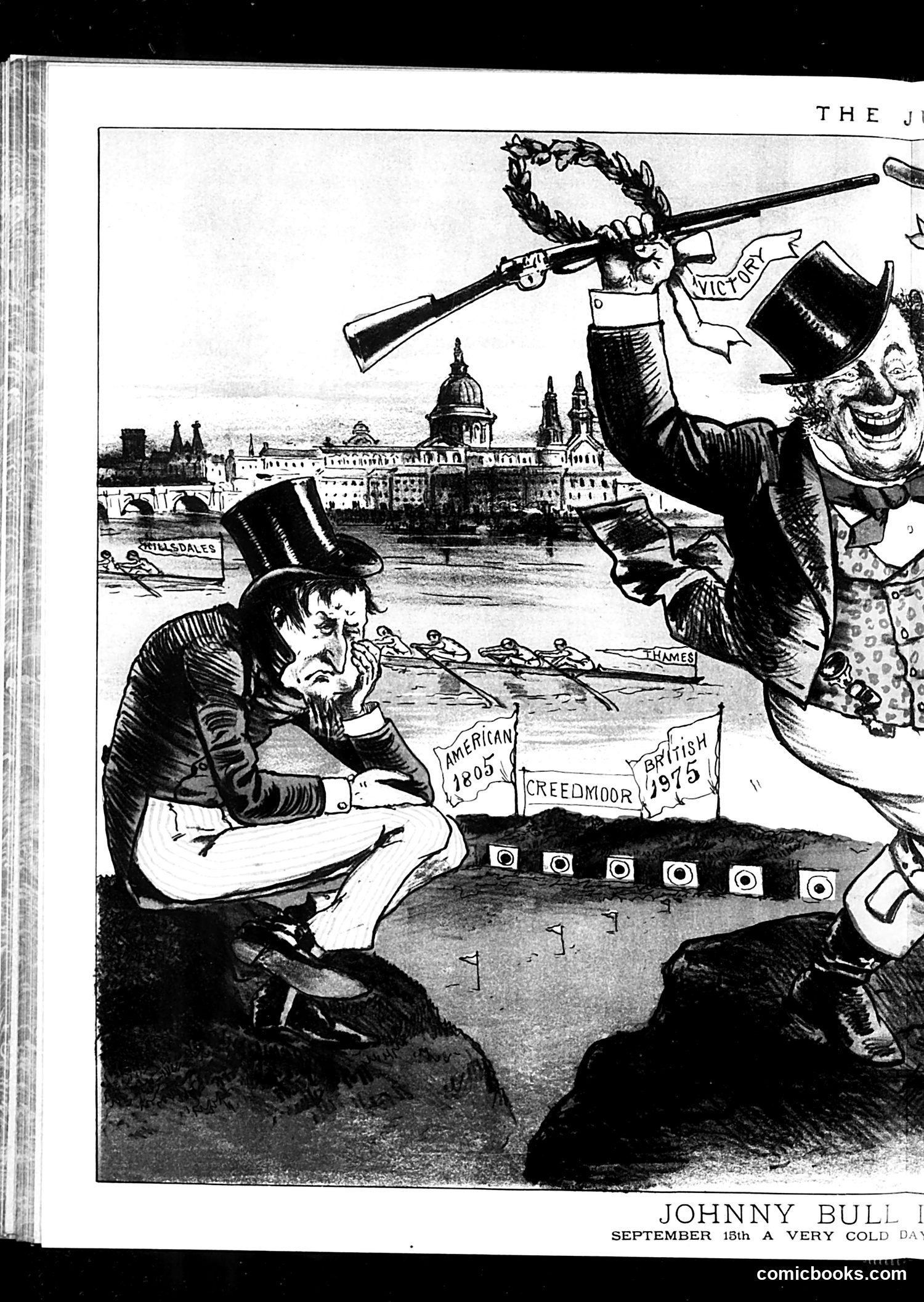
This Judge magazine cartoon depicts **Johnny Bull** (the traditional British personification) as a gloomy figure sitting by the Thames in London, sketching targets. He's labeled with two rowing competitions: "American 1908" and "British 1913," referencing Olympic or international rowing races. A jubilant American figure on the right (wearing a "Victory" banner and top hat) celebrates with a rifle adorned with laurels, suggesting American athletic triumph. The American appears to be taunting the dejected British competitor. The satire mocks British decline in international sporting competitions relative to American prowess around 1913. The cold weather caption reinforces the dreary mood. This reflects early 20th-century anxieties about shifting Anglo-American power dynamics through the lens of athletic competition.
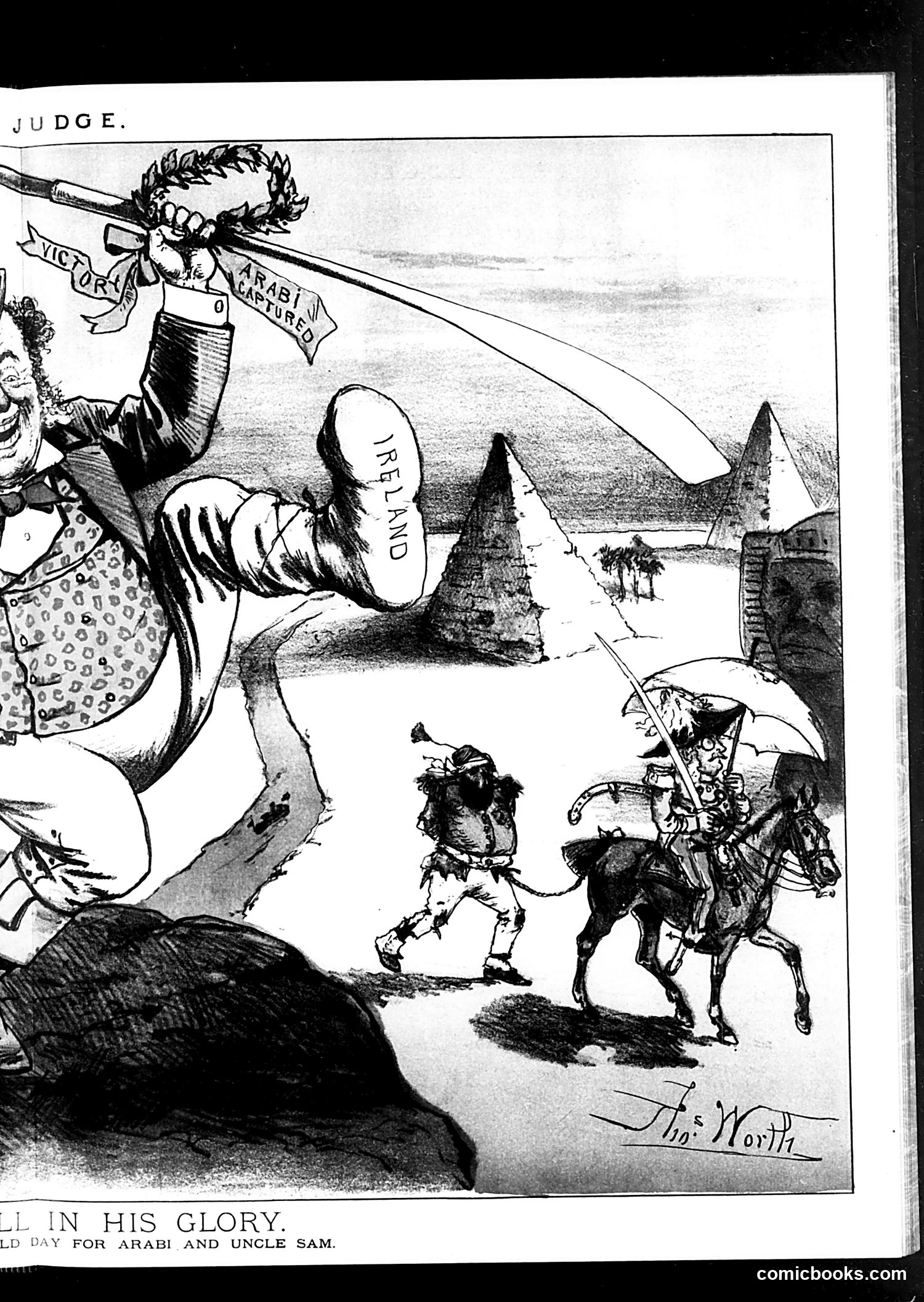
This Judge magazine cartoon titled "In His Glory" satirizes American intervention in Middle Eastern affairs. The large figure on the left appears to be Uncle Sam (identified by the traditional American figure iconography), wielding a sword labeled "Victory" and "Arabi Captured." Below, smaller figures on horseback and foot represent military forces, likely depicting the aftermath of conflict involving Arabi—probably referring to Ahmad Urabi Pasha, an Egyptian military leader involved in 1880s-era tensions. The cartoon's message criticizes Uncle Sam's triumphalism and involvement in foreign military campaigns, particularly regarding Arabian/Egyptian conflicts. The ironic title suggests satire about American imperial ambitions and militarism, questioning whether such interventions truly represent American glory or represent overreach and questionable foreign policy choices.
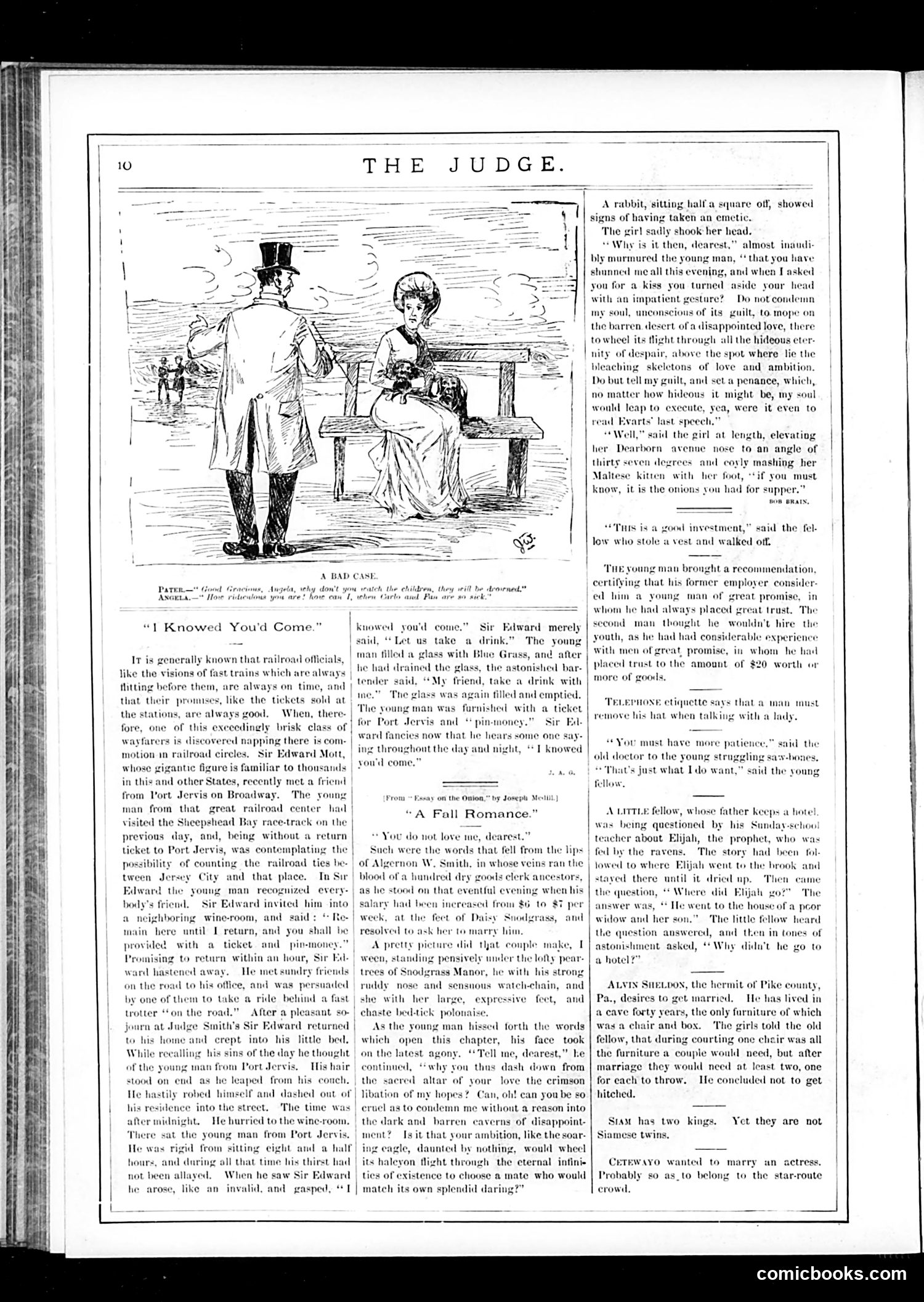
**Main Cartoon: "A Bad Case"** This depicts a railroad official (likely representing Sir Edward Mott, a real figure familiar to Judge's readers) encountering a young man he'd invited to wait for him hours earlier. The satire mocks railroad executives' notorious unreliability—they promise punctuality to passengers but fail to keep personal commitments. The young man, rigid from waiting all night, greets the tardy official with resigned acceptance ("I knowed you'd come"), satirizing both the official's carelessness and the public's cynical expectations of railroad incompetence. **Secondary Story: "A Fall Romance"** A melodramatic parody of Victorian romance literature. A dry-goods clerk with a recent salary increase (from $6 to $7 weekly) attempts to propose to Daisy Snodgrass, employing overwrought poetic language. The humor lies in applying grandiose romantic rhetoric to a mundane, lower-class situation—the contrast between his flowery declarations and his modest circumstances creates the joke.
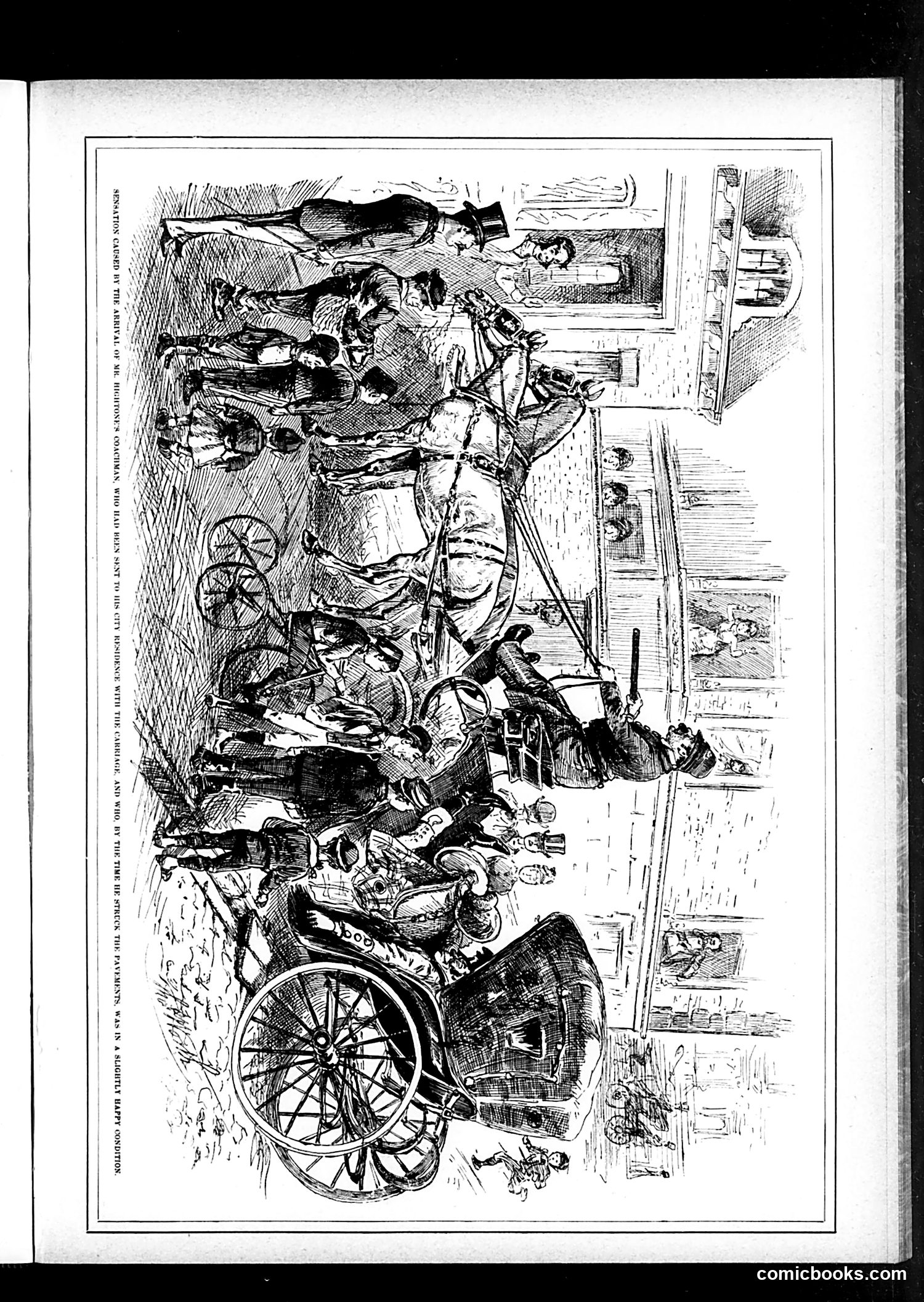
The OCR text from this page is severely corrupted and essentially unreadable—it appears to contain only individual letters and characters without coherent words or context. While the image shows a detailed satirical engraving (rotated 90 degrees, making it difficult to interpret with full confidence), it depicts what appears to be a crowded indoor scene with multiple figures, bicycles, and period clothing consistent with late 19th-century American illustration style. Without legible text identifying the specific cartoon's title, date, or subject matter, I cannot reliably identify the figures, political references, or satirical intent for a modern reader. To properly explain this cartoon's meaning, I would need either a clearer OCR transcript or additional publication information.
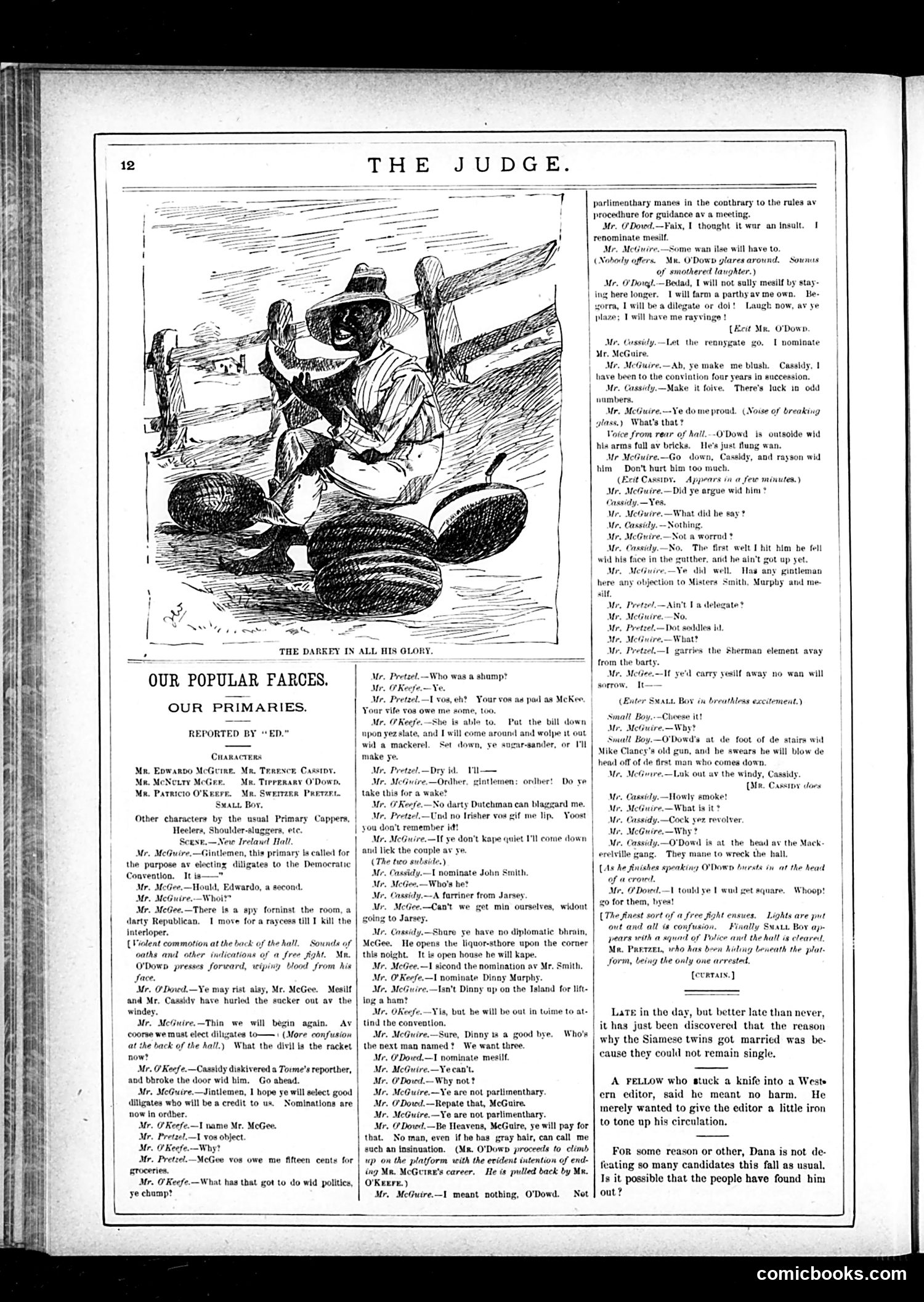
This is a satirical piece titled "The Darkey in All His Glory" depicting an Irish-American Democratic primary meeting at New Ireland Hall. The cartoon mocks Irish immigrant political culture through exaggerated dialect and chaotic behavior. The satire targets: 1. **Irish political machines**: The characters (McGee, O'Dowd, Cassidy, O'Keefe, etc.) represent stereotypical Irish ward bosses engaged in corrupt, violent primary politics—brawls break out constantly, personal grudges interrupt nominations, and the proceedings descend into chaos. 2. **Ethnic/class commentary**: The heavily caricatured Irish brogue ("parlimenthary," "diligates") and violent conduct suggest Irish immigrants were unfit for democratic participation. 3. **Nomination farce**: Candidates are selected based on bribes (a candidate promising to "keep open house" with liquor), personal connections, and who hasn't recently committed crimes ("not Dinny up on the Island for lifting a ham"). The cartoon reflects 19th-century American nativism and anti-Irish prejudice while satirizing actual machine politics corruption.
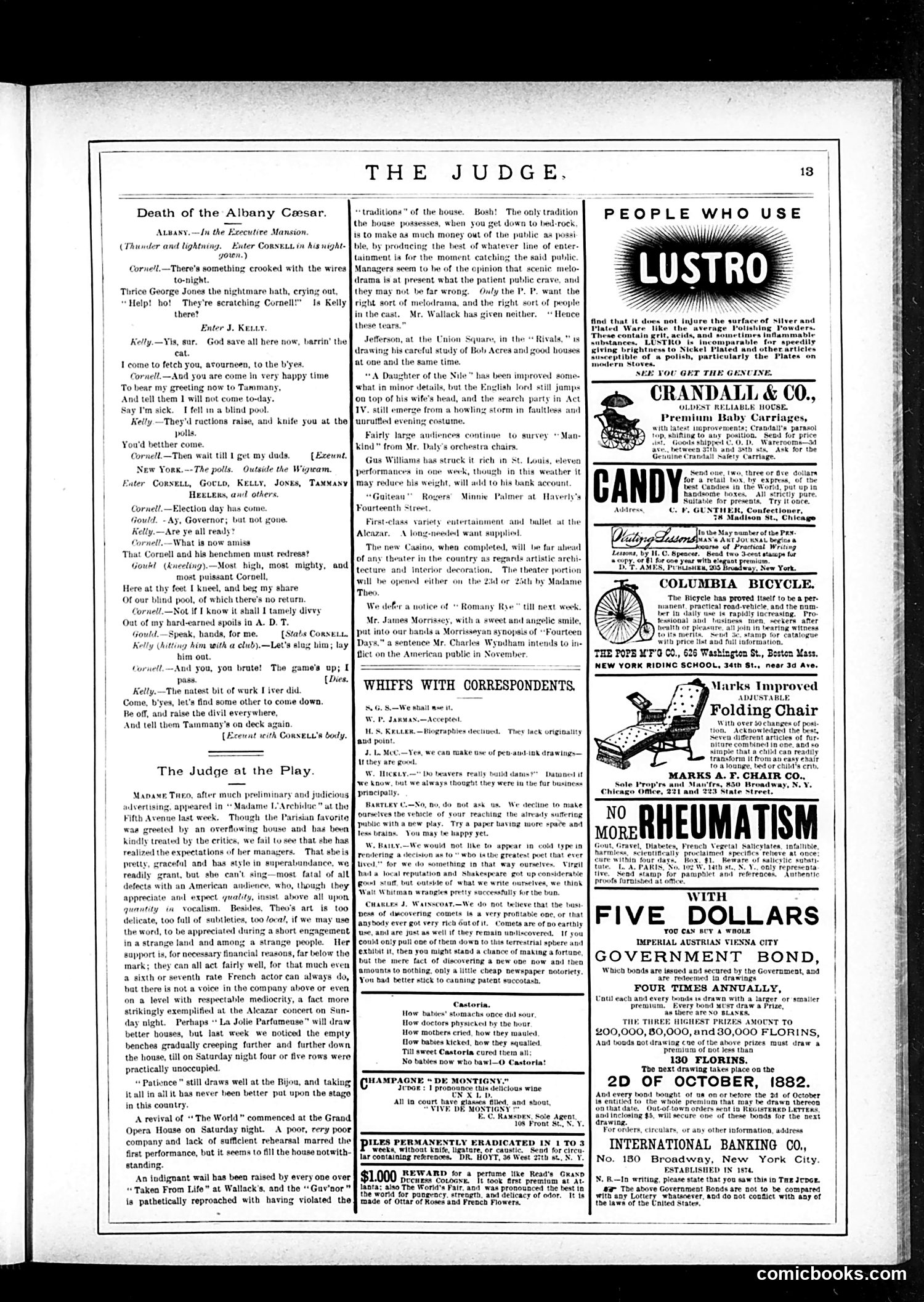
This page is primarily **advertisements and editorial content** rather than political cartoons. The visible advertisements include: - **Lustro** (silver polish) - **Crandall & Co.** (pianos) - **Candy** (confectionery) - **Columbia Bicycle** - **Marks Improved Folding Chair** - **No Rheumatism** (patent medicine) - **Five Collars** (clothing) - **Government Bond** investment advertisement - **Giles Permanently Eradicated** (likely a medical treatment) The editorial sections include "The Judge at the Play" (theater reviews) and "Whiffs with Correspondents" (letters to the editor). These reflect Judge's format as a satirical weekly mixing humor, social commentary, and commercial advertising typical of 1880s American magazines.
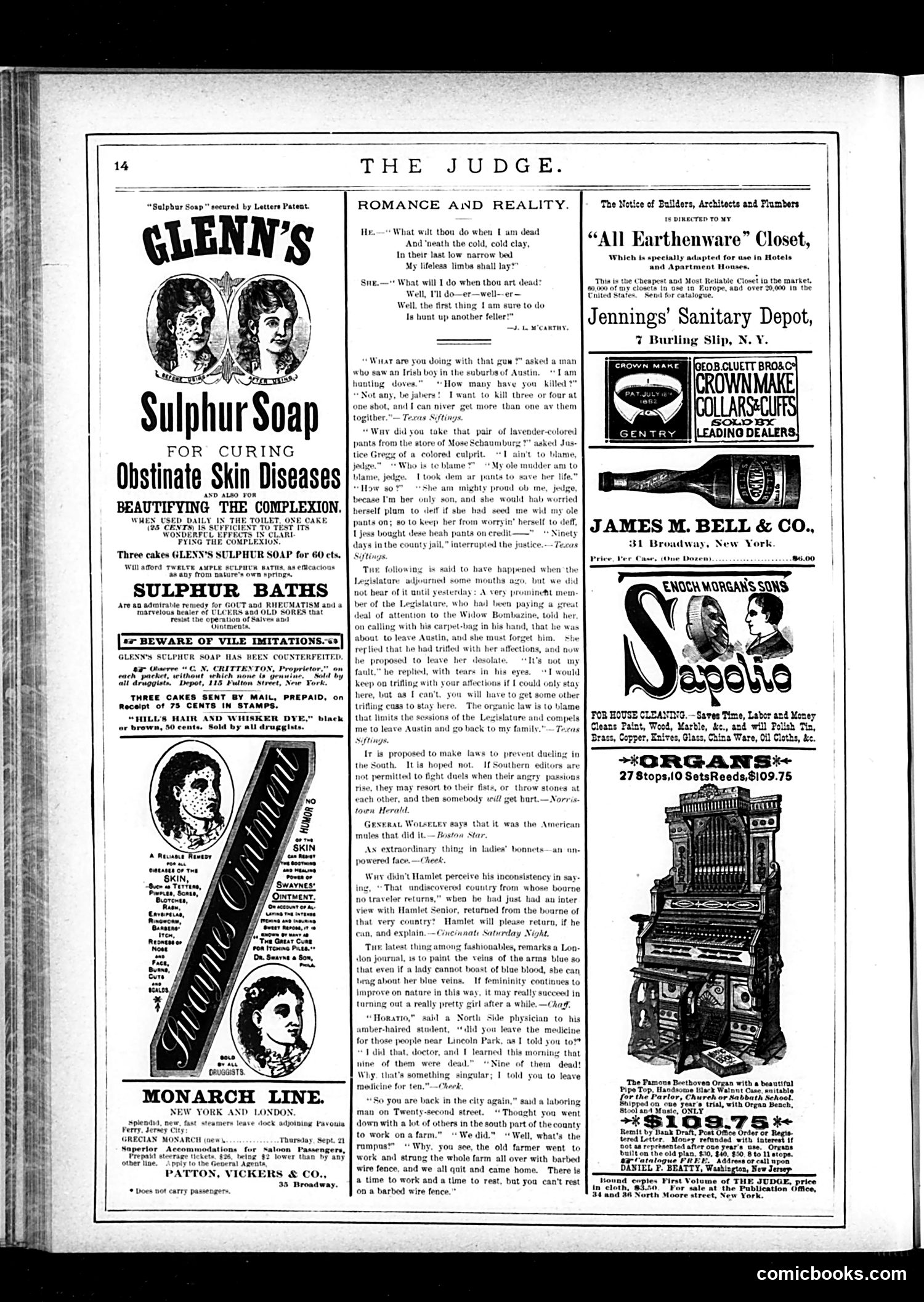
This page is primarily **advertisements** (Glenn's Sulphur Soap, Monarch steamship line, and various other products) rather than satirical cartoons. The actual editorial content is a section titled **"Romance and Reality,"** which presents contrasting pairs of idealized romantic sentiments versus crude practical responses. For example: a lover asks what his beloved will do when he dies, and she replies she'll "take up another feller." An Irish boy hunting explains he killed animals; a Black youth admits stealing pants to help his mother. A politician abandons his widow for political reasons. The satire targets **hypocrisy and disillusionment**: the gap between how people claim to feel (romantic, selfless, honorable) versus how they actually behave (selfish, mercenary, practical). These brief anecdotes mock sentimental idealism by juxtaposing it with blunt reality—a recurring *Judge* magazine tactic for social criticism. The racist dialect in one anecdote reflects unfortunate period conventions in American satirical publications.
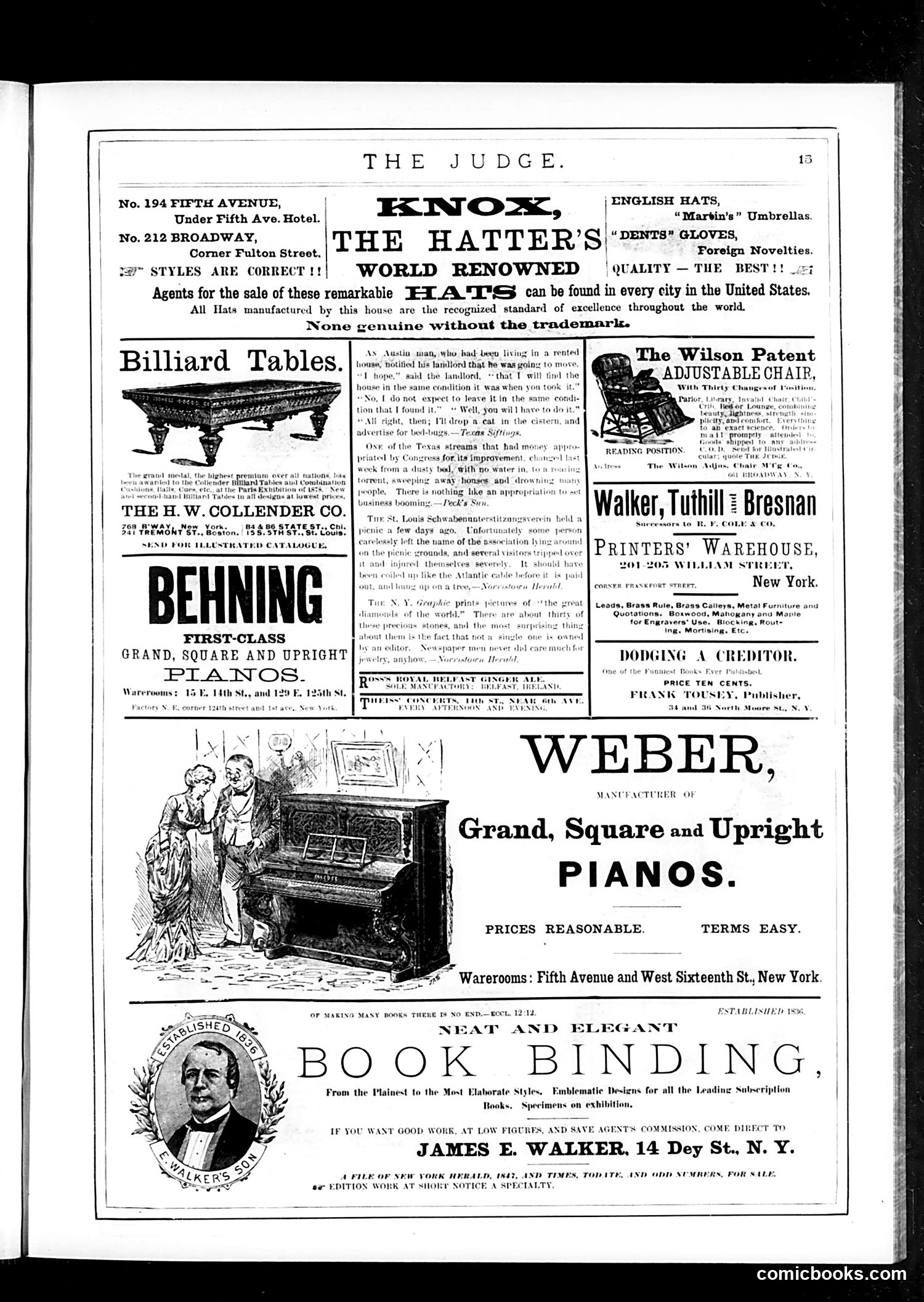
This page is **primarily advertising**, not editorial content or political satire. It's from *Judge*, a satirical magazine, but this particular issue page functions as a classified ad section. The advertisements promote luxury goods and services typical of 1880s-90s New York: Knox hats (a prestigious brand), billiard tables, pianos (Behning and Weber brands), an adjustable chair, a printing warehouse, and book binding services. These ads target middle-to-upper-class consumers. The only potentially satirical element is a small illustration showing a couple admiring a piano—a conventional "aspirational lifestyle" image meant to appeal to piano buyers, not to mock them. **What we'd miss today**: The prominence of piano ownership as a status symbol, the geographic concentration of luxury retailers on Fifth Avenue and Broadway, and how print advertising dominated urban commerce before electronic media.
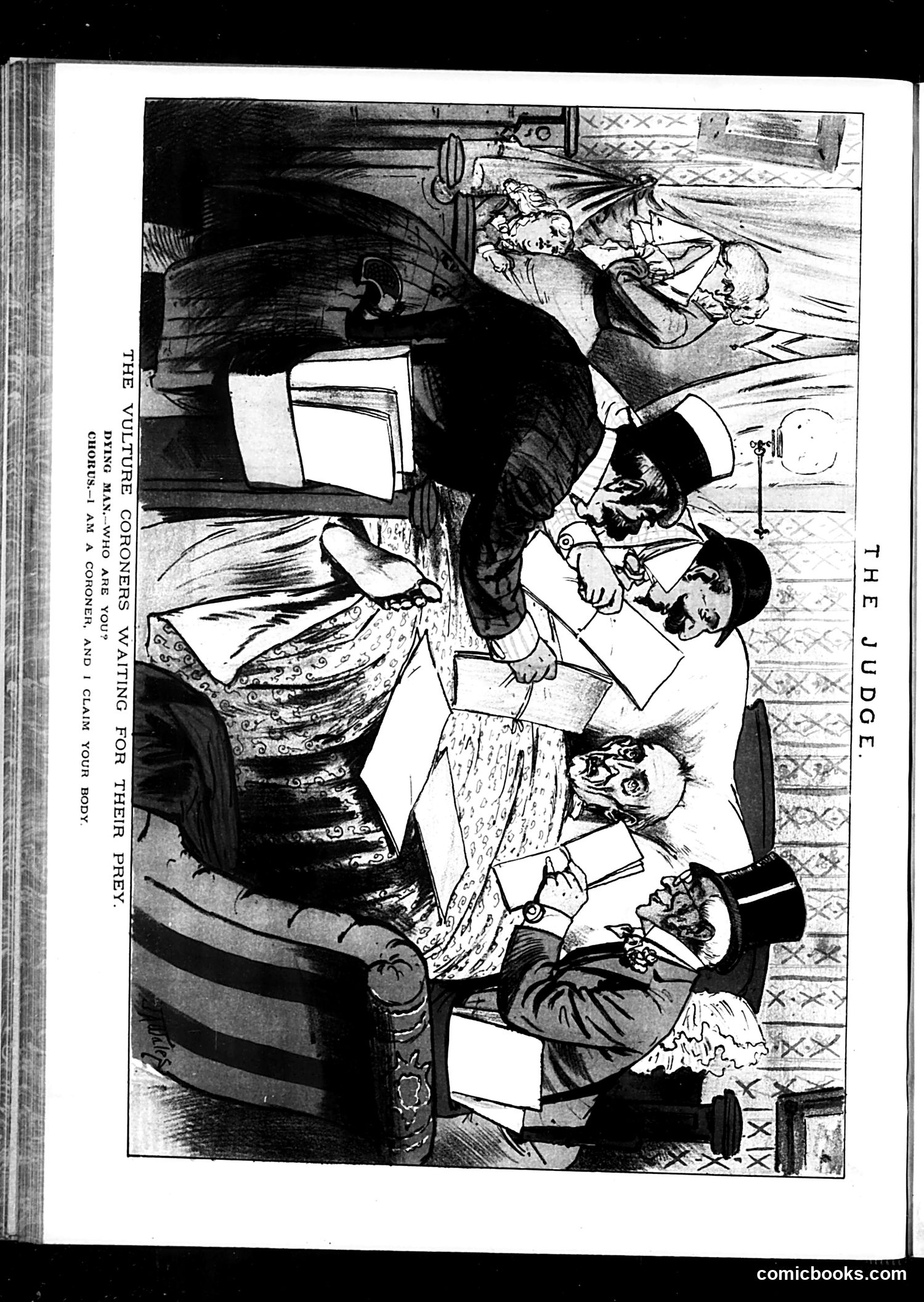
This satirical cartoon depicts multiple vulture-like figures in formal dress (coroners) circling a dying man in bed, eagerly awaiting his death to claim his body. The caption's dialogue—the man asking "who are you?" and the chorus responding "I am a coroner, and I claim your body"—suggests corruption in the coroner system. The satire likely critiques the practice of coroners treating death investigations as profit opportunities, competing greedily over corpses. The vulture imagery emphasizes predatory behavior. This reflects real concerns about coroner conflicts of interest during this era, where coroners often profited from fees associated with death investigations and autopsies, creating perverse incentives to rush or sensationalize death determinations.