
A complete issue · 24 pages · 1882
Judge — April 29, 1882
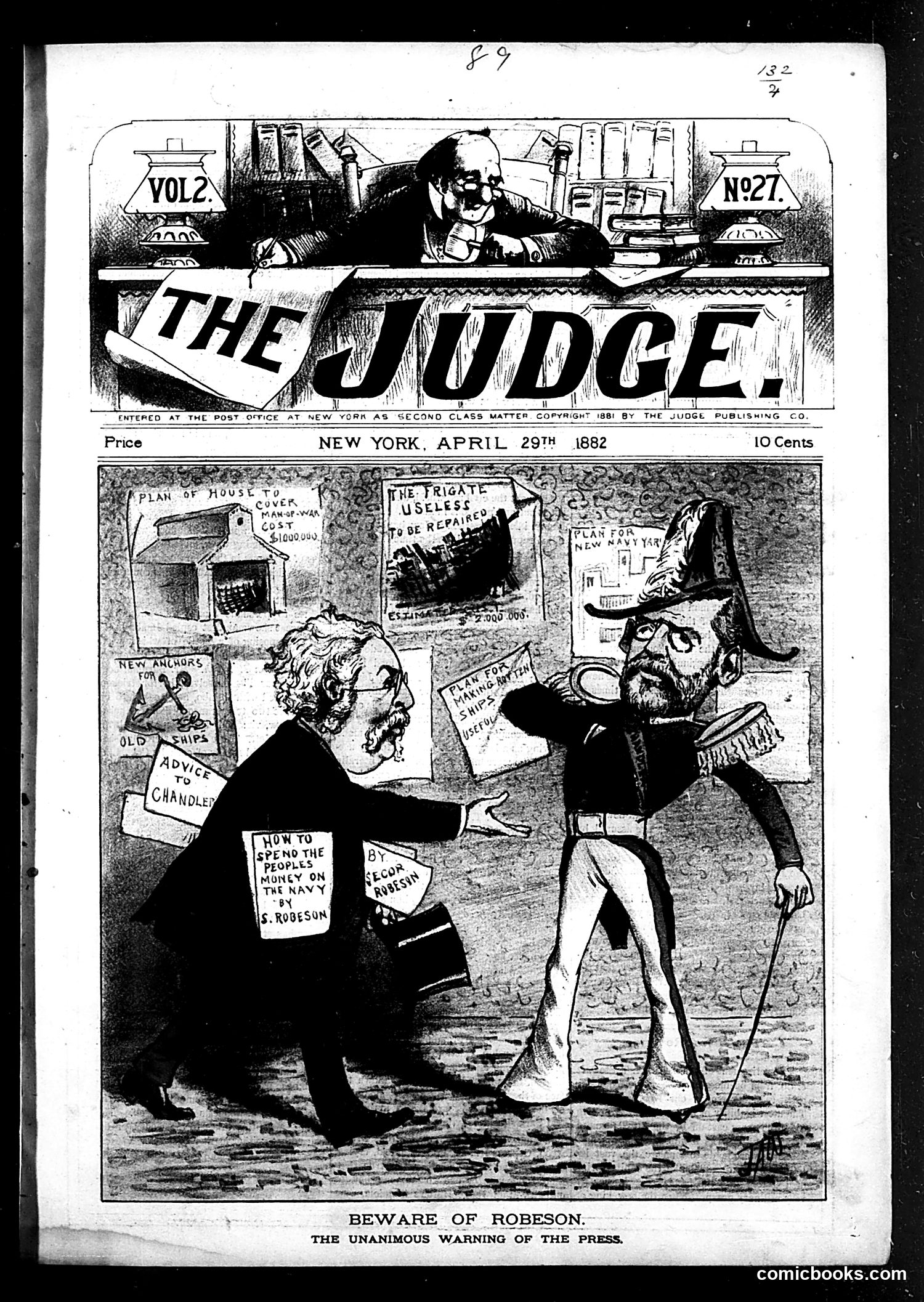
This political cartoon satirizes **Secretary of the Navy George M. Robeson** (identifiable by the caption and skeletal devil caricature). The left figure, appearing to be a naval official or politician, holds documents labeled "How to Spend the People's Money on the Navy" by Robeson, suggesting wasteful or corrupt naval spending. The surrounding vignettes mock Robeson's alleged mismanagement: blueprints for useless ships, a frigate "useless and to be repaired" (costing $2,000,000), and symbols of poor judgment ("Old Ships," "Advice to Chandlers"). The cartoon represents press criticism of Robeson's tenure—likely referencing contemporary debates over naval expenditures and suspected corruption. The "unanimous warning" subtitle indicates broad journalistic opposition to his policies, positioning *Judge* as part of collective public scrutiny of his administration.
This *Judge* page satirizes two contemporary figures and events: **"Beware of Robeson!"** mocks newspapers' hysterical warnings to Secretary of the Navy William E. Chandler about his predecessor, Admiral George M. Robeson. The satire suggests these warnings are absurdly overdramatic—treating Robeson as a dangerous desperado rather than a departing official. The piece sarcastically notes Robeson apparently left only "battered canal boats" from the Navy budget, yet newspapers act as though Chandler needs constant protection from him. **"The Jews' Revenge"** ridicules Judge Henry Hilton, who inherited the A.T. Stewart & Co. department store empire. Hilton famously refused Jewish guests at his Saratoga hotel—an act the article frames as his downfall. The satire suggests that through business mismanagement, Hilton's tyrannical policies (refusing Jewish customers and employees) will ultimately destroy the enterprise, constituting a form of Jewish "revenge" through his own incompetence rather than intentional retaliation. Both pieces use sarcasm to mock public figures and their failures.
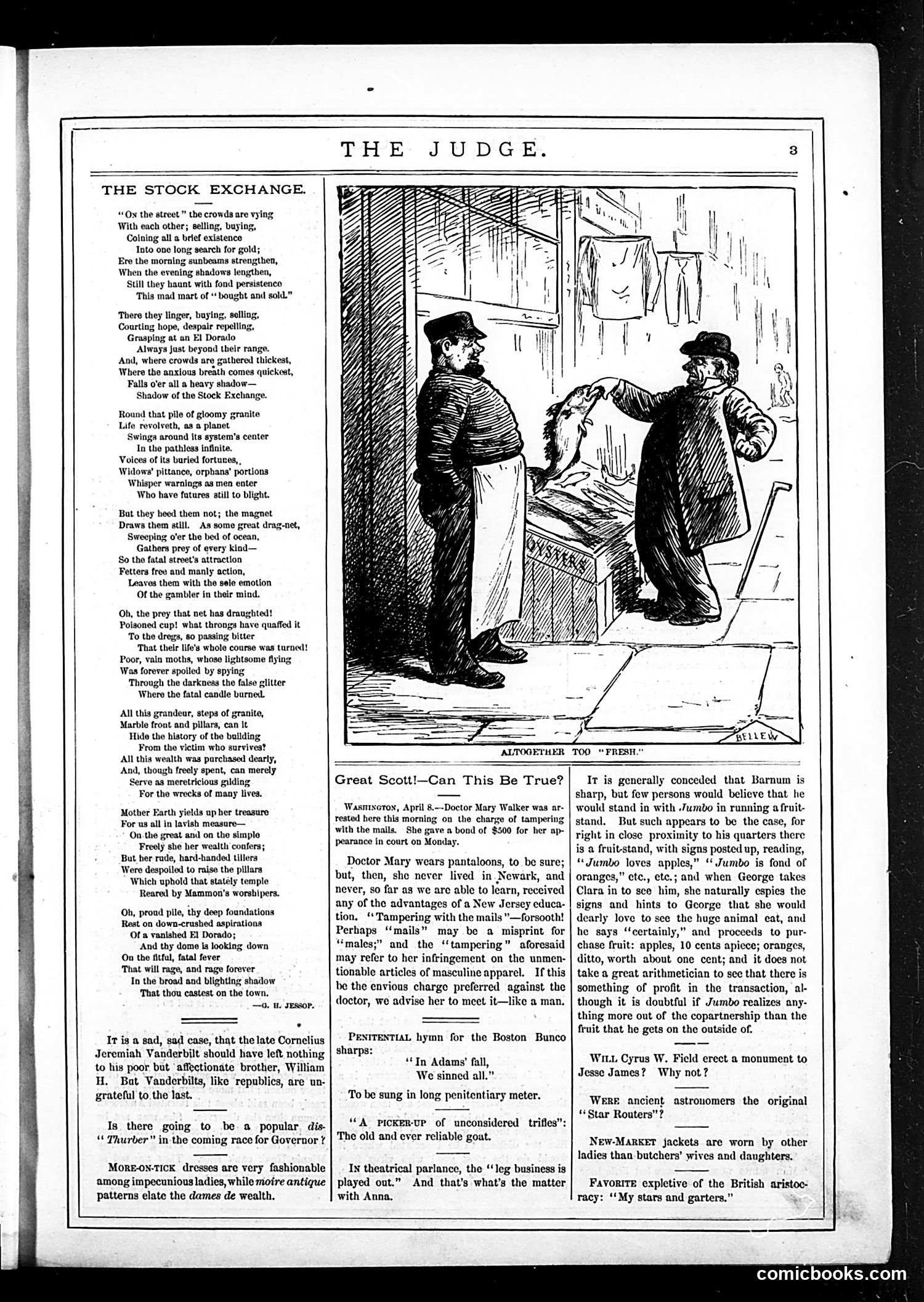
This page contains satirical commentary on late-19th-century American society. The main cartoon depicts two men at what appears to be a laundry or tailor shop, with the caption "Altogether Too 'Fresh,'" likely a visual pun on the term "fresh" (impertinent). The lengthy poem "The Stock Exchange" attacks financial speculation as morally corrosive—depicting Wall Street as a system that destroys lives through gambling-like trading. It emphasizes how the exchange's wealth was built on exploiting workers ("down-crushed aspirations") and warns of its corrupting influence. The miscellaneous items below include jabs at: - **Cornelius Vanderbilt's will** (mocking the wealthy for their lack of charity) - **Doctor Mary Walker** (arrested for mail tampering; the piece sarcastically defends her unconventional pants-wearing) - **Boston con artists** (sharps) The overall thrust criticizes wealth inequality, financial speculation as vice, and social hypocrisy—typical progressive-era critique circa 1880s-90s.
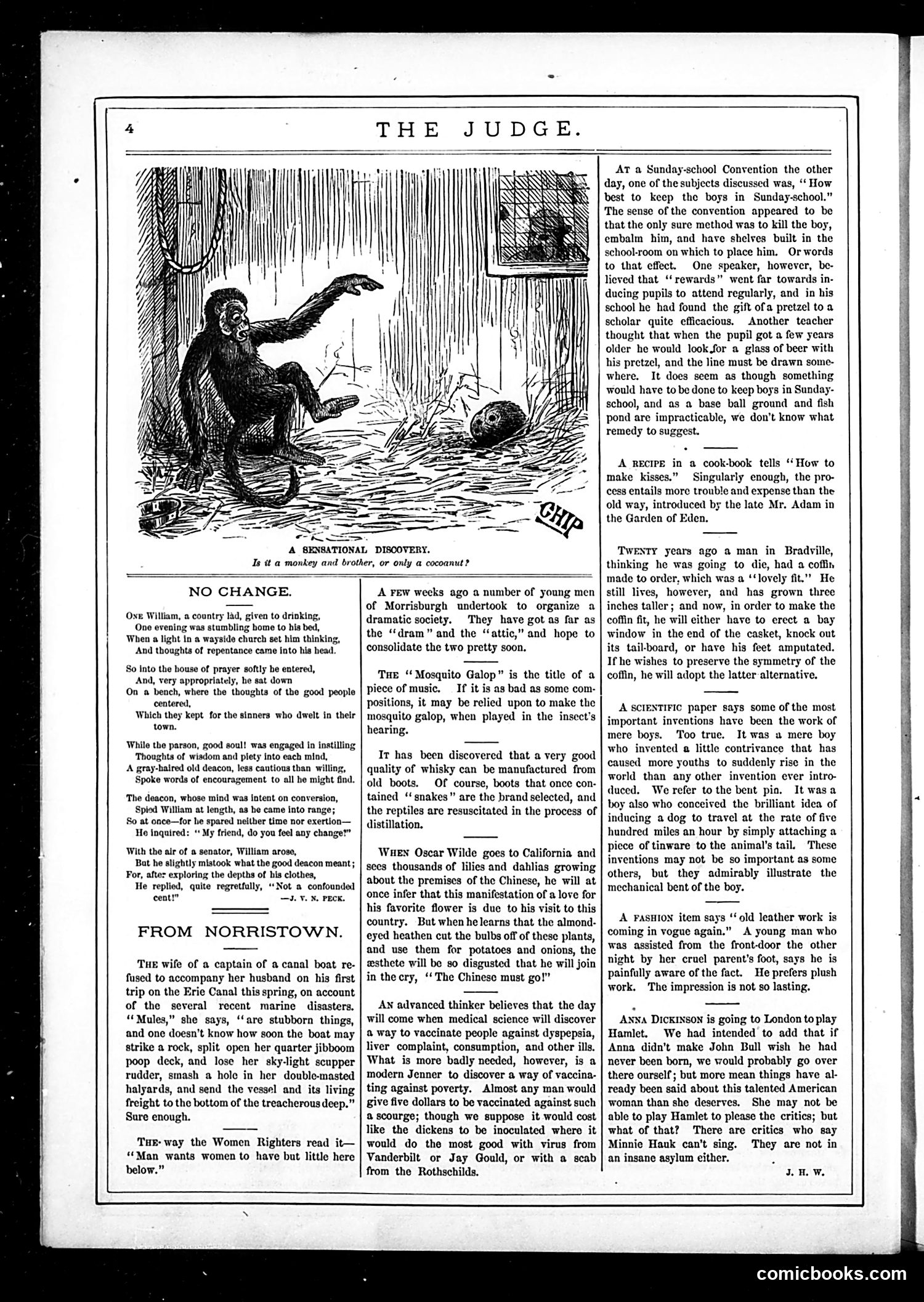
## Main Cartoon: "A Sensational Discovery" The large illustration depicts a monkey examining a coconut with the caption "Is it a monkey and brother, or only a cocoanut?" This satirizes contemporary debates about evolution and Darwinism. The visual pun mocks both evolutionary theory (questioning whether the monkey recognizes itself as related to humans) and racial pseudoscience that compared non-European peoples to primates. Judge presents this as absurdist humor, ridiculing the intellectual pretensions of those engaging in such comparisons. ## Accompanying Humor Pieces The page contains brief satirical anecdotes typical of Judge's format. "No Change" jokes about a drunk man misunderstanding a deacon's offer of spiritual salvation as a request for money. Other items mock contemporary topics: dramatic societies, the "Woman's Rights" movement, and caricatured depictions of Chinese immigrants and Oscar Wilde. The overall tone is lighthearted, irreverent satire aimed at American social foibles and contemporary intellectual fashions.
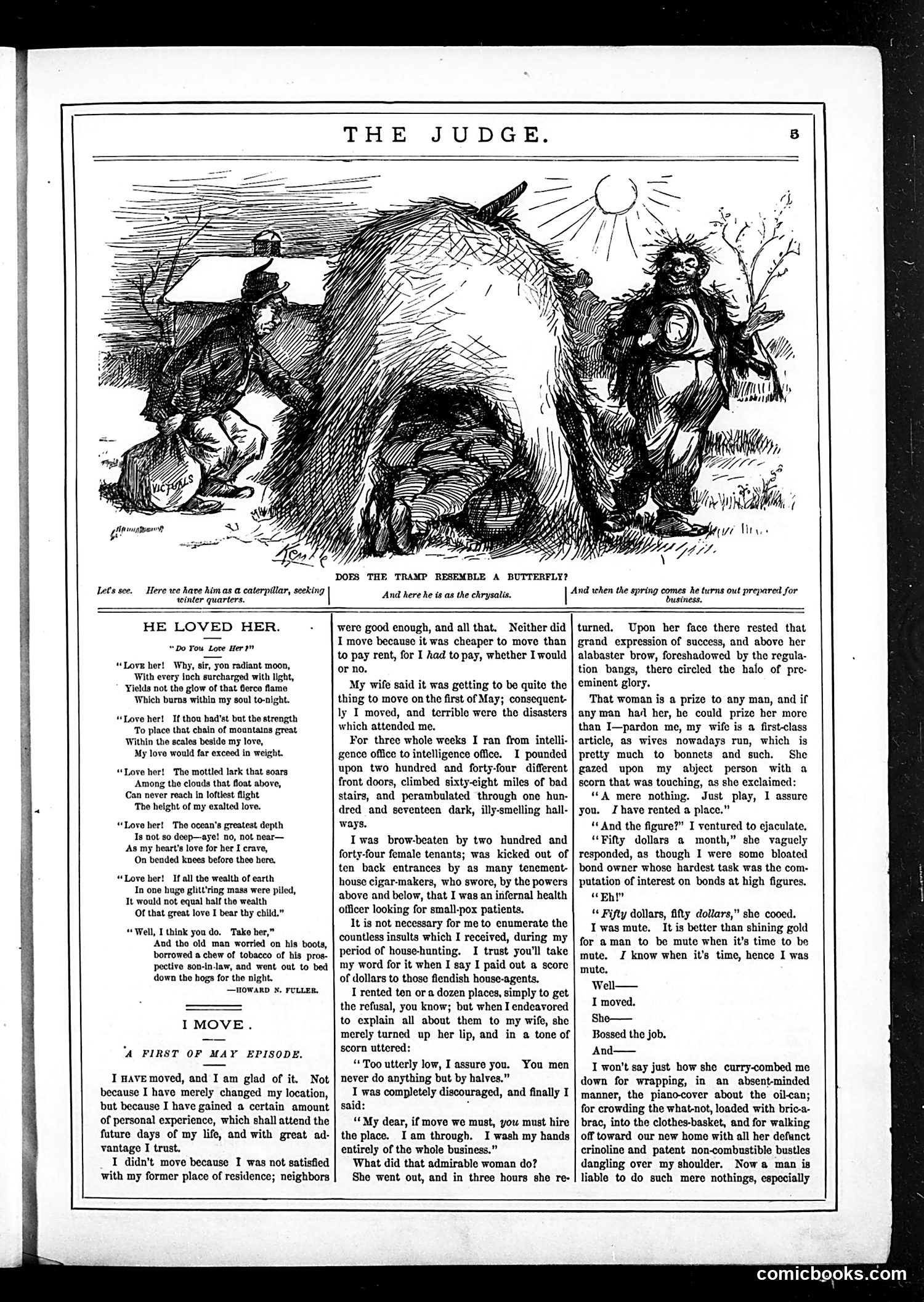
This page contains two satirical pieces typical of 19th-century American humor magazines. **"Does the Tramp Resemble a Butterfly?"** (top cartoon): A visual metaphor comparing a vagrant's seasonal transformation. The tramp appears in three stages—as a caterpillar (winter destitution), chrysalis (spring transition), and butterfly (summer readiness for work/panhandling). This satirizes how the poor adapted survival strategies seasonally, mocking both the tramp's cyclical poverty and perhaps society's indifference to it. **"He Loved Her" and "I Move"** (text pieces): Comic sketches about domestic life. The first ridicules overwrought romantic declarations through exaggerated poetic language. The second humorously chronicles the misery of moving day (apparently May 1st was common moving day), detailing the speaker's frustrating apartment-hunting experiences—duplicitous landlords, rude tenants, and dismissed properties—before his wife successfully negotiates housing, suggesting women's superior practical judgment. The humor targets both romantic excess and the genuine hardships of 19th-century urban life.
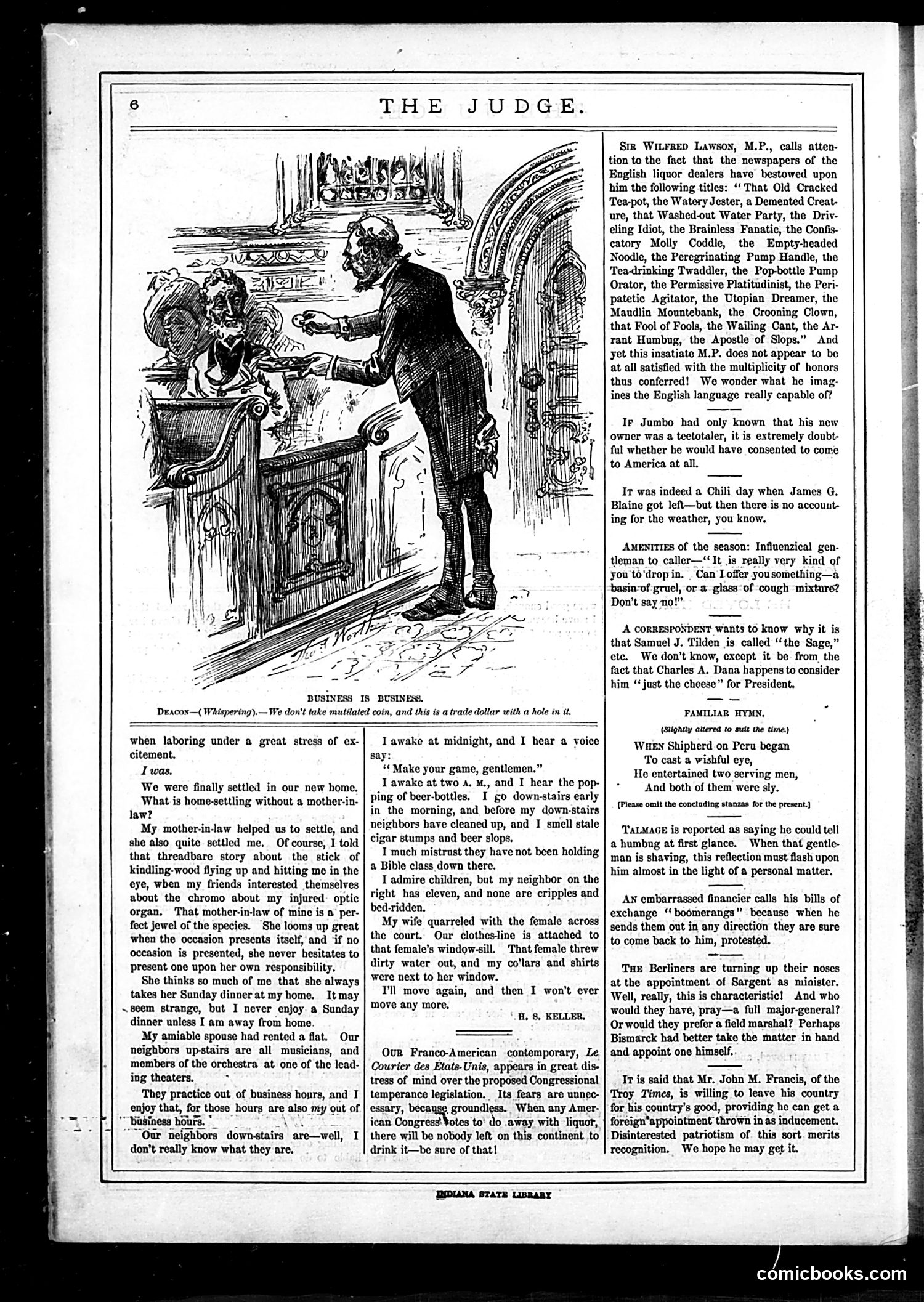
The main cartoon, titled "Business is Business," depicts a merchant refusing a damaged trade dollar coin with a hole in it. This satirizes commercial dishonesty during the Gilded Age—the merchant's whispered complaint highlights how businesses exploited technicalities to reject currency while conducting their own questionable practices. The page also contains H.S. Keller's humorous essay about urban apartment living's annoyances: noisy upstairs neighbors (musicians), rowdy downstairs neighbors (apparently gamblers and drinkers based on "Make your game"), and clothing line disputes. It's relatable domestic satire about crowded city life. Additional brief items mock British MP Wilfred Lawson (a temperance advocate mocked by liquor industry newspapers), reference Jumbo the elephant's recent arrival in America, and joke about Secretary of State James G. Blaine's political setbacks. The humor relies on recognizing contemporary figures and issues familiar to 1880s readers but now obscure.
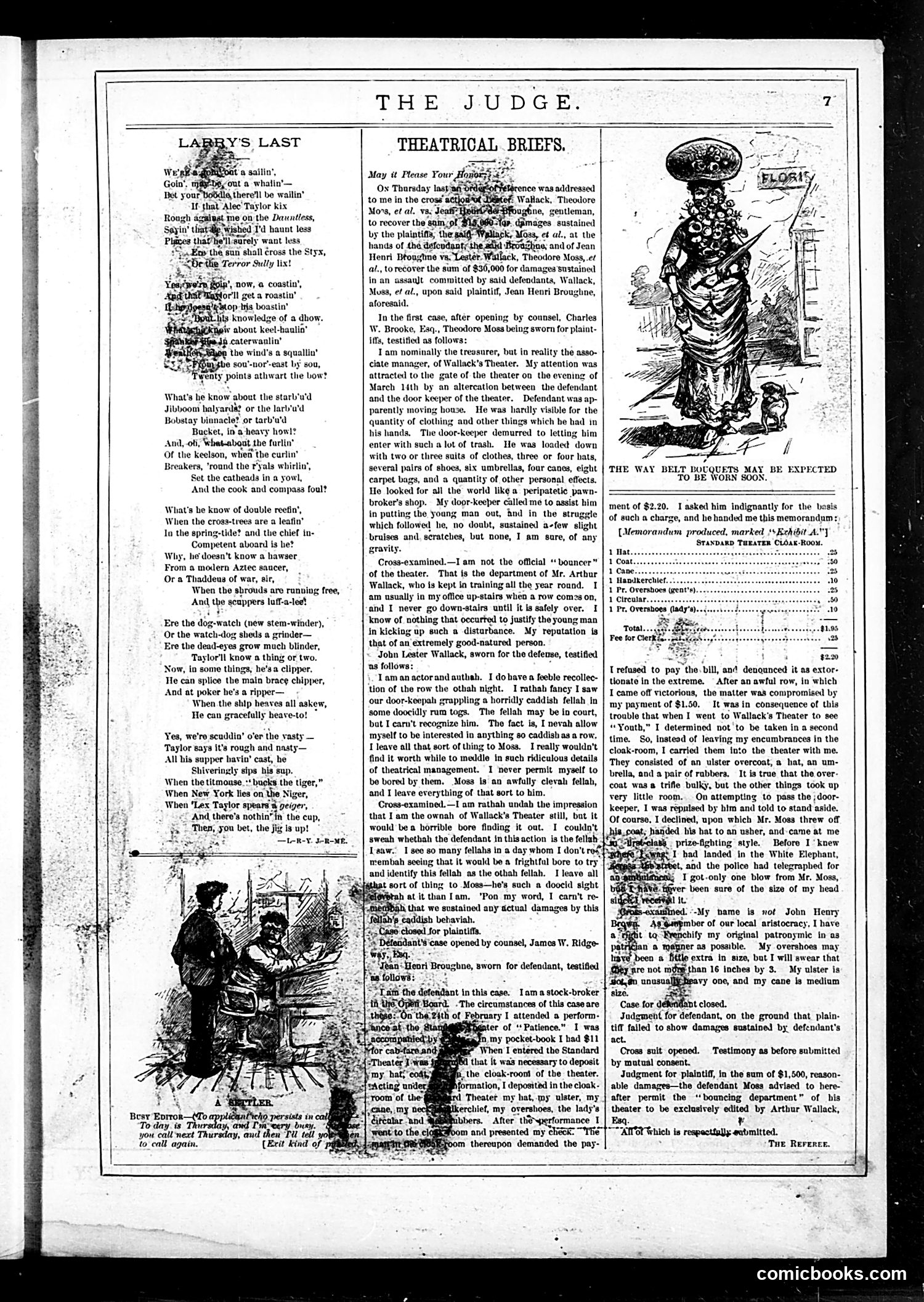
This page from the satirical magazine *Judge* contains two main sections: **"Larry's Last"** (left column): A comic poem mocking an incompetent sailor named Alec Taylor aboard a ship called the *Dauntless*. The verse ridicules Taylor's complete ignorance of nautical terminology and seamanship—he confuses basic maritime equipment and cannot perform sailor duties. The humor relies on nautical jargon and the contrast between his pretensions and actual incompetence. **"Theatrical Briefs"** (right column): A satirical legal report about lawsuits involving actors at Wallack's Theater, including Theodore Moss and others. The piece humorously describes a theater manager's testimony about a chaotic incident where a defendant arrived at the theater loaded with excessive personal belongings (clothes, hats, umbrellas, canes) resembling "a peripatetic pawn-broker's shop." The satire mocks both the theatrical world and overly formal legal proceedings through absurdist detail. Both sections use exaggeration and specialized vocabulary to satirize incompetence and pomposity.
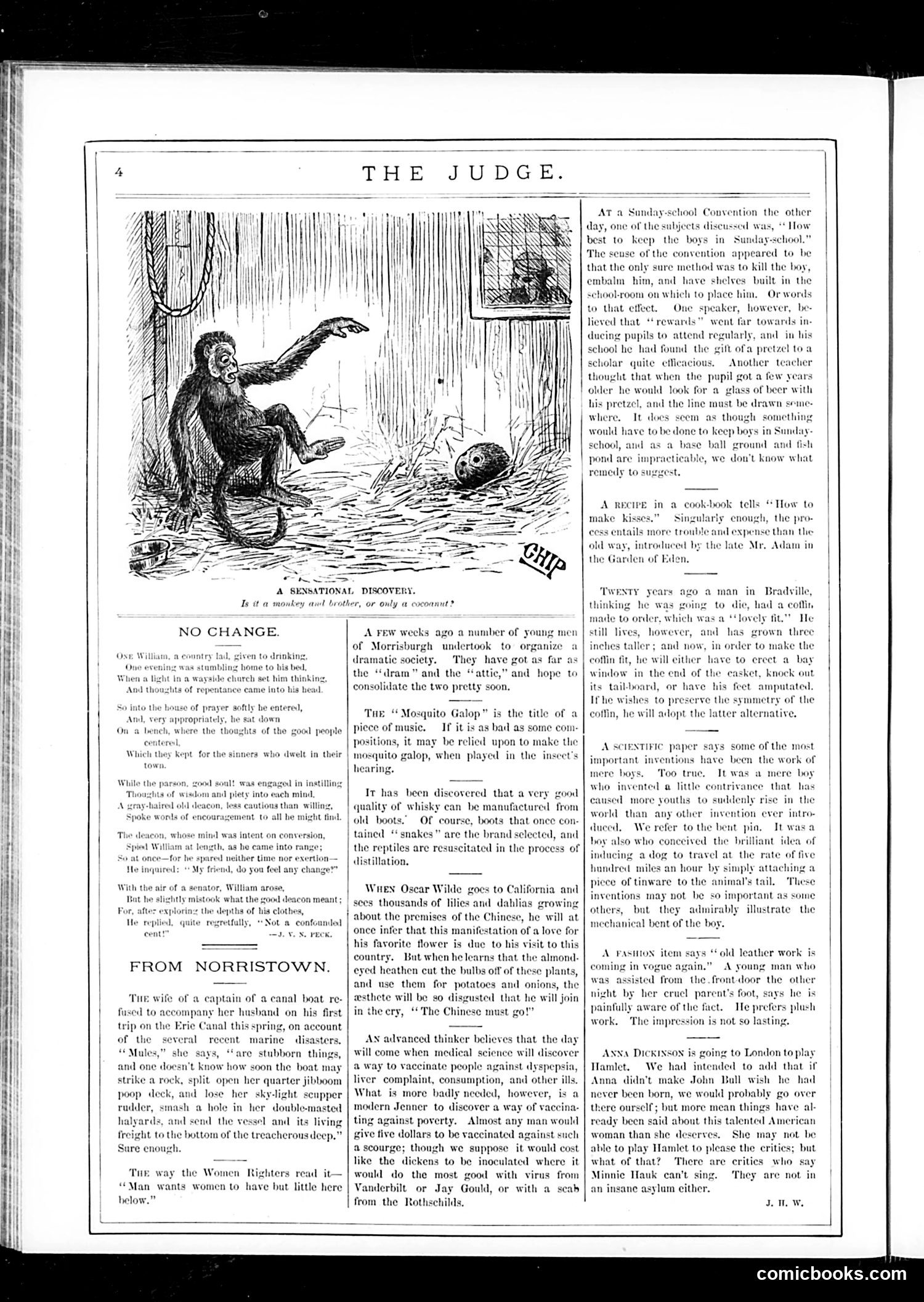
The main cartoon depicts a monkey or ape examining what appears to be a broth or soup pot, with the caption asking whether "it is a monkey aut broth" (likely "or a broth"). The joke appears to be a visual pun playing on the ambiguity of what's being shown—deliberately unclear whether we're looking at an animal or food. The surrounding text contains various humorous anecdotes typical of *Judge* magazine's satirical style, including stories about whisky distilled from old boots, Oscar Wilde's presumed vanity regarding flowers, and attempts to keep boys attending Sunday school (suggesting the only effective method would be to kill and embalm them). The humor reflects late-19th-century American sensibilities: mocking pseudo-scientific claims, poking fun at pretension, and offering sardonic social commentary on contemporary institutions. The tone is lighthearted absurdism rather than pointed political critique.
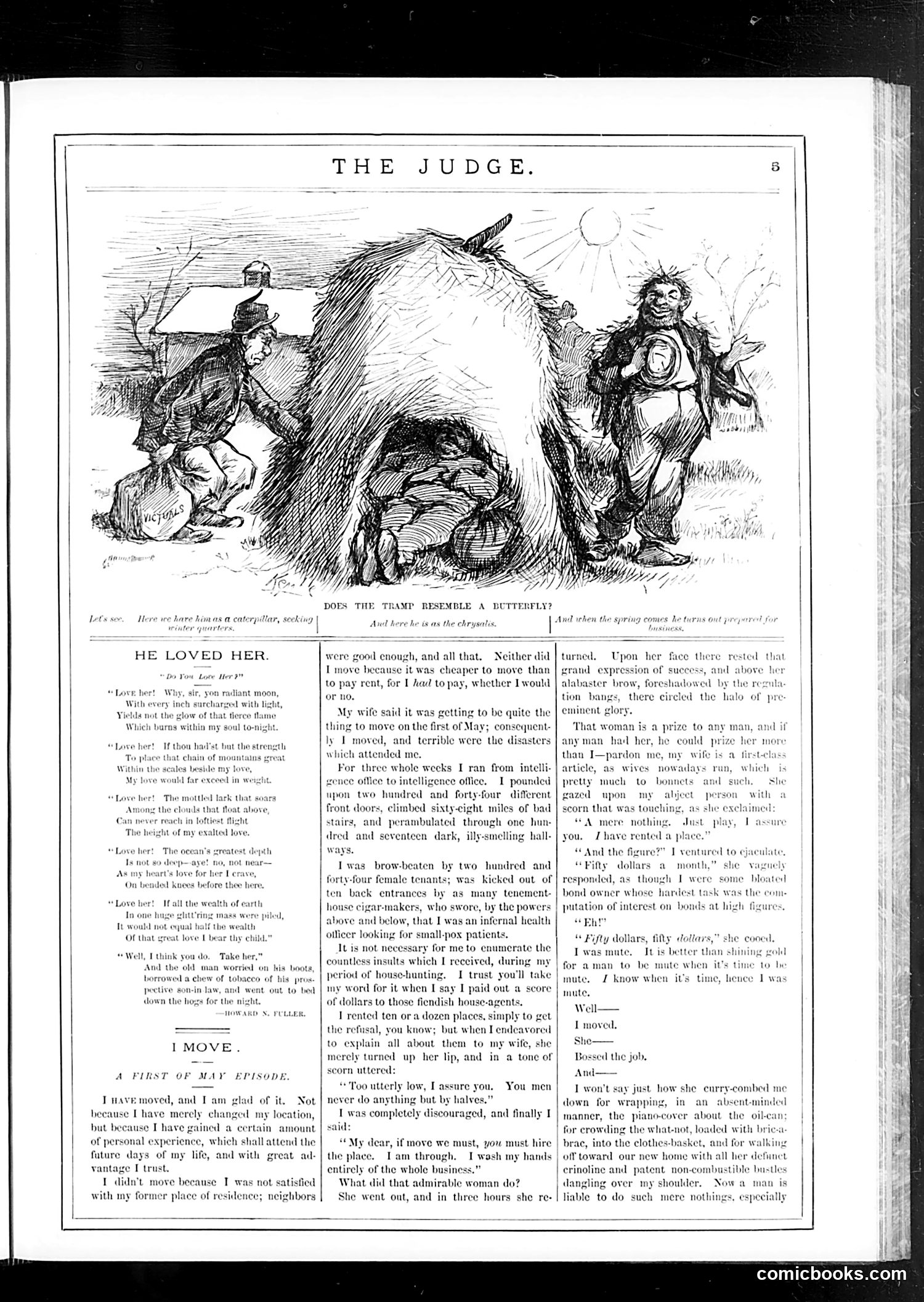
This page from *Judge* satirizes the moving day experience common in America (notably, "First of May" was traditionally moving day). **The Cartoon:** The top illustration, captioned "Does the Tramp Resemble a Butterfly?", appears to show a shabby vagrant figure amid belongings, metaphorically comparing the moving process to an ugly caterpillar—suggesting the chaos and degradation of relocating. **The Story:** "I Move" by Howard S. Fuller humorously chronicles a man's exhausting house-hunt. He pounds on 244 doors, climbs 68 miles of stairs, endures abuse from landlords and tenants, and pays $20 to agents. His wife finally takes over, hires a place for $50/month—which horrifies him—yet he grudgingly accepts her authority, concluding he's been "curry-combed" and dominated throughout. **The Satire:** The joke targets both moving-day anxiety and marital dynamics. The husband's helplessness and the wife's bossy competence reflects contemporary gender humor: despite romantic poetry about loving her, he ultimately has no say. The exaggerated misery (questioning tenants, hostile landlords) captures real Victorian-era housing frustrations.
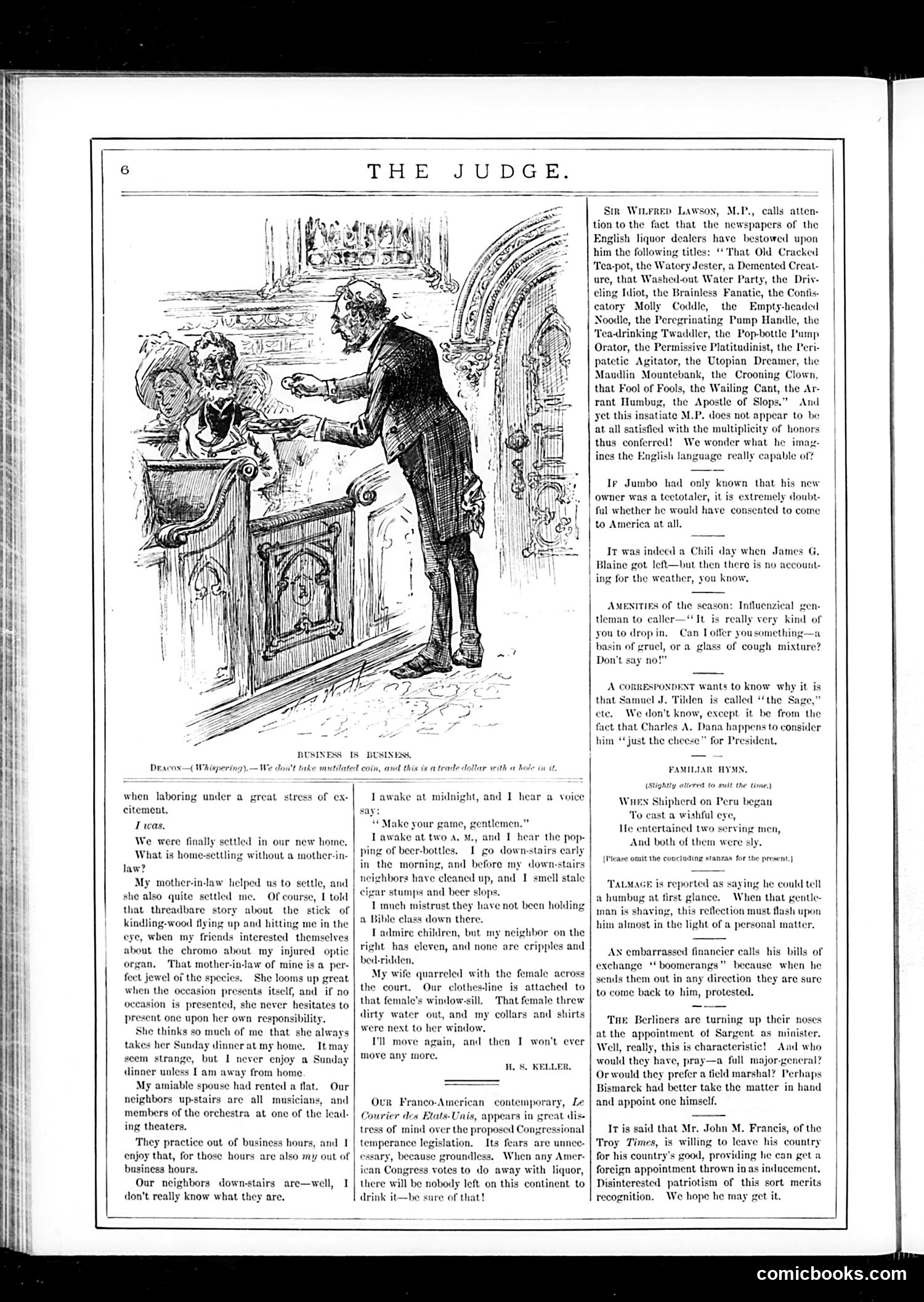
The main cartoon depicts a deacon (clergy member) whispering to what appears to be a parishioner, likely about accepting a counterfeit or damaged "trade dollar" coin in a business transaction—hence the caption "Business is Business." The satire mocks the hypocrisy of a supposedly moral religious figure compromising ethics for profit. The page's text includes complaints about noisy neighbors (musicians practicing at odd hours, beer-drinking neighbors), a dispute with a neighbor over clothesline placement, and commentary on political figures. Sir Wilfred Lawson, an English temperance advocate and M.P., is ridiculed by liquor dealers' newspapers with insulting epithets. The satirical point: institutions and individuals who claim moral authority—whether clergy, politicians championing temperance, or respectable citizens—often abandon principles when business interests or personal convenience intervene. The humor relies on exposing this gap between professed values and actual behavior.
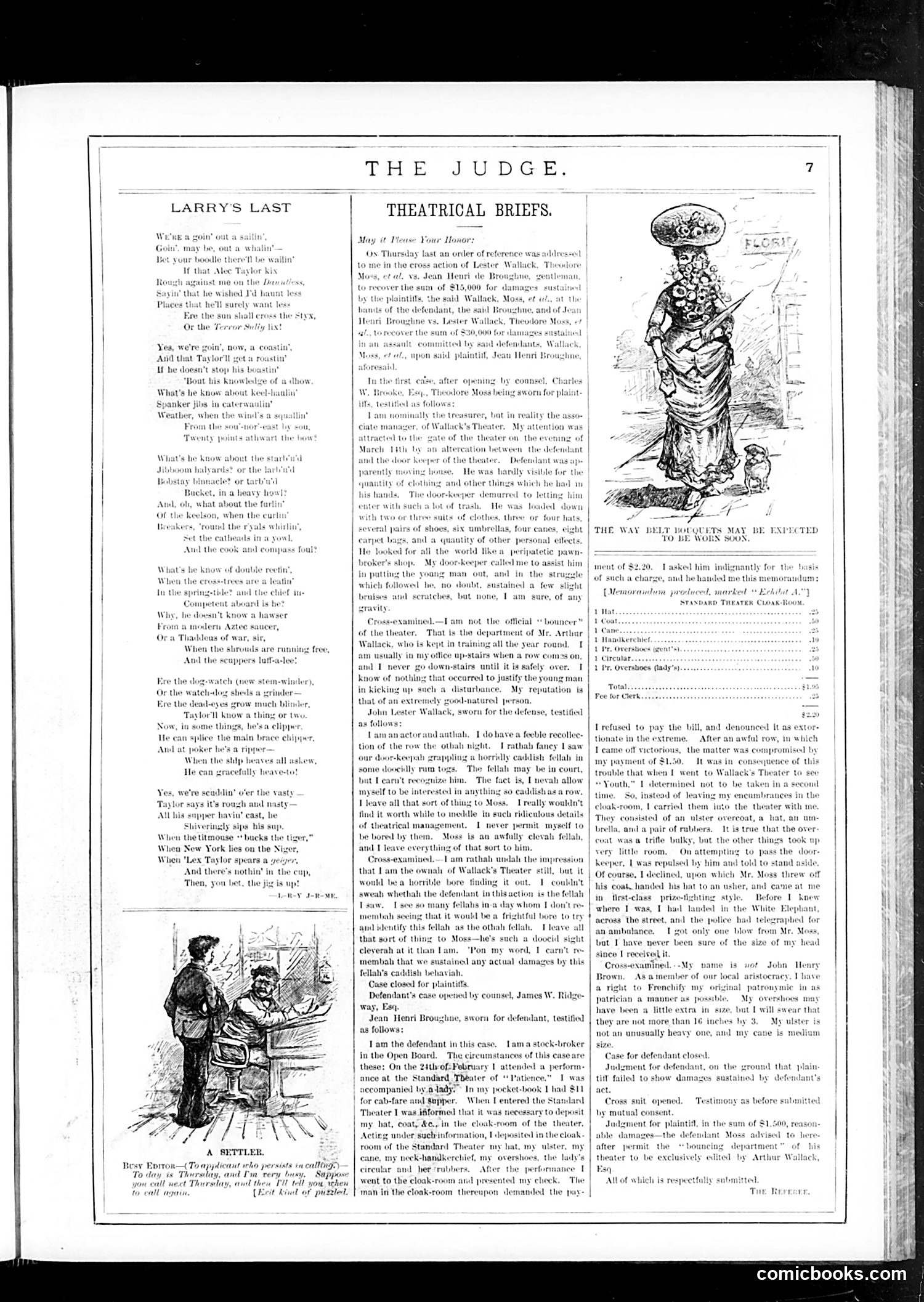
This page contains two distinct items: a humorous poem "Larry's Last" and a theatrical brief about a lawsuit. **"Larry's Last"** is a nautical comedy poem about an elderly sailor (Larry) who, despite extensive seafaring knowledge, is hilariously ignorant of landlubber matters. The repeated refrain "What's he know about..." mocks his specialized expertise—he understands rigging and ship operations but hasn't a clue about modern city life, theater, or civilized society. This is classic turn-of-the-century humor about cultural displacement and specialized ignorance. **The theatrical brief** reports actual court testimony from a lawsuit between theater owner **Lester Wallack** and performer **Jean Henri Broughton**. The dispute centers on a backstage altercation where Broughton allegedly damaged Wallack's belongings and clothing. Witnesses testify about the incident's circumstances. The case involves competing claims about financial damages and the nature of the confrontation—presenting theater-world drama as legal proceeding, perhaps commenting on theatrical personalities' volatility.
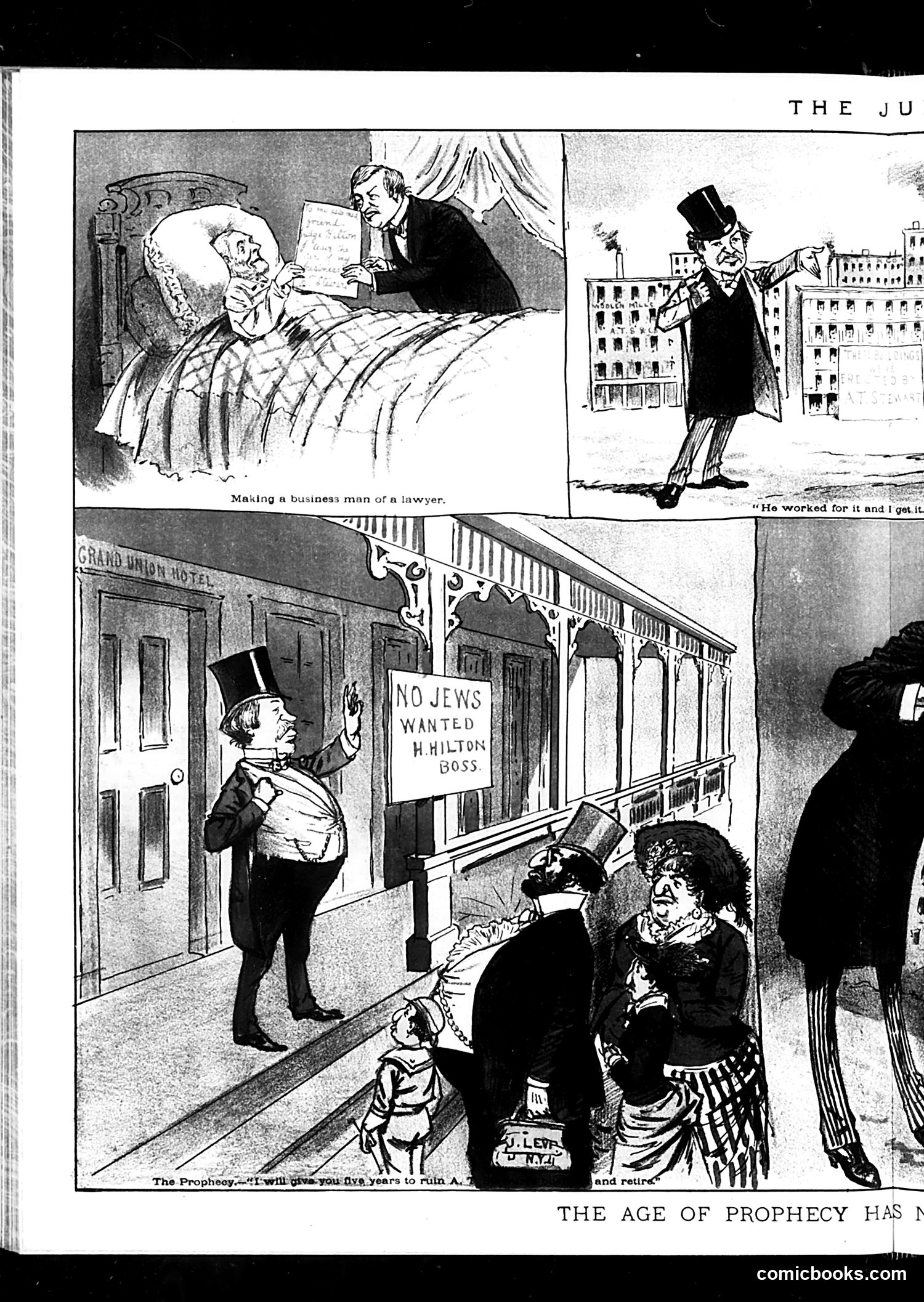
This page contains three satirical cartoons from *Judge* magazine: 1. **Top left**: "Making a business man of a lawyer" - depicts a woman in bed instructing a man, mocking the blurred line between legal and illicit business practices. 2. **Top right**: A man in formal dress with the caption "He worked for it and I got it" - likely satirizing inheritance or nepotism in business/politics. 3. **Bottom**: "The Prophecy" - shows a figure posting a sign reading "NO JEWS WANTED—HAMILTON BOSS" at the Grand Union Hotel, with people observing below. This directly satirizes antisemitic discrimination and exclusionary hiring/housing practices that were common in the era, presenting such prejudice as absurd and worthy of public ridicule. The page's overall theme appears critical of business ethics violations and discriminatory practices.
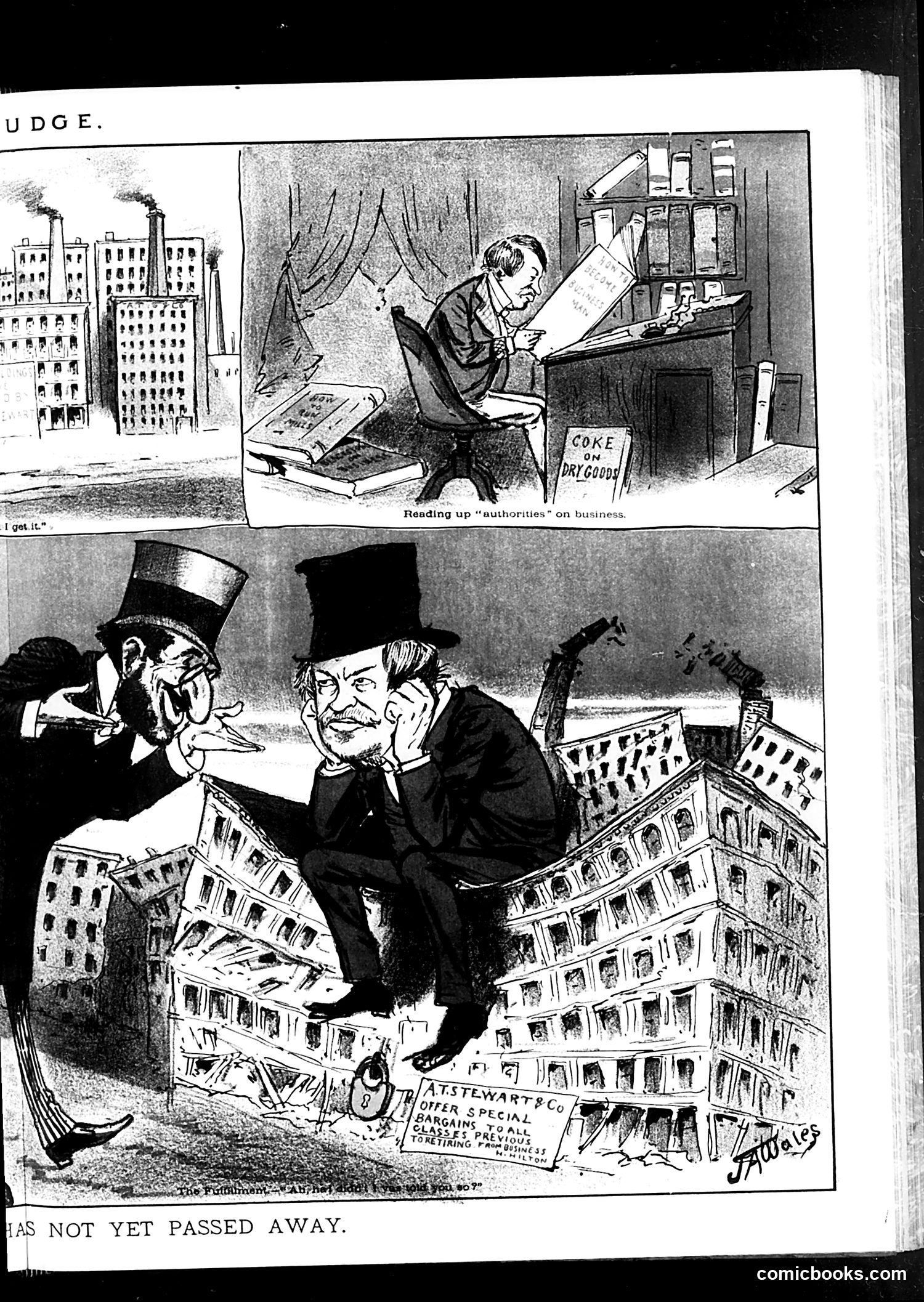
This page contains two satirical cartoons from *Judge* magazine. The **top cartoon** shows a businessman consulting "authorities" on business matters—referencing how companies cite expert guidance to justify decisions. The **bottom cartoon** depicts two well-dressed men in top hats sitting atop stacked apartment buildings, appearing smug and satisfied. A sign references "A.T. Stewart & Co." offering bargains on glass and previous stock "to all classes." This appears to satirize **wealthy landlords or merchants** profiting from real estate or goods sales, possibly mocking their exploitation of tenants or customers while claiming to serve "all classes." The caricatured facial features suggest these are specific identifiable figures, though their exact identities are unclear from the visible text. The overall theme suggests critique of business practices and wealth inequality during the Gilded Age era.
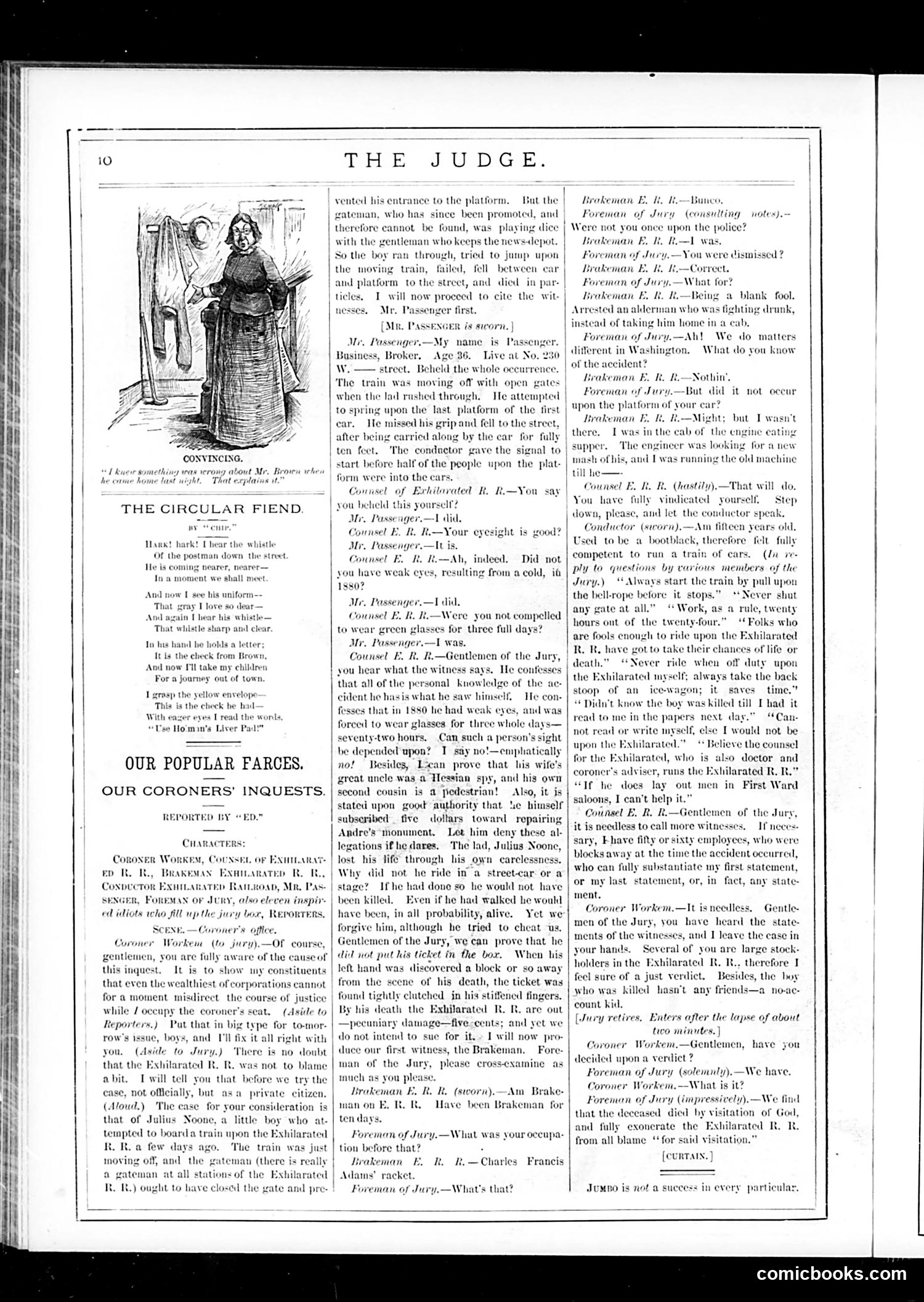
This page satirizes the legal system's ability to manipulate coroner's inquests through rhetorical sophistry and character assassination. The main sketch depicts a railroad accident where a boy, Julius Noone, dies trying to board a moving train. The **Counsel for the Exhilarated Railroad** (a deliberately absurd name) cross-examines the witness, Mr. Passenger, systematically destroying his credibility through irrelevant attacks: questioning his eyesight because he once wore glasses, implying his relatives were spies or pedestrians, and suggesting the boy himself was at fault. The satire targets how corporate defendants (here, the railroad) used lawyers to obscure responsibility through character attacks rather than addressing facts. The counsel's strategy—making the victim blame-worthy and the witness unreliable—reflects Judge magazine's critique of how wealthy corporations escaped accountability in Gilded Age courts despite obvious negligence. The "Circular Fiend" poem above is unrelated humor about a postman's visits.
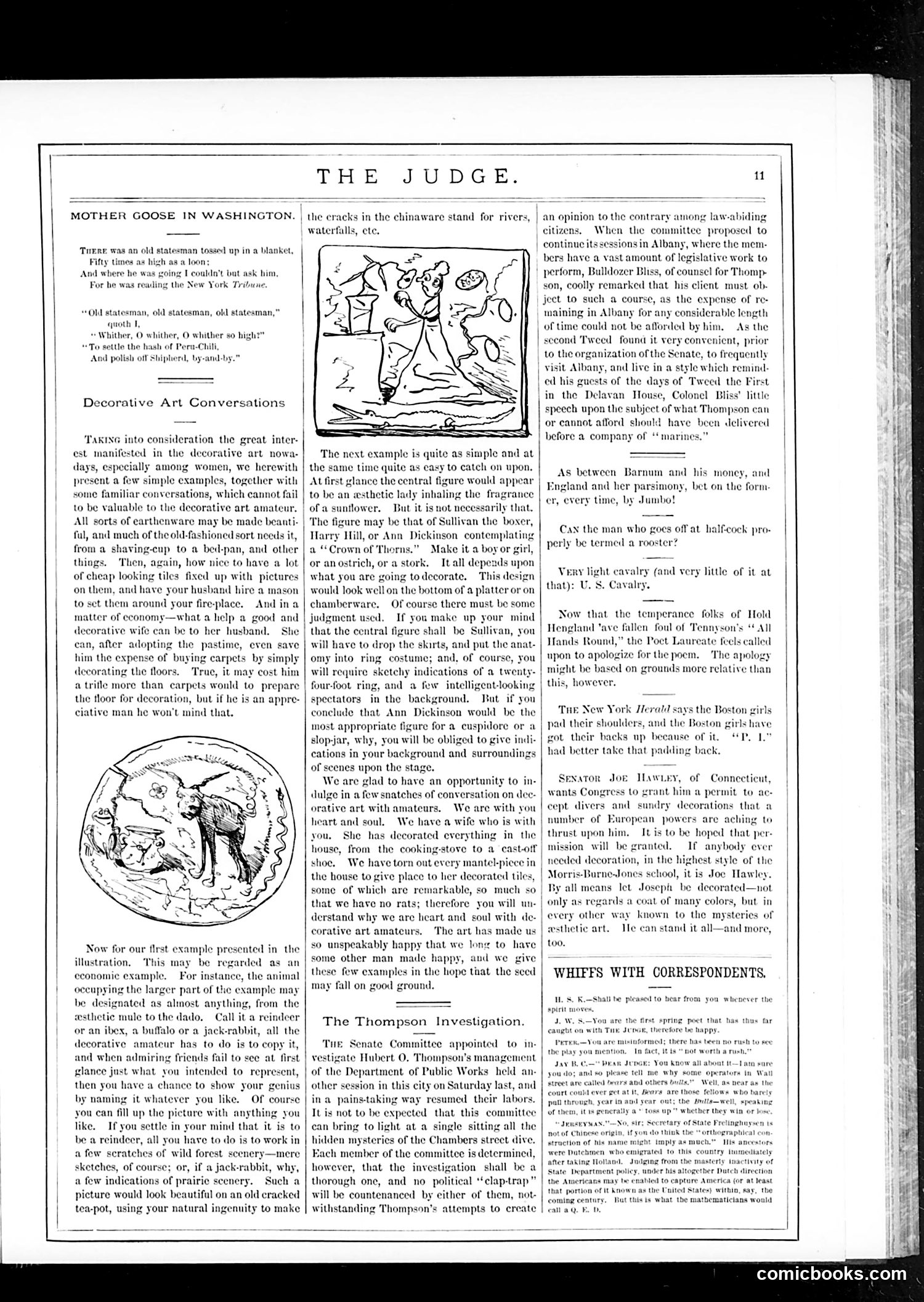
This page contains two satirical sections from *Judge* magazine: **"Mother Goose in Washington"** presents a nursery-rhyme parody mocking an unnamed old statesman who is "tossed up in a blanket" while reading the *New York Tribune*. He declares he's going to "settle the hash of Peru-Chili / And polish off Shiperd, by-and-by"—likely referencing 19th-century diplomatic disputes over Peru-Chile relations and an obscure political figure named Shiperd. The satire ridicules how politicians appear disconnected from reality while obsessing over foreign affairs. **"Decorative Art Conversations"** humorously mocks the Victorian craze for amateur decorative art, particularly among women. Judge satirizes the pretentiousness of decorating household items (teapots, chamber pots, tiles) with vague animal drawings that could represent anything—a mule, ibex, or jack-rabbit—depending on whatever the decorator claims. The satire suggests this trend is economical nonsense dressed up as artistic sophistication. Both sections exemplify *Judge's* satirical approach to contemporary social and political absurdities.
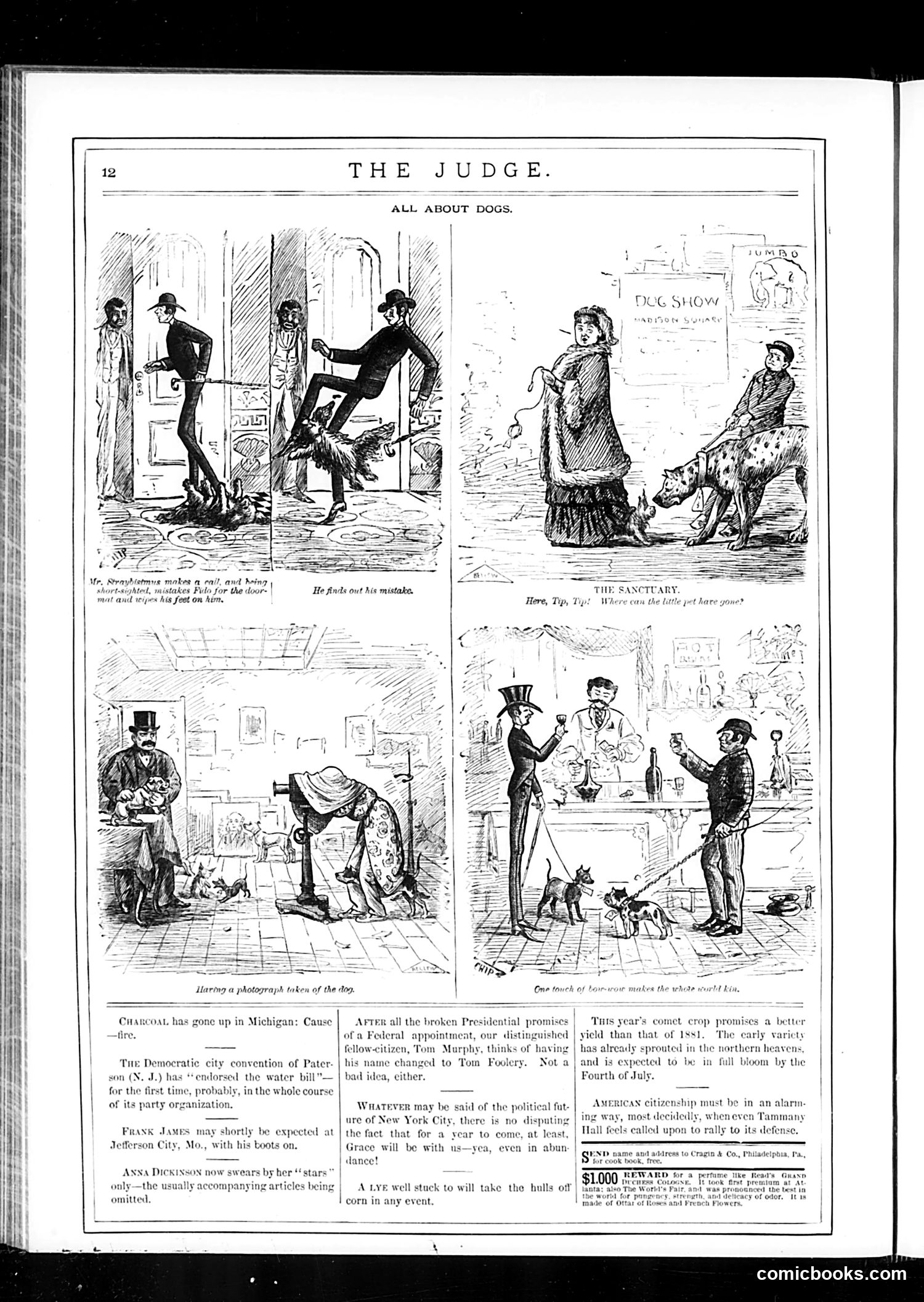
This page contains four comic vignettes satirizing Victorian-era dog ownership and society's pretensions around pets. **The cartoons mock:** 1. **Upper left**: A man's embarrassment when his supposedly well-behaved dog misbehaves in public—the humor lies in the disconnect between owner expectations and reality. 2. **Upper right** ("The Sanctuary"): A woman protecting her dog from a boy, playing on sentimental attitudes toward pets as innocent creatures needing protection. 3. **Lower left**: A man awkwardly posing his dog for a photograph—satirizing the era's emerging photography hobby and people's vanity in documenting their possessions. 4. **Lower right**: Men at what appears to be a tavern with small dogs, likely mocking the arbitrary social rules around where dogs belong. The scattered text items are typical Judge filler—brief political jokes about Charcoal prices in Michigan, Tom Murphy's federal appointment hopes, and Anna Dickinson's eccentric behavior. These aren't coordinated with the dog cartoons; they're just editorial padding common to 19th-century satirical magazines.
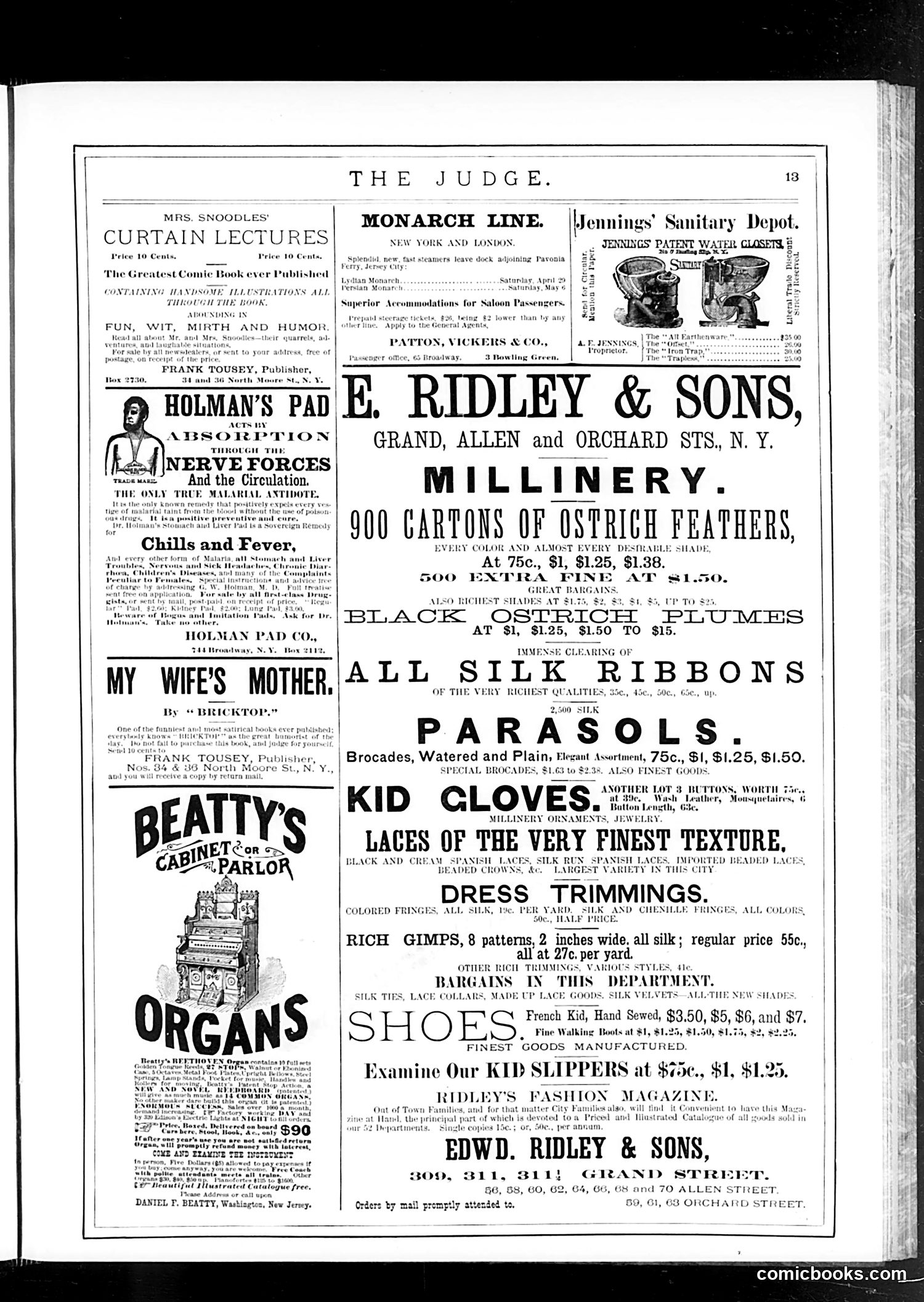
This is primarily an **advertising page**, not a satirical cartoon page. It's page 13 from *Judge* magazine, but the content is dominated by commercial advertisements rather than editorial satire. The page features ads for: - Mrs. Snoodles' "Curtain Lectures" (a humorous book) - Holman's Pad for nerve problems - Beatty's Cabinet Organs - E. Ridley & Sons, a major New York millinery and clothing retailer The Ridley's ad is the largest, promoting ostrich feathers, silk ribbons, parasols, kid gloves, laces, dress trimmings, and shoes—typical late 19th-century women's fashion items. There is **no identifiable political cartoon or satire** on this page. It appears to be a typical issue of *Judge* where editorial content shared pages with paid advertisements. The humor content is limited to book/product titles and marketing copy.
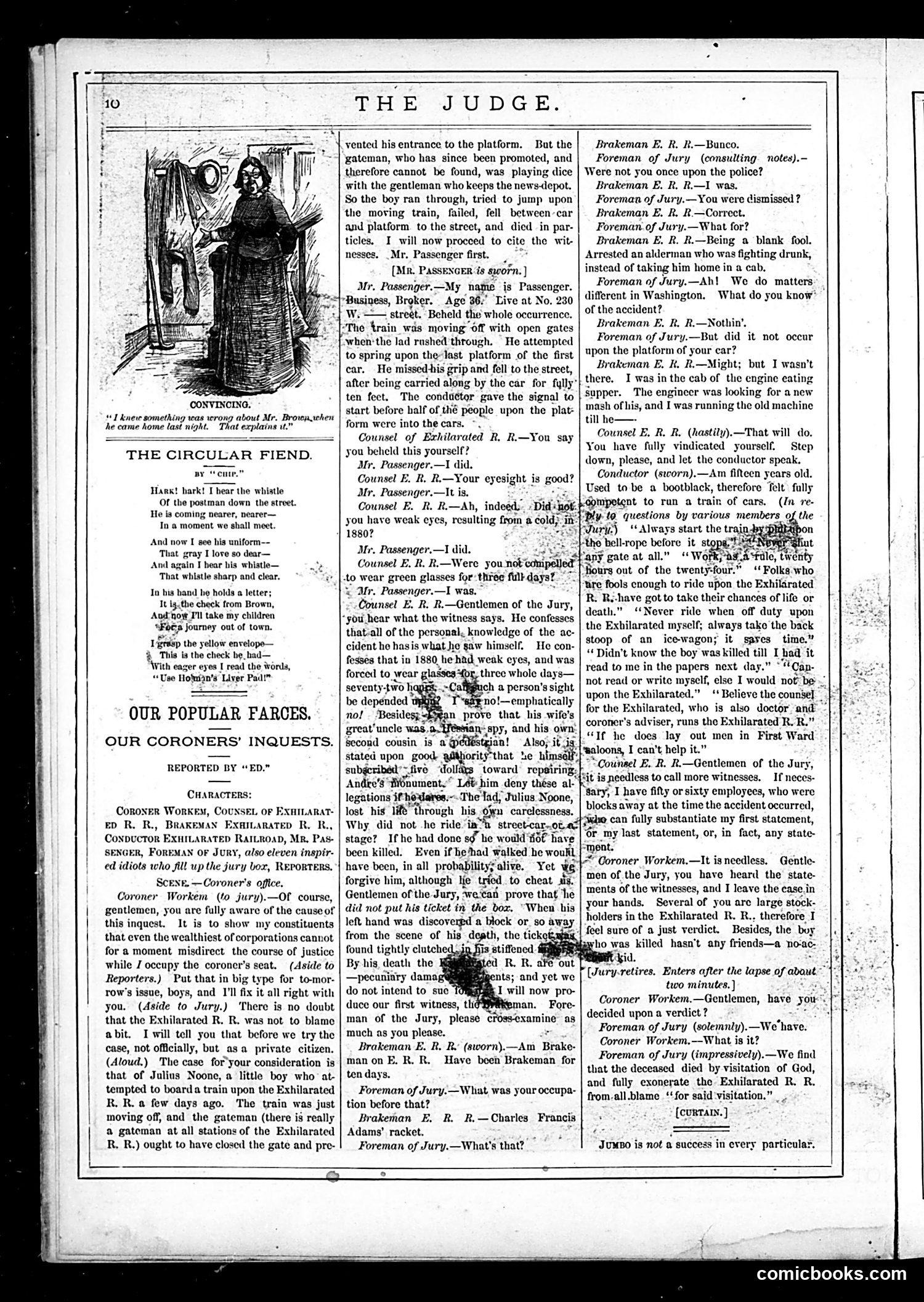
This page contains a coroner's inquest sketch satirizing railroad corporations' ability to evade accountability for deaths. A boy named Julius Noone was killed trying to board a moving train on the "Exhilarated Railroad," and the coroner—clearly complicit with the railroad—stages a rigged investigation. The satire targets how the railroad's lawyer discredits the eyewitness (Mr. Passenger) through absurd ad hominem attacks: because the witness wore glasses for a cold in 1880, his testimony about what he saw is supposedly unreliable. The lawyer then pivots to irrelevant character assassination (claims about the witness's wife's relatives). The coroner himself admits bias before the trial begins, joking with reporters he'll write favorable coverage in exchange for favorable reporting. The sketch exposes how wealthy corporations manipulated legal proceedings and public officials to escape responsibility for worker/passenger deaths—a major Progressive-era concern during railroad expansion.
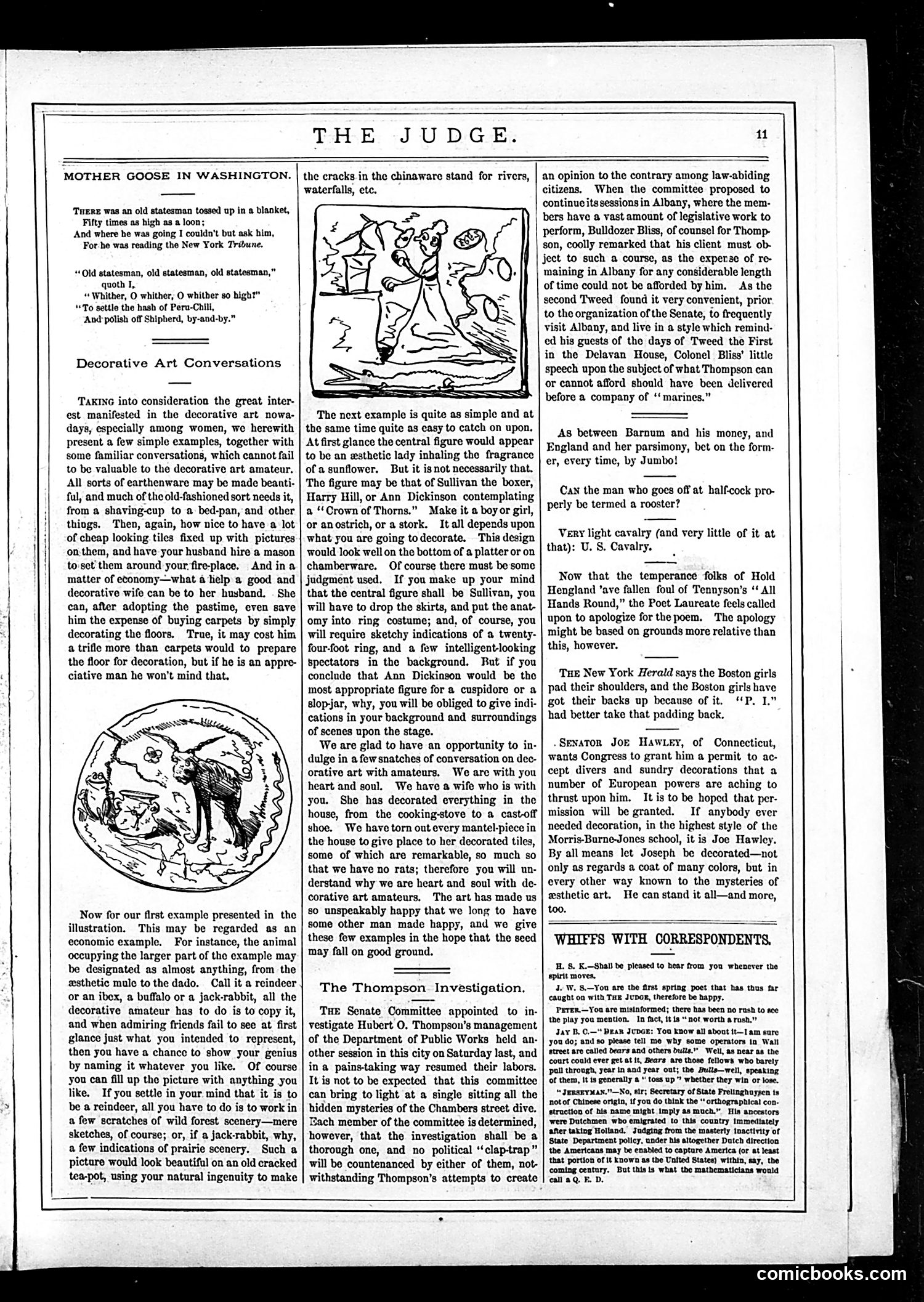
This page satirizes decorative art's growing popularity among amateur enthusiasts, particularly women, in the late 19th century. **The "Mother Goose" poem** mocks a statesman reading the *New York Tribune* while being tossed in a blanket—suggesting absurdity in political posturing and journalism. **The "Decorative Art Conversations" section** presents tongue-in-cheek advice for decorating household items (cracked teapots, platters, chamber pots). The humor lies in suggesting amateur decorators can paint *anything* on objects and call it whatever they wish—a boxer, Ann Dickinson (a famous orator), or an ostrich—without skill mattering. The illustrations show ridiculous examples: a wild animal scene and a figure inhaling a flower that could represent various subjects depending on the decorator's imagination. **The satire targets:** the pretentiousness of the decorative arts movement, amateur artists' lack of actual ability, and the notion that anyone could create "art" by simply naming their work after famous figures, regardless of resemblance.
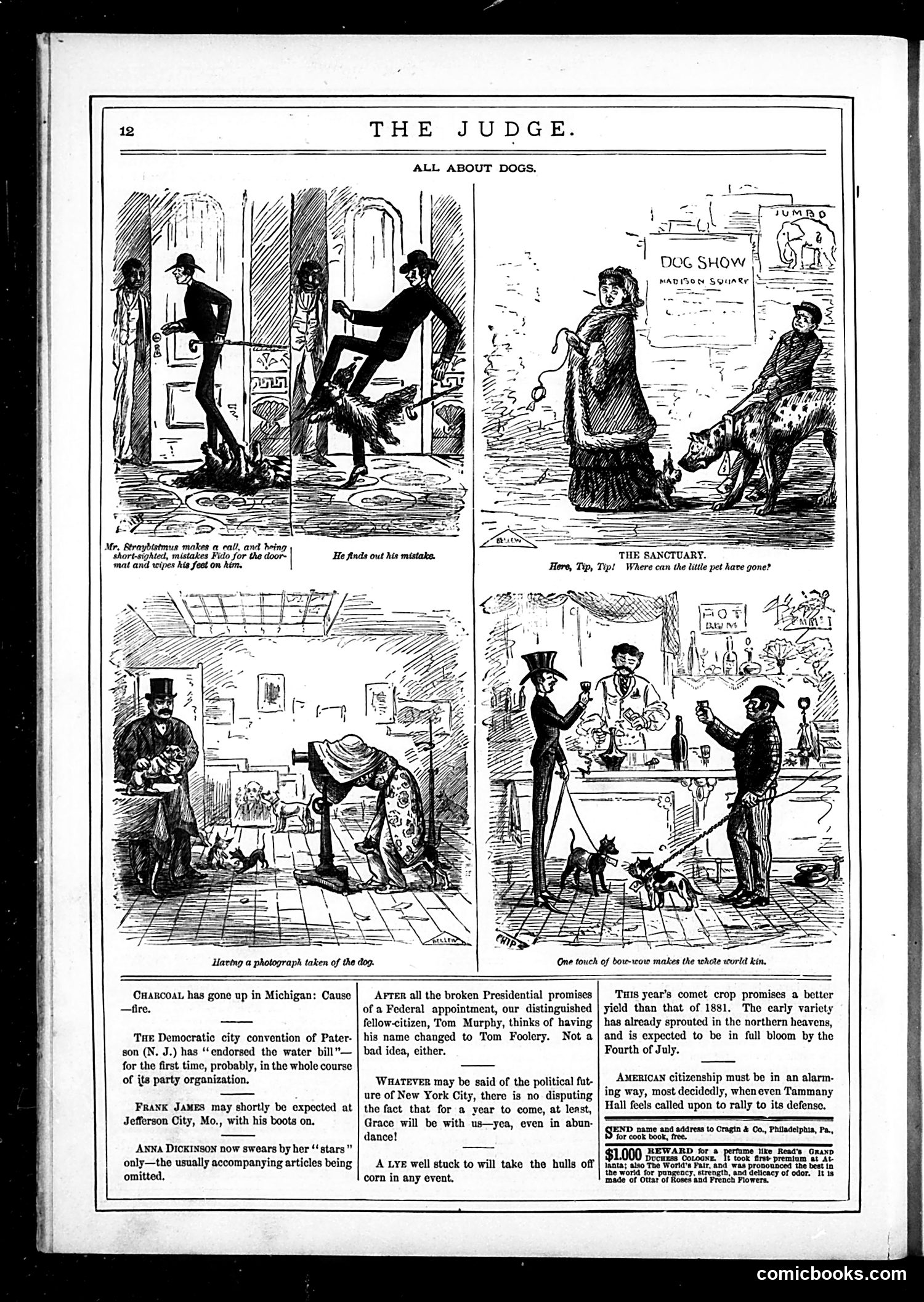
This page from Judge combines four humorous dog-related cartoon vignettes with brief political commentary. The cartoons depict everyday situations involving dogs: a myopic man mistaking a dog for a doormat and wiping his feet on it; people searching for a lost pet; a dog being photographed; and a bar scene where a small dog causes social upheaval. The accompanying text contains satirical jabs at contemporary politics and figures. References include: Michigan charcoal prices, Paterson's water bill endorsement, outlaw Frank James, abolitionist Anna Dickinson's speech style, Tom Murphy's broken Federal appointment promises (mocking him as "Tom Foolery"), Grace (likely a political figure in New York), Tammany Hall's civic defense efforts, and comet predictions. The humor relies on wordplay and topical political references now obscure without historical context. A patent medicine advertisement appears at bottom—typical period magazine content.
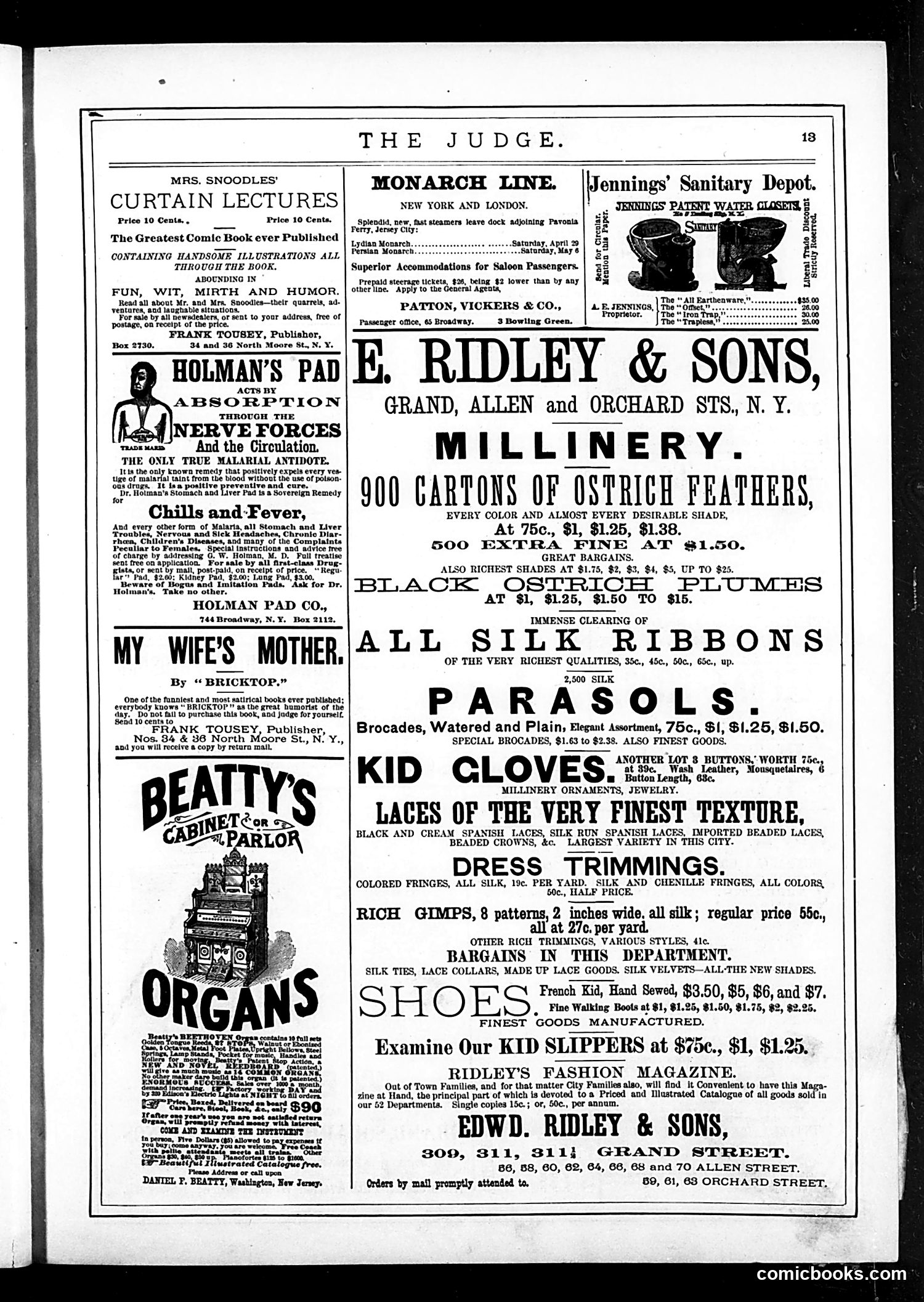
This page is primarily a collection of advertisements for 1880s-era commercial products and services, with no discernible political cartoons or satire. The main content includes ads for E. Ridley & Sons millinery business (prominent center), selling ostrich feathers, silk ribbons, parasols, and kid gloves at various price points. Surrounding advertisements promote patent medicines (Holman's Pad for nerve ailments, Patton Vickers shipping line), books including "Mrs. Snoodles' Curtain Lectures" and "My Wife's Mother" by "Bricktop," plus Beatty's Cabinet Organs. The one potential satirical element is a book advertised as "My Wife's Mother," which the blurb claims "Bricktop" made famously comedic—suggesting the mother-in-law was already a familiar figure of fun in 1880s American culture. Otherwise, this appears to be a standard advertising page from Judge magazine rather than satirical content.
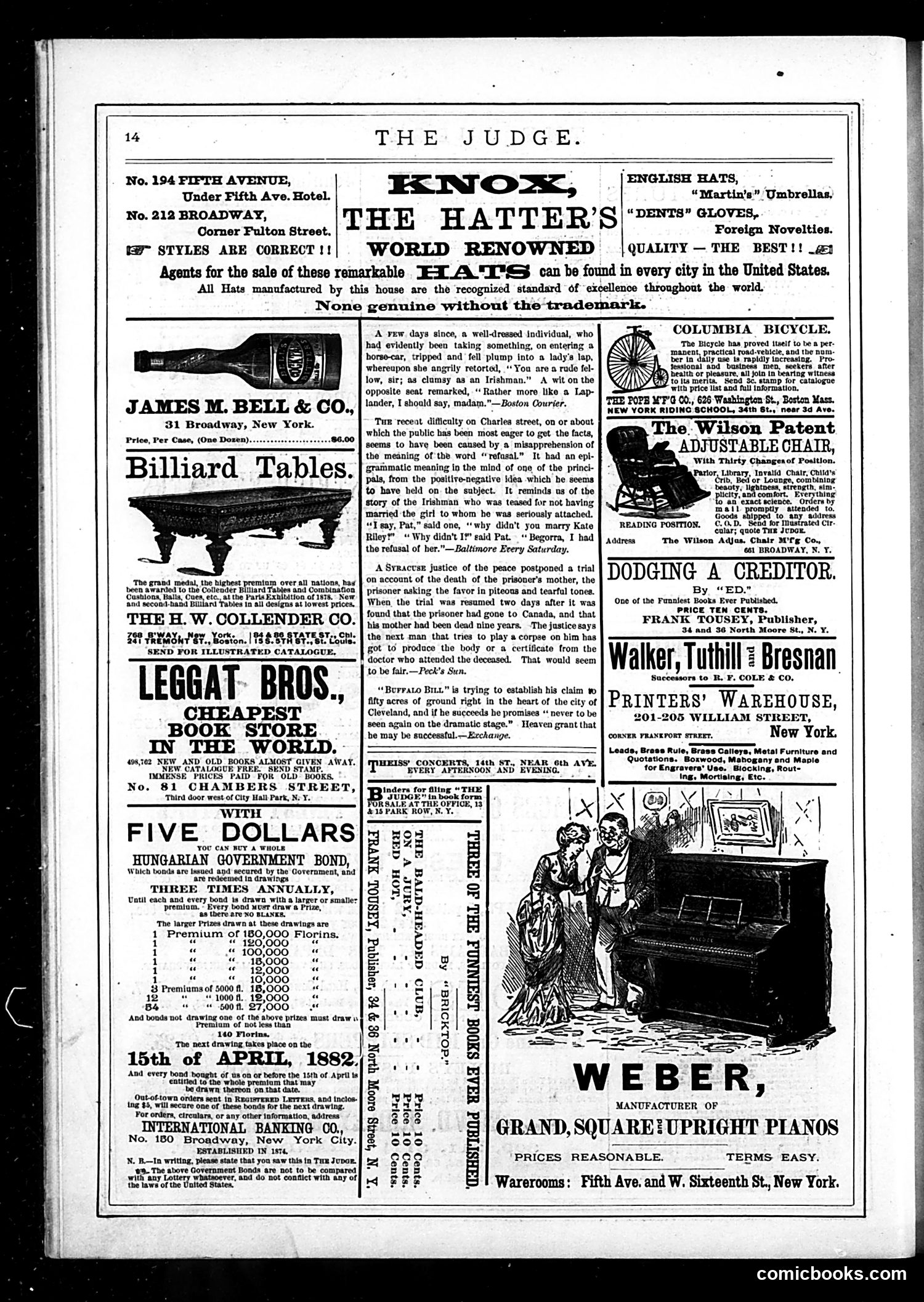
This is primarily an **advertising page** from Judge magazine (circa 1882, based on the April 15 drawing date visible). The page contains multiple paid advertisements for products like hats, billiard tables, books, and pianos, interspersed with brief humorous anecdotes. The small comic content includes: - A **piano advertisement** featuring an illustration of people at a piano with the caption "HERE'S THE CORNER BROKER EVERY FURNISHED"—likely a pun about financial speculation - Several **short jokes** about verbal misunderstandings: one about calling someone a "Laplander" (clumsy), another about an Irish phrase "the refusal of her" (meaning he had the choice to marry her), and a final anecdote about a prisoner's mother supposedly dying but the prisoner fleeing to Canada instead These jokes rely on **puns and ethnic stereotypes** (particularly Irish stereotypes common to 19th-century American humor). The satire is mild—mostly wordplay rather than political commentary. The page is dominated by commercial advertising, which was typical for 19th-century satirical magazines.
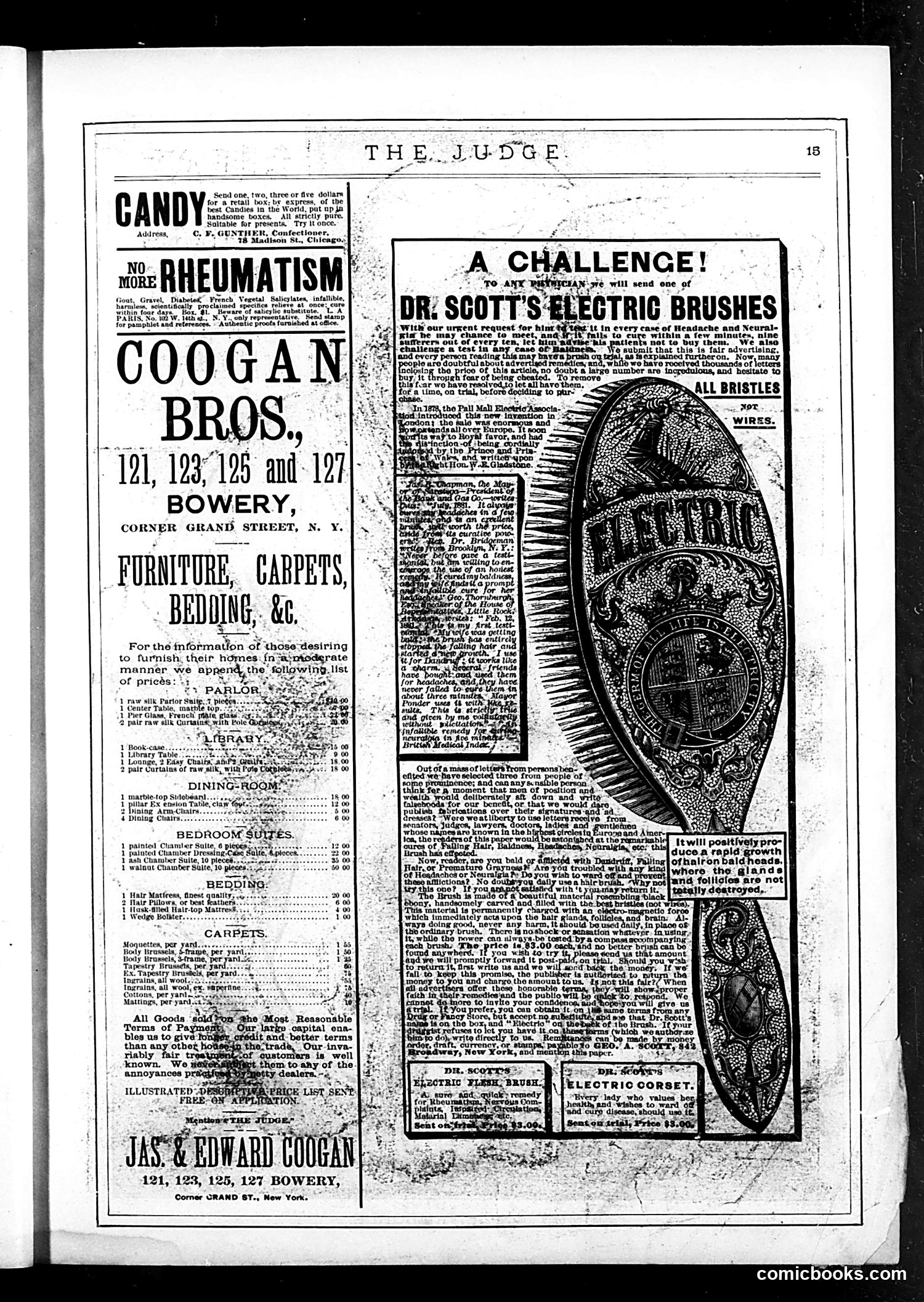
This page is primarily **advertising**, not editorial cartoon content. It contains multiple commercial advertisements from the 1880s-90s era placed in *Judge* magazine. The notable ads include: **Coogan Bros. Furniture** (left side) - A standard furniture/home goods listing at their Bowery location. **Dr. Scott's Electric Brushes & Corset** (center/right) - A pseudo-medical product advertisement making dubious health claims. The "challenge" promises the brushes cure rheumatism, neuralgia, and baldness through electrical stimulation. This represents the era's widespread **quack medicine industry**, where electrical devices were marketed as cure-alls despite lacking scientific validity. The detailed testimonials and scientific-sounding language were typical marketing tactics exploiting consumers' desperation. **Other ads** include candy, rheumatism pills, and unrelated products. The satire here is **implicit rather than explicit** — *Judge* published these ads alongside its satirical content, likely allowing readers to recognize the absurdity themselves. No specific political figures are caricatured on this page.
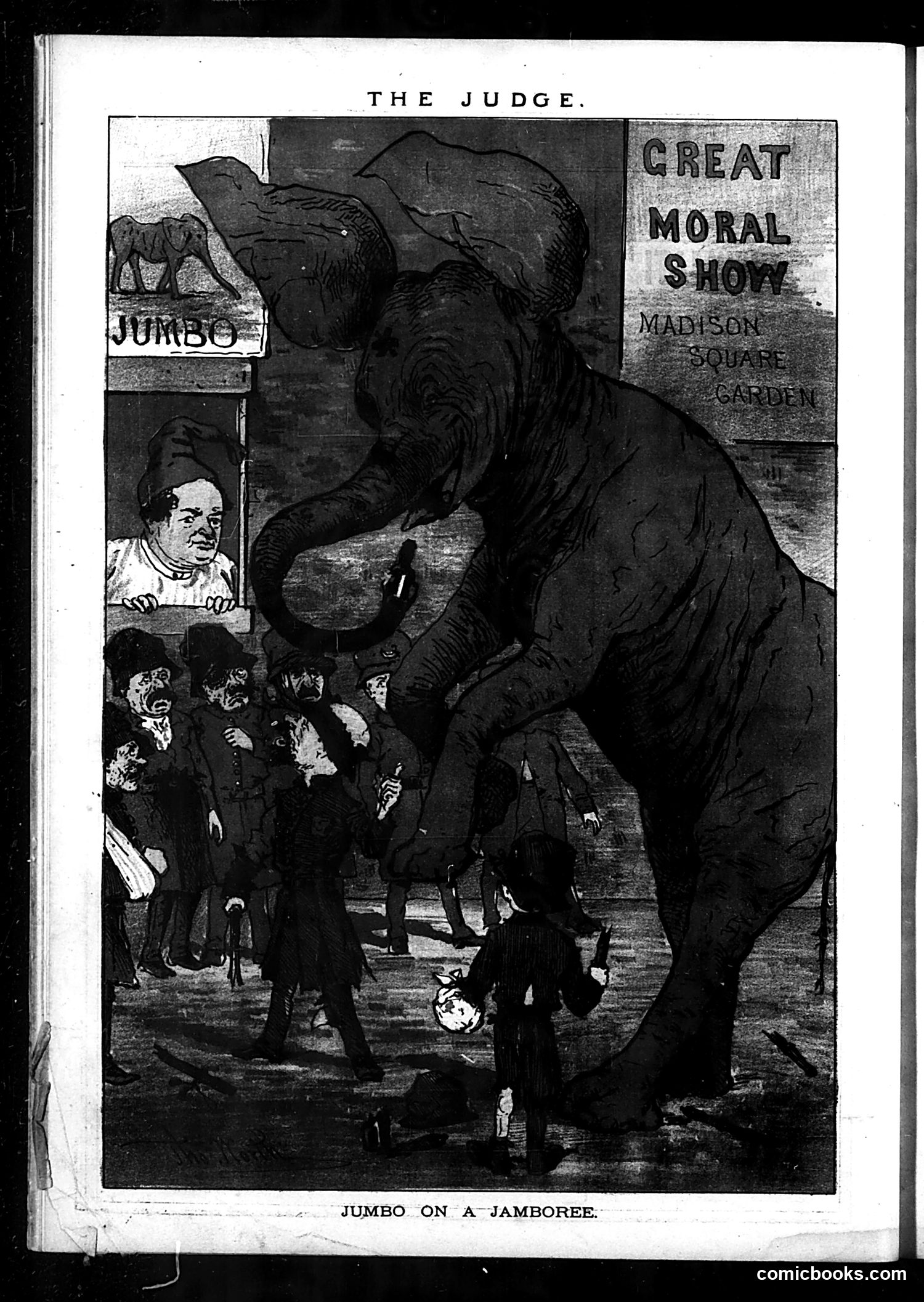
This satirical cartoon from *Judge* depicts a massive elephant labeled "Jumbo" (likely referencing P.T. Barnum's famous circus elephant) surrounded by small human figures at what appears to be a public event or "jamboree." The signs visible include "Great Moral Show" and "Madison Square Garden," suggesting this references a real exhibition. The satire appears to mock either the spectacle of Barnum's circus attractions or a specific public event where crowds gathered around a novelty. The disproportionate scale—the enormous elephant towering over tiny people—emphasizes how such attractions captivated and dominated public attention and civic spaces. Without additional context about the specific historical moment, the exact political target remains unclear, though the cartoon clearly critiques either commercialized entertainment, public gullibility, or the invasion of respectable venues by circus-like attractions.