
Judge, 1882-04-29 · page 18 of 24
Judge — April 29, 1882 — page 18: what you’re looking at
What you’re looking at
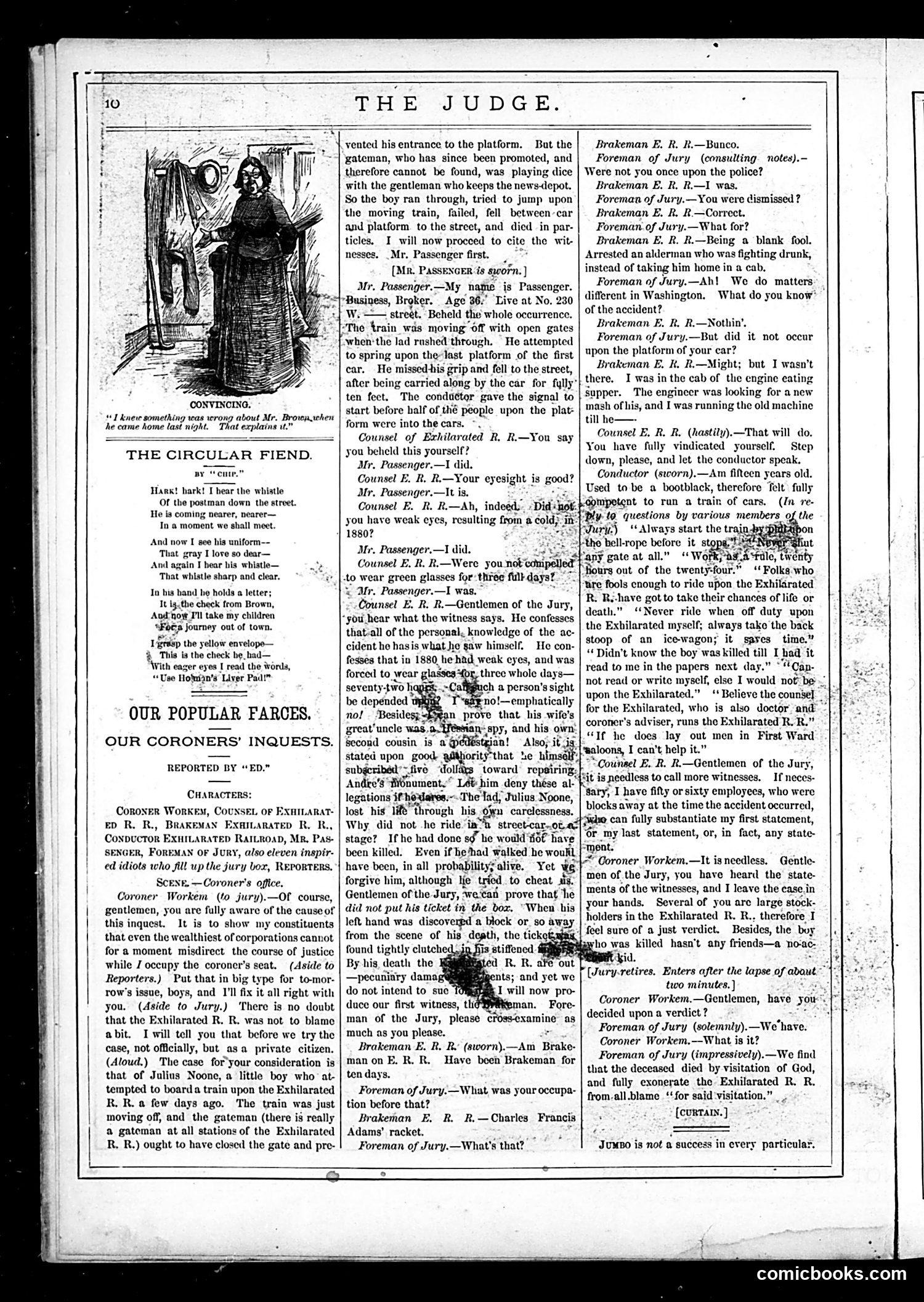
This page contains a coroner's inquest sketch satirizing railroad corporations' ability to evade accountability for deaths. A boy named Julius Noone was killed trying to board a moving train on the "Exhilarated Railroad," and the coroner—clearly complicit with the railroad—stages a rigged investigation. The satire targets how the railroad's lawyer discredits the eyewitness (Mr. Passenger) through absurd ad hominem attacks: because the witness wore glasses for a cold in 1880, his testimony about what he saw is supposedly unreliable. The lawyer then pivots to irrelevant character assassination (claims about the witness's wife's relatives). The coroner himself admits bias before the trial begins, joking with reporters he'll write favorable coverage in exchange for favorable reporting. The sketch exposes how wealthy corporations manipulated legal proceedings and public officials to escape responsibility for worker/passenger deaths—a major Progressive-era concern during railroad expansion.
📄 Transcribed text from this page (OCR, searchable)
Machine-transcribed from the original scan — historical spelling and the odd misread are preserved.
THE JUDGE. CONVINCING. “1 knew something was wrong about Mr. Browaschen he came home last night. That explains it.” THE CIRCULAR FIEND. ay “cur.” Hark! hark! [hear the whistle Of the postman down the street. He is coming nearer, nearer— In a moment we shall meet. And now I see his uniform—— That gray I love so dear— Ani again I bear his whistle— That whistle sharp and clear. In his hand he holds a letter; It ig.the check from Brown, Avd:how Ill take my children Foe journey out of town. I grasp the yellow envelope— & This is the check be had— With eager eyes I read the words, «Use Hobafan’s Liver Pad!” OUR POPULAR FARCES. OUR CORONERS’ INQUESTS. REPORTED BY “ED.” CHARACTERS: Coroner Workem, Co' L OF EXHILARAT- ep R. R., Brake! MILARATED R. R., Conpuctor EXHILARATED RatLroaD, Mr, Pas- SENGER, FOREMAN OF JURY, also eleven inspir- ed idiots who fill up the jury box, REPORTERS. Scene. —Coroner’s office. Coroner Workem (to jury).—Of course, gentlemen, you are fully aware of the cause ot this inquest, It is to show my constituents that even the wealthiest of corporations cannot for a moment misdirect the course of justice while J occupy the coroner’s seat. (Aside to Reporters.) Put that in big type for to-mor- row’s issue, boys, and I'll fix it all right with you. (Aside to Jury.) There is no doubt that the Exhilarated R. R. was not to blame abit. I will tell you that before we try the case, not officially, but asa private citizen. (Aloud.) The case for’your consideration is that of Julius Noone, a little boy who at- tempted to board a train upon the Exhilarated R. R.a few days ago. The train was just moving off, and the gateman (there is really a gateman at all stations of the Exhilarated R, R.) ought to have closed the gate and pre- | vented his entrance to the platform. But the gateman, who has since been promoted, and therefore cannot be found, was playing dice with the gentleman who keeps the news-depot. So the boy ran through, tried to jump upon the moving train, failed, fell between-car and platform to the street, and died in par- ticles, I will now procced to cite the wit- nesses. _Mr. Passenger first. (MR. PassencER ts sworn.) Mr. Passenger.—My name js Passenger. Business, Broker. Age 36.’ Live at No. 230 «| W. —— street. ‘Beheld the whole occurrence. “The train was moving off with open gates when‘ the lad rushed through. He attempted to spring upon the-last platform of the first car. He missed-his grip and fell to the street, after being carried along by the car for fylly’ ten feet. The conductor gave the signal to start before half of thé people upon the plat- form were into the cars. ~. Counsel of Exhilarated R. R.—You say you beheld this yourself? Mr, Passenger.—I did. Counsel E. R, R.—Your eyesight is Bood? Mr, Passenger.—It is. Counsel E. R. R.—Ah, indeed. Did HOt. you have weak eyes, resulting from S cold, e802 2 Mr, Passenger.—I did. , Counsel E. R. R.—Were you not compelled to wear green glasses for: three full days? & Mr. Passenger.—I was. Counsel E. R. R.—Gentlemen of the Jury, “you hear what the witness says. He confesses thatéall of the personal. knowledge of the ac- cident he hasis what he saw himself. He con- fesses that in 1880 he had weak eyes, and was forceil to, wear glaésea {pe three whole days— seventy: $70 he —Caf¥guch a person's sight be depended t no!—emphatically no! Beside fan prove that his wife's great'uncle was, a fren, Spy, and his own: Second cousin is ag ifestjan! Also; it jg. stated upon good ority-that he ulmsal: subgeribéd”s.five ‘ollas toward repeirini Ande’ “HiOnument.” Lét him deny thése al- legations it hedares:-~The" tad, Julius Noone, lost his li’ through his <Oiyn carelessness. Why did not -he ride “ia” street-car-.0b. e|* stage? Ifhe had done sf he would fe have been killed. Even if he*had walked he wouKl have been, in all probability; alive. Yet ve forgive him, although le tried to cheat sls. Gentlemen of the Jury, Wwe‘can prove that he did not put his ticket in the box, “When his left hand was discoverpd a block or. so away from the scene of hi } death, the ticket found tightly clutched.in fis stiffened By his, death the 1d R. R. afe out —pecuniary dama; nts; and yet we do not intend to sue I will now pro- duce our first witness, thi . Fore- man of the Jury, please ‘crossexamine a3 much as you please. Brakeman E. R. Re’ (sworn).—Am ‘Brake. manon E. R. R. Have been Brakeman for ten days. Foreman of Jury.—What was your occupa- tion before that? Brakeman E, RB. Adams’ racket. : ny Foreman of Jury.—What's that? R.—Charles Francis Brakeman E. R. R.—Bunco. Foreman of Jury (consulting Were not you once upon the police? Brakeman E. R, R.—I was. Foreman of Jury.—You were dismissed ? Brakeman E. R. R.—Correct. Foreman of Jury.—What for? Brakeman E, R. R.—Being a blank fool. Arrested an alderman who was fighting drunk, instead of taking him home in a cab, Foreman of Jury.—Ah! We do matters different in Washington. What do you know* of the accident? Brakeman E. R. R.—Nothin’, Foreman of Jury.—But did it not occur upon the platform of your car? Brakeman E, Rk. R.—Might; but I wasn’t there. I was in the cab of the engine eating Supper. The engineer was looking for a new mash of his, and I was running the old machine till he-—- Counsel E. R. R. (hastily).—That will do. You have fully vindicated yourself. Step down, please, and let the conductor speak. Conductor (sworn).—Am fifteen years old. Used to be a bootblack, therefore felt fully notes). — uur) - competent to run a train of cars. (In re- ly to questions by various members of the “ Always start the train n “tho bell-rope before it stopg "ft “Hany gate at all.” Wo Patio, twerity flours out of the twenty-four.” ‘“ Folka.who ure fools cnough to ride upon the Exhilarated R. R.-have got to take their chances of life or death.” ‘Never ride when off duty upon the Exhilarated myself; always take the back stoop of an icewagon; it sayes time.” “ Didn't know the boy was killed till I had it read to me in the papers next day.” "Cap. not read or write myself, else I would not be _ upon the Exhilarated.” ‘* Believe the counsel. for the Exhilarated, who is also doctor and ~ coroner's adviser, runs the Exhilarated R.R.” “If he does lay out men in First Ward ‘aaloons, I can't help it.” “Counsel E. R. R.—Gentlemen of the Jury, it is needless to call more witnesses. If neces- “gary, I have fifty or sixty employees, who were blocks away at the time the accident occurred, r Bcd can fully substantiate my first statement, ‘Or my last statement, or, in fact, any state- “ment. Coroner Workem.—It is needless. Gentle- men of the Jury, you have heard the state- ments of the witnesses, and I leave the ease.in your hands. Several of you are large stock- holders in the Exhilarated R. R., therefore. I feel sure of a just verdict. Besides, the boy who was killed hasn't any friends—a no-ac: gid. (Jury-retires, Enters after the lapse of about: two minutes. } Coroner Workem.—Gentlemen, have you. decided upon a verdict ? Foreman of Jury (solemnly) Coroner Workem.—What is it Foreman of Jury (impressively).—We find that the deceased died by visitation of God, and fully exonerate the Exhilarated R. R. from-all.blame ‘‘for said‘visitation.” We'l hate: (curtain. JuMBO is not a success in every particular. comicbooks.com