
A complete issue · 16 pages · 1882
Judge — March 4, 1882
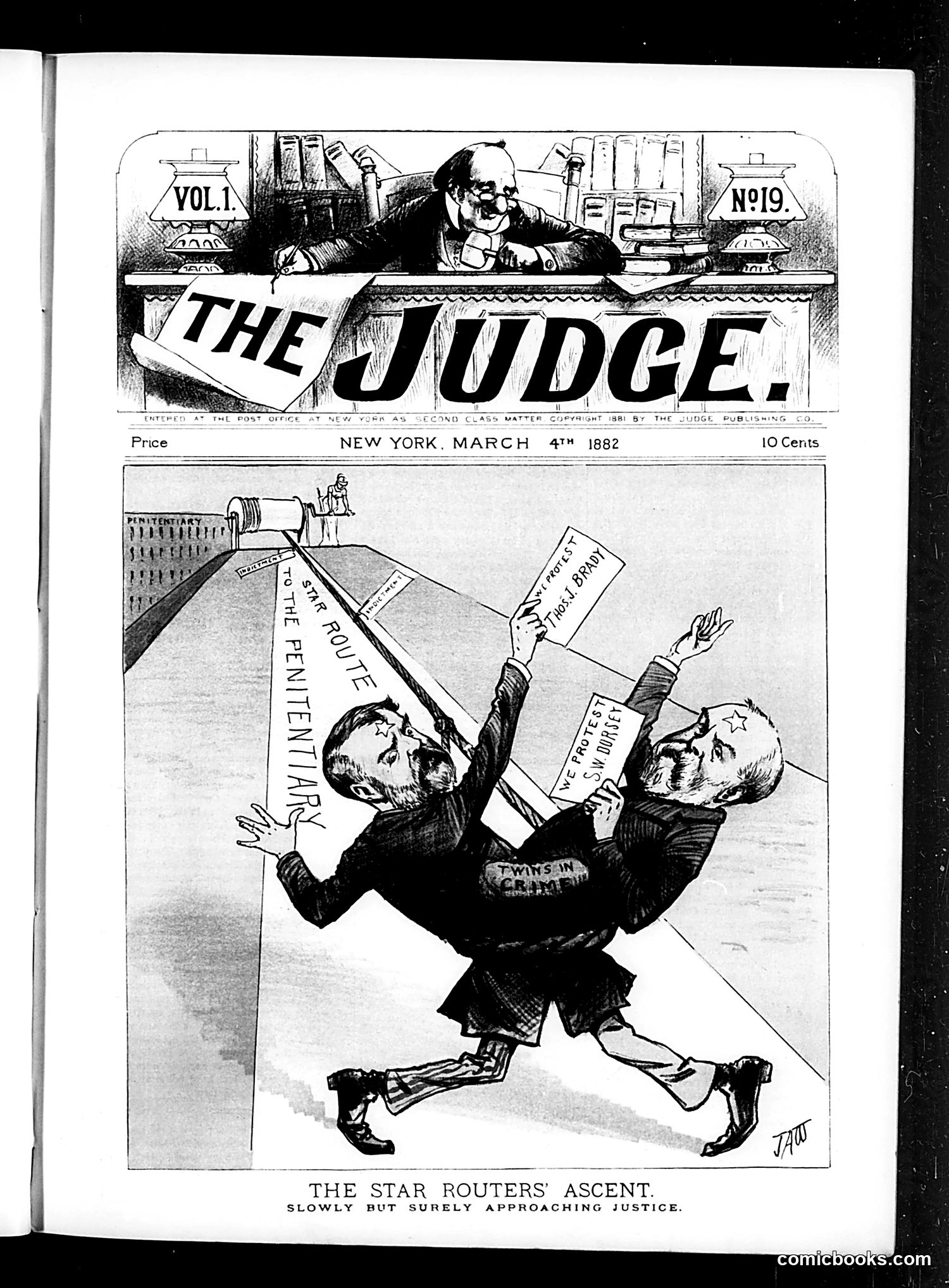
This political cartoon from March 1882 satirizes the "Star Route" scandal—a major corruption case involving fraudulent mail contracts. The cartoon depicts two figures (labeled "TWINS") climbing upward toward "JUSTICE" while juggling incriminating documents labeled "STAR ROUTE FRAUD." The judge presiding above represents the judicial system finally holding wrongdoers accountable. The title's ironic phrase "slowly but surely approaching justice" suggests the prosecution was moving at a frustratingly glacial pace, mocking how long it took to bring the corrupt contractors to account. The Star Route frauds involved inflated mail-delivery contracts under the Hayes administration—a prominent scandal of the early 1880s. Judge magazine used the cartoon to criticize both the delay in prosecuting the scheme and the audacity of the perpetrators.
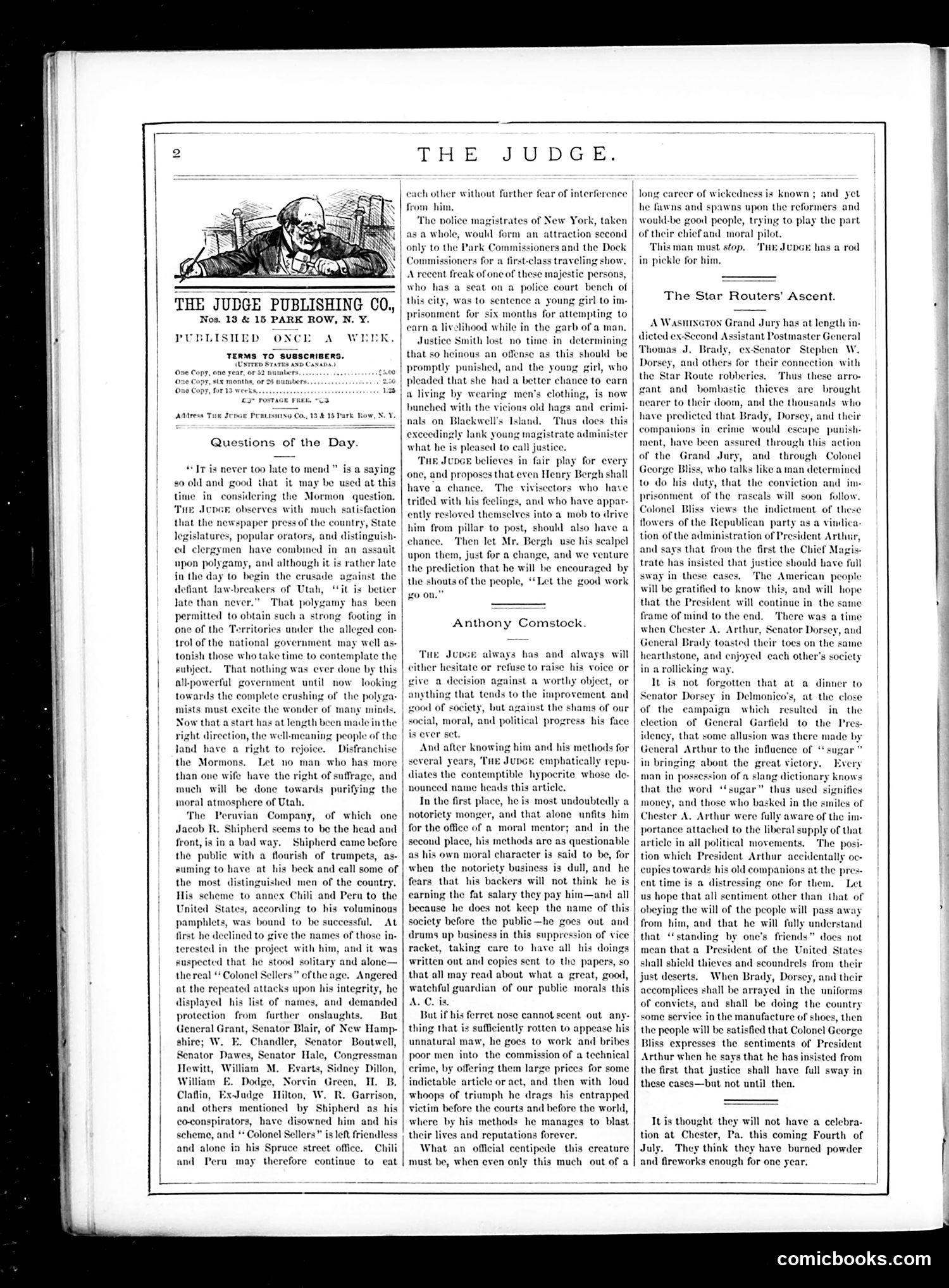
This page from *Judge* magazine contains three distinct satirical pieces: **1. Mormon Polygamy Editorial** ("Questions of the Day"): The opening attacks Utah's polygamous Mormons, calling for their disenfranchisement as a moral reform. This reflects late-19th-century anti-Mormon sentiment and federal efforts to suppress polygamy in U.S. territories. **2. The Peruvian Company Scandal**: The piece mocks Jacob R. Shipherd, who claimed prominent supporters (including General Grant and senators) for a scheme to annex Chile and Peru to the United States. When these figures publicly disowned him, Shipherd was left isolated—satirized as a "Colonel Sellers" (a fictional con artist). This exposes political scheming and fraudulent claims of influence. **3. Police Court Justice**: The final section criticizes New York magistrate Justice Smith for sentencing a young woman to Blackwell's Island for cross-dressing to earn a living—depicting judicial overreach and moral rigidity as absurd. The cartoon (illustration at top) appears to be the magazine's masthead or decorative element.
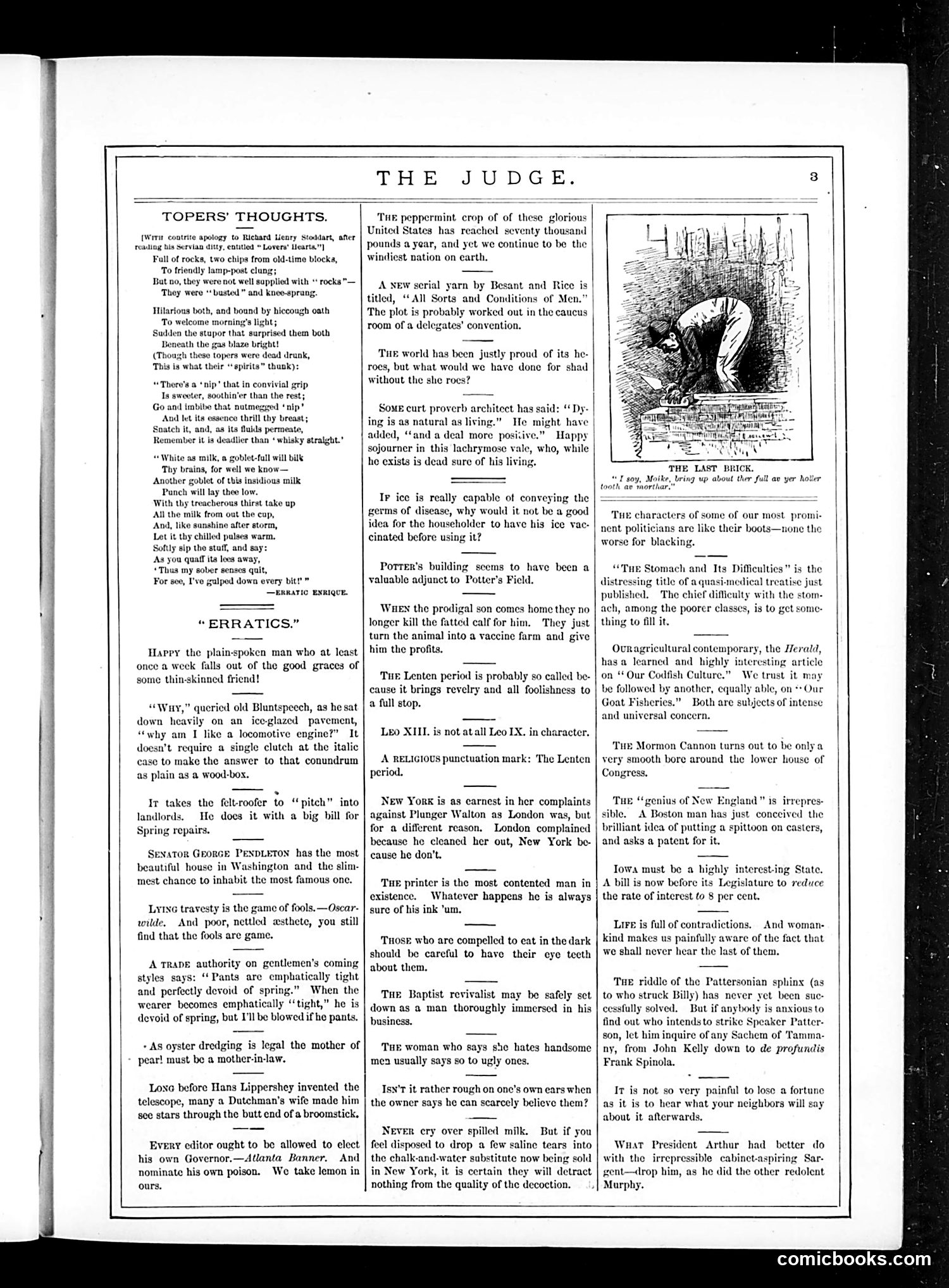
This page from the satirical magazine *Judge* contains multiple short humor pieces rather than a single cartoon. The main illustration shows a cityscape (labeled "THE LAST MILE"), likely referencing execution or urban life. The humor pieces mock various social absurdities: drunk men's philosophical musings ("Topers' Thoughts"), a man's pratfall on ice, Senator Pendleton's political ambitions, and contemporary fads (tight pants). Several items satirize common American hypocrisies—the peppermint industry's growth despite America's reputation for excessive talk, and the shift from biblical hospitality (killing the fatted calf) to commercial exploitation (turning animals into "vaccine farms"). References to Besant and Rice's serial novel and Potter's building suggest topical allusions readers of the era would recognize. The tone is lighthearted social commentary typical of *Judge*'s approach: mocking pretension, hypocrisy, and modern trends through brief, witty observations rather than pointed political attack.
**The Planter—A Fable** is a cautionary verse about a farmer who begins work happily but gradually increases his drinking ("on second rounds he thirsty got"). As his alcohol consumption worsens, he loses his productivity and joy, eventually collapsing drunk. While he sleeps, crows devour his unplanted corn. The moral warns against mixing alcohol into work—those "who plant the 'rye' 'long with the corn" reap "more pain and loss." **Fussy Kate Field's Tirade** mocks Kate Field (a real 19th-century writer/activist), sarcastically praising her as fashionable and accomplished while actually attacking her recent criticism of shop girls' manners. The author uses absurdist exaggeration—placing her prominence impossibly far back (claiming she was a gazette editress during the War of 1812) and inventing ridiculous anecdotes—to ridicule her as presumptuous and hypocritical for critiquing overworked, underpaid workers.
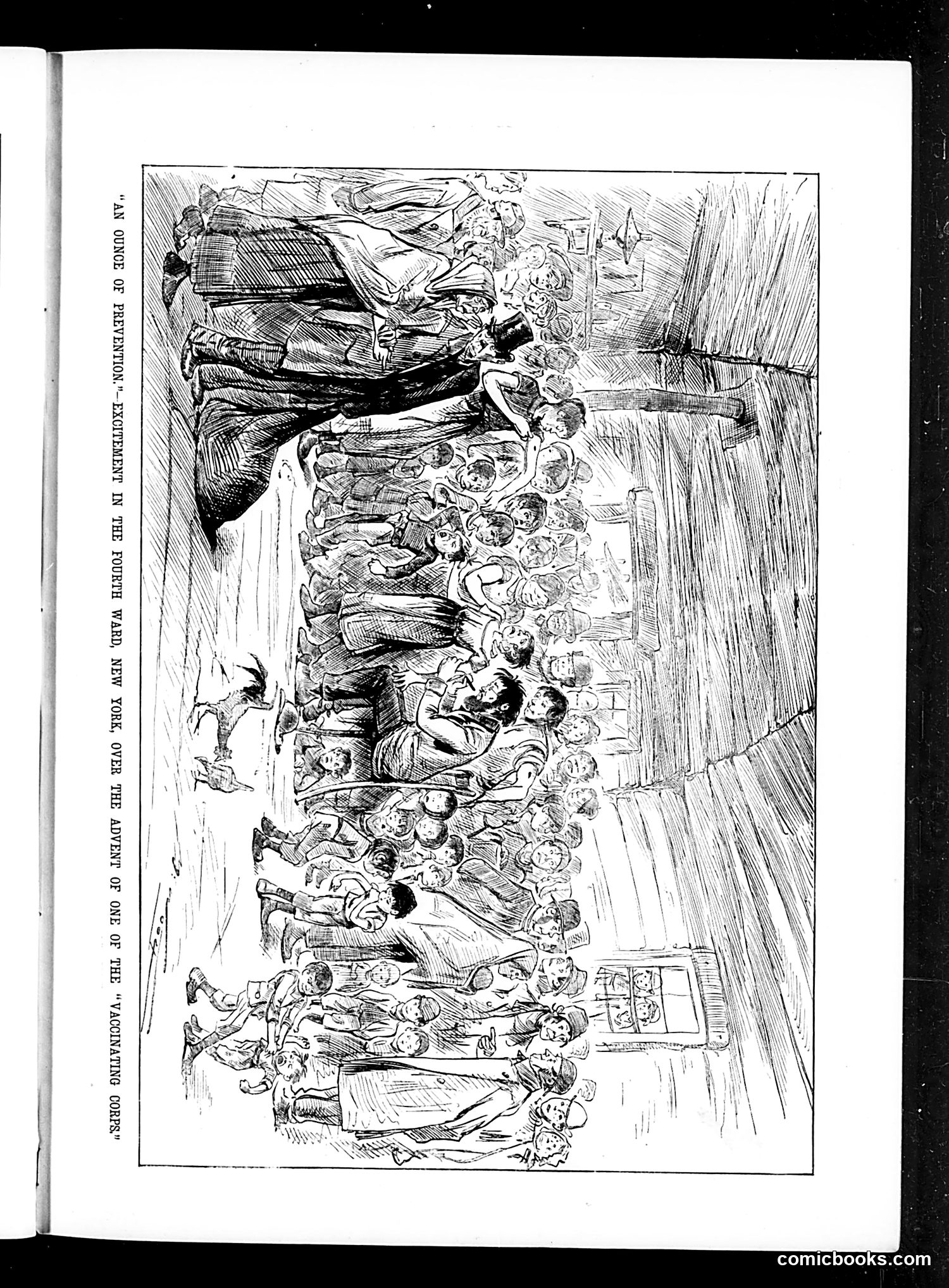
I can see this is a detailed satirical engraving from Judge magazine, printed sideways on the page. The image depicts a crowded interior scene with numerous figures engaged in various activities - appearing to show a chaotic gathering or social commentary. However, I cannot reliably read the caption text printed vertically along the left margin due to image resolution and orientation. Without being able to clearly identify the specific caption, the figures depicted, or confirm the historical event being satirized, I cannot accurately explain what political or social references this cartoon makes for a modern reader. To properly explain this cartoon's meaning and context, I would need either a clearer image of the caption text or additional historical documentation about this particular Judge publication issue.
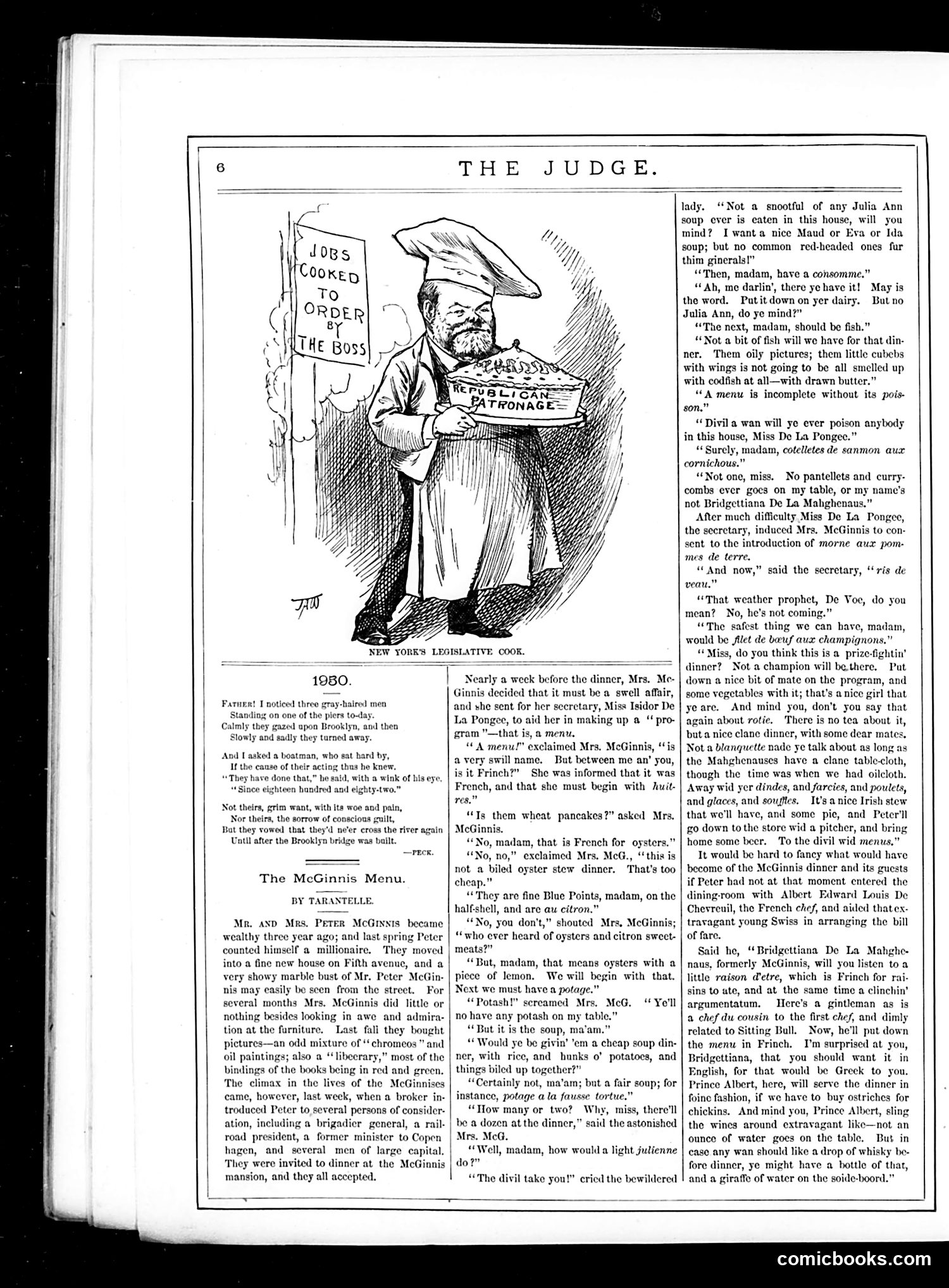
## Main Cartoon: "New York's Legislative Cook" This is a satirical illustration mocking **New York State legislature members** depicted as incompetent cooks taking orders from "the boss." The sign reads "Jobs Closed to Order of the Boss," suggesting political patronage and corruption—jobs distributed through party machinery rather than merit. The figure holds a dish labeled "Pelican Patronage," a reference to politicians feeding at the public trough. ## Text Content: "The McGinnis Menu" The accompanying story satirizes **newly wealthy Irish-American social climbers** (the McGinnises) attempting to host an elegant dinner. Mrs. McGinnis, speaking in exaggerated Irish brogue, constantly misinterprets French menu terms—"huîtres" (oysters) as "wheat pancakes," "potage" (soup) as "potash," "julienne" as "Julia Ann." The satire targets **social pretension and class aspiration**: wealthy but culturally unsophisticated immigrants trying desperately to appear refined while fundamentally rejecting Continental cuisine and refinement. Both pieces mock **incompetence masked by false authority**—whether political appointees or social pretenders.
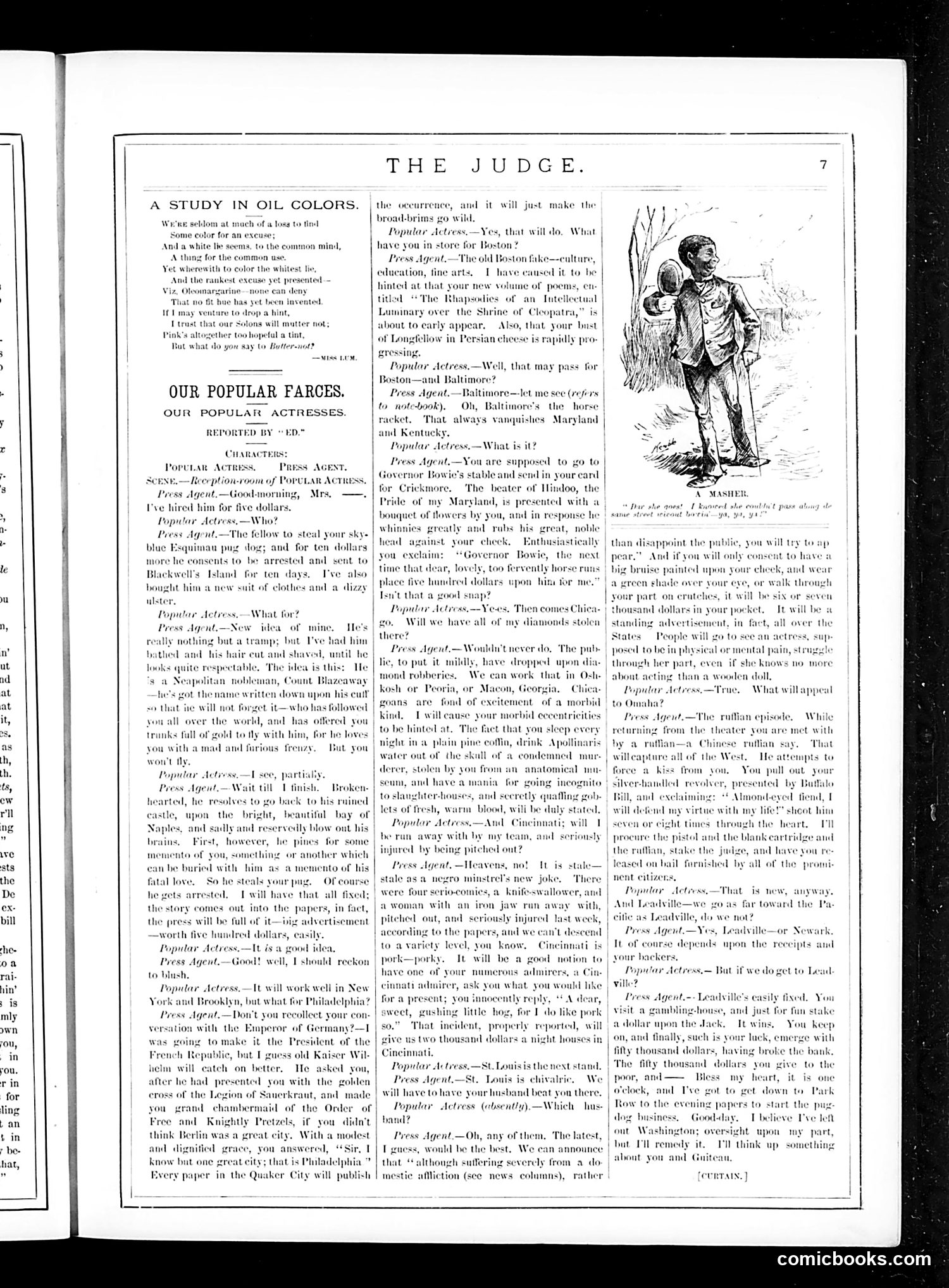
This page contains **"Our Popular Farces,"** a satirical dialogue between a Press Agent and a Popular Actress, lampooning theatrical publicity stunts of the era. The satire targets how press agents manufactured scandals and sensational stories to promote actresses. The agent proposes increasingly absurd schemes: hiring a man to steal her skirts, arranging his arrest to generate newspaper coverage, creating fake romantic entanglements with governors, and staging violent incidents (bruises, eye injuries) to attract public sympathy and attention. The comedy mocks both the desperate hunger of newspapers for sensational stories and the willingness of theatrical figures to exploit them. Regional variations are mocked—different scandals work better in different cities (New York versus Philadelphia versus Cincinnati). The accompanying sketch shows a disheveled male figure, likely representing the unfortunate hired accomplice caught up in these fabricated schemes. The satire reflects genuine late-19th-century concerns about tabloid journalism, manufactured celebrity, and the blurring of entertainment and news.
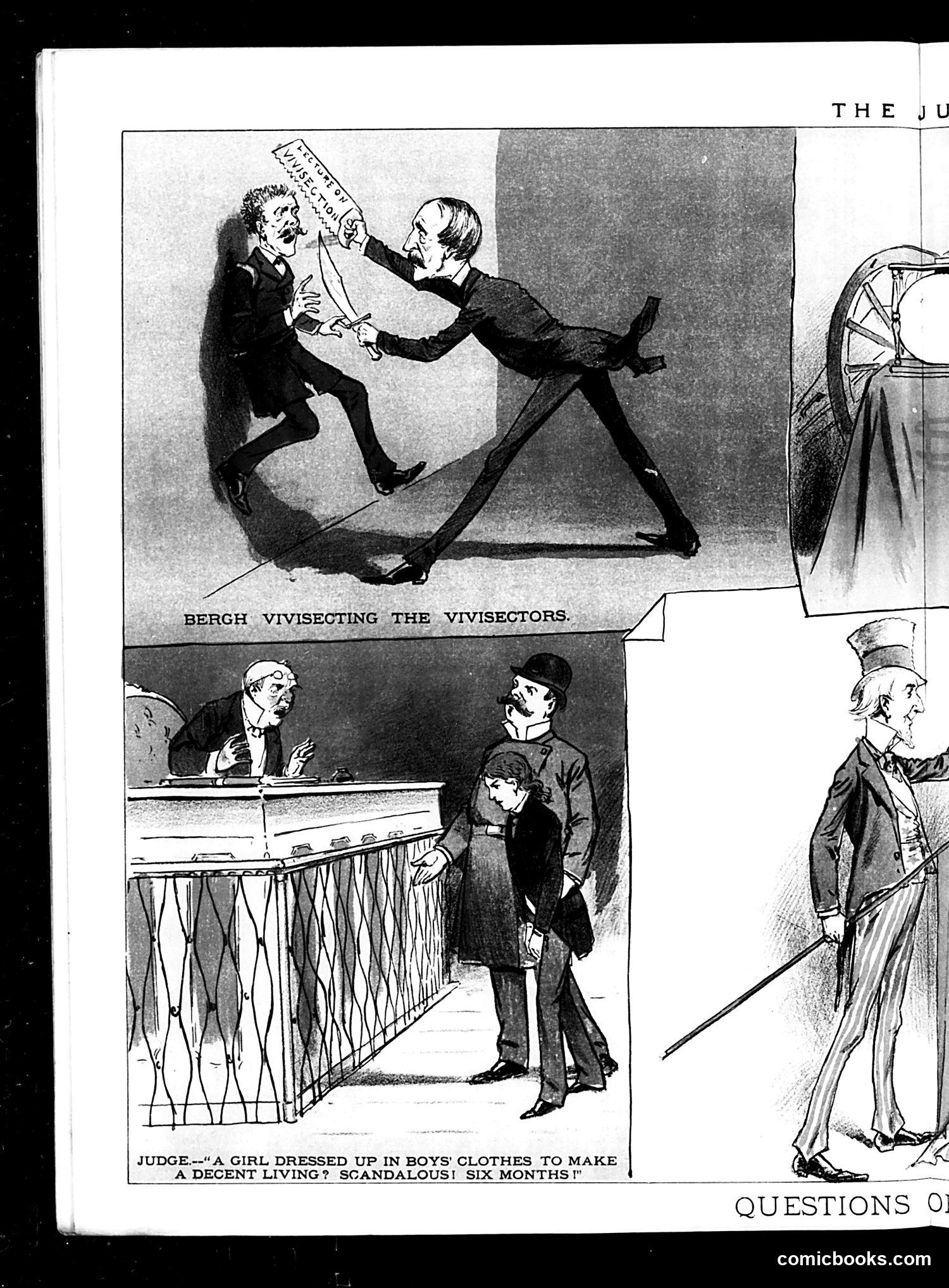
This page from *Judge* magazine satirizes judicial hypocrisy regarding poverty and gender roles. The top panel shows "Bergh vivisecting the vivisectors"—likely referencing Henry Bergh, founder of the ASPCA, engaged in conflict with someone (unclear who). The main cartoon depicts a judge sentencing a girl dressed in boys' clothes to six months imprisonment for this deception. The judge calls it "scandalous," yet the satire's point—emphasized by the caption—is that the judge condemns her survival strategy while apparently unconcerned about the desperate poverty forcing her to cross-dress for employment. The cartoon critiques the judicial system's moral priorities: punishing a vulnerable person's practical solution to destitution rather than addressing the systemic inequality that made such deception necessary for "a decent living."
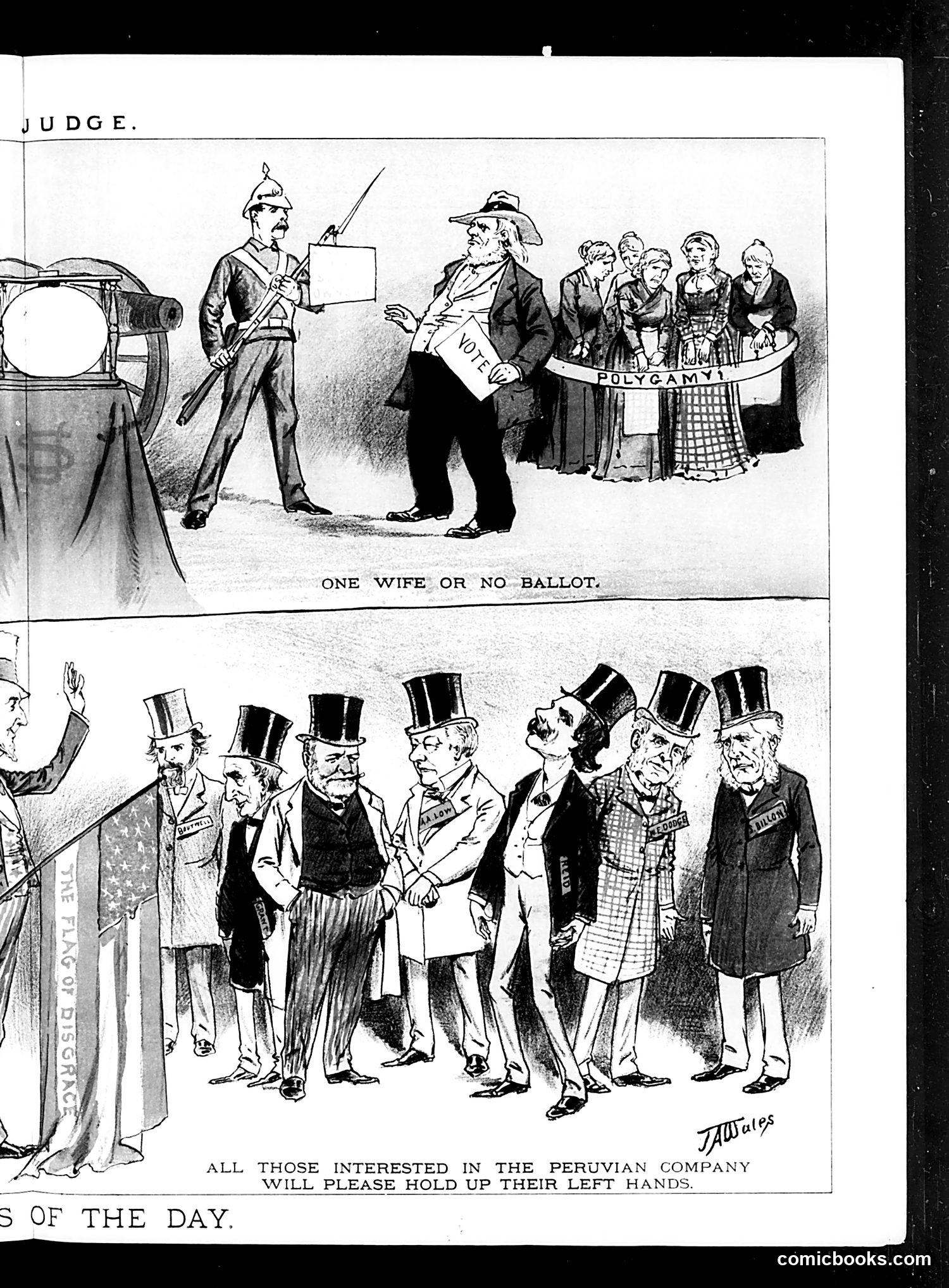
This page contains two political cartoons satirizing polygamy and the "Peruvian Company." **Top cartoon ("One Wife or No Ballot"):** A military judge confronts a man holding a "Vote" sign, with women labeled "Polygamy" in the background. This appears to critique polygamous practices—likely referencing the polygamy controversy surrounding the LDS (Mormon) Church, which was a major political issue of the 19th century. The caption suggests denying voting rights to polygamists. **Bottom cartoon:** Men in top hats are asked to raise their left hands if interested in the "Peruvian Company." The phrase "The Flag of Dishonor" appears on the left. This appears to reference a specific financial scandal involving Peru, possibly the infamous Peruvian guano trade corruption or a fraudulent investment scheme. The gesture mocks politicians or businessmen complicit in questionable dealings. Without seeing the issue's date, the specific "Peruvian Company" scandal referenced remains unclear.
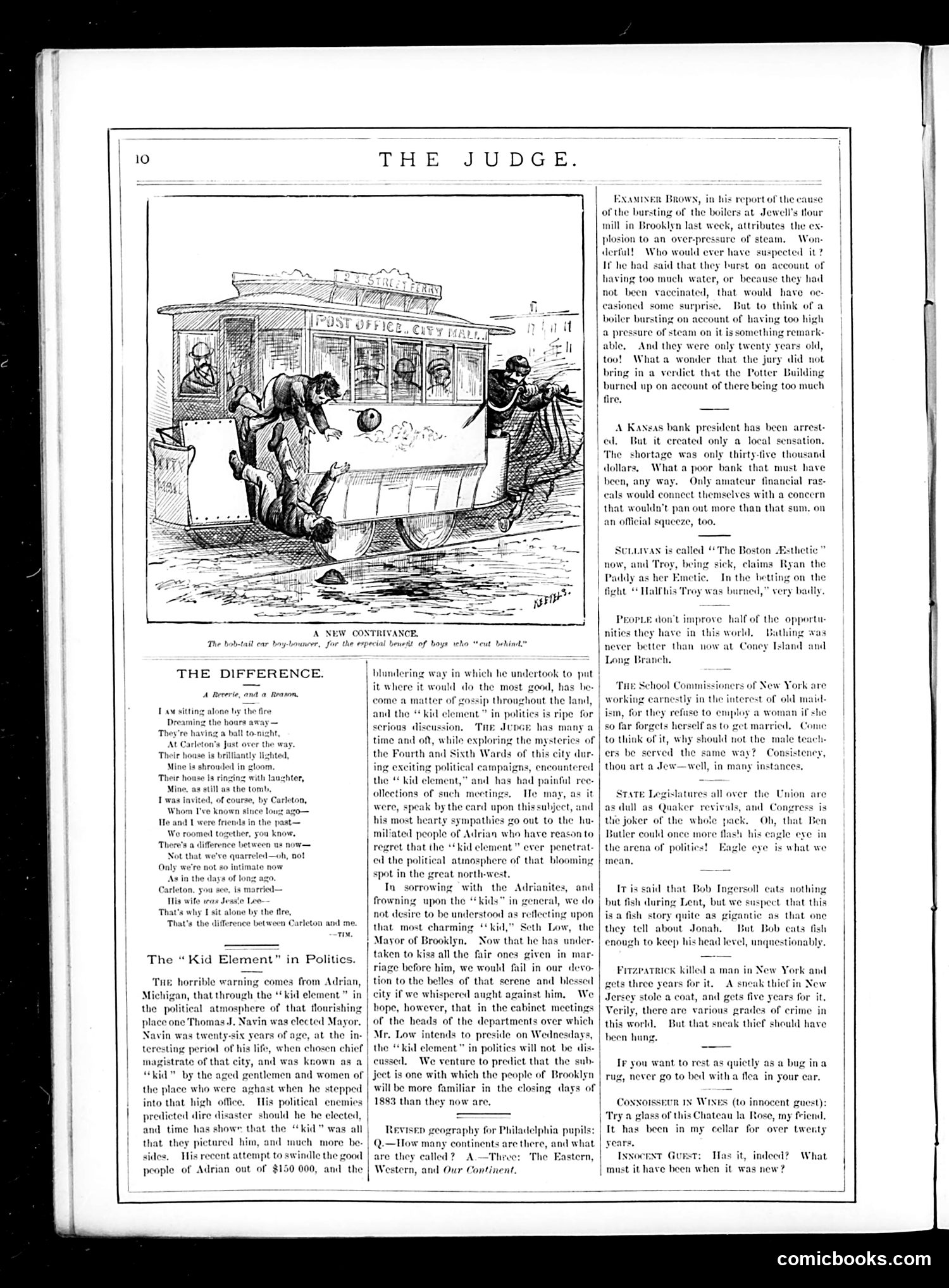
**The Main Cartoon:** "A New Contrivance" depicts a mobile post office—a wheeled structure allowing mail delivery to reach people who "can't be bothered." The satire mocks both urban convenience culture and those too lazy to visit actual post offices. The caption's phrase "red-blooded" likely contains irony about American efficiency. **Political Content:** The "Kid Element in Politics" section attacks Thomas J. Navan, elected Mayor of Adrian (Michigan) as a young man. The article criticizes his immaturity and recent attempted swindle of $150,000. It also takes shots at Seth Low, Brooklyn's mayor, suggesting he represents the same youthful incompetence in politics—using "kid element" as code for dangerous inexperience in high office. **Minor Items:** Brief jabs at a Kansas bank president's arrest, boxing matches (Sullivan), and Coney Island bathing. The geography quiz mocks educational standards. The page reflects late-19th-century anxieties about youth in power and urban inefficiency.
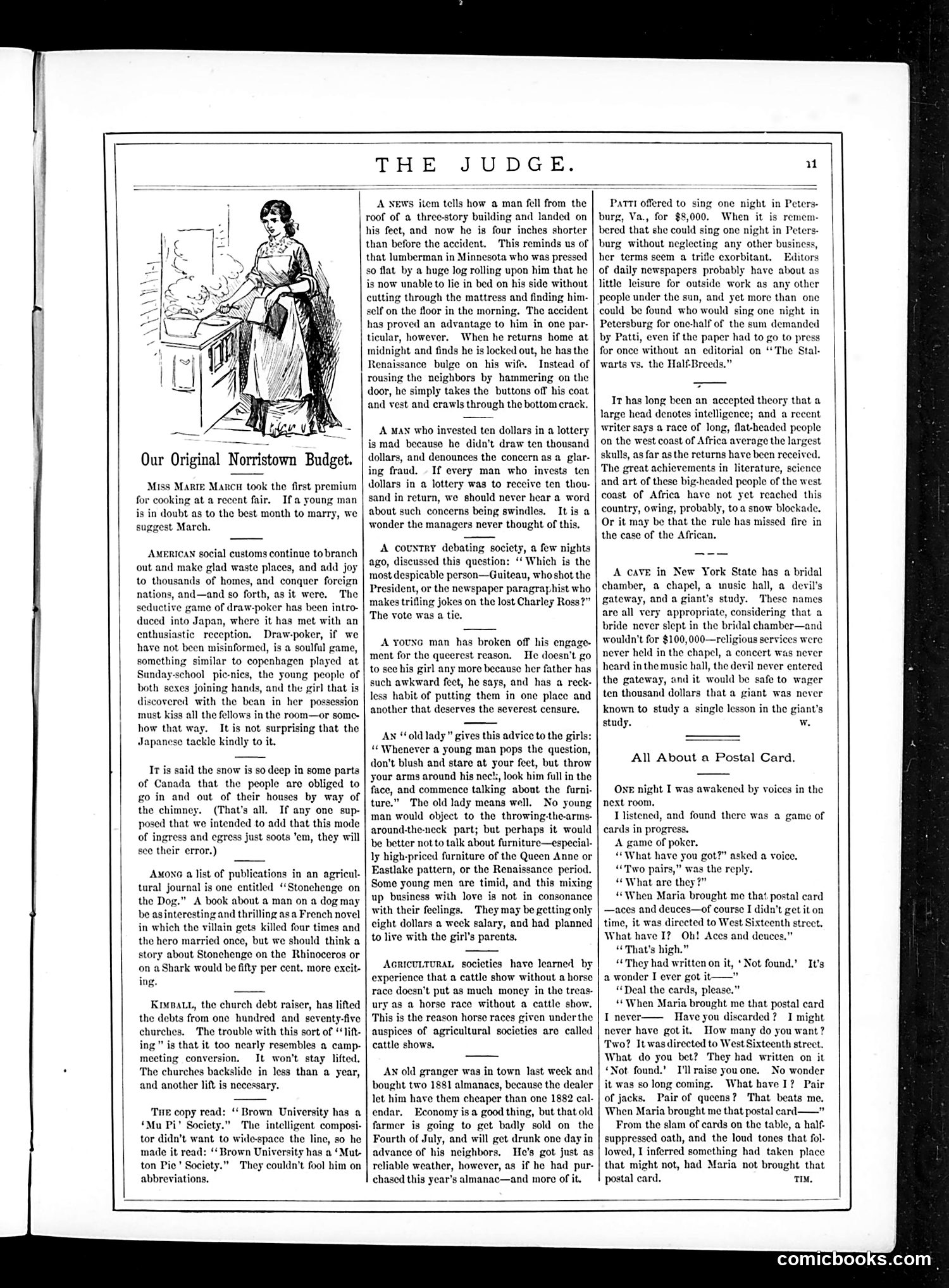
This page from *Judge* magazine contains satirical short humor pieces rather than political cartoons. The content mocks various contemporary absurdities: **The cartoon** (top left) shows a woman in a domestic scene, illustrating the opening anecdote about Marie March winning a cooking prize—with the joke being that March is apparently an ideal month for marriage. **The humor pieces** mock: - Americans exporting frivolous customs (poker to Japan) - Absurd newspaper reports (people entering houses via chimneys in Canada) - Ridiculous book titles about animals - Church debt-raising schemes that don't stick - Typographical errors (confusing "Mu Pi" with "Mutton Pie") - Lottery fraud victims complaining unreasonably - A debate equating President Garfield's assassin (Guiteau, 1881) with joke-writers about the Charley Ross kidnapping case The satire targets human foolishness, journalistic absurdity, and American social pretension rather than specific political figures, making it timeless rather than topical.
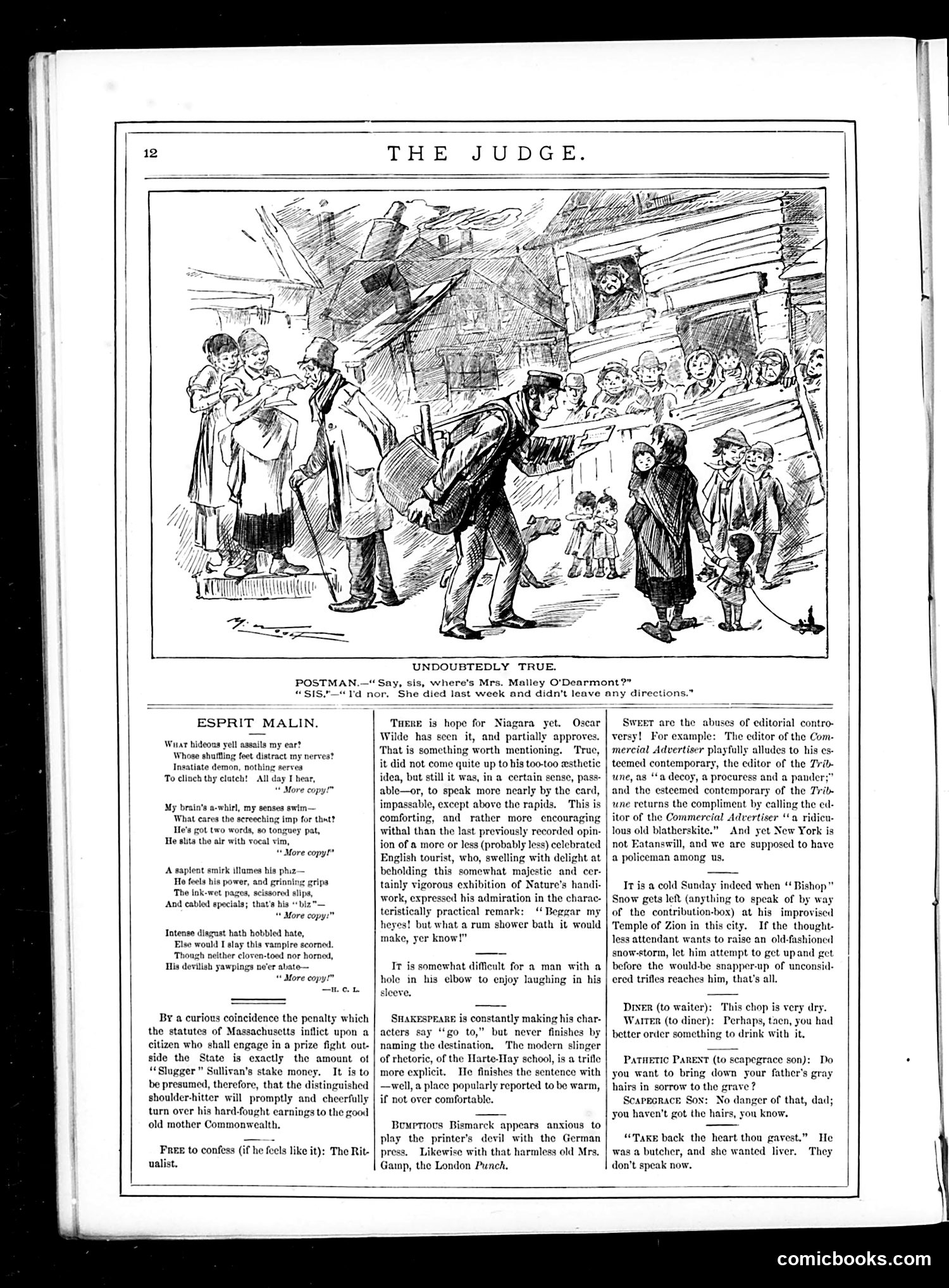
The main cartoon depicts a postal carrier delivering mail while being verbally assaulted by frustrated newspaper editors or publishers demanding "more copy!" (more content/articles). The postman appears harried while figures gesture dramatically around him. The accompanying text commentary mocks newspaper editorial culture—particularly the constant pressure for fresh material and the petty rivalries between competing papers. It references real contemporary tensions: the "Commercial Advertiser" and "Tribune" editors exchanging insults; Oscar Wilde's recent visit to Niagara Falls; and the Massachusetts prizefighting law (likely referencing boxer John L. Sullivan). The satirical pieces mock editorial hypocrisy, newspaper sensationalism, and the undignified personal attacks editors level at competitors while claiming to serve public interest. The humor assumes readers are familiar with New York's competitive newspaper scene of the period and its culture of aggressive, personality-driven journalism.
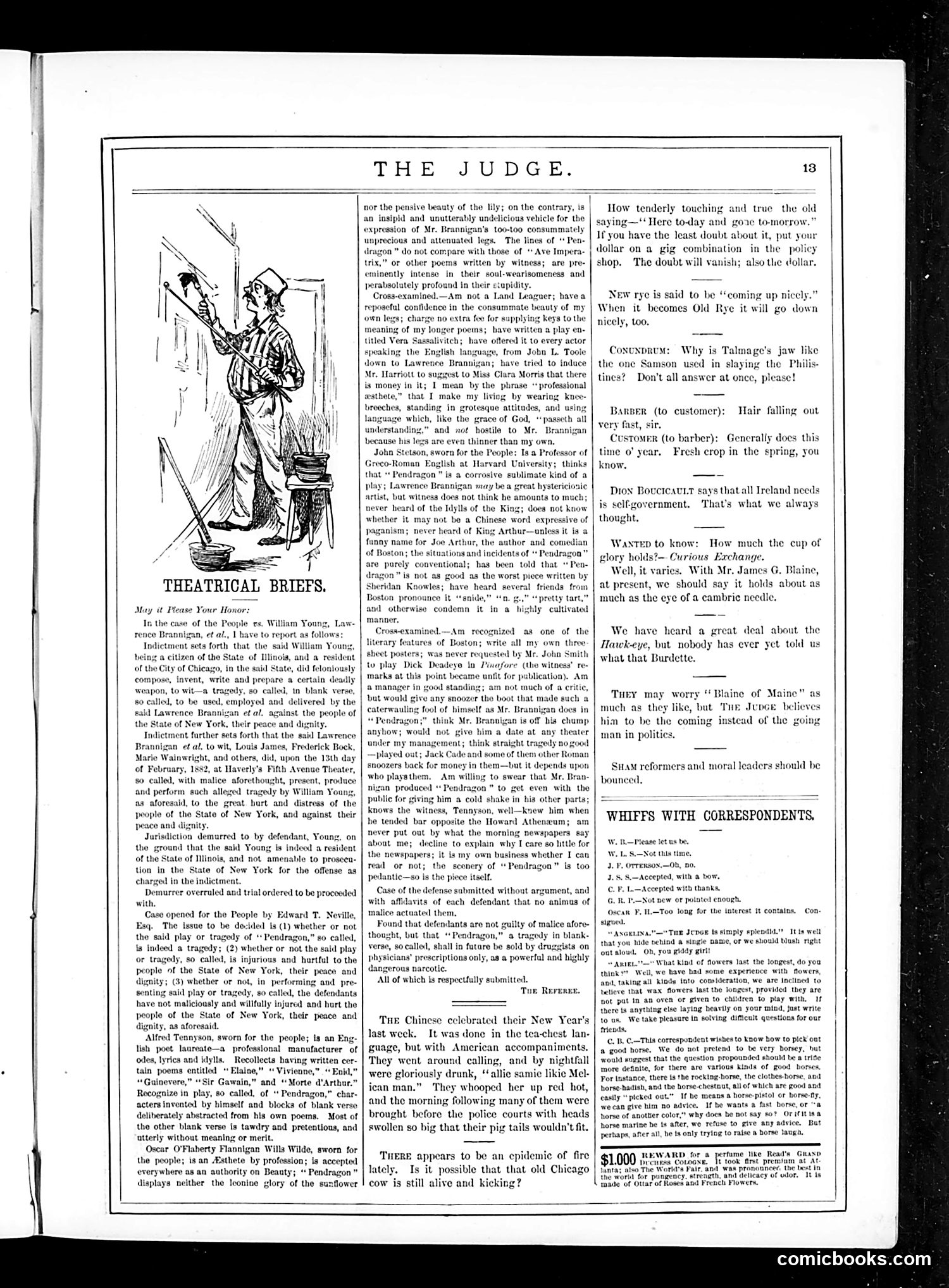
This page satirizes the theatrical production of "Pendragon," a play by William Young that premiered at Haverly's Fifth Avenue Theatre in February 1882. Judge frames it as a legal case where the play is prosecuted for injuring New York citizens. The cartoon depicts testimony from famous witnesses "for the people": **Alfred Tennyson** (English Poet Laureate) testifies that the play steals from his own Arthurian poems ("Elaine," "Vivienne," etc.) but executes them poorly with pretentious, meaningless blank verse. **Oscar Wilde** (represented as an aesthete obsessed with beauty) argues the play lacks artistic merit—it displays neither natural beauty nor aesthetic refinement, and criticizes the lead actor's legs. The satire mocks both the play's poor quality and the pretentious artistic criticism of the era. By treating a bad theatrical production as a criminal matter, Judge ridicules contemporary theater while also satirizing the affected language and self-importance of artistic authorities like Wilde.
This page is primarily an **advertisement and promotional section** for *Judge* magazine, not a political cartoon spread. The main content announces the commercial success of a competing publication called *"Our Continent,"* a new American literary weekly. The announcement boasts of selling 58,000 copies of its first issue and claims extraordinary demand that outpaces printing capacity—a notable claim suggesting competitive tension in late-19th-century publishing. The irony is that *Judge* is promoting a rival publication, which may reflect either genuine industry enthusiasm or subtle mockery of extravagant business claims. The page fills remaining space with period advertisements (cosmetics, shirt makers, scrap metal collection) and what appears to be the beginning of a humorous poem about a woman and a spider. This is a composite business/advertising page rather than editorial satire.
This is primarily an **advertising page** from Judge magazine (circa 1882, based on the Austrian bond drawing date). The page contains no political cartoons—it's dominated by commercial advertisements for various products and services. **Notable advertisers include:** - Knox hats (top center)—claiming world-renowned status - James M. Bell & Co. billiard tables - The H.W. Collender Co. (billiards equipment) - Weber pianos - A Wilson Patent adjustable chair - Columbia bicycles - Miller's umbrellas - An International Banking Co. offering Austrian government bonds as lottery investments **The only illustration of note** is a domestic scene (lower right) showing a woman at a piano with a man, likely advertising piano sales or lessons. The page reflects late-19th-century consumer culture and the types of luxury goods marketed to Judge's affluent readership. The Austrian bond offering is particularly striking as a speculative investment opportunity presented to American readers.
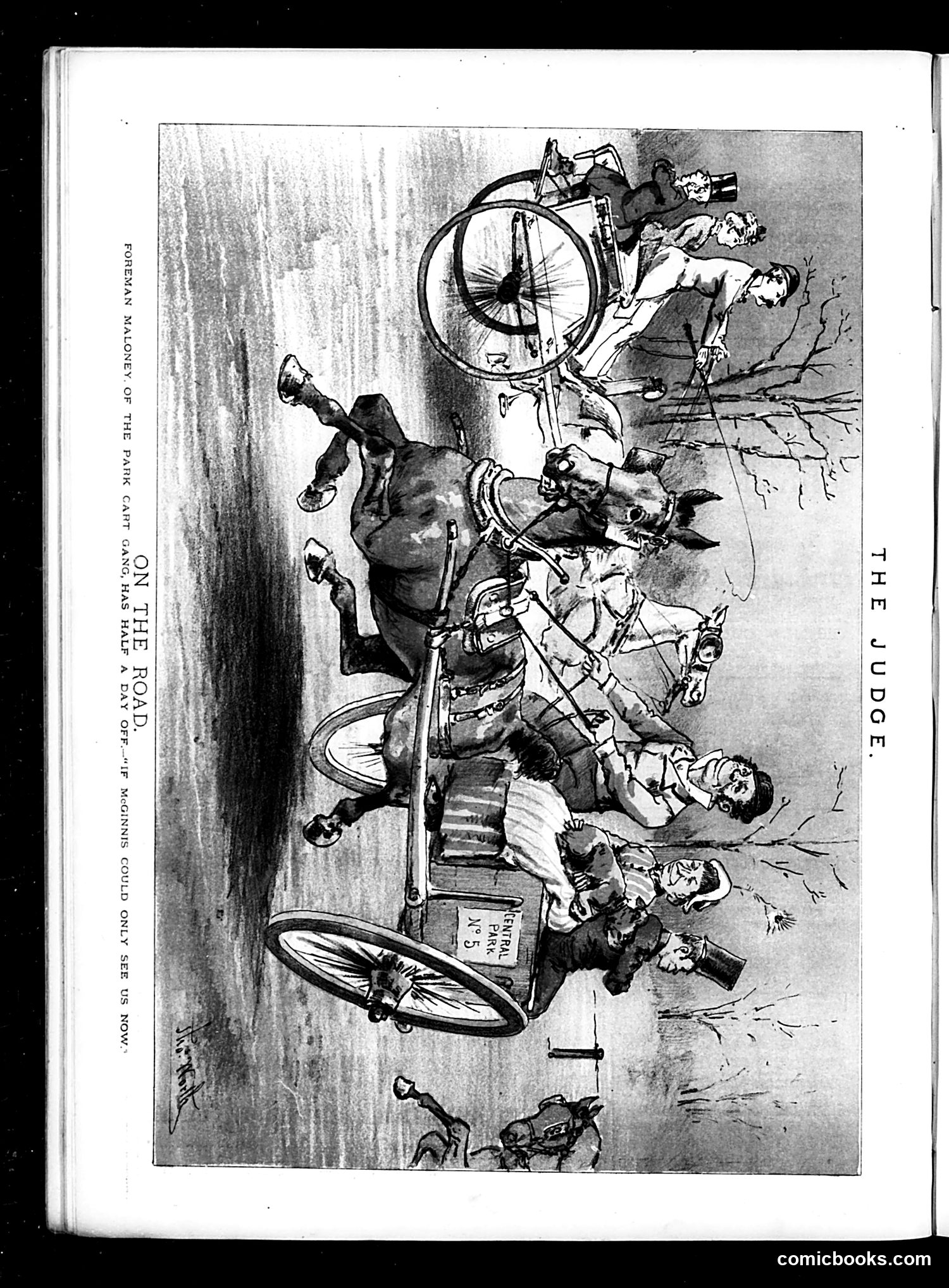
This cartoon satirizes a "park cart gang" member enjoying unexpected leisure time. The image depicts a working-class figure (likely Irish, suggested by the name "McGinnis" in the caption) riding a bicycle with several companions, appearing to be on a recreational outing. The satire centers on the contrast between the character's ordinary labor—operating park carts (likely for street cleaning or similar municipal work)—and their aspirations for leisure and respectability. The humor targets working-class pretensions and the novelty of bicycles as status symbols in the late 19th/early 20th century. The caption suggests the character imagines how their supervisor would react to seeing them enjoying recreational freedom. The cartoon mocks both the laborer's desire to appear genteel during off-hours and stereotypes about Irish immigrant workers.