
Judge, 1882-03-04 · page 4 of 16
Judge — March 4, 1882 — page 4: what you’re looking at
What you’re looking at
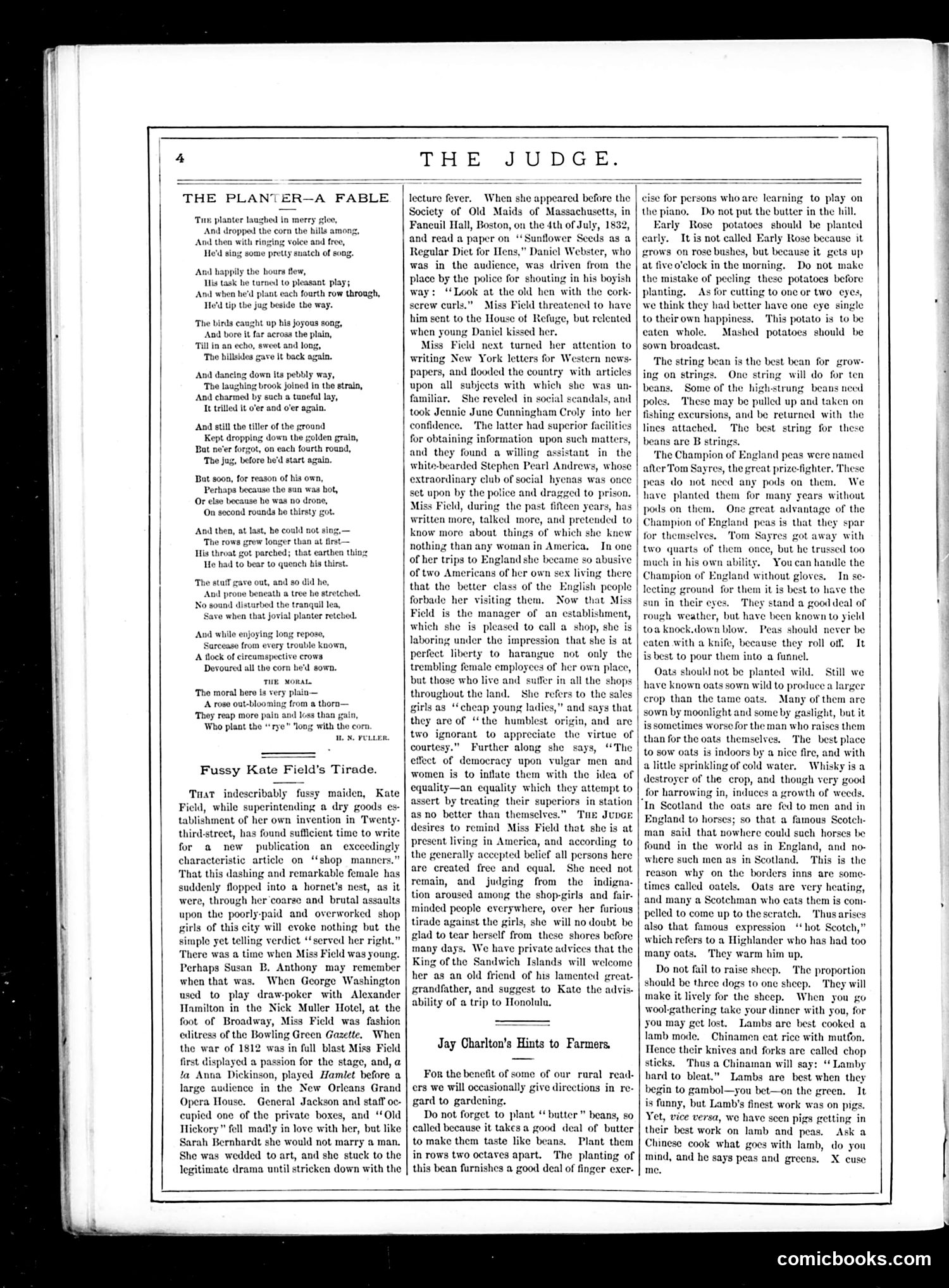
**The Planter—A Fable** is a cautionary verse about a farmer who begins work happily but gradually increases his drinking ("on second rounds he thirsty got"). As his alcohol consumption worsens, he loses his productivity and joy, eventually collapsing drunk. While he sleeps, crows devour his unplanted corn. The moral warns against mixing alcohol into work—those "who plant the 'rye' 'long with the corn" reap "more pain and loss." **Fussy Kate Field's Tirade** mocks Kate Field (a real 19th-century writer/activist), sarcastically praising her as fashionable and accomplished while actually attacking her recent criticism of shop girls' manners. The author uses absurdist exaggeration—placing her prominence impossibly far back (claiming she was a gazette editress during the War of 1812) and inventing ridiculous anecdotes—to ridicule her as presumptuous and hypocritical for critiquing overworked, underpaid workers.
📄 Transcribed text from this page (OCR, searchable)
Machine-transcribed from the original scan — historical spelling and the odd misread are preserved.
4 THE PLANTER—A FABLE Tue planter laughed in merry gle And dropped the corn the hills among, And then with ringing voice and free, He'd sing some pretty snatch of song. And happily the hours flew, His task he turned to pleasant play; And when he'd plant each fourth row throagh, He'd tip the jug beside the way. The birds caught up his joyous song, And bore it far across the plain, Till in an echo, sweet and long, The hillsides gave it back again. And dancing down its pebbly way, The laughing brook joined in the strain, ‘And charmed by such a tuneful lay, It trilled it o'er and o'er again. And still the tiller of the ground Kept dropping down the golden grain, But ne'er forgot, on each fourth round, The jug, before he'd start again. But soon, for reason of his own, Perhaps because the sun was hot, Or else because he was no drone, On second rounds he thirsty got. And then, at last, he could not sing,— The rows grew longer than at firs His throat got parched; that earthen thinz He had to bear to quench bis thirst. ‘The stuiT gave out, and so did he, And prone beneath a tree he stretched. No sound disturbed the tranquil lea, Save when that jovial planter retched. And while enjoying long repose, Surcease from every trouble known, A flock of circumspective crows Devoured all the corn he'd sown. me Tho moral here is very plain— A rose out-blooming from a thora— They reap more pain and loss than Who plant the “rye” ‘long with the corn. BN, PULLER. Fussy Kate Field’s Tirade. Tuat indescribably fussy maiden, Kate Field, while superintending a dry goods es- tablishment of her own invention in Twenty- third-street, has found sufficient time to write for a new publication an exceedingly characteristic article on “shop manners.” ‘That this dashing and remarkable female has suddenly flopped into a hornet’s nest, as it were, through her coarse and brutal assaults upon the poorly-paid and overworked shop girls of this city will evoke nothing but the simple yet telling verdict ‘served her right.” There was a time when Miss Field was young. Perhaps Susan B, Anthony may remember when that was. When George Washington used to play draw-poker with Alexander Hamilton in the Nick Muller Hotel, at the foot of Broadway, Miss Field was fashion cdlitress of the Bowling Green Gazette. When the war of 1812 was in full blast Miss Field first displayed a passion for the stage, and, a Ja Anna Dickinson, played Hamlet before a large audience in the New Orleans Grand Opera House. General Jackson and staff oc- cupied one of the private boxes, and “Old Hickory” fell madly in love with her, but like Sarah Bernhardt she would not marry a man. She was wedded to art, and she stuck to the legitimate drama until stricken down with the THE JUDGE. lecture fever. When she appeared before the Society of Old Maids of Massachusetts, in Faneuil Hall, Boston, on the 4th of July, 1832, and read a paper on “Sunflower Seeds as a Regular Diet for Hens,” Daniel Webster, who was in the audienc ‘as driven from the place by the police for shouting in his boyish way: ‘Look at the old hen with the cork- screw curls,” Miss Field threatened to have him sent to the House of Refuge, but relented when young Daniel kissed her. Miss Field next turned her attention to writing New York letters for Western news papers, and flooded the country with articles upon all subjects with which she was un- familiar. She reveled in social scandals, and took Jennie June Cunningham Croly into her confidence. The latter had superior facilitic for obtaining information upon such matters, and they found a willing a: ant in the white-bearded Stephen Pearl Andrews, whose extraordinary club of social hyenas was once set upon by the police and dragged to prison. Miss Field, during the past fifteen years, has written more, talked more, and pretended to know more about things of which she knew nothing than any woman in America, In one of her trips to England she became so abusive of two Americans of her own sex living there that the better class of the English people forbade her visiting them. Now that Miss icld is the manager of an establishment, which she is pleased to call a shop, she is laboring under the impression that she is at perfect liberty to harangue not only the trembling female employees of her own place, but those who live and suffer in all the shops throughout the land. She refers to the sales girls as ‘‘cheap young ladies,” and says that they are of “the humblest origin, and are two ignorant to appreciate the virtue of " Further along she says, “The effect of democracy upon vulgar men and women is to inflate them with the idea of equality—an equality which they attempt to assert by treating their superiors in station as no better than themselves.” Tue Jupcr desires to remind Miss Field that she is at present living in America, and according to the generally accepted belief all persons here are created free and equal. She need not remain, and judging from the indigna- tion aroused among the shop-girls and fair- minded people everywhere, over her furious tirade against the girls, she will no doubt be glad to tear herself from these shores before many days, We have private advices that the King of the Sandwich Islands will welcome her as an old friend of his lamented great- grandfather, and suggest to Kate the ad ability of a trip to Honolulu, Jay Charlton’s Hints to Farmers, For the benefit of some of our rural read- ers we will occasionally give directions in re- gard to gardening. Do not forget to plant ‘ butter” beans, so called because it takes a good deal of butter to make them taste like beans, Plant them in rows two octaves apart. The planting of this bean furnishes a good deal of finger ex ° for persons whoare learning to play on the piano. Do not put the butter in the hill. Early Rose potatoes should be planted early. It is not called Early Rose because it grows on rose bushes, but because it gets up at fiveo'clock in the morning. Do not make the mistake of peeling these potatoes before planting, As for cutting to one or two eyes, we think they had better have one eye single to their own happiness, ‘This potato is to be eaten whole. Mashed potatoes should be sown broadcast. The string bean is the best bean for grow- ing on strings. One string will do for ten beans, Some of the hig! poles. These may be pulled up and taken on fishing excursions, and be returned with the lines attached. The best string for these s are B strings. ‘The Champion of England peas were named | after Tom Sayres, the great prize-fighter, These | peas do not need any pods on them, We have planted them for many years without | pods on them. One great advat | Champion of England peas is that they spar for themselves, Tom Sayres got away with two quarts of them once, but he trussed too much in his own ability, You can handle the Champion of England without glov In se- lecting ground for them it is best to have the sun in their eyes. ‘They stand a good deal of rough weather, but have been known to yiel toa knock.down blow. Peas should never be eaten with a knife, because they roll off, It is best to pour them into a funnel. Oats should not be planted wild. Still w | have known oats sown wild to produce a larger crop than the tame oats. Many of them are | sown by moonlight and some by gaslight, but it | is sometimes worse for the man who raises them | than for the oats themselves. The best place to sow oats is indoors by a nice fire, and with a little sprinkling of cold water. Whisky is a destroyer of the crop, and though very good _for harrowing in, induces a growth of weeds. In Scotland the oats are fed to men and in England to horses; so that a famous Scotch man said that nowhere could such horses be found in the world as in England, and no- where such men as in Scotland. This is the reason why on the borders inns are some- times called oatels. Oats are very heating, and many a Scotchman who cats them is cont- pelled to come up to thescratch. ‘Thus ar also that famous expression ‘hot Scotch,” which refers to a Highlander who has had too many oats. They warm him up, Do not fail to raise sheep. ‘The proportion should be three dogs to one sheep. They will make it lively for the sheep. When wool-gathering take your dinner with 5 you may get lost. Lambs are best cooked a lamb mode, Chinamen cat rice with mutfon. Hence their knives and forks are called chop sticks. Thus a Chinaman will say: ‘ Lamby hard to bleat.” Lambs are best when they begin to gambol—you bet—on the green. It is funny, but Lamb's finest work was on pigs. Yet, vice versa, we have seen pigs getting in their best work on lamb and peas. Ask a Chinese cook what goes with lamb, do you mind, and he says peas and greens. X cuse me. strung beans need be you go pu, for comicbooks.com