
A complete issue · 16 pages · 1881
Judge — November 5, 1881
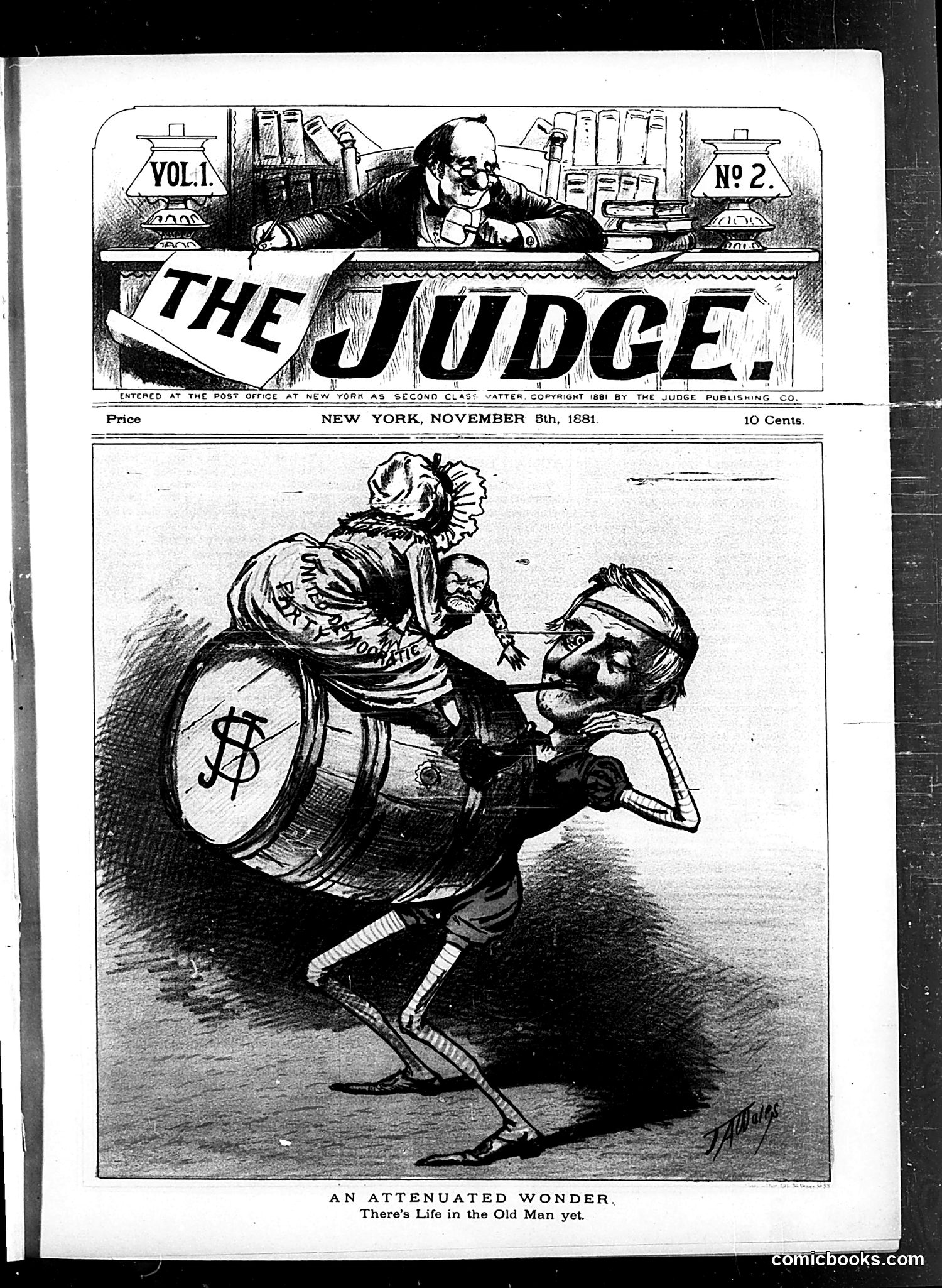
This political cartoon satirizes an elderly man (likely a political figure or leader) carrying an enormous barrel marked with a dollar sign. The exaggerated, skeletal physique contrasts sharply with the massive financial burden he bears, suggesting the cartoon critiques how fiscal responsibilities are crushing the nation's leadership. The caption "An Attenuated Wonder" and subtitle "There's Life in the Old Man yet" imply ironic commentary—despite appearing worn-out and depleted, the figure persists under financial strain. The 1881 date places this during the Gilded Age, when political corruption, financial speculation, and government spending were common satirical targets in American periodicals. The cartoon likely criticizes either a specific political leader or broader governmental fiscal mismanagement of the era.
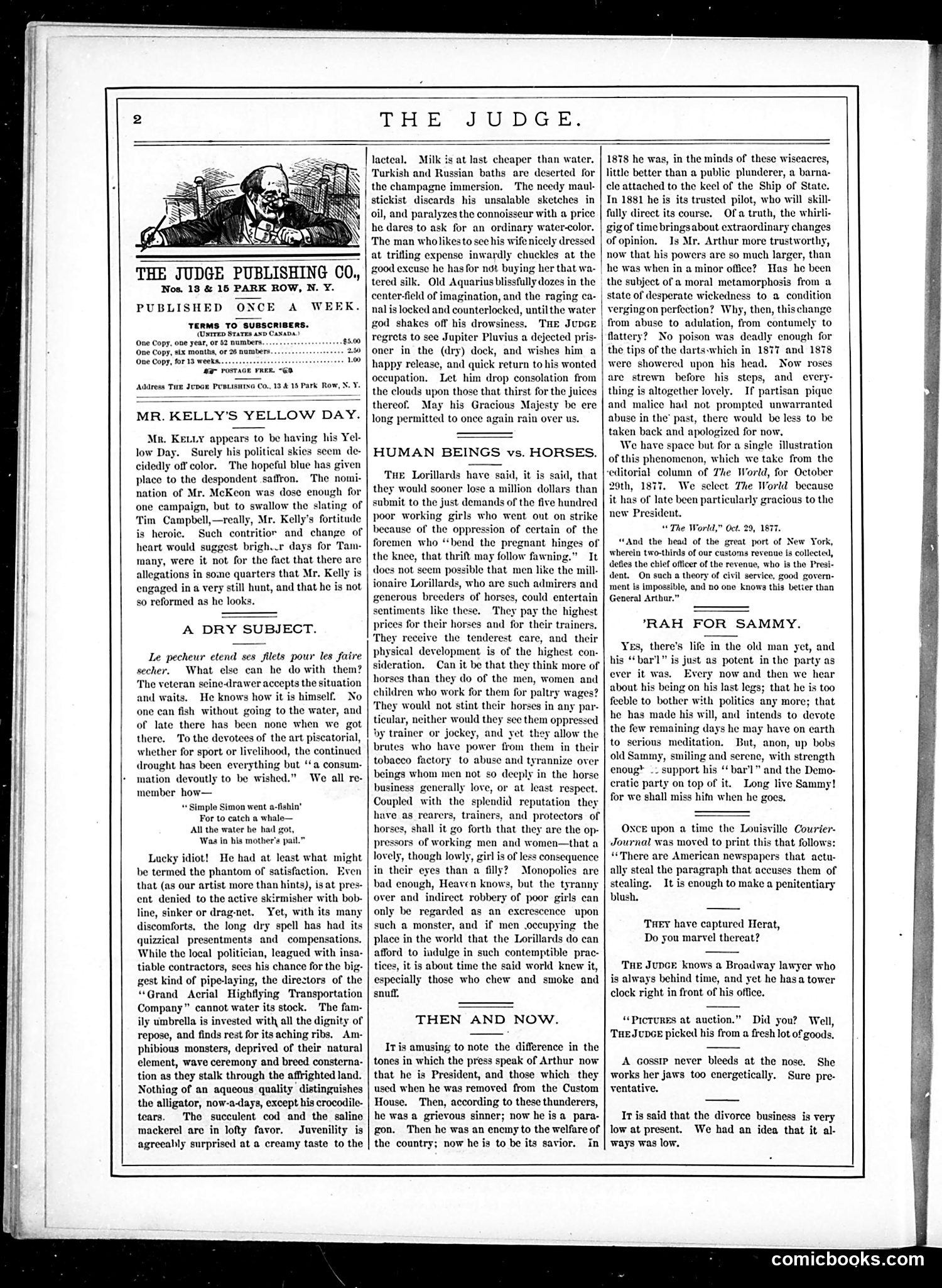
This page contains **Mr. Kelly's Yellow Day**, a political cartoon about Irish-American politician John Kelly (Tammany Hall leader). The satire mocks Kelly's weakened political position—his "political skies" have turned from hopeful blue to "despondent saffron" (yellow). The cartoon references his forced acceptance of Tim Campbell's nomination despite his opposition, suggesting Kelly's power within Tammany is declining. The **"Dry Subject"** section is a lighthearted essay about a prolonged drought affecting New York, using fishing and water imagery to comment on various social consequences: pipeliners exploit the situation, aquatic animals suffer, and ironically, milk becomes cheaper than water. The fragmentary **"Human Beings vs. Horses"** column appears to critique the wealthy Lorillard family for allegedly refusing fair wages to striking factory workers while indulging their horses with expensive care—satirizing misplaced priorities of the wealthy. The page reflects 1870s-80s urban American concerns: political corruption, labor disputes, and weather impacts on city life.
This page contains two literary pieces from *Judge* magazine, not political cartoons. **"Jersey Jane"** is a humorous poem satirizing overwrought Romantic poetry and Victorian affectation. It parodies serious literary conventions (referencing Thomas Campbell's famous poem "Hohenlinden") by treating mundane seaside tourism at Coney Island with mock-epic grandeur. The joke is the deflation of lofty poetic language applied to ordinary middle-class leisure. **"The Round Table Club"** is a prose humor piece featuring Hans Lusher, a German immigrant character rendered in heavy dialect comedy. The humor derives from the "funny foreigner" stereotype popular in period American magazines—Hans repeatedly fails to convey Joe's hen story, unable to understand or translate the punchline. The satire targets both immigrant incomprehension and the futility of explaining jokes, not political positions. Both pieces exemplify *Judge's* literary humor rather than editorial satire.
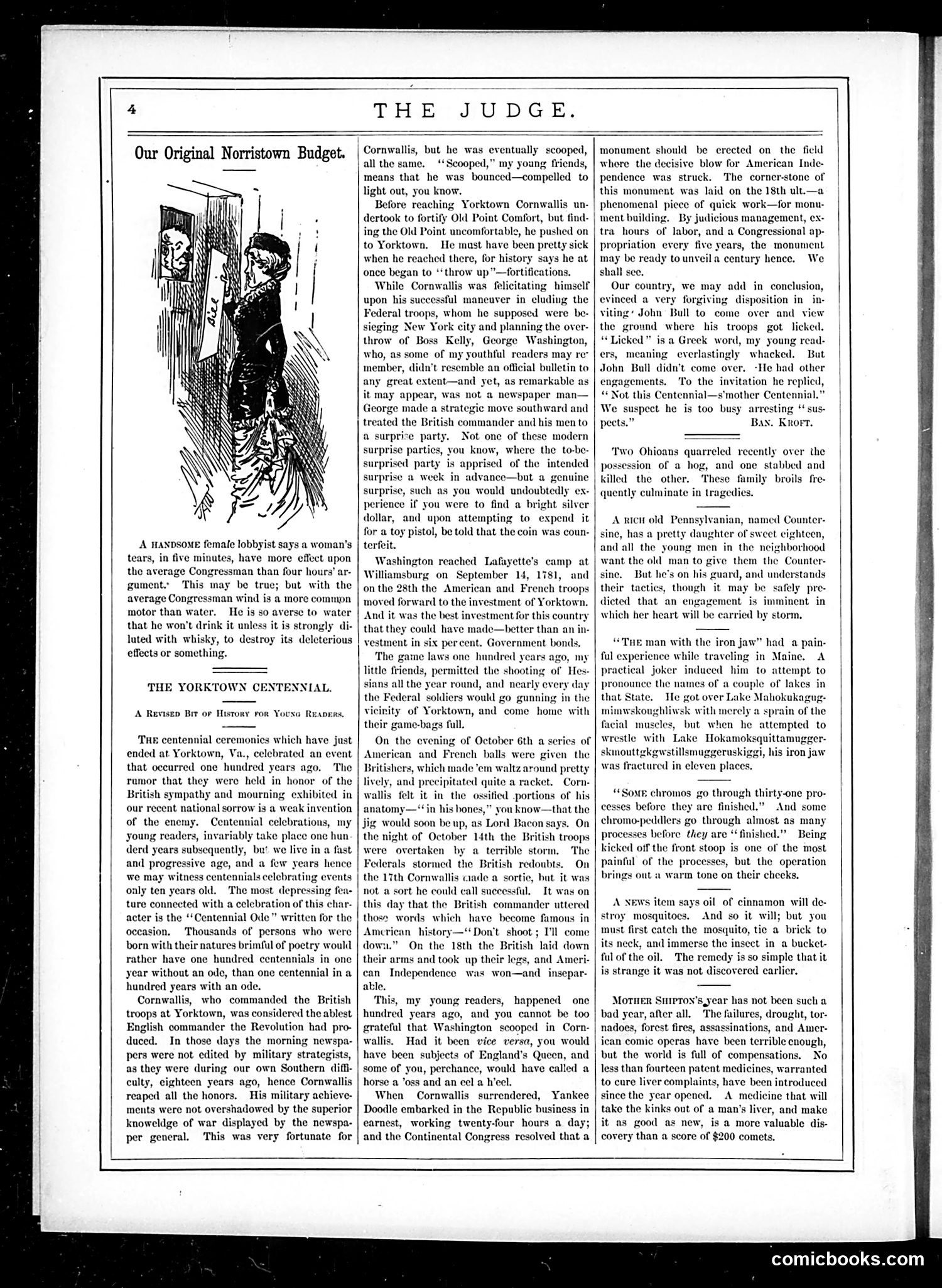
This page from *Judge* magazine satirizes the Yorktown Centennial celebration (1881, marking the 100th anniversary of the 1781 British surrender). The author mocks several aspects: **The main targets:** - The absurdity of "Centennial Odes"—tedious poems written for such occasions - General Cornwallis, the British commander, who is portrayed as incompetent (he "scooped" or forced to flee) - The revisionist framing of the celebration; the author jokes that modern America celebrates events only ten years old, undercutting the supposed historical grandeur **The joke's point:** The piece lampoons both the pretentiousness of centennial ceremonies and American journalism's tendency to overshadow military achievement with newspaper commentary—a dig at Civil War-era "newspaper generals" who second-guessed strategy. The illustration (upper left) shows what appears to be a female lobbyist, illustrating an opening anecdote about Congressional persuasion through emotional appeals rather than argument.
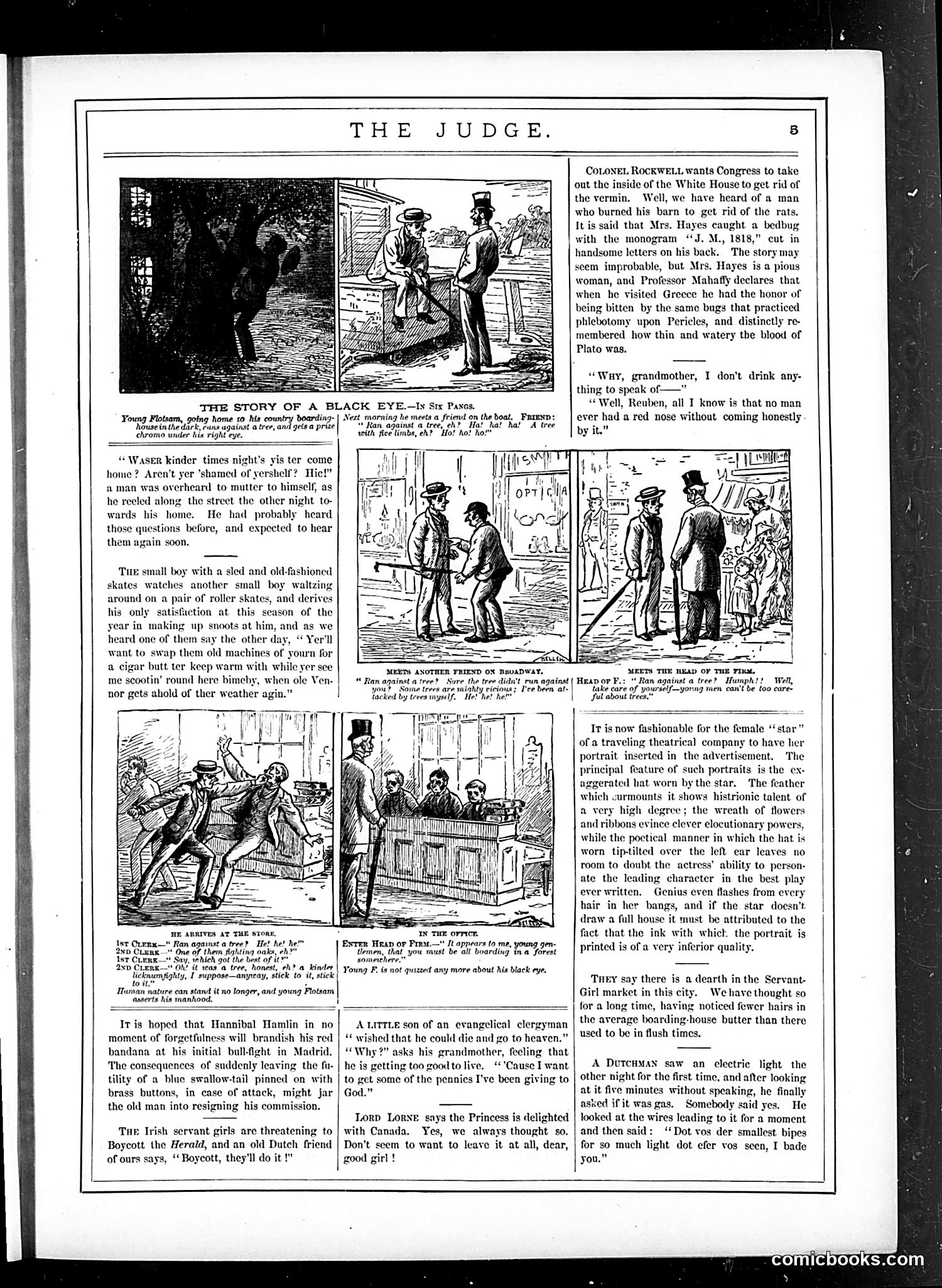
This page contains multiple satirical pieces typical of the magazine's humor: **Main Story: "A Black Eye in Six Panels"** depicts a young man repeatedly encountering acquaintances who make jokes about his black eye, each suggesting increasingly absurd causes (running into a tree, fighting an oak). The humor culminates when he finally fights back verbally, earning respect and ending the mockery. **Side Commentary** includes jabs at: - Colonel Rockwell's proposal to fumigate the White House (bedbugs were a genuine concern) - Mrs. Hayes and historical references to ancient Greek philosophers being bitten by bugs - Hannibal Hamlin attending a bullfight in Madrid (potential danger to a dignitary) - Irish servant girls boycotting newspapers - Lord Lorne and the Princess's visit to Canada The pieces blend physical comedy, wordplay, and topical political references. Overall, it's typical 19th-century satirical magazine content mixing domestic humor with commentary on contemporary public figures and events.
This page contains a serialized story about Toft McGudgeon, an older bachelor employee who responds to a matrimonial advertisement signed "Madge." The humor derives from the genteel courtship conventions of the era clashing with workplace mockery. When McGudgeon prepares for his meeting with the mysterious "Madge" at the Astor House hotel, his coworkers—particularly Tom Tripper, the proprietor's son—notice his unusual grooming: cologne and a red rose pinned to his lapel. They immediately deduce he's pursuing a romantic "mash" (crush) and spy on him. The satire targets both the absurdity of matrimonial advertisements as a matchmaking method and the self-conscious dignity bachelors must maintain while pursuing romance. McGudgeon's secretive behavior and the coworkers' gleeful detection of his romantic venture represent typical workplace ribaldry about unmarried men seeking wives through unconventional means.
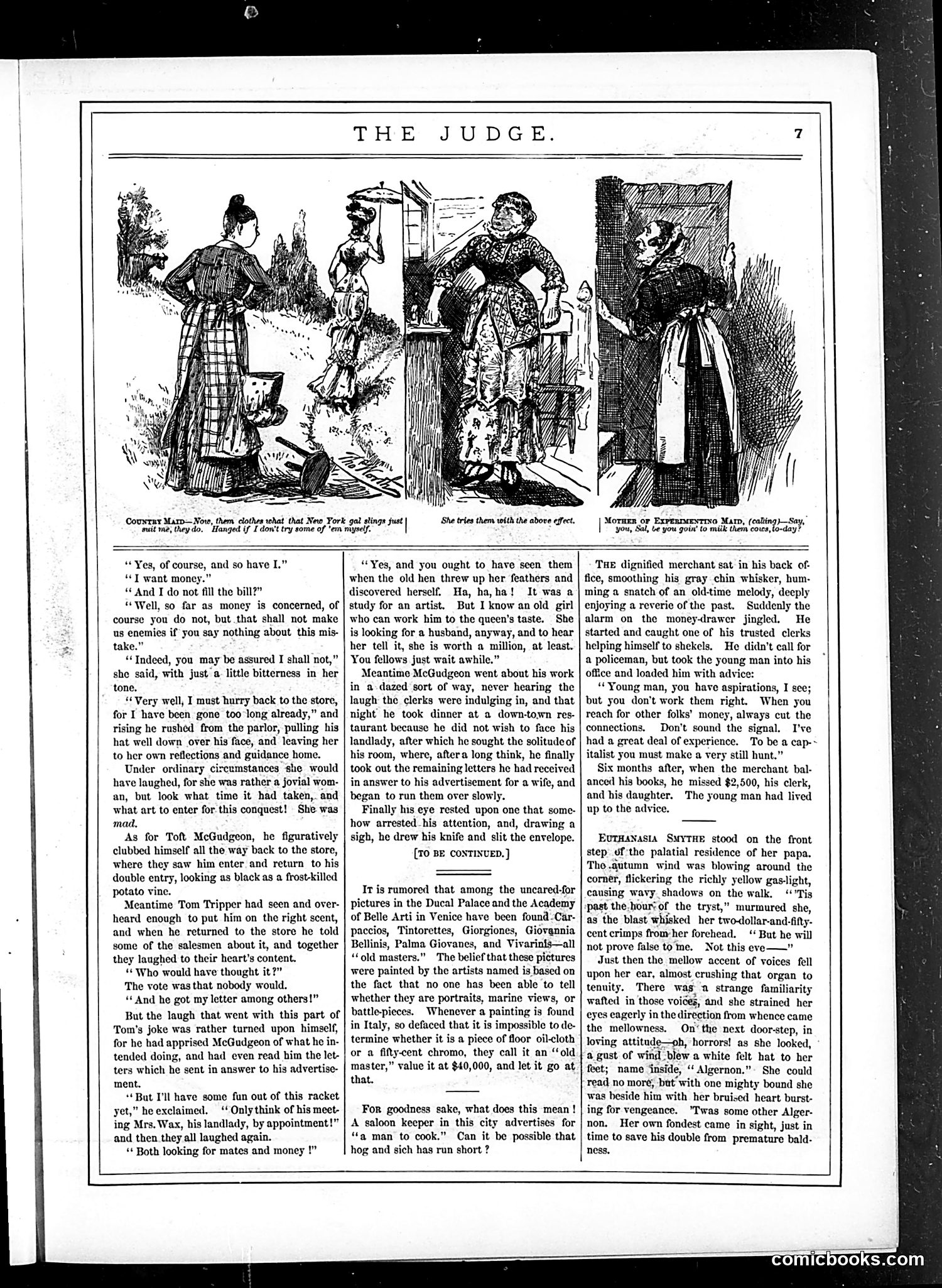
This page from *Judge* magazine contains a serialized story about romantic deception. The main narrative involves **McGudgeon**, a merchant who answered a matrimonial advertisement from "Country Maid," seeking a wife with money. He's been tricked by **Tom Tripper**, a store clerk who orchestrated the meeting. The "Country Maid" turns out to be McGudgeon's own landlady, **Mrs. Wax**, whom he didn't recognize. The satire mocks both parties: McGudgeon for his mercenary marriage-seeking, and the women for similar financial desperation. The cartoons above illustrate the deception and embarrassment. A separate sidebar satirizes Italian art dealers' practice of labeling any damaged, unidentifiable painting as a lost "old master" and valuating it at $40,000—ridiculing art-world fraud and credulous collectors willing to pay inflated prices for dubious authenticity. Both segments critique 19th-century greed and dishonesty.
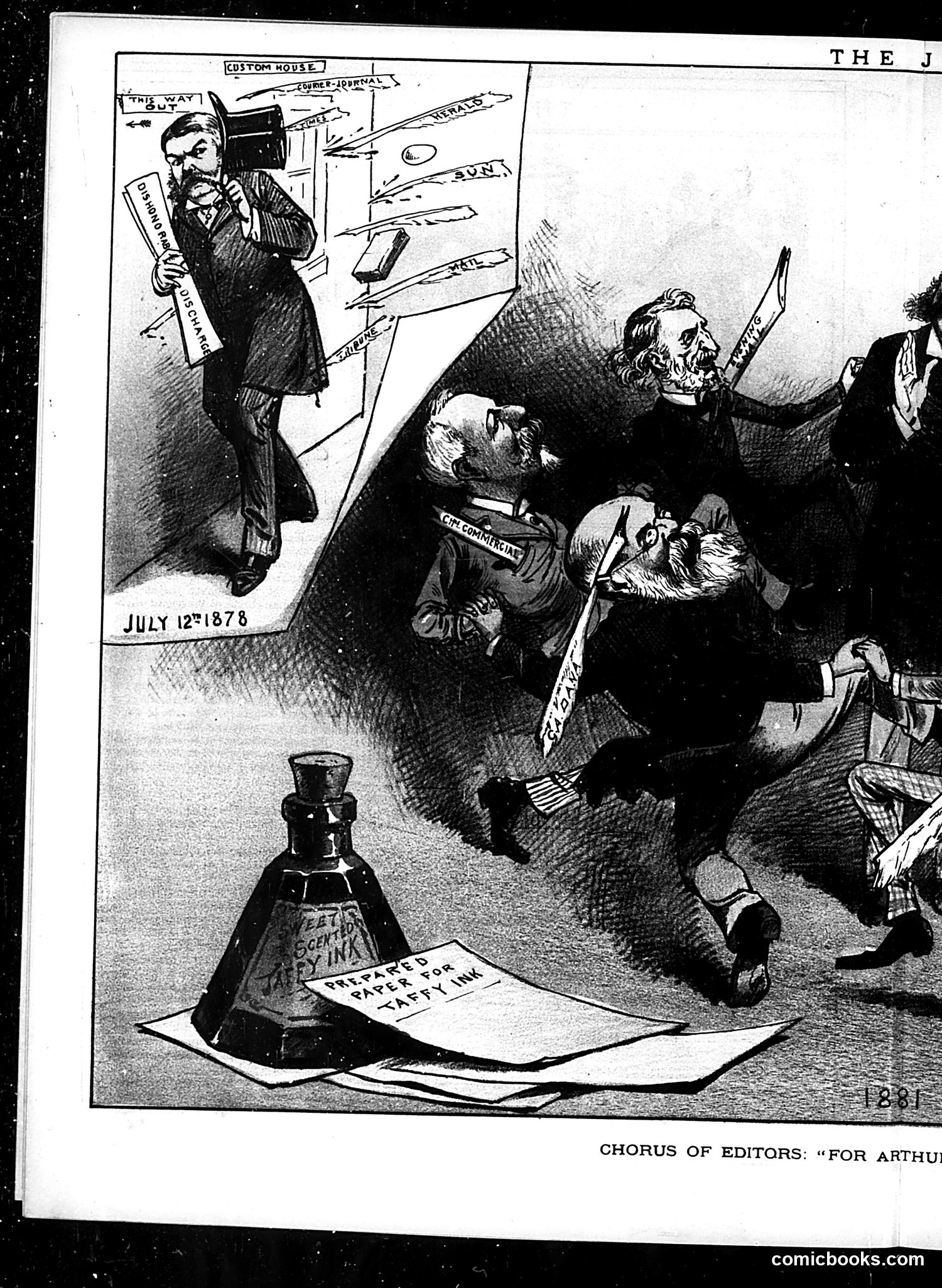
This cartoon satirizes newspaper editors' unified support for Arthur (likely Chester Arthur, vice president at the time). The figure on the left holds a "Custom House" document while addressing a "chorus" of editors on the right, who appear to be responding in unison. The central visual joke involves an inkbottle labeled "PRINTER'S INK FOR TAFFY INK"—a pun suggesting editors produce flattery ("taffy") rather than honest journalism. The scattered papers at bottom reinforce this critique of editorial corruption. The cartoon appears to attack the collusion between political patronage (custom house appointments) and press manipulation, suggesting editors were compromised by government connections and produced propaganda rather than independent reporting.
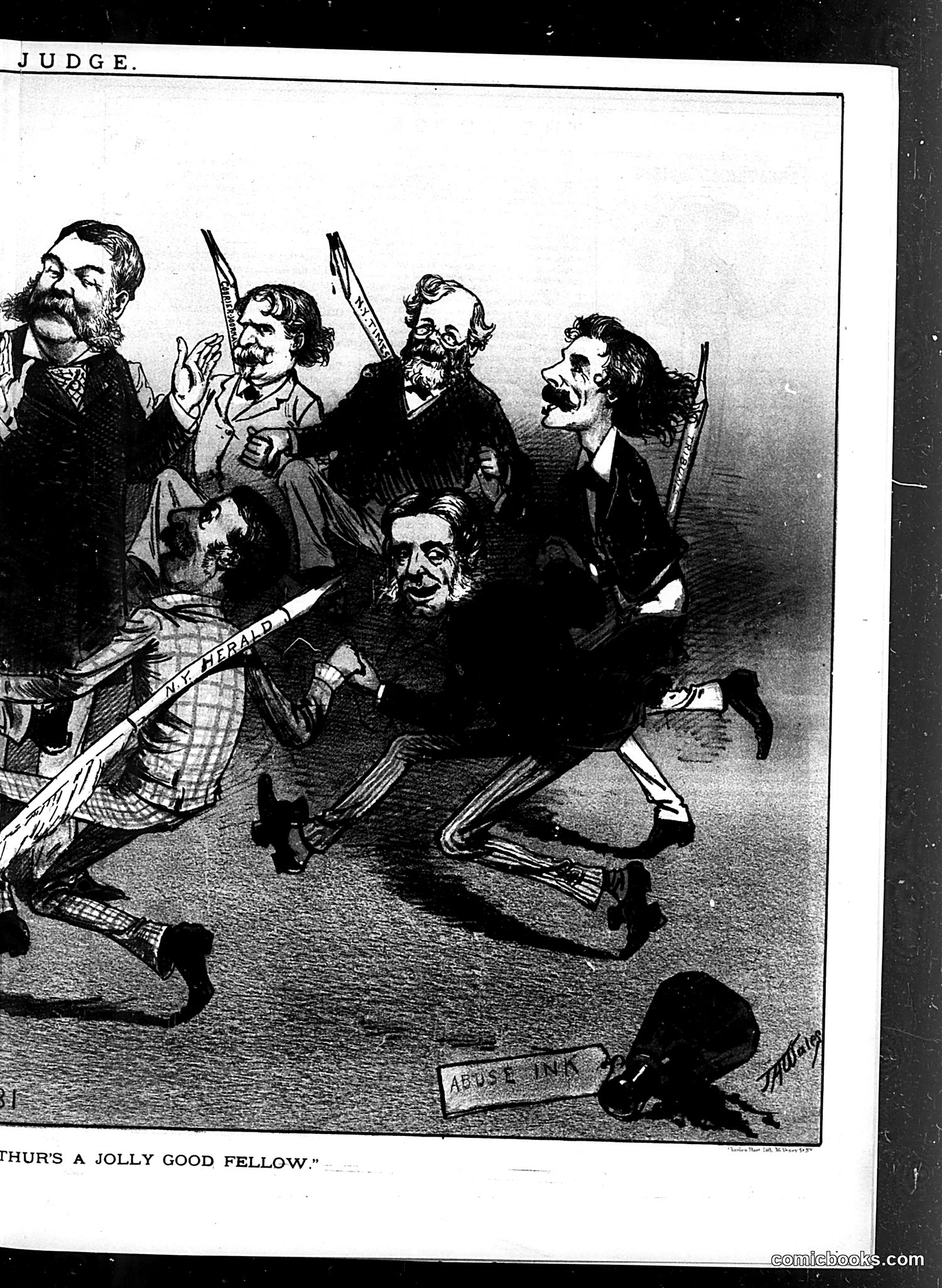
This Judge magazine cartoon depicts five men in 19th-century dress wielding weapons (swords/daggers), with one figure kneeling. A label reading "ABUSE INK" appears near the bottom, and there's a rat in the lower right corner. The title "'THUR'S A JOLLY GOOD FELLOW'" suggests ironic commentary on someone being celebrated despite questionable behavior. The weapons and aggressive postures indicate the figures are engaged in conflict or violence. The "ABUSE INK" label likely refers to abusive journalism or inflammatory rhetoric. The rat may represent deception or corruption. Without clearer identification of the specific figures or historical context visible in the image alone, I cannot definitively name which political or social controversy this satirizes, though it clearly mocks powerful figures for conduct the magazine deemed reprehensible.
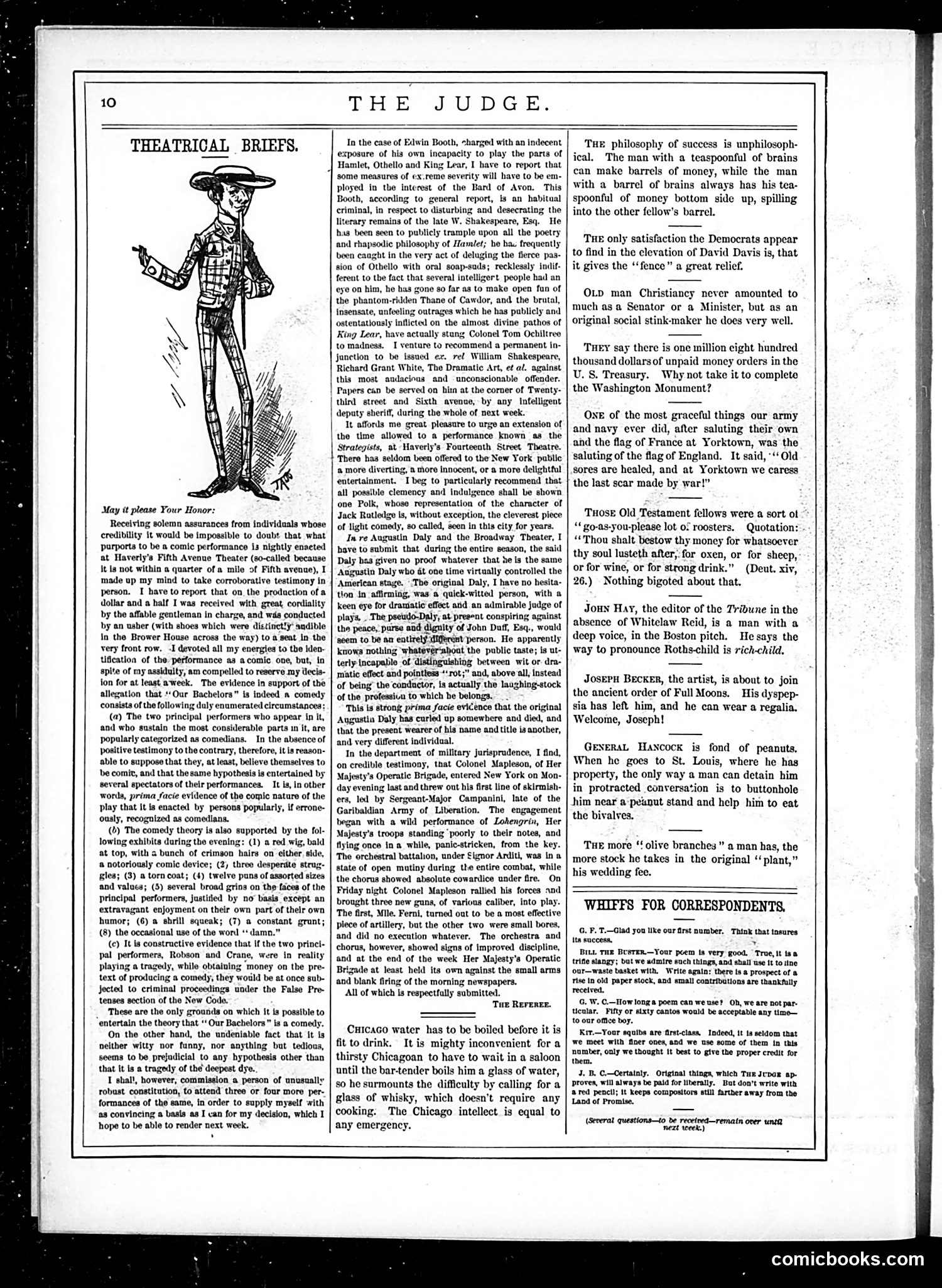
This page from *Judge* contains a satirical theater review of the comedy "Our Bachelors" at Haverly's Fifth Avenue Theater. The reviewer uses mock-legal language ("May it please Your Honor") to deliver a scathing critique, arguing the play isn't actually funny despite being marketed as a comedy. The humor lies in the reviewer's deadpan enumeration of supposed evidence of comedy—a red wig, puns, torn coat, actors' grins—while openly admitting the play is "neither witty nor funny, nor anything but tedious." The satirical point: the performance relies on cheap theatrical gimmicks rather than genuine humor. The second brief mentions Edwin Booth's poor performances in Shakespearean roles (Hamlet, Othello, King Lear), sarcastically suggesting legal action against him for "desecrating" Shakespeare's literary works. The illustration shows a theatrical character in period costume, likely representing the comedic style being mocked.
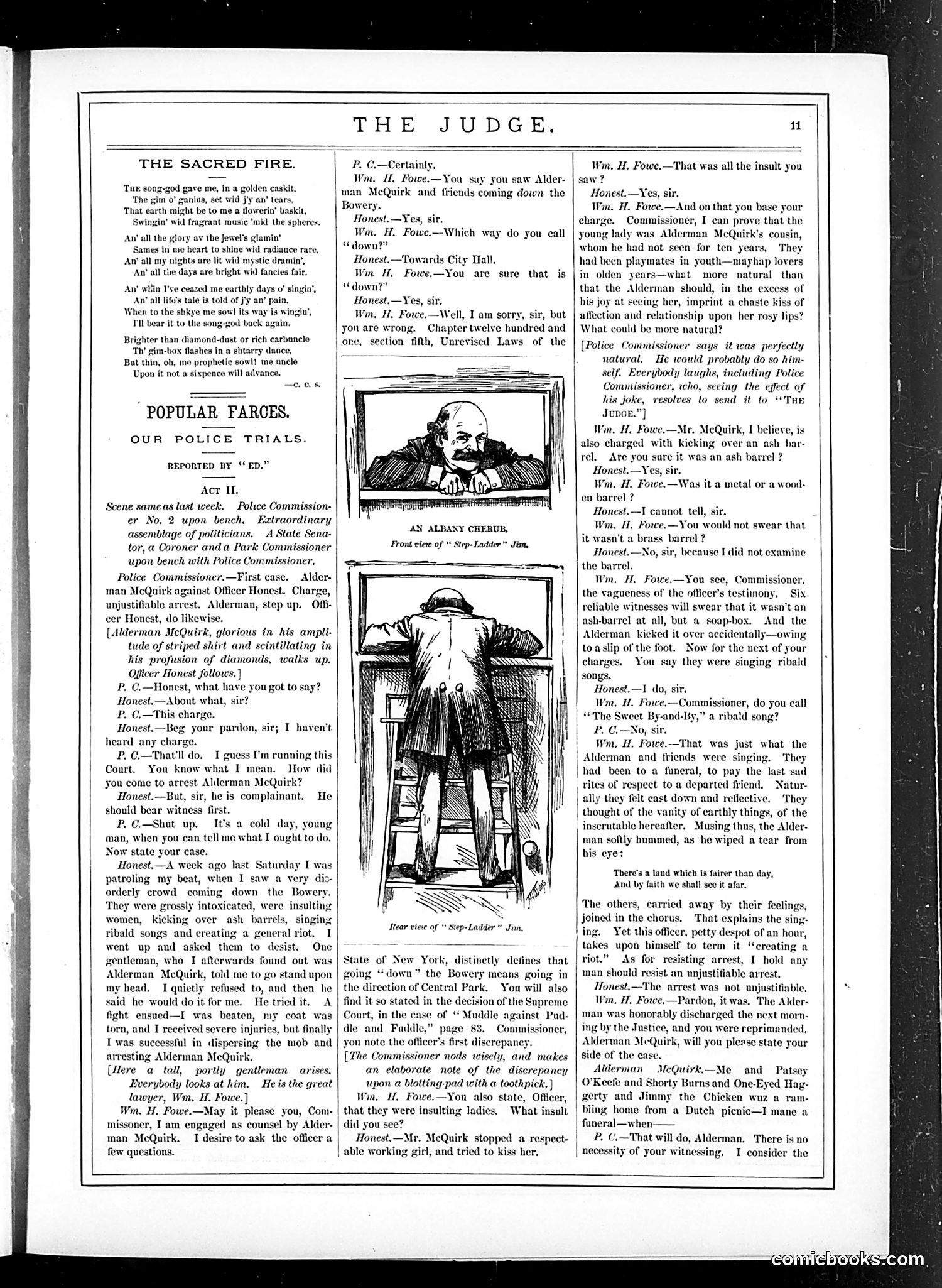
This page satirizes **corrupt police trials in New York City**, likely from the 1880s-90s. The central mockery: Officer Honest testifies truthfully about arresting Alderman McQuirk for drunken rowdiness, but the lawyer **Wm. H. Fowe** (appearing to represent the corrupt politician) exploits absurd legal technicalities—like redefining what "down the Bowery" means according to obscure state laws—to discredit honest testimony. The **Police Commissioner**, flanked by politicians and cronies, takes notes on these meaningless "discrepancies" rather than weighing actual guilt or innocence. The joke: **Political machine corruption trumps justice**. An obviously guilty alderman can evade accountability through legal sophistry and connections, while decent officers face humiliation. The cartoon mocks both the police apparatus and the judges/politicians who enable it. The two sketches labeled "Albany Cherub" (showing "Step-Ladder Jim" front and rear) appear to reference another corrupt political figure, reinforcing the theme of untouchable politicians.
This satirical piece mocks pretentious theater-goers who affect exaggerated sophistication. Two fashionably dressed young men occupy seats at a performance by actor Edwin Booth, speaking in affected language ("Yahs") while dismissing Booth's talent and criticizing the "ordinary looking audience" around them—despite their own evident lack of genuine theatrical knowledge. The joke culminates when these self-proclaimed aesthetes, oblivious to the irony, are themselves observed and found ridiculous by the narrator. The satire targets the affectation of cultural superiority among gilded-age dandies who use obscure vocabulary and name-dropping (Garrick, Salvini, Barrett) to appear refined while revealing their emptiness through contradictions and pretense. The accompanying column criticizes actual social corruption (a policeman bribed by an alderman), suggesting Judge's broader critique: false aestheticism masks real moral decay in American society.
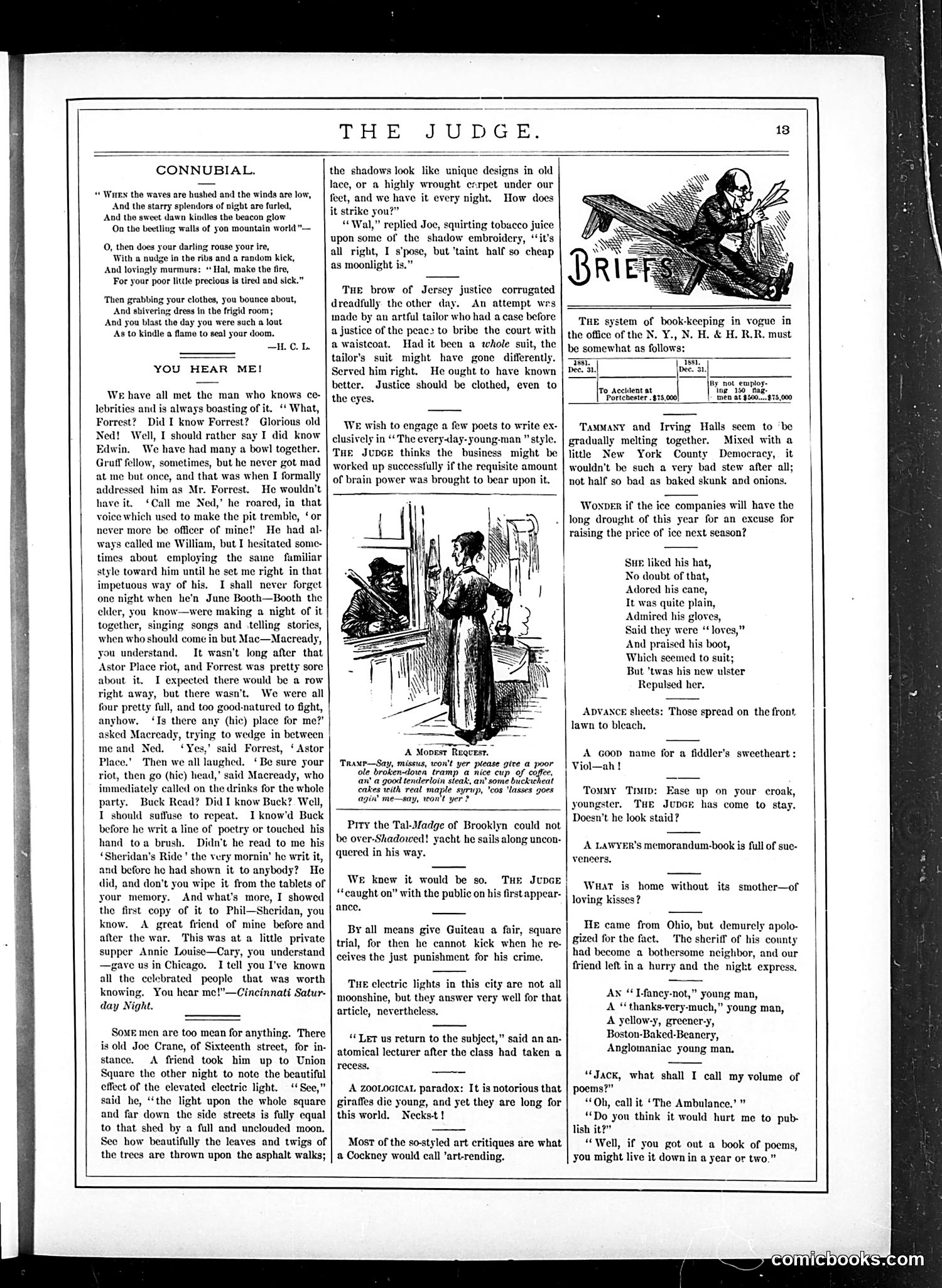
This page from the satirical magazine *Judge* contains three separate humor pieces mocking recognizable social types: 1. **"Connubial"**: A poem satirizing the romantic gap between courtship and marriage—depicting a wife interrupting her husband's poetic reverie with nagging demands to make a fire. 2. **"You Hear Me!"**: A lengthy monologue lampooning the tedious name-dropper who constantly boasts of friendships with celebrities. The narrator claims intimate acquaintance with actors Edwin Forrest, John Booth, William Macready, and poet Buck Read, referencing the real Astor Place Riot (1849) between Forrest and Macready supporters. The joke: such people exhaust everyone with fabricated celebrity connections. 3. **"A Miser Reproof"**: Brief anecdote about Joe Crane, a miserly character who, shown beautiful electric lights in Union Square, complains they're "not half so cheap as moonlight." The page targets vanity, marital disillusionment, and miserliness—universal comedic targets requiring minimal historical context beyond recognizing that Forrest and Macready were famous 19th-century actors.
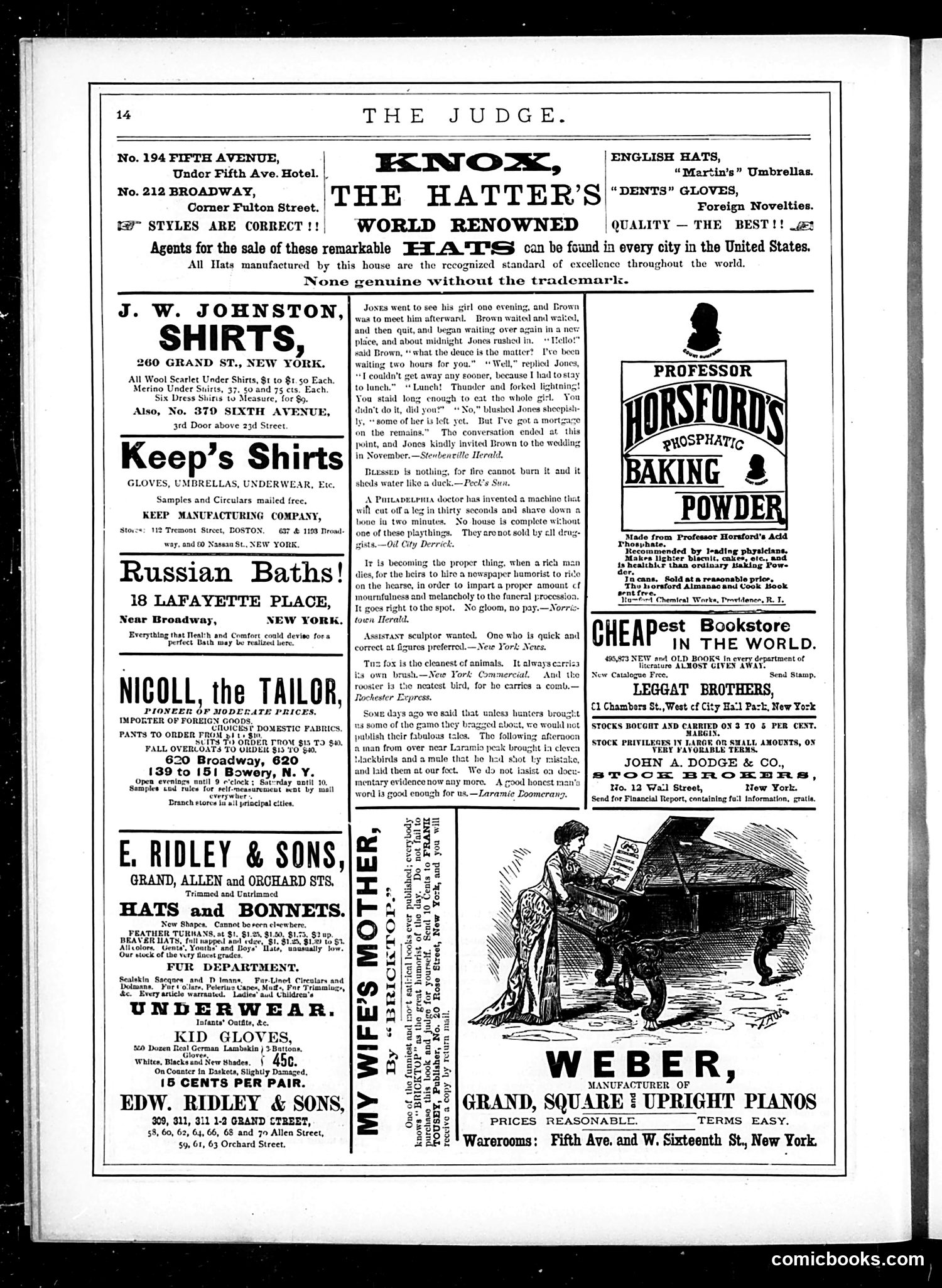
This page is almost entirely commercial advertising, with only scattered joke fragments interspersed. There is one cartoon image showing a woman at a piano with an attendant or servant figure, labeled "WEBER" below it—apparently advertising grand and upright pianos. The text fragments are brief, seemingly comedic short pieces typical of Judge magazine's humor: jokes about Jones waiting for his girlfriend (and eating too much of her food), fire-resistant material, a rapid leg-amputation machine, hiring newspaper humorists for funeral processions, and animal observations (a fox carrying its brush, a rooster its comb). These appear to be the sort of absurdist or mildly risqué humor Judge was known for, but without broader context, their specific satirical targets—if any—are unclear. The page serves primarily as a vehicle for clothing, hat, and musical instrument advertisements.
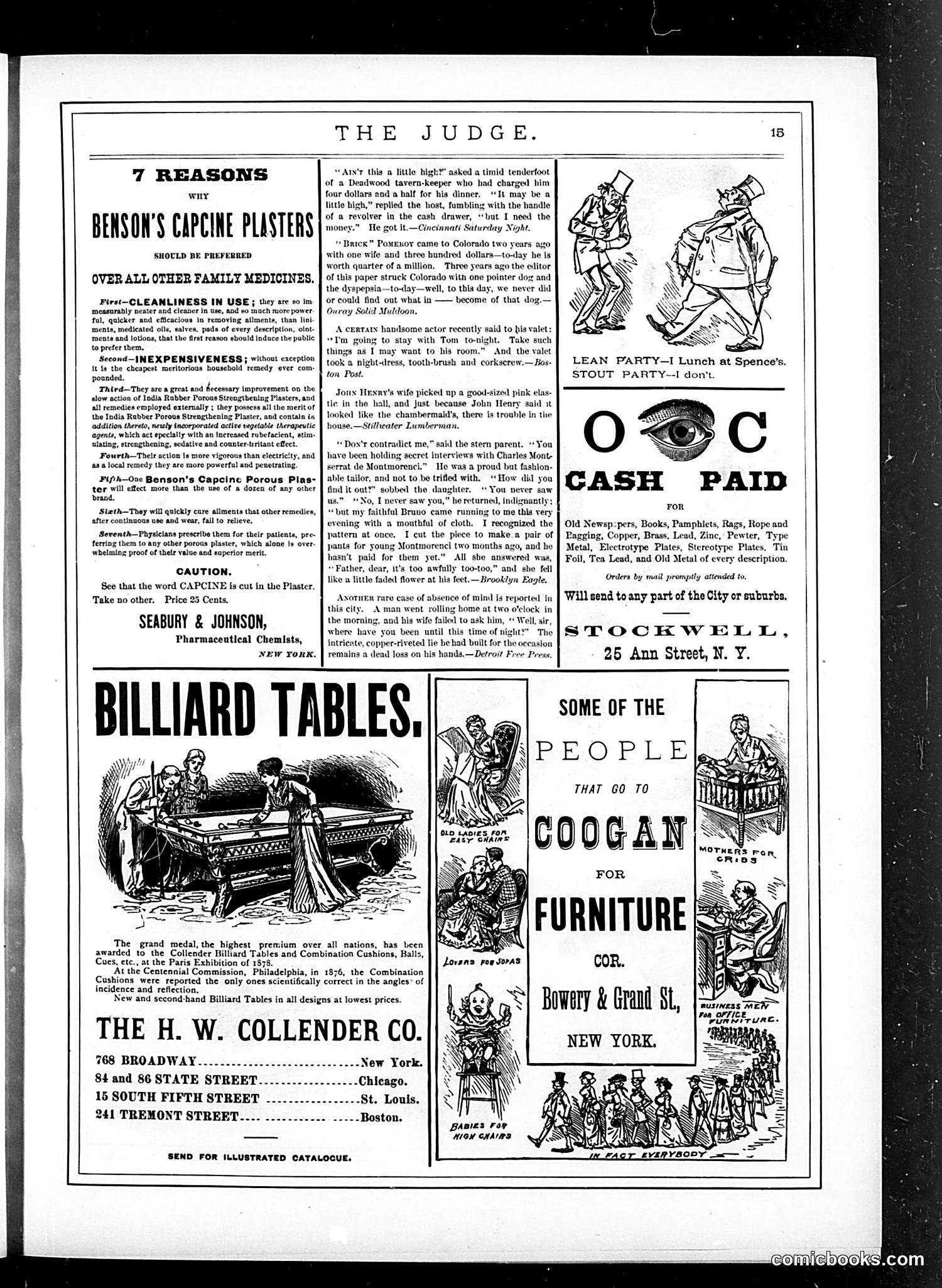
This is primarily an **advertising page** from Judge, a late 19th-century satirical weekly. The dominant content consists of patent medicine ads (Benson's Capcine Plasters, billiard tables, furniture) rather than political cartoons. The small **humorous anecdotes** scattered throughout reflect period attitudes: a Deadwood tavern-keeper threatens a customer with a revolver over dinner prices (Old West frontier justice); a Colorado prospector's sudden wealth contrasts with a newspaperman's mysterious dog loss (gold rush era social mobility); domestic anecdotes mock courtship propriety and parental authority (a tailor father discovers his daughter's suitor through a telltale cloth scrap from his own work). The two illustrated cartoons at right ("Lean Party" and "Coogan Furniture") show generic social scenes typical of Judge's visual humor—no specific political figures are identifiable. This page exemplifies how 19th-century satirical magazines blended advertising revenue with brief comedic commentary on contemporary manners and frontier life.
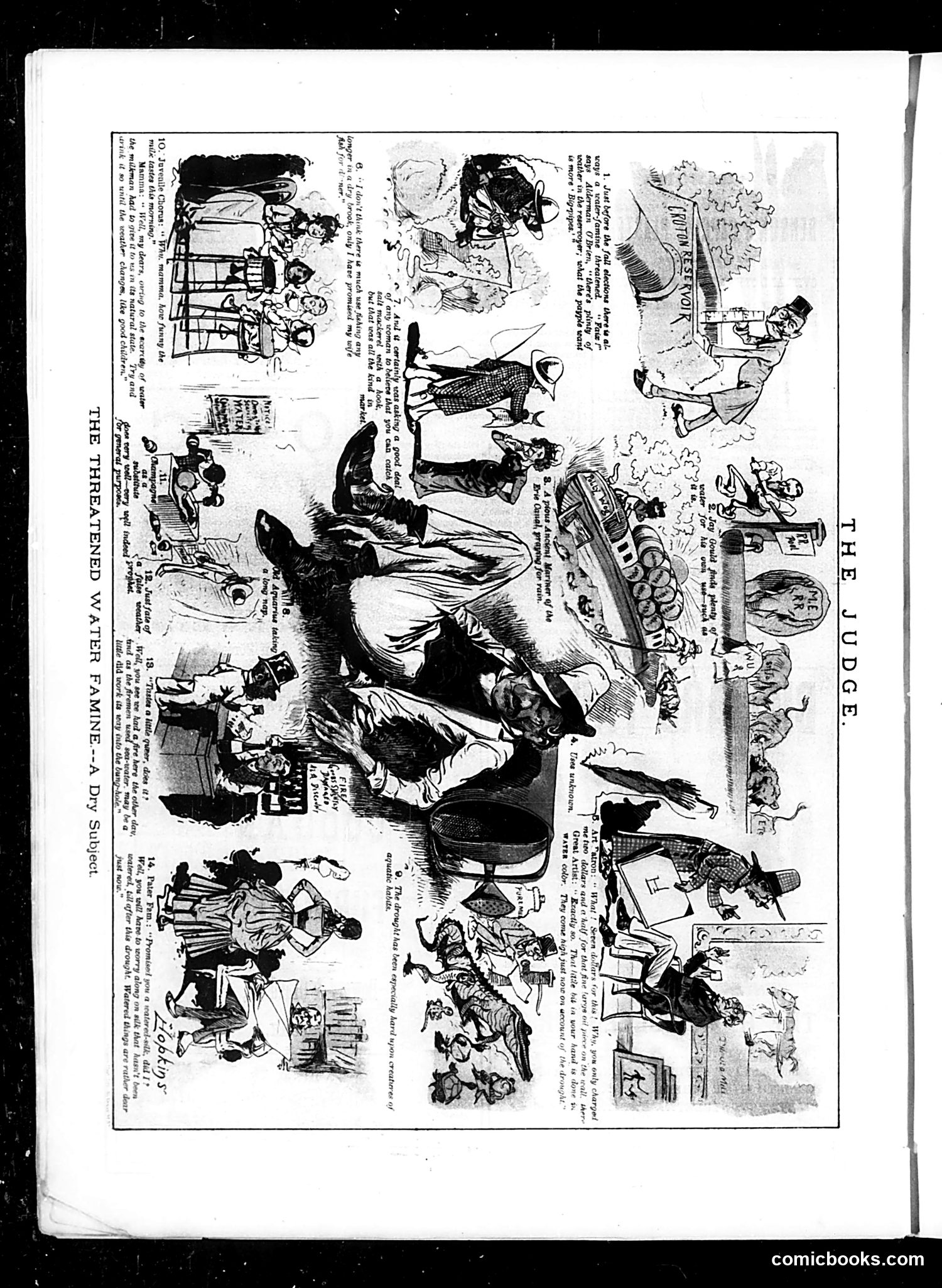
This political cartoon satirizes what appears to be a recurring pre-election pattern: politicians threaten a water shortage crisis just before elections to distract voters or gain political advantage. The central figure (likely a politician or political machine operator) is depicted manipulating or controlling the narrative around a water famine. The OCR'd text suggests cynicism about the timing—that such crises are conveniently "threatened" before elections rather than genuinely occurring. The satire's point: voters are being deceived by manufactured crises used as political tools. The cartoon mocks both the politicians creating false alarms and the public's gullibility in believing them. "A Dry Subject" puns on both the actual drought topic and the tedious, repetitive nature of this political game. Without clearer OCR or visible date information, the specific election and location cannot be determined, but the criticism targets predictable electoral manipulation tactics.