
Judge, 1881-11-05 · page 2 of 16
Judge — November 5, 1881 — page 2: what you’re looking at
What you’re looking at
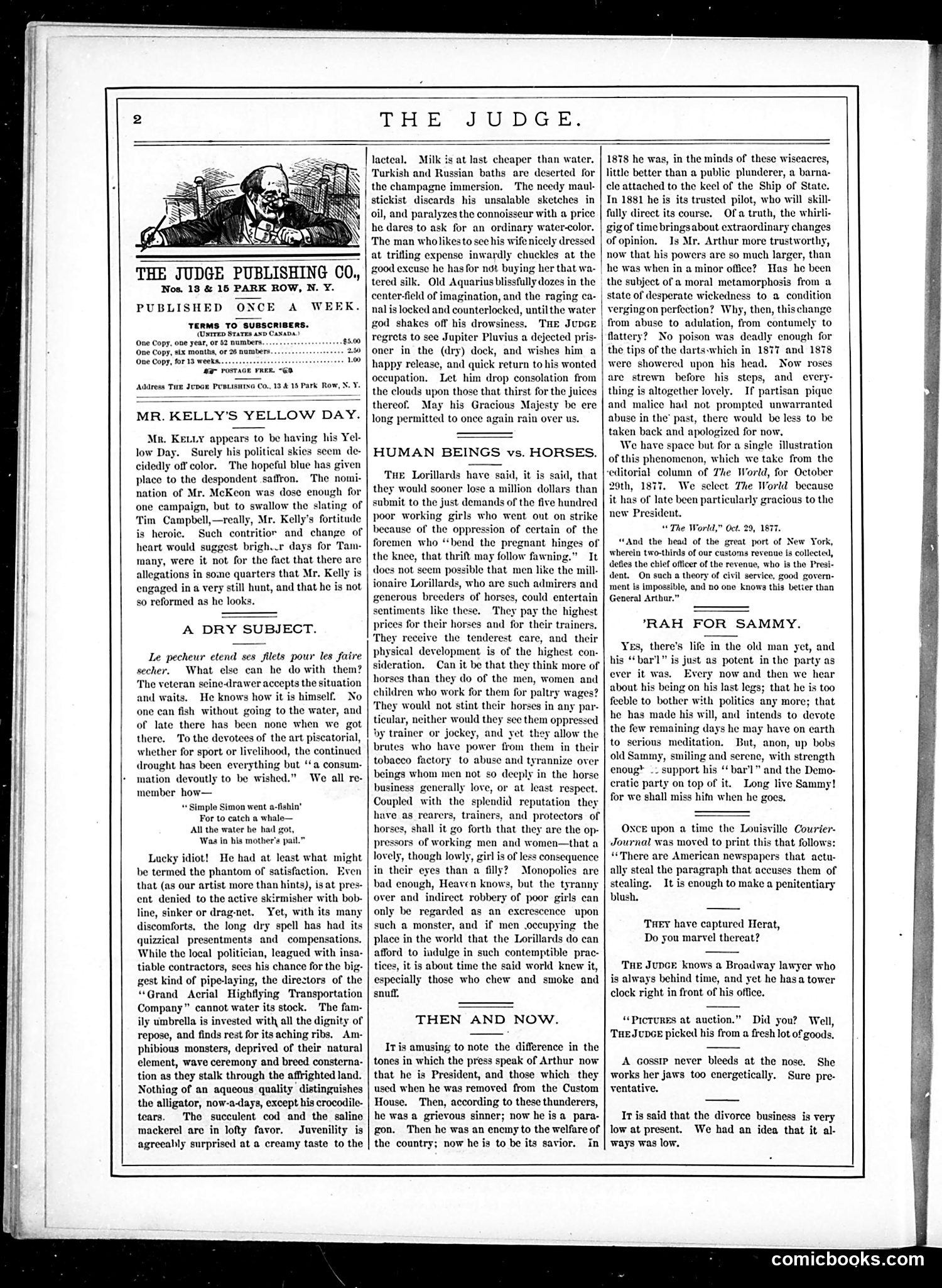
This page contains **Mr. Kelly's Yellow Day**, a political cartoon about Irish-American politician John Kelly (Tammany Hall leader). The satire mocks Kelly's weakened political position—his "political skies" have turned from hopeful blue to "despondent saffron" (yellow). The cartoon references his forced acceptance of Tim Campbell's nomination despite his opposition, suggesting Kelly's power within Tammany is declining. The **"Dry Subject"** section is a lighthearted essay about a prolonged drought affecting New York, using fishing and water imagery to comment on various social consequences: pipeliners exploit the situation, aquatic animals suffer, and ironically, milk becomes cheaper than water. The fragmentary **"Human Beings vs. Horses"** column appears to critique the wealthy Lorillard family for allegedly refusing fair wages to striking factory workers while indulging their horses with expensive care—satirizing misplaced priorities of the wealthy. The page reflects 1870s-80s urban American concerns: political corruption, labor disputes, and weather impacts on city life.
📄 Transcribed text from this page (OCR, searchable)
Machine-transcribed from the original scan — historical spelling and the odd misread are preserved.
THE JUDGE. THE JUDGE PUBLISHING CO,, Nos. 13 & 15 PARK ROW, N. Y. PUBLISHED ONCE A WEEK. TERMS TO SUBSCRIBERS. (Usrrep States axp C One Cops, one year, oF 2 numbers. One Copy, six months, of 26 numbers. One Copy, for 13 weeks... Aa POSTAGE YRER. “GO MING Co., 13.4 18 Park Row, MR. KELLY’S YELLOW DAY. Mr. KELLY appears to be having his Yel- low Day. Surely his political skies seem de- cidedly off color. The hopeful blue has given place to the despondent saffron. The nomi- nation of Mr. McKeon was dose enough for one campaign, but to swallow the slating of Tim Campbell,—really, Mr. Kelly's fortitude is heroic. Such contrition and change of heart would suggest brigh.r days for Tam- many, were it not for the fact that there are allegations in some quarters that Mr. Kelly is engaged in a very still hunt, and that he is not so reformed as he looks. A DRY SUBJECT. Le pecheur etend ses filets pour les faire secher. What else can he do with them? ‘The veteran seine-drawer accepts the situation and waits. He knows how it is himself. No one can fish without going to the water, and of late there has been none when we got there. To the devotees of the art piscatorial, whether for sport or livelihood, the continued drought has been everything but ‘a consum- mation devoutly to be wished.” We all re- member how— “Simple Simon went a-fishin’ For to catch a whale— All the water he had got, Waz in his mother’s pail.” Lucky idiot! He had at least what might be termed the phantom of satisfaction. Even that (as our artist more than hints), is at pres- ent denied to the active skirmisher with bob- line, sinker or drag-net. Yet, with its many discomforts, the long dry spell has had its quizzical_presentments and compensations. While the local politician, leagued with insa- tiable contractors, sces his chance for the big- gest kind of pipelaying, the directors of the “Grand Acrial Highflying Transportation Company” cannot water its stock. ‘The fam- ily umbrella is invested with all the dignity of repose, and finds rest for its aching ribs. Am- phibious monsters, deprived of their natural element, wave ceremony and breed consterna- tion as they stalk through the affrighted land. Nothiag of an aqueous quality distinguishes the alligator, now-a-days, except his crocodile- tears. The succulent cod and the saline mackerel are in lofty favor. Juvenility is agreeably surprised at a creamy taste to the lacteal, Milk is at last cheaper than water, Turkish and Russian baths are deserted for the champagne immersion. ‘The needy maul- stickist discards his unsalable sketches in oil, and paralyzes the connoisseur with a price he dares to ask for an ordinary water-color. The man wholikesto see his wife nicely dressed at trifling expense inwardly chuckles at the xcuse he has for ndt buying her that wa- tered silk. Old Aquarius blissfully dozes in the center-ficld of imagination, and the raging ca- | nal is locked and counterlocked, untilthe water god shakes off his drowsine THE JUDGE regrets to see Jupiter Pluvius a dejected pris- | oner in the (dry) dock, and wishes him a happy release, and quick return to his wonted occupation. Let him drop consolation from the clouds upon those that thirst for the juices thereof. May his Gracious Majesty be ere long permitted to once again rain over us. HUMAN BEINGS vs. HORSES. Tue Lorillards have si it is said, that they would sooner lose a million dollars than submit to the just demands of the five hundred poor working girls who went out on strike because of the oppression of certain of the foremen who ‘bend the pregnant hinges of the knee, that thrift may follow fawning.” It does not seem possible that men like the mill- ionaire Lorillards, who are such admirers and generous breeders of horses, could entertain sentiments like these. They pay the highest prices for their horses and for their trainer They receive the tenderest care, and their physical development is of the highest con- sideration. Can it be that they think more of horses than they do of the men, women and children who work for them for paltry wage: They would not stint their horses in any par- ticular, neither would they sce them oppressed by trainer or jockey, and yet they allow the brutes who have power from them in their tobacco factory to abuse and tyrannize over beings whom men not so deeply in the horse business gencrally love, or at least respect. Coupled with the splendid reputation they have as rearers, trainers, and protectors of horses, shall it go forth that they are the op- pressors of working men and women—that a lovely, though lowly, girl is of less consequence in their eyes than a filly? Monopolies are bad enough, Heaven knows, but the tyranny over and indirect robbery of poor girls can only be regarded as an excrescence upon such a monster, and if men .occupying the place in the world that the Lorillards do can afford to indulge in such contemptible prac- tices, it is about time the said world knew it, especially those who chew and smoke and snuff, THEN AND NOw. Iris amusing to note the difference in the tones in which the press speak of Arthur now that he is President, and those which they used when he was removed from the Custom House. Then, according to these thunderers, he was a grievous sinner; now he is a para- gon. Then he was an encmy to the welfare of the country; now he is to be its savior. in 1878 he was, in the minds of these wiseacres, little better than a public plunderer, a barna- cle attached to the keel of the Ship of State. In 1881 he is its trusted pilot, who will skill- fully direct its course. Of a truth, the whirli- gigof time brings about extraordinary changes of opinion, Is Mr. Arthur more trustworthy, now that his powers are so much larger, than he was when in a minor office? Has he been the subject of a moral metamorphosis from a state of desperate wickedness to a condition verging on perfection? Why, then, this change from abuse to adulation, from contumely to flattery? No poison was deadly enough for the tips of the dartswhich in 1877 and 1878 were showered upon his head. Now roses are strewn before his steps, and every thing is altogether lovely. If partisan pique and malice had not prompted unwarranted abuse in the’ past, there would be less to be taken back and apologized for now. We have space but for a single illustration of this phenomenon, which we take from the editorial column of The World, for October 29th, 1877. We select The World becaus it has of late been particularly gracious to the new President. “ The World,” Oct. 29, 1877. “And the head of the great port of New York, wherein two-thirds of our customs revenue is collected, defies the chief officer of the revenue, who is the Presi- dent. On such a theory of civil service, good govern- ment is impossible, and no one knows this betier than General Arthar.” "RAH FOR SAMMY. Yes, there's life in the old man yet, and his “bar'l” is just as potent in the party as ever it was. Every now and then we hear about his being on his last legs; that he is too feeble to bother with politics any more; that he has made his will, and intends to devote the few remaining days he may have on carth to serious meditation. But, anon, up bobs old Sammy, smiling and serene, with strength enoug* -- support his “bar'l” and the Demo- cratic party on top of Long live Sammy! for we shall miss him when he goes. ONcE upon a time the Louisville Courier. Journal was moved to print this that follow: “There are American newspapers that actu- ally steal the paragraph that accuses them of stealing. It is enough to make a penitentiary blush, Trey have captured Herat, Do you marvel thereat? Tue Jupce knows a Broadway lawyer who is always behind time, and yet he hasa tower clock right in front of his office. “Picrures at auction.” Did you? Well, ‘Tue JupcE picked his from a fresh lot of goods, A Gossip never bleeds at the nose. She works her jaws too energetically. Sure pre- ventative. Ir is said that the divorce business is very low at present. We had an idea that it al- ways was low. comicbooks.com