
Judge, 1881-11-05 · page 11 of 16
Judge — November 5, 1881 — page 11: what you’re looking at
What you’re looking at
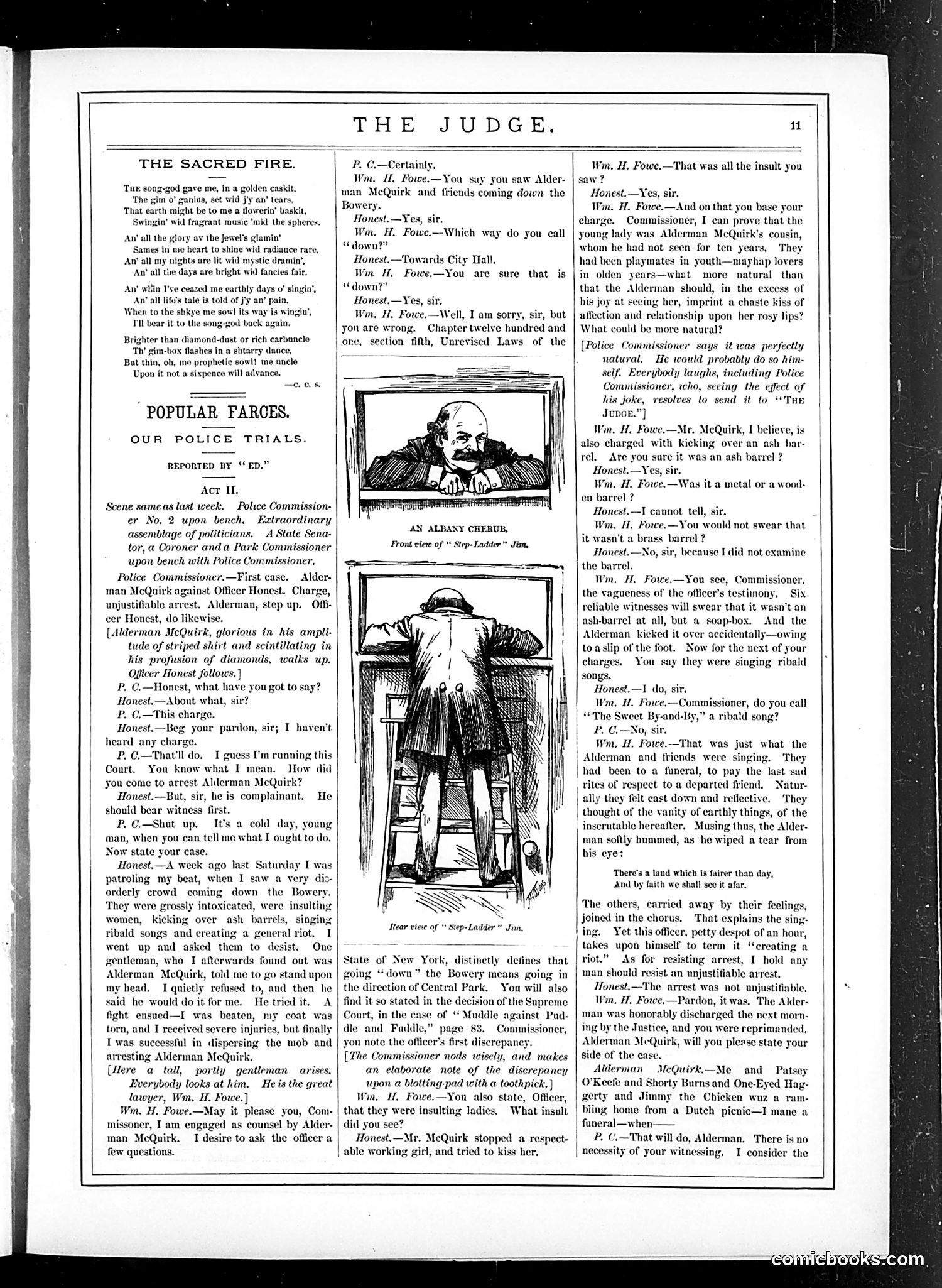
This page satirizes **corrupt police trials in New York City**, likely from the 1880s-90s. The central mockery: Officer Honest testifies truthfully about arresting Alderman McQuirk for drunken rowdiness, but the lawyer **Wm. H. Fowe** (appearing to represent the corrupt politician) exploits absurd legal technicalities—like redefining what "down the Bowery" means according to obscure state laws—to discredit honest testimony. The **Police Commissioner**, flanked by politicians and cronies, takes notes on these meaningless "discrepancies" rather than weighing actual guilt or innocence. The joke: **Political machine corruption trumps justice**. An obviously guilty alderman can evade accountability through legal sophistry and connections, while decent officers face humiliation. The cartoon mocks both the police apparatus and the judges/politicians who enable it. The two sketches labeled "Albany Cherub" (showing "Step-Ladder Jim" front and rear) appear to reference another corrupt political figure, reinforcing the theme of untouchable politicians.
📄 Transcribed text from this page (OCR, searchable)
Machine-transcribed from the original scan — historical spelling and the odd misread are preserved.
THE JUDGE. THE SACRED FIRE. Tur song-god gave me, ina golden caskit, ‘The gim o” ganioa, set wid j'y an’ tears, That earth might be to me a dowerin’ baskit, Swingin’ wid fragrant music 'mkl the spheres Aw’ all the glory av the jewel’s glamin’ ‘Sames in me heart to shine wid radiance rare, An’ all my nights are lit wid mystic dramin’, An’ all tue days are bright wid fancies fair. An’ wlin I've ceased me earthly days An’ all life's tale is told of j to the shkye me sow! its way is wingin’, Vil bear it to the song-god back again, * singin’, Brighter than diamond-dust or rich carbunclo Th’ gim-box flashes in a shtarry dance, Bat thin, oh, me prophetic sowl! me uncle Upon it not a sixpence will advance, cok "POPULAR FARCES. OUR POLICE TRIALS. REPORTED BY ‘ ED.” Act II. Scene sameas last week. Police Commission- er No, 2 upon bench, Extraordinary assemblage of politicians, A State Sena- tor, a Coroner anda Park Commissioner upon bench with Police Commissioner. Police Commissioner.—First case. Alder- man McQuirk against Officer Honest. Charge, unjustifiable arrest. Alderman, step up. Offi- cer Honest, do likewise. (Alderman McQuirk, glorious in his ampli- tude of striped shirt and scintillating in his profusion of diamonds, walks up. Officer Honest follow P. C.—Honest, what has Honest.—About what, si P. C.—This charge. Honest.—Beg your pardon, sir; 1 haven't heard any charge. P.C.—Thav'll do. I guess I'm running this Court. You know what I mean. How did you come to arrest Alderman McQuirk? Honest.—But, sir, he is complainant. should bear witness first. P.C.—Shut up. It’s a cold day, young man, when you can tell me what I ought to do. Now state your case. Honest.—A week ago last Satur patroling my beat, when I saw av He dic- orderly crowd coming down the Bowery. They were grossly intoxicated, were insulting women, kicking over ash barrels, singing ribald songs and creating a general riot. I went up and asked them to desist. One gentleman, who I afterwards found out was Alderman MeQuirk, told me to go stand upon my head. I quietly refused to, and then he said he would do it for me. He tried it. A fight ensued—I was beaten, my coat was torn, and I received severe injuries, but finally I was successful in dispersing the mob and arresting Alderman McQuirk. (Here a tall, portly gentleman arises. Everybody looks at him. He is the great lawyer, Wm. H. Fowe.} Wm. H, Fowe.—May it please you, Com- missoner, Iam engaged as counsel by Alder- man McQuirk. I desire to ask the officer a few questions. }man MeQuirk and friends ¢ P. C.—Certainly. Wm, H. Fowe.—You say you saw Alder- ing down the Bowery. Honest.—Yes, sir. Wm. H. Fowe.—Which way do you call “down?” Honest.—Towards City Hall. Wm H. Fowe.—You are sure that “down?” Honest.—Yes, si Wn, H, Fowe.—Well, I am sorry, sir, but you are wrong. Chapter twelve hundred and ore, section fifth, Unreviscd Laws of the is AN ALBANY CHERUB, Front view of Step-Ladder” Jim. Rear view of * Step-Lader™ Simm, ite of New York, distinctly detines that going “down” the Bowery means going in the direction of Central Par! You will also find it so stated in the decision of the Supreme Court, in the case of Muddle against Pud- dle and Fuddle, you note the officer's first di [The Commissioner nods wisely, and makes an elaborate note of the discrepancy upon a dlotting-pad with a toothpick. } Wn. H. Fow You also e, Officer, that they were insulting ladies. What insult did you see? Honest.—Mr. McQuirk stopped a respect- able working girl, and tried to kiss her. Wm. H. Fowe.—That was all the insult you saw ? Honest.—Yes, sir. Wm, H. Fowe.—And on that you base your charge. Commissioner, I can prove that the young lady was Alderman McQuirk’s cousin, whom he had not seen for ten years. They had been playmates in youth—mayhap lovers in olden years—what more natural than that the Alderman should, in the excess of his joy at seeing her, imprint a chaste kiss of affection and relationship upon her rosy lips? What could be more natural? [Police Commissioner says it was perfectly natural. He would probably do so him- self. Everybody laughs, including Police Commissioner, who, seeing the effect of his joke, resolves to send it to *THE Jupce.”) Wm. H, Fowe.—Mr. McQuirk, I believe, is also charged with kicking over an ash bar- rel, Are you sure it was an ash barrel ? Honest.—Yes, sir. Wm, H, Fowe.—Was it a metal or a wood- en barrel ? Honest.—I cannot tell, sir. Wm, H. Fowe,—You would not swear that it wasn't a brass barrel ? Honest.—Xo, sir, because I did not examine the barrel. Wm. H. Fowe.—You see, Commissioner, the vagueness of the officer's testimony. Six reliable witnesses will swear that it wasn't an ash-barrel at all, but a soap-box. And the Alderman kicked it over accidentally—owing toaslip of the foot. Now for the next of your charges. You say they were singing ribald songs. Honest.—I do, si Wm. H. Fowe.—Commissioner, do you call “The Sweet By-and-Iy,” a ribald song? P. C.—Xo, Wm. H. Fowe.—That was just what the Alderman and friends were singing. ‘They | had been to a funeral, to p d , tites of respect to a departed friend. ture | ally they felt cast down and reflective. They | thought of the vanity of earthly things, of the inscrutable hereafter. Musing thus, the Alder- man softly hummed, as he wiped a tear from his eye: There's a land which is fairer than day, And by faith we shall see it afar, ‘The others, carried away by their feelings, joined in the chorus. ‘That explains the sing- ing. Yet this officer, petty despot of an hour, takes upon himself to term it “creating a riot.” As for resisting arrest, I hold any man should resist an unjustifiable arrest. Honest.—The arrest was not unjustifiable. Wm. H. Fowe.—Pardon, it was. The Alder- man was honorably discharged the next morn- ing by the Justice, and you were reprimanded. Alderman McQuirk, will you please state your side of the case, Alderman MeQuirk.—Me and Patsey O'Keefe and Shorty Burns and One-Eyed Hag- gerty and Jimmy the Chicken wuz a ram- biing home from a Dutch pienic—I mane a funeral—when—— P. C.—That will do, Alderman. There is no necessity of your witnessing. I consider the