
Judge, 1881-11-05 · page 3 of 16
Judge — November 5, 1881 — page 3: what you’re looking at
What you’re looking at
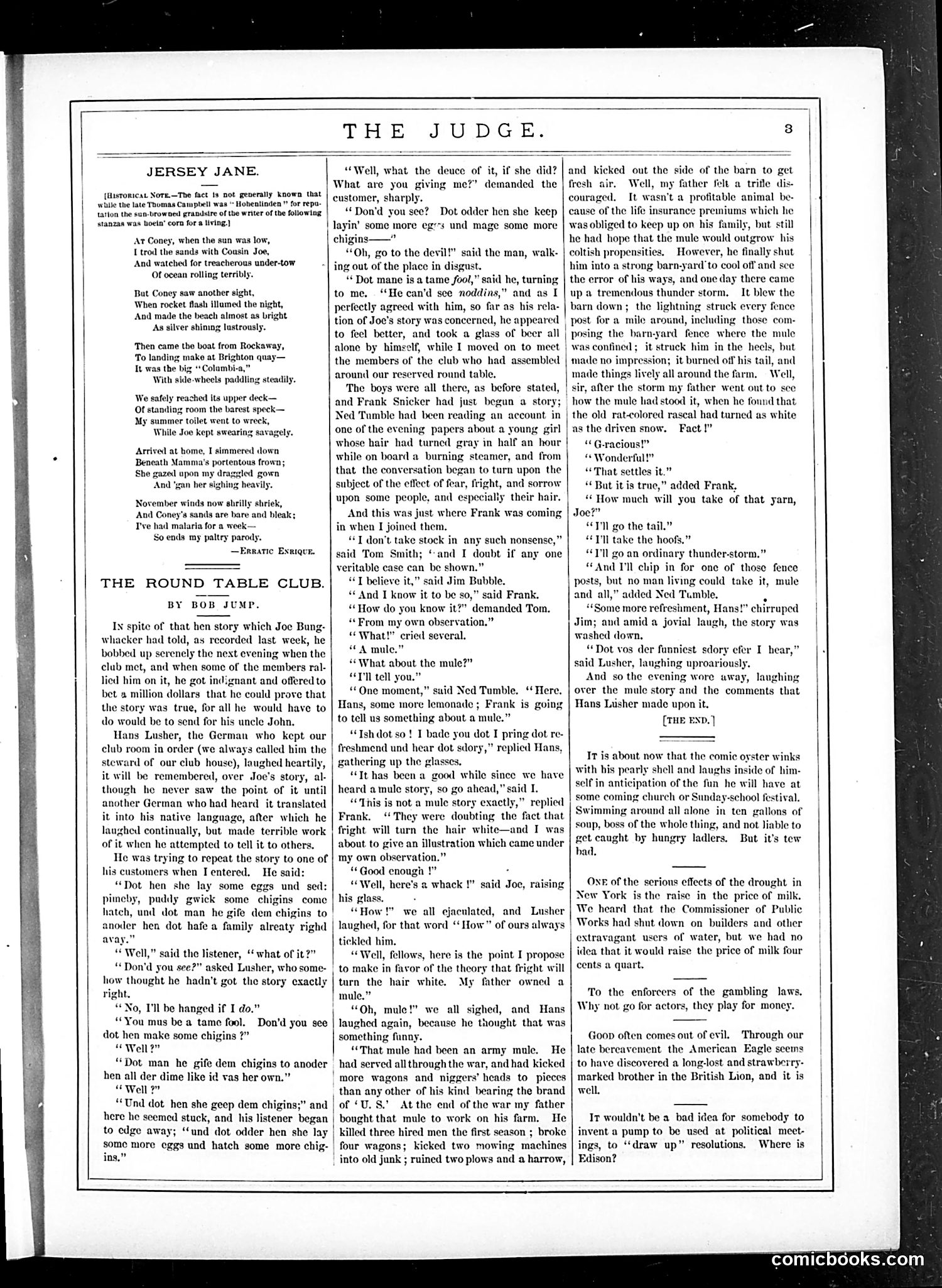
This page contains two literary pieces from *Judge* magazine, not political cartoons. **"Jersey Jane"** is a humorous poem satirizing overwrought Romantic poetry and Victorian affectation. It parodies serious literary conventions (referencing Thomas Campbell's famous poem "Hohenlinden") by treating mundane seaside tourism at Coney Island with mock-epic grandeur. The joke is the deflation of lofty poetic language applied to ordinary middle-class leisure. **"The Round Table Club"** is a prose humor piece featuring Hans Lusher, a German immigrant character rendered in heavy dialect comedy. The humor derives from the "funny foreigner" stereotype popular in period American magazines—Hans repeatedly fails to convey Joe's hen story, unable to understand or translate the punchline. The satire targets both immigrant incomprehension and the futility of explaining jokes, not political positions. Both pieces exemplify *Judge's* literary humor rather than editorial satire.
📄 Transcribed text from this page (OCR, searchable)
Machine-transcribed from the original scan — historical spelling and the odd misread are preserved.
THE JUDGE. JERSEY JANE. [Wistoricat Nore.—The fact 1s not generally known that while the late Thomas Campbell was ‘= Hobentinden ” for repa- tation the sun-browned grandstre of the writer of the following: stanzas was Uoein’ corn for a living.) At Coney, when the sun was low, [ trod the sands with Cousin Joe, And watched for treacherous under-tow Of ocean rolling terribly. But Coney saw another sight, When rocket flash illumed the night, And made the beach almost as bright ‘As silver shimng lustrously. Then came the boat from Rockaway, ‘To landing make at Brighton quay— It was the big **Colambi-a,” With side-wheels paddling steadily. We safely reached its upper deck— Of standing room the barest speck— My summer toilet went to wreck, While Joo kept swearing savagely. Arrived at home, I simmered down Beneath Mamma’s portentous frown; She gazed upon my draggled gown And ‘gan her sighing heavily. November winds now shrilly shrie And Coney’s sands are bare and bleak; had malaria for a week. So ends my paltry parody. —Enraric Exrique. THE ROUND TABLE CLUB. BY BOB JUMP. In spite of that hen story which Joe Bung- whacker had told, as recorded last week, he bobbed up serenely the next evening when the club met, and when some of the members ral- lied him on it, he got indignant and offered to bet a million dollars that he could prove that the story was true, for all he would have to do would be to send for his uncle John. Hans Lusher, the German who kept our club room in order (we always called him the steward of our club house), laughed heartil it will be remembered, over Joe's story, al- though he never saw the point of it until another German who had heard it translated it into his native language, after which he laughed continually, but made terrible work of it when he attempted to tell it to others. He was trying to repeat the story to one of his customers when Tentered. He said: “Dot hen she lay some eggs und sed: pimeby, puddy gwick some chigins come hatch, und dot man he gife dem chigins to anoder hen dot hafe a family alreaty righd avay.” “Well,” said the listener, ‘ what of it?” “Don'd you see?” asked Lusher, who some- how thought he hadn't got the story exactly right. “No, I'll be hanged if I do.” “You mus be a tame fool. Don’d you see dot hen make some chigins 2” “Well?” hen all der dime like id vas her own.” “Well 2” ] “Und dot hen she geep dem chigins;” and | here he seemed stuck, and his to edge away; ‘und dot odder hen she lay | some more eggs und hatch some more chig- ins.” “Well, what the deuce of it, if she did? What are you giving me?’ demanded the customer, sharply. “‘Don'd you see? Dot odder hen she keep layin’ some more eg’s und mage some more chigins —* “Oh, go to the devil!” said the man, walk- ing out of the place in disgust. “* Dot mane is a tame fool,” said he, turning to me. ‘He can'd see noddins,” and as I perfectly agreed with him, so far as his rela- tion of Joe’s story was concerned, he appeared to feel better, and took a glass of beer all alone by himself, while I moved on to meet the members of the club who had assembled around our reserved round table. The boys were all there, as before stated, and Frank Snicker had just begun a story; Ned Tumble had been reading an account in one of the evening papers about a young girl whose hair had turned gray in half an hour while on board a burning steamer, and from that the conversation began to turn upon the subject of the effect of fear, fright, and sorrow upon some people, and cially their hair. And this was just where Frank was coming in when I joined them. “T don't take stock in any such nonsense,” said Tom Smith; ‘and I doubt if any one veritable case can be shown.” “T believe it,” said Jim Bubble. “And I know it to be so,” said Frank. “How do you know it?” demanded Tom. + From my own observation.” “What!” cried several. “A mule.” “What about the mule?” “TM tell you.” “One moment,” suid Ned Tumble. ‘“ Here, Hans, some more lemonade ; Frank is going to tell us something about a mule.” “Ish dot so ! I bade you dot I pring dot re- freshmend und hear dot sdory,” replicd Hans, zathering up the glasses. “It has been a good while since we have heard atmule story, so go ahead,” said I. «This is not a mule story exactly,” replied Frank. ‘They were doubting the fact that fright will turn the hair white—and I was about to give an illustration which came under my own observation.” “Good enough !” : “Well, here's 2 whack !” said Joe, his glass , “How!” we all ejaculated, and Lusher laughed, for that word “How” of ours always tickled him, “Well, fellows, here is the point I propose to make in favor of the theory that fright will turn the hair white. My father owned a mule.” “Oh, mule!" we all sighed, laughed again, because he something funny. “That mule had been an army mule. He had served all through the war, and had kicked more wagons and niggers’ heads to pieces than any other of his kind bearing the brand of ‘U.S.’ At the end of the war my father bonght that mule to work on his farm. He killed three hired men the first season ; broke four wagons; kicked two mowing machines into old junk ; ruined two plows and a harrow, and Hans hought that was and kicked out the side of the barn to get fresh air, Well, my father felt a trifle dis- couraged. It wasn’t a profitable animal be- cause of the life insurance premiums which he was obliged to keep up on his family, but still he had hope that the mule would outgrow his coltish propensities. However, he finally shut him into a strong barn-yard'to cool off and sce the error of his ways, and one day there came up a tremendous thunder storm. It blew the barn down; the lightning struck every fence post for a mile around, including those com- posing the barn-yard fence where the mule was confined ; it struck him in the heels, but made no impression; it burned off his tail, and made things lively all around the farm. Well, sir, after the storm my father went out to sce how the mule had stood it, when he found that. the old rat-colored rascal had turned as white as the driven snow. Fact!” “ G-racious!” “* Wonderful!” “That settles it.” “But itis true,” added Frank, “ How much will you take of that yarn, Joe?” “Tl go the tail.” “Tl take the hoofs.” “Til go an ordinary thunder-storm.” “And I'l chip in for one of those fence posts, but no man living could take it, mule and all,” added Ned Tumble. . “Some more refreshment, Hans!” chirruped Jim; and amid a jovial laugh, the story was washed down, “Dot vos der funniest sdory efer I hear,” said Lusher, laughing uproariously. And so the evening wore away, laughing over the mule story and the comments that Hans Lusher made upon it. (THE END.] It is about now that the comic oyster winks with his pearly shell and laughs inside of him- self in anticipation of the fun he will have at some coming church or Sunday-school festival. Swimming around all alone in ten gallons of soup, boss of the whole thing, and not liable to get caught by hungry ladlers. But it’s tew had. OsE of the serious effects of the drought in New York is the raise in the price of mill We heard that the Commissioner of Public Works had shut down on builders and other extravagant users of water, but we had no idea that it would raise the price of milk four cents a quart, To the enforcers of the gambling laws. Why not go for actors, they play for money. Goon often comes out of evil. Through our late bereavement the American Eagle seems to have discovered a long-lost and strawberry: marked brother in the British Lion, and it is well. Ir wouldn't be a bad idea for somebody to invent a pump to be used at political meet- ings, to “draw up” resolutions, Where is Edison? comicbooks.com