
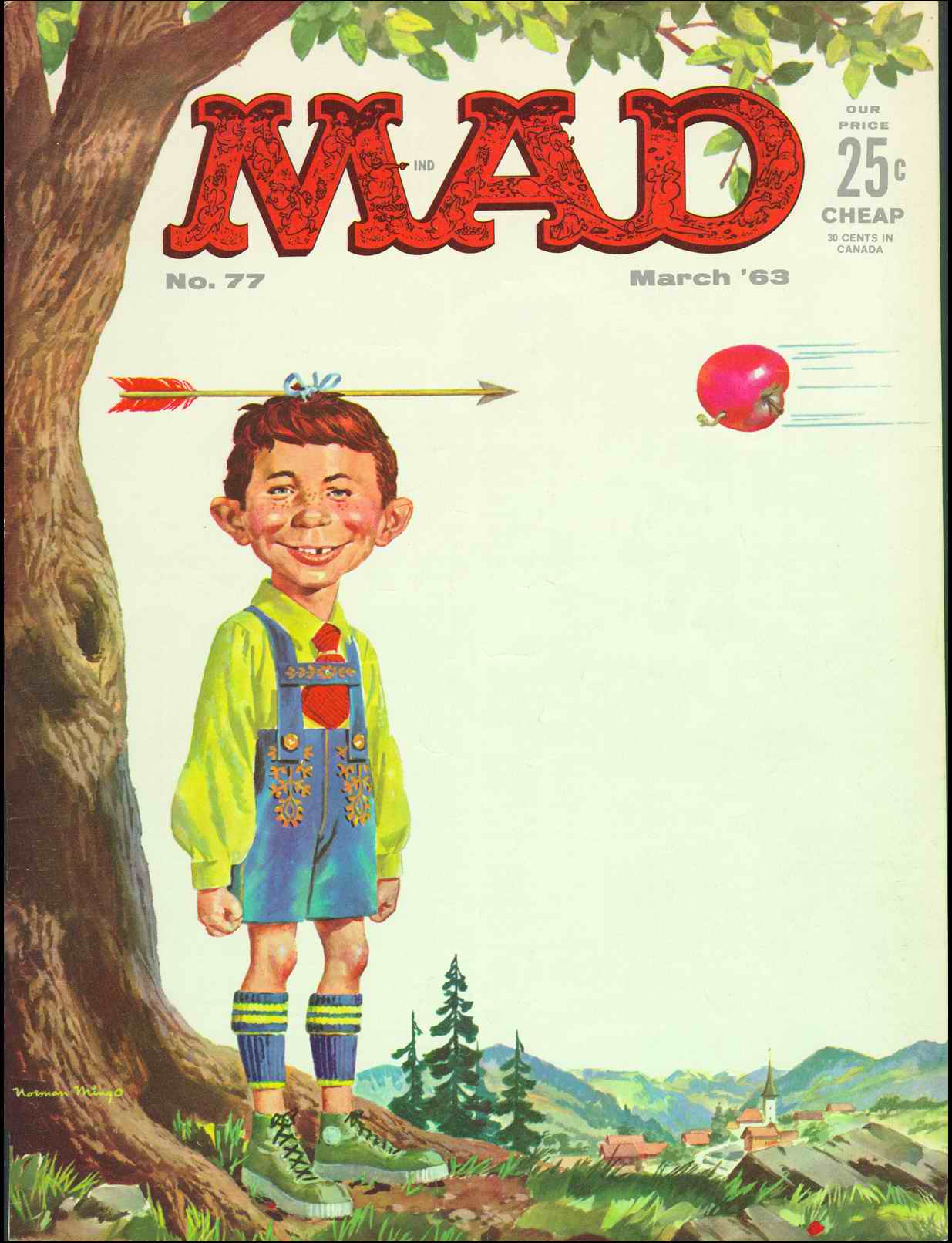
Mad #77
☆ Be the first to review + Add to your collection — Join freeMad #77 (March 1963) is a textbook example of the magazine firing on every creative cylinder at once during its early-1960s peak. The issue contains two separate Spy vs. Spy segments — the regular two-spy strip and a Spy vs. Spy vs. Spy installment featuring the Gray Spy — making it one of the denser showcases for Antonio Prohías's Cold War allegory in a single issue. Wally Wood's 'If Five Comic Strip Cartoonists Interpreted the Age-Old Riddle' demonstrates Mad's particular gift for meta-commentary: rather than simply parodying Peanuts, Mark Trail, or B.C., the piece dissects each strip's visual grammar and storytelling tics, treating newspaper comics as a formal language worth interrogating. The 'Speaking from Pictures' section, which grafted satirical captions onto genuine UPI wire photographs of sitting heads of state and celebrities, exemplifies Mad's willingness to lampoon real political power at the height of the Cold War — a genuine editorial risk in early 1963.
In "Mad's 1963 All-Inclusive Magazine Calendar," Gary Belkin and Wallace Wood turn a classic joke into a satirical tour through the absurdity of mid-century comic strips, imagining how iconic daily features like Peanuts, Mark Trail, B.C., Miss Peach, or Jules Feiffer’s panel might tackle the age-old riddle of the chicken crossing the road. With sharp wit and deadpan precision, the story plays with the conventions of newspaper comics in a way only Mad could, all rendered in Wallace Wood’s unmistakable, detailed style. Norman Mingo’s cover captures the joke’s spirit with a classic, exaggerated take on the scene.
In this classic Mad parody from 1963, five iconic comic strips—Peanuts, Mark Trail, B.C., Miss Peach, and a Jules Feiffer-style panel—each tackle the age-old riddle "Why did the chicken cross the road?" with their signature styles, delivering sharp satire and absurd takes on familiar formats. The humor lies in how each cartoonist’s unique voice transforms the simple premise into something delightfully strange, all rendered in the crisp, typeset lettering of the era.
In this sharp satire from Mad #77, a father-and-son law firm—so sure of their brilliance they’re blind to their own incompetence—find themselves utterly defeated in court after court, their overconfidence crumbling under the weight of their own absurdity. Written with the magazine’s signature wit and typeset letters, "The Defensers" skewers legal drama tropes with a perfectly timed, no-holds-barred send-up.
In this 1963 Mad classic, two spies tackle a jigsaw puzzle—only to find themselves caught in a trap set by the elusive Gray Spy, who’s rigged a railroad crossing with an oncoming train. The tension builds as the puzzle’s final piece reveals a deadly game of cat and mouse.
ComicBooks.com Value
Show all 19 grades ▾
This exact issue on ebay
More listings for this title
Read it digitally
Sell my copy
Have this issue — or a whole collection? Get a fair offer from us, skip the marketplace fees and the hassle.
We Buy Collections ▸History
The issue arrived during Norman Mingo's restored tenure as Mad's primary cover artist; he had returned to the magazine in 1962 after an absence and would go on to paint most of its covers through 1976. Editor Al Feldstein presided over a magazine then operating ad-free and at a circulation exceeding 1.2 million, giving it unusual editorial independence for American publishing. The Spy vs. Spy vs. Spy strip included here was part of an ongoing but sporadic sub-series: the Gray Spy had debuted in Mad #73 (September 1962), and Prohías used her appearances selectively to add a third variable — neutrality — to his binary Cold War metaphor.
Trivia · 8 facts
- Published March 1963 by EC Publications; cover painted by Norman Mingo, who had returned to the magazine the previous year after a years-long absence.
- 'If Five Comic Strip Cartoonists Interpreted the Age-Old Riddle: Why Did the Chicken Cross the Road?' — scripted by Gary Belkin with art by Wally Wood — parodies the styles of Peanuts, Mark Trail, B.C., Miss Peach, and Jules Feiffer's panel, featuring Charlie Brown, Linus, Lucy, Snoopy, Frieda, Pig-Pen, and other Peanuts characters.
- The issue contains two Spy vs. Spy entries by Antonio Prohías: a standard two-spy strip (Black Spy steals blueprints) and a Spy vs. Spy vs. Spy strip in which the Gray Spy lures both agents into a railroad-crossing trap.
- The Gray Spy — a female 'Woman in Grey' who represents neutrality and always defeats both male spies by exploiting their rivalry — had debuted in Mad #73 (September 1962); her appearance here is an early follow-up in that sub-series.
- 'The Defensers,' scripted by Lou Silverstone with art by Mort Drucker, parodies the CBS legal drama The Defenders, featuring caricatures of series stars E.G. Marshall and Robert Reed alongside a Raymond Burr/Perry Mason cameo.
- 'Speaking from Pictures' adds satirical speech-bubble captions to real UPI wire photographs, bringing in likenesses of sitting or recent heads of state and celebrities — including Kennedy, Nixon, Khrushchev, Castro, and Sinatra — as targets of political and social commentary.
- Don Martin contributed two solo pieces: 'Dr. Jekyll and Mr. Hyde' and 'On a Summer's Afternoon,' with Frank Jacobs and Jack Rickard providing the 'Mad's 1963 All-Inclusive Magazine Calendar.'
- The 'If Five Comic Strip Cartoonists' feature was later reprinted in at least one Mad reprint collection (Mad About Comics), extending its reach well beyond the original print run.
Cast · 21 characters
Full credits
Reprints
Reprinted in Svenska Mad #4/1963 (1963), More Trash from Mad #7 (1964), The Worst from MAD #8 (1965), The Ridiculously Expensive Mad #[nn] (1969), The Indigestible Mad #T4830 (1970), Mad #47 (1973), Mad #62 (1974), The Completely Mad Don Martin #[nn] (1974), Dave Berg's Mad Trash #[nn] (1977), Mad Special [Mad Super Special] #30 (1980), Dave Berg's Mad Trash #[nn] (1981), Mad #150 (1981), Mad Special [Mad Super Special] #40 (1982), Mad Special [Mad Super Special] #101 (1995), Mad about Comic Strips #[nn] (2003), Mad #25 (2022), Mad #34 (2023), Mad #38 (2024), Mad #45 (2025)
Key issues in Mad
Reviews
Reader reviews
No reader reviews yet.