
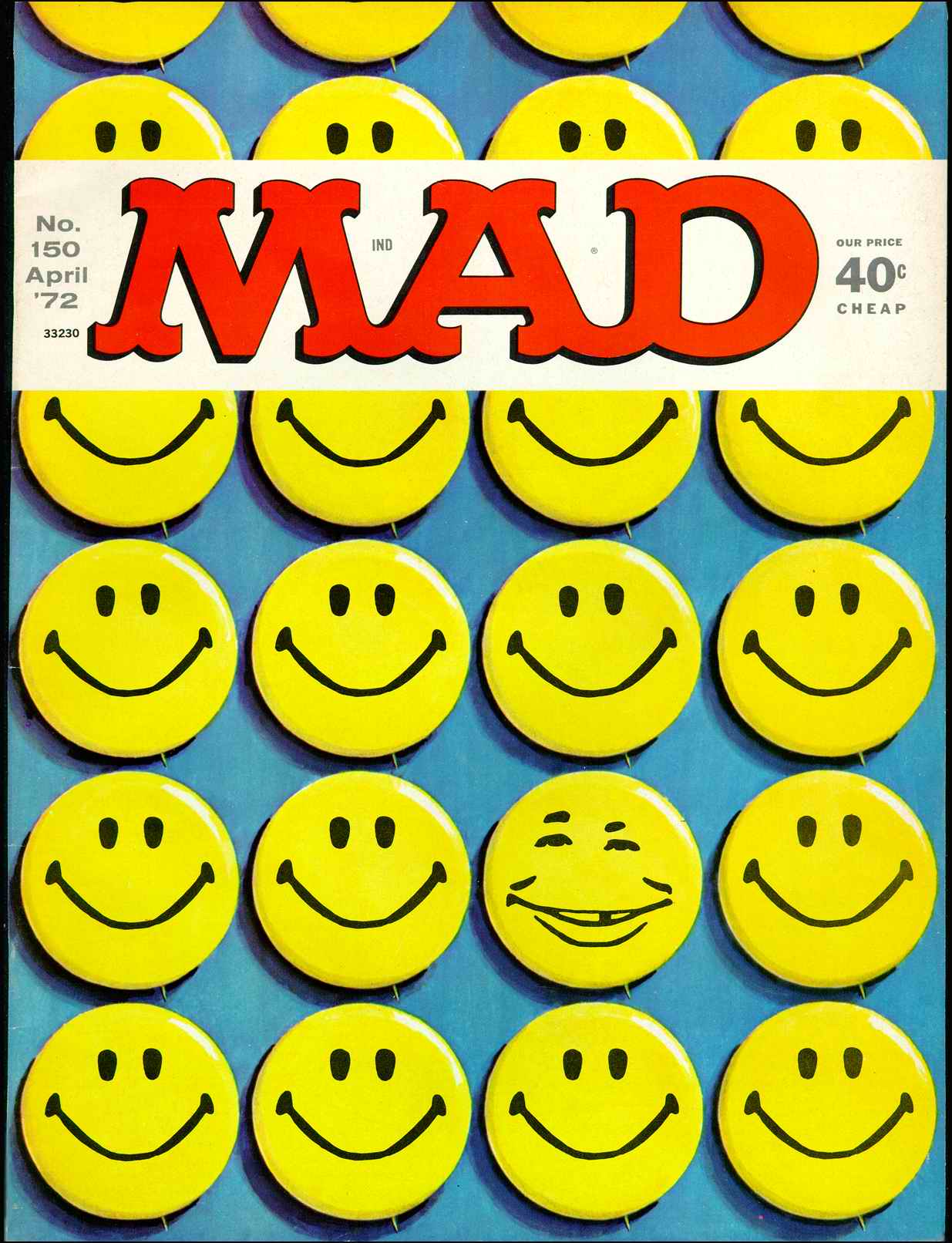
Mad #150
☆ Be the first to review + Add to your collection — Join freeMad #150 (April 1972) lands at one of the most culturally charged moments in the magazine's history — right at the cusp of its greatest editorial reach, just as editor Al Feldstein was steering the publication toward the circulation peak it would hit the following year. The issue's centerpiece, a Mort Drucker–illustrated Frank Jacobs piece lampooning the Nixon White House as a Gilbert & Sullivan operetta, exemplifies Mad's signature method of embedding sharp political satire inside beloved pop-culture forms, a technique the magazine had honed since the mid-1950s. As the sole survivor of the original EC Comics line, and operating entirely without paid advertising, Mad #150 also represents the magazine at its editorially purest — a 52-page black-and-white broadside against American political and consumer culture with no commercial strings attached. The issue gathers virtually the entire roster of what the magazine billed as 'The Usual Gang of Idiots,' making it a textbook snapshot of the Feldstein-era ensemble at full strength.
In "The Tourist," a satirical take on the pop-culture frenzy of the era, a fading musical star, her self-absorbed teen idol son, and a troupe of eager young performers hit the road on a chaotic cross-country tour. Written by Arnie Kogen and brought to life with sharp, expressive art by Angelo Torres (pencils and inks), the story captures the absurdity of fame with a wry, biting edge. Cover by Angelo Torres.
In this satirical 1972 skewering from Mad #150, the Democratic presidential hopefuls trade their own features for the iconic noses of famous figures in a bizarre bid to boost their public appeal—because apparently, a well-placed schnoz is the key to electoral success. A sharp, typeset parody of political image-making, it’s classic Mad at its most absurdly clever.
In a satirical twist on the wholesome "Partridge Family," *The Putrid Family* hits the road with a washed-up star, her self-obsessed teen son, and a troupe of perpetually unimpressed kids, all faking harmony for a nation that’s long since stopped listening.
ComicBooks.com Value
Show all 10 grades ▾
This exact issue on ebay
Raw / ungraded ▾ $8.5–$39.99 13 listings
More listings for this title
Read it digitally
Sell my copy
Have this issue — or a whole collection? Get a fair offer from us, skip the marketplace fees and the hassle.
We Buy Collections ▸History
By April 1972, editor Al Feldstein had been steering Mad since 1956, having assembled a remarkably stable stable of writer-artists — among them Frank Jacobs, Mort Drucker, Al Jaffee, Don Martin, Dave Berg, Sergio Aragonés, and Antonio Prohias — who collectively defined the magazine's tone for decades. The institutional context of this issue is striking: publisher William Gaines's parent entity had just reincorporated as Warner Communications, Inc. in February 1972, yet Mad continued to operate with a famously lean full-time staff of only six people, insulating its editorial voice from corporate pressures. The magazine published eight issues per year on a fixed schedule by this period, and issue #150 appeared as the 1972 presidential election season was heating up, giving the issue's dual political salvos — the Nixon operetta parody and Dave Gantz's piece on Democratic candidates — an immediate topical bite that also proved remarkably durable as historical record.
Trivia · 8 facts
- Published April 1972 by EC Comics (publisher William Gaines, editor Al Feldstein); 52 pages, black-and-white.
- Lead political satire: 'The White House Follies of '72,' scripted by Frank Jacobs with art by Mort Drucker, frames Nixon White House life as a Gilbert & Sullivan operetta.
- Antonio Prohias contributed a 'Spy vs. Spy'-adjacent inside-cover strip titled 'The Tourist,' written and drawn by Prohias himself.
- Al Jaffee contributed both a 'More Snappy Answers to Stupid Questions' installment (with a blank balloon inviting reader participation) and the back-cover Mad Fold-In.
- Don Martin ('Mad's Maddest Artist') contributed 'One Fairly Nice Day Downtown'; Dave Berg contributed 'The Lighter Side of Air Travel' — two recurring features that define the Feldstein-era magazine.
- Sergio Aragonés supplied his trademark marginal cartoons throughout the issue, as he did on nearly every Mad issue of the era.
- Angelo Torres drew 'The Putrid Family,' a parody of the TV series The Partridge Family, scripted by Arnie Kogen.
- Jack Davis illustrated 'When TV Makes Full Use of Howard Cosell,' scripted by Frank Jacobs — one of two separate Jacobs pieces in the same issue, reflecting his prolific output for the magazine.
Full credits
Reprints
Reprinted in Mad #43 (1972), Mad #47 (1973), Mad #59 (1974), Mad Special [Mad Super Special] #19 (1976), Mad Special [Mad Super Special] #20 (1976), Mad Special [Mad Super Special] #21 (1976), Mad #108 (1978), Mad Clowns Around #48 (1978), Mad Special [Mad Super Special] #30 (1980), Mad Special [Mad Super Special] #40 (1982), A Mad Big Book [Mad Zaps The Human Race!] #[nn] (1984), Mad Special [Mad Super Special] #47 (1984), Mad Special [Mad Super Special] #48 (1984), Mad Special [Mad Super Special] #69 (1989), Mad Special [Mad Super Special] #76 (1991), Mad XL #33 (2005), Mad's Greatest Artists: Mort Drucker #[nn] (2012), Mad's Greatest Artists: Don Martin #[nn] (2014), Mad #32 (2023)
Key issues in Mad
Reviews
Reader reviews
No reader reviews yet.