
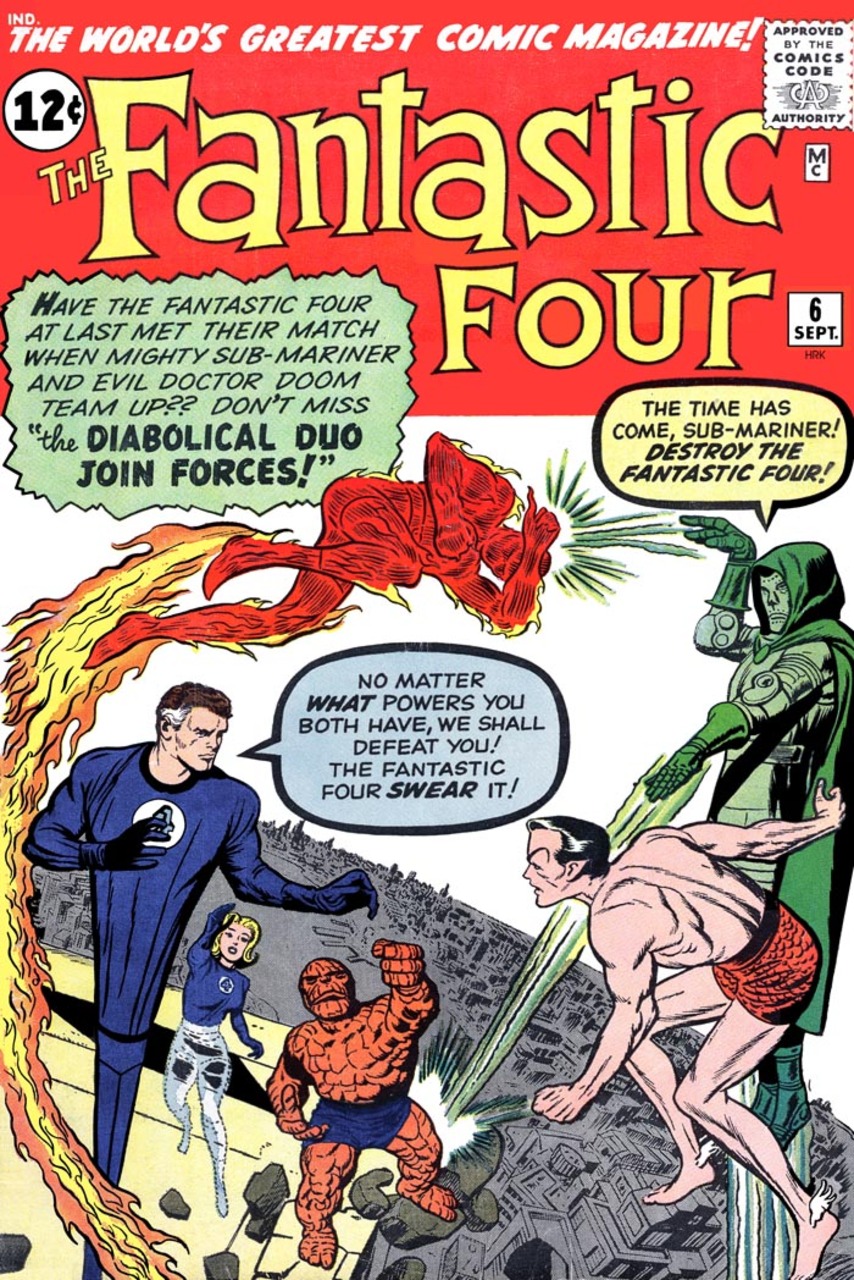
Fantastic Four #6
Fantastic Four #6 (cover-dated September 1962) marks the first time two super-villains teamed up anywhere in the Marvel Universe — Doctor Doom and the Sub-Mariner joining forces against a shared enemy — a storytelling move that proved the fledgling shared universe could sustain ongoing inter-character continuity beyond the hero side of the ledger. By bringing together the FF's two most dangerous adversaries from consecutive prior issues, Lee and Kirby demonstrated that their emergent universe rewarded reader loyalty: what happened in one issue had direct consequences in the next, a narrative discipline that comics historian Les Daniels later identified as the engine of the title's 'increasingly complex ideas.' The issue also quietly established two concepts — unstable molecules and the Yancy Street Gang — that would become permanent fixtures of Fantastic Four mythology for decades. Together, these contributions made FF #6 a foundational stone in the architecture of what Marvel would come to call the Marvel Age of Comics.
In "Captives of the Deadly Duo!, Part 1," the Fantastic Four face a shocking alliance as Dr. Doom teams up with the Sub-Mariner, setting the stage for a battle that tests loyalty and trust. When Human Torch discovers Invisible Girl hiding a photo of the Sub-Mariner in a book, old tensions flare—especially as the two enemies now stand side by side. Written by Stan Lee and illustrated with dynamic energy by Jack Kirby, with inks by Dick Ayers, colors by Stan Goldberg, and letters by Terry Szenics, this 1962 issue features a cover by Kirby and Ayers that captures the clash of titans.
In "Captives of the Deadly Duo!, Part 1," Doctor Doom manipulates the Sub-Mariner into joining a dangerous alliance, offering him a mysterious device known as the "Grabber." When the Human Torch uncovers a hidden photo of the Sub-Mariner in the Invisible Girl’s book, tensions rise—just as the Sub-Mariner plants the Grabber in the Baxter Building, lifting it into space. With the building hurtling toward the Sun and the Sub-Mariner realizing he’s been betrayed, the Fantastic Four face a crisis that tests their unity and ingenuity.
In "Part 2 When Super-Menaces Unite," Doctor Doom manipulates the Sub-Mariner into joining forces against the Fantastic Four, handing him a mysterious device known as the "Grabber." When the Human Torch uncovers a hidden photo of the Sub-Mariner in the Invisible Girl’s book, tensions rise as the team races to stop the Baxter Building—now lifted into space by the Grabber—from colliding with the Sun. As the Sub-Mariner realizes he’s been betrayed, the tide turns in a desperate struggle to save Earth and reclaim control.
In "Part 3 When Friends Fall Out!", the Sub-Mariner is drawn into a dangerous alliance with Doctor Doom, who hands him a mysterious device known as the "Grabber." When the Human Torch uncovers a hidden photo of the Sub-Mariner in the Invisible Girl’s book, tensions rise among the Fantastic Four. The Sub-Mariner places the Grabber in the Baxter Building, sending it hurtling toward the Sun—only to realize too late that Doctor Doom has betrayed him. As the building teeters on disaster, the team must confront the fallout of broken trust and a scheme that threatens them all.
In "Part 4 Trapped!", the Sub-Mariner is drawn into a dangerous alliance with Doctor Doom, who hands him a mysterious device known as the "Grabber." When the Human Torch uncovers a hidden photo of the Sub-Mariner in the Invisible Girl’s book, tensions rise as the Fantastic Four race to stop the Grabber’s deadly plan. With the Baxter Building lifted into space and hurtling toward the Sun, the team must unravel the betrayal before it’s too late—while the Sub-Mariner confronts the true cost of his alliance.
In "Part 5 The End... or the Beginning?", the Sub-Mariner is drawn into a dangerous alliance with Doctor Doom, who arms him with a mysterious device known as the "Grabber." As tensions rise, the Human Torch uncovers a hidden photo of the Sub-Mariner in the Invisible Girl’s book, hinting at secrets beneath the surface. When the Grabber is planted in the Baxter Building and the tower is pulled into space, the Sub-Mariner realizes too late that Doom has used him—leaving the building on a deadly path toward the Sun, while Doom himself is cast into the void.
ComicBooks.com Value
Show all 22 grades ▾
Find on ebay
Read it digitally
Sell my copy
Have this issue — or a whole collection? Get a fair offer from us, skip the marketplace fees and the hassle.
We Buy Collections ▸History
The issue was produced via the 'Marvel Method' that Stan Lee and Jack Kirby had settled into by mid-1962: Kirby plotted and penciled pages from a loose story conference with Lee, who then scripted dialogue over the finished art. However, according to a closely argued piece by Michael Breen published in The Jack Kirby Collector #61 — and analyzed by Marvel editor Tom Brevoort on his blog — FF #6 may be an anomaly in which Kirby not only penciled but also wrote the final lettered script, with Lee returning to sole scripting duties on issue #7; this remains a contested scholarly claim rather than settled fact. The cover date of September 1962 corresponds to an on-sale date in the summer of that year, during the bimonthly publication schedule the series maintained through its earliest issues. Inking duties were split between Dick Ayers, who handled the bulk of the issue, and Joe Sinnott, who inked two pages — a rare early Sinnott contribution that collectors and historians have noted as a visible quality contrast within the same issue.
Trivia · 8 facts
- Title story: 'Captives of the Deadly Duo!' — a five-part, 24-page story written by Stan Lee, penciled by Jack Kirby, with inks by Dick Ayers (primary) and Joe Sinnott (two pages), lettered by Artie Simek, and colored by Stan Goldberg.
- First team-up of two super-villains in the Marvel Universe: Doctor Doom (his second appearance overall, following FF #5) and the Sub-Mariner/Namor (his second Silver Age appearance, following FF #4) ally against the Fantastic Four.
- First mention of the Yancy Street Gang, the recurring group of street toughs from Ben Grimm's old neighborhood who taunt the Thing throughout the series; the Gang does not make a physical appearance until Fantastic Four #15.
- First use of the term 'unstable molecules,' Reed Richards's fictional scientific concept explaining why the team's costumes survive their respective powers — a piece of in-universe lore that Marvel writers would invoke for decades across many titles.
- The Baxter Building — the FF's headquarters — is lifted entirely off its Manhattan foundation and sent hurtling toward the sun by Doom's magnetically powered 'grabber' device, one of Doom's most audacious Silver Age schemes.
- The issue deepens the Sue Storm–Namor romantic tension established in FF #4: Johnny discovers a hidden photograph of Namor in Sue's belongings, and Sue herself is unable to explain her fascination with the Atlantean prince to Reed.
- Namor ultimately turns on Doom after realizing he has been betrayed, hurling Doom into space and reversing the Baxter Building's course — establishing early that Namor's moral code, however antagonistic toward surface-dwellers, is distinct from Doom's pure treachery.
- The issue has been reprinted extensively, including in Marvel Masterworks #2 (1987), Essential Fantastic Four Vol. 1 (1998), Fantastic Four Omnibus Vol. 1 (2005), Fantastic Four Epic Collection Vol. 1 (2014), Mighty Marvel Masterworks: The Fantastic Four Vol. 1 (2021), and a Facsimile Edition (August 2025).
Cast · 6 characters
Full credits
Reprints
Reprinted in Los 4 Fantásticos #6 (1963), Creepy Worlds #37 (1965), Fantastic Four Annual #3 (1965), The Fantastic Four #72-111 (1966), Fantastiske Fire #6/1968 (1968), Super X [Príncipe Submarino / O Incrível Hulk] #12 (1968), Fantask #2 (1969), I Fantastici Quattro #4 (1971), Creepy Worlds #130 (1972), The Mighty World of Marvel #12 (1972), The Mighty World of Marvel #13 (1972), Marvel Treasury Edition #2 (1974), Marvel Comics' The Fantastic Four #81445 (1977), Los Cuatro Fantásticos #5 (1980), Une Aventure des Fantastiques #22 (1980), The Marvel Saga the Official History of the Marvel Universe #4 (1986), The Marvel Saga the Official History of the Marvel Universe #5 (1986), Marvel Masterworks #2 (1987), Fantastic Four Classic #3 (1993), Marvel Masterworks: The Fantastic Four #[1] (1997), Marvel Klassik #4 (1998), Essential Fantastic Four #1 (1998), Biblioteca Marvel: Los 4 Fantásticos #01 (1999), Marvel Masterworks: The Fantastic Four #1 (2003) + 19 more
Key issues in Fantastic Four
 ★
★ ★
★ ★
★ ★
★ ★
★ ★
★ ★
★ ★
★Variants (1)
Reviews
Reader reviews
No reader reviews yet.