
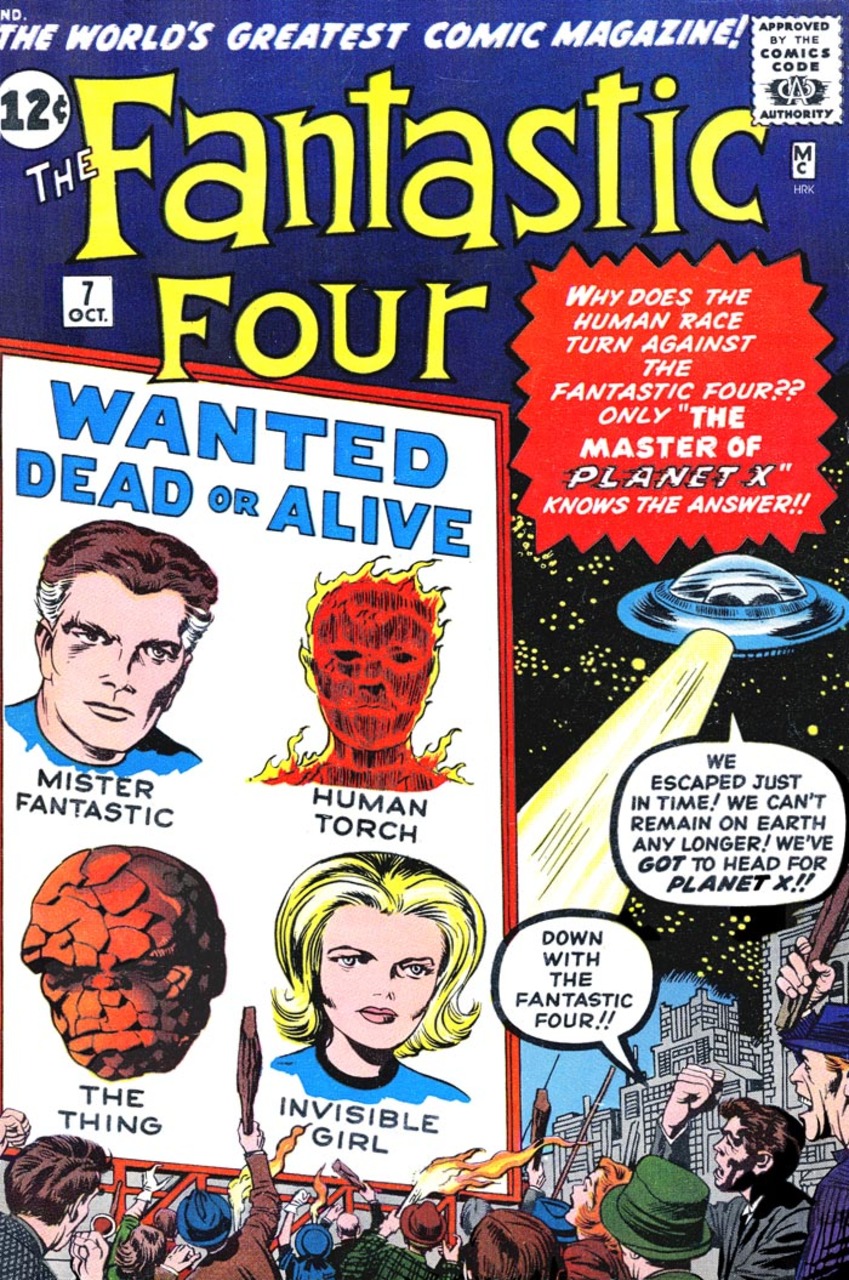
Fantastic Four #7
Fantastic Four #7 holds its place in Silver Age history as the first appearance of Kurrgo, Master of Planet X — a villain who embodies the transitional moment between Marvel's Atlas-era monster-book DNA and its emerging superhero storytelling ambitions. The issue also marks the Fantastic Four's first-ever journey to another planet, establishing the team's cosmic scope as a defining characteristic that would distinguish them from other Marvel heroes. Within the story, Lee delivers an early morality-tale twist: Kurrgo's greed in trying to hoard the lone antidote to Reed's shrinking formula leads directly to his own death on a doomed world, foreshadowing the more sophisticated ironic endings Lee and Kirby would refine throughout the run. Taken together, the issue shows the Lee-Kirby machine working through its growing pains in real time — still indebted to the B-movie alien-invasion plots that filled pre-hero Atlas titles, yet already reaching toward the character-driven cosmic adventure that would come to define the Fantastic Four.
In "Prisoners of Kurrgo, Master of Planet X Part 1 It Came From the Skies!", the Fantastic Four face a cosmic threat when a mysterious robot from Planet X activates a hostility ray, turning entire populations against them. Written by Stan Lee and brought to life with dynamic art by Jack Kirby—pencils and inks—this pivotal issue sees the team confronting alien intrigue on a distant world, with cover art by Kirby capturing the drama in bold, iconic style.
In "Prisoners of Kurrgo, Master of Planet X Part 1 It Came From the Skies!", the Fantastic Four find themselves unexpectedly drawn into a cosmic mystery when a mysterious alien entity known as Kurrgo, Master of Planet X, summons them through a strange transmission. As the team prepares to accept a formal invitation to Washington, D.C., a robotic emissary arrives from space, setting in motion a journey that will pull them into an alien world on the brink of destruction.
In "Part 2 Outlawed," the Fantastic Four are thrust into a crisis when Kurrgo's robot transports them to the doomed Planet X, where a hostility ray incites chaos among the locals. Forced to confront the planet's impending doom, the team must find a way to save Kurrgo’s people—even as the planet begins to collapse around them.
In "Part 3 Bound for Planet X!", the Fantastic Four are brought to a distant world by a mysterious robot sent by Kurrgo, who claims to need their help. As the robot activates a "hostility ray" to turn the planet's inhabitants against them, the team must navigate chaos and suspicion to fulfill Kurrgo’s final request—saving his people from an impending doom.
In "Part 4 Twenty Four Hours till Zero!", the Fantastic Four are brought to Planet X by a mysterious robot, only to be turned against by a hostility ray that incites chaos among the locals. Forced to seek refuge, they're entrusted with a desperate mission: save Kurrgo’s people from the planet’s impending doom—before time runs out.
In "Part 5 The End of Planet X!", the Fantastic Four race against time as Mister Fantastico devises a gas reducer to save them from a planet doomed to collapse. With only two escape pods, the team prepares to leave—only for Kurrgo to betray them, hoarding the antidote in a desperate bid for control. As the planet erupts and the ships launch, Reed reveals a startling truth: there was no real antidote, and in the infinite scale of the universe, size is ultimately meaningless.
ComicBooks.com Value
Show all 21 grades ▾
This exact issue on ebay
Raw / ungraded ▾ $1.5–$450 10 listings
Read it digitally
Sell my copy
Have this issue — or a whole collection? Get a fair offer from us, skip the marketplace fees and the hassle.
We Buy Collections ▸History
Fantastic Four #7 was produced by the core early-Marvel creative team of writer-editor Stan Lee and penciler Jack Kirby, with inking by Dick Ayers, coloring by Stan Goldberg, and lettering by Artie Simek — the same crew responsible for the book's formative issues. The series had been running on a bimonthly schedule through its earliest issues, and several contemporaneous commentators have noted that the shift toward a more demanding monthly cadence may have placed accelerated production pressure on Lee and Kirby around this period, with issue #7 bearing the hallmarks of a story assembled more quickly than the preceding run of issues that introduced Doctor Doom and Namor.
Trivia · 8 facts
- First appearance of Kurrgo, Master of Planet X, an alien tyrant who would return in later Marvel continuity.
- First appearance of Xantha, Kurrgo's home world also identified as Planet X in some sources.
- First appearance of Kurrgo's giant robot, visually influenced by science-fiction films of the era, particularly The Day the Earth Stood Still.
- Marks the Fantastic Four's first trip to another planet — Planet X — establishing the team's cosmic adventuring dimension.
- The story is divided into five titled chapters: 'It Came From the Skies!', 'Outlawed', 'Bound for Planet X!', 'Twenty Four Hours Till Zero!', and 'The End of Planet X!'
- Cover date is October 1962; the U.S. Copyright Office on-sale/release date recorded by the Grand Comics Database is July 1962.
- Has been collected in Essential Fantastic Four Vol. 1 (1998, black-and-white), Marvel Masterworks: The Fantastic Four Vol. 1 (multiple editions from 1987 onward), Fantastic Four Omnibus Vol. 1 (2005), the Fantastic Four Epic Collection Vol. 1 (2014), and Mighty Marvel Masterworks: The Fantastic Four #1 (2021); a facsimile edition is scheduled for September 2025.
- Full creative credits: script by Stan Lee, pencils by Jack Kirby, inks by Dick Ayers, colors by Stan Goldberg, letters by Artie Simek, cover pencils by Jack Kirby.
Full credits
Reprints
Reprinted in Los 4 Fantásticos #7 (1963), Spellbound #44 (1964), Marvel Collectors' Item Classics #4 (1966), Fantastiske Fire #7/1968 (1968), Fantask #3 (1969), HIP Classics #19150 (1970), Hit Comics #150 (1970), I Fantastici Quattro #4 (1971), Marvel Annual #1973 (1972), The Mighty World of Marvel #14 (1973), The Mighty World of Marvel #15 (1973), The Fantastic Four #1 (1979), Los Cuatro Fantásticos #6 (1980), Une Aventure des Fantastiques #23 (1980), The Marvel Saga the Official History of the Marvel Universe #5 (1986), Marvel Masterworks #2 (1987), Marvel Masterworks: The Fantastic Four #[1] (1997), Marvel Klassik #4 (1998), Essential Fantastic Four #1 (1998), Biblioteca Marvel: Los 4 Fantásticos #01 (1999), Marvel Masterworks: The Fantastic Four #1 (2003), Fantastic Four Omnibus #1 (2005), Marvel Masterworks: The Fantastic Four #1 (2009), Fantastic Four Epic Collection #1 (2014) + 12 more
Key issues in Fantastic Four
 ★
★ ★
★ ★
★ ★
★ ★
★ ★
★ ★
★ ★
★Variants (1)
Reviews
Reader reviews
No reader reviews yet.