
A complete issue · 68 pages · 1921
Captain Billy's Whiz Bang #20
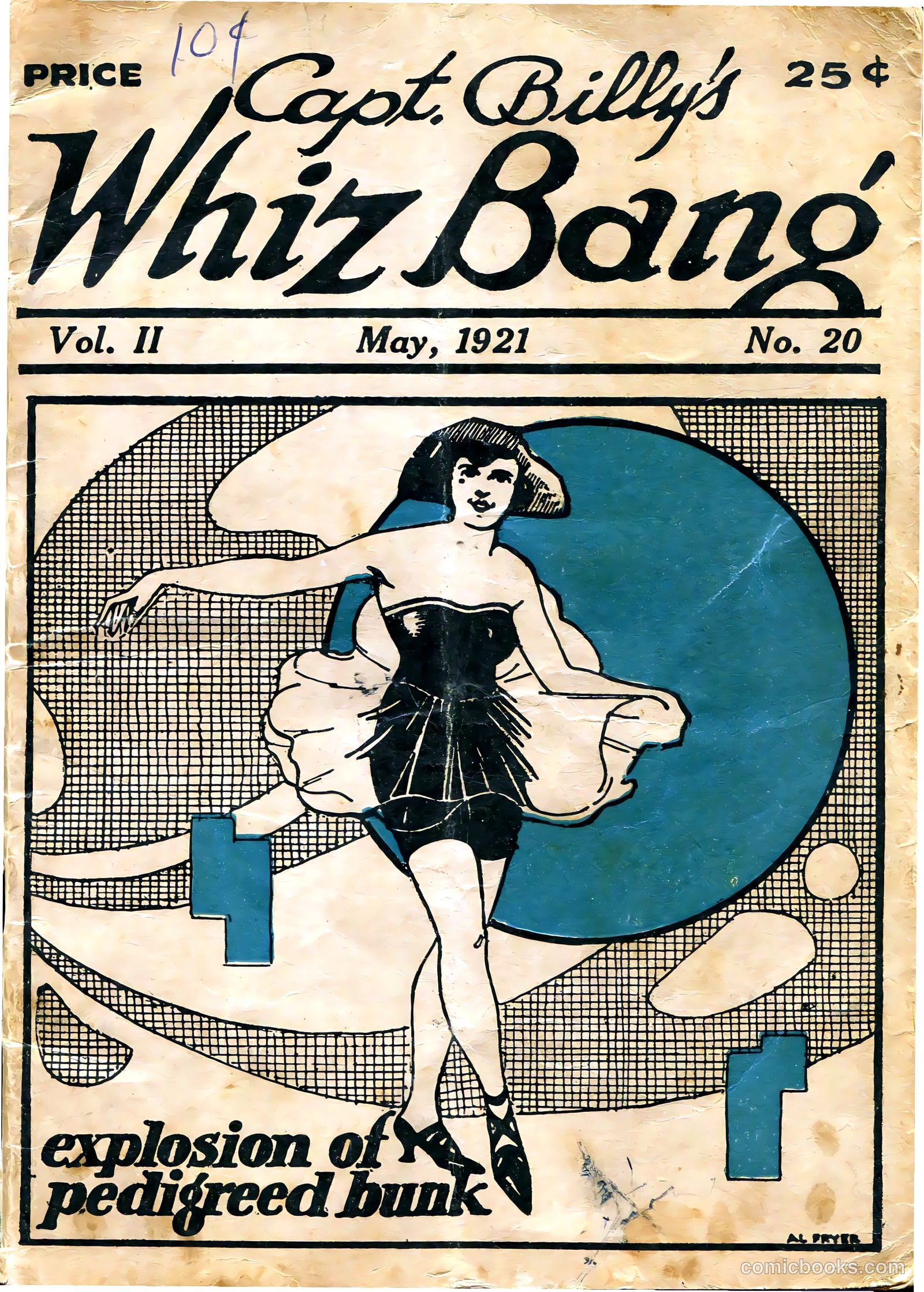
This is the cover of a satirical magazine featuring an illustration by Al Fryer. The central image shows a stylized woman in black undergarments posed against a large blue circle, surrounded by abstract geometric shapes suggesting an explosion. The subtitle "explosion of pedigreed bunk" indicates the magazine's satirical intent—it aimed to debunk pretentious or false claims circulating in 1920s culture. The term "pedigreed bunk" suggests mockery of elite or high-status nonsense, particularly regarding attitudes about women, sexuality, or fashion during the post-WWI era. The image's suggestive nature and bold graphic style were characteristic of early 1920s satirical publications targeting adult audiences with irreverent humor about contemporary social conventions.
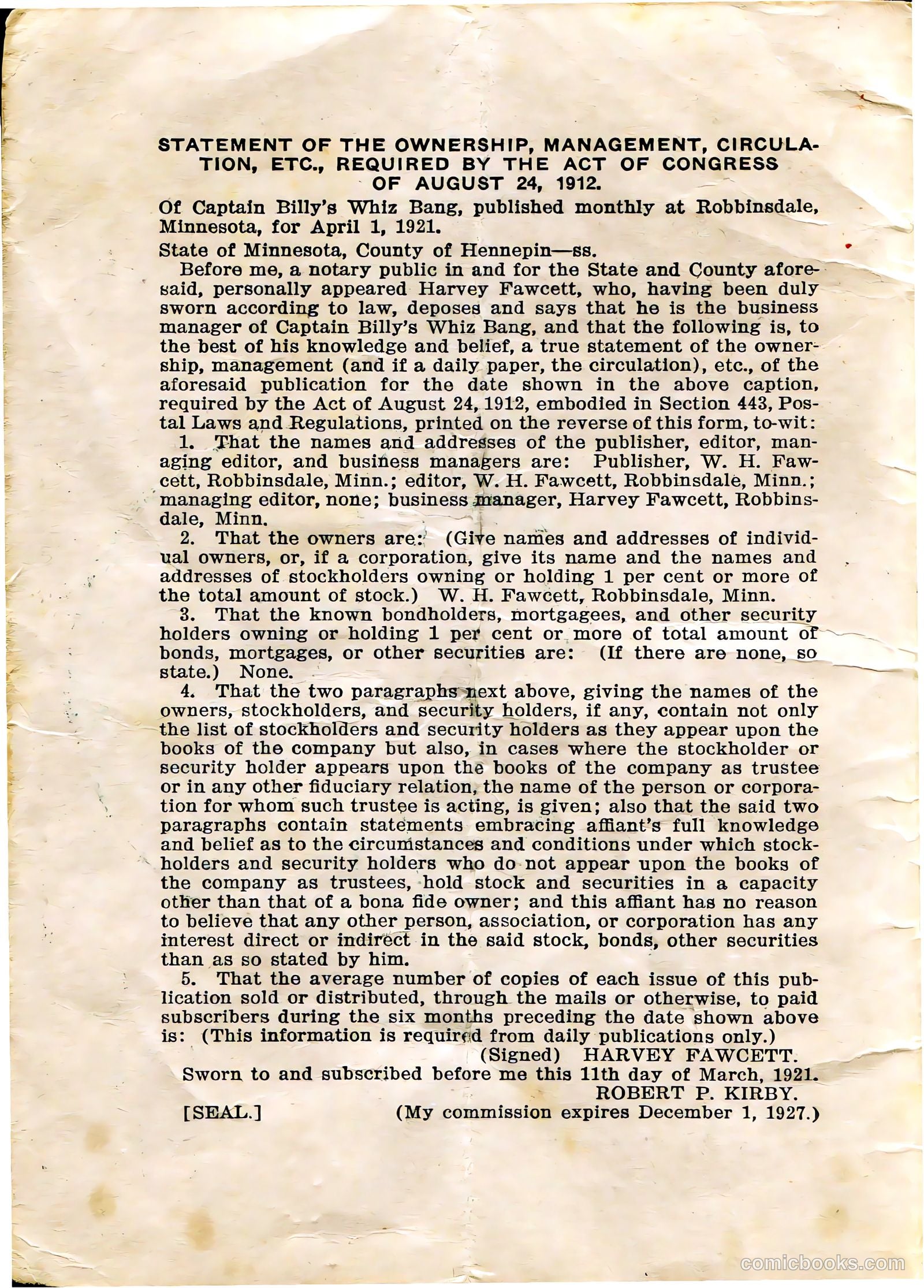
This is **not a cartoon or satirical content page**—it's a legal ownership statement. The Postal Service required all publications to file these declarations under the Act of August 24, 1912. The document certifies that *Captain Billy's Whiz Bang*, a monthly magazine published in Robbinsdale, Minnesota, is owned and managed by W. H. Fawcett, with Harvey Fawcett as business manager. There are no stockholders or bondholders beyond Fawcett himself. While *Whiz Bang* was indeed a satirical humor magazine popular in the 1920s, **this particular page contains only bureaucratic filing information**—the type of disclosure statement that appeared in publications during this era to maintain mailing privileges.
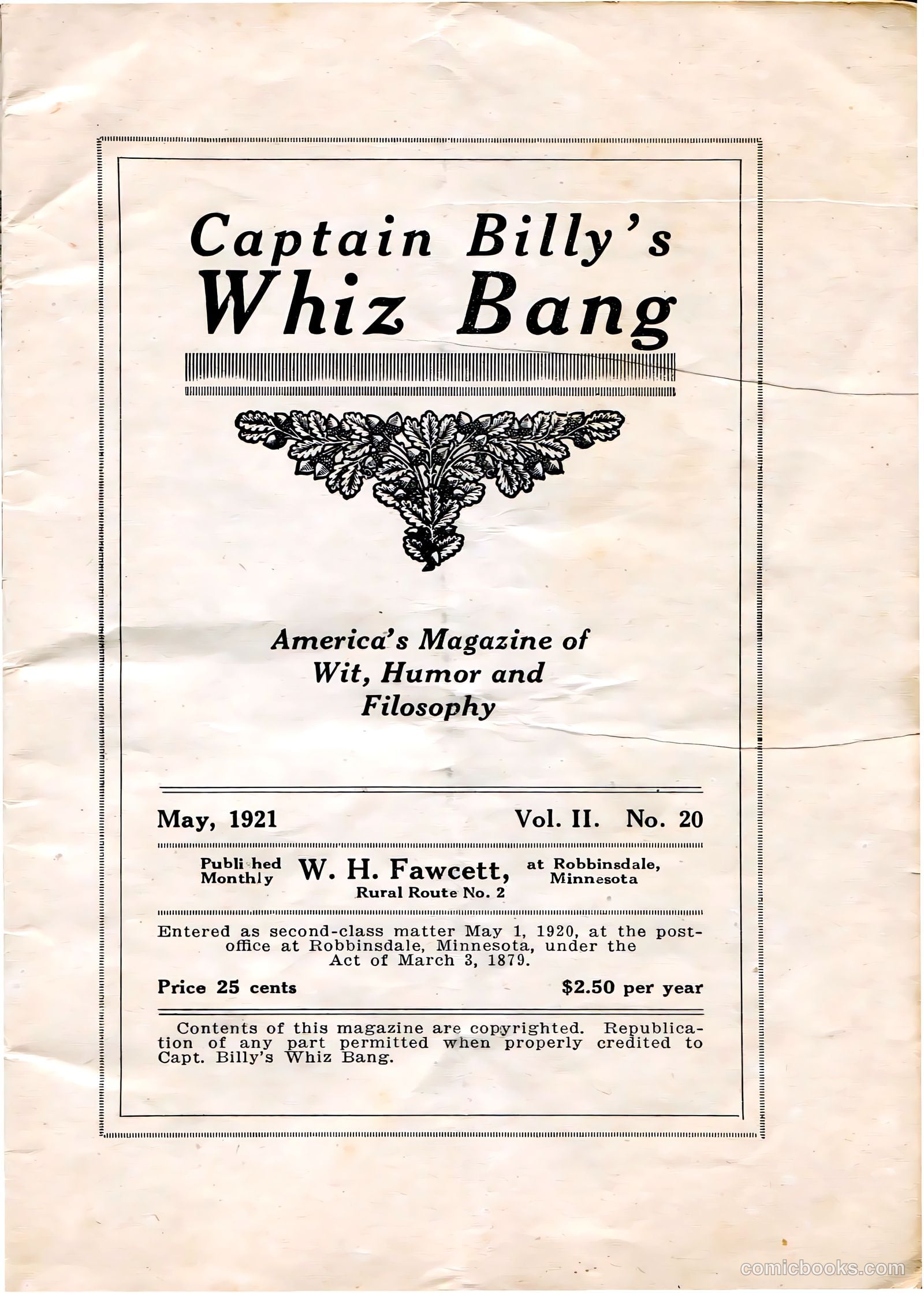
This is the title/masthead page of **Captain Billy's Whiz Bang**, a monthly satirical magazine published from rural Minnesota in May 1921. The page contains no cartoons—it's purely publication information. The magazine, edited by W.H. Fawcett, styled itself as "America's Magazine of Wit, Humor and Filosophy" [sic]. Priced at 25 cents per issue or $2.50 annually, it was entered as second-class mail. The decorative lace ornament is typical of 1920s magazine design. This post-WWI publication represents grass-roots American humor journalism, distributed via rural mail routes from small-town Minnesota.
This appears to be a **title or dedication page** rather than a cartoon page. It features a Theodore Roosevelt quote emphasizing undivided American patriotism—likely referencing contemporary concerns about immigrant loyalties and hyphenated identities (e.g., "Italian-American"). The 1921 copyright date and dedication to fighting forces suggests this publication emerged in the post-WWI period, when debates intensified about assimilation and "100% Americanism." The editor's identification as a Spanish and World War veteran emphasizes credibility in advocating for unified national loyalty. The quote itself was likely aimed at those perceived as having divided allegiances—a common anxiety in 1920s America.
This is a humor column describing a rural Minnesota farm acquiring an electric lighting plant—a rare luxury during Depression-era low wheat prices. The narrator celebrates this modern convenience by hosting a party in the hay loft. The satire targets rural/urban class divisions: the narrator self-deprecatingly notes his farm lacks "class" but has "fun," while neighbors have been generous with their thoughts about his "bundle of bunk" (exaggerated stories). The humor centers on conflicting rural customs: Gus proposes a "snoose party" (chewing Copenhagen snuff—a common farm habit), but Mrs. Bill rejects this as unrefined. The twelve-year-old's discovery practicing toe dancing in the barn inspires an alternative dancing party instead, blending rural simplicity with aspirational refinement via newfound electric lighting. The piece gently mocks both rustic manners and the pretensions that electricity inspires—electricity as a marker of modernity and status even on struggling farms.
This page contains a humorous poem about a rural barn dance on the "Whiz Bang farm." The text describes traditional square-dance activities—with musicians playing drum, jew's harp, and fiddle—and mentions specific dance moves like the "possum trot" and "lima bean." The satire appears light-hearted, poking fun at rural recreation and courtship customs (pinching girls' cheeks, changing partners). The poem's refrain, "Pick 'em up Silas and lay 'em down deep," suggests physical comedy or rowdy behavior. The concluding paragraph adds a cautionary note: apparently, the lights failed during an actual dance event, causing Mrs. Bill to ban future dances if girls from neighboring "Sugar Creek" attend—suggesting moral anxiety about unsupervised mixed socializing in darkness.
This is the opening of "Captain Billy's Whiz Bang," a satirical humorist column. The narrator (Captain Billy) mocks contemporary Spring poetry and urban affectation, preferring rustic authenticity. He's relocated his family to a Minnesota lake cabin settlement. The satire targets an educated Minneapolis woman—"Miss B——"—described as an aristocratic snob utterly ignorant of actual rural life despite her education. She's portrayed as pretentious ("like an angel from Heaven") yet comically unprepared: she's never seen real pumpkins or understood soil, only read about such things in seminaries. The humor comes from anticipated culture-clash comedy: an urbane city girl encountering genuine country living and practical farming (the hired man, the pedigreed bull, wild asparagus). The setup implies she'll be humorously out of place and exposed as shallow. This reflects early-20th-century American satire mocking educated elites as disconnected from authentic "Mother Nature" and working rural America.
This page from the satirical magazine contains a humorous anecdote about dining etiquette. The unnamed narrator describes "Gus," a crude, uncouth man with atrocious table manners who eats asparagus by sucking it directly rather than using proper utensils—compared to a street-cleaning suction hose from WWI Paris. A refined woman ("Miss B—") initially attempts correct etiquette but abandons it, mimicking Gus's crude approach. The joke celebrates her adaptability to "backwood" behavior, though she remains slightly more refined. The final section is self-deprecating humor: the narrator admits his only virtue—being tender-hearted—while his wife (Mrs. Bill) uses this as coded criticism, implying excessive weakness (unwilling to kill flies or beat carpets). The satire targets class pretensions and rural versus genteel social standards, typical of 1920s American humor mocking both extremes.
This page contains four humorous anecdotes from *Captain Billy's Whiz Bang*, a satirical magazine known for rural Americana humor. **Pedro the Bull**: A joke about Gus, the farm's hired man, charging admission to see a prize bull. A visitor with nine children asks the cost; Gus admits them free, saying he wants Pedro to see such an unattractive family—implying their appearance would be amusing to the animal. **Texas Girls & Lollipops**: A light joke about young women in Texas loving candy so much it ruins their hair, framed as complaints from lovesick men. **The Abandoned Car Seat**: Dry humor about a couple who abandoned their car at the farm while reporting it stolen. The magazine keeps the useless seat, noting it's worthless without the vehicle. **Gus's Vices**: A satirical portrait of the hired man as morally flexible—progressing from gambling to drinking bootleg whiskey, with a comment that his weakness isn't women (implying that's the only vice preventing greater ruin). The humor targets rural life, hired help, and Depression-era vice culture.
This page contains two humorous anecdotes rather than political cartoons. The first story mocks a prankster named "Gus" who rings the dinner bell to lure flies into the farmhouse, then closes doors to trap them while he works undisturbed—a joke about his "originality" in creating mischief. The second, titled "Spooky Stuff," satirizes spiritualism and séance culture (popular in the early 20th century). At a séance, spiritualists discuss conversations with ghosts. A medium asks if anyone has *loved* a ghost—an unusual claim. An Irishman volunteers, but mishears "ghost" as "goat," creating a pun-based punchline. The joke mocks both spiritualist pretensions and the absurdity of claiming intimate relationships with the supernatural.
This is a text article (not a cartoon) titled "Sissified Flirts" by Richmond, published in *Captain Billy's Whiz Bang*, page 9. The piece mocks "male sissified flirts"—men perceived as effeminate or overly interested in socializing—describing them as social pests at formal events. Richmond then recounts a masque ball at the Ambassador Hotel in Los Angeles thrown by theatrical people for wealthy tourists. The article describes chaos at this event, mentioning that hotel management eventually stopped the affair when word spread that alcohol would be available upstairs (likely a Prohibition-era reference, given the emphasis on "booze"). The satire targets both the sissified flirts themselves and the theatrical/entertainment world's associated perceived decadence and rule-breaking during Prohibition.
This page from the satirical magazine recounts a Hollywood scandal at what appears to be a hotel event. The text describes two unnamed male comedians—one described as "heavy" and "jolly," the other famous for never smiling—who brazenly carried bottles (likely alcohol during Prohibition) into a dining room, causing controversy among the film colony attendees. The author defends their behavior as relatively harmless, then pivots to criticize cross-dressing male performers at the same event who wore "feminine attire" and "lace tights." The piece frames these performers as dangerously emasculated, contrasting them unfavorably with the comedians' "hip pocket protrusion" (the bottles). The satire attacks Hollywood morality while simultaneously defending alcohol consumption and masculinity against what it presents as gender-nonconforming behavior—reflecting 1920s attitudes toward both Prohibition violations and gender presentation.
This is gossip-column satire about 1920s Hollywood scandals. The text mocks silent-film celebrities' marital dealings, specifically: **Mildred Harris** ("Charlie's used-to-be"—Charlie Chaplin's ex-wife) who led a formal "Grand March" with actor **Earl Williams**. The piece satirizes payoffs surrounding their marriages: Williams allegedly paid $40,000 to settle a pre-marital relationship after his wedding; Harris received ~$200,000 from Chaplin upon their separation. The author sarcastically "calculates" that Earl and Mildred collectively profited $160,000 from these matrimonial deals. The opening paragraphs discuss acceptable vs. unacceptable behavior at public gatherings—contrasting rowdy but "masculine" men drinking with effeminate guests, using derogatory language ("sissy simps," "queer folk"). The final line mentions "Mary and Doug" (likely Mary Pickford and Douglas Fairbanks) pointedly *not* mingling—suggesting celebrity social hierarchies or scandal avoidance.
This page contains gossip about a costume ball attended by silent film stars and industry figures. Key references include: **Edna Purviance** — Charlie Chaplin's frequent leading lady, whose career was being revived in Chaplin's film "The Kid" (1921). **Larry Semon and Lucille Carlisle** — Semon was a popular silent-film comedian; the piece jokes about their romantic dispute, noting they danced only with each other. **Bull Montana** — A character actor known for gorilla/ape roles, whose distinctive appearance made costumes unnecessary. The satire mocks the rumor by suggesting his face *is* the costume. The page exemplifies *Whiz Bang's* typical content: Hollywood gossip, insider jokes about the film industry, and mild mockery of celebrities' romantic entanglements and public images. The closing aphorism reflects the magazine's flirtation-focused humor typical of 1920s men's magazines. No political content is present.
This page contains no illustrations—it's purely text presenting satirical aphorisms from *Captain Billy's Whiz Bang*, a popular 1920s American humor magazine. The "philosophy" consists of cynical one-liners mocking Prohibition (then in effect), marriage, morality, and human nature. Key targets include: - **Prohibition**: Sarcastically equating it with temporary moral enthusiasm ("morality on a jag") - **Gender relations**: Women portrayed as inherently pursuing men; marriage depicted as transforming male declarations of love into cursing - **Hypocrisy**: Virtue is "seldom advertised," implying people hide moral failings - **Human nature**: More authentically revealed in crude contexts (dog fights) than religious settings The humor relies on cynicism, double meanings (whiskey being "chaste"), and absurdist comparisons (horses and bits). This reflects 1920s post-WWI disillusionment and anti-establishment sentiment characteristic of *Whiz Bang's* irreverent satirical style.
This page contains no cartoons—only satirical aphorisms (witty one-liners) typical of *Captain Billy's Whiz Bang*, an American humor magazine popular in the early 20th century. The quips mock contemporary gender relations and marriage customs. The jokes reflect 1920s-era attitudes: women's talkativeness, wives' infidelity compared to pets, gender roles (women "wearing the pants"), and the notion that attractive women are inherently dangerous. Several jabs target women's intelligence and morality as inversely related. The humor relies on misogyny common to the period—portraying women as deceitful, talkative, or incompetent. The aphorisms use the format of folk wisdom or proverbs to deliver cynical commentary on love and domestic life, which was the magazine's standard comedic approach.
This page from *Captain Billy's Whiz Bang* (a 1920s satirical magazine) contains no illustrations—only text-based jokes and aphorisms. The content is entirely comedic observations about marriage, gender relations, and social behavior, presented as pithy one-liners separated by asterisks. The jokes target common domestic frustrations: men's broken promises, women's manipulation tactics, infidelity, and in-law conflicts. Several jokes reference biblical figures (Mother Eve) and apply outdated moral frameworks (the "wise virgins") to critique modern behavior. The final entry uses mock-biblical language to satirize married men's suffering, particularly from overbearing mothers-in-law. The humor reflects 1920s attitudes: somewhat misogynistic (mocking women as scheming), cynical about marriage, and dismissive of moral hypocrisy. No specific political figures or events are referenced—these are general social satire targeting the institution of marriage itself.
This page from *Captain Billy's Whiz Bang* contains satirical prose rather than a cartoon. The text is a cynical philosophical essay on human existence that catalogs life's disappointments and contradictions. The satire targets how society judges men regardless of their choices: poor men are called incompetent, rich men dishonest. Politicians are grafters; non-politicians are undesirable. Charitable giving is dismissed as showiness; refusing to give as stinginess. The piece suggests life offers no winning position—people celebrate your birth only to criticize you throughout life and after death. The closing joke about paper and envelopes being the only things that haven't "gone down" (presumably in value/status) is a wry commentary on economic inflation, likely referencing post-WWI economic instability.
This is a humorous letter from a character named Sven to "Uncle Billy" (the magazine's editor), written in exaggerated Swedish-American dialect. Sven describes his experiences as an extra in Hollywood films. The satire targets **1920s Hollywood excess and absurdity**: a ridiculous "Sex picture" with a banal plot (banker seducing a maid), overwrought directing, and Sven's method-acting violence—he literally knocks out the leading man so hard filming stops for a week. The second anecdote mocks the era's crude filmmaking, where they glue whiskers onto both an actor and a real elephant for a "cave-man picture." The humor relies on Sven's malapropisms and broken English ("dam gude actor," "baskardon"), presenting him as an oblivious immigrant who takes absurd instructions literally. **Whiz Bang** was known for satirizing Hollywood's pretensions and the film industry's growing prominence in American culture during the silent era.
This page contains two items: 1. **A letter from "Svens Peterson"** written in exaggerated Swedish-American dialect humor, describing encounters in what appears to be Hollywood (references to film production, "moving picture game," "Foreman Clark"). The humor relies on phonetic dialect spelling and malapropisms typical of 1920s ethnic comedy—a now-offensive style common in period magazines. 2. **"What a Pity, Poor Kitty!"**—a brief comedic poem about a city man who mistakes a skunk for a cat, pats it, and suffers the consequences (needing to bury his clothes). This is a classic setup-and-punchline joke playing on urban naiveté. Both pieces represent typical *Whiz Bang* content: broad humor targeting immigrants and city dwellers, with no apparent political commentary.
This page is primarily **text-based**, not a cartoon. It's an article by Rev. "Golightly" Morrill, pastor of People's Church in Minneapolis, reporting on his recent three-month tour of South and Central America for the *Whiz Bang* magazine. The satire targets **Venezuelan bureaucracy and corruption** at ports of entry—Morrill criticizes passport visas, custom fees, red-tape, delays, and "insolence" from officials who allegedly rob travelers of "time, money and patience." The article opens with the wry comparison that entering Venezuela is nearly as difficult as "the descent to hell." The introduction also contains a humorous anecdote about Morrill's home being burglarized during his absence, with his parting note sarcastically referencing a Bible passage against theft.
This page contains satirical travel commentary on La Guayra, Venezuela, mocking both the locale and its inhabitants through crude stereotypes typical of early 20th-century American humor magazines. The satire targets: **Local residents**: Depicted as thieves, prostitutes, and morally corrupt—"sun-burnt bandits" who would desecrate the dead, and "enchantresses" spreading disease. **Women specifically**: Characterized as seductive dangers to visiting American men ("dark-eyed daughters of delight"). **Religious hypocrisy**: A saloon named "Gracias a Dios" (Thanks to God) exemplifies "simple-minded" people mindlessly following scripture while engaging in vice. **Educational standards**: The anecdote of a naked boy roaming a girls' school mocks Venezuelan institutions as chaotic and indecent. The humor relies on exaggeration, double entendre ("learning much and not missing anything"), and moral superiority—presenting Venezuela as simultaneously dangerous and ridiculous to the American reader. No specific political event appears referenced; rather, this reflects casual racist and xenophobic attitudes normalized in 1920s American popular media.
This page contains travel narrative text rather than cartoons. The author describes visits to Spanish and South American locations—La Guayra, Valencia, Puerto Cabello, and Caracas—offering satirical social commentary. The satire targets: - **Church hypocrisy**: A Valencia church placard warning men not to "wink at girls" while the town suffers plague - **Colonial exploitation**: Political prisoners in Puerto Cabello forced to labor naked among rocks - **Pretentious tourism**: A guidebook calling brutal conditions "charming natural beauties" - **Venezuelan society**: Caracas described as civilized ("Paris of South America") despite its citizens' troubling characteristics The humor relies on the author's deadpan juxtaposition of genteel descriptions with grim realities, exposing the gap between how colonial authorities presented these places and their actual conditions.
This is a satirical travel account mocking Caracas, Venezuela, presented as social commentary. The author describes the city's moral corruption across multiple fronts: wealthy young men neglecting university studies for gambling and vice; the sale of women and girls for sexual purposes (explicitly noting a 12-year-old); and street solicitation by sex workers ("filles publiques"). The piece also attacks homosexuality, using derogatory terms ("maricos," "fairies") to ridicule cross-dressing men in public spaces. The author compares this vice to similar practices in Algiers and Cairo. The satire's point appears twofold: to scandalize American readers with tales of foreign depravity, and to suggest governmental corruption (police indifference). The references to Beethoven, Wagner, and classical painters provide ironic contrast—cultural sophistication paired with moral bankruptcy—emphasizing the author's judgment that Caracas civilization is superficial and rotten.
This page contains no cartoons or illustrations—it's text only, presenting a satirical essay on historical moral decadence. The author catalogs examples of sexual depravity across civilizations: ancient Egypt's temples, classical Greece's "Socratic love," Roman emperors like Tiberus, and contemporary figures including Venezuelan dictator President Gómez. The piece uses increasingly lurid language, describing Gómez as a "modern Bluebeard" who allegedly sacrifices children and drinks their blood. The satire appears to function as social commentary, contrasting historical "moral decadence" with contemporary political corruption. By equating ancient philosophical practices with modern authoritarian abuse, the author suggests that moral corruption persists across time and geography—though Gómez receives the harshest contemporary condemnation as a brutal despot.
This page contains a satirical written piece (no visible cartoon) attacking an unnamed Venezuelan dictator—likely Juan Vicente Gómez, based on references to "the land of Bolívar, the Liberator." The satire mocks the ruler's corruption: maintaining a harem, suppressing free press and speech, imprisoning political dissidents, and brutality toward citizens. The piece includes a mock "prayer" parodying the Lord's Prayer, replacing spiritual concerns with selfish material demands ("bread, booze, and beef") while ignoring others' suffering. The text then shifts to social commentary on Venezuelan society, noting high illegitimacy rates and cultural attitudes toward unmarried men with multiple mistresses. This reflects early-20th-century American satirical magazines' practice of targeting foreign despots as moral cautionary tales.
This page contains two distinct sections of satirical text rather than visual cartoons. The first section morally critiques cities engaged in hedonistic practices, referencing Alexander the Great's alleged desire to destroy Lamsacus (a town known for Priapus worship—fertility cult rituals). The author draws a parallel to the 1812 Caracas earthquake that killed 12,000 people, interpreting it as divine punishment for the city's "wickedness." This reflects early 20th-century American moral anxiety about urban vice and sexual depravity. The second section, "Why Sergeants Are Liked," presents a sergeant's sentimental anecdote about childhood generosity and maternal wisdom. The humor derives from the sergeant's crude language ("lob-sided, mutton-headed, goofus-brained") contradicting his touching story—satirizing the stereotype of the gruff military man with unexpected sentimentality.
This page contains two separate jokes from *Captain Billy's Whiz Bang*, a WWI-era satirical magazine. **"Parley Vouz?"** plays on officers stationed in France during WWI taking French lessons—ostensibly for language training, but clearly using them as pretexts for dating French women. The joke's humor lies in the major's deflection: when asked to calculate costs "respectably" rather than "roughly," he dodges the question, implying the real expense is romantic rather than educational. **"Shocking!"** mocks a second lieutenant's inattention during a military tactics class. The instructor poses a scenario about encountering "two young ladies" in enemy territory during a training exercise. The officer's response reveals he wasn't paying attention—but his final question about whether the corn was "shocked" (bundled for storage) suggests he's either deliberately deflecting or genuinely missing the point of the tactical problem entirely. The humor targets military incompetence and distraction, likely reflecting frustrations with hastily-trained officers during wartime.
This is a **humor advice column** where readers submit questions to "Captain Billy" (the magazine's persona). The page contains four separate Q&A exchanges: 1. A reader asks who won the lightweight boxing championship; Billy jokes "My coal dealer" 2. A woman asks what a husband is; Billy offers satirical commentary on husbands as domestic servants and poor financial managers 3. An immigrant named Ole reports his brother works in Minnesota; Billy makes an ethnic joke about hired men smelling bad from snuff 4. A reader asks about "Popcorn Balls"; Billy makes an innuendo joke about never being "to one" The humor relies on **puns, double entendres, and ethnic stereotypes** common to 1920s American comedy. The magazine appears designed for adult male readers seeking irreverent, lowbrow humor about marriage, work, and bodily functions.
This is a humor advice column featuring absurdist jokes with punny pseudonyms. Each question contains a play on words in the questioner's name that sets up the joke. Notable examples: - "Ophelia Anckel" asks about bigamy penalties; "Two mothers-in-law" is the humorous answer - "Grace Gravydisch" suspects her husband visiting "Jack" is actually attending "Jack Pot" (gambling) - "E. Normous Nutt" asks about "The Evening Wore On" expression; the answer is "The Close of the Day" - "Rundown Ike" asks about hair tonic; the reply references "Wine of Pepsin" - "Miss Fitt" asks about becoming a popular aesthetic dancer; the advice is to "shiver and shake and look wicked" The humor relies entirely on name puns and double meanings typical of 1920s comedy magazines.
This page presents a question-and-answer humor column where "Captain Billy" responds to reader queries with absurdist or pun-based jokes. The humor relies on deliberate misinterpretation and wordplay: - **"Old Salt"** plays on naval terminology (saltpeter used in explosives) - **"Peruvian Plump"** is a fabricated animal described as Arctic-dwelling with "two or more speeds"—nonsensical absurdity - **"Model woman" vs. "woman model"** contrasts a hypothetical ideal with reality through naked wordplay - **Napoleon crossing the Rockies in a canoe (1492)** combines historical impossibilities for comedic effect - **Growing macaroni** jokes about manufacturing pasta by making holes in dough The satire targets readers' credulity. These are intentionally foolish answers to earnest questions, reflecting the magazine's irreverent, anti-intellectual comedy style typical of 1920s American humor publications aimed at working-class audiences.
This page contains four humorous poems/verses rather than visual cartoons. The content reflects 1920s-era satirical humor: **"Gabriel's Trump"** and **"Gabriel's Limber Kicks"** appear to reference card games and casual violence—possibly satirizing social behavior of the era. **"Forgetful Maiden"** mocks a woman's infidelity through a mock toast, suggesting she drinks, smokes, and forgets her commitment—reflecting contemporary anxieties about changing women's behavior during the Jazz Age. **"Quick, Mama, the Handkerchief"** is a mild joke about a child's cold in hot weather, playing on literal misunderstanding. The humor is crude and domestic, typical of Whiz Bang's bawdy, working-class comedic style. No specific political figures are caricatured on this page.
This is an editorial page, not a cartoon. It's the masthead/introduction to *Captain Billy's Whiz Bang*, a satirical magazine founded by a veteran around 1919. The editor celebrates the publication's explosive growth: from 3,500 copies in October 1919 to 300,000 by May 1921—achieved entirely through word-of-mouth, with no advertising or subscription agents. The tagline "The Bull is Mightier Than the Bullet" likely references the magazine's irreverent, folksy humor as more powerful than military force. The editor invokes the Cherry Sisters (famous vaudeville performers) as a comedic benchmark and promises expansion into Canada. This reflects post-WWI American culture: veterans returning home hungry for entertainment and camaraderie, the power of grassroots media distribution, and satirical magazines' popularity in the 1920s before mass advertising dominated publishing.
This page contains editorial material and the beginning of an essay on drums—not a political cartoon. The top section is a call for reader submissions (stories, jokes, verses) to Captain Billy, followed by a patriotic statement referencing WWI ("the recent war," soldiers in "khaki and blue"). The magazine pledges to defend "personal and national liberty" and citizens' rights to "pursuit of happiness, health and prosperity." The main text discusses the cultural and historical significance of drums across civilizations—from ancient Egypt to contemporary jazz bands and the Salvation Army. It traces drums' origins to "savages" using percussion in combat, then their evolution through religious and entertainment contexts. The piece is informational rather than satirical, celebrating percussion instruments' universal role in human culture. No specific caricatures or political figures are identified on this visible portion.
This page contains no cartoon or illustration—it's purely text: a romantic, nostalgic essay about drums in history and culture. The author celebrates the drum as a symbol of liberty and national heroism, tracing its power from the Alhambra to the French Revolution (the Bastille storming). The piece invokes the German poet Heine and references classical military traditions—reveille, tattoos, funeral marches. The centerpiece is a sentimental anecdote about Napoleon's unnamed drummer-boy, swept into an Alpine valley by avalanche. Despite separation from his regiment, he drums commands (advance, charge) until playing a funeral march as soldiers pass overhead. This isn't satire but rather patriotic nostalgia typical of *Whiz Bang*'s mix of humor and earnest sentiment. The drum represents duty, sacrifice, and the call to arms—themes resonating for post-WWI American readers.
This page contains patriotic propaganda text rather than a cartoon. Published during or shortly after World War I (references to 1917 and Germany suggest WWI era), it uses the drum as a metaphor for American military patriotism. The text invokes historical American conflicts—the Revolutionary War ('76), War of 1812, Mexican-American War, Civil War ("Rebellion"), Spanish-American War, and WWI—to frame drumming as synonymous with righteous warfare. It explicitly calls for a "drum-head court martial" against Germany, using military terminology to advocate harsh punishment. The passage opens with a romantic anecdote about Napoleon's drummer boy freezing in the Alps, lending tragic nobility to military sacrifice. The final rallying cry celebrates "Uncle Sam, the drum-major" leading humanity toward "freedom." For modern readers: this represents jingoistic wartime messaging conflating percussion instruments with patriotic duty and military aggression, exemplifying how WWI propaganda weaponized nationalism and historical narratives.
This page from *Captain Billy's Whiz Bang* (a 1920s-era humor magazine) presents a extended joke comparing marriage to military combat, using military terminology throughout. The satire depicts marriage as a battle where: courtship involves "presenting arms" and "engagements"; the wife becomes "Commanding Officer" who controls finances, confines the husband to quarters, and conducts "counter attacks" at department stores; household items (pots, flatirons) serve as "hand-grenades"; and children represent the final, most devastating assault ("infantry"). The humor targets both spouses—the husband as a deluded "nut" thinking himself a "Colonel" when powerless, and the wife as a strategic opponent who thoroughly outmaneuvers him. The joke's punch comes from inverting martial hierarchy: the wife commands while the husband supplies, and domesticity proves more chaotic than actual warfare. This reflects post-WWI cynicism about both war and gender dynamics in American marriage.
This page contains four brief satirical commentaries rather than cartoons: 1. **War vs. Marriage**: A joke comparing military enlistment (4-year commitment with no escape clause) to marriage—suggesting marriage is equally inescapable. 2. **Women's Fashion**: Mocks a preacher who claimed society women wear only four garments, with the author sardonically noting he apparently didn't count shoes and stockings. 3. **Medical "Cure"**: Satirizes a doctor's claim about stopping hiccups via the "fifth curvicular nerve," suggesting the advice is worthless without knowing where this nerve actually is. 4. **Monkey Cage**: A brief quip against frivolous entertainment and socializing. The final section, "Stop—Look—Listen," is a humorous poem about the speaker's moral anxiety around attractive women—likely satirizing either dated prudishness or performative morality of the era.
This is a content page from *Captain Billy's Whiz Bang*, not a cartoon page. It announces an upcoming poetry section titled "Smokehouse Poetry." The page advertises two poems to be published in future issues: 1. "The Gila Monster Route" — a hobo narrative for the June issue, with excerpts about a starving vagrant dying in the desert 2. A poem from an Alcatraz prisoner begging for publication to reach "the great outside," describing dungeon torture and psychological torment The final paragraph announces plans for a *Smokehouse Poetry* book collecting past gems and new verses, plus a new "Winter Annual—Follies." Rather than satire, this represents the magazine's editorial blend: mixing lowbrow humor with gritty social commentary about marginalized figures (hobos, prisoners).
This page contains no cartoon or satirical content. It's primarily promotional material and a poem. The top section advertises an upcoming issue of Whiz Bang magazine (October 1921-22), promoting its mix of jokes, stories, poetry, and advice columns. Below that is a poem titled "Or Ever the Knightly Years Were Gone" by William Ernest Henley. The poem appears to be serious romantic/melancholic verse about a past relationship set in ancient Babylon, dwelling on themes of lost love, pride, and longing. It's unclear why this particular poem was selected for this magazine page, though Henley was a recognized poet. This appears to be filler content rather than satirical material characteristic of Whiz Bang's typical editorial approach.
This page contains a narrative poem about "Toledo Slim," a character described as a down-and-out vagrant. The poem recounts Slim's fall from prosperity—he was once successful in New York—to his current status as a "bum." The narrative describes Slim meeting a woman in a bar and helping her find housing, resulting in a romantic relationship. The poem uses period slang ("chewed the rag," "shot the con," "hustling") to depict urban underworld life. This is not political satire but rather a moralistic tale about economic hardship and redemption. It reflects 1920s attitudes toward poverty and street life, presenting Slim's circumstances with both sympathy and the language of working-class vernacular culture that characterized much of *Whiz Bang's* content.
This page contains a narrative poem titled "Captain Billy's Whiz Bang"—a first-person account of petty crime and personal tragedy. The speaker describes robbing a wealthy home with a partner named Jackie Brown, getting caught by police, and being imprisoned ("sent me up the river"). Upon release, he returns home to find his girlfriend has abandoned him for Jackie Brown and relocated to San Francisco, where she dies of consumption (tuberculosis). The narrative shifts to the speaker's vengeful search across America, eventually learning his former lover died in Denver. The poem is sentimental and moralistic—a cautionary tale about crime, betrayal, and loss that was typical of period popular entertainment. It reflects early 20th-century working-class anxieties about poverty, criminality, and social instability.
This page contains two poems rather than political cartoons. "Captain Billy's Whiz Bang" is a first-person narrative about revenge—the speaker shoots a man named Frisco after a street encounter, then escapes by train. It's a violent crime story presented as entertainment. "The Midnight Glide of Pauline Revere" by W.K. Edwards parodies historical heroism (evoking Paul Revere) by depicting a modern woman engaged in sexually suggestive dancing at what appears to be a jazz-age party. The poem satirizes contemporary youth culture—specifically the "flapper" era's dancing crazes and intimate physical contact—through mock-serious language. The moral message condemns modern entertainment venues as inferior to home-based amusement. The humor targets changing social mores regarding courtship and dancing in the 1920s.
This page contains two World War I memorial poems, not cartoons. Both address fallen soldiers in Flanders Fields (Belgium, site of major WWI battles). Lt. Col. John McCrae's "The Anxious Dead" calls upon living soldiers to honor the dead and continue fighting with resolve. R.W. Lillard's "America's Answer" responds as if from American soldiers, reassuring the fallen that their sacrifice won't be forgotten and that "ten million hands" will carry forward the cause of freedom. The poems represent propaganda literature encouraging continued American commitment to WWI, using emotional appeals about sacrifice and duty. They reflect early 1900s patriotic rhetoric common in wartime publications aimed at maintaining public support for the war effort.
This is a poem, not a cartoon. The speaker—a soldier or veteran—bitterly rejects romantic notions of poppies in Flanders fields. The poem references the famous WWI poem "In Flanders Fields" by John McCrae, which sentimentalized poppies growing on battlefields as symbols of fallen soldiers. Chrisman's speaker counters this idealization harshly. He describes witnessing millions of actual poppies in wheat fields during combat, where soldiers died among them—not beautifully, but horrifically ("wallerin' in poppies"). The poem uses harsh language and colloquial speech to strip away romantic mythology, asserting that poppies are simply flowers, not redemptive symbols. It's anti-war satire rejecting sentimentalized depictions of battlefield death.
This page contains two humorous poems rather than political cartoons. "Our Lonely Love-Sick Gob" is a sailor's confessional verse about romantic rejection—a shipmate stole his girlfriend by telling stories, and she left him for this rival. The poem's humor derives from the sailor's naive complaint and the crude moral: warn other lovesick sailors to keep their romantic interests away from shipmates. "Human Nature" is a brief, cynical quatrain playing on double meanings: absence, peroxide, onions, and "bunk" (nonsense) produce predictable results, with the final punchline suggesting that manure makes grass grow—implying human nature itself is worthless or productive only of negativity. Both poems target working-class male audiences with bawdy, self-deprecating humor typical of early 20th-century servicemen's magazines.
This page contains three poems with military themes, likely from World War I era based on the "Soldier's Prayer" and references to military life. There are no cartoons or caricatures visible. The content includes: 1. **"Soldier's Prayer"** - A satirical prayer about military hardships (poor food, theft of belongings, harsh conditions) 2. **"My Sarah Jane"** - A comedic poem describing an unattractive woman using crude physical descriptions 3. **"My Girl"** - A sentimental poem about a deceased child The humor relies on crude characterizations and dark comedy typical of early-20th-century soldier magazines. "Whiz Bang" was known for bawdy, irreverent humor aimed at servicemen. The contrast between the sentimental final poem and the crude earlier ones reflects the magazine's satirical approach to military life and personal relationships.
This is a satirical attack on Prohibition and "blue laws" (moral legislation restricting alcohol). The unnamed narrator complains that pre-Prohibition beer was safe, but modern bootleg liquor is dangerously adulterated ("snuff, ground glass and paint"). The piece mocks both Prohibition's consequences and its enforcement: one drink causes such violent intoxication that the narrator wrecks a place, gets beaten by police (who sit on his brow, kick him), and faces arrest alongside ninety others. His friends must pay an enormous "$30,000" fine for bail. The satire cuts multiple ways—criticizing dangerous black-market alcohol, brutal police response to drunkenness, and the absurdity of laws that created this chaos. For modern readers: this reflects genuine 1920s Prohibition-era dangers, when unregulated bootleg alcohol actually did contain toxic additives, and police violence during alcohol-related arrests was common.
This page contains three humorous anecdotes rather than political cartoons. The jokes satirize: 1. **Prohibition-era drinking**: The opening story mocks attempts to quit alcohol and homemade remedies for colds, ending with the narrator giving up on sobriety and planning to go to Spain—likely referencing how some Americans fled to escape Prohibition laws (1920-1933). 2. **"Well, He's Some Place"**: A dark joke about failed homemade liquor (hooch), where Jenkins dies from drinking his own concoction—satirizing the dangers of Prohibition-era bootlegging and amateur distilling. 3. **"Candy Kisses"**: A brief joke about a toothless girlfriend, using wordplay on "candy" and "gum." The humor reflects anti-Prohibition sentiment common in American satirical magazines of the 1920s-30s.
This page contains **humorous one-liners and brief jokes** rather than political cartoons. The content includes: - **"Pasture Pot Pourri"**: A collection of gags with risqué or cynical humor typical of 1920s magazines - **"A Cold One"**: Dark humor about death ("It's the coffin they carry you offin") - References to petty crime, romance, and workplace gossip - **"Gus's Favorite Song"**: A nonsense verse about an old mare on a whipple tree (a farming reference) - A closing anecdote about drunk sailors ("Pat and Mike") making an Irish-accented joke about Christ The humor is bawdy, irreverent, and working-class in tone—reflecting *Whiz Bang*'s appeal to soldiers and laborers rather than genteel audiences. No specific political figures or dated events are referenced on this page.
This page contains brief humor items and satirical quips rather than a cartoon. The content reflects 1920s-era social commentary: **Key themes:** - Gender relations ("Girls...don't get married"; women climbing trees) - Prohibition-era jokes ("We lost our good spirit when they took away our booze") - Women's suffrage references ("poll cat" jab at voting women) **Specific references:** The "Dutch Room Raid" section appears to satirize Prohibition enforcement, toasting various American cities. The line "We lost our good spirit when they took away our booze" directly mocks Prohibition's impact on American morale. **Overall tone:** These are lighthearted, cynical quips about marriage, women's independence, and alcohol prohibition—typical humor for Whiz Bang's irreverent, working-class audience during the Prohibition era.
This page contains no cartoons—it's a "Classified Ads" section consisting entirely of humorous fake advertisements reprinted from various regional newspapers. The jokes target small-town life: a widower seeking discretion in contacting a woman; a newlywed carpenter eager to work; a church service on drunkenness that apparently drew large crowds; and a nurse overwhelmed by requests, limited by caring for canaries and houseplants. These read as gentle satirical observations of rural American life circa the 1920s—poking fun at romantic mishaps, religious hypocrisy (the church packed for a sermon on wine), and the gap between people's stated capacities and actual availability. The humor relies on readers recognizing these as exaggerated but recognizable social situations from their communities.
This page contains a collection of humorous classified advertisements and newspaper clippings rather than political cartoons. The satire works through absurd or compromising personal ads, likely reprinted from actual newspapers to mock their oddness. Examples include: a woman seeking a mate, someone offering to house young men, debates about stocking colors, and a housekeeper position requiring a child. The final entry requests a husband "must be a sinner; none other need apply." The humor derives from the classified ads' peculiar requirements and implications—suggesting desperation, moral flexibility, or social transgression. This was typical Whiz Bang content: light satirical commentary on American social life through real newspaper absurdities presented without editorial commentary.
This page contains **no cartoons or illustrations**—only a humorous column of brief satirical observations about gender relations and dating customs. The piece uses exaggerated generalizations to mock both men and women. Key targets include: women's fashion choices (suspenders, nail polish, silk stockings); dating behavior and communication styles; double standards in social conduct; and gender stereotypes (women fainting at mice, gossiping, etc.). The humor relies on period-specific references like "hootch" (Prohibition-era alcohol), telephone etiquette, and theater behavior. Overall, it's lighthearted social satire typical of 1920s-era men's magazines—poking fun at contemporary dating norms and the perceived absurdities of both sexes without deeper political commentary.
This page contains satirical commentary on 1920s social issues rather than a traditional cartoon. The text mocks contemporary trends through brief, quip-style observations: **Key targets:** - Modern masculinity (men wearing belts, wristwatches, smoking pills) - Jazz music (called "the voice of the devil") - Women's changing roles (married women wanting to play football) - Modern courtship technology (electric lights ruining romantic gas-lamp dimming) - **Prohibition's failure** (more crime in 1920 than 1919 despite the ban) - Rising housing/living costs The page concludes with humorous verse about romantic love and workplace dynamics. The satire reflects post-WWI anxieties about rapid social change, women's liberation, and Prohibition's unintended consequences—common themes in 1920s humor magazines.
This is a humor advice column featuring responses to reader letters. The satire targets rural social conventions and courtship customs of the era. **Key jokes:** - **Belle's** rejected story wins a "diamond studded stomach pump" — mocking overly sentimental rural submissions - **Sweet Marie's** advice about bridegroom not seeing the bride before the wedding, then cynically suggesting surveillance of the groom, satirizes rural superstitions and marital distrust - **Dolly** addresses simultaneous wedding/christening invitations — poking fun at hastily arranged rural marriages - **Will E. Crowder** references a woman "walking home after an automobile ride," implying sexual impropriety — typical 1920s scandal insinuation - **Grace's** closing joke about babies making "bankroll smaller" and "clothes shabbier" mocks the financial hardships of large rural families The column uses folksy humor to gently mock rural American life and social anxieties.
This page contains four humorous poems rather than political cartoons. The content consists of bawdy, satirical verses typical of Whiz Bang magazine's irreverent style: 1. **"Deep Stuff"** - A crude joke about a car accident during lovemaking, playing on "liver" and "fliver" (slang for car). 2. **"Cannibalism"** - A darkly humorous piece suggesting a couple eloped in an airplane, with the implication they cannibalized each other (unclear/likely metaphorical). 3. **"Sing This Merrily"** - A brief, playful poem about romantic pursuit. 4. **"Treat 'em Rough"** - A violent domestic scene depicting a man's abusive behavior toward a woman, ending with frustration over cats. These poems reflect Whiz Bang's characteristic blend of crude humor, dark comedy, and risqué content aimed at adult male readers. The material is notable for its casual treatment of violence and crude sexuality.
This page contains three satirical jokes rather than cartoons: 1. **"In Memoriam"** - A dark humor epitaph for "William Dough," a chemistry student who fatally confused sulfuric acid (H₂SO₄) with water (H₂O). The joke plays on the tragic consequences of academic carelessness. 2. **Mrs. Murphy joke** - A woman collector for a "Drunkards' Home" asks Mrs. Murphy for donations. Mrs. Murphy offers to "give you Murphy"—a play on words suggesting her husband is the solution to their charitable needs (implying he belongs in such a home). 3. **"Elsie" verse** - A rhyming joke about a woman with a "little light" (unclear reference, possibly to intelligence or literal lighting) that goes out whenever "William called"—suggesting romantic disappointment. All three jokes rely on wordplay and dark humor typical of 1920s-era satirical magazines.
This page is primarily a **table of contents and humor section** rather than a political cartoon. It lists six chapters of a serialized story titled "Life," each with flirtatious or romantic dialogue snippets ("Glad to meet you," "Isn't the moon beautiful?"). Below are three separate **satirical anecdotes**: 1. A joke about Gertrude Hoffman (a classical dancer) considering muzzling her pet snake after it bit her during performance 2. A humor piece about stockings mentioned in someone's will 3. A notice about Richard G. Badger authoring a book on "Nervous Children" The humor relies on wordplay, ironic juxtaposition, and light social commentary typical of 1920s satirical magazines—nothing requiring specific historical context beyond understanding period attitudes toward romance, inheritance, and child psychology.
This page contains three brief humorous anecdotes with no illustrations: 1. **"Wondairful Climax!"** — A French military attaché in Washington attends a golden wedding (50th anniversary) and, upon learning what it is, expresses amazement that a couple could remain together harmoniously for fifty years. 2. **"A Twice Told Tale"** — A short poem about a teddy bear on ice that melts away, with a pun on "tale" being told twice. 3. **"There's a Limit"** — A flirtatious poem where a man compliments a woman's loving heart, but she dismissively responds she didn't realize she was being "so decollette" (a fashion reference to neckline exposure). The final line jokes about Prohibition agents being bolder than bootleggers—a contemporary reference to 1920s alcohol enforcement.
This page contains three separate humorous pieces reflecting early 20th-century American popular humor: 1. **"Some Bugler"** uses racist dialect humor about Black soldiers, featuring exaggerated speech patterns. The joke relies on stereotyped characterizations common to the era's "comedy." 2. **"Ching Wong Long and Ching Fong Luey"** employs racist Chinese stereotypes with a pun on "chop suey" and "suicide"—mocking both Chinese immigrants and their food. 3. **"More Latin"** appears to be nonsense Latin verse, likely mock-academic humor. The final aphorism about giggling girls becoming cackling women reflects period misogyny. These pieces exemplify how Whiz Bang traded in crude racial and ethnic stereotyping as entertainment—reflecting deeply prejudiced attitudes normalized in early American satirical magazines.
This satirical story mocks traveling salesmen ("drummers") of the era. The joke hinges on their reputation for infidelity and exaggeration. The salesmen boast to a skeptical pastor about their marital faithfulness—claims so obviously false that the minister offers a silk hat to anyone truthfully claiming lifelong fidelity. The pastor "wins his point," exposing their lies. The punchline reverses expectations: when John's wife asks why he didn't accept the challenge, he admits the real reason wasn't his infidelity—it's that he looks bad in a silk hat. This undercuts the moral lesson, suggesting vanity matters more than integrity. The satire targets salesmen's reputation for unreliability and dishonesty, while the final joke suggests even when caught in hypocrisy, men prioritize their appearance over admitting wrongdoing. The piece reflects early 20th-century anxieties about male morality and commercial culture.
This page contains three humorous anecdotes rather than political cartoons: 1. **"It Was Ocean Blood"**: A correction to an April article. A sailor fights three men to help a shipmate and gets stabbed, groaning "Oh, Gawsch! I hope I'm stabbed!" The humor lies in his delayed realization of his injury. 2. **Verse about a woman**: A brief poem about a "sweet and pretty miss" who lived by the racetrack, with a joke about her husband dressing a hen indoors. 3. **"The Hope of the Fat"**: A joker outside a synagogue quotes Shakespeare about fate, then a "fat, greasy-looking little man" offers to take him to see the rabbi. The humor appears to rely on ethnic stereotypes. The magazine's satirical tone targets social situations and character types rather than specific political figures.
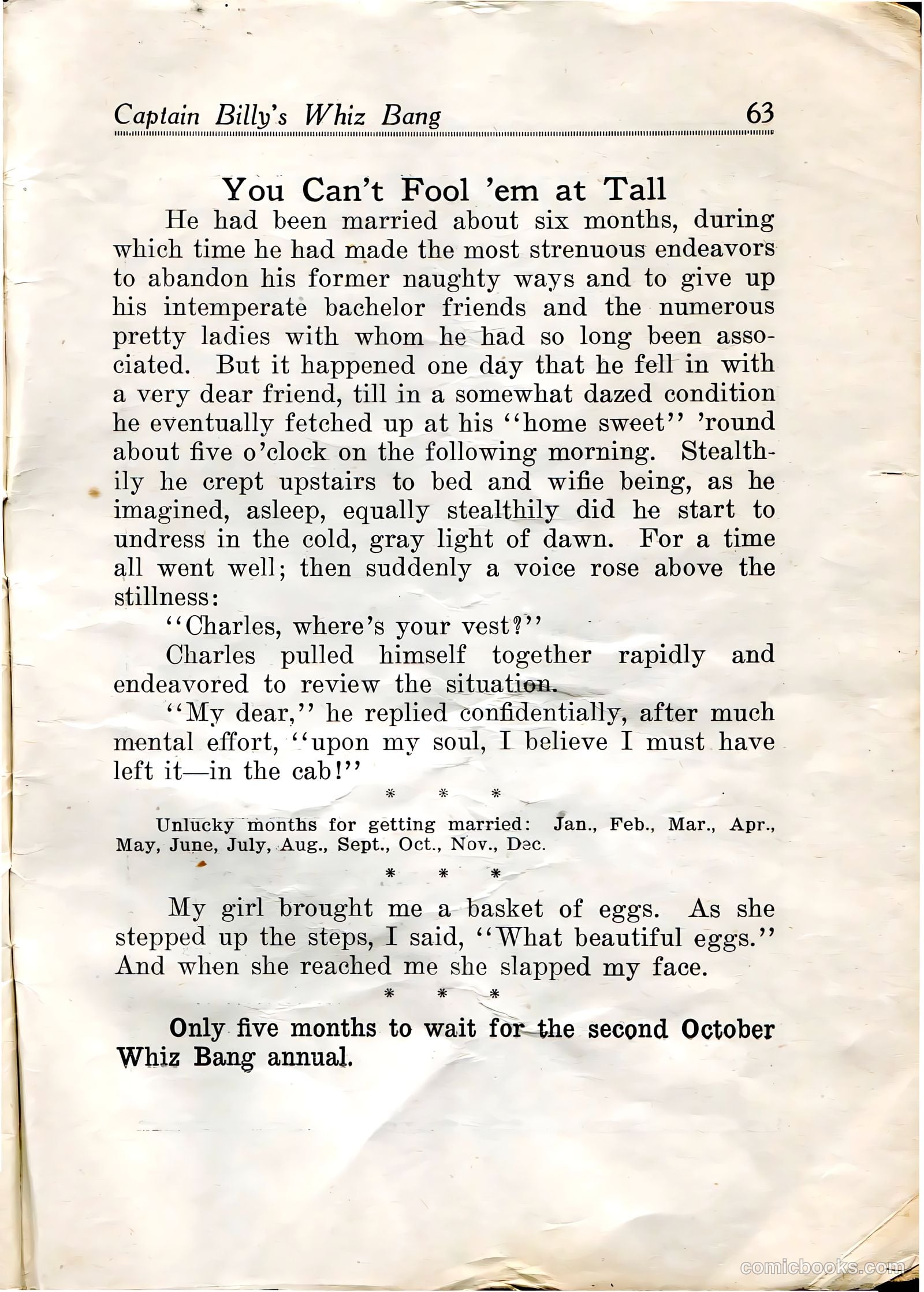
This page contains three brief humorous anecdotes typical of 1920s men's magazines. **Main story**: A married man, who had promised to reform his bachelor ways, comes home at 5 AM after a night out with old friends—clearly drunk ("dazed condition"). His wife catches him undressing and demands to know where his vest is. His desperate lie—that he left it in a cab—is transparently absurd, hence the title: "You Can't Fool 'em at Tall" (wives are too clever for such excuses). **The intermediate jokes** include a list sarcastically naming every month as "unlucky" for marriage, and a crude double-entendre about eggs that leads to the narrator being slapped. The humor targets married men's infidelity, domestic deception, and the perpetual tension between husbands' desire for bachelor freedom and wives' vigilance. The satire assumes a male audience sympathetic to the husband's predicament while acknowledging women's justified skepticism of male excuses.
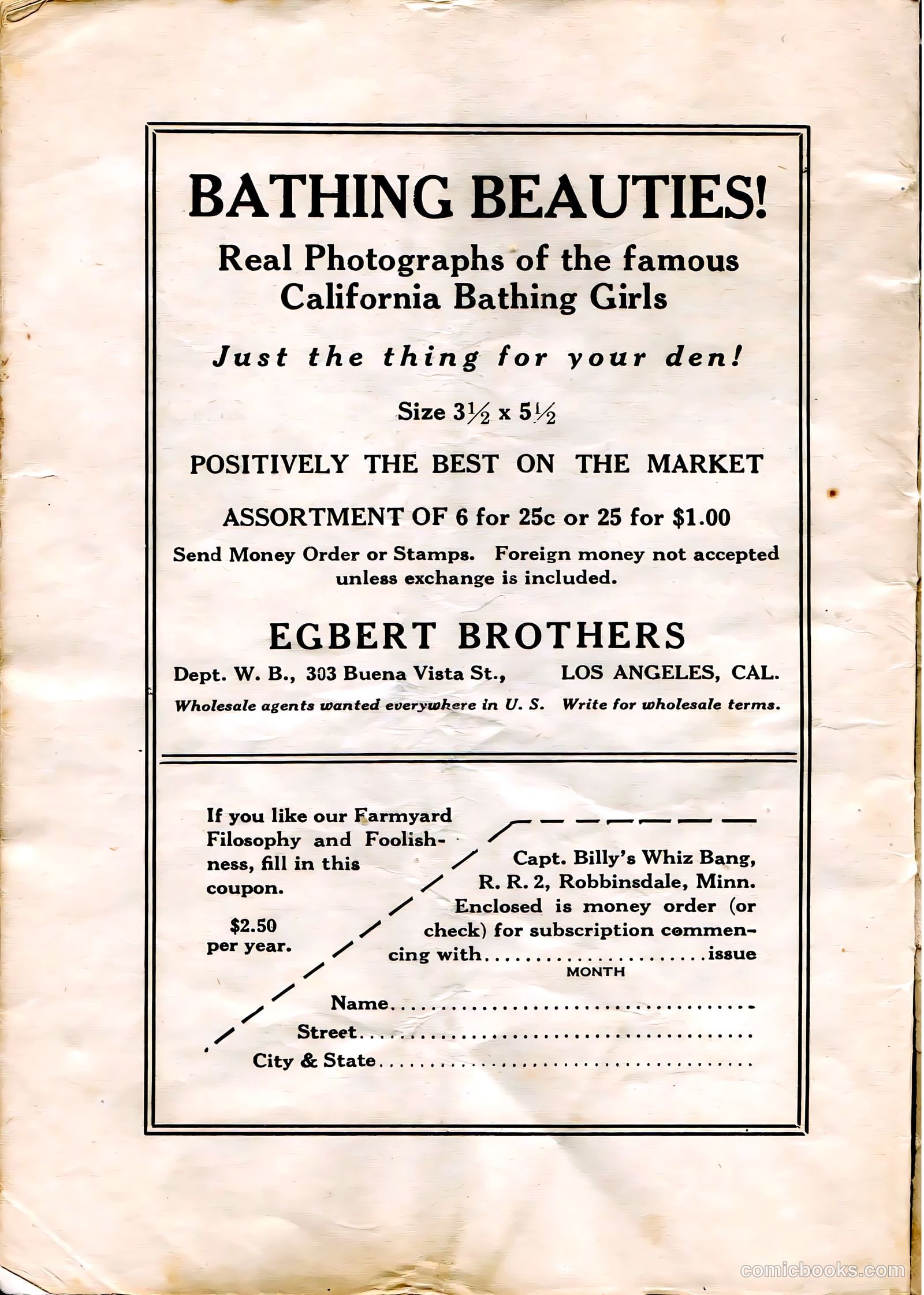
This page is primarily **advertising**, not editorial content or satire. It contains two distinct advertisements: 1. **Top ad**: Egbert Brothers sells photographs of "California Bathing Girls"—likely pin-up style images marketed as risqué material for men ("just the thing for your den"). Pricing suggests these were mass-produced, affordable novelty items. This reflects 1920s-era popularity of bathing beauty imagery. 2. **Bottom ad**: A subscription coupon for *Capt. Billy's Whiz Bang*, the magazine itself, priced at $2.50/year. The reference to "Farmyard Philosophy and Foolishness" describes the magazine's humorous, folksy editorial style. The page demonstrates how early 20th-century magazines monetized through both advertising and direct subscriptions, while also revealing period attitudes toward women's bodies as consumer commodities and entertainment.
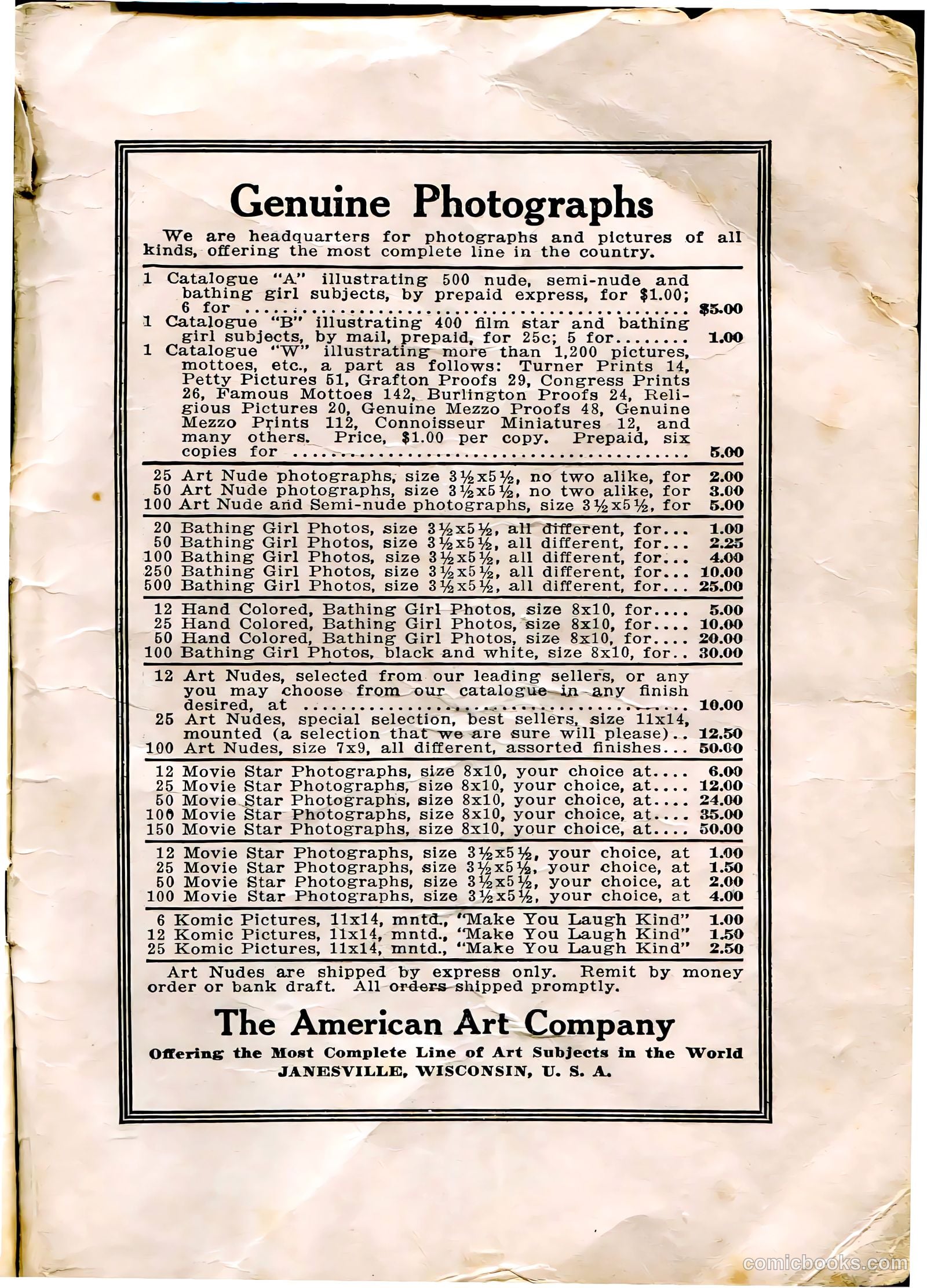
This page is **entirely advertising**, not satirical content. It's a mail-order catalog from The American Art Company of Janesville, Wisconsin, selling photographs and pictures. The company marketed "genuine photographs" of nude, semi-nude, and "bathing girl" subjects—catalog "A" featured 500 such images. They also sold film star photographs, "art nudes," hand-colored bathing girl photos, and movie star portraits in various sizes, all purchasable by mail for modest prices (ranging from $1.00 to $50.00). This reflects early 20th-century commercial photography, when such imagery was sold through mail-order catalogs. The euphemistic language ("art nudes," "bathing girls") suggests the borderline-respectable status of this business. No satire or political commentary is present—this is straightforward period advertising.
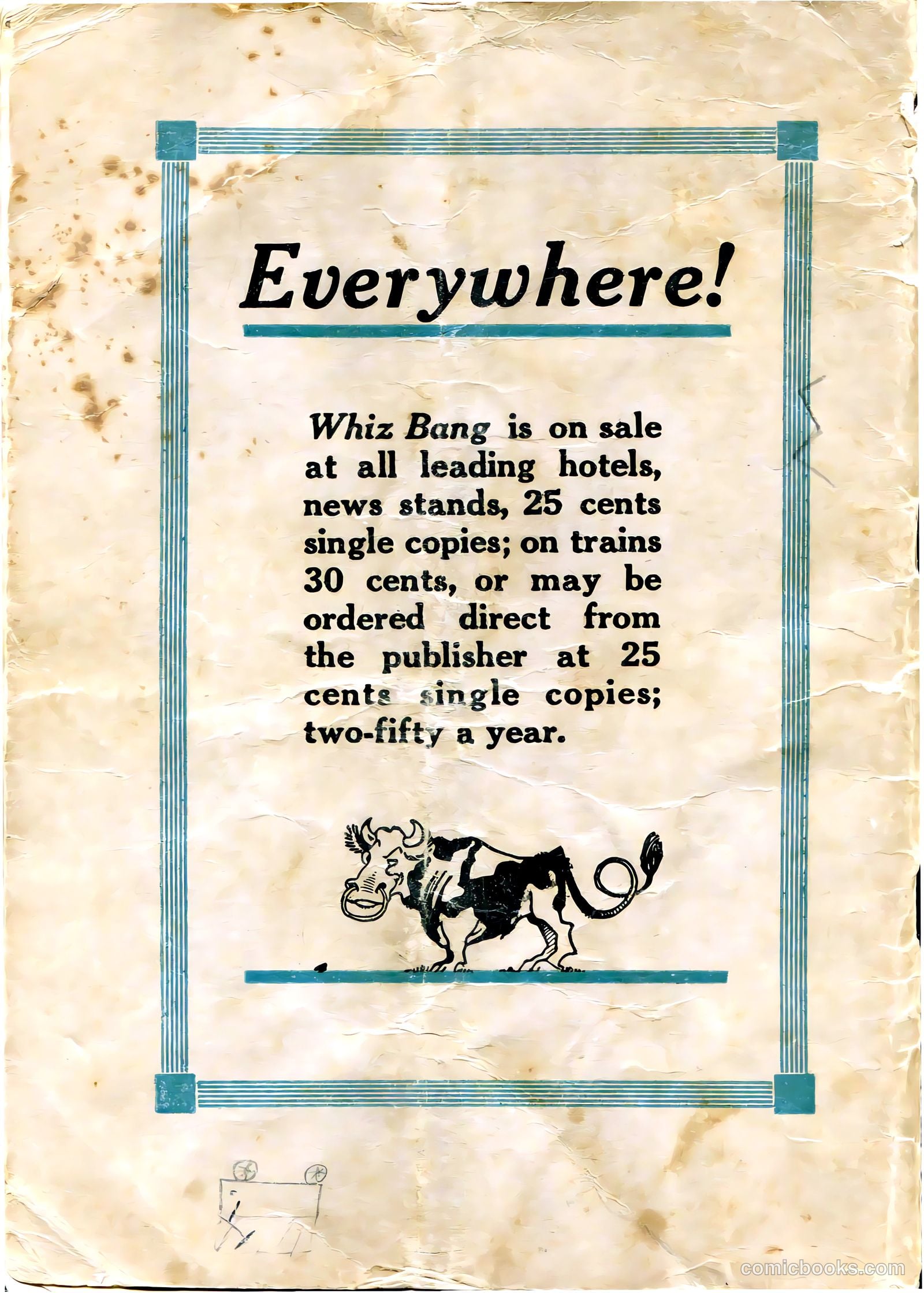
This is a **title/advertisement page** for *Whiz Bang*, a satirical magazine. The page announces distribution channels and pricing for the publication. The central image shows a **cartoon cow or bull character** in a playful, exaggerated style—typical of early 20th-century comic illustration. The animal appears to be the magazine's mascot or logo, rendered in black silhouette with humorous proportions. The text emphasizes the magazine's wide availability ("Everywhere!") across multiple retail channels: hotels, newsstands, and trains. Pricing varied by location (25-30 cents per issue) with a yearly subscription option. This advertising approach reflects the magazine's ambition to reach a broad, mobile audience during what appears to be the 1920s era. The decorative blue-green border frames the content in an Art Deco-influenced design typical of the period.