
Captain Billy's Whiz Bang, May 1921 · page 24 of 68
Captain Billy's Whiz Bang #20 — page 24: what you’re looking at
What you’re looking at
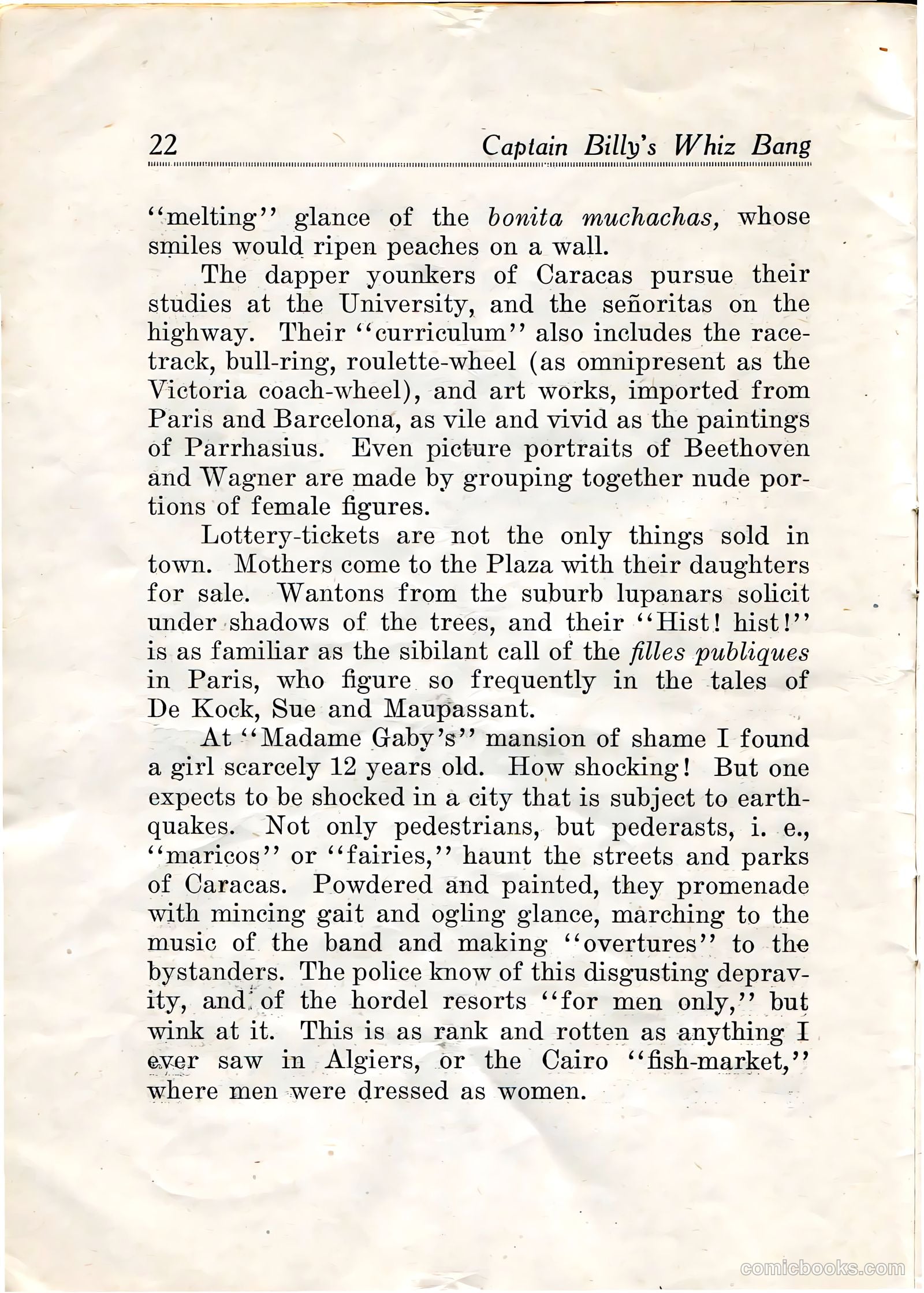
This is a satirical travel account mocking Caracas, Venezuela, presented as social commentary. The author describes the city's moral corruption across multiple fronts: wealthy young men neglecting university studies for gambling and vice; the sale of women and girls for sexual purposes (explicitly noting a 12-year-old); and street solicitation by sex workers ("filles publiques"). The piece also attacks homosexuality, using derogatory terms ("maricos," "fairies") to ridicule cross-dressing men in public spaces. The author compares this vice to similar practices in Algiers and Cairo. The satire's point appears twofold: to scandalize American readers with tales of foreign depravity, and to suggest governmental corruption (police indifference). The references to Beethoven, Wagner, and classical painters provide ironic contrast—cultural sophistication paired with moral bankruptcy—emphasizing the author's judgment that Caracas civilization is superficial and rotten.
📄 Transcribed text from this page (OCR, searchable)
Machine-transcribed from the original scan — historical spelling and the odd misread are preserved.
22 Captain Billy's Whiz Bang “melting” glance of the bonita muchachas, whose smiles would ripen peaches on a wall. The dapper younkers of Caracas pursue their studies at the University, and the señoritas on the highway. Their “curriculum” also includes the race-track, bull-ring, roulette-wheel (as omnipresent as the Victoria coach-wheel), and art works, imported from Paris and Barcelona, as vile and vivid as the paintings of Parrhasius. Even picture portraits of Beethoven and Wagner are made by grouping together nude por-tions of female figures. Lottery-tickets are not the only things sold in town. Mothers come to the Plaza with their daughters for sale. Wantons from the suburb lupanars solicit under shadows of the trees, and their “Hist! hist!” is as familiar as the sibilant call of the filles publiques in Paris, who figure so frequently in the tales of De Kock, Sue and Maupassant. At “Madame Gaby’s” mansion of shame I found a girl scarcely 12 years old. How shocking! But one expects to be shocked in a city that is subject to earth-quakes. Not only pedestrians, but pederasts, i. e., “maricos” or “fairies,” haunt the streets and parks of Caracas. Powdered and painted, they promenade with mincing gait and ogling glance, marching to the music of the band and making “overtures” to the bystanders. The police know of this disgusting deprav-ity, and of the hordel resorts “for men only,” but wink at it. This is as rank and rotten as anything I ever saw in Algiers, or the Cairo “fish-market,” where men were dressed as women.