
Captain Billy's Whiz Bang, May 1921 · page 22 of 68
Captain Billy's Whiz Bang #20 — page 22: what you’re looking at
What you’re looking at
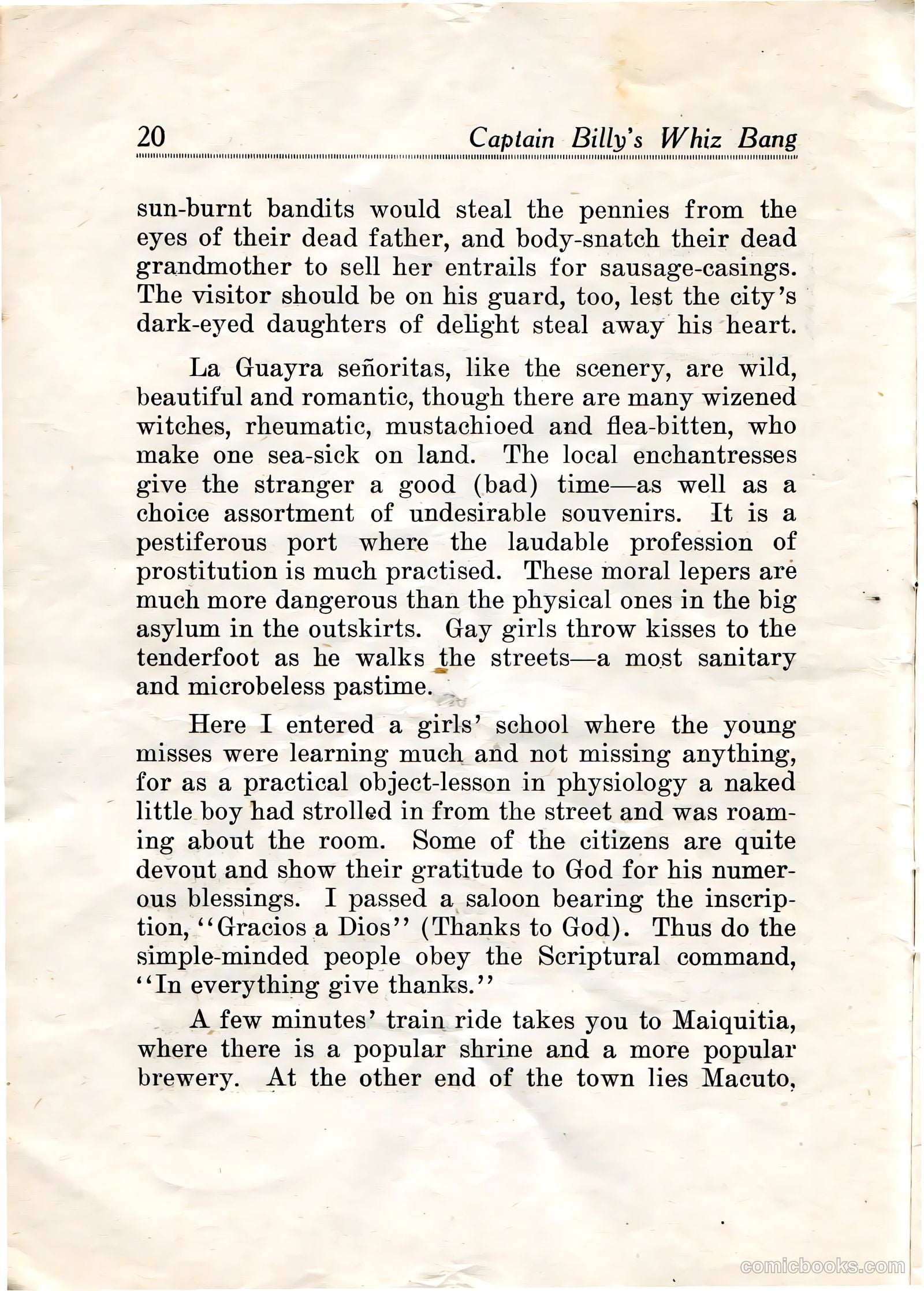
This page contains satirical travel commentary on La Guayra, Venezuela, mocking both the locale and its inhabitants through crude stereotypes typical of early 20th-century American humor magazines. The satire targets: **Local residents**: Depicted as thieves, prostitutes, and morally corrupt—"sun-burnt bandits" who would desecrate the dead, and "enchantresses" spreading disease. **Women specifically**: Characterized as seductive dangers to visiting American men ("dark-eyed daughters of delight"). **Religious hypocrisy**: A saloon named "Gracias a Dios" (Thanks to God) exemplifies "simple-minded" people mindlessly following scripture while engaging in vice. **Educational standards**: The anecdote of a naked boy roaming a girls' school mocks Venezuelan institutions as chaotic and indecent. The humor relies on exaggeration, double entendre ("learning much and not missing anything"), and moral superiority—presenting Venezuela as simultaneously dangerous and ridiculous to the American reader. No specific political event appears referenced; rather, this reflects casual racist and xenophobic attitudes normalized in 1920s American popular media.
📄 Transcribed text from this page (OCR, searchable)
Machine-transcribed from the original scan — historical spelling and the odd misread are preserved.
20 Captain Billy's Whiz Bang sun-burnt bandits would steal the pennies from the eyes of their dead father, and body-snatch their dead grandmother to sell her entrails for sausage-casings. The visitor should be on his guard, too, lest the city's dark-eyed daughters of delight steal away his heart. La Guayra señoritas, like the scenery, are wild, beautiful and romantic, though there are many wizened witches, rheumatic, mustachioed and flea-bitten, who make one sea-sick on land. The local enchantresses give the stranger a good (bad) time—as well as a choice assortment of undesirable souvenirs. It is a pestiferous port where the laudable profession of prostitution is much practised. These moral lepers are much more dangerous than the physical ones in the big asylum in the outskirts. Gay girls throw kisses to the tenderfoot as he walks the streets—a most sanitary and microbeless pastime. Here I entered a girls' school where the young misses were learning much and not missing anything, for as a practical object-lesson in physiology a naked little boy had strolled in from the street and was roam- ing about the room. Some of the citizens are quite devout and show their gratitude to God for his numer- ous blessings. I passed a saloon bearing the inscrip- tion, “Gracios a Dios” (Thanks to God). Thus do the simple-minded people obey the Scriptural command, “In everything give thanks.” A few minutes' train ride takes you to Maiquitia, where there is a popular shrine and a more popular brewery. At the other end of the town lies Macuto,