
Captain Billy's Whiz Bang, May 1921 · page 35 of 68
Captain Billy's Whiz Bang #20 — page 35: what you’re looking at
What you’re looking at
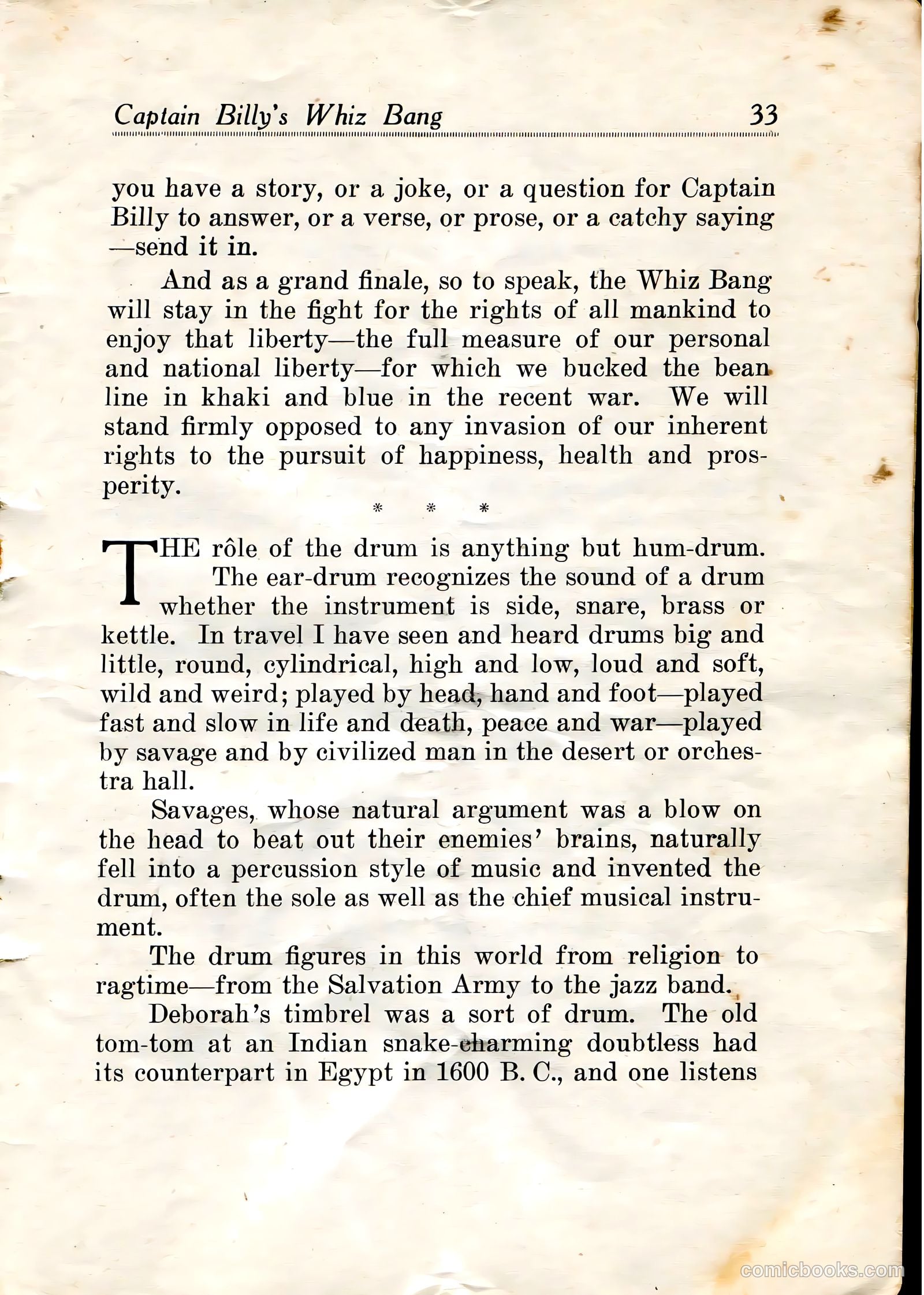
This page contains editorial material and the beginning of an essay on drums—not a political cartoon. The top section is a call for reader submissions (stories, jokes, verses) to Captain Billy, followed by a patriotic statement referencing WWI ("the recent war," soldiers in "khaki and blue"). The magazine pledges to defend "personal and national liberty" and citizens' rights to "pursuit of happiness, health and prosperity." The main text discusses the cultural and historical significance of drums across civilizations—from ancient Egypt to contemporary jazz bands and the Salvation Army. It traces drums' origins to "savages" using percussion in combat, then their evolution through religious and entertainment contexts. The piece is informational rather than satirical, celebrating percussion instruments' universal role in human culture. No specific caricatures or political figures are identified on this visible portion.
📄 Transcribed text from this page (OCR, searchable)
Machine-transcribed from the original scan — historical spelling and the odd misread are preserved.
Captain Billy's Whiz Bang 33 you have a story, or a joke, or a question for Captain Billy to answer, or a verse, or prose, or a catchy saying —send it in. And as a grand finale, so to speak, the Whiz Bang will stay in the fight for the rights of all mankind to enjoy that liberty—the full measure of our personal and national liberty—for which we bucked the bean line in khaki and blue in the recent war. We will stand firmly opposed to any invasion of our inherent rights to the pursuit of happiness, health and pros- perity. * * * THE rôle of the drum is anything but hum-drum. The ear-drum recognizes the sound of a drum whether the instrument is side, snare, brass or kettle. In travel I have seen and heard drums big and little, round, cylindrical, high and low, loud and soft, wild and weird; played by head, hand and foot—played fast and slow in life and death, peace and war—played by savage and by civilized man in the desert or orches- tra hall. Savages, whose natural argument was a blow on the head to beat out their enemies' brains, naturally fell into a percussion style of music and invented the drum, often the sole as well as the chief musical instru- ment. The drum figures in this world from religion to ragtime—from the Salvation Army to the jazz band. Deborah's timbrel was a sort of drum. The old tom-tom at an Indian snake-charming doubtless had its counterpart in Egypt in 1600 B. C., and one listens