A complete issue · 100 pages · 1943
12 Sports Aces, May 1943
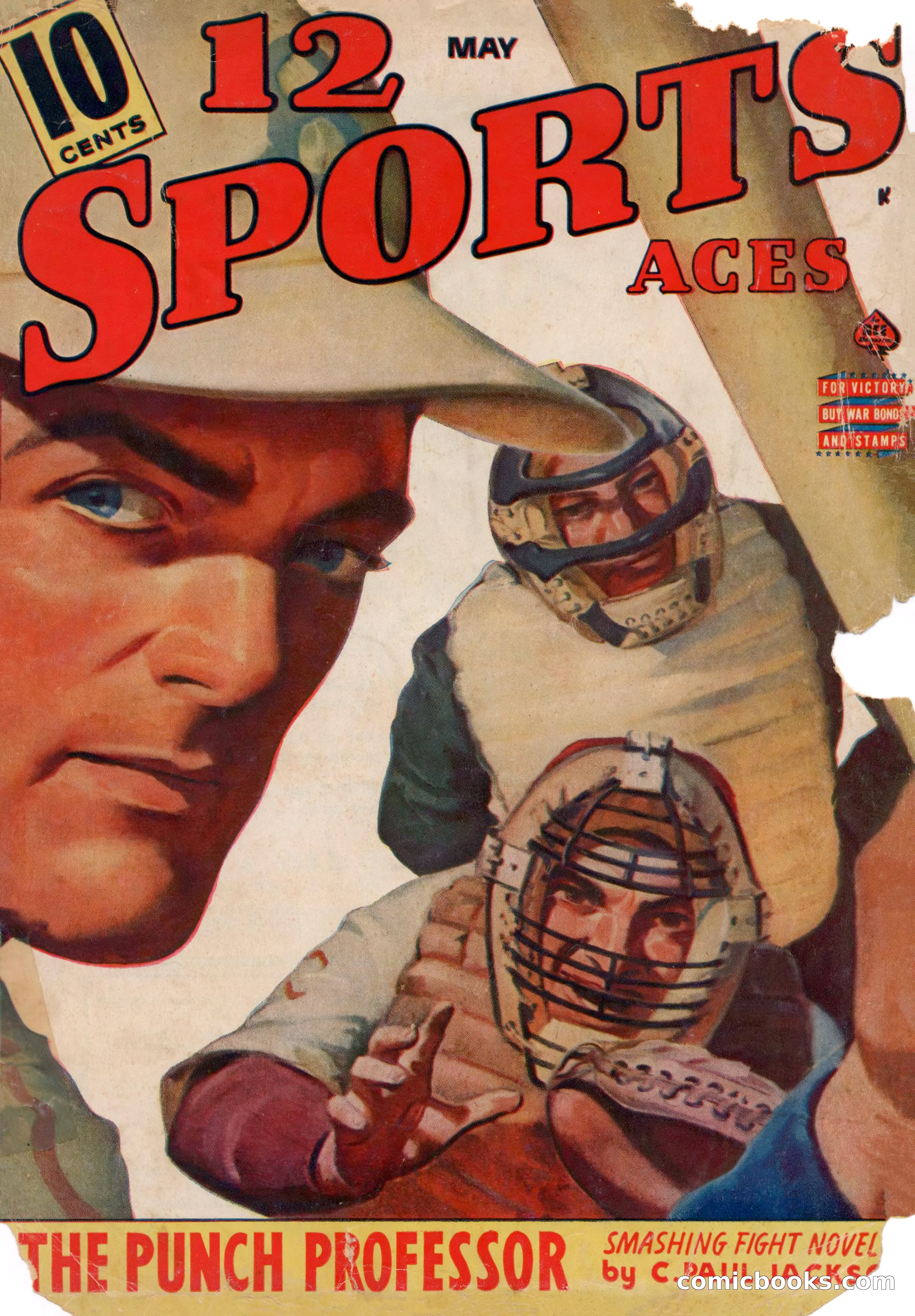
# Sports Aces - May Issue Cover This is the cover of a May issue of *Sports Aces*, a 10-cent pulp magazine. The cover features illustrations of what appears to be boxers or fighters in combat gear, with one close-up face on the left and two additional fighter figures on the right wearing protective headgear. The main headline advertises "The Punch Professor," described as a "Smashing Fight Novel by C. Dahl" (author name partially visible). Small text in the corner promotes war bonds and stamps, indicating this was published during World War II. The bold red lettering and action-oriented imagery are typical of pulp sports fiction magazines from this era.
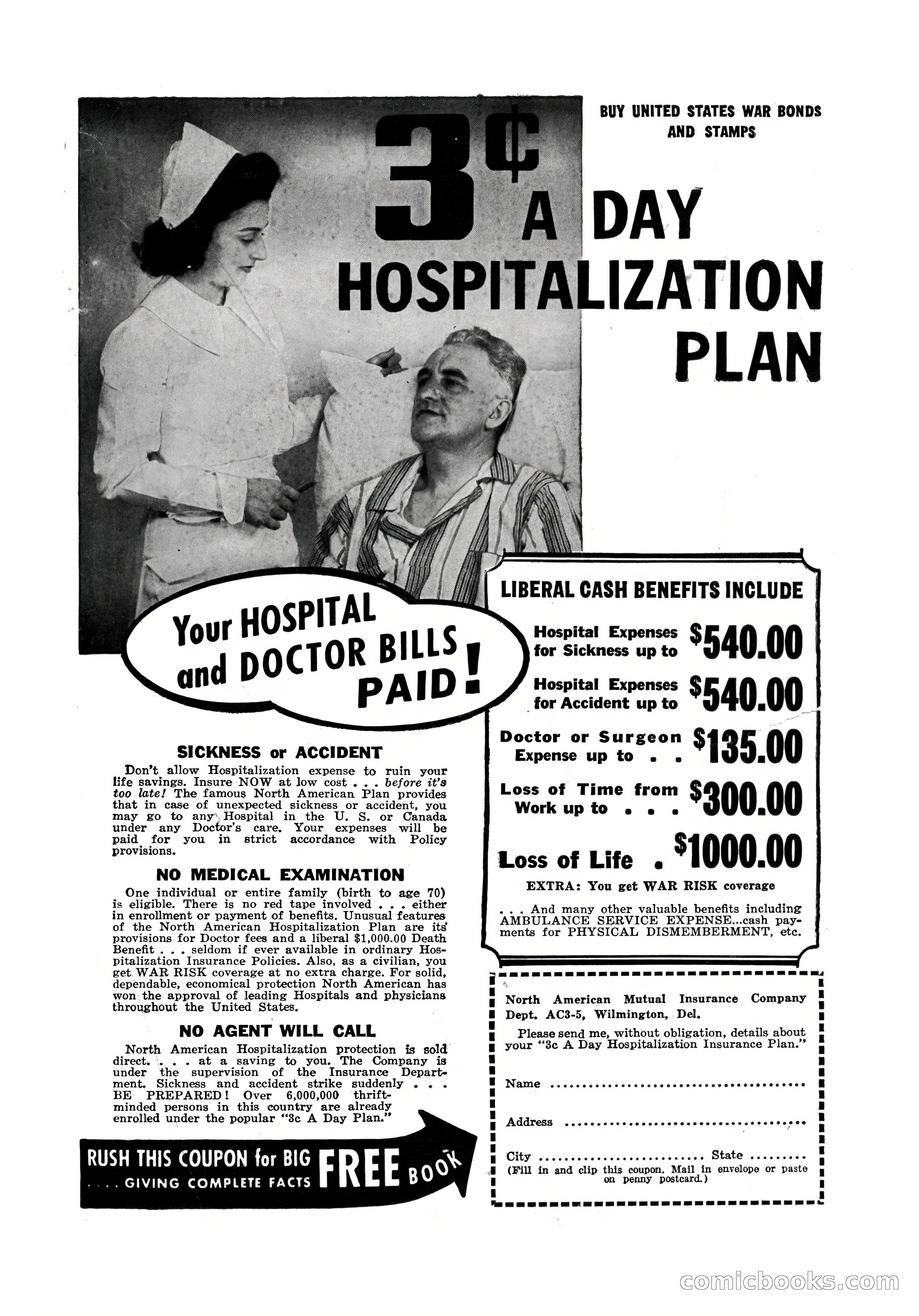
# Advertisement Page This is a full-page advertisement for North American Mutual Insurance Company's "3¢ A Day Hospitalization Plan," featuring a nurse and patient in the upper left. The ad promotes affordable health insurance coverage with no medical examination required, listing benefits including hospital expenses up to $540, doctor fees up to $135, and loss-of-life coverage of $1,000. It emphasizes war risk coverage and appeals to Depression-era readers by highlighting that over 6 million Americans are already enrolled. A tear-out coupon at the bottom requests information, and the page includes patriotic messaging to "Buy United States War Bonds and Stamps."
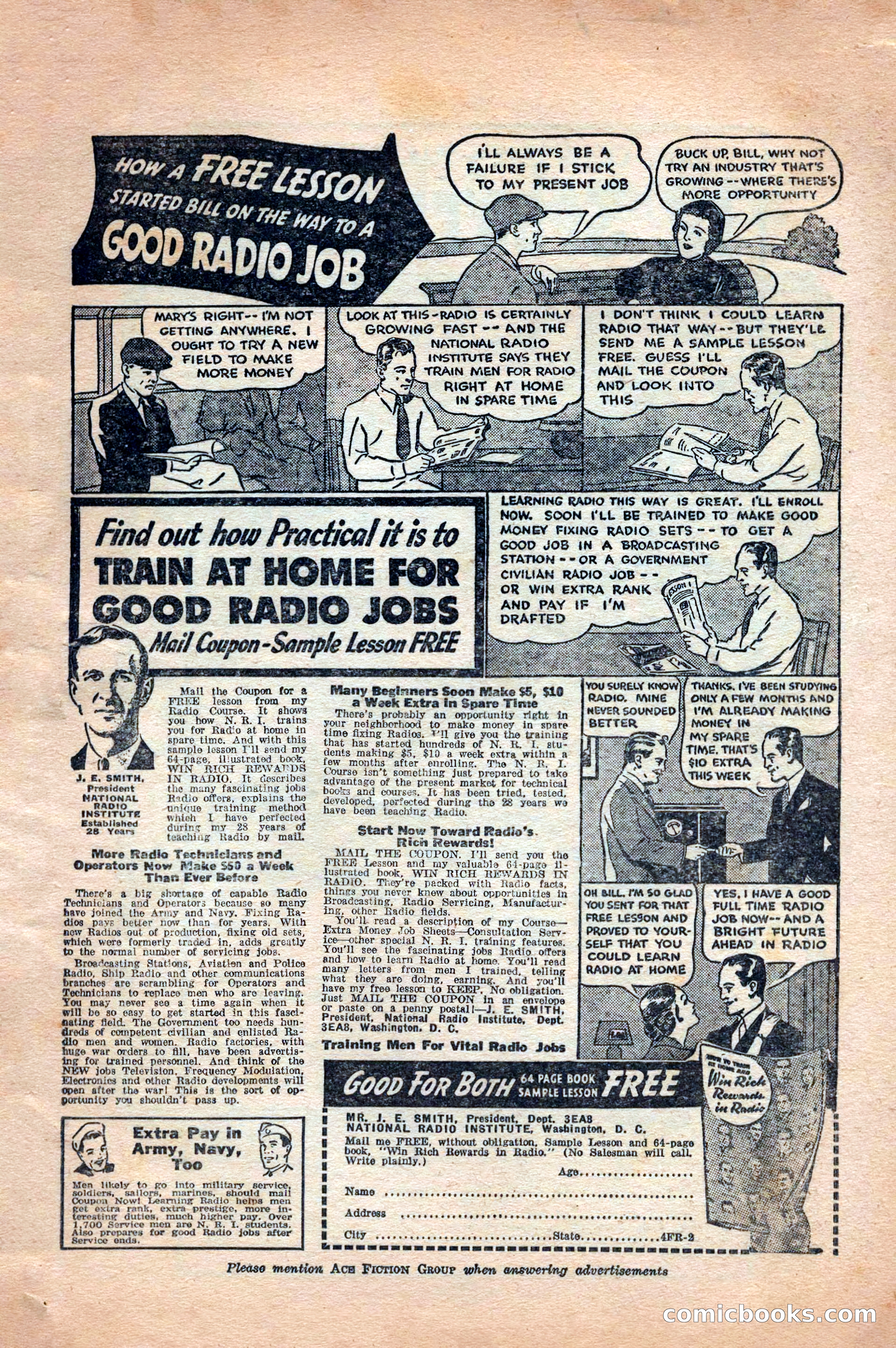
This page is primarily an **advertisement** for the National Radio Institute's home-study radio training course, presented as a comic-strip narrative. The visible text promotes correspondence courses teaching radio repair and operation, emphasizing wartime job opportunities and extra income potential. Comic panels depict a dialogue between characters discussing radio training benefits, while the lower half contains detailed promotional copy, testimonials from the institute's president J.E. Smith, and a mail-in coupon for a free sample lesson and illustrated book titled "Win Rich Rewards in Radio." The advertisement targets both civilians seeking employment and servicemen interested in advancement.
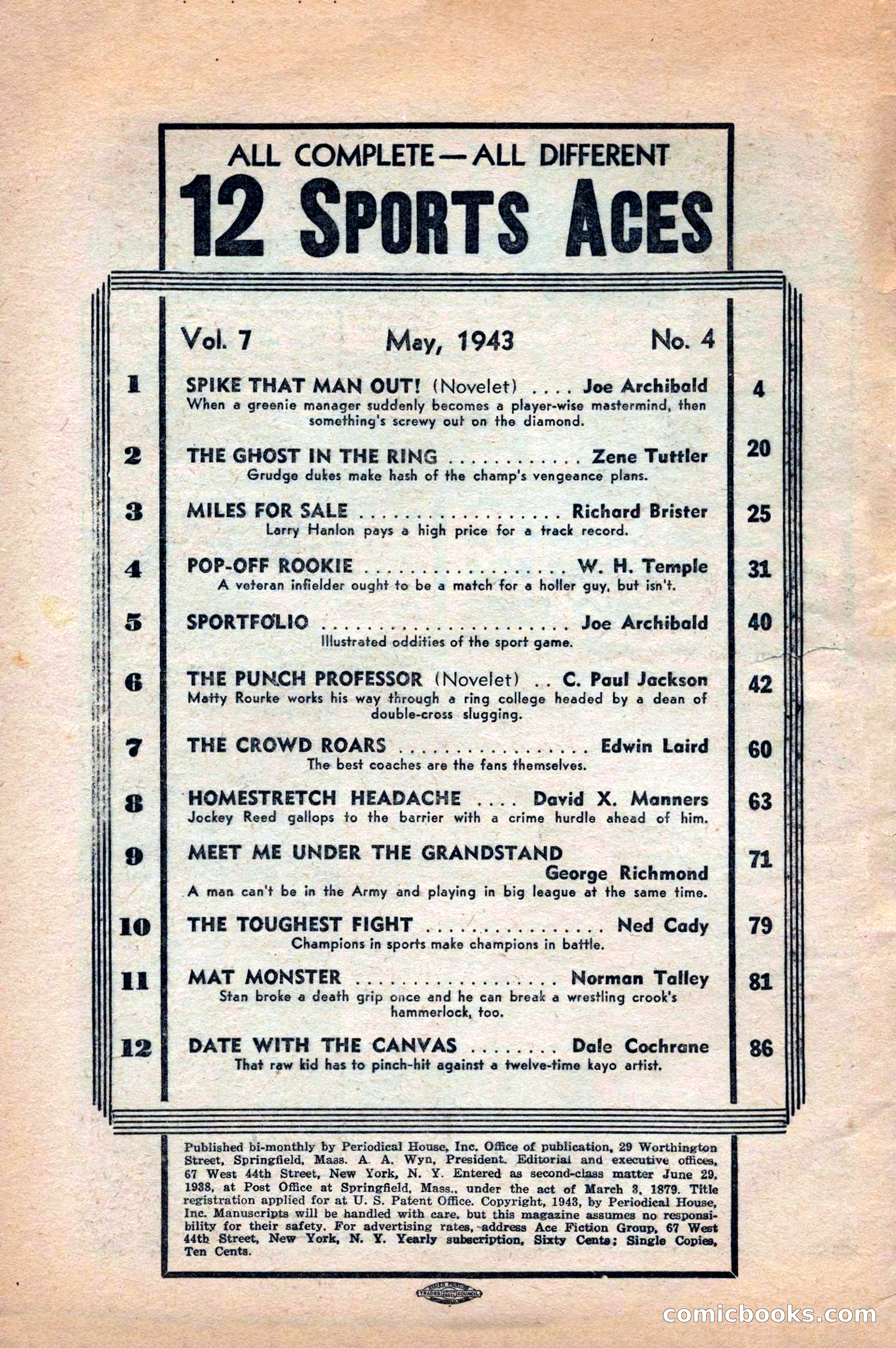
This is a table of contents page from *12 Sports Aces*, Vol. 7, No. 4 (May 1943), a bi-monthly pulp fiction magazine. The page lists twelve complete short stories and novelets featuring sports-themed plots—including tales about baseball, boxing, horse racing, and wrestling. Stories are credited to authors like Joe Archibald, Zene Tuttler, and others, with page numbers and brief plot descriptions for each entry. Publication details appear at the bottom.
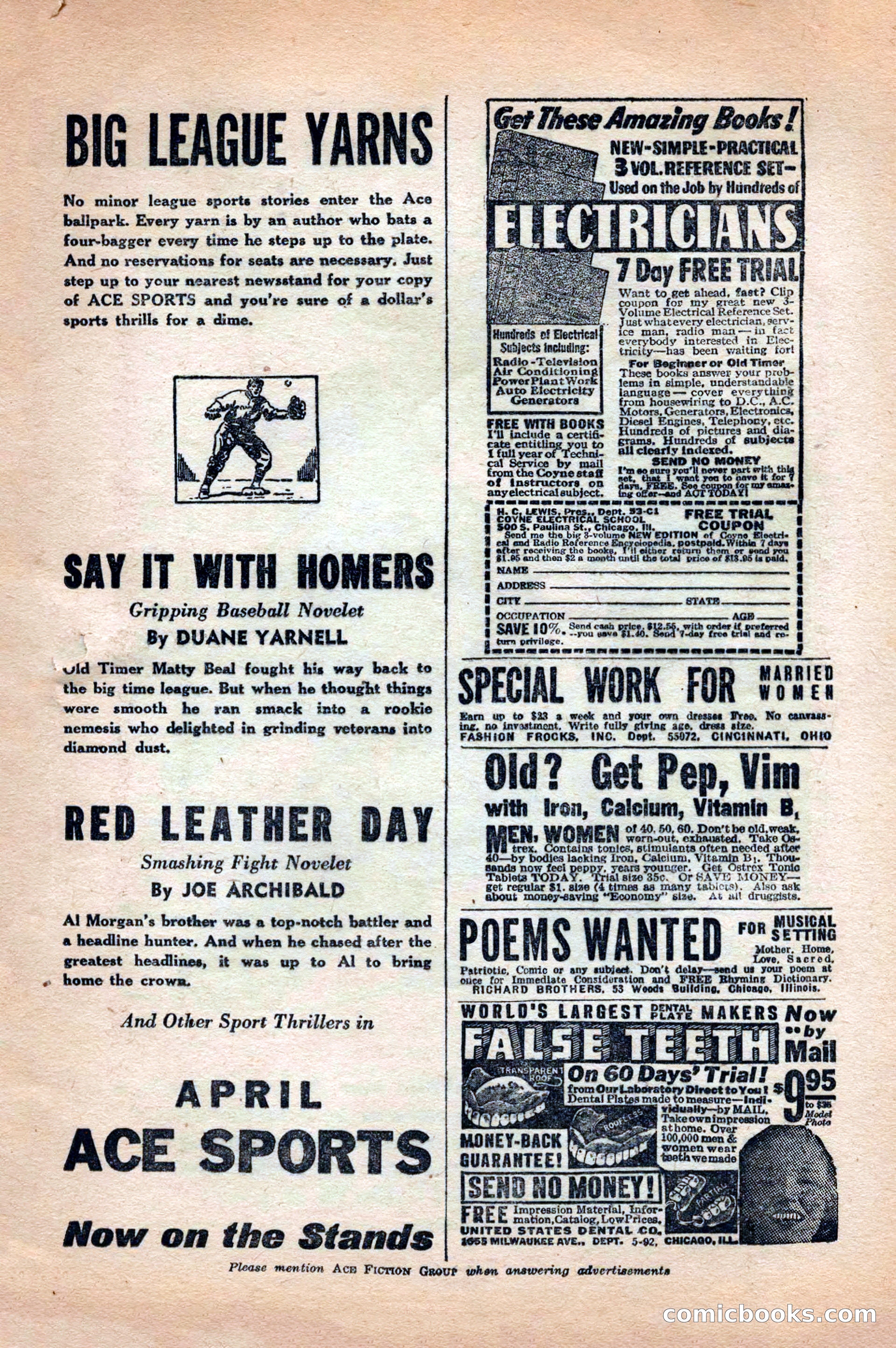
# Page Analysis This is an advertisement and promotional page from *Ace Sports* magazine's April issue. The left side advertises two sports novelettes: "Say It with Homers" by Duane Yarnell, a baseball story about a veteran pitcher facing a grinding rookie rival, and "Red Leather Day" by Joe Archibald, a boxing story about a headline-hunting fighter. The right side contains various classified advertisements for electrician reference books, false teeth, poems, vitamin supplements, and other mail-order products typical of early 20th-century pulp magazine back pages. The page prominently urges readers to visit newsstands for the current sports issue.
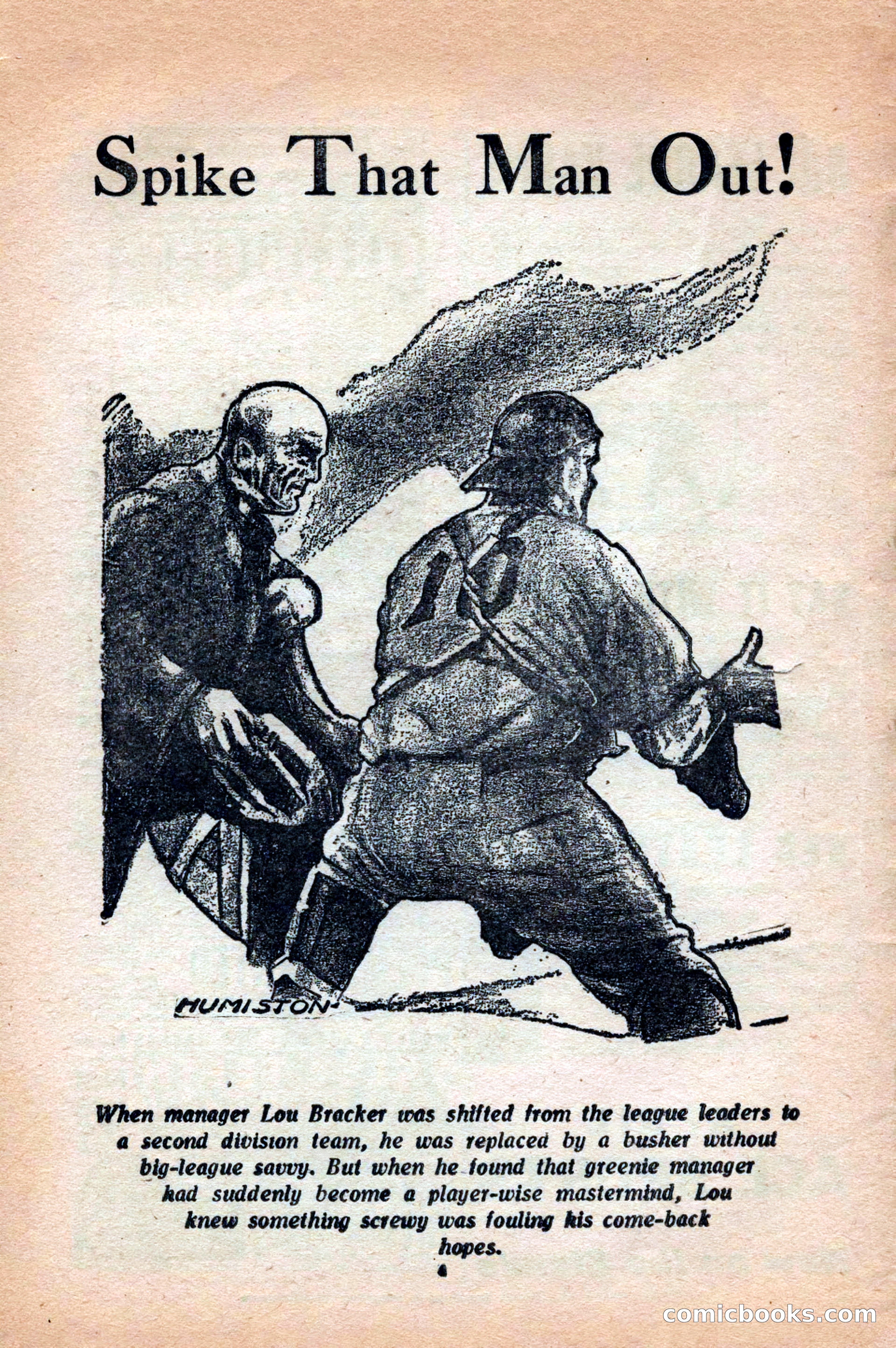
This is an interior story illustration from an early-20th-century pulp magazine. The image shows a skeletal Death figure whispering to a baseball manager in uniform, with the headline "Spike That Man Out!" The accompanying text describes a baseball narrative: manager Lou Bracker, demoted from leading the league to a second-division team, suspects foul play when his replacement—an inexperienced "busher"—suddenly becomes strategically brilliant, threatening Bracker's comeback hopes. The story appears to be a hardboiled sports-themed pulp tale involving mysterious interference.
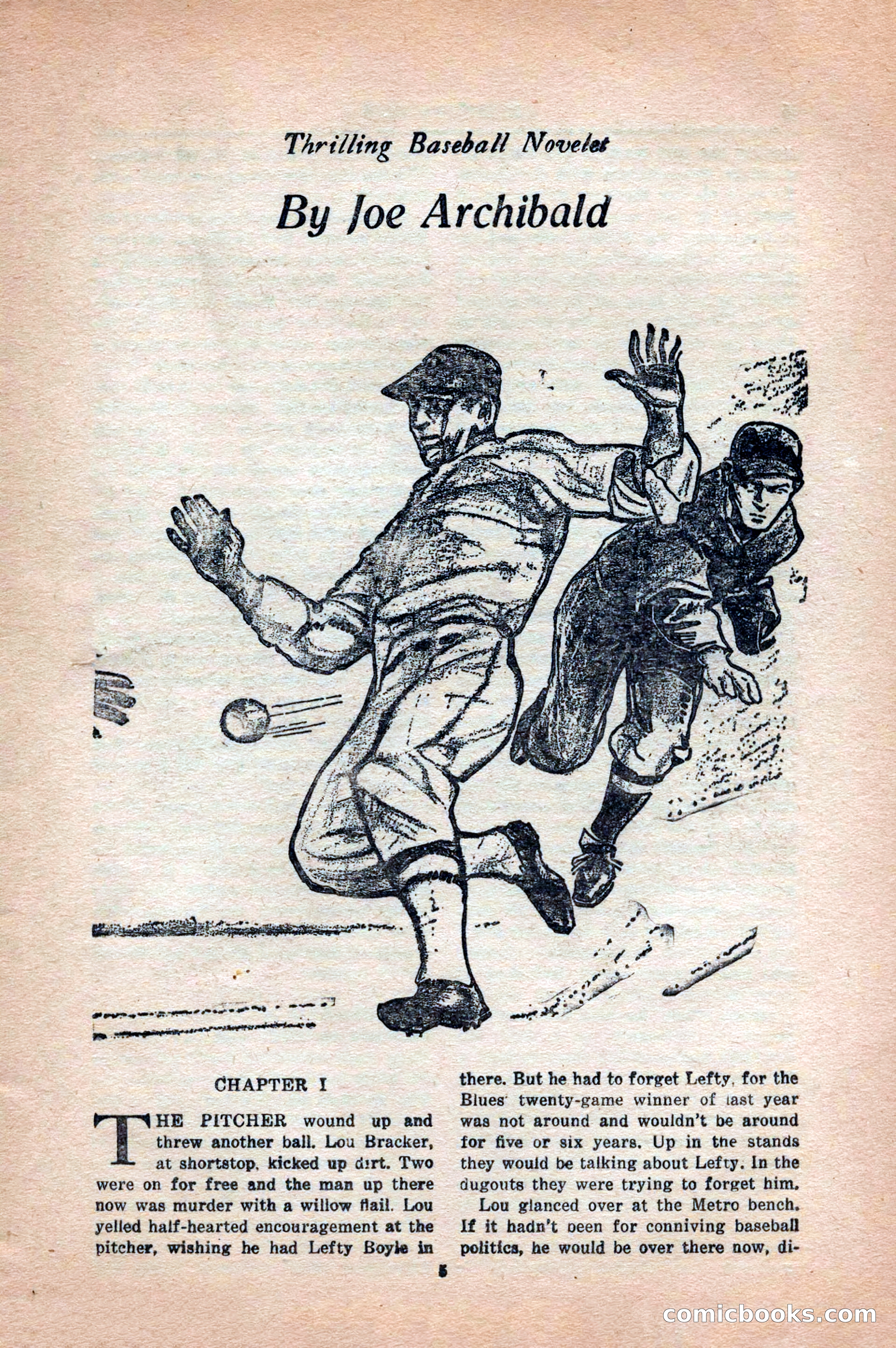
# Page Analysis This is an interior story page from a pulp fiction baseball novella by Joe Archibald titled "Thrilling Baseball Novelet." The page features Chapter I and includes both an illustration and prose text. The illustration shows a baseball pitcher in mid-throw with other players visible. The story opens with Lou Bracker, a shortstop, encouraging his pitcher while wishing for the absent Lefty Boyle, a twenty-game winner now absent for several years due to what appears to be baseball politics that have separated the players between teams.
# Page Analysis This is **story prose** from a pulp fiction baseball narrative titled "12 Sports Aces." The page depicts a baseball game where Lou Bracker, a veteran shortstop now playing manager for the Boston Blues, makes an impressive defensive play against his former team, the Metros. The story explores Bracker's frustration at being passed over for a managerial position (which went to Sam Chipman, an inexperienced manager from the minor leagues) and his internal conflict about his future in baseball at age thirty-eight. The narrative focuses on Bracker's bitterness toward Chipman and his consideration of a management offer from Boston.
# Page Analysis This is **story prose** from a pulp baseball fiction narrative titled "Spike That Man Out!" (page 7). The text depicts a competitive baseball game between the Blues and Metros, focusing on player Lou Bracker's actions at bat and his internal reflections about past teammates and a woman from his past. The passage includes game details—runners on base, plays, and managerial decisions—interwoven with Bracker's memories and emotions as he attempts to bring in a tying run.
# Page Analysis: 12 Sports Aces This is **story prose** from a pulp fiction magazine called *12 Sports Aces*. The page contains two sections: the conclusion of a baseball game scene between the Blues and Metros (featuring players like Lou Bracker and Seffler), and Chapter II, which shifts to Lou calling his friend's girlfriend, Madge Talbot, in Boston. The narrative moves from an on-field confrontation and game action to Lou's personal life, describing his meeting with Madge at her apartment and dinner at the Statler hotel. The story appears to be hardboiled sports fiction blending baseball action with romantic tension.
# Page Analysis This is **story prose** from a hardboiled crime pulp fiction magazine, titled "Spike That Man Out!" The page depicts a conversation between Lou Bracker and a woman named Madge at what appears to be a restaurant. Lou, apparently connected to baseball and possibly law enforcement, discusses his upcoming visit to see someone named Lefty, who is imprisoned for the death of Charlie Kriger, a famous baseball catcher. The narrative reveals Lefty was convicted of killing Kriger despite uncertainty about his guilt, and includes backstory about Kriger's reputation as a gambling man and skilled baseball expert. The dialogue explores themes of loyalty, baseball's cultural importance during wartime, and doubt about the conviction.
# Page Analysis This is story prose from *Sports Aces*, a pulp fiction magazine. The page contains two narrative sections: the first depicts a conversation between Lou Bracker and Madge Talbot about Lefty Boyle's criminal conviction for murder, with Madge expressing doubts about his guilt; the second shifts to Lou's experiences as a baseball player for the Boston Blues, where he struggles to focus on the game while preoccupied with thoughts of Madge and Lefty. The narrative appears to blend crime drama with sports fiction, exploring Lou's emotional conflict between his baseball career and personal relationships.
# Page Analysis This is **story prose** from a hardboiled crime or sports fiction pulp magazine, titled "Spike That Man Out!" The visible text depicts a baseball game between two teams—the Blues and the Zebras—held at a prison. The narrative follows Lou Bracker, apparently a prison warden or official, watching an inmate pitcher named Lefty Boyle perform exceptionally well despite poor defensive support. After the game, Lefty expresses frustration about his imprisonment, declaring he'd rather fight in World War II (against "Japs" and "Nazis") than continue playing baseball. The story appears to involve some criminal backstory involving a character named Charlie Kriger and money ("five C's").
# Page Analysis This page contains **story prose** from a pulp-fiction magazine titled "Sports Aces." The visible text comprises two sections: the conclusion of an earlier scene involving a character named Lefty Boyle in prison and his conversation with Lou Bracker, followed by **Chapter III**, which shifts to a baseball game between the Boston Blues and the visiting Metro team. The narrative describes the opening innings with vivid detail about pitcher Mace Brownell's performance and the competitive tension between the teams, including batter interactions and managerial strategy.
# Page Analysis **Page Type:** Story prose (continuation of a baseball fiction narrative) **Content:** This page contains the continuation of "Spike That Man Out!", a baseball pulp fiction story. The narrative follows a game between two teams—the Blues and the Metros—focusing on pitcher Tresky, manager Lou Bracker, and various players. The text depicts in-game action including pitching sequences, hits, player interactions, and bench jockeying, with tension building between teams and escalating conflict between players and umpires over calls.
# What This Page Shows This page contains story prose from a baseball fiction narrative in *Sports Aces* magazine. The text describes a dramatic baseball game between the Metro and Boston teams, focusing on a crucial play sequence in the eighth inning. Players named Lou Bracker, Seffler, Lombard, and Brownell execute plays and throws, culminating in a collision at second base when Seffler slides hard into Lou Bracker during a force play attempt. The narrative emphasizes the tension, athletic skill, and physical contact of competitive baseball.
This page is labeled "Missing Page" at the top and marked "Page 15" at the bottom, indicating it is from the interior of a pulp magazine. The page itself is blank or heavily degraded, showing only a mottled, textured background with patches of green, blue, purple, and tan coloration—likely the result of age, water damage, or deterioration. No readable story text, illustrations, or advertisements are discernible. The OCR text appears to be noise from the scanning process. This appears to be a damaged or missing page placeholder in a digitized pulp magazine collection.
This is a missing page from a pulp magazine, labeled "Page 16" at the bottom right. The page displays only a heavily textured, deteriorated surface in browns, greens, purples, and blues—the result of age, damage, or poor preservation. The OCR text is unintelligible, yielding only fragments that suggest scanning errors rather than actual content. The "Missing Page" header at the top confirms this is a placeholder or error page rather than original story material or advertisement. No legible text, illustration, or story content is visible on this damaged page.
# Page Analysis This is **Page 17** of a pulp magazine, labeled as a "Missing Page" at the top. The page appears to be primarily illustrative rather than text-based, featuring an abstract or heavily degraded image with mottled colors—predominantly greens, blues, purples, and earth tones—against a textured, aged background with a dark border. The OCR text is largely indecipherable, consisting of fragmented characters that don't form coherent words. Given the "Missing Page" heading and poor visual quality, this may be a placeholder page or a reproduction of a damaged original from the publication's archive.
This page is labeled "Missing Page" at the top and "Page 18" at the bottom, indicating it is a placeholder or error page from a pulp magazine. The image shows a heavily degraded or intentionally obscured textured background in muted greens, blues, and browns with a worn, vintage appearance and rust-colored border. The OCR text is largely illegible, consisting only of fragmentary characters and symbols with no readable content. This appears to be either a damaged scan of an actual missing page from an archived pulp magazine, or a deliberately blank/corrupted page inserted as a placeholder in a digitized collection.
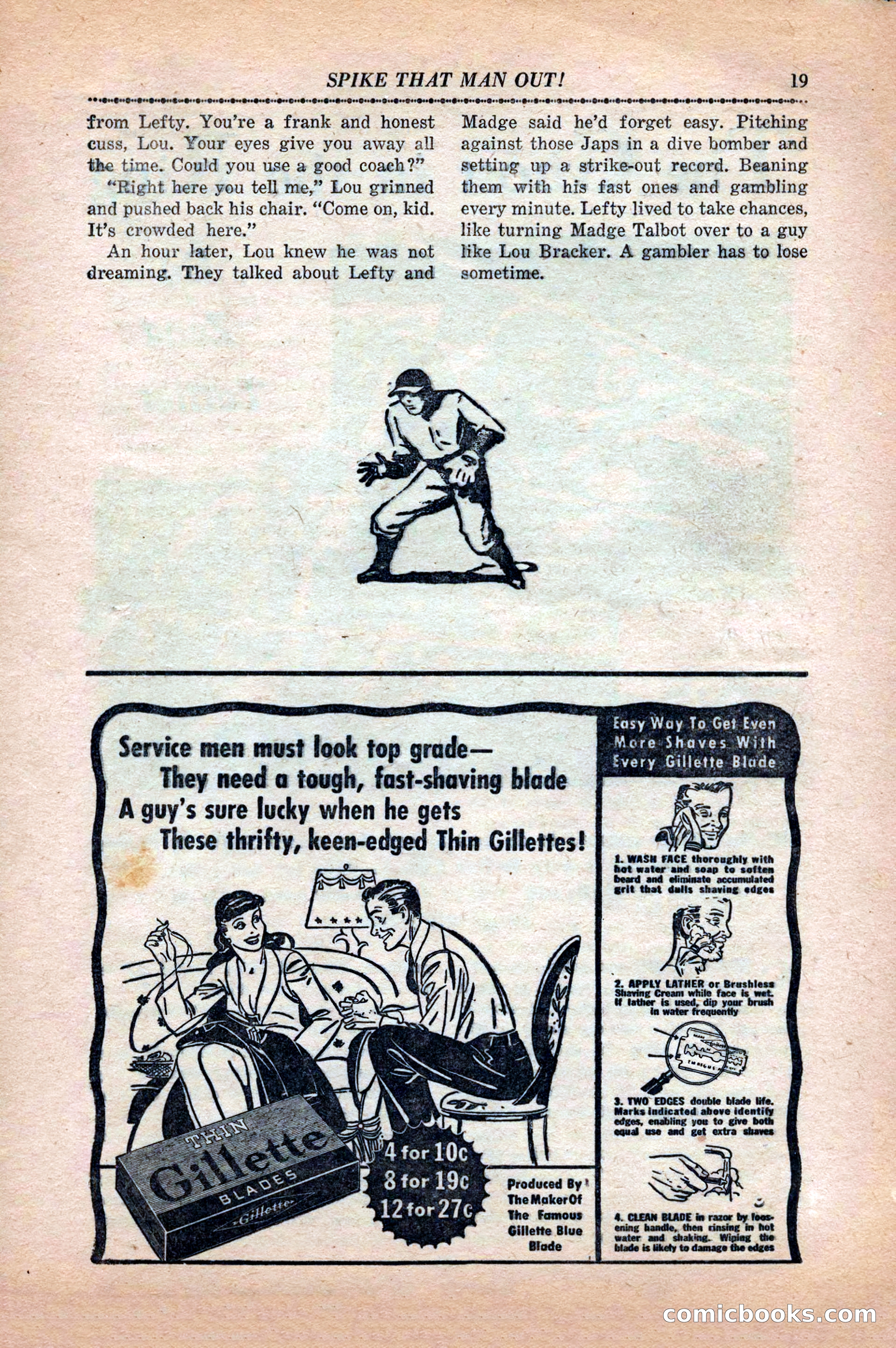
# Page 19 of "Spike That Man Out!" This is a story page from a pulp magazine, containing prose narrative alongside a Gillette razor blade advertisement. The visible text describes a conversation between characters named Lou, Lefty, and Madge about pitching in what appears to be a baseball or military aviation context (references to "dive bomber" and "Japs" suggest wartime setting). The lower half features a vintage Gillette advertisement targeting servicemen, with pricing for razor blades and illustrated instructions for proper shaving technique.
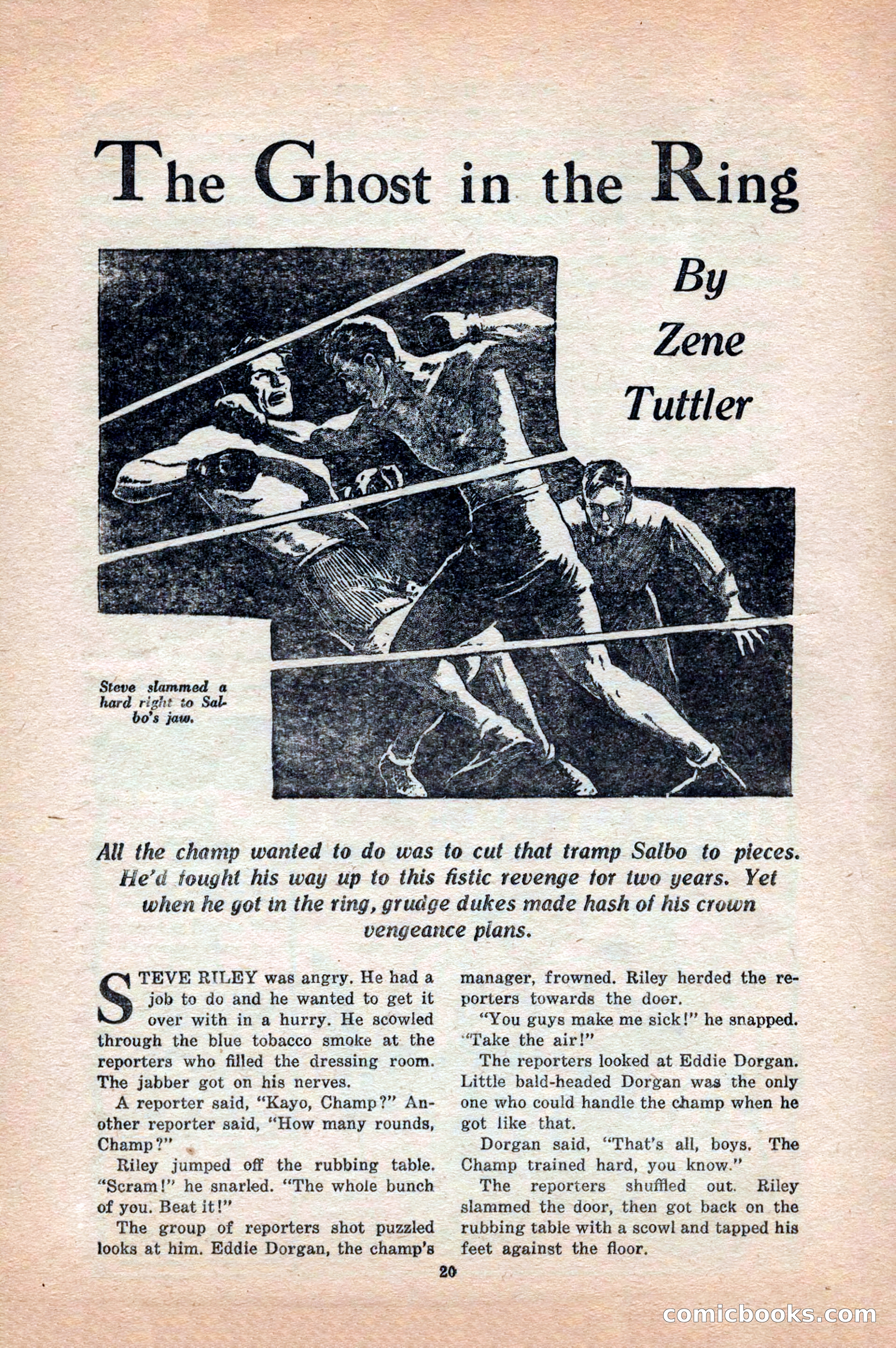
# "The Ghost in the Ring" by Zene Tuttler This page contains story prose and accompanying illustrations from a pulp fiction boxing tale. The narrative follows Steve Riley, an angry boxing champion preparing for a match against his rival Salbo, whom he has trained two years to fight. The text depicts Riley's irritable behavior toward reporters in the dressing room before the bout, with his manager Eddie Dorgan eventually clearing them out. The illustrations show boxing action scenes with Riley and opponents in the ring.
# Page Content This is story prose from a pulp fiction magazine, specifically page 21 of "The Ghost in the Ring." The page depicts a conversation between boxing manager Dorgan and fighter Steve Riley about Riley's upcoming championship fight against Salbo. The narrative reveals that Riley seeks revenge against Salbo, whom he blames for destroying his friend Joe's boxing career and confidence. The text explains that Joe later became a soldier and was reported missing in action during World War II. Riley won the championship title and has finally forced Salbo into a fight match. The page ends as a girl with distinctive blue eyes enters the room.
# Page Analysis: "12 Sports Aces" This page contains story prose from what appears to be a boxing-themed pulp fiction narrative. The text depicts a confrontation between boxer Steve and his rival Sammy Salbo, beginning with Steve's ex-girlfriend Edith warning him against fighting Salbo, followed by their dramatic first-round boxing match. The narrative emphasizes Steve's emotional turmoil over losing Edith to Salbo while building tension for their violent encounter in the ring. The page is numbered 22 and shows no illustrations—only densely printed text typical of early pulp magazine formatting.
# Page Analysis This page contains story prose from a pulp fiction boxing narrative titled "The Ghost in the Ring." The text describes an intense prizefight between two boxers named Steve and Salbo, detailing their combat through multiple rounds. The passage focuses on the physical brutality of the match—exchanges of punches, knockdowns, and recoveries—culminating in the eighth round where Steve dominates a weakening Salbo. The narrative emphasizes the crowd's reactions and Steve's growing realization about his opponent's character and endurance. This appears to be page 23 of the story.
# Page Analysis This page contains **story prose** from a boxing narrative in *12 Sports Aces*, a pulp magazine. The text depicts an intense boxing match between two fighters named Steve and Salbo, with Steve apparently fighting to win a championship title. The passage shows the brutal back-and-forth of multiple rounds, with both fighters sustaining injuries and knockdowns. Notably, Salbo reveals mid-fight that he plans to enlist in the military after winning and is searching for someone named Joe Riley. The excerpt ends with the ninth and tenth rounds concluding in a draw, the crowd giving them an ovation.
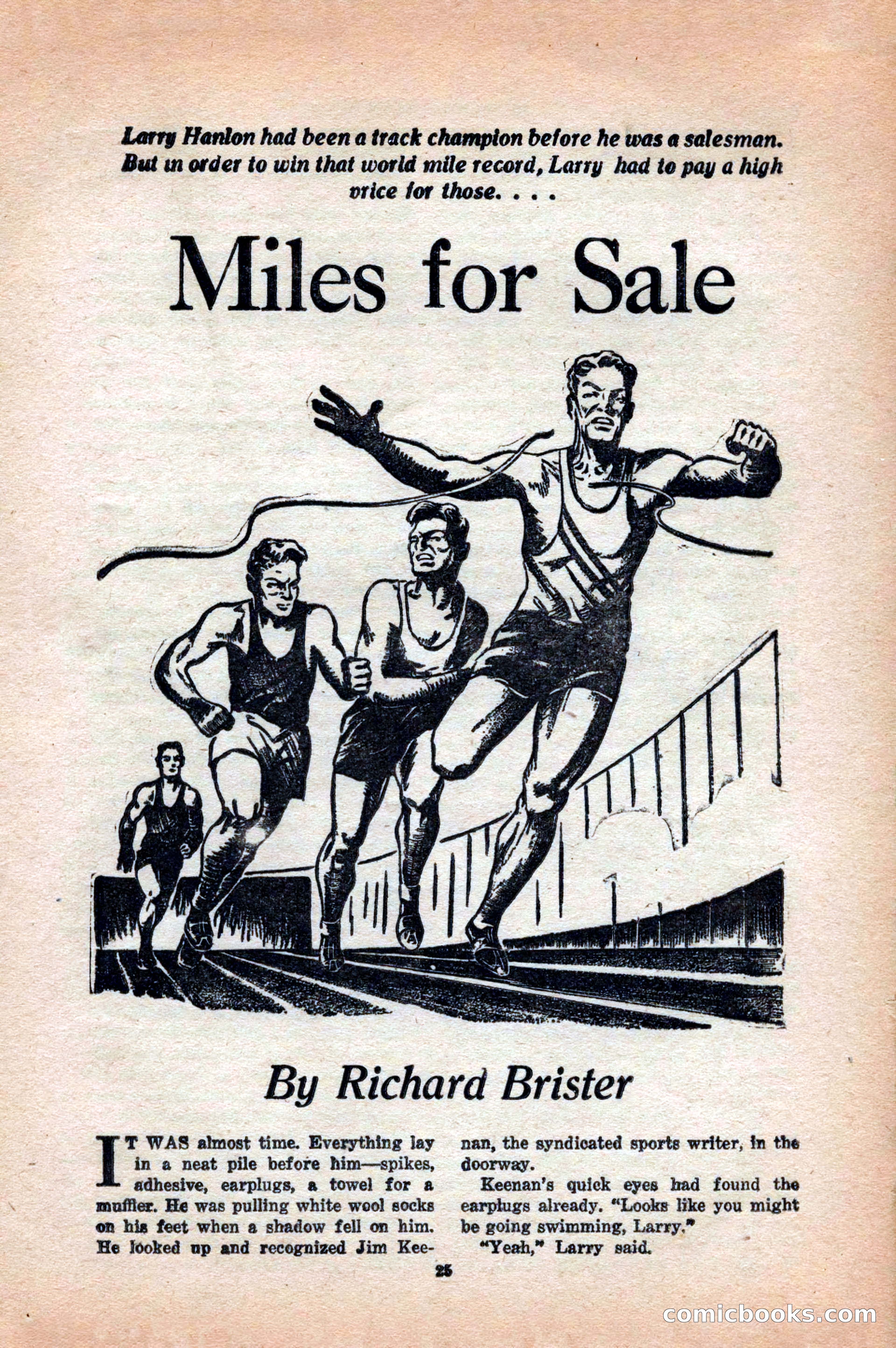
This is a story page from a pulp magazine featuring the opening of "Miles for Sale" by Richard Brister. The page includes a dramatic illustration of runners competing in a race, with the lead runner breaking through a finish line tape. The text introduces Larry Hanlon, a former track champion turned salesman, who is preparing for an attempt at a world mile record. A sports writer named Jim Keenan encounters him and notices suspicious equipment—earplugs and other items—suggesting Larry may be taking questionable measures to achieve his athletic goal.
This page contains story prose from a pulp fiction magazine called "12 Sports Aces." The narrative follows Larry Hanlon, a twenty-seven-year-old whisky salesman and competitive runner, as he prepares for a mile race against Joe Cogan. The text describes Larry's pre-race routine, his past running achievements, and a flashback to a previous competition at State where Cogan defeated him. The passage concludes with Larry spotting an attractive woman dancing at an inn after the race, identified as Peg Starrett.
# Page Analysis: "Miles for Sale" This is **story prose** from a pulp-fiction magazine. The page depicts a narrative about Larry Hanlon, a former champion runner turned liquor salesman who is grappling with his career uncertainty. The story shows Hanlon meeting a woman named Peg Starrett in Norristown, Pennsylvania, becoming engaged to her, and then confronting his boss Warriner about his future. Hanlon, now twenty-seven, wants to leave his sales job and running career but fears losing his position if he stops competing. The conflict centers on whether his sales success depends solely on his fading athletic reputation rather than genuine ability.
# Page Analysis This is **story prose** from a pulp fiction magazine titled "12 Sports Aces" (page 28). The text depicts a narrative about a competitive runner named Larry Hanlon who, after conversation with a coach named Pop Lanning, decides to attempt breaking a world record despite Pop's skepticism about his sprinting ability. The passage concludes with Larry preparing for a race at what appears to be a track meet, with competitors in their starting positions and a starter preparing to fire the starting pistol. The story focuses on Larry's determination to prove himself both as an athlete and as a salesman.
# Page Analysis This is story prose from a pulp magazine, page 29 of "Miles for Sale." The text depicts a competitive track race, focusing on the protagonist Larry's internal experience during what appears to be the final laps. Larry runs with inserted earplugs to block crowd noise, maintaining pace against rivals including Bellotti and Joe Cogan. The narrative alternates between detailed physical descriptions of his running form and his mental calculations about strategy, as he battles fatigue while approaching the finish line of what seems to be a record-breaking race.
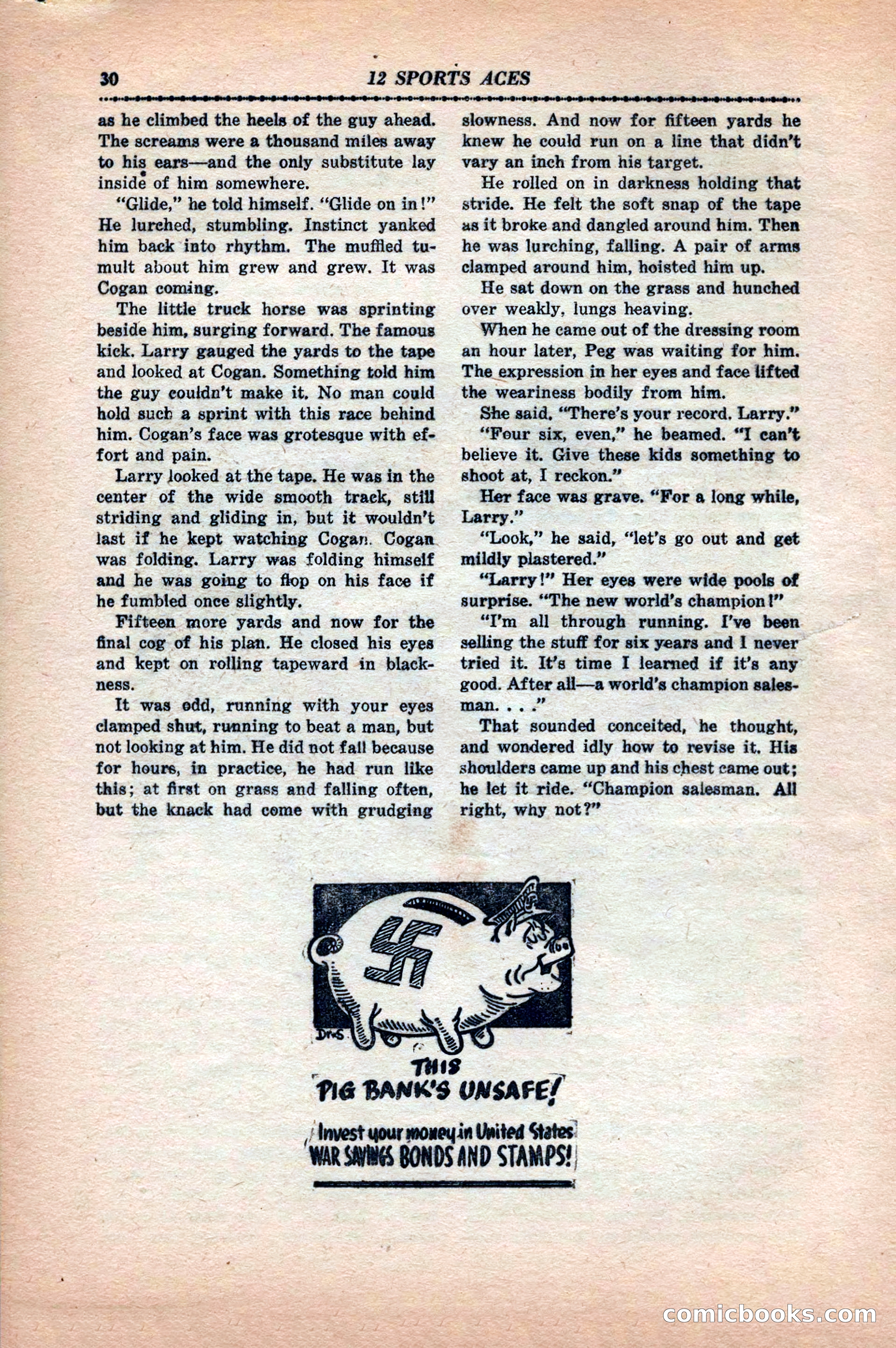
# Page Description This page is story prose from a pulp fiction magazine titled "12 Sports Ages" (page 30). The text depicts the climactic finish of a track race where the protagonist Larry defeats a competitor named Cogan by running the final yards with his eyes closed, using practiced technique. After winning with a time of "four six, even," Larry reveals to his waiting girlfriend Peg that he's retiring from running to pursue sales work. The page concludes with a wartime public service advertisement encouraging readers to invest in U.S. War Savings Bonds and Stamps, featuring an illustration of an unsafe piggy bank.
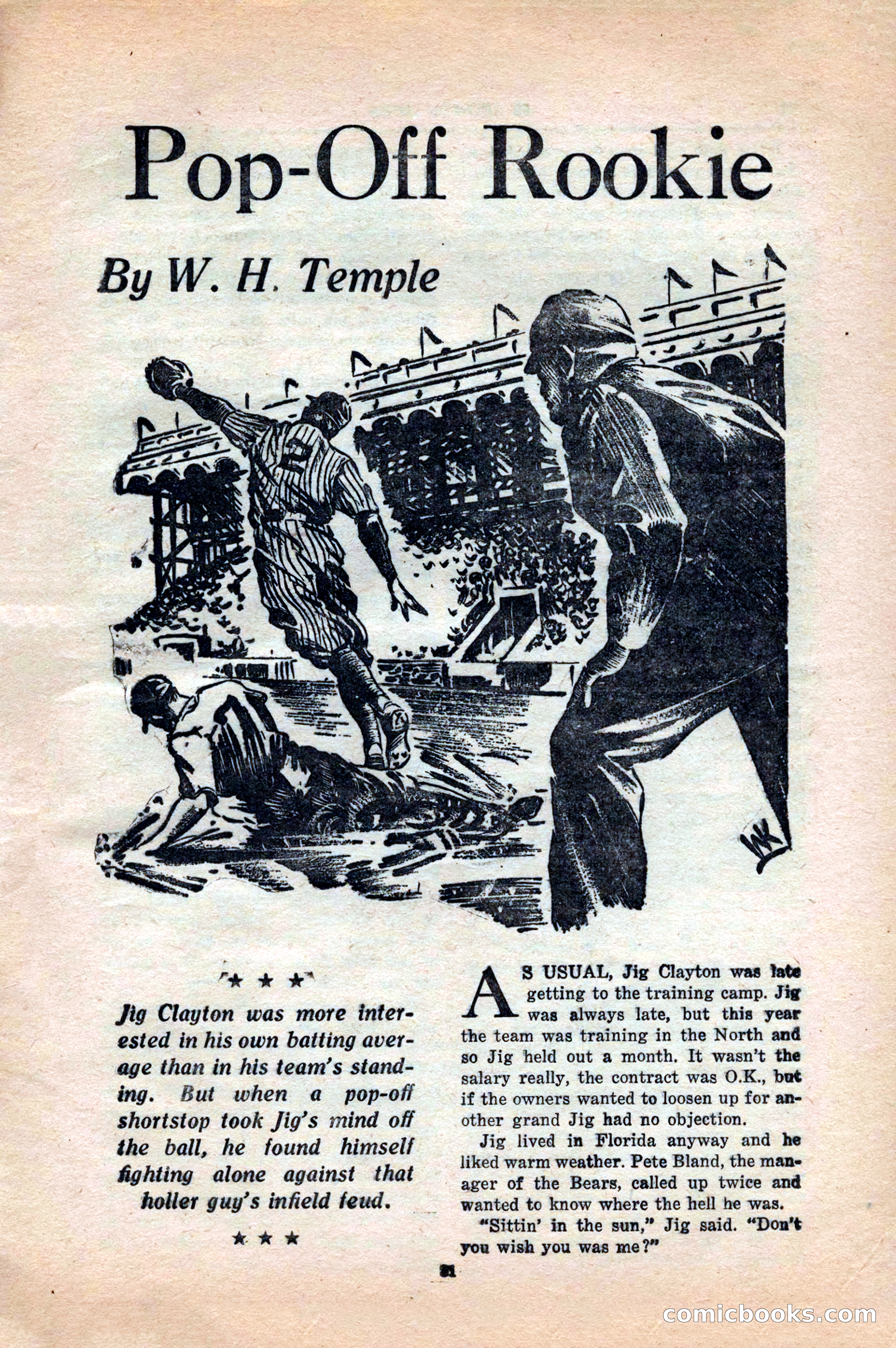
# Page Analysis This is the opening page of a short story titled "Pop-Off Rookie" by W. H. Temple, appearing in what is likely a sports-themed pulp magazine. The page features a dramatic black-and-white illustration showing a baseball player sliding into base while another player stands nearby, with a crowded stadium in the background. The visible text introduces the protagonist, Jig Clayton, a baseball player more interested in his personal batting average than team performance, who arrives late to spring training in Florida rather than joining his team, the Bears, in the North. The story establishes conflict between Clayton and his manager, Pete Bland, who is frustrated with the player's tardiness.
This is a page of story prose from *12 Sports Aces*, a pulp magazine. The text depicts a baseball training scene where veteran player Jig Clayton returns to his team after a contract holdout, facing off against a brash rookie shortstop during practice. The narrative details Clayton's batting performance and subsequent fielding drills, with tension building between Clayton and the loudmouthed young player who mocks his abilities.
# Page Analysis This is **story prose** from a pulp fiction magazine titled "Pop-Off Rookie" (visible at page top). The page continues a baseball narrative following veteran second baseman Jig Clayton's friction with rookie shortstop Eddie Duncan. The text describes their first exhibition game, where Duncan's aggressive field leadership irritates Clayton, and a subsequent clubhouse conversation between Clayton and Manager Pete Bland about the rookie's talent and competitive spirit. The passage ends with the team's opening day, where Duncan's loud, confident personality continues to provoke Clayton's resentment, though the text is cut off mid-sentence.
This page is story prose from a pulp sports fiction magazine titled "12 Sports Aces." The narrative describes a baseball game featuring characters named Eddie Duncan, Jig Clayton, and Beacon. The passage details several plays—including Duncan's fielding error, a subsequent double play, and Clayton's hit that drives in a run—while also portraying the interpersonal dynamics between the players, particularly Clayton's resentment of Duncan's popularity with fans despite Clayton's superior play.
# Page Analysis: "Pop-Off Rookie" This is story prose from page 35 of a pulp baseball fiction titled "Pop-Off Rookie." The narrative follows Jig Clayton, a baseball player whose performance declines after an encounter with Eddie Duncan, a rookie shortstop. After the rookie makes an impressive home run despite Clayton's intimidation attempts, Clayton's batting average drops and he blames Duncan for his slump. The page concludes with a tense playoff game where Duncan is injured during a play at second base, struck by a sliding runner's spikes.
# Page Analysis This is story prose from page 36 of *12 Sports Aces*, a pulp magazine. The text depicts a baseball narrative centered on player Jig Clayton. The visible portion shows Clayton witnessing teammate Eddie Duncan playing injured during a game, then visiting Duncan's hotel room afterward. Later, Clayton visits a bowling alley where he overhears patrons discussing Duncan's value to the team, leading to a heated argument and physical confrontation with another patron who defends Duncan's abilities. The page concludes mid-scene as the man swings at Clayton.
# Page Analysis This page contains **story prose** from "Pop-Off Rookie," a baseball fiction story (page 37 of the publication). The narrative follows Jig Clayton, a veteran second baseman, who gets into conflict with Eddie Duncan, a talented rookie shortstop. After being disciplined for breaking training, Jig returns to play and makes a difficult throw despite his injured thumb. During a game, he defends himself against a runner's aggressive spikes, earning the umpire's support, while Duncan observes the confrontation silently.
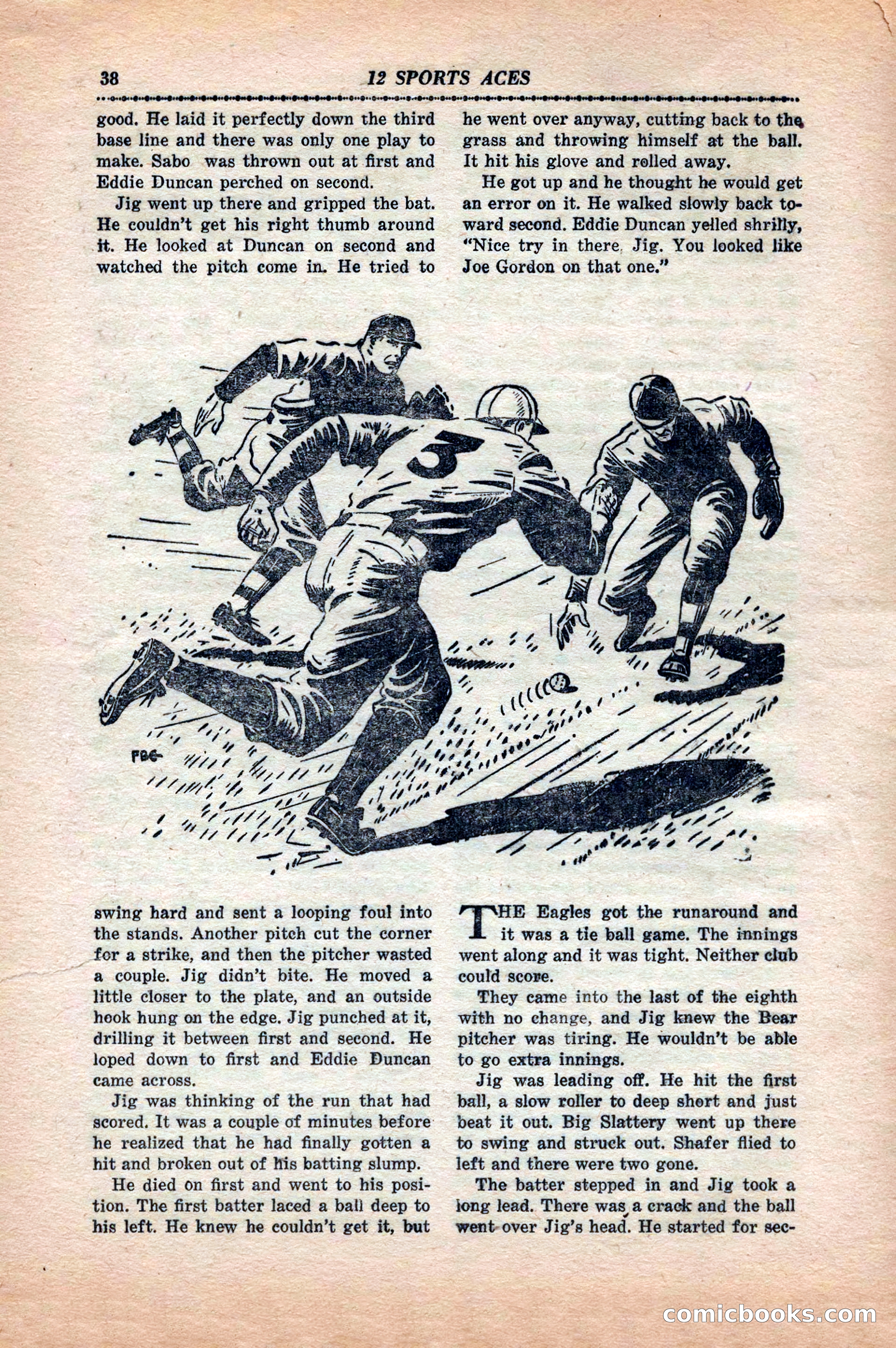
# Page Analysis This is an interior story page from *12 Sports Aces*, a pulp sports fiction magazine. The page contains prose narrative about a baseball game, accompanied by a black-and-white illustration depicting a play at a baseball base. The text describes a player named Jig attempting to break out of a batting slump during a tied game, detailing his at-bats and defensive plays across multiple innings. The illustration shows fielders in action around what appears to be second base, with dynamic movement lines emphasizing the athletic action.
# Page Analysis: "Pop-Off Rookie" This page contains story prose from what appears to be a baseball fiction narrative titled "Pop-Off Rookie" (page 39). The text describes the climactic final inning of a baseball game where protagonist Jig Clayton, playing shortstop despite an injured thumb, makes a crucial play to win the game. The narrative details a double play attempt, with Jig diving to reach home plate early in the passage, then later making a bare-handed catch at shortstop in the final inning. The page ends with Jig and teammate Eddie Duncan—who also played injured—walking off the field together in good spirits after their victory.
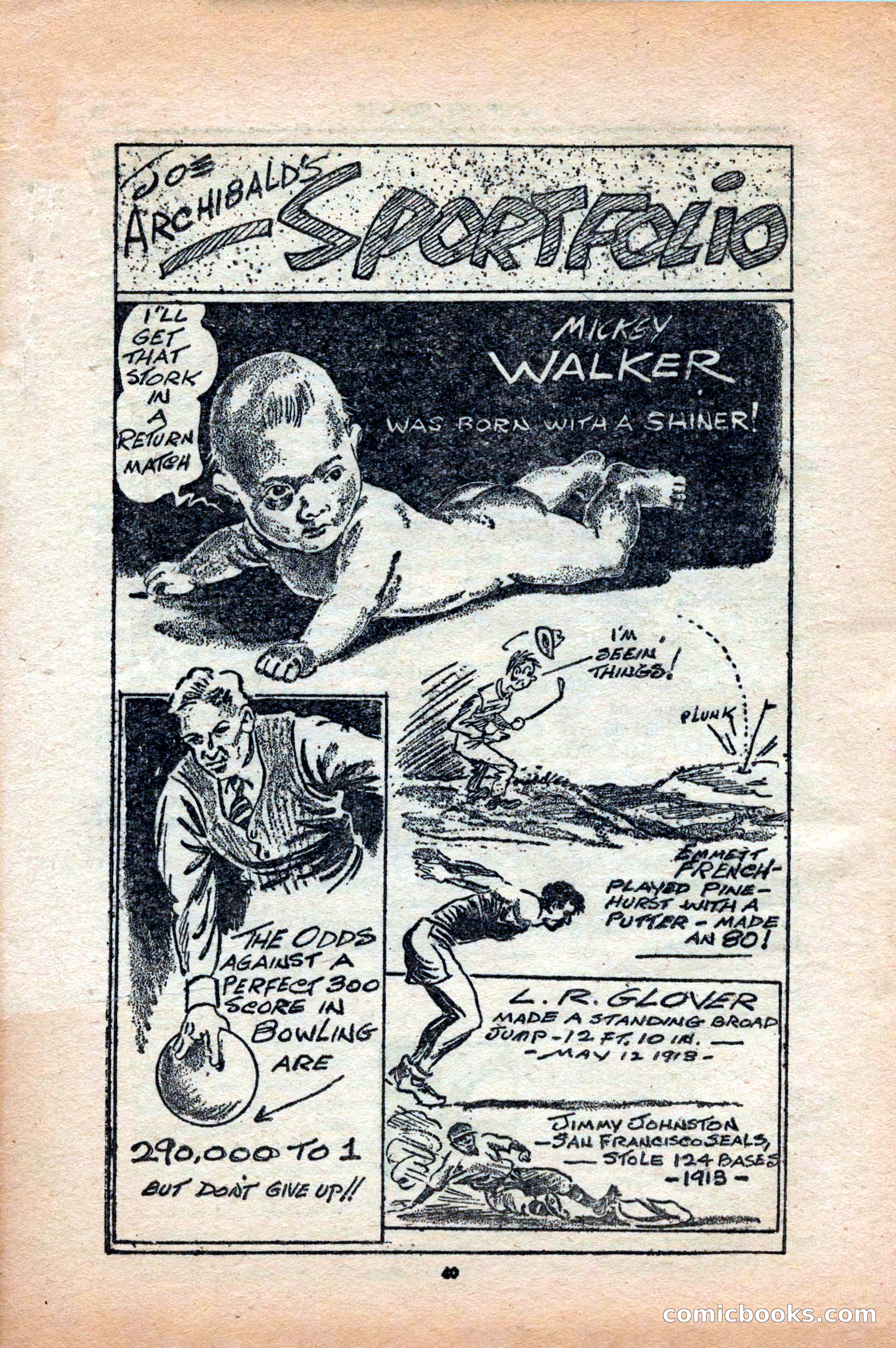
This is an interior illustration page from an early-20th-century pulp magazine titled "Sportazio" by Ros Archibalds. The page features a comic-strip style layout with a large illustration of an infant labeled "Mickey Walker" at the top, accompanied by smaller panels depicting various athletic feats and records. The visible text references Walker being "born with a shiner," mentions odds against achieving a perfect 300 bowling score, describes Z.R. Glover's standing broad jump record from 1918, and notes Jimmy Johnston stealing 124 bases for the San Francisco Seals. The page appears to showcase unusual or remarkable athletic achievements and sports trivia in a humorous format.
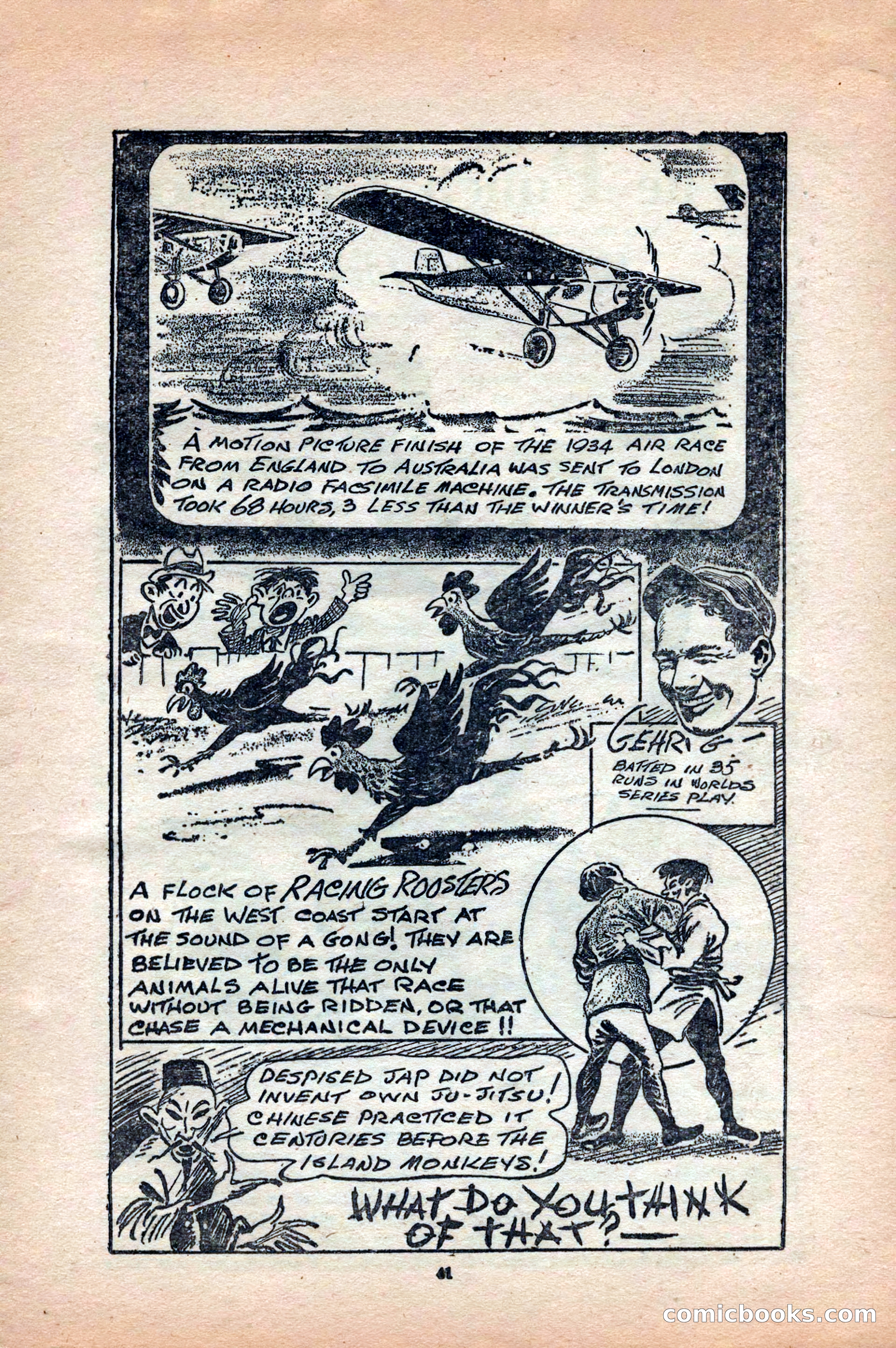
# Page Analysis This is an interior story illustration page from a pulp magazine, likely from the 1930s. The page contains three separate anecdotal vignettes presented in comic-strip format with illustrated panels and accompanying text. The top panel describes a 1934 air race finish transmitted via radio facsimile from England to Australia. The middle section features racing roosters on the West Coast that allegedly race without riders or mechanical devices. The bottom panel discusses the origins of ju-jitsu, with a character disputing Japanese invention and claiming Chinese monkeys practiced it centuries earlier. The page appears designed as entertainment trivia presented through illustrations and humorous dialogue.
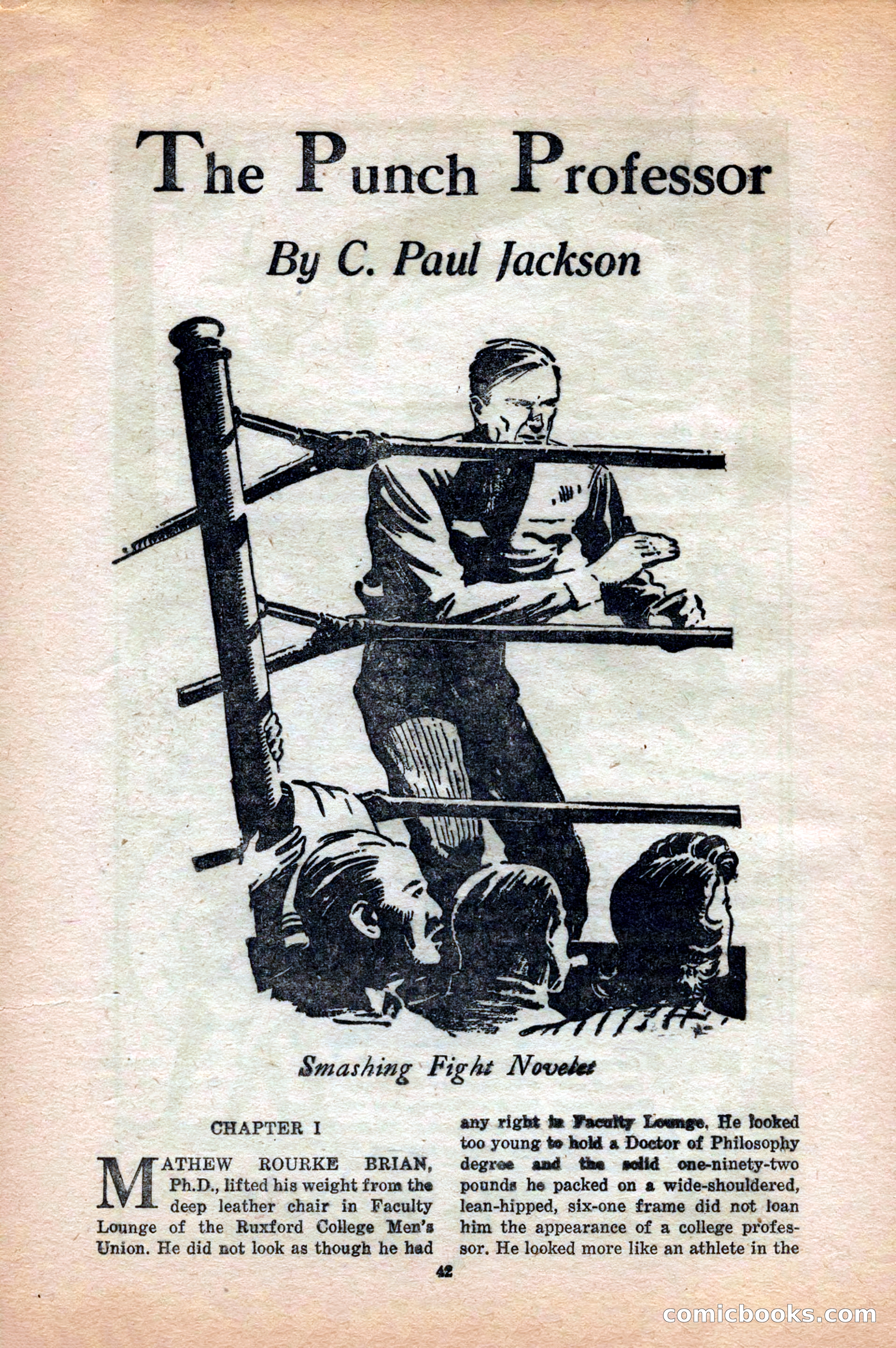
# Analysis This is a **story opening page** from a pulp fiction magazine, featuring Chapter I of "The Punch Professor" by C. Paul Jackson. The page includes a dramatic illustration showing a man in boxing stance wielding what appears to be a large mallet or club above three other figures, suggesting violent action. The visible text introduces the protagonist, Mathew Rourke Brian, a Ph.D. who appears unusually athletic and youthful for an academic—described as having an athletic build (192 pounds, six feet one inch) that contradicts his professorial role. The subtitle "Smashing Fight Novelette" indicates this is likely a hardboiled or action-adventure story blending academic and combat themes.
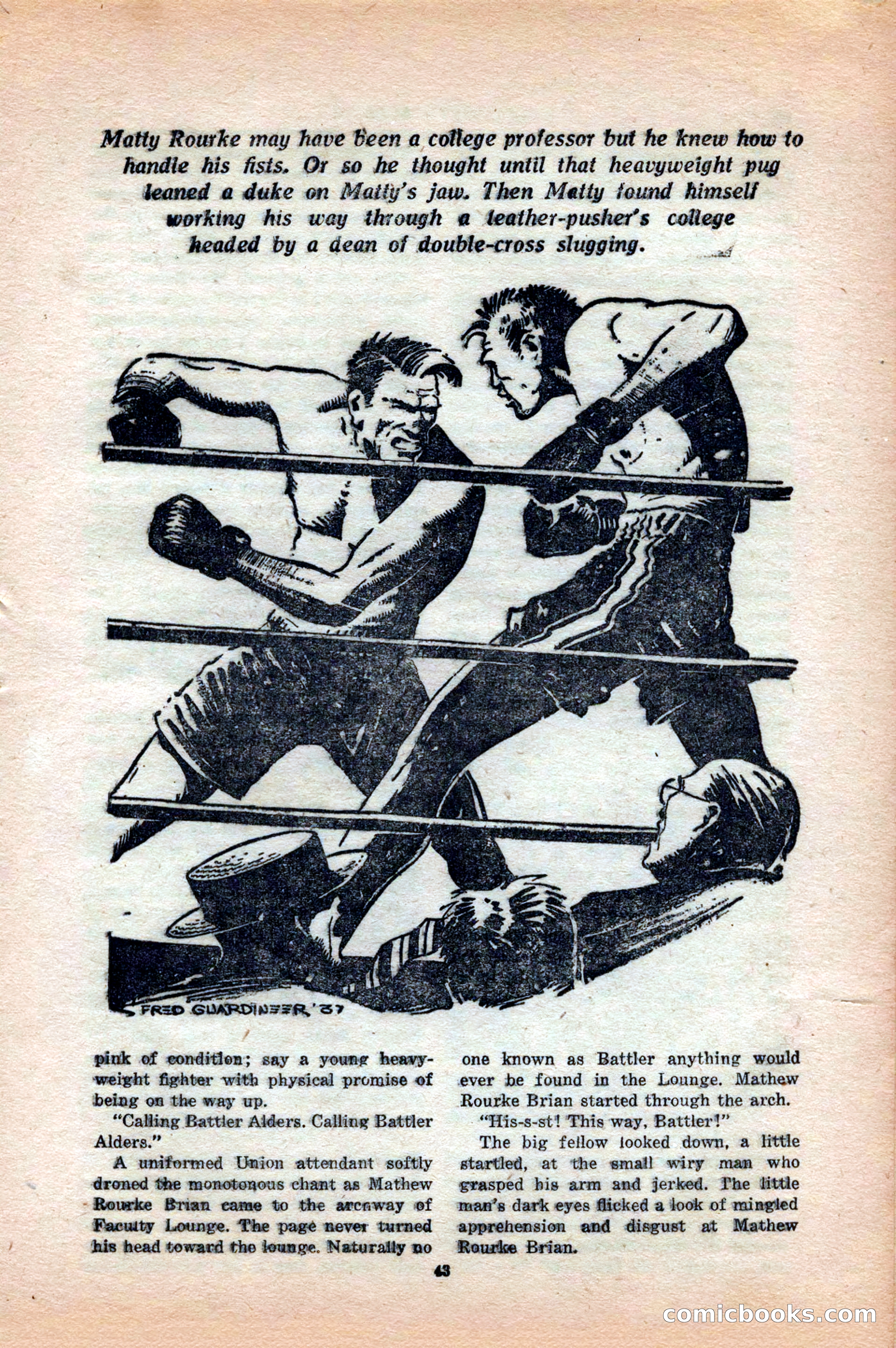
This is an interior story page from a pulp magazine featuring both illustration and prose text. The black-and-white illustration by Fred Guardinger depicts a boxing or fighting scene with multiple figures on what appears to be a staircase or tiered structure. The story concerns a character named Matty (or Mathew) Rourke Brian, apparently a college professor who gets drawn into a boxing-related conflict after being struck by a heavyweight fighter, leading him through what the text describes as a "leather-pusher's college" run by someone skilled in violent double-crossing. The visible prose describes Rourke's encounter in what appears to be a lounge or athletic facility.
This page is story prose from a pulp fiction magazine called "12 Sports Aces." The narrative depicts a humorous case of mistaken identity in which Spike Babb, a boxing coach at a college, initially confuses Mathew Rourke Brian—a newly appointed Assistant Professor of Mathematics—with "Battler Alders," apparently a boxer. Babb's embarrassed realization of his error, and his continued puzzlement over Brian's resemblance to someone else, drive the scene's comedic tension as Brian must leave for his appointment with the college president.
This page contains story prose from "The Punch Professor," a pulp fiction narrative. The text depicts a confrontation between Mathew Rourke Brian, a young college professor, and Battler Alders, a aggressive man who bumps into him on a staircase landing. After Alders insults and throws a punch at Brian, the professor instinctively delivers a powerful uppercut that knocks Alders down, an action captured by photographer Tim McCarty's flash camera. The scene shows Brian's surprised realization of what he's done as Alders recovers and recognizes his attacker.
# Page Analysis: "12 Sports Aces" Pulp Fiction This page contains story prose from a pulp fiction magazine, specifically page 46 of what appears to be a hardboiled boxing or crime story. The text depicts a brutal fight between Mathew Rourke Brian (a college professor) and "Battler" Alders (a professional fighter), with photographer Tim McCarty documenting the bout. After Brian is knocked down, a police officer arrives at the scene while a heavy-voiced man (apparently Alders's manager) pressures the cop not to press charges, claiming Alders acted in self-defense against an unprovoked attack. The officer releases Brian with a warning.
# Page 47: Prose Story with Newspaper Illustration This page contains prose narrative from a story titled "The Punch Professor." Matthew Rourke Brian, apparently a college professor, has been publicly implicated in a brawl with a professional boxer named Battler Alders. After receiving a dismissal letter from Ruxford College's president, Brian is visited by newspaper man Tim McCarty, who shows him tonight's newspaper headline: "Battler Alders Addles Nazi Sympathizer," featuring a photograph of Brian being knocked down. The story details the alleged incident and Alders' account of events.
# Page Analysis This is story prose from a pulp-fiction magazine titled "12 Sports Aces" (page 48). The text depicts a conversation between newspaper reporter Tim McCarty, a Ph.D. named Mathew Rourke Brian, and a character named Spike Babb. McCarty questions Brian about an incident involving boxer Battler Alders, shows photographs of the fight, and identifies a mysterious man named B.J. Benson in the background. Spike Babb then begins telling a story about a boxer from twenty-two years prior during Jack Dempsey's era, suggesting a possible connection to Brian's identity.
# Page Content Analysis This is **story prose** from "The Punch Professor," a hardboiled crime tale. The page shows dialogue and narrative describing a criminal conspiracy: Spike Babb reveals to a young man named Brian that he may be the son of Mat Rourke, a boxer imprisoned for manslaughter in a rigged trial. Babb explains that Rourke's trainer, Terry Brian, disappeared before testifying, and that B. J. Benson, Rourke's restaurant manager, appears to have been involved in the frame-up. The younger Brian acknowledges he was raised by "Uncle Terry" and promises to check his birth certificate to verify his identity.
# Page Analysis This is story prose from page 50 of *12 Sports Aces*, a pulp magazine. The page contains Chapter III of what appears to be a boxing/crime story. The narrative follows young Matty Rourke, who sits in a fight club dressing room four months after events described earlier. Rourke has discovered letters from Terry Brian revealing a conspiracy involving his father's death and implicating someone named Benson in a "frame-up" of the fight game. Determined to clear his father's name, Rourke seeks boxing training from Spike Babb and Tim McCarty to infiltrate Benson and Alders' operation through the boxing ring. The page emphasizes themes of revenge, corruption in professional boxing, and uncovering hidden truth.
# Page 52: "12 Sports Aces" — Boxing Story Prose This page contains story prose from what appears to be a boxing-themed pulp fiction magazine. The narrative follows a fighter named Matty Rourke in his boxing match against Rocky Stone. The text describes the opening rounds of their bout, including Stone's aggressive charging style, a low blow that injures Matty, and Matty's recovery and counter-attack. The passage emphasizes Matty's natural boxing instinct and the crowd's excitement as the two fighters engage in intense hand-to-hand combat in the ring.
# Page Analysis: "The Punch Professor" This page contains story prose from a hardboiled boxing pulp fiction narrative titled "The Punch Professor." The text depicts boxer Matty Rourke's rapid rise through the boxing ranks under manager Spike Babb's guidance. After Matty defeats Rocky Stone in a knockout lasting one minute and twelve seconds, Babb negotiates carefully for his next opponents rather than immediately matching him against top contenders like Spider Johnson or Battler Alders. The passage chronicles Matty's subsequent victories—winning ten straight fights over several weeks—and his developing reputation, culminating in a questionable draw where his opponent was knocked down at the final bell.
# Page 54 of "12 Sports Aces" This page contains story prose from a boxing narrative. The text describes negotiations between a boxing promoter and a manager regarding a fight between a young boxer named Matty Rourke and an opponent called Spider Johnson, followed by a detailed account of their six-round boxing match. The story details Rourke's struggle against Johnson's superior reach and technique, a suspicious moment where Johnson appears to apologize during a clinch, and the climactic final round where the fighters trade heavy blows to crowd excitement.
# Page Analysis This is **story prose** from a pulp fiction magazine titled "The Punch Professor." The page depicts a boxing match narrative: boxer Matty Rourke defeats Spider Johnson in the seventh round with a knockout that seems suspiciously easy. After the fight, a Commission chairman named Colonel Eisen enters the dressing room to announce an investigation into whether the match was fixed, as rumors had circulated beforehand and experts believe Johnson took harder blows without falling. Rourke's manager and associates deny involvement in any potential throw.
# Page Analysis This page contains story prose from Chapter V of what appears to be a hardboiled boxing/sports crime narrative in *12 Sports Aces* magazine (page 56). The text depicts a confrontation in Colonel Eisen's office where Tim McCarty accuses B.J. Benson of orchestrating a fixed fight between boxers Matty Rourke and Spider Johnson, with various parties present disputing the claims. The scene culminates in physical tension as Battler Alders and Matty Rourke prepare to fight. The narrative focuses on boxing match manipulation and alleged conspiracy among promoters and fighters.
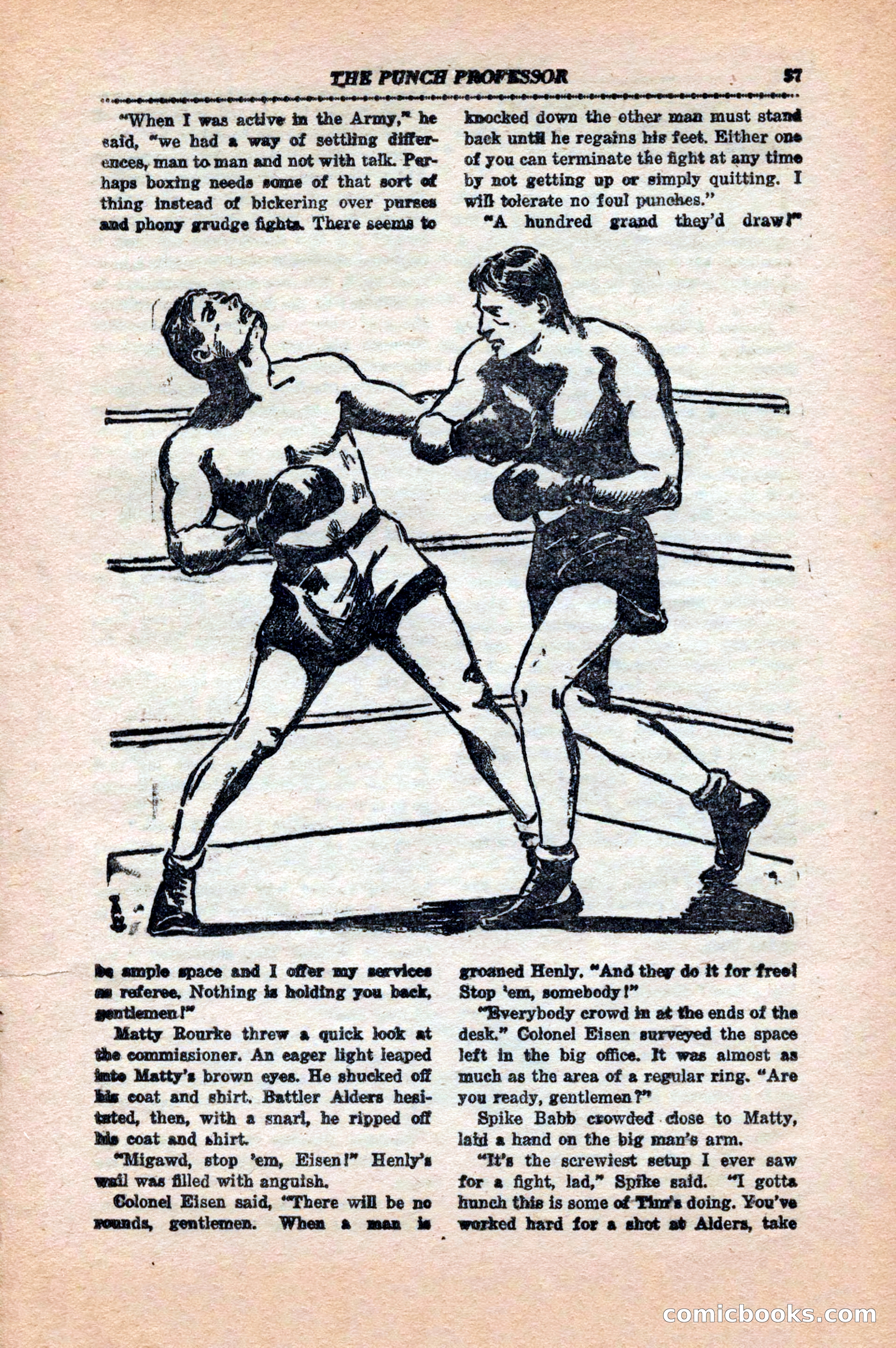
# Page Analysis This is an interior story page from a pulp magazine featuring both prose narrative and an illustration. The visible text describes a boxing dispute being settled by an impromptu fight arranged by Colonel Eisen, a military officer. Rather than formal rounds, Eisen establishes street-fight rules in an office space, with onlookers like Henly protesting the arrangement and Spike Babb warning the protagonist Matty about potential sabotage by someone called "Tim." The accompanying illustration depicts two shirtless boxers squaring off in a ring, with a smaller figure between them.
# Page 58 from "42 Sports Aces" — Story Prose This page contains story prose from what appears to be a hardboiled crime or boxing pulp story. The text describes a brutal bare-knuckle boxing match between protagonist Matty Rourke and an opponent named Battler Alders, with Matty initially knocked down but recovering to deliver a devastating counterattack. The narrative then shifts to post-fight dialogue where characters Tim McCarty and Spike Babb confront a man named Squidge Pavelec, suggesting he possesses knowledge about a death connected to someone called Killer Birk and implying blackmail or conspiracy.
# Page Content Summary This page contains story prose from "The Punch Professor," a pulp fiction narrative about boxing and crime. The text shows Colonel Eisen concluding a case involving corruption in professional boxing—Benson and his associates have confessed to rigging fights and causing a boxer's death. Eisen commends the protagonists Tim and Matty Rourke for exposing the ring, then offers Rourke a position at Ruxford College. Rourke accepts but reveals he's enlisted in the Marine Reserve and will report for active duty tomorrow, having finally settled his vendetta against those responsible for the injustice.
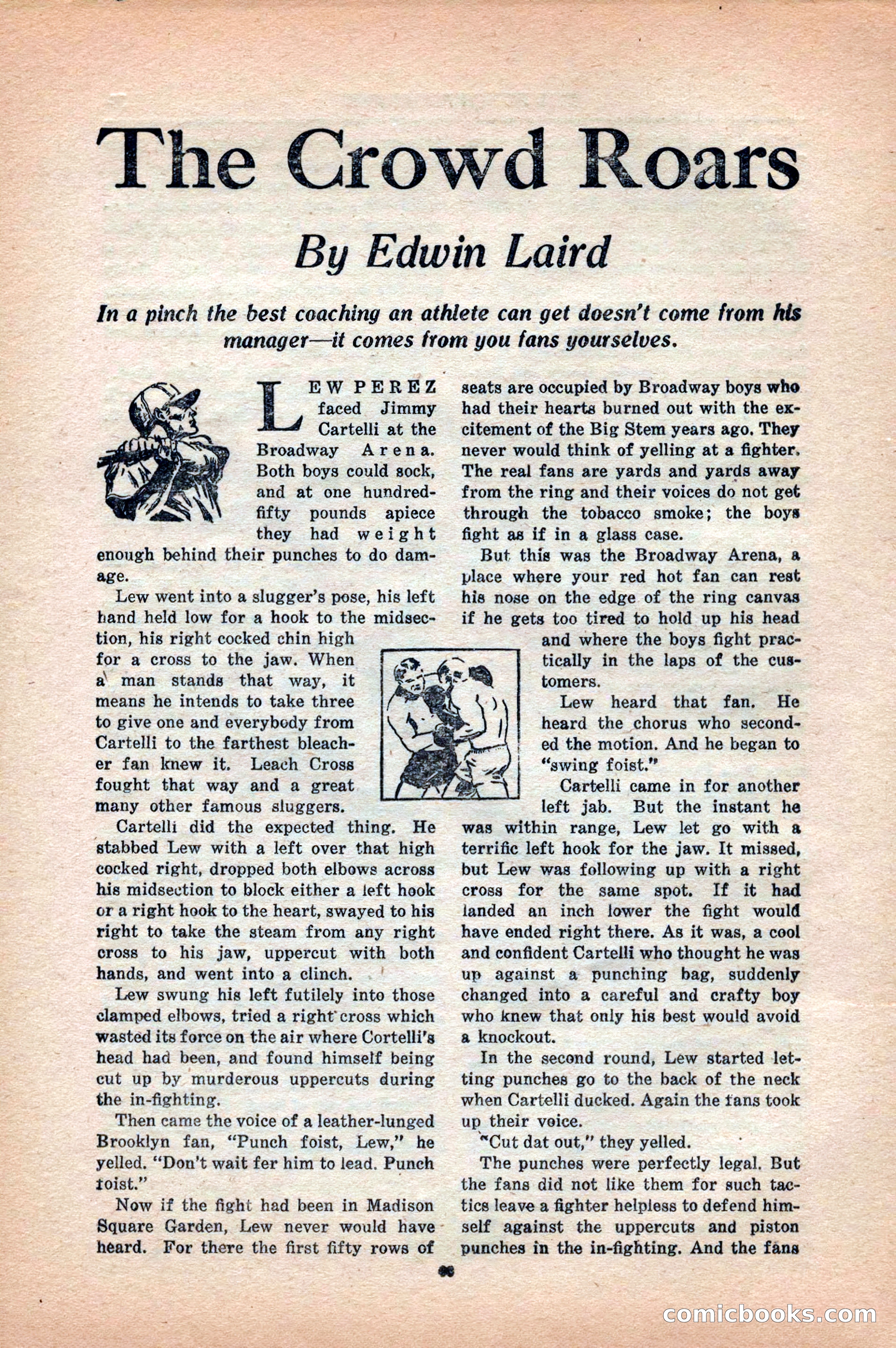
# "The Crowd Roars" by Edwin Laird This is story prose from a pulp magazine, featuring an illustration of two boxers mid-fight. The narrative describes a boxing match between Lew and Jimmy Cartelli at the Broadway Arena, emphasizing how fan encouragement affects the fighter's performance. When a Brooklyn fan yells at Lew to punch aggressively rather than wait for his opponent to lead, Lew gains confidence and begins fighting more effectively, forcing Cartelli to become defensive. The story illustrates the author's opening claim that fan support—not managers—provides crucial coaching during critical moments in athletic competition.
# Page Analysis: "The Crowd Roars" This is prose fiction—a story page from a pulp magazine, numbered page 61. The text discusses how sports fans influence athletic competition across different games. It focuses primarily on basketball, describing how crowd noise helps players correct mistakes (like taking too many steps before shooting) and assists referees in calling fouls. The passage contrasts this with boxing (where fans encouraged a fighter named Lew) and hockey (where fast action makes fan input ineffective). The author argues fans serve as unofficial score-keepers in baseball, influencing outcomes in ways official records don't capture.
# Page Analysis This is **story prose** from a pulp magazine article titled "12 Sports Aces." The text argues that sports spectators play a vital role in athletic competition through their vocal support and commentary. It uses examples from baseball, tennis, and boxing—including references to Bill Tilden, Jack Dempsey, Joe Louis, and Gene Tunney—to demonstrate how fan enthusiasm and shouting can influence athlete performance and game outcomes. The piece encourages readers to enthusiastically cheer at sporting events. At the bottom is a wartime advertisement about sinking U-boats.
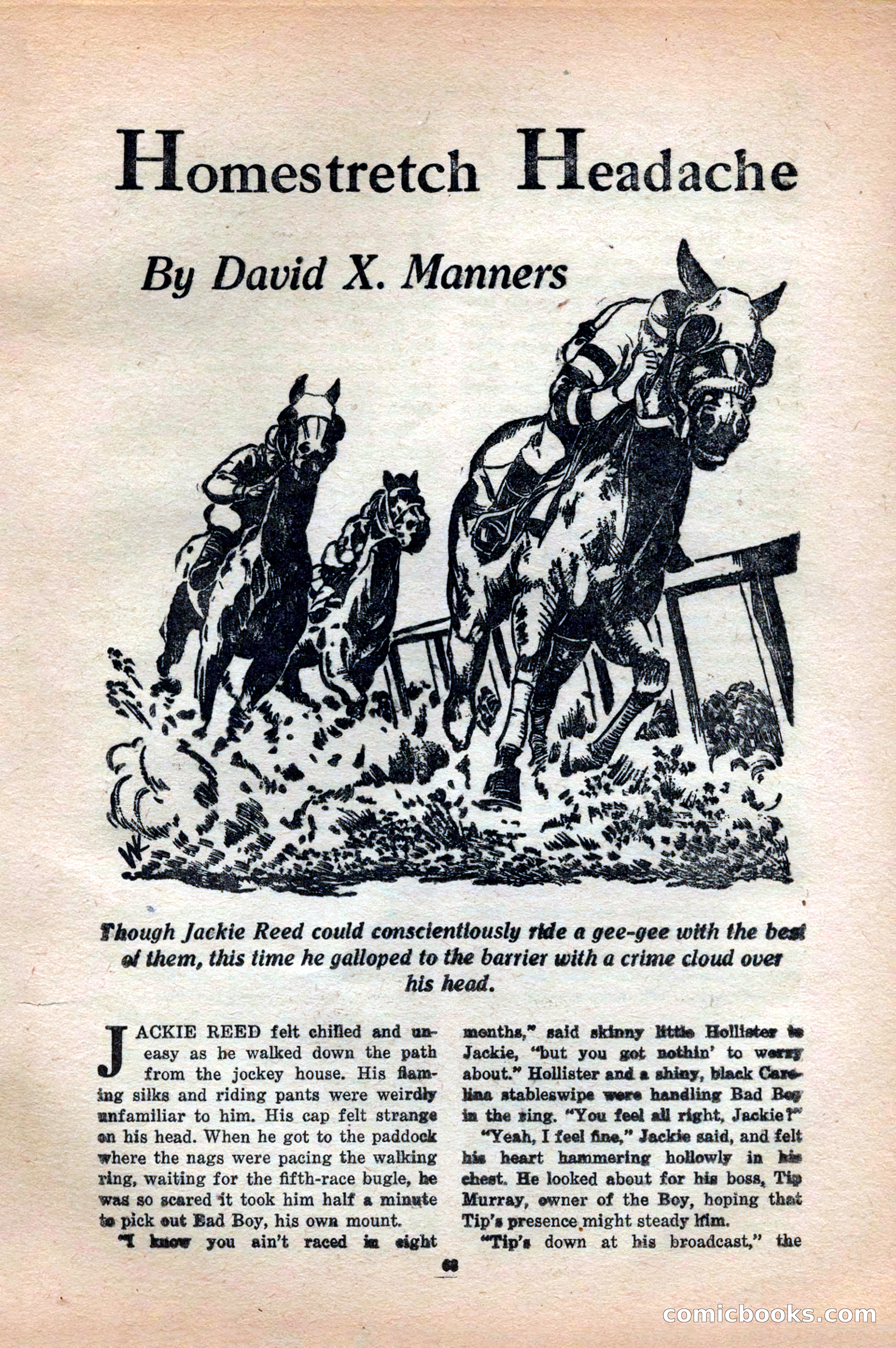
# Page Analysis This is an interior story page from a pulp magazine featuring the opening of a short story titled "Homestretch Headache" by David X. Manners. The page includes a dramatic illustration of horses and riders galloping, followed by the beginning of prose narrative. The story concerns Jackie Reed, a jockey who feels anxious and unfamiliar with his surroundings as he prepares to ride a horse named Bad Boy in the fifth race, despite not having raced in eight months. The visible text establishes an atmosphere of unease and hints at some unstated trouble weighing on the protagonist's mind.
# Page Analysis This is story prose from a pulp magazine titled "12 Sports Aces" (page 64). The narrative follows Jackie, an apprentice jockey, who has secured a racing opportunity through his mentor Hollie and actor-owner Tip Murray. The passage depicts Jackie's emotional conflict about riding the prized racehorse Bad Boy despite his past scandal, culminating in preparations for the race at the paddock. The story emphasizes Jackie's gratitude toward both men while showing Tip's own anxieties—his fading movie career and significant financial investment in the champion horse. The excerpt ends as the horses approach the starting gate for the race.
# Page Analysis This is **story prose** from a pulp fiction magazine, specifically a horse-racing narrative titled "Homestretch Headache" (visible in the header). The page depicts the climactic finish of a horse race. Jockey Jackie rides the horse Bad Boy in a desperate attempt to win for his patron, Tip Murray, who has given him a second chance. Despite Bad Boy's valiant effort and initial lead, rival horses—particularly El Cato and Sparrow Maid—surge forward in the homestretch. At the finish line, El Cato wins by a length, with Bad Boy finishing third. Jackie dismounts devastated, having failed Tip's trust, while Tip himself appears crushed by the loss.
# Page Analysis This is **story prose** from a pulp fiction magazine titled "12 Sports Aces" (page 66). The text depicts a narrative about a jockey named Jackie who works with a racehorse trainer named Tip Murray and a temperamental thoroughbred called Bad Boy. Jackie discovers that Bad Boy suffers from chronic indigestion caused by bolting his feed too quickly. Through patient hand-feeding and care—including acquiring a goat companion for the horse—Jackie works to rehabilitate the animal's condition before an upcoming race called the Wildmere Memorial.
# What's on This Page This page contains story prose from a pulp fiction magazine titled "Homestretch Headache" (page 67). The narrative follows Jackie Reed, a jockey working for trainer Tip Murray with a racehorse called Bad Boy. After overhearing gossip about Tip's past and a subsequent fight Tip had defending Jackie's reputation, the discouraged jockey decides to leave. Jackie writes a farewell note to Tip and departs, heading toward a bus stop where he enters a nearby bar. The page ends as fire sirens begin screaming, suggesting an impending crisis or accident.
# Page Analysis This is story prose from page 68 of *12 Sports Aces*, a pulp magazine. The text depicts a horse-racing narrative in which Jackie, apparently a disgraced jockey, encounters trainer Tip Murray after a stable fire destroys Tip's barns and horses. After being blamed and driven away, Jackie later learns that Tip's remaining horse, Bad Boy, will race in the Wildmere Stakes. Jackie then approaches the jockey assigned to ride Bad Boy and lures him away under false pretenses, suggesting Jackie may plan to ride the horse himself.
# Page Description This is story prose from a pulp fiction magazine, page 69 of what appears to be a horse-racing story titled "Homestretch Headache." The narrative follows a jockey named Jackie who deceives a man named Tip Murray by claiming his child is ill to prevent him from reaching the racetrack in time for the fifth race. Jackie intends to ride a horse called Bad Boy illegally in Murray's place. The visible text concludes with a dramatic description of the race itself, with Bad Boy making a late charge through the field as it approaches the finish.
# Page Analysis This page contains **story prose** from a pulp fiction magazine titled "12 Sports Aces" (page 70). The text describes the climactic finish of a horse race featuring a jockey named Jackie riding a horse called Bad Boy against a competitor named Rosab. After Bad Boy wins, Jackie learns that a boy has been found tied up in a stable, creating complications. The passage concludes with Jackie's employer, Tip Murray, reassuring Jackie of his loyalty and revealing he wants Jackie to continue riding Bad Boy in future races, particularly the Santa Rey. A small decorative illustration appears at the bottom of the page.
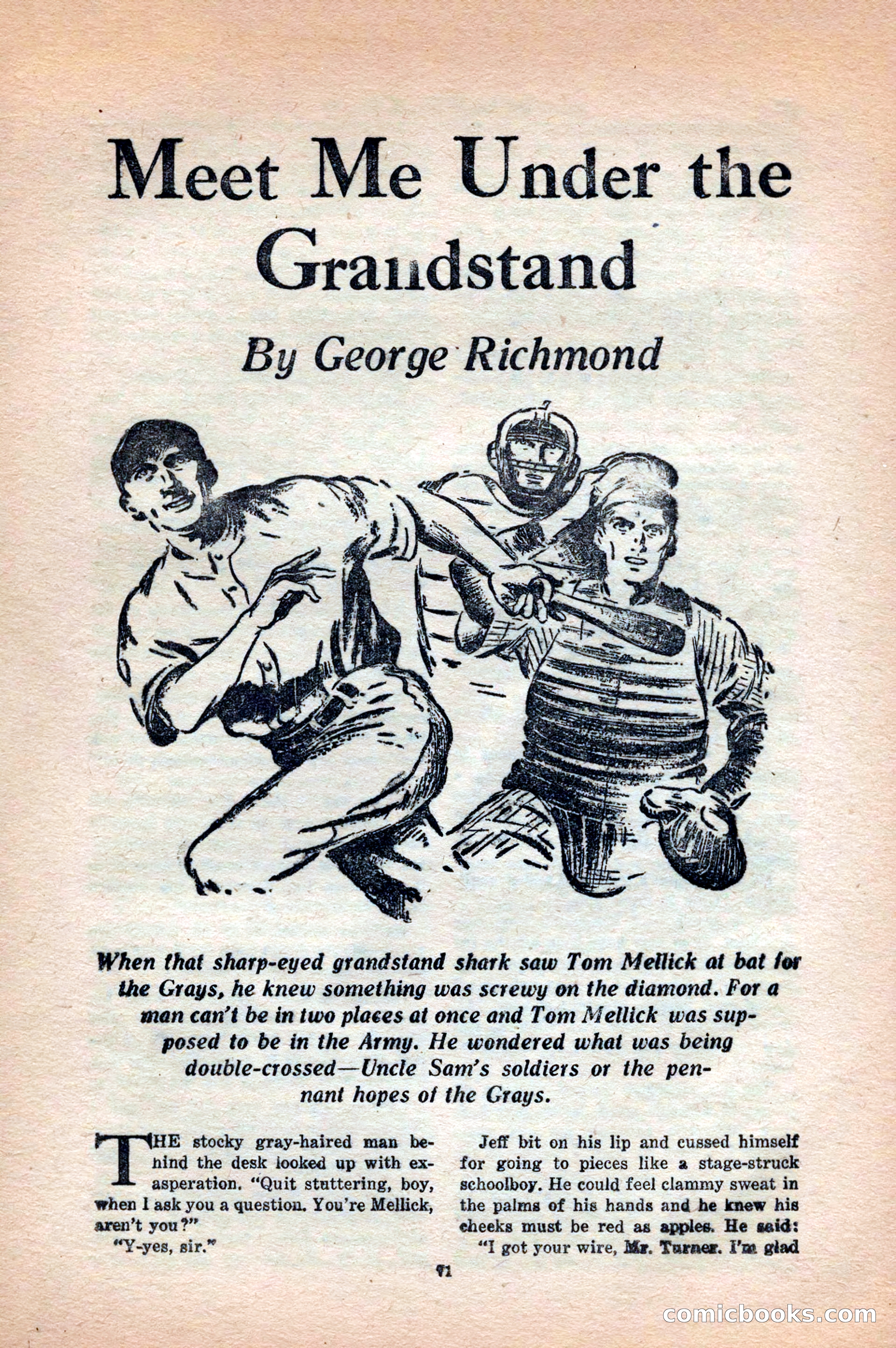
This is a story page from an early-20th-century pulp magazine featuring "Meet Me Under the Grandstand" by George Richmond. The page includes a black-and-ink illustration of three baseball players and begins the story's narrative. The plot appears to involve a mysterious discrepancy: a man named Tom Mellick is spotted playing baseball for the Grays, despite supposedly being enlisted in the Army, prompting investigation into whether military personnel or the team's pennant hopes are being compromised. The visible prose shows an interrogation scene where a nervous character named Jeff is questioned by a gray-haired man.
# Page Analysis This is **story prose** from a pulp sports fiction magazine (page 72 of "12 Sports Aces"). The narrative follows Jeff Mellick, a young baseball player who has just joined a professional team called the Grays. The text depicts his nervous first day: meetings with managers and teammates (including the arrogant outfielder "Cheeky" Graham), his receipt of instructions, and the opening moments of his first game. A notable subplot involves Jeff's deceptive age—a manager questions whether he's actually twenty-two as claimed, causing Jeff anxiety. The passage emphasizes Jeff's internal tension despite his attempts to appear calm and capable.
This page contains story prose from what appears to be a baseball-themed pulp fiction tale titled "Meet Me Under the Grandstand." The narrative follows a character named Jeff, a baseball player experiencing anxiety during a game between the Grays and Bisons. The text describes Jeff's nervous fielding performance, his tense interactions with teammates like the intimidating left fielder Graham, and culminates with Jeff stepping up to bat and making solid contact with a pitch. The story focuses on internal tension and competitive dynamics among the players.
# Page Content Analysis This is **story prose** from page 74 of "32 Sports Aces," a pulp magazine. The text depicts a baseball narrative in which a player named Jeff has apparently assumed his brother Tom's identity to play for a team called the Grays. After a game, an insurance salesman named Mr. Nolan recognizes Jeff and learns the deception. Jeff persuades Nolan to keep the secret, arguing he'll prove his worth to the club, while Nolan expresses concern about potential fraud charges. The scene captures the dramatic tension between Jeff's athletic ambitions and the legal complications of his impersonation.
# Page Analysis This is story prose from a pulp fiction magazine, specifically a hardboiled crime or sports-themed narrative titled "Meet Me Under the Grandstand" (page 75). The passage depicts a tense confrontation between Jeff, apparently a baseball player, and two men who suspect him of wrongdoing. First, a man named Nolan attempts to blackmail Jeff over some unspecified transgression. Later, Jeff's teammate Graham confronts him suspiciously about a phone call and his odd behavior during a game, hinting at knowledge of Jeff's involvement in something that could jeopardize the team's pennant chances. Jeff attempts to deflect both situations while internally anxious about exposure.
# Page Analysis This is **story prose** from a pulp sports fiction magazine titled "12 Sports Aces" (page 76). The text depicts a baseball game in progress, following a young player named Jeff (apparently nicknamed "Mellick") through a crucial game. Jeff makes a promising defensive play early on but later fails to properly position himself on a fly ball, allowing two runs to score for the opposing Bisons team. His manager Tuffy Turner subsequently summons him to the office with an ominous message, leaving Jeff anxious about what the meeting will reveal. The narrative focuses on Jeff's internal conflict between proving himself as a competent player and his apparent mistakes costing his team the game.
# Page 78 from "12 Sports Aces" This page contains story prose from what appears to be a baseball fiction narrative. The text describes the climactic final inning of a baseball game, where a player named Jeff hits a game-winning home run. After the game, manager Tuffy Turner confronts Jeff in the showers, revealing he knows Jeff has been impersonating his brother Tom to secure a tryout, since Tom was drafted into the Army. Turner decides to keep Jeff on the team conditionally, offering him a chance to prove himself despite the deception.
# Analysis This page contains the opening of a prose story titled "The Toughest Fight" by Ned Cady. The narrative describes boxer Barney Ross, a former lightweight and welterweight champion, in a foxhole during what appears to be combat in the Guadalcanal jungle during World War II. The story draws a metaphorical parallel between Ross's boxing technique—particularly his "tunnel fighter" strategy of waiting for openings through opponents' defenses—and his tactical approach to the military engagement with Japanese forces surrounding his position. Small illustrations accompany the text, including one of a soldier in a foxhole.
# Page 80: "12 Sports Aces" — Prose Article This page contains story prose from what appears to be a sports-themed pulp magazine. The text discusses ordinary American athletes who became military heroes during World War II, focusing on Lieutenant James V. Edmondsen and Lieutenant Commander Henry G. Sanchez. The narrative describes how these men's athletic backgrounds—football at Santa Monica Junior College and soccer/water polo at the Naval Academy respectively—prepared them for heroic wartime service, including Edmondsen sinking a Japanese submarine off Oahu and earning the Purple Heart. The piece emphasizes that heroes are typically unremarkable people with a developed sense of teamwork and dedication from athletics.
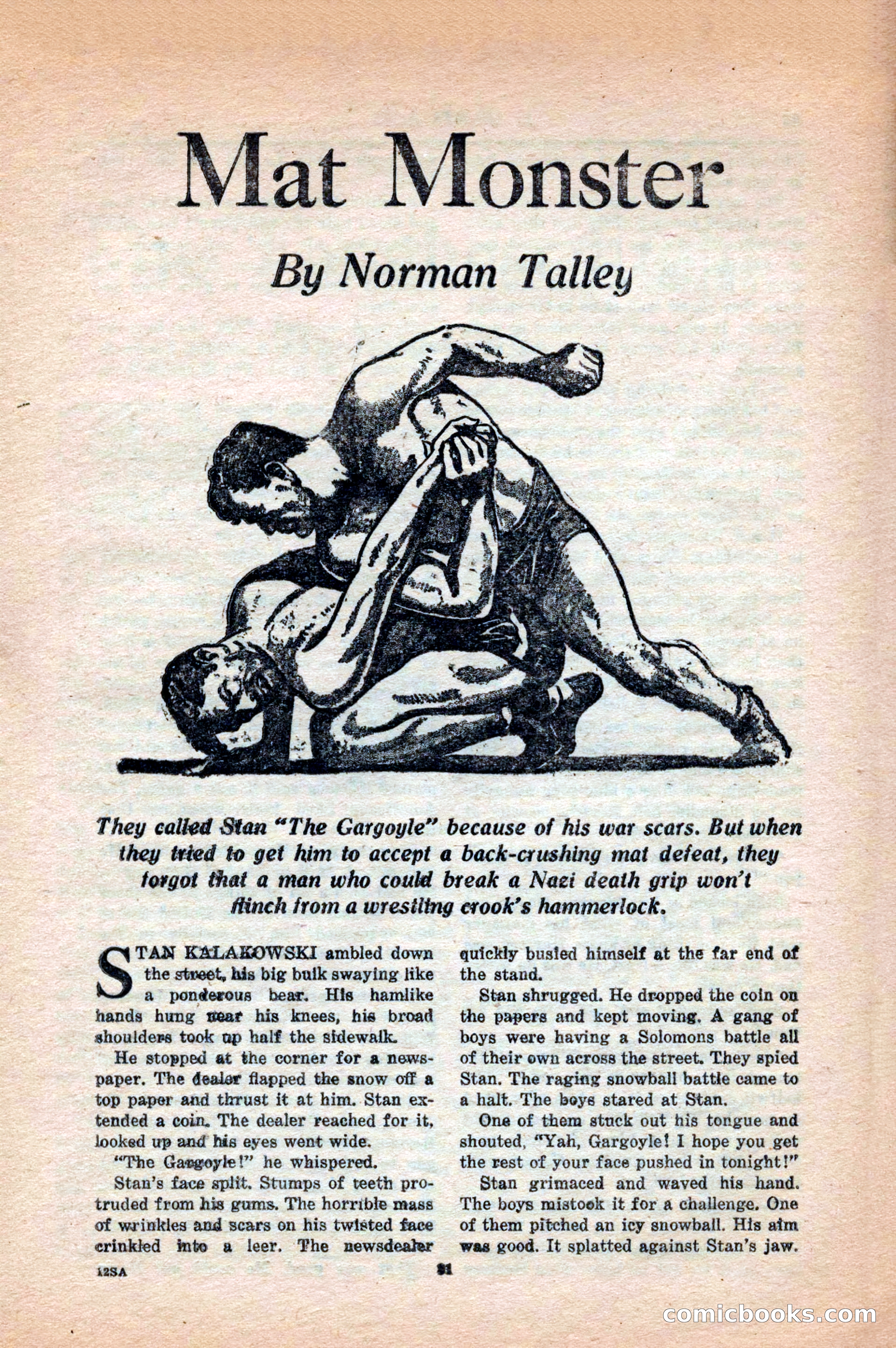
# Mat Monster Analysis This is a story page from an early pulp magazine, featuring prose fiction with an accompanying illustration at the top. The story, "Mat Monster" by Norman Talley, concerns Stan Kalakowski, a heavily scarred war veteran nicknamed "The Gargoyle" who is apparently a professional wrestler. The visible text introduces Stan walking through a snowy street, where a newspaper dealer recognizes his disfigured face with fear, and neighborhood boys taunt him before hitting him with a snowball. The subtitle promises a plot about Stan refusing a fixed wrestling match despite pressure from those who underestimate his toughness.
# Page 82: "12 Sports Aces" — Story Prose This page contains story prose from a pulp-fiction magazine. It depicts a professional wrestler nicknamed "The Gargoyle" (Stan, appears to be a Polish immigrant) preparing for a rigged match against Crusher Carter. His manager, Jake Hertzog, plans to have Stan lose deliberately so they can profit from a subsequent rematch. The passage explores Stan's foreign background, his confusion about American wrestling's commercialism versus the fair competition he knew in his home country, and his growing dislike of the unethical scheme unfolding around him.
# Mat Monster - Story Prose This page contains story prose from a pulp fiction magazine titled "Mat Monster." The narrative depicts a professional wrestling match between two fighters: Stan, the protagonist, and an opponent named Carter. Stan has been instructed by his manager Hertzog to intentionally lose the bout. The text describes the physical action of the match—Carter's aggressive attacks, Stan's strategic responses, and Carter's attempt to choke Stan into submission—while exploring Stan's internal conflict between following orders to lose and his instinct to fight fairly. The crowd's hostile reaction to Stan contrasts with their enthusiasm for Carter.
This is story prose from page 84 of *12 Sports Aces*, a pulp magazine. The text depicts an intense wrestling match between Stan and Carter, with Stan fighting to pin his opponent while enduring dirty tactics including an eye gouge. The narrative interweaves the present wrestling action with Stan's memories of being captured by Nazis in Poland in 1939, establishing his motivation to win and later fight the Germans with modern Allied support.
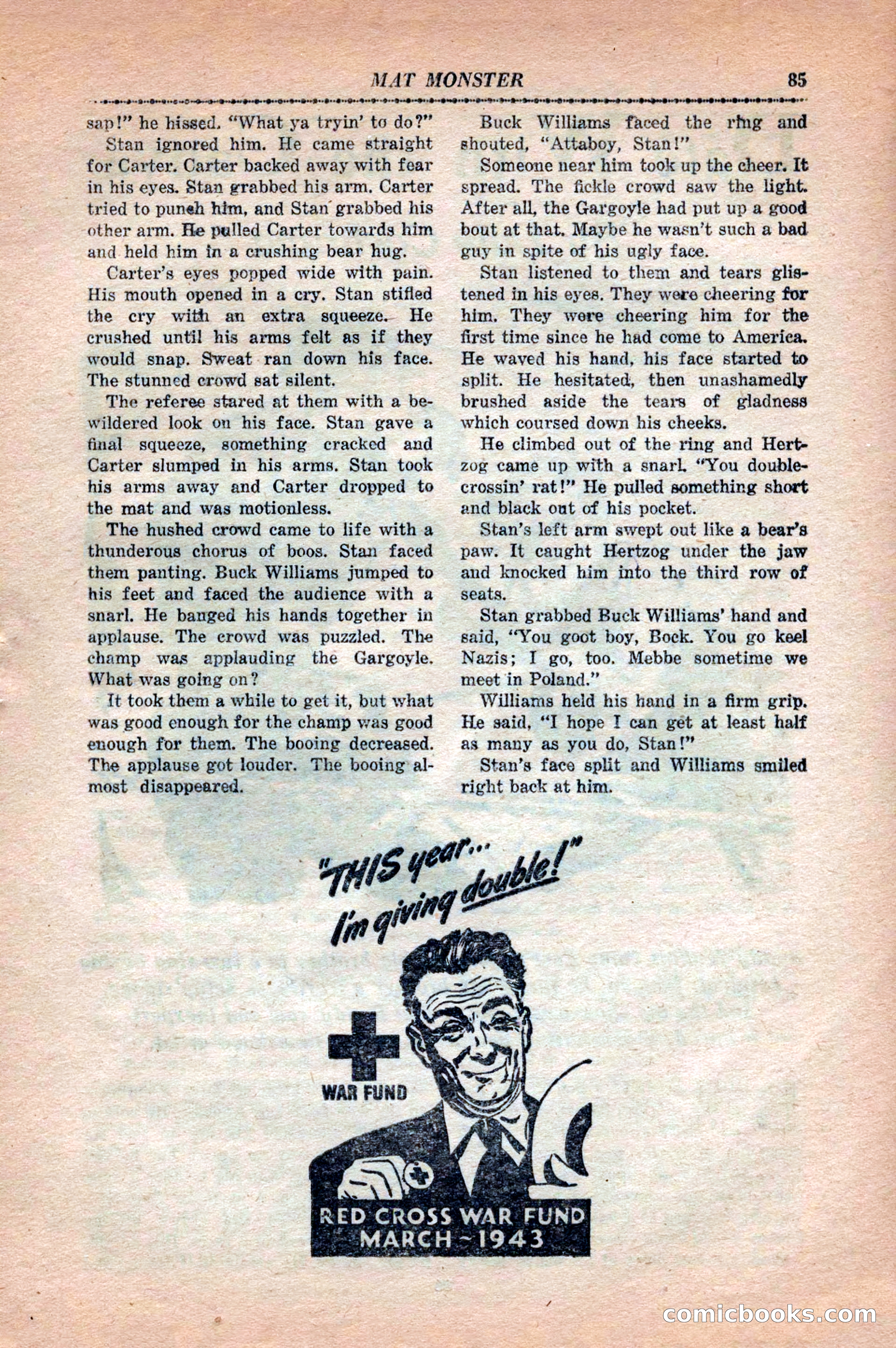
# Page Analysis: "Mat Monster" This page contains story prose from a pulp fiction narrative titled "Mat Monster" (page 85). The text depicts the climax of a wrestling match where a character named Stan defeats his opponent Carter in brutal fashion, then experiences an emotional moment when the crowd—initially booing—begins cheering for him. The passage concludes with Stan and Buck Williams discussing fighting Nazis, suggesting a wartime setting. At the bottom is a Red Cross War Fund advertisement dated March 1943, encouraging donations with the phrase "This year... I'm giving double!"
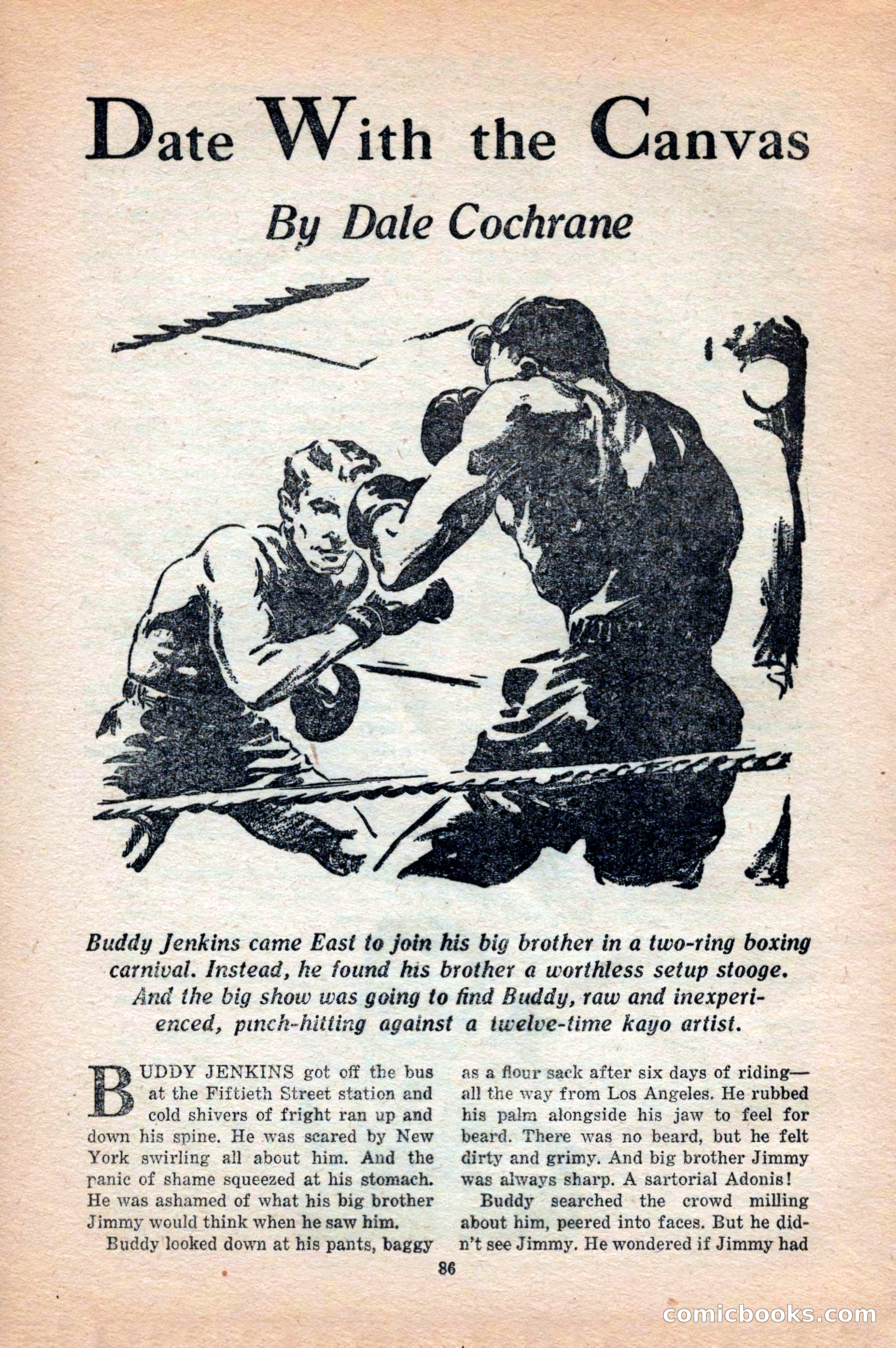
# Page Analysis This is an interior story page from a pulp magazine, featuring the beginning of a short story titled "Date With the Canvas" by Dale Cochrane. The page includes a black-and-white illustration showing two boxers in a fighting stance, and below it, the opening prose of the narrative. The story concerns a young man named Buddy Jenkins who has traveled from Los Angeles to New York to join his older brother Jimmy in boxing, only to discover his brother is a disreputable "stooge" in the sport. The visible text describes Buddy's arrival and nervous search for his brother at a bus station.
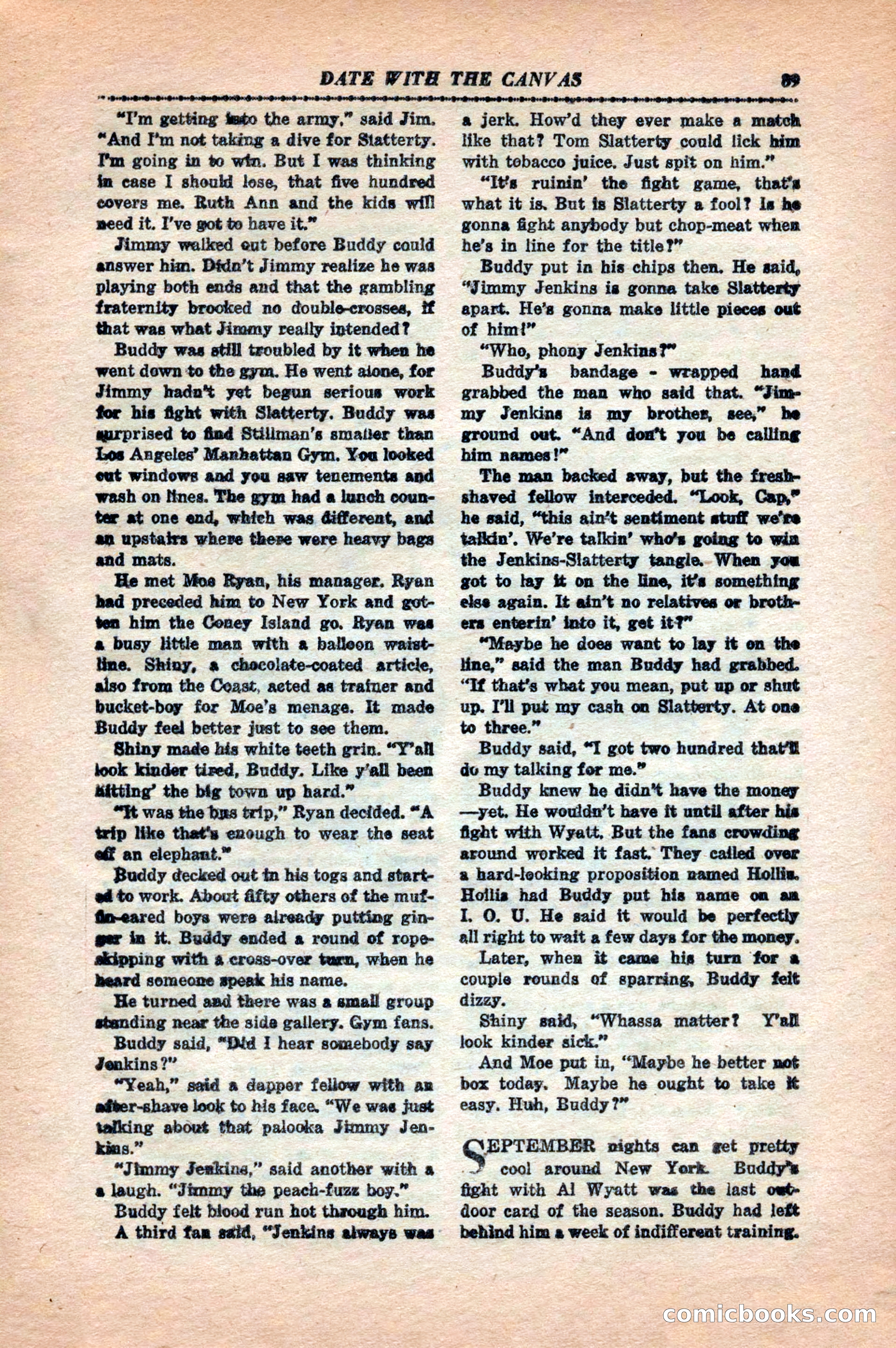
# Page Analysis: "Date with the Canvas" This is **story prose** from what appears to be a pulp fiction magazine (page 87). The text follows two brothers, Buddy and Jimmy, who reunite at Madison Square Garden in New York. Buddy, a boxer, has come to town for a fight against an opponent named Al Wyatt at Coney Island, while his older brother Jimmy was once a promising fighter himself. The passage depicts their chance meeting outside the subway and Buddy's shock at Jimmy's deteriorated appearance—worn clothes, thin face, and hollow eyes—before Jimmy brings him to his modest fifth-floor walkup apartment in their old neighborhood on Avenue A, where a blonde woman appears.
# Page 88: Sports Aces Pulp Magazine Story This page contains story prose from what appears to be a boxing/crime pulp narrative. The text follows Buddy, a boxer training for a Coney Island fight, as he discovers his brother Jimmy involved in a suspicious arrangement with three mysterious visitors. Buddy overhears the men discussing fixing a fight "in the fourth or fifth round," revealing that Jimmy has agreed to throw a bout for money—likely to pay off debts from gambling losses at a restaurant and pool hall. The passage ends with Buddy confronting Jimmy about this illegal arrangement and its serious consequences.
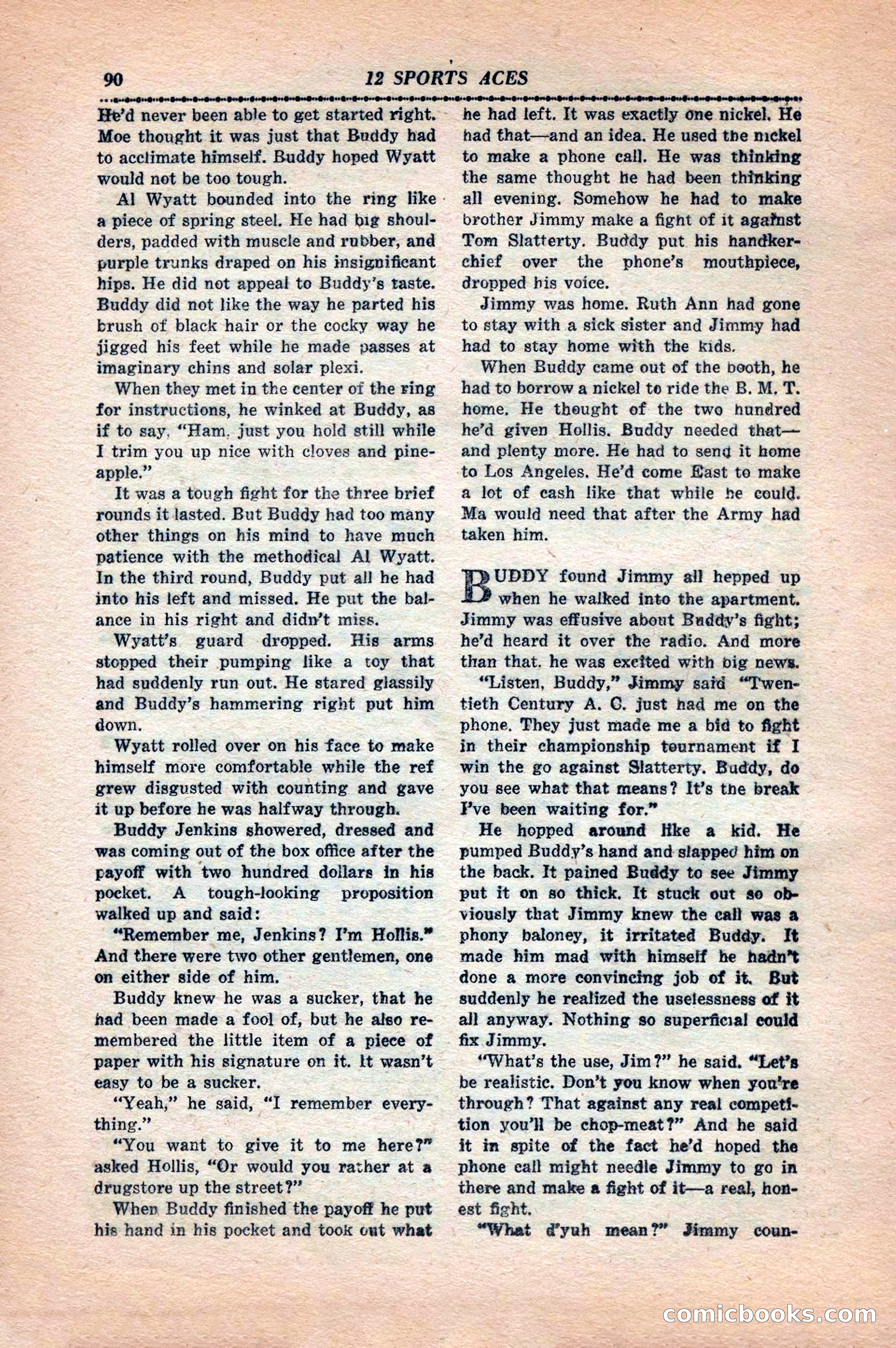
# Page Analysis **Type:** Story prose text (interior fiction page) **Content:** This page is from a hardboiled boxing story titled "Date with the Canvas." It depicts boxer Buddy at a New York gymnasium, where he overhears gym patrons dismissing his brother Jimmy Jenkins as an unworthy fighter facing champion Tom Slatterty. Buddy angrily defends his brother and, despite lacking the funds, impulsively bets two hundred dollars on Jenkins to win, arranging the wager through a man named Hollis. The narrative explores themes of family loyalty, boxing culture, and financial desperation among working-class fighters.
This page is story prose from a pulp-fiction magazine. The narrative follows Buddy Jenkins, a boxer who has just won a fight and collected two hundred dollars in prize money. However, a man named Hollis confronts him afterward and apparently collects the money, leaving Buddy with only a nickel. Buddy uses it to call his brother Jimmy with an idea, then returns home to find Jimmy excited about a championship fight opportunity—though Buddy suspects the phone call was staged for his benefit.
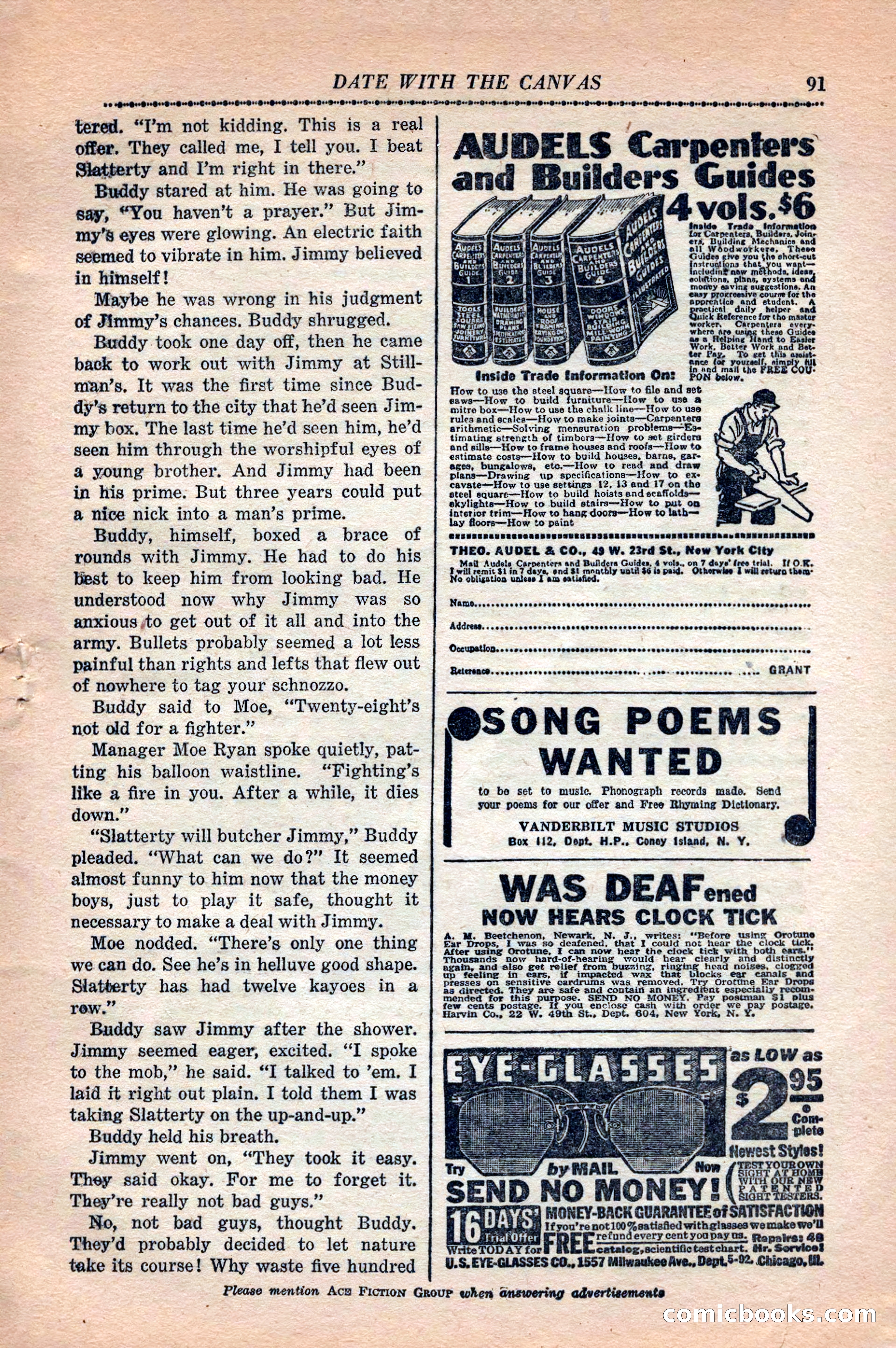
# Page Content Summary This page contains story prose from a pulp fiction narrative titled "Date with the Canvas" (page 61). The visible text describes a boxing-related plot involving characters named Buddy, Jimmy, and a manager named Moe Ryan, discussing Jimmy's upcoming fight against someone named Slatterty and his involvement with "the mob." The right half of the page is devoted to period advertisements, including Audels Carpenters and Builders Guides (a four-volume set), a "Song Poems Wanted" notice from Vanderbilt Music Studios, a "Was Deafened" testimonial ad for an ear device, and an eye-glasses advertisement offering frames "as low as $2.95."
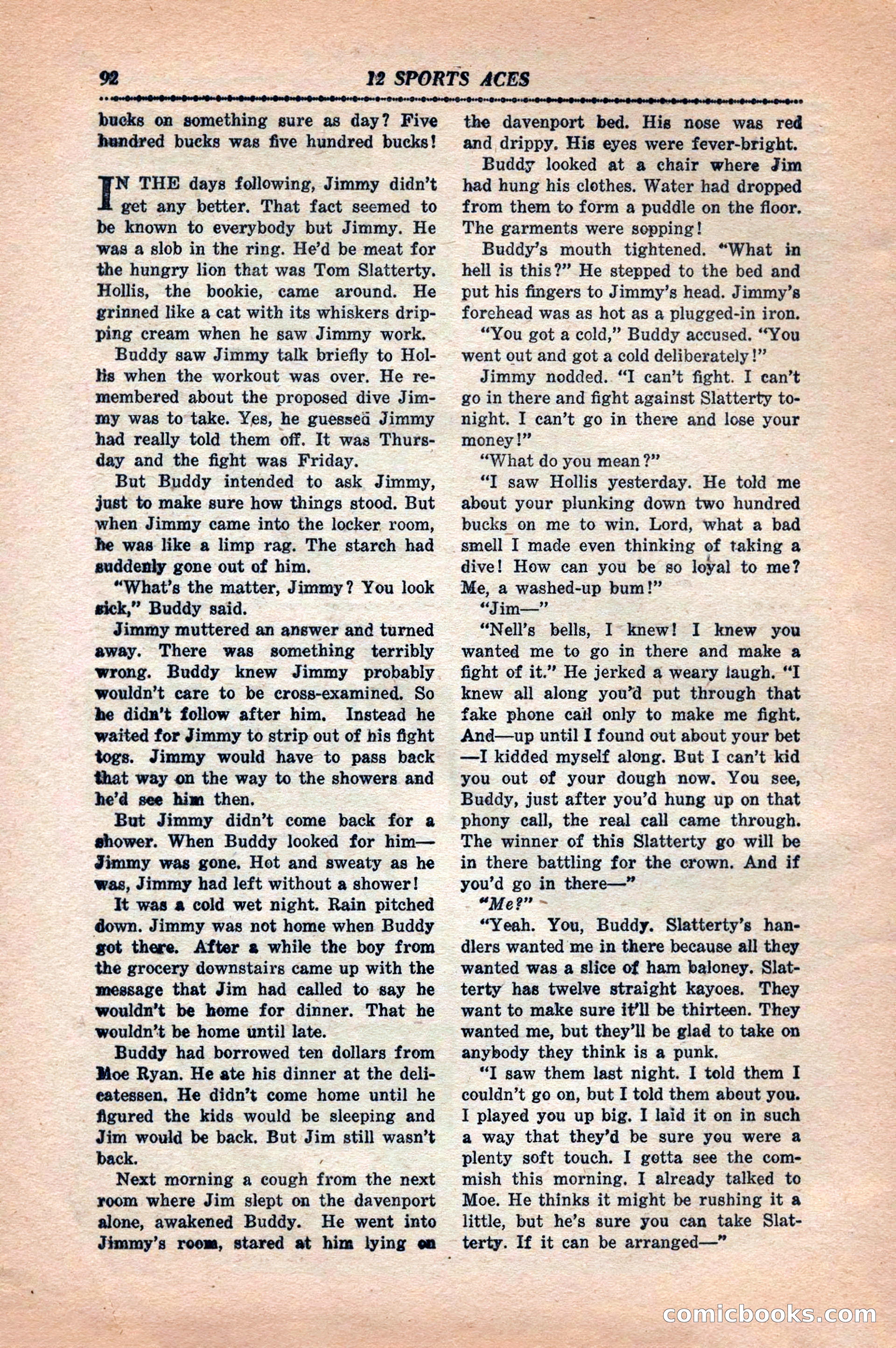
# Page Analysis: "12 Sports Aces" This page contains story prose from what appears to be a boxing-themed pulp fiction narrative. The text depicts a dramatic confrontation between Buddy and his fighter Jimmy, who has deliberately caught a cold to avoid fighting Tom Slatterty. Jimmy confesses that Buddy bet two hundred dollars on him to win, and that he cannot bring himself to take a dive as originally planned. The passage culminates with a revelation that Slatterty's handlers actually want Buddy—not Jimmy—to fight, suggesting an unexpected twist in the boxing match plot.
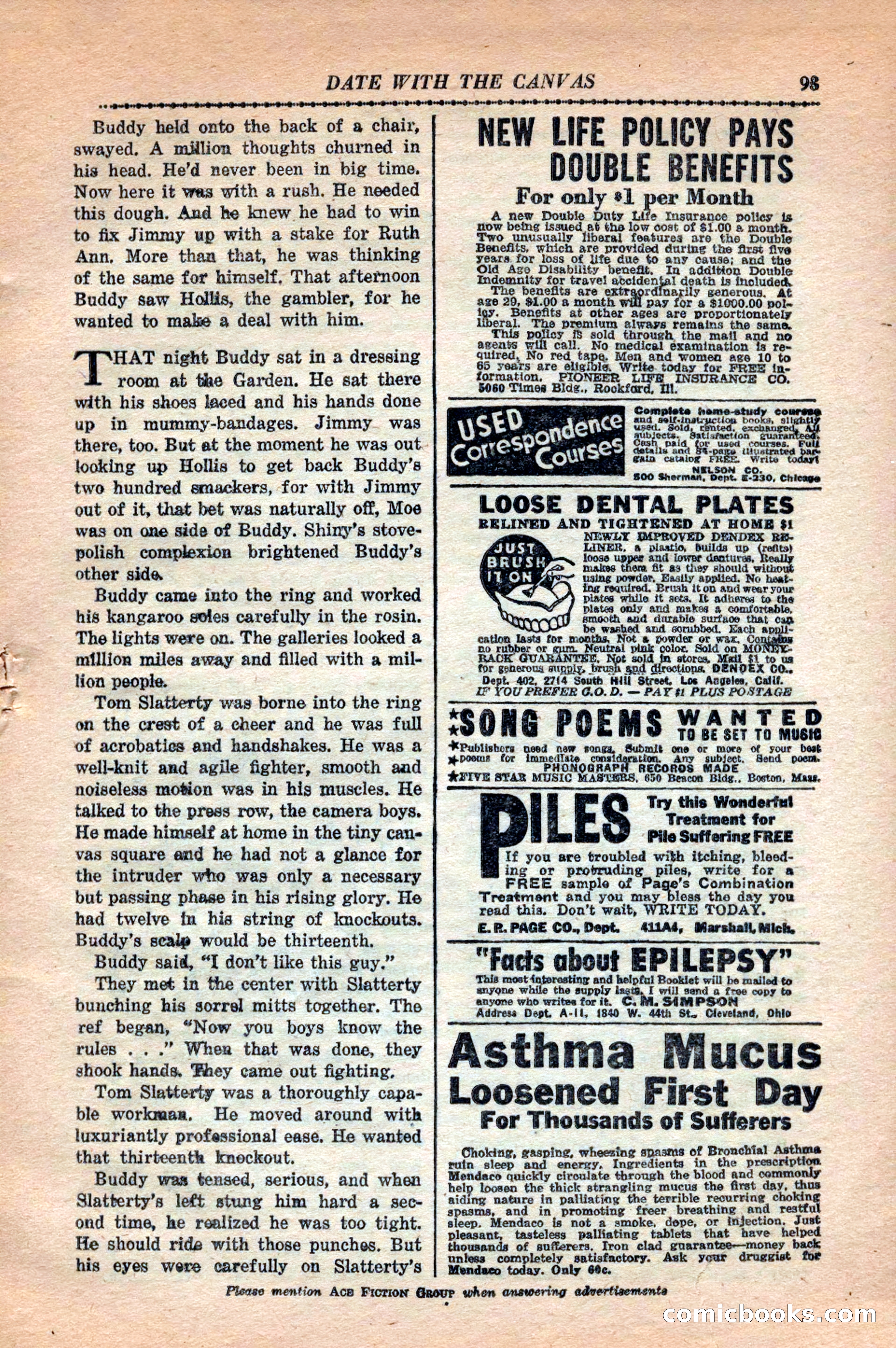
This page is the continuation of a prose story titled "Date with the Canvas" (visible at page header). The main text (left column and part of right) follows protagonist Buddy's perspective as he prepares for and begins a boxing match against Tom Slatterty at what appears to be Madison Square Garden. Buddy is tense and focused on the fight, while also thinking about personal matters involving friends Jimmy and Ruth Ann. The right side of the page is filled with various classified advertisements and product promotions typical of pulp magazines, including life insurance, dental plates, song publishing opportunities, and medical treatments for ailments like piles, epilepsy, and asthma.
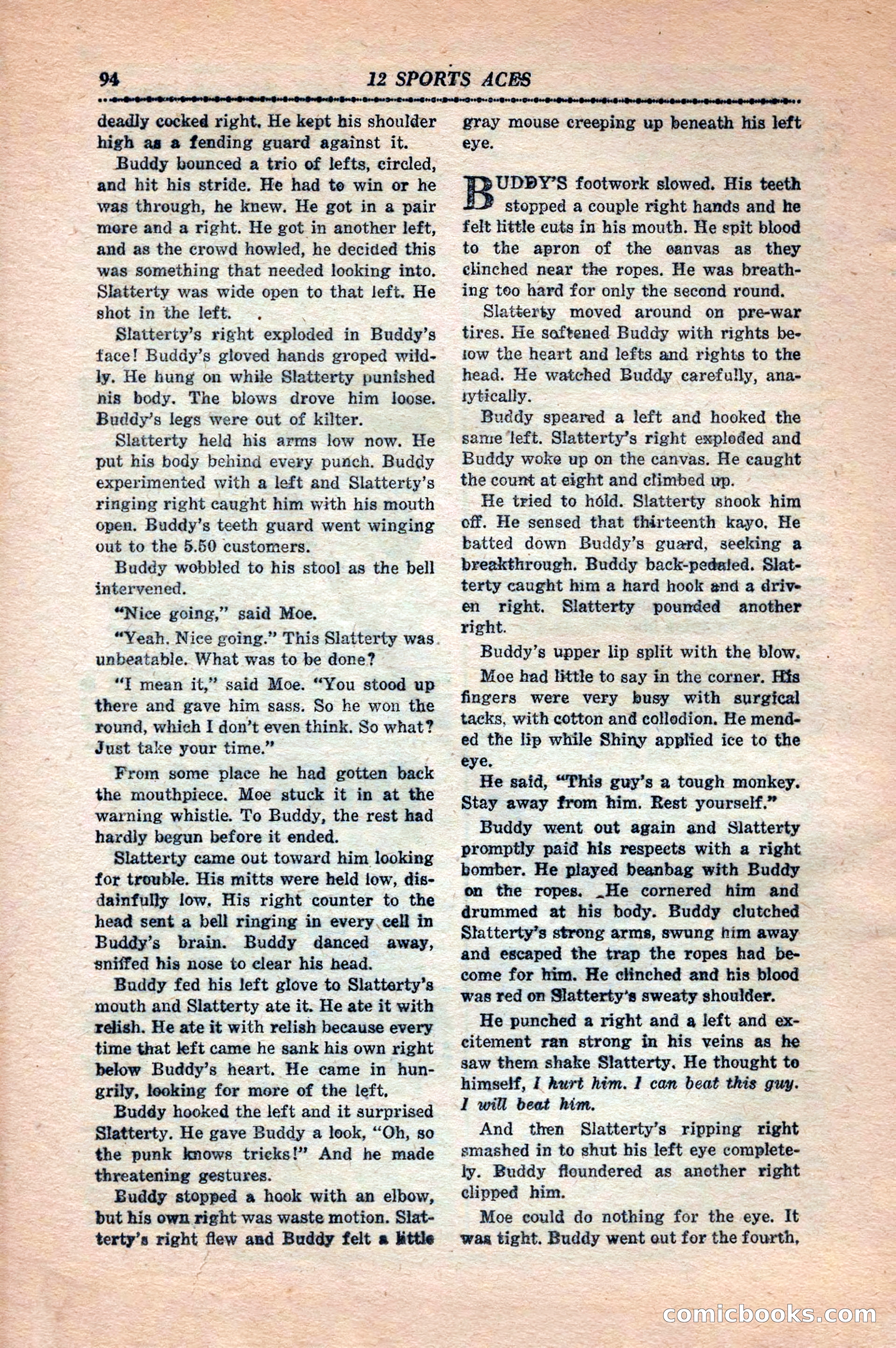
# Page Analysis This page contains **story prose** from a boxing narrative in *12 Sports Aces* pulp magazine. The text depicts an intense prizefight between two boxers named Buddy and Slatterty. Buddy is struggling through multiple rounds against the superior fighter Slatterty, absorbing heavy punishment—split lips, mouth cuts, and body blows—while his corner man Moe offers sparse encouragement between rounds. The passage captures the brutal, exhausting nature of the bout as Buddy attempts to survive the onslaught despite mounting injuries and Slatterty's relentless aggression.
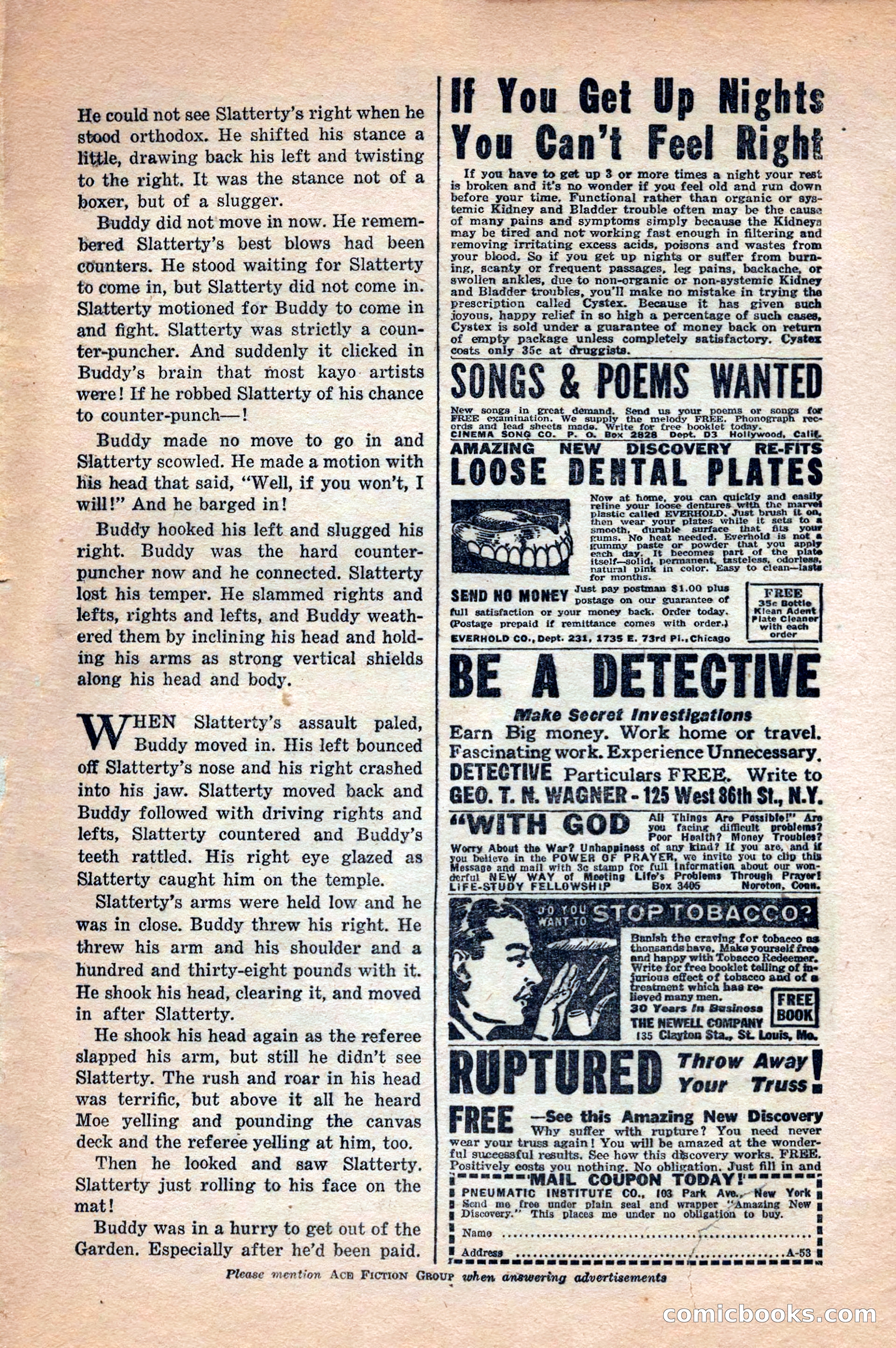
This page contains the conclusion of a pulp-fiction boxing story alongside various period advertisements. The left column depicts a climactic fight between characters named Buddy and Slatterty in what appears to be Madison Square Garden, with Buddy ultimately defeating his opponent. The right side features vintage advertisements for products like Cystex (a kidney/bladder remedy), loose dental plates, songs and poems wanted, detective work opportunities, and tobacco cessation treatments—typical commercial content found in early-20th-century pulp magazines.
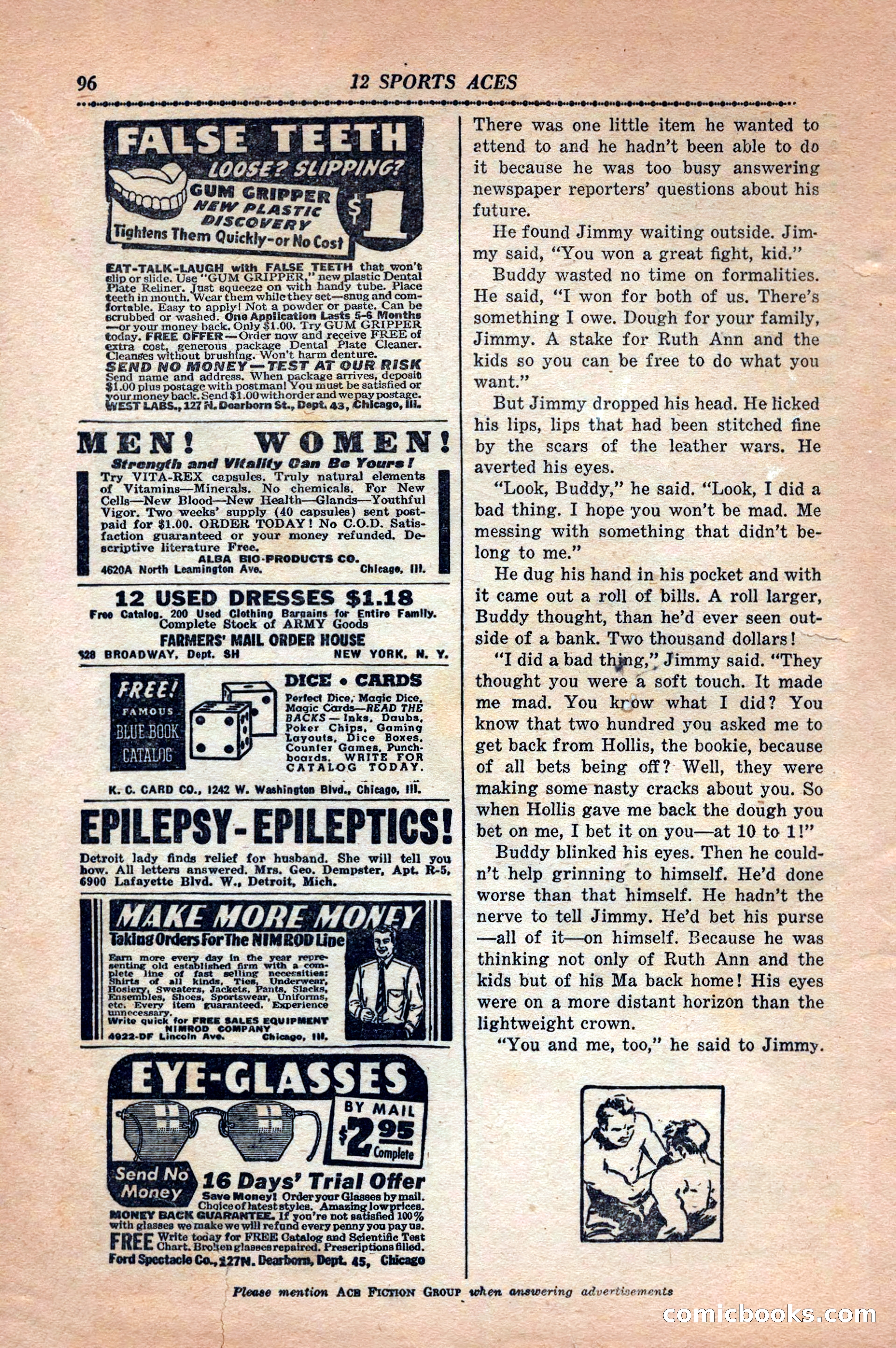
# Page Analysis This is page 96 of a pulp fiction magazine titled "12 Sports Aces." The page is divided between advertisements (left side) and story prose (right side). The visible story text depicts a scene between two characters, Buddy and Jimmy, after what appears to be a boxing match. Jimmy confesses to Buddy that he bet money on Buddy's fight at 10-to-1 odds using funds Buddy had asked him to recover from a bookie named Hollis. The passage explores their friendship and mutual sacrifice, with both having risked their finances on the outcome. The left side contains period advertisements for false teeth adhesive, vitamin supplements, mail-order clothing, dice and cards, and eyeglasses—typical of pulp magazine advertisements from this era.
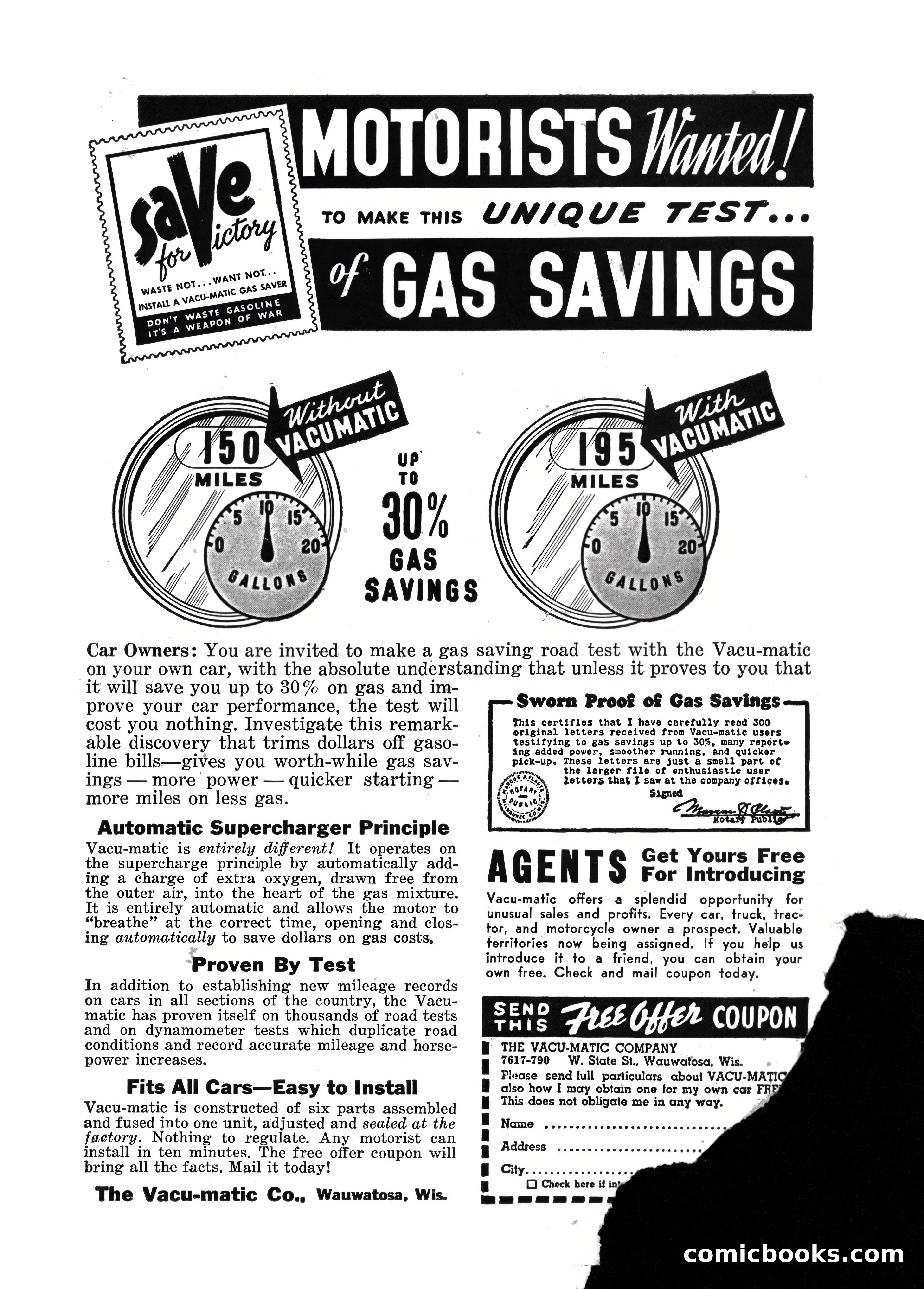
# Page Description This is a full-page advertisement, not story content. It promotes the Vacu-matic, a purported automotive supercharger device that claims to improve gas mileage by up to 30% and enhance engine performance. The ad invites motorists to test the device on their own cars at no cost, includes testimonials of gas savings, explains the "automatic supercharger principle" operating on added oxygen, and offers a free coupon for interested buyers or sales agents in Wauwatosa, Wisconsin.
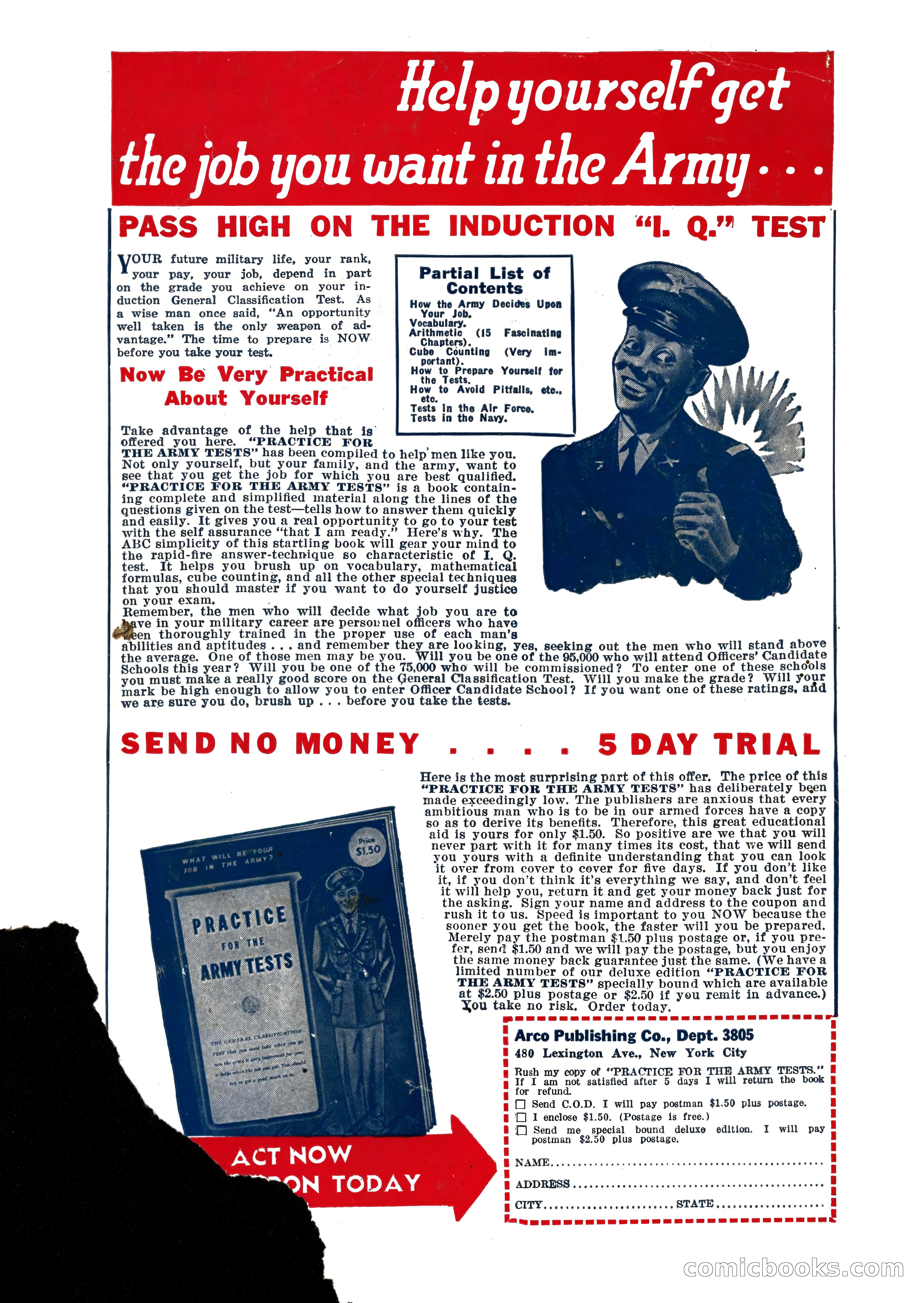
# Analysis of Advertisement Page This is a full-page advertisement, not story content or a magazine cover. It promotes a study guide titled "Practice for the Army Tests," designed to help men prepare for the Army's induction General Classification Test. The ad emphasizes that performance on this test determines military job placement, rank, and pay, and argues that the $1.50 study book offers essential preparation in vocabulary, mathematics, and test-taking techniques. A coupon at the bottom allows readers to order the book with a five-day money-back guarantee. The advertisement appears designed to appeal to young men facing military induction during what appears to be the World War II era.