
Pulp Fiction, 1943 · page 89 of 100
12 Sports Aces, May 1943 — page 89: what you’re looking at
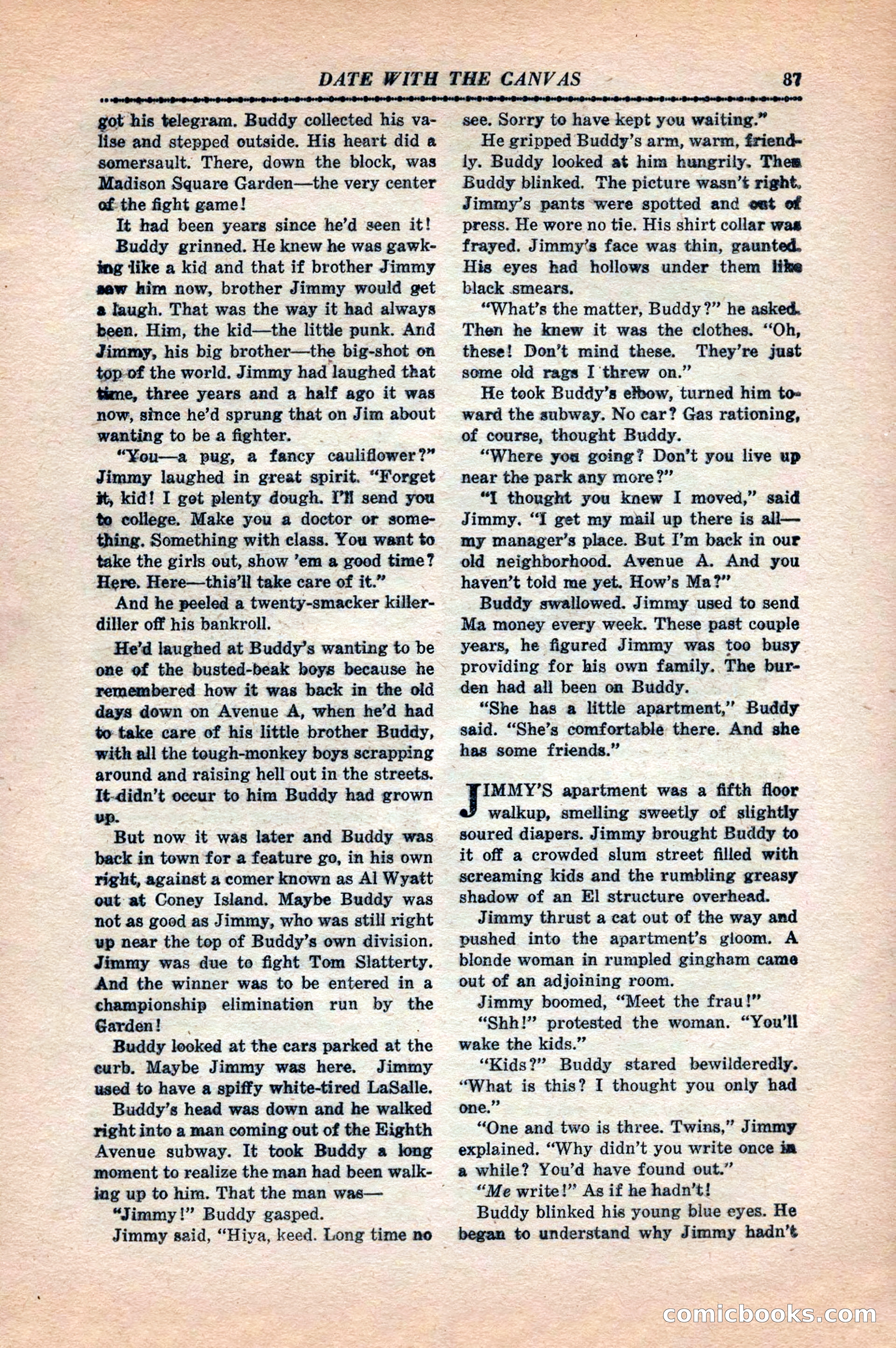
A restored page from Pulp Fiction, 1943. Page through the whole issue in the reader above.
📄 Transcribed text from this page (OCR, searchable)
Machine-transcribed from the original scan — historical spelling and the odd misread are preserved.
DATE WITH THE CANVAS got his telegram. Buddy collected his va- lise and stepped outside. His heart did a somersault. There, down the block, was Madison Square Garden—the very center of: the fight game! It had been years since he’d seen it! Buddy grinned. He knew he was gawk- ing like a kid and that if brother Jimmy saw him now, brother Jimmy would get @ laugh. That was the way it had always been. Him, the kid—the little punk. And Jimmy, his big brother—the big-shot on top-of the world. Jimmy had laughed that time, three years and a half ago it was ‘now, since he’d sprung that on Jim about wanting to bea fighter. “You—a pug, a fancy cauliflower?” Jimmy laughed in great spirit. “Forget it, kid! I got plenty dough. 7M send you to college. Make you a doctor or some- thing. Something with class. You want to take the girls out, show ’em a good time? Here. Here—this’ll take care of it.” And he peeled a twenty-smacker killer- diller off his bankroll. He’d laughed at Buddy’s wanting to be one of the busted-beak boys because he remembered how it was back in the old days down on Avenue A, when he’d had to take care of his little brother Buddy, with all the tough-monkey boys scrapping around and raising hell out in the streets. It-didn’t oceur to him Buddy had grown But now it was later and Buddy was back in town for a feature go, in his own right, against a comer known as Al Wyatt out at Coney Island. Maybe Buddy was not as good as Jimmy, who was still right up near the top of Buddy’s own division. Jimmy was due te fight Tom Slatterty. And the winner was to be entered in a championship elimination run by the Garden! . Buddy leoked at the cars parked at the eurb. Maybe Jimmy was here. Jimmy used to have a spiffy white-tired LaSalle. Buddy’s head was down and he walked right into a man coming out of the Highth Avenue subway. It took Buddy a long moment to realize the man had been walk- ing up to him. That the man was— “Jimmy!” Buddy gasped. Jimmy said, “Hiva, keed. Long time no 87 see. Sorry to have kept you waiting.” He gripped Buddy’s arm, warm, friend- ly. Buddy looked at him hungrily. Thes Buddy blinked, The picture wasn’t right, Jimmy’s pants were spotted and eat of press. He wore no tie. His shirt collar was frayed. Jimmy’s face was thin, gaunted. His eyes had hollows under them like black smears, “‘What’s the matter, Buddy?” he asked. Then he knew it was the clothes. “‘Oh, these! Don’t mind these. They’re just some old rags I threw on.” He teok Buddy’s elbow, turned him to- ward the subway. No car? Gas rationing, : of course, thought Buddy. “Where you going? Don’t you live up near the park any more?” “{ thought you knew I moved,” said Jimmy. “I get my mail up there is all— my manager’s place. But I’m back in our old neighborhood. Avenue A. And you haven’t told me yet. How’s Ma?” Buddy swallowed. Jimmy used to send Ma money every week. These past couple years, he figured Jimmy was too busy providing for his own family. The bur- den had all been on Buddy. “She has a little apartment,” Buddy said. “She’s comfortable there. And she has some friends.” WIMMY’S apartment was a fifth floor walkup, smelling sweetly of slightly soured diapers. Jimmy brought Buddy to it off a crowded slum street filled with sereaming kids and the rumbling greasy shadow of an El structure overhead. Jimmy thrust a cat out of the way and pushed into the apartment’s gioom. A blonde woman in rumpled gingham came out of an adjoining room. Jimmy boomed, “Meet the frau!” “Shh!” protested the woman. “You'll wake the kids.” “Kids?” Buddy stared bewilderedly. “What is this? I thought you only had one.” “One and two is three. Twins,” Jimmy explained. “Why didn’t you write once i a while? You’d have found out.” “Me write!” As if he hadn’t! Buddy blinked his young blue eyes. He began to understand why Jimmy hadn’t Gomichbook (EO) 3