
Pulp Fiction, 1943 · page 11 of 100
12 Sports Aces, May 1943 — page 11: what you’re looking at
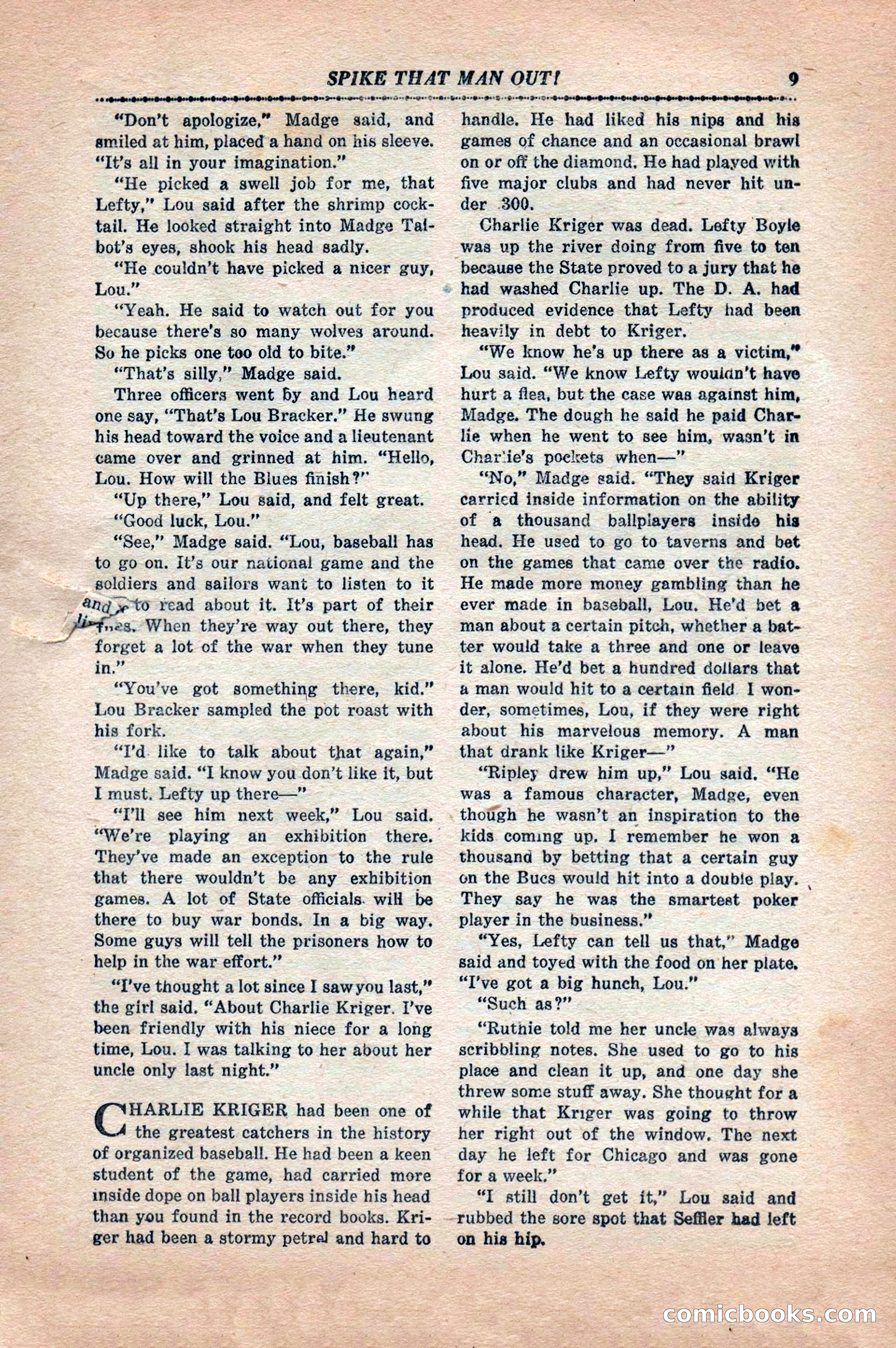
A restored page from Pulp Fiction, 1943. Page through the whole issue in the reader above.
📄 Transcribed text from this page (OCR, searchable)
Machine-transcribed from the original scan — historical spelling and the odd misread are preserved.
SPIKE THAT MAN OUT! 3 == © 0 0 rene esQer Ber Gee Gor Gee Gor Gee Ger her Gor er Ger Gor Bo- Der Boe Feo ewer He ek das Beier Cees ene Dee Ger Pee Ber Devoe “Don’t apologize,” Madge said, and smiled at him, placed a hand on his sleeve. “It’s all in your imagination.” “He picked a swell job for me, that Lefty,” Lou said after the shrimp cock- tail. He looked straight into Madge Tal- bot’s eyes, shook his head sadly. “Te couldn’t have picked a nicer guy, Lou.” “Yeah. He said to watch out for you because there’s so many wolves around. So he picks one too old to bite.” “That’s silly,” Madge said. Three officers went by and Lou heard one say, “That’s Lou Bracker.” his head toward the voice and a lieutenant came over and grinned at him. “Hello, Lou. How will the Blues finish?” “Up there,” Lou said, and felt great. “Good luck, Lou.” “See,” Madge said. “Lou, baseball has to go on. It’s our national game and the soldiers and sailors want to listen to it _ and “to read about it. It’s part of their nes, When they’re way out there, they forget a lot of the war when they tune in.” “You’ve got something there, kid.” Lou Bracker sampled the pot roast with his fork. “T’d. like to talk about that again,” Madge said. “I know you don’t like it, but I must. Lefty up there—” “T’ll see him next week,” Lou said. “We're playing an exhibition there. They’ve made an exception to the rule that there wouldn’t be any exhibition games. A lot of State officials. wil be there to buy war bonds. In a big way. Some guys will tell the prisoners how to - help in the war effort.” “I’ve thought a lot since I sawyou last,” the girl said. “About Charlie Kriger. I’ve been friendly with his niece for a long time, Lou. I was talking to her about her uncle only last night.” HARLIE KRIGER had been one of the greatest catchers in the history of organized baseball. He had been a keen student of the game, had carried more inside dope on ball players inside his head than you found in the record books. Kri- ger had been a stormy petrel and hard to He swung Bias handle. He had liked his nips and his games of chance and an occasional brawl on or off the diamond, He had played with five major clubs and had: never hit un- der 300. Charlie Kriger was dead. Lefty Boyle was up the river doing from five to ten ‘because the State proved to a jury that he » had washed Charlie up. The D. A. had produced evidence that Lefty had been heavily in debt to Kriger. “We know he’s up there as a victim,” Lou said. “We know Lefty wouidn’t have hurt a flea, but the case was against him, Madge. The dcugh he said he paid Char- lie when he went to see him, wasn’t in Char'ie’s pockets when—” “No,” Madge said. “They said Kriger carried inside information on the ability of a thousand ballplayers inside his head. He used to go to taverns and bet on the games that came over the radio. He made more money gambling than he ever made in baseball, Lou. He'd bet a man about a certain pitch, whether a bat- ter would take a three and one or leave it alone. He’d bet a hundred dollars that & man would hit to a certain field. I won- der, sometimes, Lou, if they were right about his marvelous memory. A man that drank like Kriger—” “Ripley drew him up,” Lou said, “He was a famous character, Madge, even thoigh he wasn’t an inspiration to the kids coming up. 1 remember he won a thousand by betting that a certain guy on the Bucs would hit into a double play. . They say he was the smartest poker player in the business.” “Yes, Lefty can tell us that,” Madge said and toyed with the food on her plate, “T’ve got a big hunch, Lou.” “Such as?” “Ruthie told me her uncle was always scribbling notes. She used to go to his place and clean it up, and one day she threw some stuff away. She thought for a while that Kriger was going to throw her right out of the window. The next day he left for Chicago and was gone for a week.” “TY still don’t get it,” Lou said and -rubbed the sore spot that Seffier had left on his hip, com *(a) ,OOKS (EO)