
Pulp Fiction, 1943 · page 81 of 100
12 Sports Aces, May 1943 — page 81: what you’re looking at
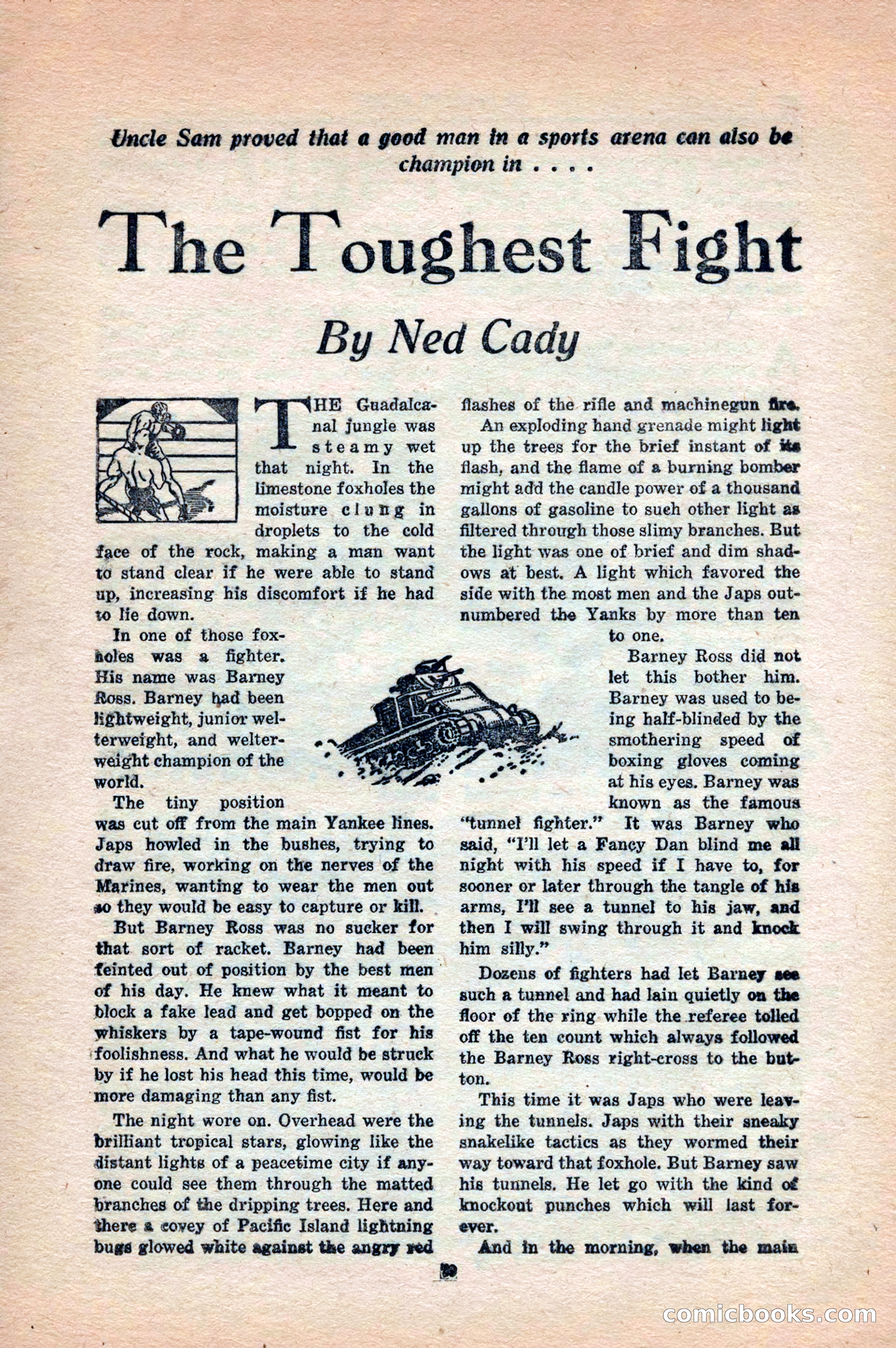
A restored page from Pulp Fiction, 1943. Page through the whole issue in the reader above.
📄 Transcribed text from this page (OCR, searchable)
Machine-transcribed from the original scan — historical spelling and the odd misread are preserved.
» Uncle Sam proved that a geod man in a sports arena can also be champion in... . The Toughest Fight By Ned Cady HE Guadalca- nal jungle was 3 steamy wet that night. In the limestone foxholes the moisture clung in droplets to the cold face of the rock, making a man want to stand clear if he were able to stand up, increasing his discomfort if he had 10 lie down. In one of those fox- holes was a fighter. His name was Barney Ross. Barney had been Ee&htweight, junior wel- terweight, and welter- weight champion of the world. The tiny position was cut off from the main Yankee lines. Japs howled in the bushes, trying to draw fire, working on the nerves of the Marines, wanting to wear the men out ao they would be easy to capture or kill. | But Barney Ross was no sucker for that. sort of racket. Barney had been feinted out of position by the best men’ of his day. He knew what it meant to block a fake lead and get bopped on the whiskers by a tape-wound fist for his ‘foolishness. And what he would be struck by if he lost his head this time, would be ‘more damaging than any fist. The night wore on. Overhead were the brilliant tropical stars, glowing like the distant lights of a peacetime city if any- one could see them through the matted branches of the dripping trees. Here and there a covey of Pacific Island lightning bugs glowed white against the angry red flashes of the rifle and machinegun fire. An exploding hand grenade might light up the trees for the brief instant of is flash, and the flame of a burning bomber might add the candle power of a thousand gallons of gasoline to sueh other light as filtered through those slimy branches. But the light was one of brief and dim shad- ows at best. A light which favored the side with the most men and the Japs out- numbered the Yanks by more than to one, Barney Ross did not let this bother him. Barney was used to be- ing half-blinded by the smothering speed of boxing gloves coming at his eyes. Barney was known as the famous “tunnel fighter.” It was Barney who said, “I'll let a Fancy Dan blind me ali night with his speed if I have to, for sooner or later through the tangle of his arms, I'll see a tunnel to his jaw, and then I will swing through it and knock him silly.” Dozens of fighters had let Barney see such a tunnel and had lain quietly on the floor of the ring. while the referee tolled off the ten count which always followed the Barney Ross right-cross to the but- ton. ; This time it was Japs who were leav- ing the tunnels. Japs with their sneaky snakelike tactics as they wormed their way toward that foxhole. But Barney saw his tunnels. He let go with the kind of knockout punches which will last for- ever, And in the morning, when the main COPMIG OOO S (Ee)