
Pulp Fiction, 1943 · page 8 of 100
12 Sports Aces, May 1943 — page 8: what you’re looking at
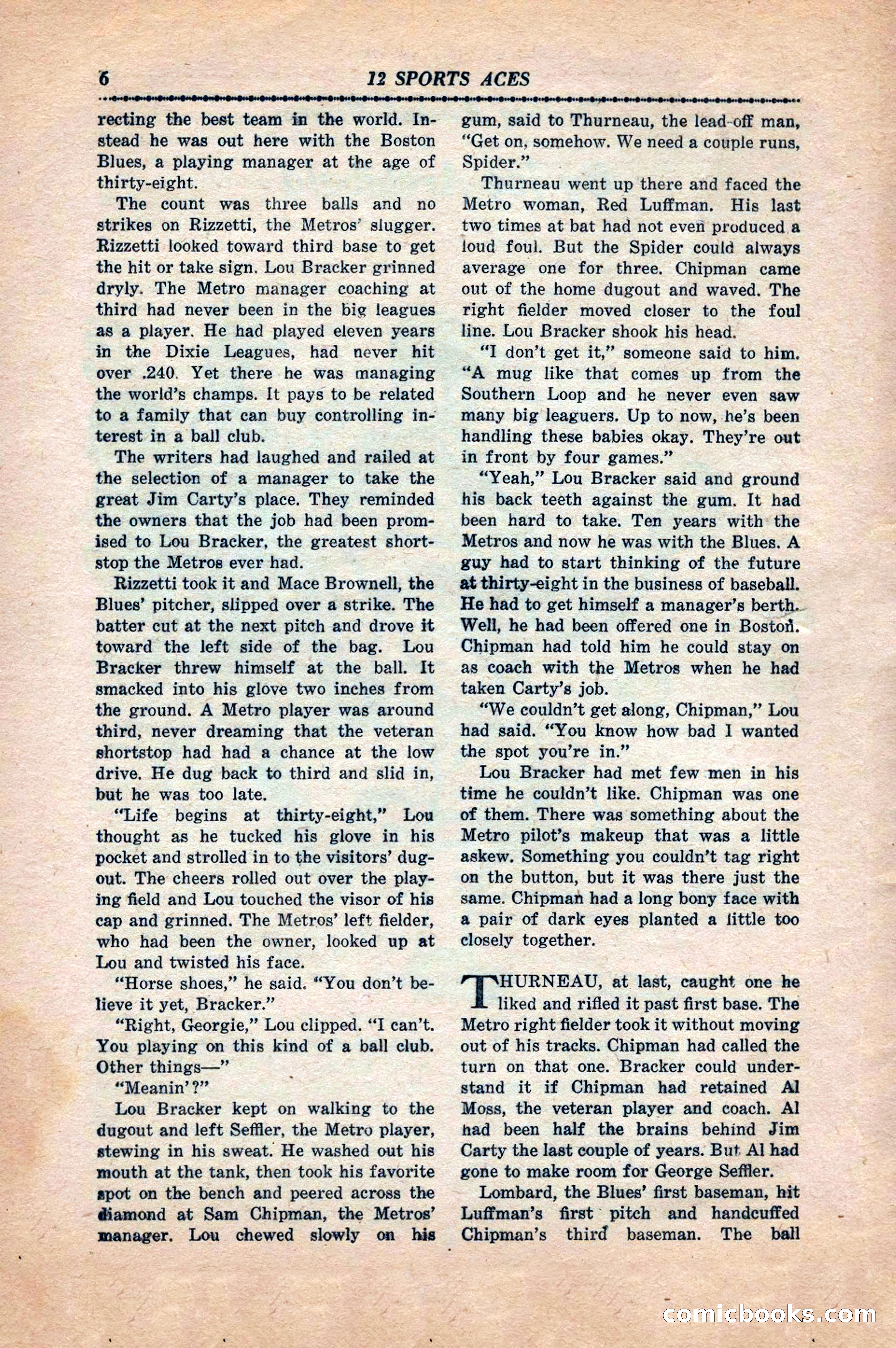
A restored page from Pulp Fiction, 1943. Page through the whole issue in the reader above.
📄 Transcribed text from this page (OCR, searchable)
Machine-transcribed from the original scan — historical spelling and the odd misread are preserved.
. 6 12 SPORTS ACES 1 8 Ont 0+ ee Gee Per GroGerPer Por Ger Gre Gor Bor Ger Goe Ger G sr Gre Gee G11 Ges Gor Her Ser Gor Gor G ov Or Gre Ore Wee «Per GooG ro 1214 Bs Bie Gs Bar Bore Ors Ore Oo Ores Ore Gir Ore Ger Orr Bor Peres GerCerdee 6 recting the best team in the world. In- stead he was out here with the Boston Blues, a playing manager at the age of thirty-eight. The count was three balls and no strikes on Rizzetti, the Metros’ slugger. Rizzetti looked toward third base to get the hit or take sign. Lou Bracker grinned dryly. The Metro manager coaching at third had never been in the big leagues as a player. He had played eleven years in the Dixie Leagues, had never hit over .240. Yet there he was managing the world’s champs. It pays to be related to a family that can buy controlling in- terest in a ball club. The writers had laughed and railed at the selection of a manager to take the great Jim Carty’s place. They reminded the owners that the job had been prom- ised to Lou Bracker, the greatest short- stop the Metros ever had. Rizzetti took it and Mace Brownell, the Blues’ pitcher, slipped over a strike. The batter cut at the next pitch and drove it toward the left side of the bag. Lou Bracker threw himself at the ball. It smacked into his glove two inches from the ground. A Metro player was around third, never dreaming that the veteran shortstop had had a chance at the low drive. He dug back to third and slid in, but he was too late. “Life begins at thirty-eight,” Lou thought as he tucked his glove in his pocket and strolled in to the visitors’ dug- out. The cheers rolled out over the play- ing field and Lou touched the visor of his cap and grinned. The Metros’ left fielder, who had been the owner, looked up at Lou and twisted his face. “Horse shoes,” he said. “You don’t be- lieve it yet, Bracker.” | “Right, Georgie,” Lou clipped. “I can’t. You playing on this kind of a ball club. Other things—” ““Meanin’ ?” Lou Bracker kept on walking to the dugout and left Seffier, the Metro player, stewing in his sweat. He washed out his mouth at the tank, then took his favorite spot on the bench and peered across the diamond at Sam Chipman, the Metros’ manager. Lou chewed slowly on his gum, said to Thurneau, the lead-off man, “Get on, somehow. We need a couple runs, Spider.” Thurneau went up there and faced the Metro woman, Red Luffman. His last two times at bat had not even produced.a loud foul. But the Spider could always average one for three. Chipman came out of the home dugout and waved. The right fielder moved closer to the foul line. Lou Bracker shook his head. “TI don’t get it,” someone said to him. “A mug like that comes up from the Southern Loop and he never even saw many big leaguers. Up to now, he’s been handling these babies okay. They’re out in front by four games.” “Yeah,” Lou Bracker said and ground his back teeth against the gum. It had been hard to take. Ten years with the Metros and now he was with the Blues. A guy had to start thinking of the future at thirty-eight in the business of baseball. He had to get himself a manager’s berth. Well, he had been offered one in Boston. Chipman had told him he could stay on as coach with the Metros when he had taken Carty’s job. “We couldn’t get along, Chipman,” Lou had said. “You know how bad I wanted the spot you’re in.” Lou Bracker had met few men in his time he couldn’t like. Chipman was one of them. There was something about the Metro pilot’s makeup that was a little askew. Something you couldn’t tag right on the button, but it was there just the same. Chipman had a long bony face with a pair of dark eyes planted a little too closely together. HURNEAU, at last, caught one he liked and rifled it past first base. The | Metro right fielder took it without moving out of his tracks. Chipman had called the turn on that one. Bracker could under- stand it if Chipman had retained Al Moss, the veteran player and coach. Al had been half the brains behind Jim Carty the last couple of years. But Al had gone to make room for George Seffler. Lombard, the Blues’ first baseman, hit Luffman’s first pitch and handcuffed Chipman’s third baseman. The ball Gomichboo (eC)