
Pulp Fiction, 1943 · page 92 of 100
12 Sports Aces, May 1943 — page 92: what you’re looking at
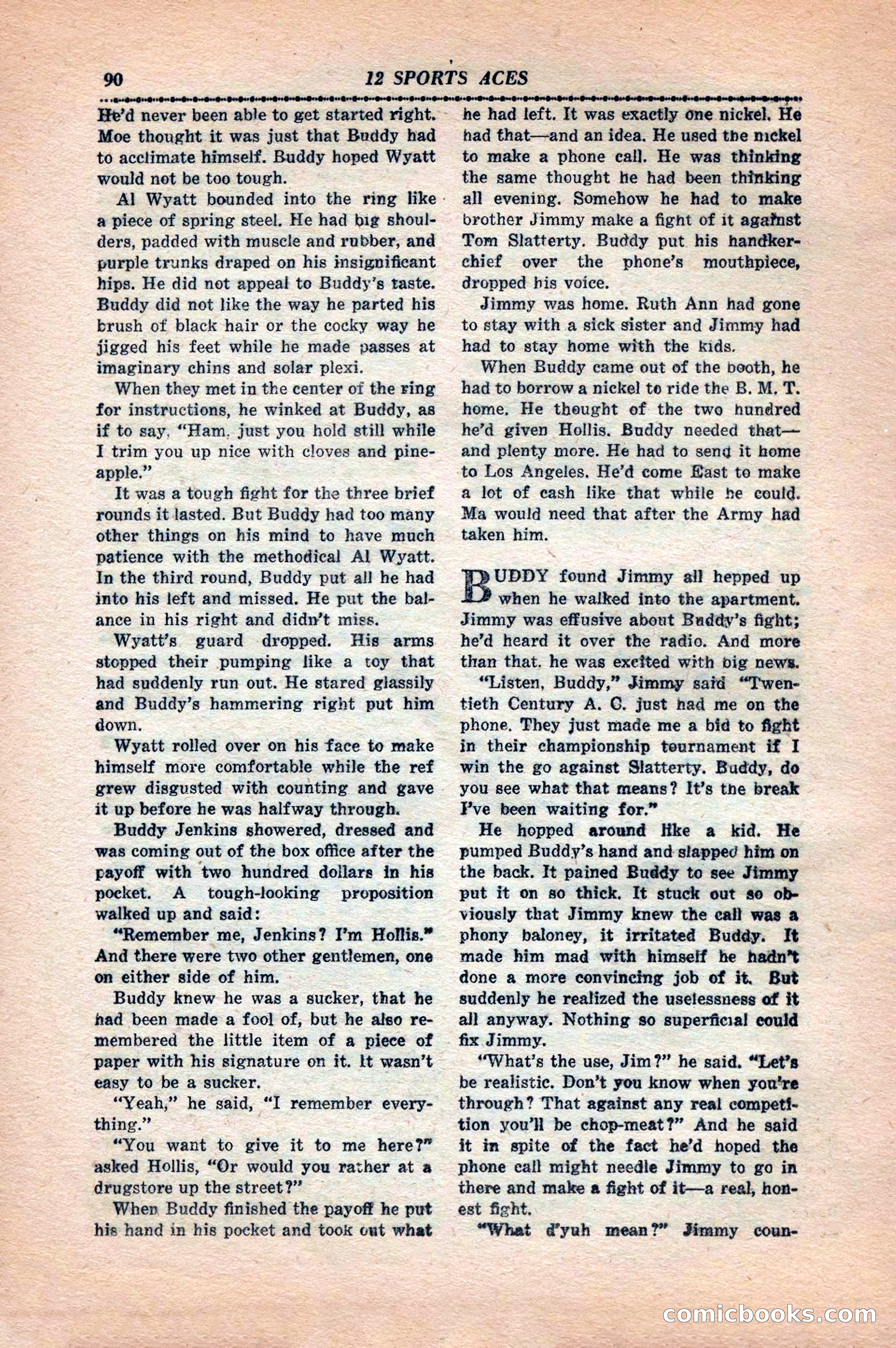
A restored page from Pulp Fiction, 1943. Page through the whole issue in the reader above.
📄 Transcribed text from this page (OCR, searchable)
Machine-transcribed from the original scan — historical spelling and the odd misread are preserved.
90 2 e000 de Ge Gor Fre Ore Ove Bes Per Gor Gor Ger Ber Grr Sor Ger Gee G 0+ Ors oo Oo Grr He’d never been able to get started right. Moe thought it was just that Buddy had to acclimate himself. Buddy hoped Wyatt would not be too tough. Al Wyatt bounded into the ring like - a piece of spring steel. He had big shoul- ders, padded with muscle and rubber, and purple trunks draped on his msignificant hips. He did not appeal to Buddy’s taste. Buddy did not like the way he parted his brush of black hair or the cocky way he jigged his feet while he made passes at imaginary chins and solar plexi. When they met in the center of the ring for instructions, he winked at Buddy, as if to say, “Ham. just you hold still while I trim you up nice with cloves and pine- apple.” It was a tough fight for the three brief rounds it lasted. But Buddy had too many other things on his mind to have much patience with the methodical Al Wyatt. In the third round, Buddy put al! he had into his left and missed. He put the bal- ance in his right and didn’t miss. Wyatt's guard dropped. His arms stopped their pumping like a toy that had suddenly run out. He stared giassily and Buddy’s hammering right put him down. Wyatt rolled over on his face to make himself more comfortable while the ref grew disgusted with counting and gave it up before he was halfway through. Buddy Jenkins showered, dressed and was coming out of the box office after the payoff with two hundred dollars in his pocket. A tough-looking preposition walked up and said: “Remember me, Jenkins? I’m Hollis.” And there were two other gentlemen, one on either side of him. Buddy knew he was a sucker, that he had been made a fool of, but he also re- membered the little item of a piece of paper with his signature on it. lt wasn’t easy to be a sucker. “Yeah,” he said, “I remember every- thing.” “You want to give it to me here?” asked Hollis, “Or would you rather at a drugstore up the street?” — When Buddy finished the payoff he put his hand in his pocket and took cut what 12 SPORTS ACES he had left. It was exaetly one nickel. He had that—and an idea. He used the mckel to make a phone call. He was thinking the same thought he had been thinking all evening. Somehow he had to make brother Jimmy make a fight of it aga?nst Tom Slatterty. Buddy put his handker- chief over the phone’s mouthpiece, dropped his voice. Jimmy was home. Ruth Ann had gone to stay with a sick sister and Jimmy had had to stay home with the kids. When Buddy came out of the booth, he had to borrow a nickel to ride the B. M. T. home. He theught of the two hundred he’d given Hollis. Buddy needed that— and plenty more. He had to send it home to Los Angeles. He’d come East to make a lot of cash like that while he could. Ma would need that after the Army had taken him. UDBDY found Jimmy all hepped up when he walked into the apartment. Jimmy was effusive about Budéy’s fight; he’d heard it over the radio. And more than that. he was exefted with big news. “Listen, Buddy,” Jimmy said “Twen- tieth Century A. CG. just had me on the phone, They just made me a bid to fight in their championship teurnament if I win the go against Slatterty. Buddy, do you see what that means? It’s the break Fve been waiting for.” He hopped around like a kid. He pumped Buddy’s hand and slapped him on the back. It pained Buddy to see Jimmy put it on so thick. It stuck out so ob- viously that Jimmy knew the call was a phony baloney, it irritated Buddy. It made him mad with himself he hadn't done a more convincing job of it. But suddenly he realized the uselessness of it all anyway. Nothing so superficial eould fix Jimmy. “What's the use, Jim?” he said. “Let’s be realistic. Don’t you know when you're through? That against any real compett- tion you’H be chop-meat?” And he said it in spite of the fact he’d hoped the phone call might needle Jimmy to go in there and make a fight of it—a real, hon- est ficht. : “What d’yuh mean?” Jimmy coun- comichbook (E@) S|