
Pulp Fiction, 1943 · page 12 of 100
12 Sports Aces, May 1943 — page 12: what you’re looking at
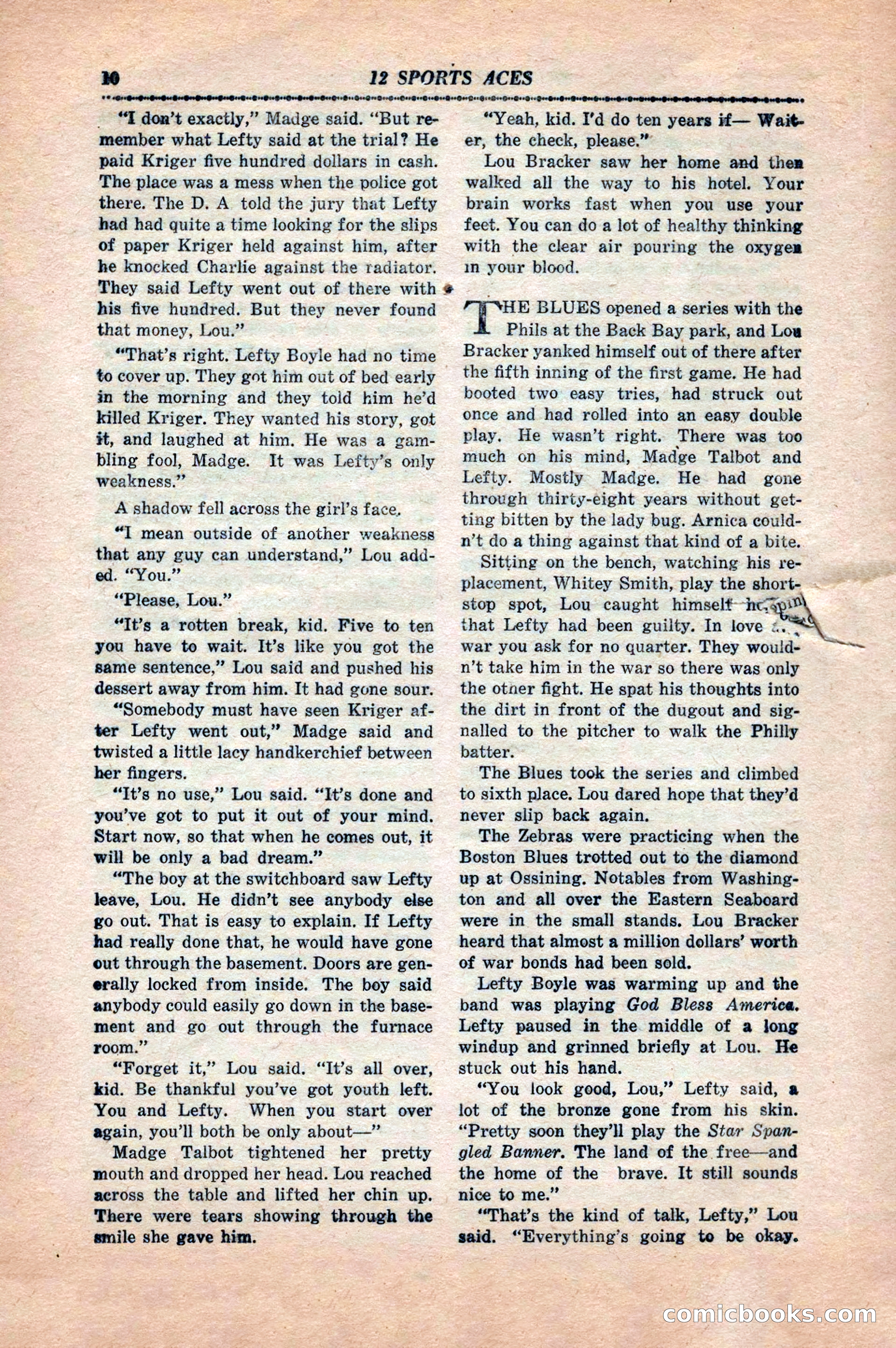
A restored page from Pulp Fiction, 1943. Page through the whole issue in the reader above.
📄 Transcribed text from this page (OCR, searchable)
Machine-transcribed from the original scan — historical spelling and the odd misread are preserved.
0 12 SPORTS ACES _ “ET don’t exactly,” Madge said. “But re- member what Lefty said at the trial? He paid Kriger five hundred dollars in cash. The place was a mess when the police got there. The D. A told the jury that Lefty had had quite a time looking for the slips of paper Kriger held against him, after he knocked Charlie against the radiator. They said Lefty went out of there with 4 his five hundred. But they never found that money, Lou.” “That’s right. Lefty Boyle had no time - to cover up. They got him out of bed early in the morning and they told him he’d killed Kriger. They wanted his story, got it, and laughed at him. He was a gam- bling fool, Madge. It was Lefty’s only weakness.” A shadow fell across the girl’s face. “I mean outside of another weakness that any guy can understand,” Lou add- ed. “You.” “Please, Lou.” “It’s a rotten break, kid. Five to ten you have to wait. It’s like you got the same sentence,” Lou said and pushed his dessert away from him. It had gone sour. “Somebody must have seen Kriger af- ter Lefty went out,” Madge said and twisted a little lacy handkerchief between her fingers. “It’s no use,” Lou said. “It’s done and you’ve got to put it out of your mind. Start now, so that when he comes out, it will be only a bad dream.” “The boy at the switchboard saw Lefty leave, Lou. He didn’t see anybody else go out. That is easy to explain. If Lefty had really done that, he would have gone out through the basement. Doors are gen- erally locked from inside. The boy said anybody could easily go down in the base- ment and go out through the furnace room.” “Forget it,’ Lou said. “It’s all over, kid. Be thankful you’ve got youth left. You and Lefty. When you start over again, you'll both be only about—’” Madge Talbot tightened her pretty mouth and dropped her head. Lou reached across the table and lifted her chin up. There were tears showing through the smile she gave him. AGA Der Orr BeBe Ger re Ore Bee Boer eros Sere re Serres Seen & “Yeah, kid. I’d do ten years H— Wait- er, the check, please.” Lou Bracker saw her home and then walked all the way to his hotel. Your brain works fast when you use your feet. You can do a lot of healthy thinking with the clear air pouring the oxygen in your blood. HE BLUES opened a series with the Phils at the Back Bay park, and Low Bracker yanked himself out of there after the fifth inning of the first game. He had booted two easy tries, had struck out once and had rolled into an easy double play. He wasn’t right. There was too much on his mind, Madge Talbot and Lefty. Mostly Madge. He had gone through thirty-eight years without get- ting bitten by the lady bug. Arnica could- n’t do a thing against that kind of a bite. Sitting on the bench, watching his re- placement, Whitey Smith, play the short- -~ stop spot, Lou caught himselt-nesp that Lefty had been guilty. In love <.* war you ask for no quarter. They would- n’t take him in the war so there was only the otaer fight. He spat his thoughts into the dirt in front of the dugout and sig- nalled to the pitcher to walk the Philly batter. The Blues took the series and climbed to sixth place. Lou dared hope that they’d never slip back again. The Zebras were practicing when the Boston Blues trotted out to the diamond up at Ossining. Notables from Washing- ton and all over the Eastern Seaboard were in the small stands. Lou Bracker heard that almost a million dollars’ worth of war bonds had been sold. Lefty Boyle was warming up and the band was playing God Bless America. Lefty paused in the middle of a long windup and grinned briefly at Lou. He stuck out his hand. “You look good, Lou,” Lefty said, a lot of the bronze gone from his skin. “Pretty soon they’ll play the Star Span- gled Banner. The land of the free—and the home of the brave. It still sounds nice to me.” “That’s the kind of talk, Lefty,” Lou said. “Everything’s going te be okay. comichbook nee com