A complete issue · 116 pages · 1943
12 Sports Aces, January 1943
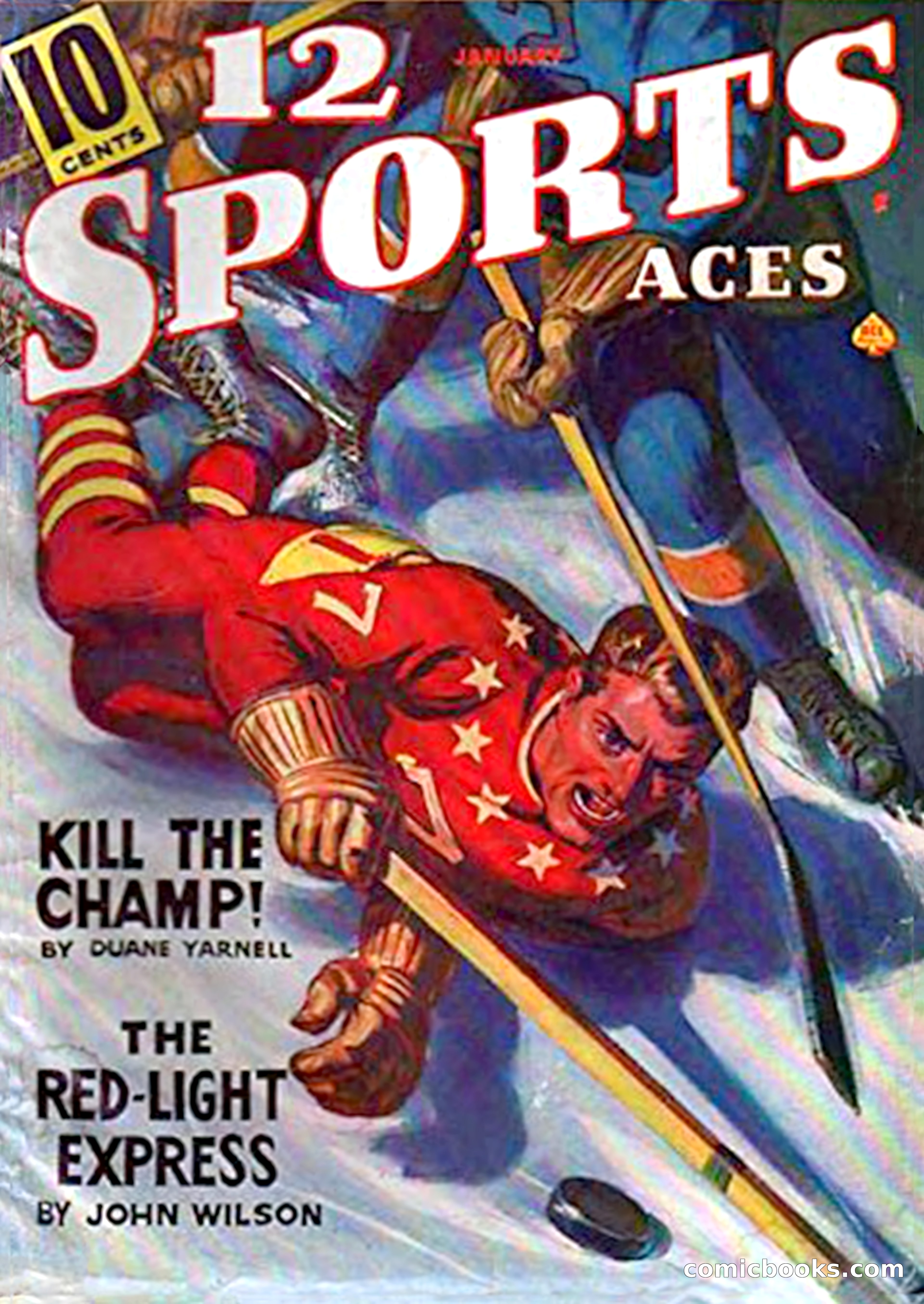
# 12 Sports Aces - Cover This is the cover of a 10-cent pulp magazine titled "12 Sports Aces." The cover features a dramatic illustration of what appears to be a hockey player in a red uniform with stars, wielding a hockey stick in an action pose against a blue background. Two stories are advertised: "Kill the Champ!" by Duane Yarnell, and "The Red-Light Express" by John Wilson. The cover art emphasizes dynamic movement and athletic competition, typical of sports-themed pulp fiction from the early twentieth century.
# Analysis This appears to be a **title page or section divider** from a pulp magazine. The page is mostly blank white space with two heavily pixelated/degraded text blocks—one near the top and one near the bottom. The OCR text is largely unreadable due to image corruption ("C©nn DOOK C©"), and the watermark "comicbooks.com" appears at the bottom right. The actual content and title of the story or section cannot be reliably determined from this image, as the text rendering is too damaged to read clearly. This is likely a transitional page between sections of the publication.
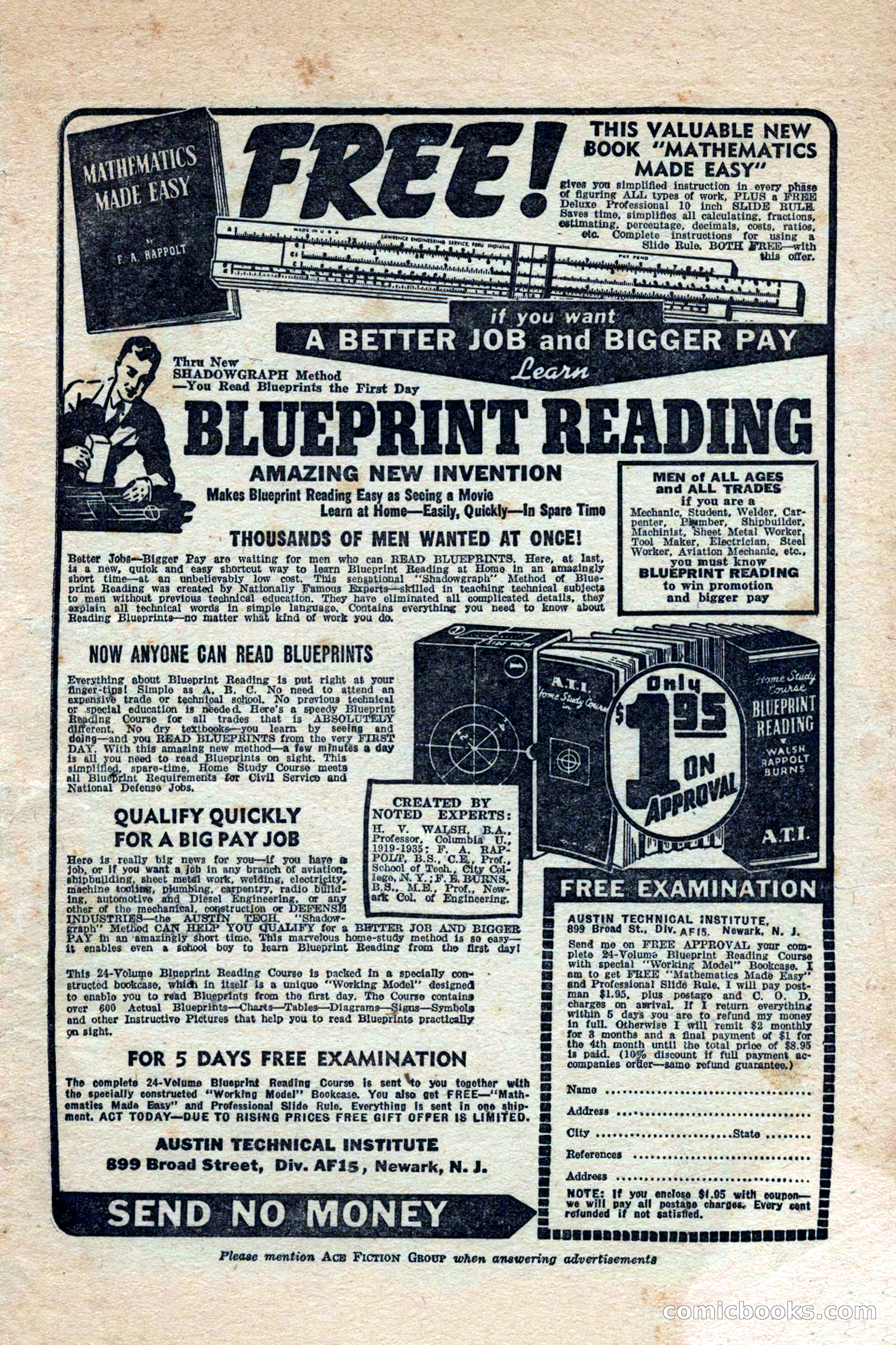
# What's on This Page This is a full-page advertisement, not story content. It promotes a correspondence course in blueprint reading offered by the Austin Technical Institute of Newark, New Jersey. The ad promises that anyone can learn to read blueprints quickly at home using the "Shadowgraph Method," qualifying them for better-paying jobs in trades like carpentry, welding, and machining. The course includes a 24-volume set, a "Mathematics Made Easy" book, and a professional slide rule, offered on a free five-day examination basis with installment payment options.
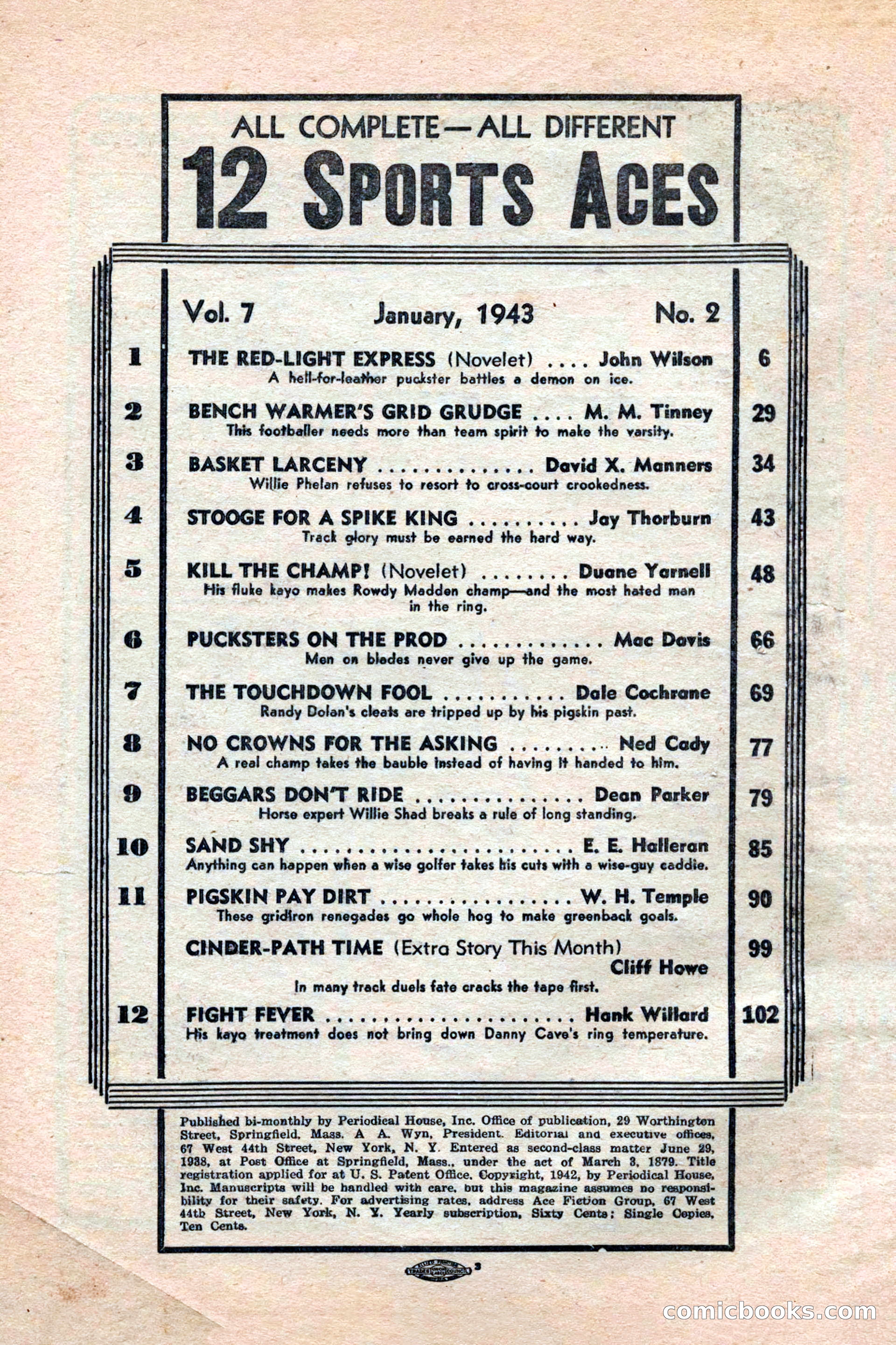
# Table of Contents Page from Sports Aces Magazine This is a table of contents page from *Sports Aces*, Volume 7, Number 2 (January 1943), a pulp fiction magazine published by Periodical House. The page lists twelve complete sports-themed short stories and novelets by various authors, including titles like "The Red-Light Express," "Bench Warmer's Grid Grudge," and "Fight Fever." Stories span multiple sports—ice hockey, football, basketball, track, boxing, and golf—with page numbers ranging from 6 to 102. Brief taglines describe each story's plot. The magazine was published bi-monthly and cost sixty cents per copy.
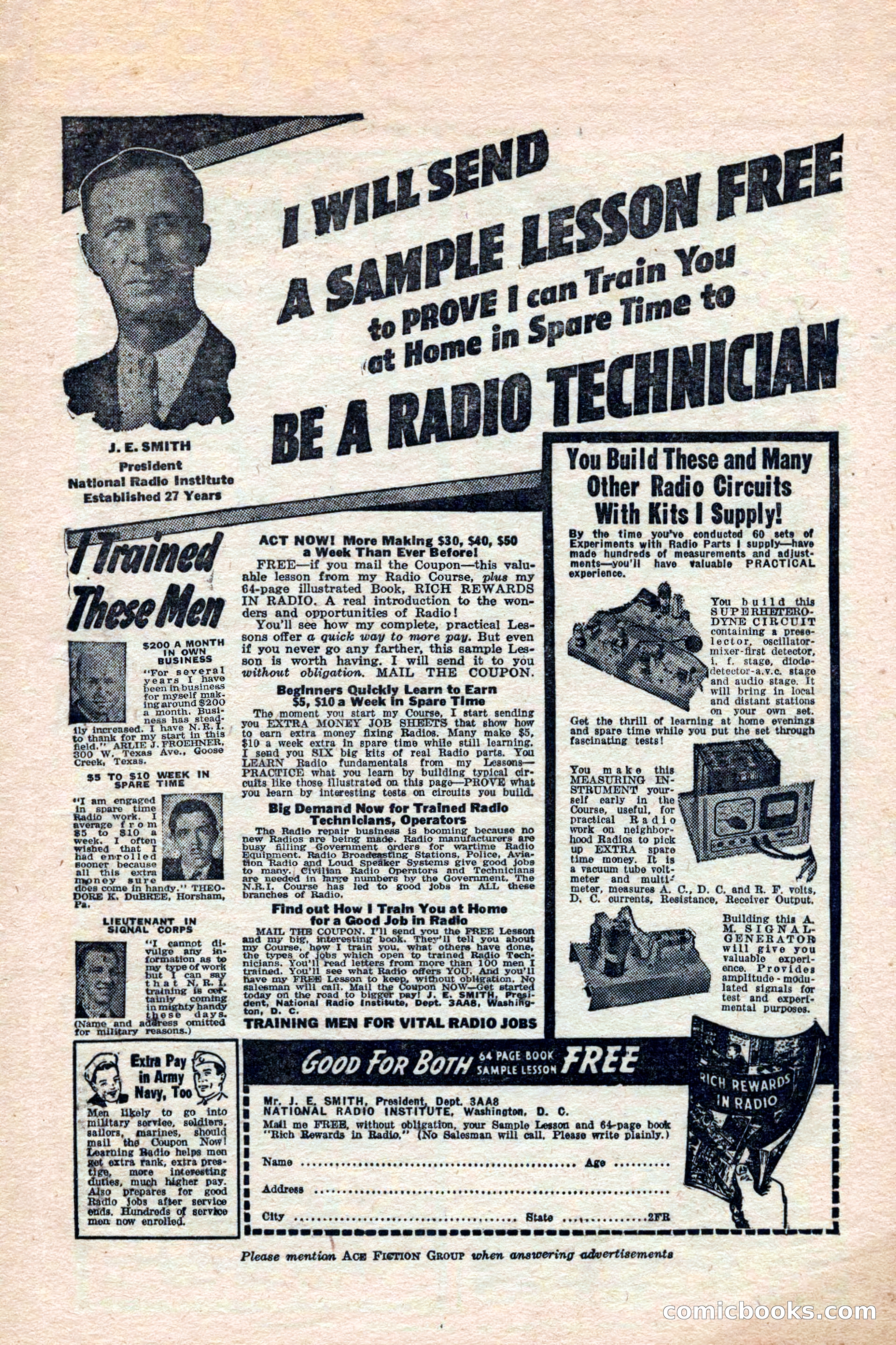
# Advertisement Page from Pulp Magazine This is an **advertisement page** from an early-20th-century American pulp magazine. The page promotes the National Radio Institute's correspondence course for training radio technicians and operators. J. E. Smith, the institute's president, promises a free sample lesson and 64-page illustrated book to readers who mail in a coupon. The advertisement emphasizes earning potential ($10-$50 weekly in spare time), includes testimonials from satisfied students, and highlights the practical radio-building kits and circuits students will assemble during the course. The layout includes a coupon at the bottom for readers to request materials.
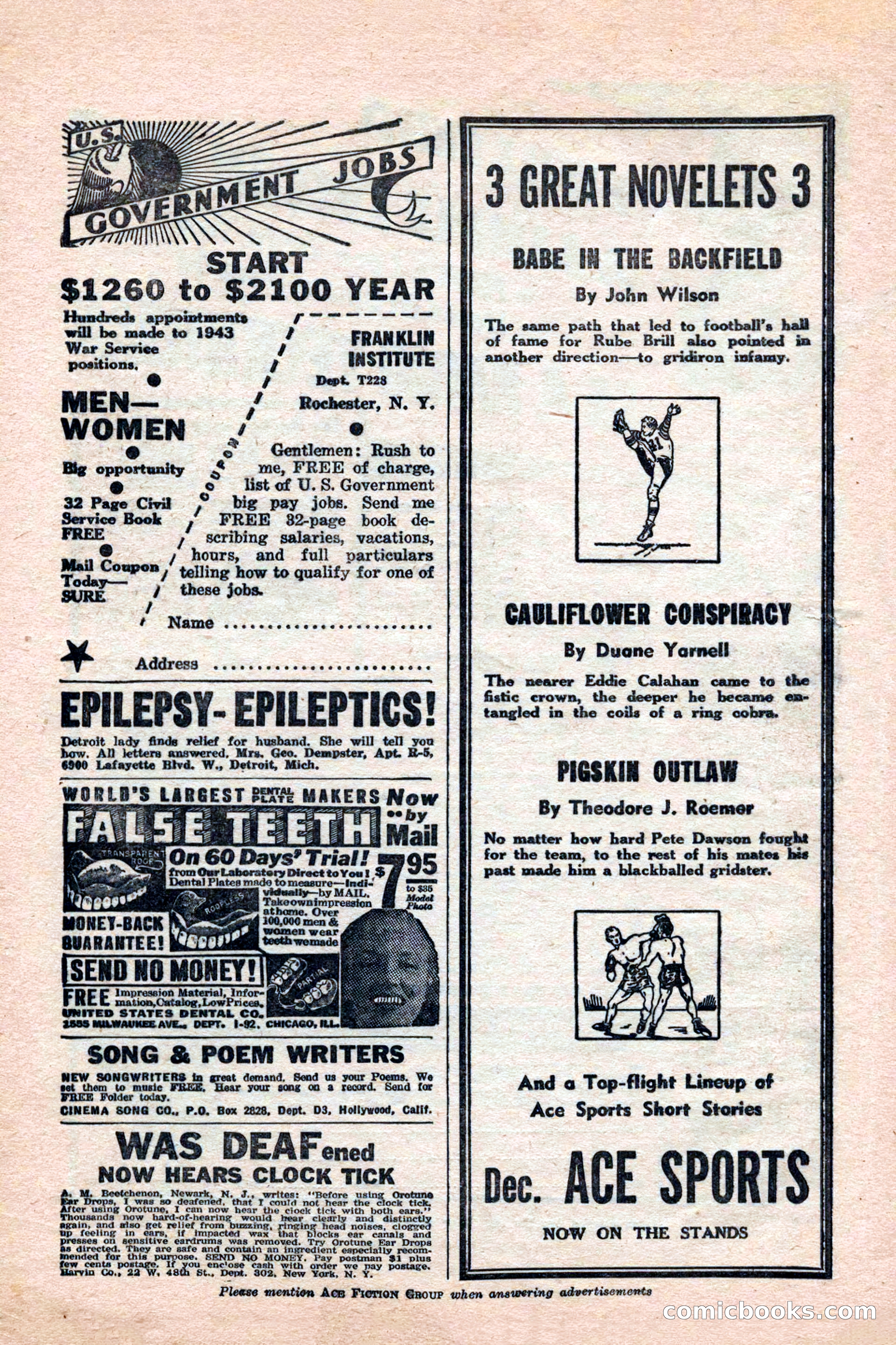
# Page Description This is an **advertisement and contents page** from a pulp magazine, likely from the 1940s based on the context clues (War Service positions mentioned, 1943 reference). The left side features various classified-style advertisements for government jobs, false teeth by mail, hearing aids, and songwriting opportunities. The right side advertises the magazine's contents: three sports novelettes titled "Babe in the Backfield" by John Wilson, "Cauliflower Conspiracy" by Duene Yarnell, and "Pigskin Outlaw" by Theodore J. Roemer, plus additional sports short stories in the upcoming issue of *Ace Sports*. Small illustrations accompany each story title.
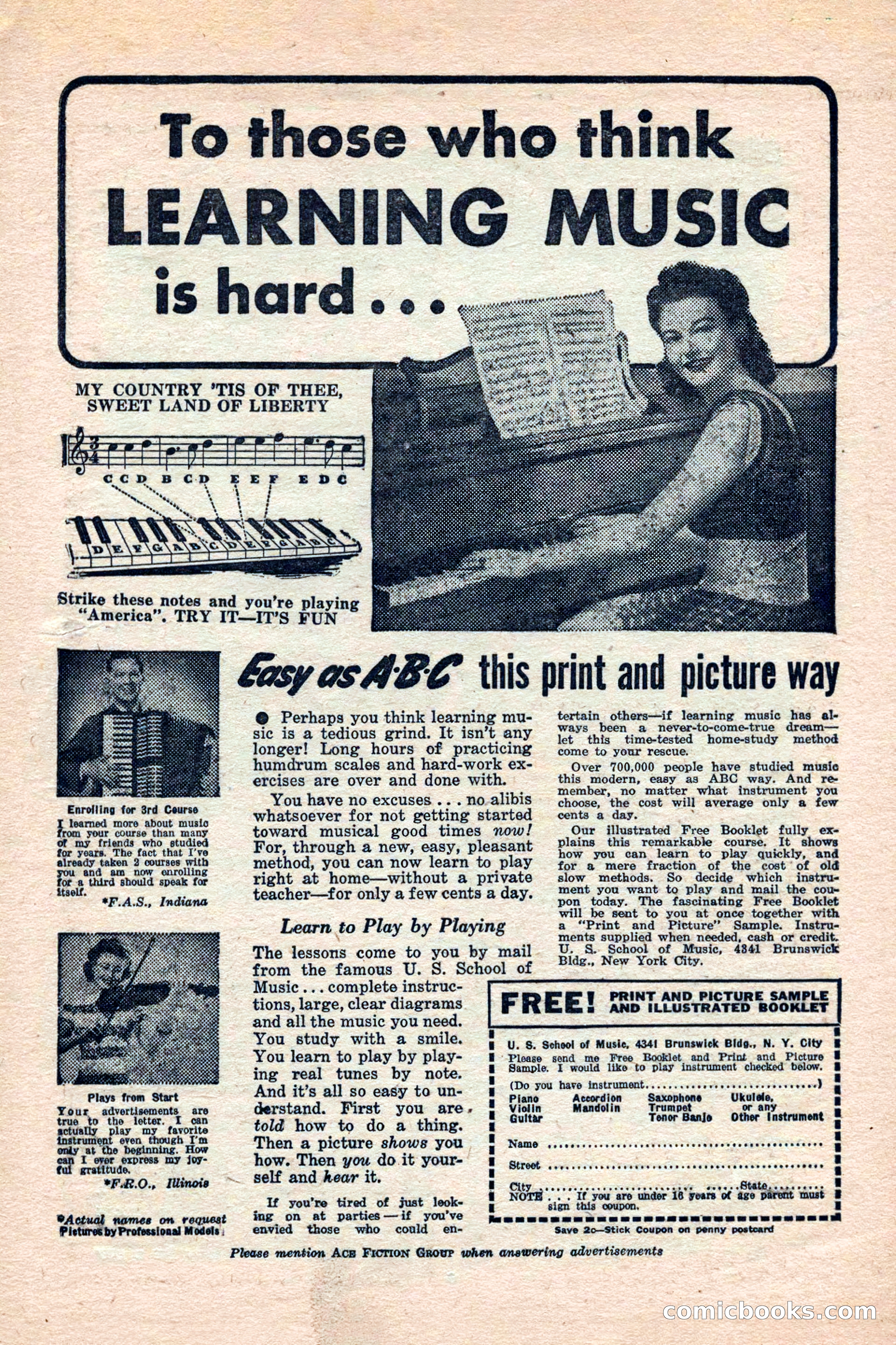
# Analysis This is an **advertisement page** from a pulp fiction magazine. The page promotes the U.S. School of Music's mail-order music lesson program, claiming to teach musical instruments "easy as ABC" through a "print and picture" method. It features testimonial letters from satisfied students, sheet music notation for "My Country 'Tis of Thee," a keyboard diagram, photographs of students, and a tear-out coupon offering a free instructional booklet. The advertisement emphasizes that learning music no longer requires expensive private teachers or tedious practice—just a few cents per day by mail.
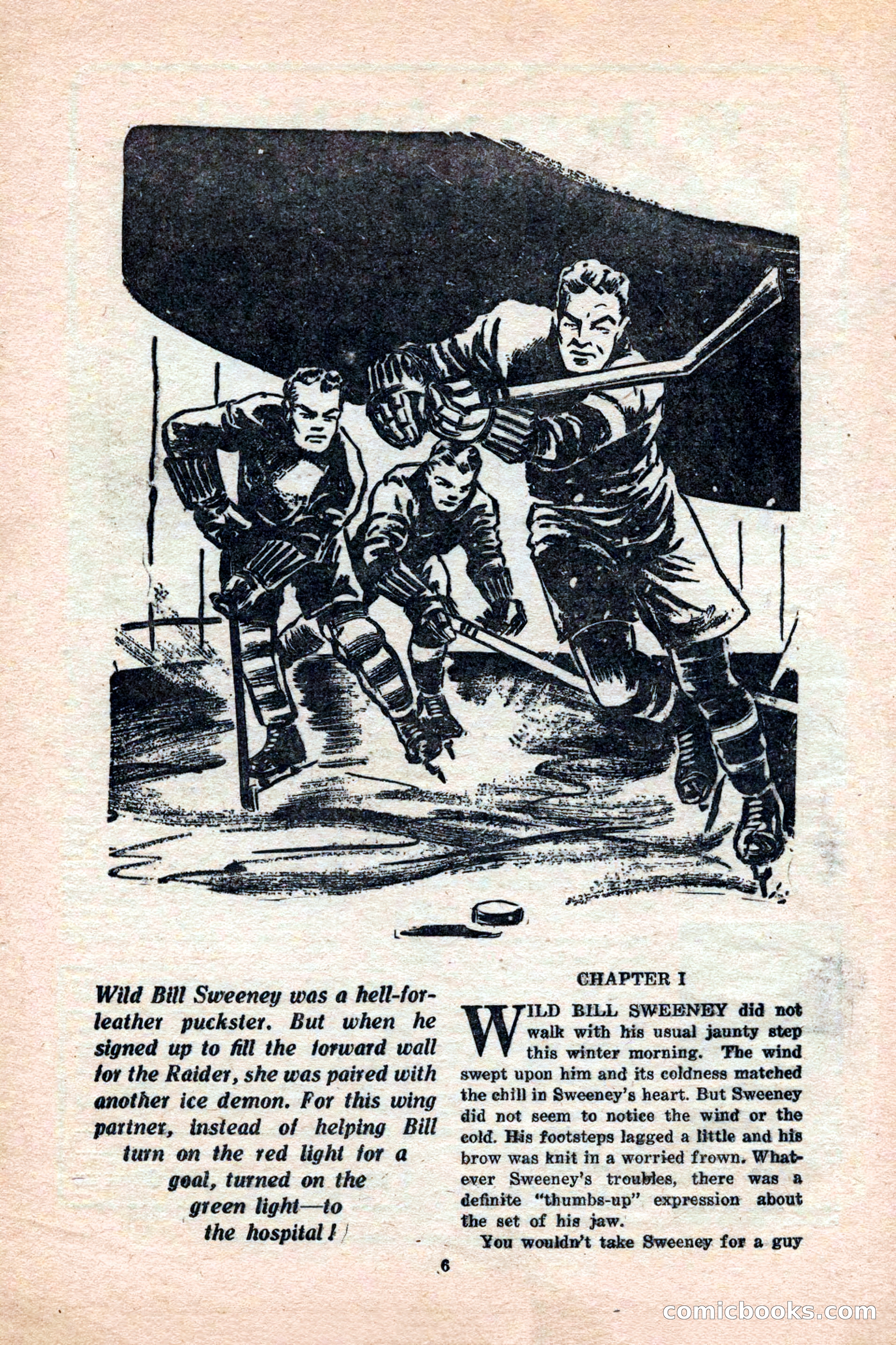
# Page Analysis This is an interior story page from a pulp magazine, featuring both an illustration and prose text. The illustration depicts four ice hockey players in action on the ice, with one adult figure and three younger players. Chapter I begins below, introducing the protagonist Wild Bill Sweeney, apparently a hockey player troubled by personal concerns despite maintaining an outwardly determined demeanor. The opening narrative suggests Sweeney was paired with a problematic teammate on a hockey team called "the Raider," resulting in his hospitalization rather than scoring success.
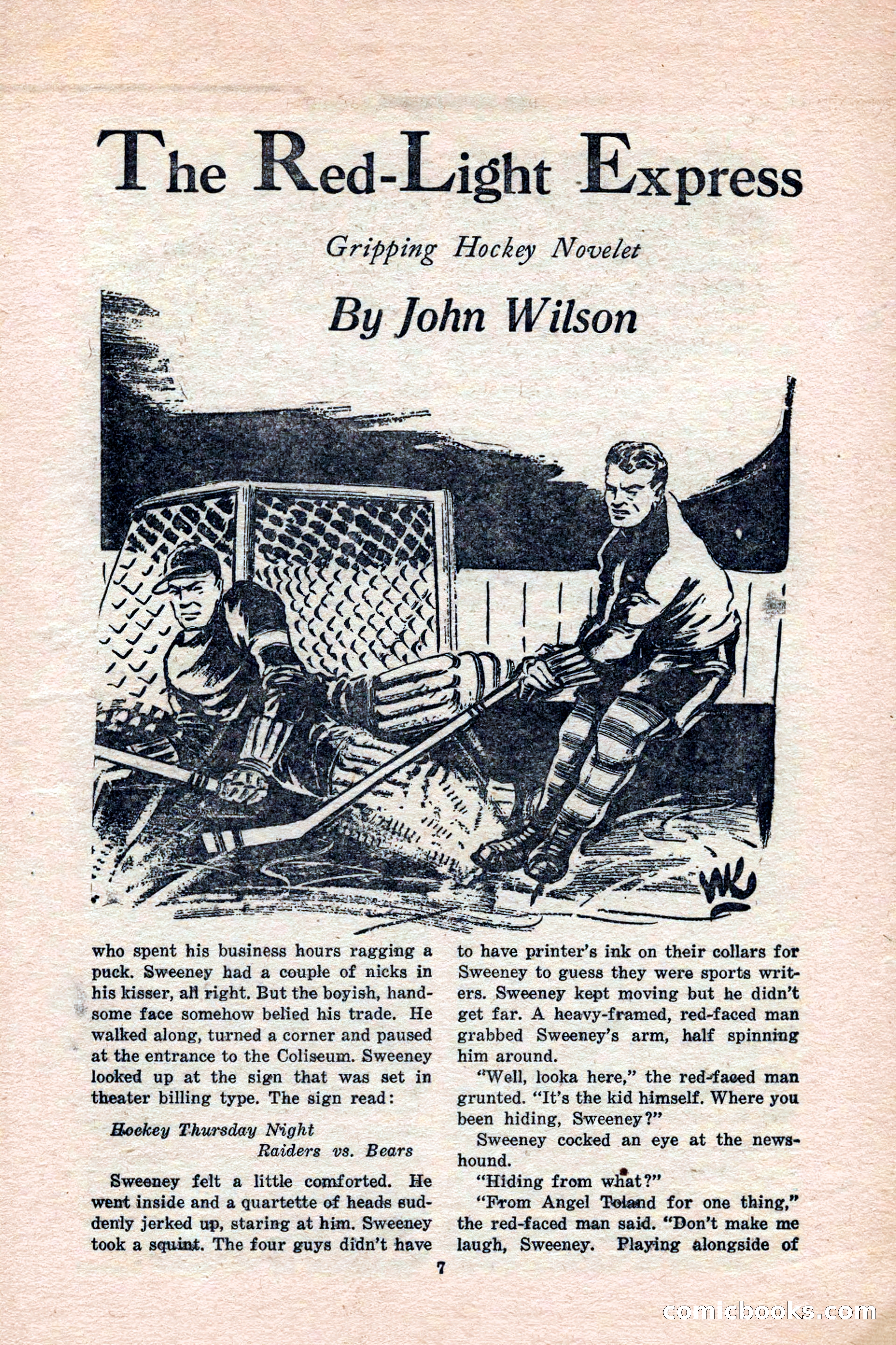
# Page Analysis This is an interior story page from a pulp magazine containing both illustration and prose text. The page presents "The Red-Light Express," a hockey novelet by John Wilson. The illustration depicts a hockey scene with players in gear near a goal, rendered in black ink. The text describes a character named Sweeney entering a hockey arena (the Coliseum) where he encounters a red-faced man who appears to be a sportswriter, inquiring about Sweeney's whereabouts and mentioning someone called Angel Toland. The narrative suggests Sweeney may be evading this person.
# Page Analysis This is **story prose** from a pulp-fiction magazine titled "12 Sports Aces." The page continues a hardboiled hockey narrative featuring a character named Sweeney, a minor-league player recruited to play forward alongside Angel Toland, a talented but allegedly cursed player nicknamed "the Jinxman." The text depicts Sweeney encountering reporters and team associates who warn him about Toland's jinx and mention the team owner's financial troubles. A confrontation develops between Sweeney and a reporter named Lew Harrigan, with Sweeney threatening violence when provoked.
# Page Analysis This is **story prose** from page 9 of "The Red-Light Express," a hardboiled crime pulp story. The narrative follows a character named Sweeney as he meets with Rock Gurnsey, owner-manager of a hockey team called the Raiders, apparently to discuss financial troubles. Sweeney encounters a young woman named Connie Leonard at a hockey rink and later discovers her newspaper photograph revealing she is a wealthy heiress who just inherited five million dollars and is engaged to a lawyer—clarifying the identity of the "dark mustached man" Sweeney saw with her earlier.
# Page Analysis This is **story prose** from page 10 of *12 Sports Aces*, a pulp magazine. The text depicts a conversation between a character named Sweeney (appears to be a hockey player) and Rock, who manages a minor-league hockey team facing financial troubles. A bespectacled businessman urges Rock to sell his struggling "Raiders" franchise to someone named Bo Madden, but Rock refuses on principle. Sweeney supports Rock's decision. The passage concludes with backstory about Sweeney's devotion to his wife Alice, whom he supported through medical recovery after an automobile accident, revealing the depth of his loyalty.
# Page Analysis This is story prose from a pulp fiction magazine titled "The Red-Light Express." The page depicts a hockey narrative in which protagonist Sweeney, a new player, joins a team called the Raiders. The text describes Sweeney entering the locker room, meeting equipment manager Buzzy Barnes, encountering the intimidating star player Angel Toland on the ice, and participating in his first practice game. The passage emphasizes Toland's dominance and Sweeney's eager performance during the scrimmage, ending mid-sentence as play continues.
# Page Analysis This is **story prose** from a pulp fiction magazine titled "Sports Aces" (page 12). The text depicts a hockey game in which the protagonist, Sweeney, faces increasingly rough treatment from opposing player Angel Toland and his team, the Raiders. After being moved to a different line, Sweeney engages in physical combat on the ice with Toland, with teammate Happy Holliday eventually intervening to prevent Toland from striking Sweeney with his stick. The narrative emphasizes the brutal, violent nature of the competition between these rivals.
# Page Analysis: "The Red-Light Express" This page contains story prose from what appears to be a hardboiled sports fiction narrative. The text depicts a confrontation following a hockey game, where character Sweeney interacts with Connie Leonard (described as wealthy) and others regarding the struggling Raiders team. Angel Toland later addresses the team in the locker room, arguing they should pressure the team owner to sell to a willing buyer to protect themselves financially. The narrative focuses on tension surrounding the team's financial troubles and potential sale.
# Page 14 of "12 Sports Aces" — Pulp Fiction Story Prose This is a page of story prose from a hardboiled sports pulp magazine. The narrative concerns a hockey team (the Raiders) and a business dispute: Rock Gurnsey, the team owner, has announced he will sell the franchise to satisfy pressure from associates including Angel Toland and Bo Madden. A character named Sweeney witnesses this betrayal and later encounters Buzzy Barnes in a diner, who cryptically suggests Sweeney has somehow helped Rock and hints that Toland is a dangerous man with a destructive influence on those around him. The dialogue suggests conflict, loyalty, and implied threats within the sports world.
# Page Analysis This is story prose from Chapter III of "The Red-Light Express," a pulp fiction magazine (appears to be sports/hardboiled fiction). The page depicts two scenes: first, Sweeney's conversation with Rock Gurnsey and Sam Jenkins at the office regarding the team's sale to Connie Leonard, then transitions to game day where Sweeney plays hockey before a large crowd. The narrative suggests romantic tension between Sweeney and Leonard while exploring themes of professional ambition, team dynamics, and an apparent "jinx" affecting the team's success. The text emphasizes Sweeney's focus on hockey while others hint at Leonard's interest in him.
# Page Analysis This is a page of prose story text from the pulp magazine *12 Sports Aces* (page 16). The story depicts a hockey game between the Bears and Raiders, focusing on player Sweeney, who plays despite fractured ribs. The narrative describes the rough action on the ice, featuring characters like Angel Toland (described as a "super-star"), Nails Hearne, and Happy Holliday. Sweeney struggles with pain and appears hampered by an apparent "jinx" associated with Angel Toland's playing style, ultimately failing to prevent the opposing team from scoring.
# Page Analysis This is **story prose** from page 17 of *The Red-Light Express*, a pulp fiction magazine. The text describes an intense ice hockey game featuring protagonists Wild Bill Sweeney and Happy Holliday against rival players including Angel Toland. The narrative follows Sweeney's athletic performance—his goal-scoring plays, his physical endurance despite injury, and the escalating tension as the game reaches its climax, with Sweeney appearing to gain the upper hand over his antagonist Angel Toland on the ice.
# Page Analysis: "12 Sports Aces" This is a prose story page from a pulp sports fiction magazine. The narrative follows a hockey player named Sweeney after a game where he defeated a team called the Bears. A mysterious man named Bo Madden approaches him outside the arena, cryptically warning that "that jinx that's been haunting the Raider forwards won't touch you." Sweeney subsequently leads the Raiders from last place to third place in four straight victories, though he's sustaining injuries while avoiding rough play. A sports columnist hints that Sweeney's success may relate to anxiety about the jinx. The page explores themes of competition, mysterious interference in sports, and underlying tensions between players.
# Page Analysis: Story Prose from "The Red-Light Express" This page contains story prose from Chapter IV of a hardboiled sports fiction narrative. The text depicts a conflict emerging around a surprise $3,000 bonus that team player Sweeney receives through his girlfriend Alice from club owner Miss Leonard, delivered by business manager Jenkins. When Sweeney mentions the bonus to Rock (apparently the team manager), Rock becomes suspicious and angry, immediately calling Miss Leonard to verify the bonus policy, while Jenkins appears evasive. The scene establishes tension and suggests potential financial or personal intrigue surrounding the club's management.
# Page Analysis This is story prose from page 20 of a pulp magazine titled "12 Sports Aces." The text appears to be from a hardboiled crime story involving a character named Rock who confronts Jenkins about embezzlement from a baseball team called the Raiders. Rock claims to possess evidence of financial fraud involving Jenkins, Bo Madden, and Angel. The scene shifts to a party at Connie Leonard's penthouse on Park Avenue, where Rock is expected to reveal his proof, though he fails to appear. A lawyer named Barry Pelham questions Sweeney about the missing Rock and the promised "answers," creating suspense about what will happen next.
# Page Analysis: "The Red-Light Express" This is a page of story prose from a pulp-fiction magazine (page 21). The text depicts a hardboiled crime drama involving a character named Sweeney who discovers that a man called Rock has been hit by a car in what appears to be a deliberate setup. After learning Rock may survive, Sweeney confronts the conspirators—including Jenkins, Harrigan, Angel Toland, Barry Pelham, and Connie Leonard—at what appears to be a social gathering, likely related to a sports team. A physical fight erupts, and Sweeney is restrained. The page ends with revelations about a conspiracy and Rock's uncertain fate.
This page contains story prose from a hardboiled crime pulp fiction magazine titled "12 Sports Aces." The narrative depicts a violent confrontation between characters named Sweeney, Bo Madden, and others. Madden's thugs have captured Sweeney, stolen money from his wallet, and Madden boasts about eliminating a rival named Rock and manipulating other characters through blackmail and financial schemes. The dialogue reveals Madden's ruthless criminal operation and his confidence in controlling the situation through strategic threats and corruption.
This page contains story prose from "The Red-Light Express," a hardboiled crime pulp fiction. The narrative follows a character named Sweeney as he visits a hospital to check on someone named Rock, who has been injured in a hit-and-run accident. Sweeney encounters Buzzy Barnes being escorted away by police, learns that Rock is in surgery, and discovers conflicting accounts of the accident. The page ends with Chapter V, beginning a new scene involving a confrontation between the "Raiders" and "Hawks," while Sweeney remains preoccupied with Rock's condition and an apparent threat from someone called Angel.
# Page Analysis This is prose fiction from a sports-themed pulp magazine. The page depicts an ice hockey game in which player Sweeney, labeled "check-shy" by fans, overcomes self-doubt and taunting from teammate Angel Toland to play aggressively during the second period. The narrative describes Sweeney's emotional turmoil, his breakthrough moment, and escalating action on the ice, ending mid-sentence as Hawks forwards advance down the boards.
# Page Analysis: "The Red-Light Express" This page contains story prose from a pulp fiction narrative. The text follows a character named Sweeney, apparently a reporter or sports figure, who is injured during a hockey game incident. The passage reveals that Buzzy Barnes—previously thought to be mentally unstable—was actually feigning illness to protect himself from Bo Madden's associates. As Sweeney recovers in the dressing room, Buzzy explains his deception, and reporter Lew Harrigan arrives with news of apprehending someone named Angel Toland. The scene involves crime elements, corruption, and journalistic investigation, suggesting this is hardboiled crime fiction rather than science fiction or horror.
# Page 26: Story Prose from "12 Sports Aces" This page contains story prose from what appears to be a hardboiled sports fiction narrative. The text follows a character named Sweeney, apparently a hockey player for the Raiders, who has been injured but returns to play despite doctor's orders. The passage describes Sweeney's dramatic comeback during a crucial game against the Hawks, where he helps tie the score at three-all and appears to overcome a "jinx" placed on him by a rival named Angel Toland. The narrative emphasizes Sweeney's determination and skill despite his injuries and the pressure of both the game and a gambling subplot involving betting on the Raiders' playoff chances.
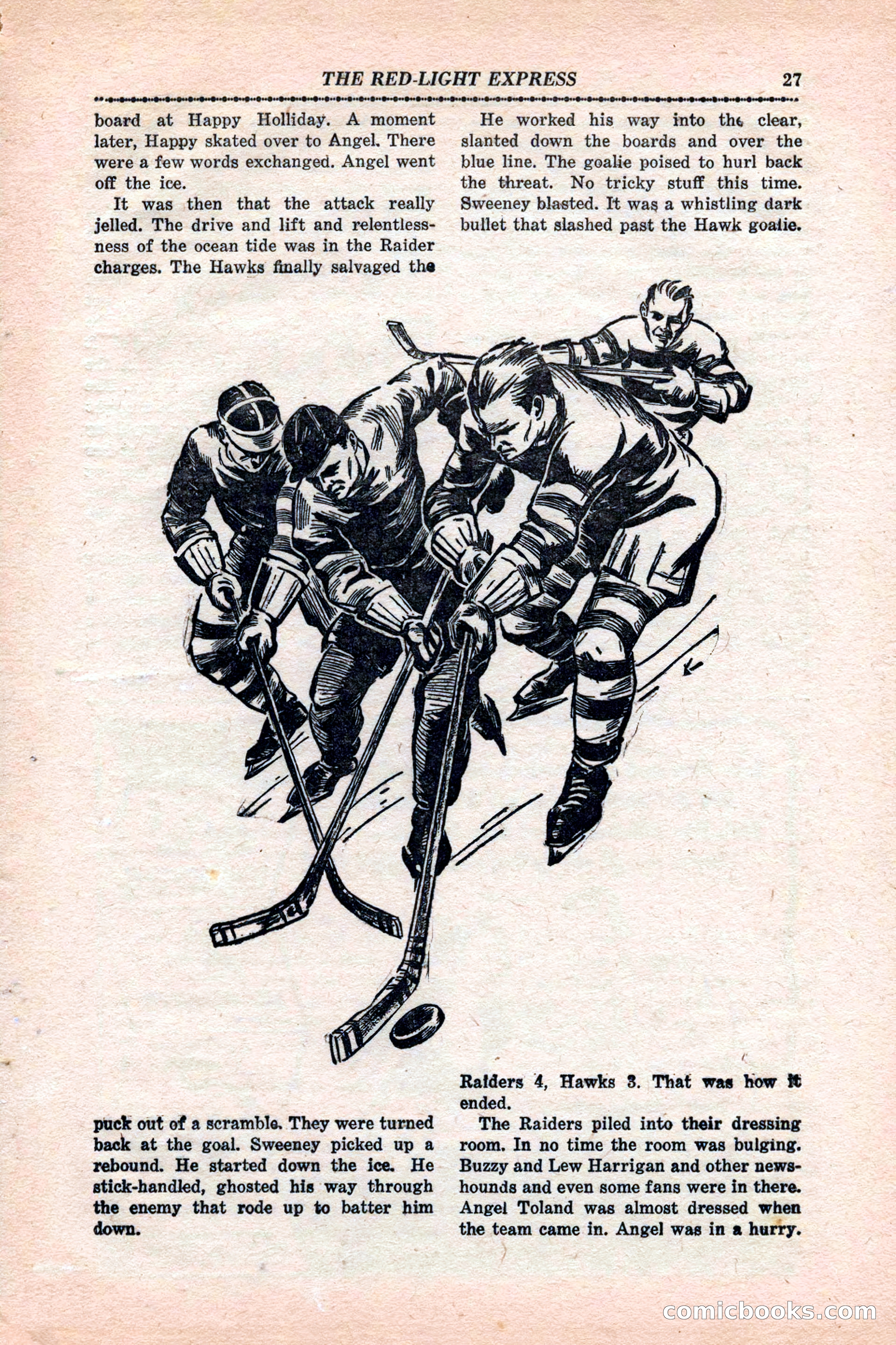
# Page Description This is an interior story page from a pulp magazine titled "The Red-Light Express." It contains narrative prose about an ice hockey game between the Raiders and Hawks, illustrated by a dramatic black-ink drawing of hockey players in action near the goal. The text describes the final moments of play—a player named Sweeney scoring the winning goal—and the subsequent celebration in the Raiders' locker room. The final score reads "Raiders 4, Hawks 3."
This page contains story prose from a pulp sports fiction magazine titled "12 Sports Aces." The narrative describes a scene where a hockey player named Sweeney, apparently injured, is celebrated by teammates and reporters. The text discusses Sweeney's interaction with a doctor, reporters discussing scoops about players named Rock Gurnsey and Connie Leonard (the Raiders' owner), and Sweeney's prospects for the upcoming playoffs. The bottom half features a vintage Gillette razor blade advertisement with illustrations of a man and woman, promoting their "Thin Gillettes" at various price points.
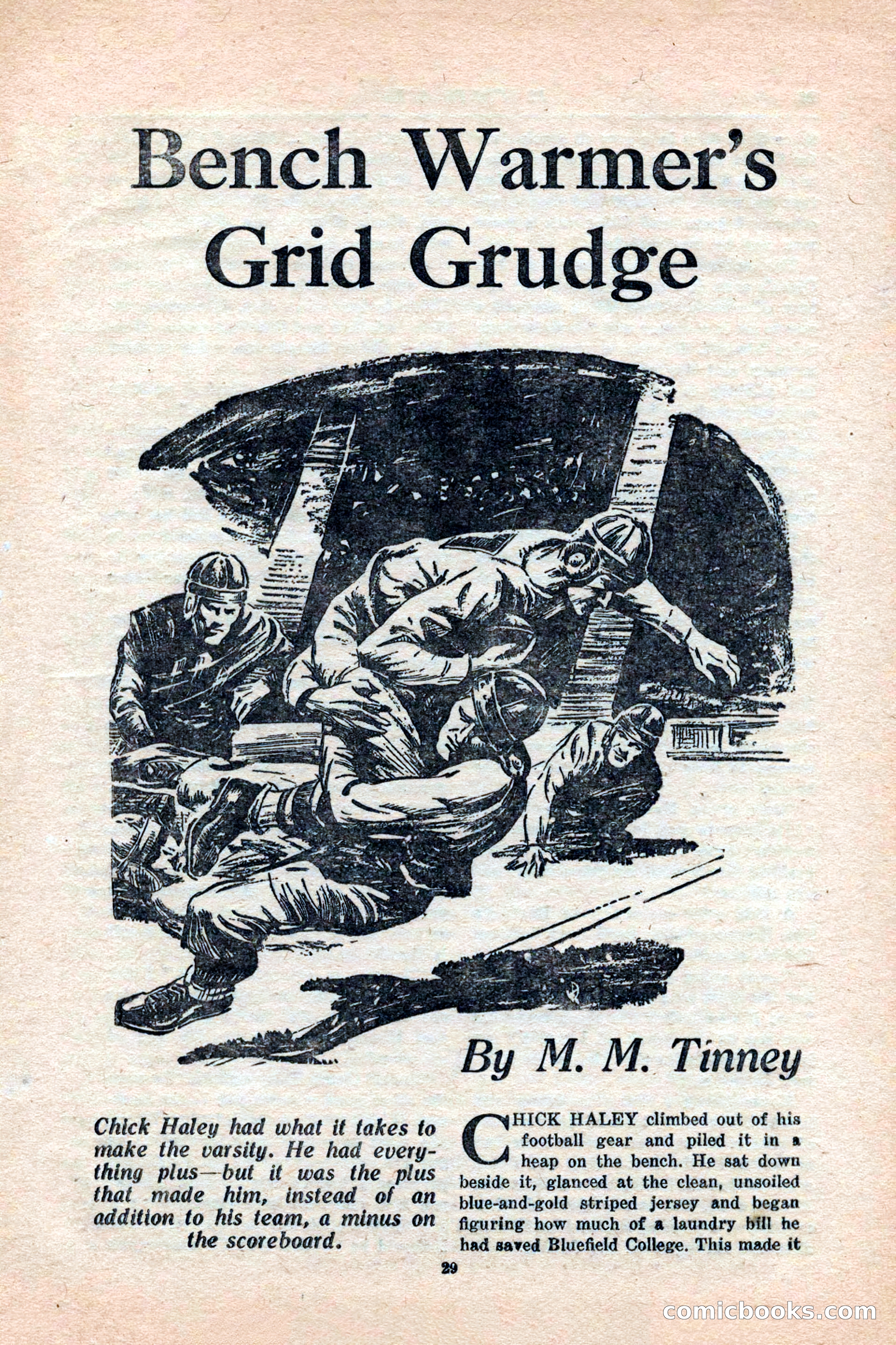
This is a story illustration and opening page for "Bench Warmer's Grid Grudge" by M. M. Tinney, appearing to be from a sports-themed pulp magazine. The woodcut-style illustration depicts several football players in a locker room scene, with the central figure (Chick Haley) sitting on a bench beside his unused uniform. The story opening establishes that Haley has the talent to make the varsity team but possesses some quality—described as a "plus" that paradoxically becomes a "minus"—that undermines his value to the team, apparently keeping him benched despite his abilities.
# Page Analysis This is **story prose** from a pulp sports fiction magazine titled "12 Sports Aces" (page 30). The text depicts a conversation between Chick Haley, a college football player benched in favor of a sophomore named Moose Bradley, and his father, Coach Steve Haley. After a team victory, Moose makes a cutting remark about Chick's position on the bench, which Chick accepts gracefully. Coach Haley then calls his son to his office to express disappointment with Chick's third and final season, suggesting he lacks the competitive drive of other players despite his team spirit.
# Page Analysis This is **story prose** from a pulp fiction magazine titled "Bench Warmer's Grid Grudge" (page 31). The text follows a college football player named Chick who, after being told by his coach that he's too nice to succeed athletically, decides to systematically make enemies on campus. The passage depicts Chick's initial failed attempt to antagonize a tackle named Art Elliot, followed by his breakthrough plan: becoming president of the Beta Kappa fraternity and then deliberately insulting the entire student body during a campus rally, calling them "suckers" and promising nothing but self-serving policies—a strategy designed to make him universally disliked and thereby, apparently, improve his football performance.
# Page 32 from "12 Sports Aces" This is story prose from a sports fiction pulp magazine. The narrative follows a character named Chick through a conflict with teammates Art Elliot and Moose Bradley over Chick's earlier attempts to deliberately create enemies on his football team. The page depicts the escalating tension culminating in a fight in the locker room before a crucial game between Bluefield and Middleton, then shifts to describing the opening moments of the football match itself, with Chick watching anxiously from the bench as Middleton's offense threatens his team's goal line.
# Page Analysis This page contains story prose from a pulp-fiction sports narrative titled "Bench Warmer's Grid Grudge." The text describes the climactic conclusion of a football game between Bluefield and Middleton, focusing on a player named Chick who enters the game mid-quarter and makes crucial defensive plays. The passage culminates in Bluefield's victory touchdown catch, followed by a locker-room scene where Coach Haley reveals the team deliberately provoked Chick to motivate him. The final paragraphs suggest Chick will apply this competitive spirit toward fighting the Japanese, indicating this is likely a wartime-era publication. A small illustration of a football player in action appears at the page bottom.
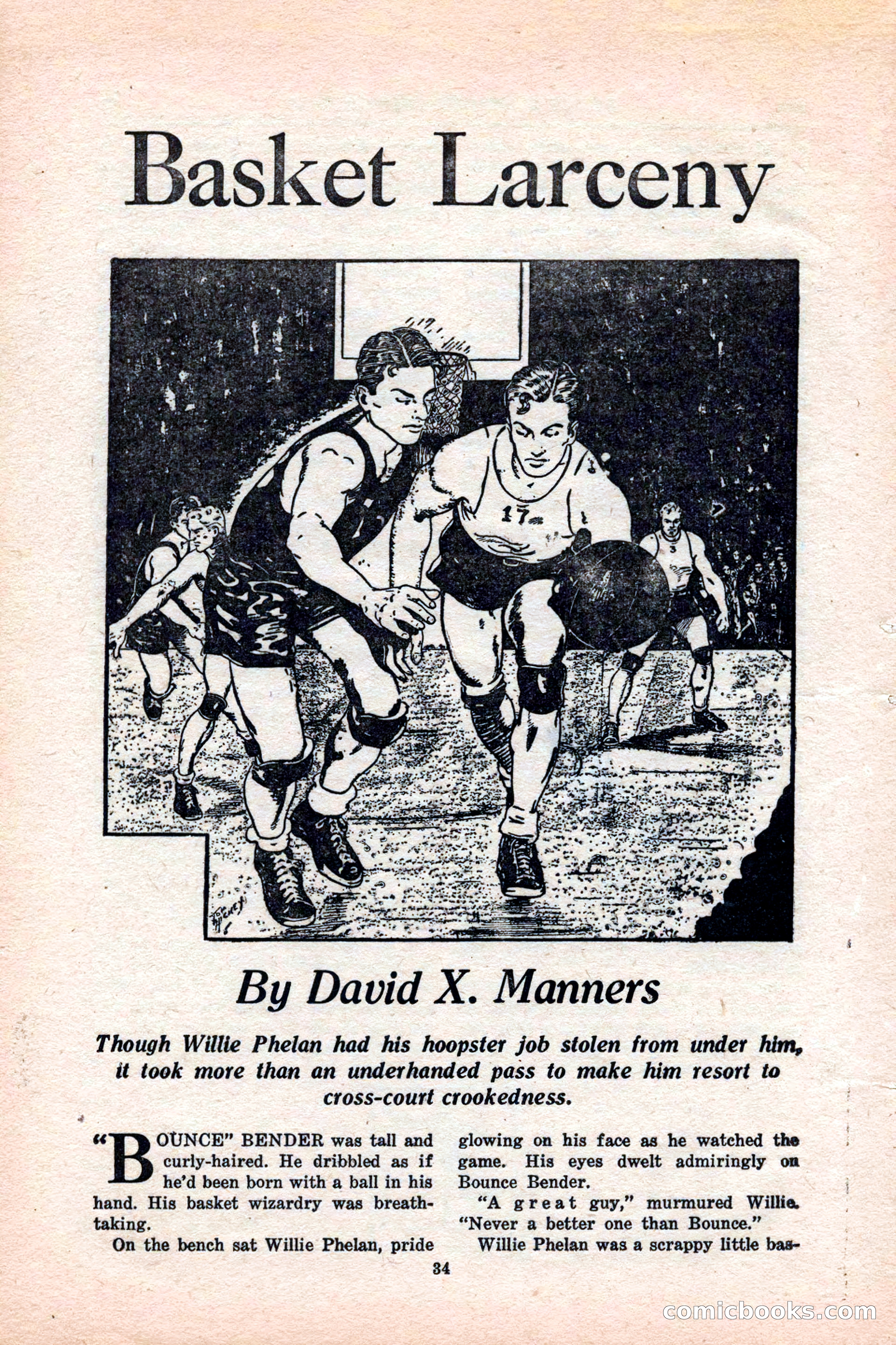
# "Basket Larceny" by David X. Manners This is a story prose page (page 34) from an early-20th-century pulp magazine. The illustration shows basketball players in action beneath a hoop. The story concerns Willie Phelan, a basketball player whose job has been taken by "Bounce" Bender, a talented player with exceptional dribbling skills. The subtitle indicates the plot involves Willie considering dishonest play—"cross-court crookedness"—to address his situation, though the full story outcome is not visible on this page.
# Page Analysis: "Basket Larceny" This is a prose story page from a pulp fiction magazine. The narrative follows Willie Phelan, a professional basketball player for a team called the Jewelers, who is benched with a knee injury. After his substitute, Bounce Bender (a college friend), performs well, the team's owner Dinter fires Willie to keep Bounce as the permanent point-getter. Willie confronts Bounce in the locker room, expecting loyalty from his former teammate, but Bounce chooses to keep his job and contract, citing family responsibilities. Willie feels betrayed by this prioritization of self-interest over friendship in professional sports.
# Page 36 of "12 Sports Aces" This page contains story prose from what appears to be a sports fiction narrative. The text describes Willie Phelan joining a basketball team called the Oilers at a refinery, where he attempts to coach his struggling teammates despite friction with their coach, Easy Mike. The story follows Willie's efforts to improve the team's performance and his interactions with players like Gramatky and McCrae, culminating in an upcoming game against the Acme Insurance team. The narrative focuses on basketball strategy, team dynamics, and Willie's coaching ambitions.
This page contains story prose from "Basket Larceny," a pulp fiction sports narrative. The text follows Willie Phelan, a basketball player who is fired from coaching a team called the Oilers, then immediately hired by a refinery owner named Sam Finney to coach the same team. Willie implements rigorous training drills and fundamentals while monitoring rival teams in the league. The story describes his coaching methods, an unsuccessful test game against the Rollins Furniture team, and hints at Willie's interest in college coaching positions, suggesting mounting pressure on the character.
# Page Analysis This is **story prose** from a pulp sports fiction magazine titled "12 Sports Aces." The page continues a narrative about Willie, who manages a basketball team called the Oilers. The plot centers on Willie's efforts to strengthen his team before an important game against the Jewelers. A key development: his former teammate Bounce Bender, previously playing for a rival team, has unexpectedly been signed to join the Oilers. Willie is shocked but resolute that winning must come before personal feelings. The text also mentions a representative from State Teachers arriving to discuss contracts, likely related to recruiting Bounce.
# Page Analysis: "Basket Larceny" This page contains story prose from a pulp fiction sports narrative titled "Basket Larceny" (page 39). The text depicts a basketball game between two teams—the Oilers and the Orioles—focusing on player Willie and his teammate Bounce. The passage describes the game's climactic moments: Bounce makes an unconventional shot, the Oilers initially lead, but ultimately lose 28-25 in the final minutes. After the defeat, Bounce angrily criticizes his teammates' rigid playing style in the locker room, though team morale recovers when players realize they can still compete for league position. The narrative appears to be examining themes of teamwork, coaching authority, and individual talent clashing with team strategy.
# Page 40: "12 Sports Aces" — Basketball Story Prose This page contains story prose from a sports fiction narrative about a basketball game between two teams: the Oilers and the Jewelers. The text depicts a tense match where Willie, apparently the Oilers' coach or manager, benches his star player Bounce Bender for refusing to follow team plays and attempting to dominate the game individually to impress a State Teachers' scout watching from the stands. The narrative follows the game's progression, Willie's frustration with Bounce's selfish play, and the introduction of a replacement player, Ellis Jorgens.
# Page Analysis: "Basket Larceny" This page contains story prose from what appears to be a sports fiction narrative titled "Basket Larceny" (page 41). The text depicts the climactic moments of a basketball game between two teams—the Oilers and the Jewelers. Willie, apparently the team captain or coach, convinces a player named Bounce to rejoin the game for the sake of the team rather than pursue personal glory or a State job. The passage describes intense back-and-forth action, with Bounce ultimately passing to Willie for what appears to be a game-winning shot just as the final buzzer sounds. The narrative emphasizes themes of teamwork and redemption over individual advancement.
# Page 42 of "12 Sports Aces" Pulp Magazine This page contains the conclusion of a story featuring characters named Willie, Bounce, and Curly-top discussing Willie's decision to accept a Navy basketball commission rather than a coaching offer at State. The narrative shows Willie assembling a team of enthusiastic players who agree to join him in this military service role. The lower half is dominated by a large advertisement offering servicemen five popular magazines for 25 cents, with four different package options containing combinations of detective, sports, western, and comic magazines. A coupon for ordering appears at the bottom of the page.
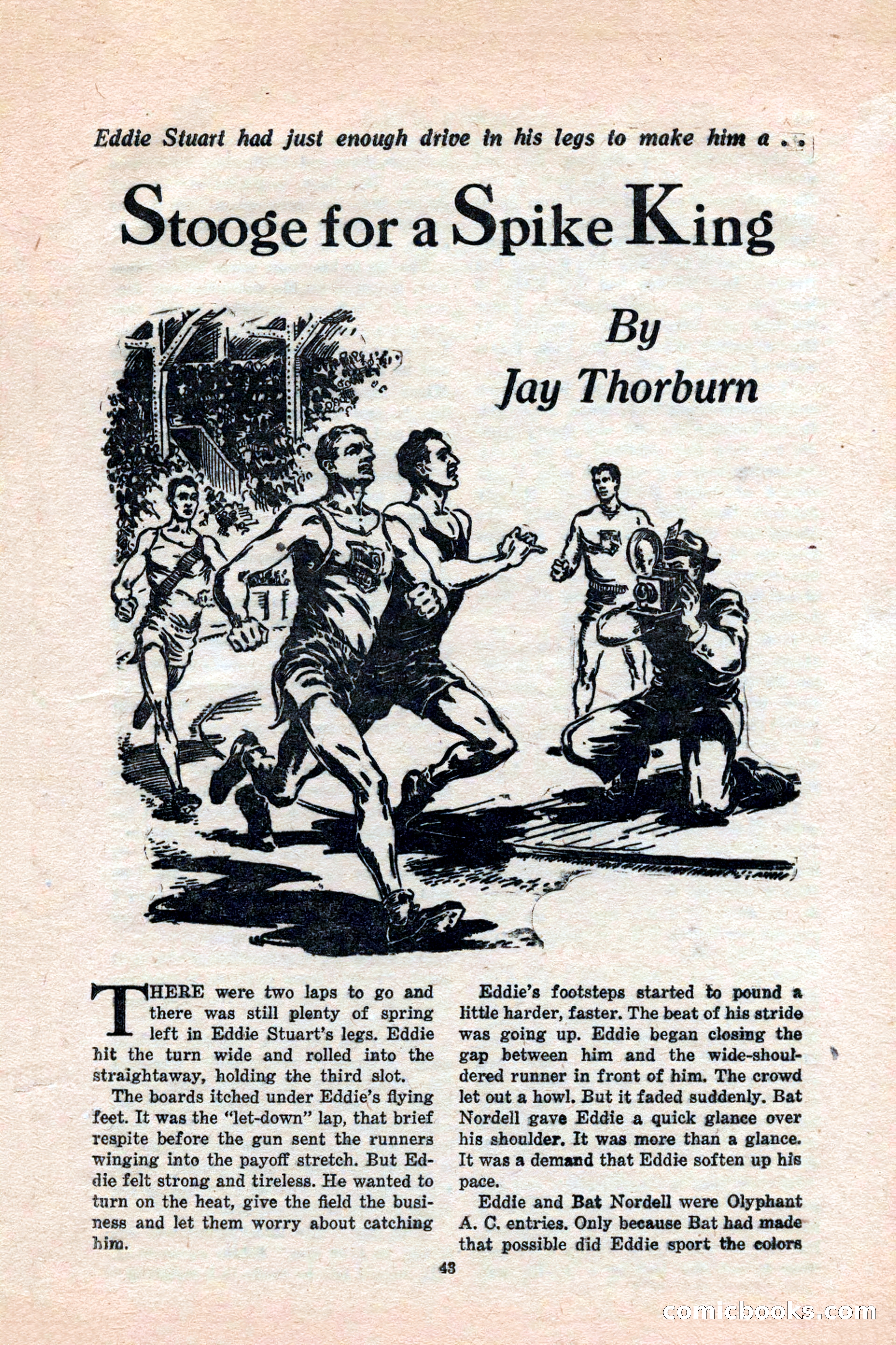
# Page Analysis This is an **interior story page** from a pulp magazine, showing the opening of a short story titled "Stooge for a Spike King" by Jay Thorburn. The page includes a dramatic illustration of runners competing in what appears to be a track event, with spectators in the background. The prose describes a competitive running race where protagonist Eddie Stuart, running in third place with two laps remaining, begins accelerating to close the gap on the runner ahead of him—a man named Bat Nordell. The story appears to explore themes of athletic competition and social obligation, as Eddie and Bat are apparently teammates for the Olyphant A.C.
# Page Analysis **Type:** Story prose text (interior page from a sports fiction story) **Content:** This page from *12 Sports Aces* depicts a climactic mile race where protagonist Eddie, a runner coached by Doc Hansen, struggles to follow his trainer's conservative strategy. During the final lap, Eddie abandons his instructions to hold back and makes a late charge, passing Chuck Oliver but arriving too late to catch the winning runner, Bat Nordell. After the race, Doc Hansen criticizes Eddie's disobedience, while Eddie defends his decision as necessary due to slower-than-expected pacing. The narrative focuses on Eddie's physical exhaustion and emotional conflict between following coaching and racing instinct.
# Page Analysis: "Stooge for a Spike King" This is story prose from page 45 of a pulp fiction magazine. The text depicts a confrontation in a boxing gym's dressing room between Bat Nordell (an apparently ruthless boxing manager), Eddie (a young boxer Bat is training), and Marty Hudlin (a disgruntled boxer Bat has displaced). Marty accuses Bat of using him up and replacing him with Eddie, while Eddie begins to question Bat's harsh treatment and demands to hear both sides of conflicts. The passage ends with a reference to a newspaper columnist preparing to publish negative information about Bat Nordell.
# Analysis of Page 46 from "12 Sports Aces" This page contains story prose from a pulp-fiction sports narrative. The text depicts a conflict between a runner named Eddie Stuart and Bat Nordell, apparently a coach or manipulator who controls Eddie through a combination of job patronage and athletic mentorship. Eddie discovers that Bat has been using him as a pacemaker while competing in races, and confronts him about changing tactics for an important Philadelphia mile run. Eddie agrees to pace Bat but declares he will run to win and plans to resign afterward—mirroring a previous runner, Marty Hudlin, who apparently attempted something similar. The page ends as the story moves toward the climactic Philadelphia race.
# Page Analysis: "Stooge for a Spike King" This page contains story prose from a pulp fiction narrative about competitive running. The text describes Eddie, a runner, competing in what appears to be a track race where he defeats rival Bat Nordell at the finish line. After collapsing from exhaustion, Eddie is helped by Doc Hansen and later congratulated by Bat, who reveals he views Eddie as his protégé and successor. The passage also includes dialogue explaining why other runners like Marty Hudlin didn't meet Bat's standards. The story appears to be sports-focused hardboiled fiction typical of pulp magazines.
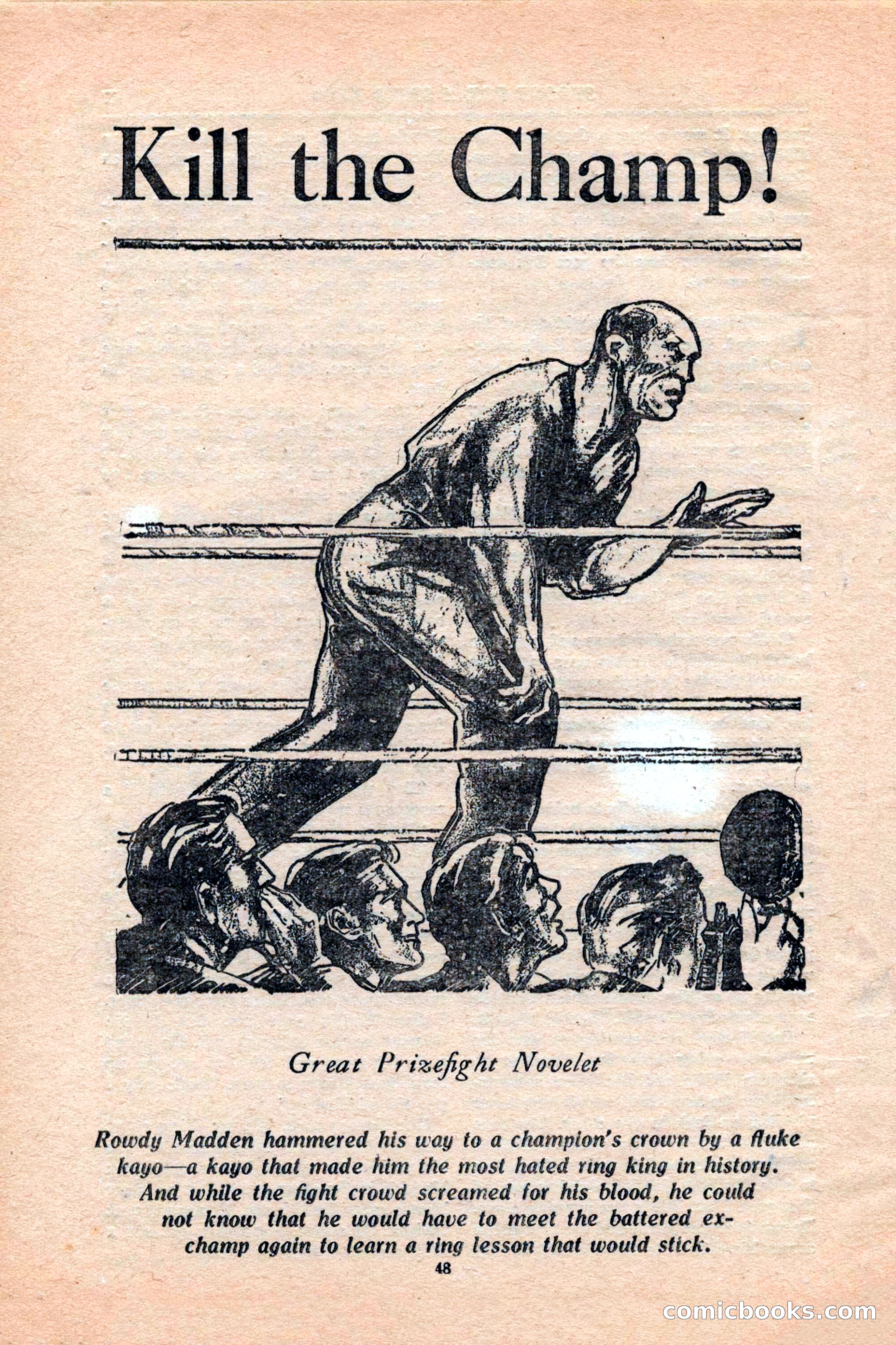
This is an interior story page from a pulp magazine featuring "Kill the Champ!," described as a "Great Prizefight Novelet." The page includes a dramatic illustration of a boxer standing victorious in a ring above a crowd, with his arms raised. The text describes a fighter named Rowdy Madden who became champion through a controversial knockout and earned hatred from fight fans, and hints that he must face the former champion again to learn an important lesson. This appears to be the opening or advertisement page for the story.
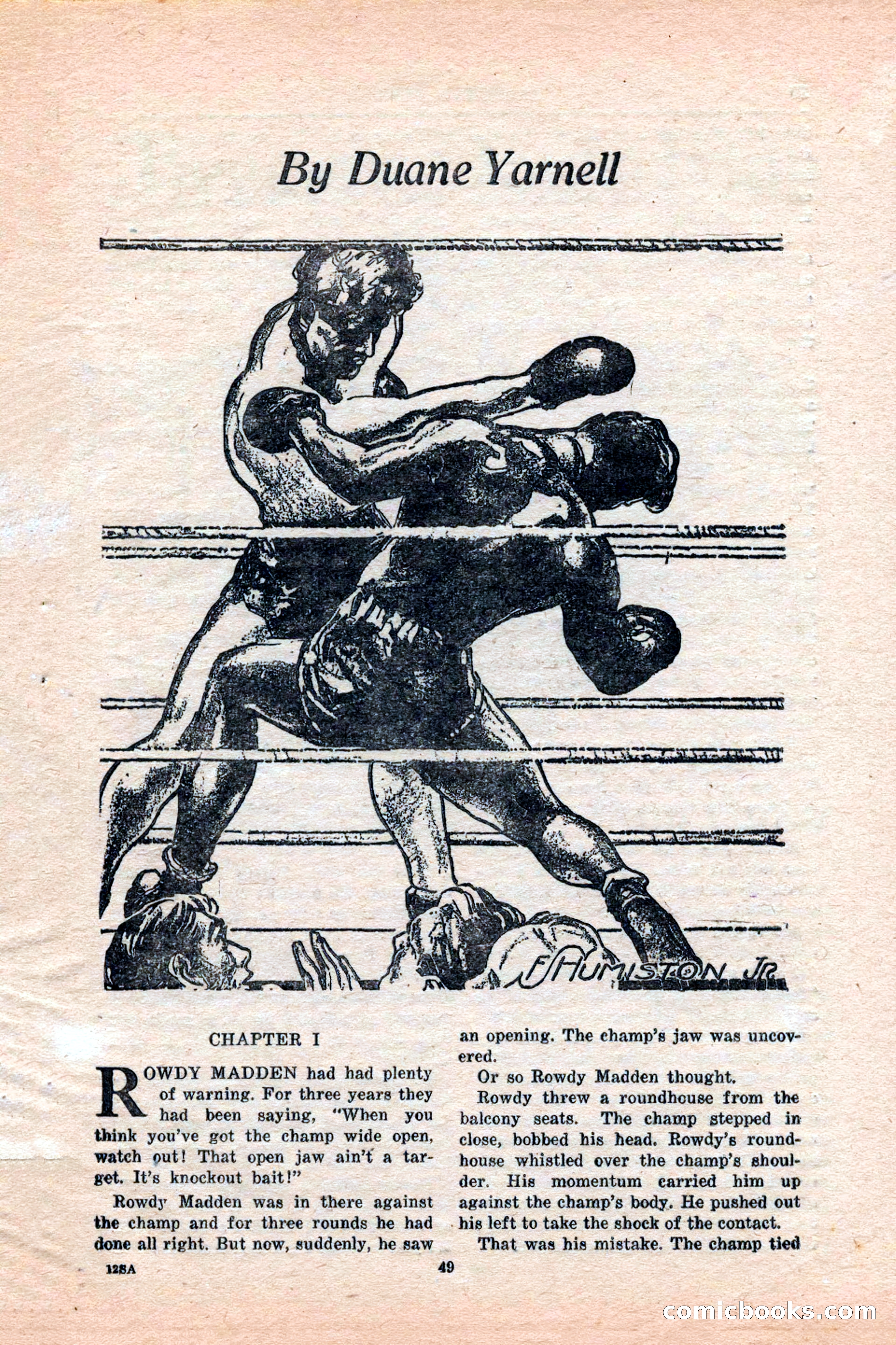
This is a page from a pulp fiction story titled "By Duane Yarnell," beginning Chapter I. The page features a dramatic black-and-white illustration of two boxers in a ring, with one fighter appearing to land a punch while the other reacts. The prose below describes a boxing match between Rowdy Madden and a champion fighter, detailing a moment where Madden spots what he thinks is an opening in his opponent's defense but makes a critical tactical error that allows the champion to counter. The narrative emphasizes the danger and skill involved in professional boxing.
# What This Page Shows This page contains story prose from a boxing pulp fiction narrative titled "12 Sports Aces" (visible at the top). The text describes a heavyweight boxer named Rowdy Madden being knocked down during a championship fight, then recovering in his corner while his manager Frosty Brown scolds him. The passage details Madden's dazed confusion, his difficult relationship with his manager, and his motivation to fight the champion to support his impoverished family. No illustrations are present—this is purely printed story text on aged pulp paper.
# Page Analysis This is **story prose** from page 51 of a hardboiled boxing pulp fiction titled "Kill the Champ!" The text depicts a boxing match between challenger Rowdy Madden and champion Marty Allen. Rowdy's manager Frosty Brown has built public hatred for Rowdy through aggressive press tactics to generate ticket sales, but Rowdy himself dislikes the violent rhetoric. During the fight, Rowdy respects the skilled, experienced champion despite the crowd's bloodthirsty demands, and cannot bring himself to hate Marty Allen, whom he recognizes as "a decent guy."
# What's on This Page This is **story prose** from a boxing fiction tale in *12 Sports Aces* magazine (page 52). The narrative describes a heavyweight boxing match between protagonist Rowdy Madden and the reigning champion. After being knocked down and nearly counted out, Rowdy recovers and, when the champion slips on blood on the canvas, lands a punch that sends the champ sprawling out of the ring. The champ hits his head and is counted out. Rowdy is declared the new heavyweight champion, though the boxing officials appear uncertain about the circumstances of his victory.
# Page Analysis This page shows story prose from a pulp fiction magazine titled "Kill the Champ!" (page 53). The narrative follows Rowdy Madden, a boxer who has just won the heavyweight championship under controversial circumstances. After being knocked unconscious by a mob bottle following his victory, Rowdy awakens in a hospital where his friend Frosty reveals a newspaper account: Rowdy defeated the defending champion Marty Allen, who had been fighting for charity. Allen—a gracious fighter who typically refused to strike opponents who lost their balance—slipped in blood during the bout, and Rowdy struck him anyway, winning unfairly and earning public hatred for his unsportsmanlike conduct.
# Analysis of Page 54 from *12 Sports Aces* This page contains story prose—specifically a section of a boxing fiction narrative. The visible text depicts a conversation between Rowdy Madden, a boxer who has recently won a championship through questionable means, and his manager Frosty. Rowdy struggles with guilt over using a dirty trick and considers renouncing his title, but Frosty convinces him to defend it instead. The passage concludes with Rowdy demanding a fight against the top challenger, Gunner Borklund, rejecting easier exhibition matches, and spending two days in the hospital before being cleared by doctors, though appearing mysteriously feverish.
# Page Analysis This is story prose from a pulp fiction boxing narrative titled "Kill the Champ!" (page 55). The text depicts a boxer named Rowdy Madden preparing for a championship fight against challenger Gunner Borklund. Rowdy is hated by fans and the public due to machinations by his manager Frosty Brown, resulting in poor ticket sales and a boycott. The passage follows Rowdy in his corner moments before the bout, as his manager gives final instructions and Rowdy studies his opponent, a large Swedish lumberjack-type fighter. The narrative captures the tension and animosity surrounding the fight.
# Page 56 from "12 Sports Aces" This page contains story prose from a boxing narrative titled "12 Sports Aces." The text depicts a dramatic boxing match between champion Rowdy Madden and challenger Gunner Borklund. Rowdy is being fouled repeatedly—hit in the eye, kidney, and jaw—by his opponent while the referee does nothing. After being knocked down and nearly defeated, Rowdy realizes his manager Frosty has been tricked by someone (implied to be a woman connected to Borklund) into believing false information about the challenger's weakened right hand. Despite his injuries and anger at the betrayal, Rowdy summons strength to rise before the count ends.
# Page Analysis This is story prose from a pulp fiction magazine, specifically page 57 of a story titled "Kill the Champ!" The visible text depicts a boxing match in which the protagonist Rowdy Madden is defeated by challenger Gunner Borklund. After losing, Rowdy regains consciousness and later negotiates his release from his manager Frosty by paying a thousand dollars for his boxing contract, deciding to leave the sport due to his injured hand. The passage emphasizes the brutal nature of the fight and Rowdy's determination to escape both his manager and the boxing world.
# Page 58 from "12 Sports Aces" This page contains story prose from a pulp fiction narrative titled "Killer Blane on Carnival Tour." The text follows Rowdy Madden, a desperate former boxing champion with an injured hand, who discovers that his rival ex-champ Marty Allen is now fighting for money at a traveling carnival. Rowdy attends a carnival boxing match, where he observes that Marty appears broken and possibly blind, suggesting Rowdy bears responsibility for Allen's downfall. The story appears to be a hardboiled boxing narrative exploring themes of redemption and consequence.
# Page Analysis This is story prose from a pulp fiction magazine, appearing to be page 59 of a story titled "Kill the Champ!" The page depicts a boxing match between the protagonist Rowdy Madden and an ex-champion fighter named Marty Allen, with a boxer called Killer Blane observing. The narrative describes the brutal fight in detail—Allen is badly beaten and knocked down, loses the match, then Rowdy himself enters the ring to challenge Killer Blane. The page ends with Killer Blane grinning menacingly as he prepares to face Rowdy, suggesting the climactic confrontation is beginning.
# Page Analysis: *12 Sports Aces* Pulp Magazine This is story prose from page 60 of *12 Sports Aces*, a pulp sports fiction magazine. The text depicts a boxing match aftermath in which Rowdy, a fighter, defeats Killer Blane in a carnival bout, then encounters Marty Allen, a former champion boxer wearing dark glasses, outside the ring. The two men reconcile past misunderstandings—Marty apologizes for doubting Rowdy's earlier claim of injury—and discuss their current financial struggles, with hints that both fighters need money and Marty's eyesight is compromised. The dialogue-heavy narrative captures hardboiled pulp style typical of Depression-era fight fiction.
# Page Analysis This is **story prose** from page 61 of a pulp fiction magazine titled "Kill the Champ!" The visible text continues Chapter V, depicting a boxing narrative. The protagonist, Rowdy, has partnered with a manager named Marty and begins fighting at a carnival against "Killer Blane" for ten dollars per round. After losing his first fight, Marty coaches Rowdy on defensive boxing techniques and chin protection. Over several carnival appearances, Rowdy gradually earns money and improves his skills through practical experience and instruction, establishing a training relationship with his new manager.
# Page 62: "12 Sports Aces" - Story Prose This page contains story prose from a pulp fiction magazine. The narrative follows a boxer named Rowdy Madden and his manager Marty Allen as they work toward securing a championship fight. The text describes Rowdy's training and fights with minor opponents, their difficulty getting the heavyweight champion to agree to a match, Marty's mysterious disappearance and return, and finally their success in arranging a title bout at "the Garden." The story concludes with Rowdy about to enter the ring for the championship fight, where some fans cheer for him.
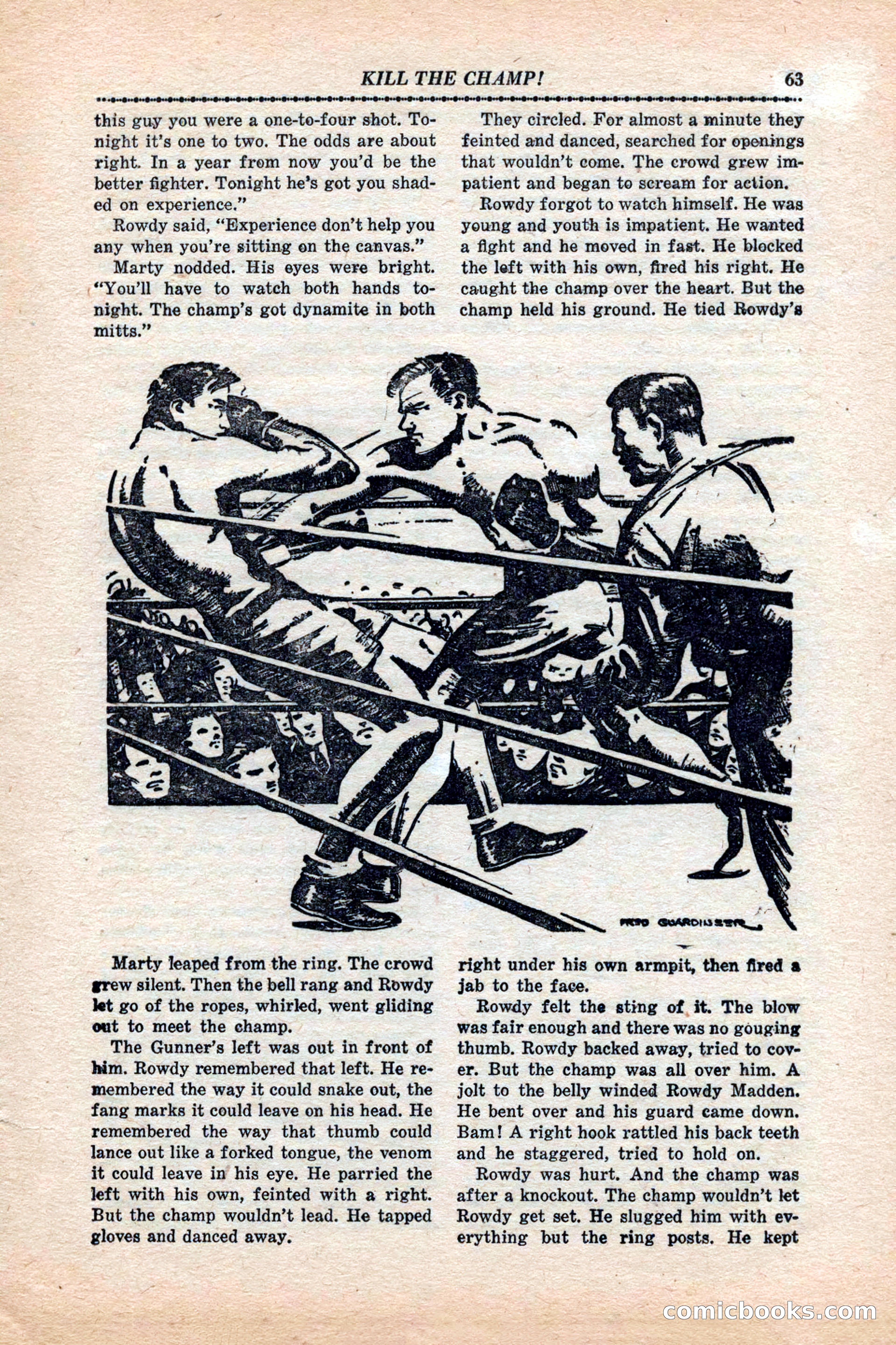
# Page Analysis This is page 63 from a pulp fiction story titled "Kill the Champ!" It contains prose narrative with an accompanying black-and-white illustration. The visible text depicts a boxing match in progress. A character named Rowdy Madden fights against a champion boxer. After initial circling and feinting, Rowdy aggressively moves in but is caught by the champion's jab to the face. The champion then presses his advantage, landing body shots and a right hook that staggers Rowdy, who appears hurt and unable to escape the champion's relentless assault. The illustration shows the boxers mid-fight in a ring with spectators visible.
# Page Analysis This is story prose from page 64 of *12 Sports Aces*, a pulp magazine. The text depicts a boxing match between a fighter named Rowdy and a champion called Gunner Borklund. Rowdy is being badly beaten and knocked down repeatedly, while his manager Marty encourages him to continue fighting. Between rounds, Marty reveals that their manager Frosty deliberately sabotaged Rowdy's previous championship fight by rigging it in Borklund's favor, and that Rowdy now has a chance for revenge. The narrative focuses on the brutal physical punishment and strategic corner work typical of boxing pulp fiction.
# Page Analysis This is **story prose** from page 65 of a pulp fiction magazine titled "Kill the Champ." The text depicts the climactic boxing match between the protagonist Rowdy and the champion Gunner Borklund. Rowdy, initially beaten down, rallies after learning his manager Marty obtained the fight through blackmail. Using tactics learned from the Gunner himself, Rowdy systematically wears down the out-of-shape champion through body shots and strategic retreats, ultimately knocking him out to win the title. The passage ends with the crowd celebrating Rowdy's unexpected victory.
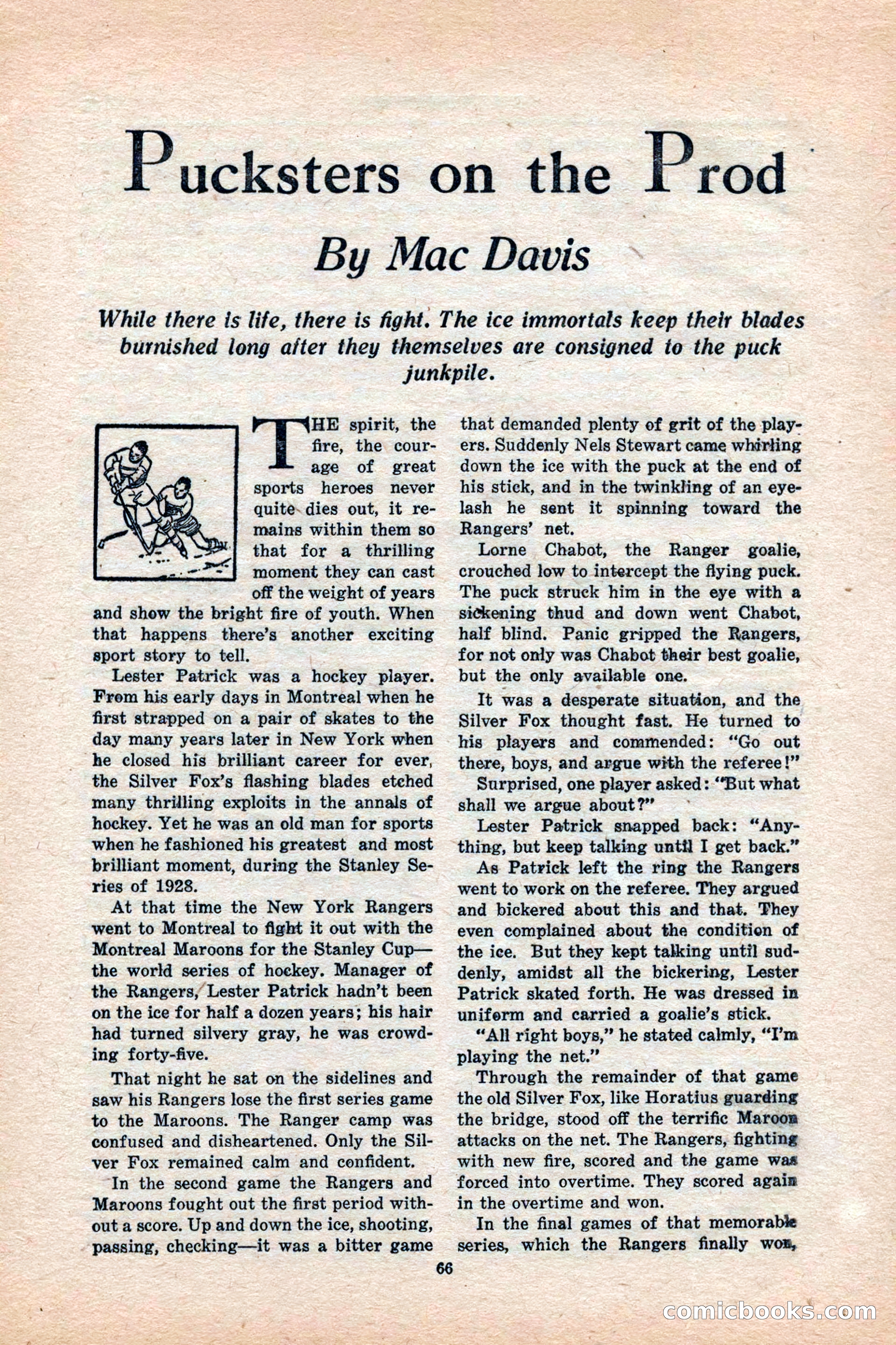
# Story Prose Page This page contains the opening and bulk of a short story titled "Pucksters on the Prod" by Mac Davis. The narrative recounts a dramatic moment from the 1928 Stanley Cup series when aging New York Rangers manager Lester Patrick, a former hockey player known as "the Silver Fox," stepped in to play goalie after the team's goalie was injured. The story depicts how Patrick rallied his demoralized team and helped lead them to victory through his unexpected participation and calm leadership. The page includes a small illustration of a hockey player in the upper left corner.
# Page Analysis This page contains story prose from what appears to be a sports history or biography article titled "Pucksters on the Prod" (page 67). The text recounts the lives of early hockey players, focusing primarily on Frank McGee, a one-eyed Ottawa Comet player who became a hockey star despite losing an eye in a collision, and briefly mentions Georges Vezina, a goaltender for whom the Vezina Trophy is named. The narrative covers McGee's remarkable Stanley Cup performances around 1905 and his eventual death in World War I, then transitions to Vezina's career and death from tuberculosis. The page is entirely text with no illustrations visible.
This page contains story prose from a pulp fiction magazine. The visible text tells the anecdote of how hockey manager Frank Patrick dismissed a young Eddie Shore in 1923, only to later pay him handsomely when Shore became a star player—a cautionary tale about Patrick's shortsightedness. The page concludes with a legal statement of ownership and management required by Congress, dated 1942.
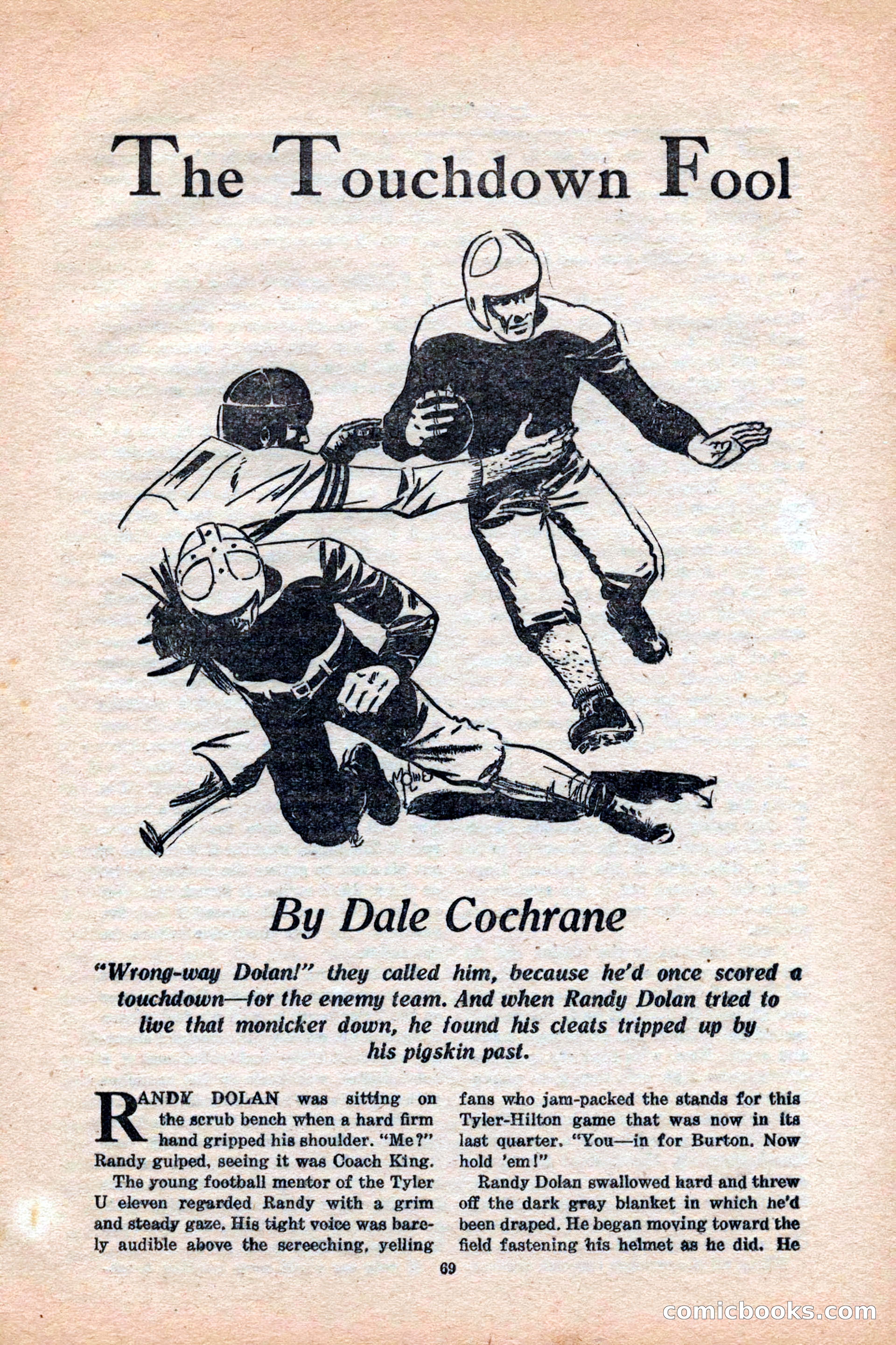
# Analysis This page shows the **opening of a short story** titled "The Touchdown Fool" by Dale Cochrane, appearing in what seems to be a sports-themed pulp magazine. The story concerns Randy Dolan, a football player nicknamed "Wrong-way Dolan" because he once scored a touchdown for the opposing team. The visible text introduces Dolan sitting on the bench during a Tyler-Hilton game when Coach King calls him in to play, despite his embarrassing past. The illustration depicts football players in action, showing the athletic subject matter.
# Page Analysis This is a story prose page from a pulp sports fiction magazine titled "12 Sports Aces." The narrative follows Randy Dolan, a former Hilton University player now at Tyler U., who begs Coach King for a chance to play in a critical game against his former school. After being inserted into the game, Randy struggles with fear of repeating his past mistakes but helps Tyler's defense hold Hilton to a field goal attempt. The passage depicts the intense back-and-forth action of a football game, with detailed descriptions of plays and Randy's internal anxiety about proving himself on the field.
# "The Touchdown Fool" — Story Prose This is a page of story prose from a pulp fiction magazine. The narrative follows a football player named Randy who, during a game between Hilton and Tyler, becomes disoriented after being hit and accidentally tackles his own teammate, enabling Tyler to score. Randy realizes his costly mistake when the scoreboard reads Tyler 7—Hilton 6, and his teammates respond with silent, bitter anger rather than celebration. The story explores Randy's shame and dread facing the locker room aftermath, knowing he may have cost Coach King a coaching position at Northern.
# Page 72 of "12 Sports Aces" — Story Prose This page contains body text from a sports fiction story. The narrative follows Randy, a college football player who, after a poor performance, decides to enlist in the Air Corps and leave school. Coach King persuades him to stay for the upcoming game against Midwest. However, Randy secretly packs to leave anyway, but is intercepted by his teammate Stymie Smith, who convinces him to return to the frat house. The passage depicts the tension between Randy's desire to escape and his friends' efforts to keep him for Saturday's important game against Midwest—apparently Tyler's debut into major collegiate football.
This page contains story prose from "The Touchdown Fool," a sports fiction narrative appearing in what is labeled as page 73 of the pulp magazine. The text describes a college football game between Tyler and Midwest, focusing on protagonist Randy's anxieties about his role on the team and Coach King's struggles after a recent defeat. The passage details the opening plays of the game, particularly featuring the opposing team's All-American player, Hips Eberle, executing an impressive broken-field run. The story references wartime conditions affecting the stadium atmosphere, suggesting this was written during an era when World War II impacted American life.
# Page Analysis This is story prose from page 74 of a pulp sports fiction magazine titled "12 Sports Aces." The narrative describes a college football game between Tyler and Midwest, where Coach King discovers that star player Hips Eberle has been replaced by his younger brother Morgan without the opposing team's knowledge. The revelation that Hips (now in the Air Corps) sat out the game to avoid injury motivates King's team to fight back against their rival, while scouts watch from the stands. The passage captures the dramatic buildup to the second half of play.
# Analysis This page contains **story prose** from a pulp fiction football narrative titled "The Touchdown Fool." The text depicts a crucial moment in a football game where Randy Dolan, a player who appears to have been benched, convinces Coach King to let him back into the game. After entering play, Randy demonstrates unexpected skill and determination, carrying the ball repeatedly against the opposing Midwest team while his teammates block for him. The passage shows Randy gaining yards despite difficult plays, with Coach King and the Tyler bench reacting with surprise at his performance. The story emphasizes themes of redemption and fighting for something larger than oneself.
# Page Analysis This is **story prose** from page 76 of *12 Sports Aces*, a pulp sports fiction magazine. The text describes the climax of a football game between Tyler and Midwest, with Tyler winning 7-6 on a dramatic play by a player named Randy. After the game, Coach King and his team discuss Randy's motivational speech and a fake photograph King used to inspire fighting spirit. The passage reveals that Randy saw Northern scouts in the stands (contradicting his earlier claim to motivate the team), and ends with Randy pointing out that the scouts are now approaching the coach. A small illustration of a football player appears at the bottom of the page.
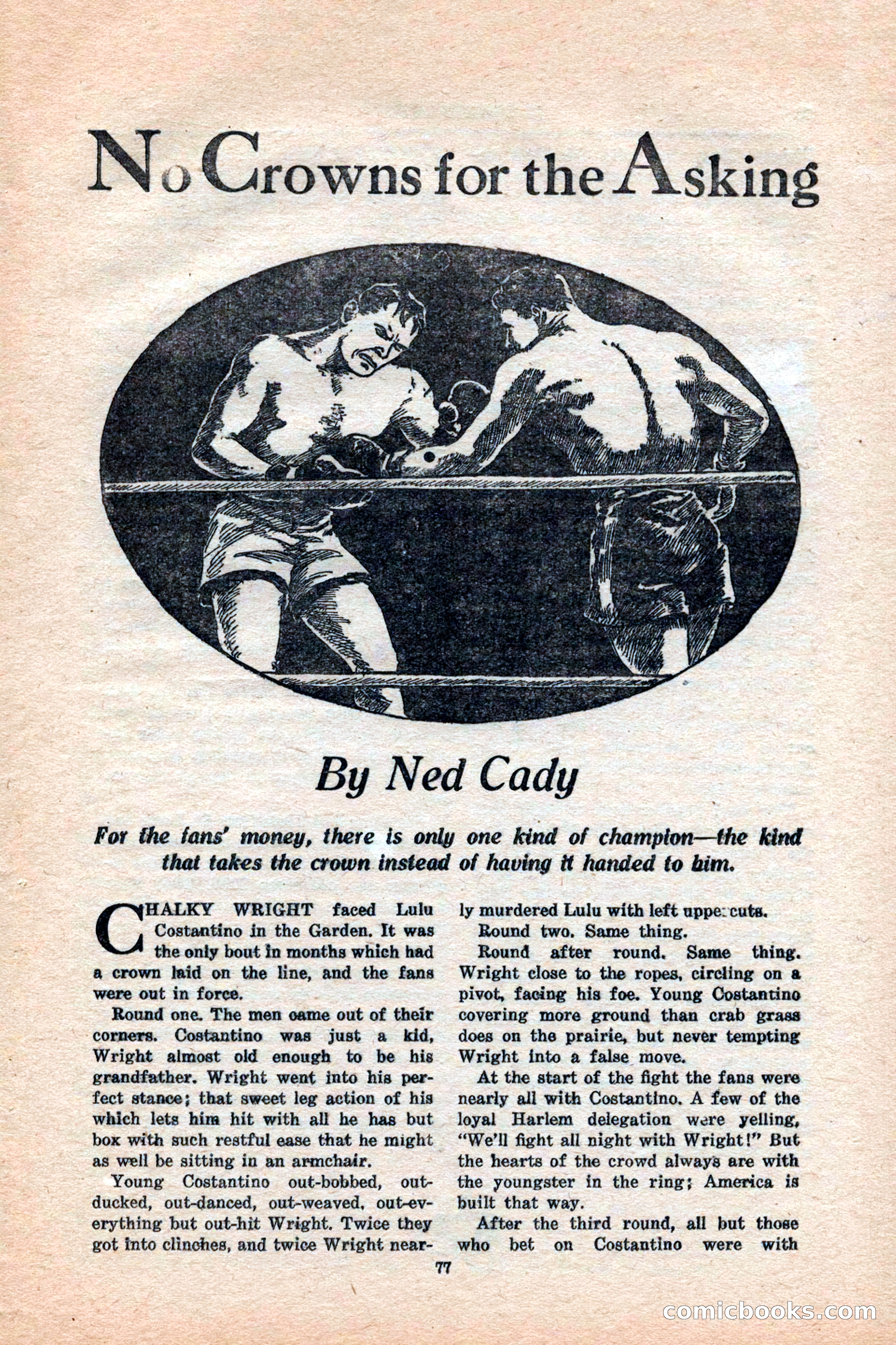
# Page Analysis This is a story prose page from a pulp fiction magazine featuring "No Crowns for the Asking" by Ned Cady. The page includes a black-and-white illustration at the top depicting two boxers in a ring, and below it begins the narrative text of a boxing story. The visible prose describes a championship boxing match between Wright (an older fighter) and young Costantino, focusing on their first three rounds. The subtitle emphasizes that true champions earn their crown through victory rather than having it awarded to them.
# Analysis of Page 78 from *12 Sports Aces* This page contains story prose from a pulp sports magazine. The text discusses what makes true athletic champions, contrasting technical victories with decisive, aggressive play. The author uses boxing examples (Jack Dempsey, Luis Angel Firpo, Jess Willard) and football/baseball references (Notre Dame, the St. Louis Cardinals' World Series victory) to argue that fans respect competitors who dominate through aggressive effort rather than merely winning on points. The piece emphasizes that champions must "step out there and took the crown"—winning decisively and earning fan admiration through their fighting spirit.
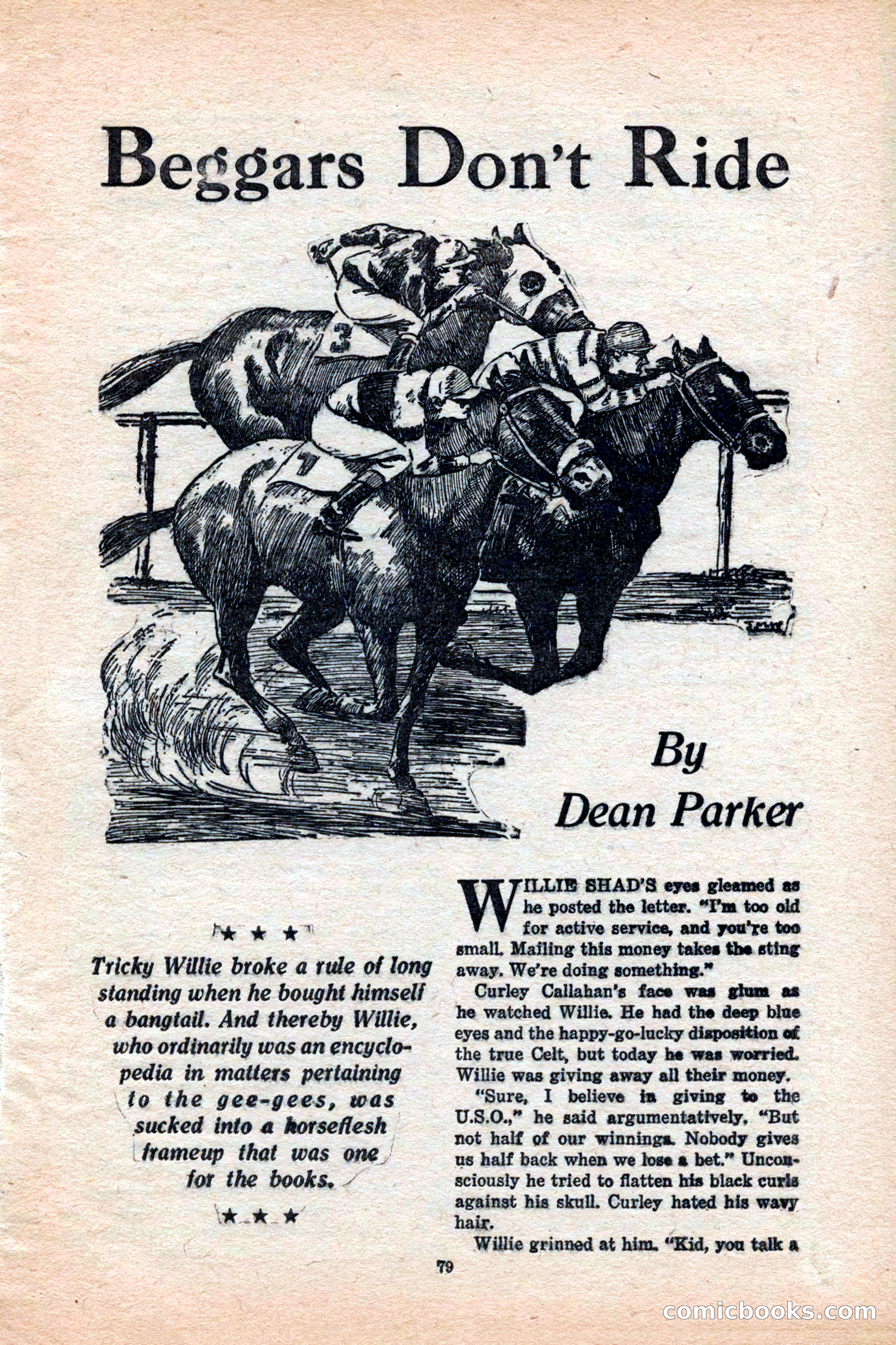
# Page Analysis This is an interior story page from a pulp magazine, showing the opening of a short story titled "Beggars Don't Ride" by Dean Parker. The page features a black-and-white illustration of horse racing at the top, depicting jockeys on racing horses. Below the illustration begins the story prose, introducing two characters—Willie Shad and Curley Callahan—who have apparently won money betting on horses and are debating whether to donate it to the U.S.O. The opening text establishes that Willie has broken his usual cautious approach to horse racing by purchasing a horse (a "bangtail"), leading to some kind of scam or scheme. The page is numbered 79.
# Page Analysis This page contains story prose from a pulp fiction magazine titled "12 Sports Aces" (page 80). The narrative concerns Willie, a sharp horse-racing bettor nicknamed "Tricky Willie," and his protégé Curley, a jockey. The text depicts Willie's obsessive plan to financially ruin a bookmaker named Soap Edwards, who apparently wronged Willie years earlier involving a woman. The passage shows Willie's contradictory nature: generous to those in need (giving money to an elderly man called Cap'n) yet focused on revenge. The scene culminates at a racetrack where Willie and Curley arrive to watch the fifth race.
# Page Analysis: Story Prose from "Beggars Don't Ride" This is a text page from a pulp fiction story titled "Beggars Don't Ride." The visible prose depicts a scene at what appears to be a horse racing venue where a character named Willie encounters a distraught girl named Jane Kumpy, whose father lost money when her horse Melody Lane nearly lost a race. Willie learns that Colonel Kumpy needs funds urgently and decides to help, apparently planning to use the horse in some scheme involving a bet. The page concludes with Willie and his companion Curley approaching Colonel Kumpy at his horse's stall.
# Page Analysis This is story prose from a pulp fiction magazine titled "12 Sports Aces." The page depicts a horse-racing narrative in which Willie and Curley investigate a racehorse called Melody Lane, which is entered in the upcoming Raleigh Cup. When the horse performs poorly in workouts, they encounter an old handler named Cap'n who reveals the animal lacks a distinctive scar Melody Lane should have. Willie concludes they've been given a different horse—possibly an identical twin—prompting him to seek out Colonel Kumpy for answers about the deception.
# Analysis of Page 83 This page contains **story prose** from "Beggars Don't Ride," a horse-racing narrative. The text depicts the day before and morning of a major race (the Raleigh Cup). Willie, the protagonist, mysteriously sends Cap'n on a secretive errand the night before the race, then appears exhausted but oddly confident. Jockey Curley doubts their horse, Melody Lane, can perform—it hasn't worked in a week—but during the actual race, the horse surprises him by running strongly and eagerly, moving up through the field in the backstretch. The passage focuses on character tension, race preparation, and the beginning of the competition itself.
# Page Analysis This is **story prose** from page 84 of a pulp magazine titled "12 Sports Aces." The text concludes a horse-racing narrative in which Willie explains to Curley how he solved a scheme involving twin foals. Willie reveals he discovered that a crooked horseman had hidden one of two twin colts and sold it separately, then secretly recovered the superior horse (Melody Lane) to race it himself—making him technically a horse thief, though he frames his actions as justified by helping people in need. The passage ends with Curley admitting Willie's cunning is unbeatable.
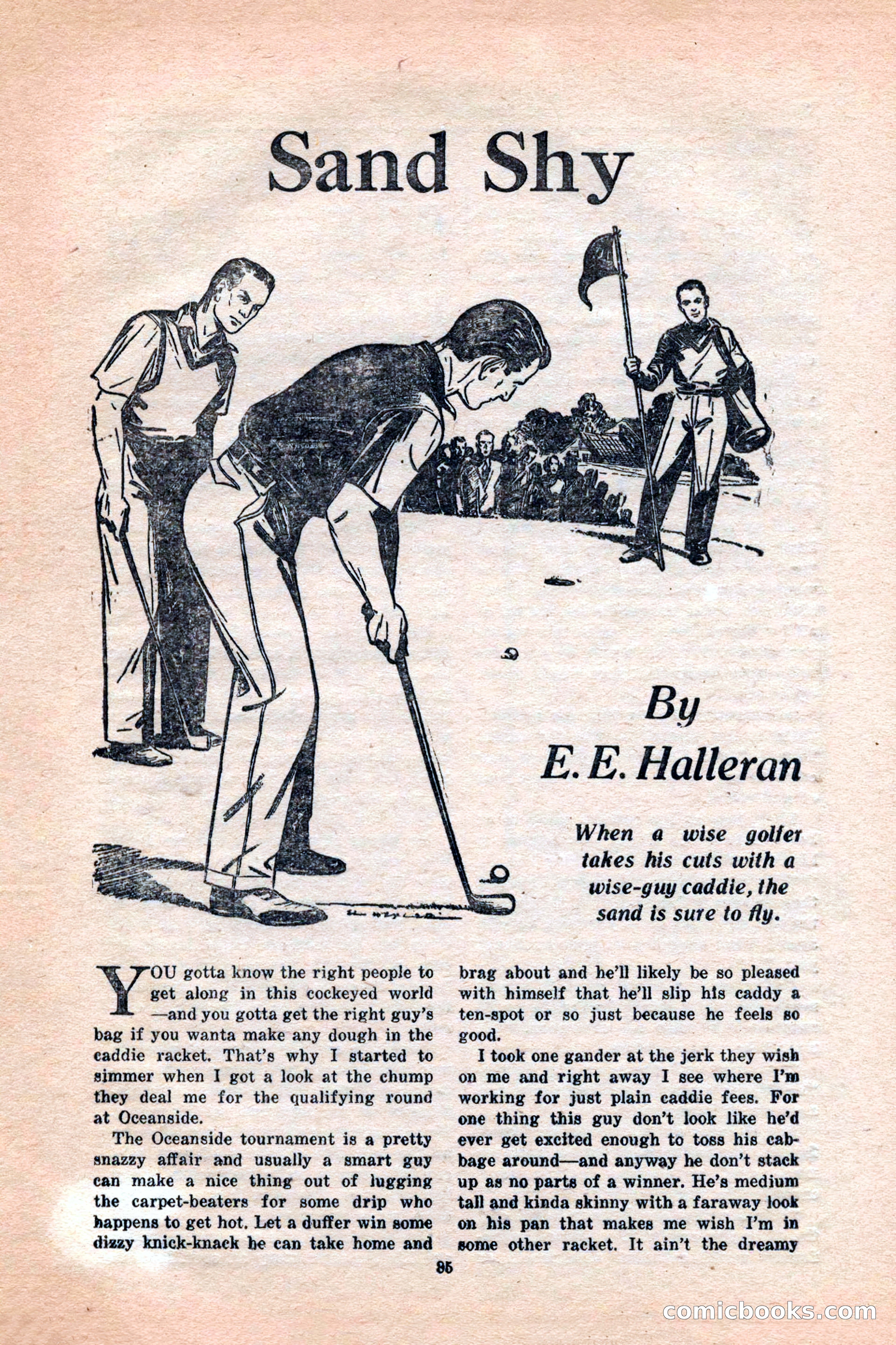
# Page Analysis This is an interior story page from a pulp fiction magazine featuring "Sand Shy" by E.E. Halleran. The page includes an illustration of a golfer taking a shot while spectators watch, accompanied by prose narrative. The visible text introduces a story about a caddie working at the Oceanside golf tournament who is assigned to work for an unprepossessing golfer he immediately dislikes, fearing he won't earn good tips. The story appears to be hardboiled crime or sports fiction written in period slang and first-person narration.
# What is on this page: This is story prose from page 86 of a pulp magazine called "12 Sports Aces." The text is a first-person narrative about a golf caddy coaching a taciturn, eccentric golfer named Rogers through a tournament. The caddy grows frustrated with Rogers's odd behavior and superstitions about sand and water hazards, particularly after Rogers dismisses the caddy's expert advice yet still performs well. The narrative describes their match-play round in detail, focusing on the caddy's irritation when Rogers ignores suggestions and still succeeds.
# Page Analysis This page contains story prose from a pulp fiction magazine titled "Sand Shy" (page 87). The narrative follows a golf caddy or gambler observing a player named Rogers compete in what appears to be a golf tournament. The text describes Rogers' psychological struggle with sand traps stemming from a past accident involving a caddie, his inconsistent performance under pressure, and the narrator's decision to bet against him in the finals, favoring his opponent Childers. The writing employs period slang and hardboiled narrative voice typical of early pulp fiction.
# Page Analysis This page contains **story prose** from what appears to be a golf-themed narrative in the pulp magazine "12 Sports Aces" (page 88). The text depicts a caddie's account of deliberately sabotaging his employer Rogers during a competitive golf match by giving him poor club selections, making distracting noises during his swing, and employing psychological tactics—all because Rogers insulted him and the caddie has bet money against him. The narrator reveals his shift from loyalty to self-interest as the match progresses through the seventeenth hole.
# Page 89 of "Sand Shy" This is a page of prose fiction from a pulp magazine story titled "Sand Shy." The narrative, told in first person by a golf caddie, describes a match between two golfers—Rogers and Childers—focusing on a pivotal moment when Rogers makes an impressive shot from a sand trap. After winning the match, Rogers pays the narrator only the standard caddie fee without a tip, and makes a cryptic, threatening remark about murder laws. The caddie concludes he should find different work, as golf caddying exposes him to too many "screwballs and mean people." A small illustration appears at the page bottom.
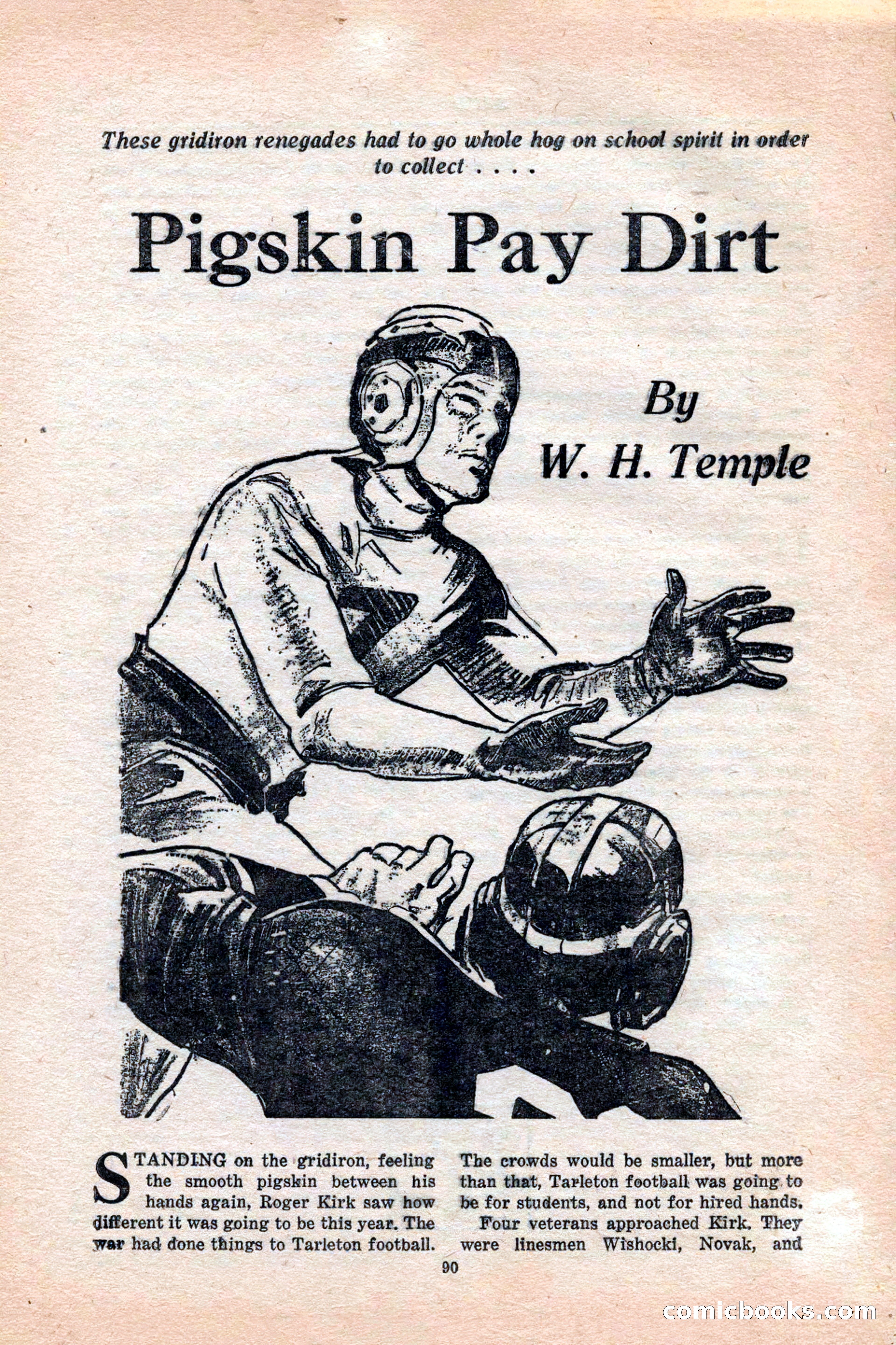
# Analysis This is a **story illustration and opening page** from a pulp fiction magazine. The image shows a football player in vintage uniform and helmet holding a pigskin, with dramatic pen-and-ink artwork typical of early pulp magazines. The visible text introduces "Pigskin Pay Dirt" by W.H. Temple, a story about Roger Kirk, who stands on the gridiron reflecting on how World War II has changed Tarleton football. The story notes the war has altered the sport—crowds will be smaller, the team will now be for students rather than hired players, and Kirk is approached by four veteran linesmen named Wishocki, Novak, and others. The title suggests the story involves football ("pigskin") and likely financial or material reward ("pay dirt").
# Page Analysis: "Pigskin Pay Dirt" This is story prose from a pulp fiction magazine. The page continues a sports-themed narrative about Kirk, a college football player at what appears to be Tarleton University. The text depicts Kirk's return to the team as an amateur player, his conversation with Coach Pop Benson about playing alongside inexperienced players, and a scrimmage where Kirk accidentally injures an opponent. After practice, Kirk learns his housing arrangement with Professor Atwood is ending due to the professor's retirement. The page concludes with Kirk encountering Lennox, an aristocratic quarterback from a fraternity, who subsequently offers Kirk a job as the fraternity's porter after their porter was fired.
# Page Analysis This page contains **story prose** from what appears to be a sports fiction story titled "12 Sports Aces" (visible in the header). The narrative follows Roger Kirk, a waiter and football player at what seems to be a college. The visible text covers two main sequences: Kirk's confrontation with a heckler diner (whom he silences by pouring soup down the man's neck), and his subsequent participation in a football game where his team faces off against Tech. The story depicts Kirk's integration into both his job and the varsity team, with particular attention to the opening plays of the football match and the team's offensive strategy.
# Page Analysis: "Pigskin Pay Dir." - Story Prose This page contains story prose from what appears to be a sports fiction piece titled "Pigskin Pay Dir." (likely "Pigskin Pay Dirt"). The narrative follows a football game between Tarleton and Tech, focusing on quarterback Kirk and his teammates as they attempt a comeback in the fourth quarter. The text describes plays, strategy, and character interactions during the crucial final moments, including Kirk's struggles with protection and his eventual successful completion of a potential game-winning pass to an end near the touchdown line.
# Page 94: Story Prose from "12 Sports Aces" This page contains story prose describing a college football narrative. Kirk scores a touchdown to end a game 7-6 for Tarleton, then leaves the locker room to find his teammates have quit the squad in protest over coaching criticism. That evening at a fraternity dance, Kirk socializes with wealthier students, and later receives an invitation to join the fraternity—an offer he initially declines. The story concludes with Tarleton playing the Kings team in football, with Kirk throwing a touchdown pass early in the game.
# Page 95 from "Pigskin Pay Dirt" This page contains story prose from what appears to be a sports fiction narrative. The text depicts Kirk, a college football captain, navigating team dynamics and recruiting efforts before an important game against Grayley. The passage describes Kirk's conversations with former teammates who are reluctant to rejoin the squad, his sadness about their refusal, and a climactic scene where students spontaneously organize a torch-lit parade through campus, carrying Kirk and fellow player Lennox to a pep rally at Rackham Auditorium. The narrative emphasizes Kirk's emotional connection to the school and his leadership role.
# Page 96: "12 Sports Aces" — Story Prose This page contains prose fiction from a pulp sports magazine. The narrative describes a college football game between Grayley and Tarleton, focusing on players Kirk and Lennox on the Tarleton team. The text details the opening plays of the match, emphasizing Lennox's physical punishment despite his strategic role as quarterback, and Grayley's dominant offensive performance led by players Chelsey, Kurvik, and Gatling. The passage illustrates tension between Kirk and Lennox regarding their contributions to the team's effort.
# Page Content Analysis This page contains **story prose** from a pulp fiction narrative titled "Pigskin Pay Dirt." The text depicts an American football game in progress, focusing on Montana and his teammates (apparently from a working-class or immigrant background) playing against the Grayley team. The passage describes specific plays—Kirk passing, Hastings running, Montana plowing through the line—culminating in Montana scoring a touchdown. The narrative emphasizes Montana's physical prowess and the team's determination to prove themselves despite being underdogs or outsiders.
# Page Analysis This is story prose from a pulp sports fiction magazine titled "12 Sports Aces." The visible text depicts the climactic final moments of a football game between Tarleton and Grayley. Kirk, the protagonist, leads his team down the field in the final minutes, ultimately scoring the winning touchdown with a pass to Hastings, followed by a successful extra point kick by Montana that gives Tarleton a 20-19 victory. The passage concludes with Kirk exhausted but triumphant, reflecting on his school as the crowd celebrates.
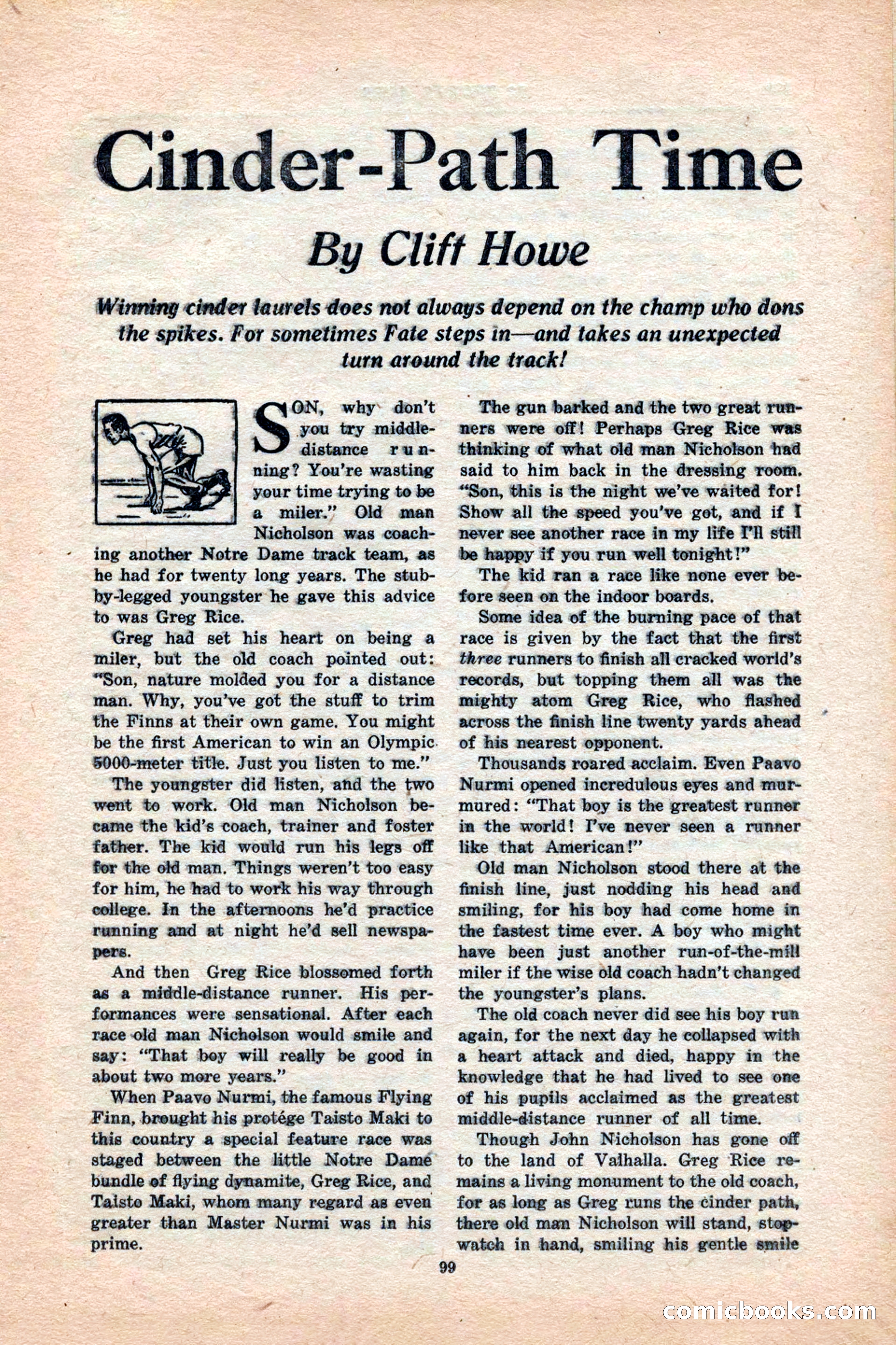
# "Cinder-Path Time" by Clift Howe This page contains story prose from a pulp fiction magazine, accompanied by a small illustration of a runner. The narrative follows Greg Rice, a Notre Dame track athlete mentored by coach old man Nicholson, who persuades the ambitious miler to compete in middle-distance running instead. Rice goes on to defeat Finnish runner Taisto Maki in a special feature race, setting world records. The coach dies satisfied the next day, having witnessed his protégé's triumph and becoming Rice's enduring inspiration for future races.
# Page Analysis: "12 Sports Aces" Pulp Magazine This is a text-only story page from *12 Sports Aces*, a pulp fiction magazine. The page presents biographical sketches of famous track-and-field runners, focusing on Gene Venzke (who set a mile record in 1932 aided by phantom footsteps he imagined behind him), Lou Zamperini (a hard-luck runner motivated by his brother's hickory stick), and Archie San Romani (an overshadowed Kansas miler). The page emphasizes dramatic anecdotes and physical hardships that shaped these athletes' careers, typical of pulp magazine's sensationalized sports storytelling.
This page contains story prose from a pulp fiction tale titled "Cinder-Path Time." The narrative follows a marathon runner from Kankakee through his athletic career, beginning with his grueling debut in the Boston Marathon and culminating in a 1928 defeat to Algerian runner El Ouafi at Madison Square Garden. The story concludes by revealing the protagonist's later life working in Gary, Indiana steel mills and tending a nursery. At the bottom of the page is a wartime advertisement encouraging readers to buy United States War Bonds and Stamps.
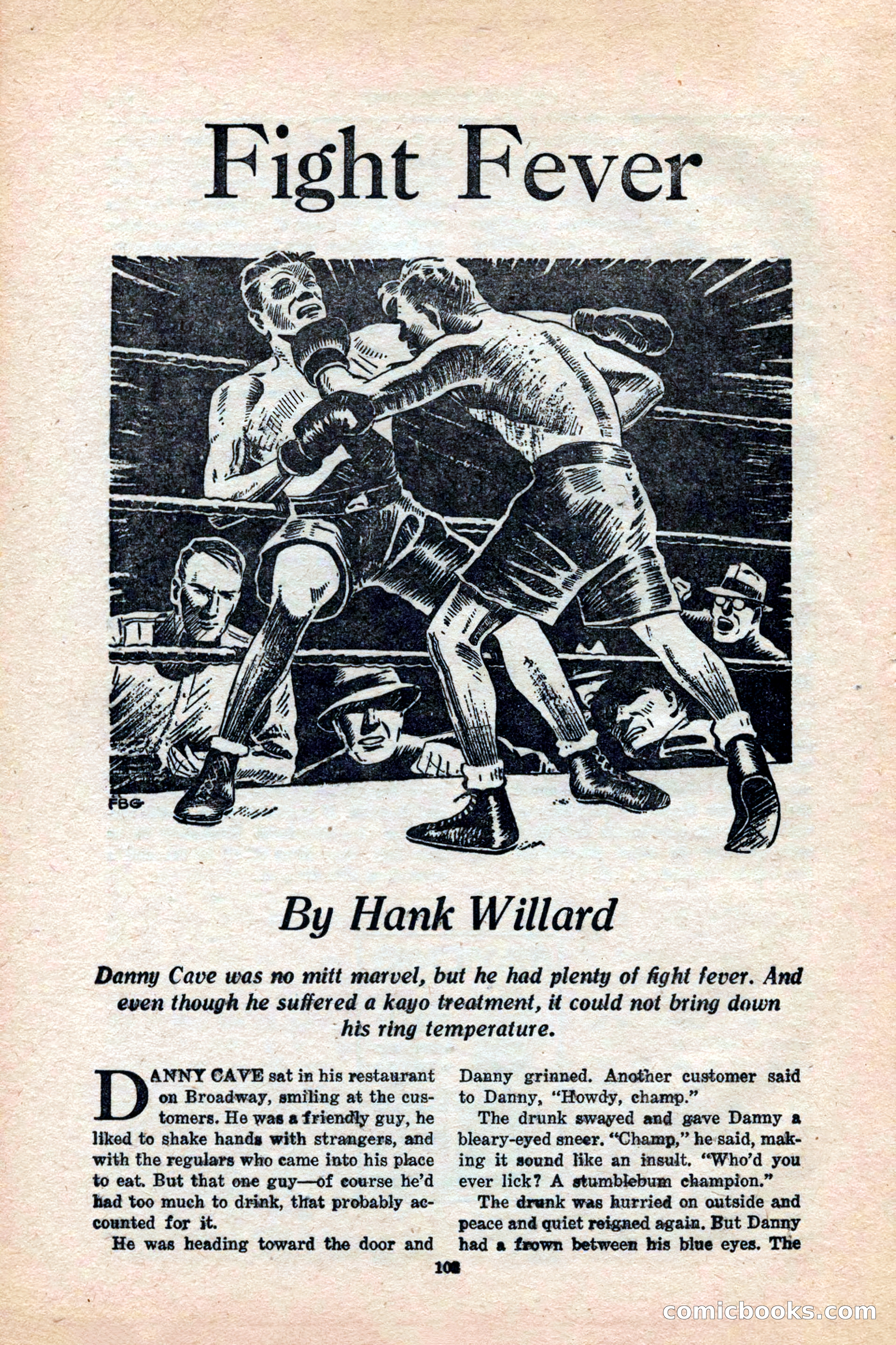
# Fight Fever This is a story page from an early pulp magazine. The page features the opening of a short story titled "Fight Fever" by Hank Willard, accompanied by a dramatic woodcut-style illustration depicting two boxers fighting in a ring while spectators watch. The visible text introduces Danny Cave, a restaurant owner on Broadway who has plenty of fighting spirit despite not being a skilled boxer. The opening scene depicts a confrontation with a drunk customer who insults Danny by questioning his boxing credentials before being removed from the establishment.
# Page Analysis: "Fight Fever" This page contains story prose from a pulp fiction narrative titled "Fight Fever" (page 163). The text depicts a boxing story in which Danny Cave, the middleweight champion, meets Grid Gaynor, a challenger who provokes him into accepting a fight. Despite his manager Sam Bradford's hesitation and his wife Ellen's concealed doubts about his abilities, Danny insists on fighting to prove himself a legitimate champion rather than merely lucky. The narrative explores themes of ambition, pride, and self-doubt within the boxing world.
# Page Analysis: "12 Sports Aces" Pulp Magazine This page contains story prose from what appears to be a boxing narrative titled "12 Sports Aces." The text describes a championship fight between the protagonist Danny Cave and challenger Grid Gaynor. The passage covers Danny's training period, pre-fight preparations with his wife Ellen and trainer Sam Bradford, and the opening rounds of their bout. The narrative focuses on boxing strategy, the physical exchange between fighters, and Danny's determination to retain his title, culminating in Danny being knocked down in the second round.
# Page Analysis This is page 105 from a pulp fiction magazine titled "Fight Fever." The page consists primarily of story prose describing a boxing match between champions Danny and Gaynor. The narrative depicts the climactic sixth round, with Danny being knocked down and defeated as his wife listens via radio at home. The right half of the page contains vintage advertisements, including a prominent ad for a beauty guide titled "Better Than Beauty" (priced at 98¢), which promises tips on charm and color coordination. Additional smaller ads appear at the bottom of the page, typical of pulp magazine layouts from this era.
# Page 106 from "12 Sports Aces" This page contains story prose from a boxing narrative. The text follows Danny, a former boxing champion who has been defeated and is now running a restaurant in New York with his wife Ellen. His manager Sam explains why he deliberately excluded a rematch clause from Danny's title contract, believing the fighter should retire while he's ahead. Despite having a comfortable life, Danny remains unhappy and struggles with the restaurant business. When the new champion Gaynor visits and mocks him, Ellen suggests Danny sell the restaurant and buy a farm upstate, where he was happiest during a past fighting trip—though Danny is skeptical about farm life.
# Page 107: "Fight Fever" This is a page of story prose from a pulp fiction magazine. The main narrative concerns a boxer named Danny who has left fighting to work on a farm, discovering he enjoys the outdoor labor and fresh air. However, he remains internally conflicted about his abandoned boxing career. The passage concludes with Ellen, apparently his wife, casually informing him that she has arranged a boxing exhibition match for him at a nearby army camp against an opponent named Joe Bronson. The page is surrounded by period advertisements for a bust-enlargement book, false teeth, and asthma medication—typical of pulp magazine marketing.
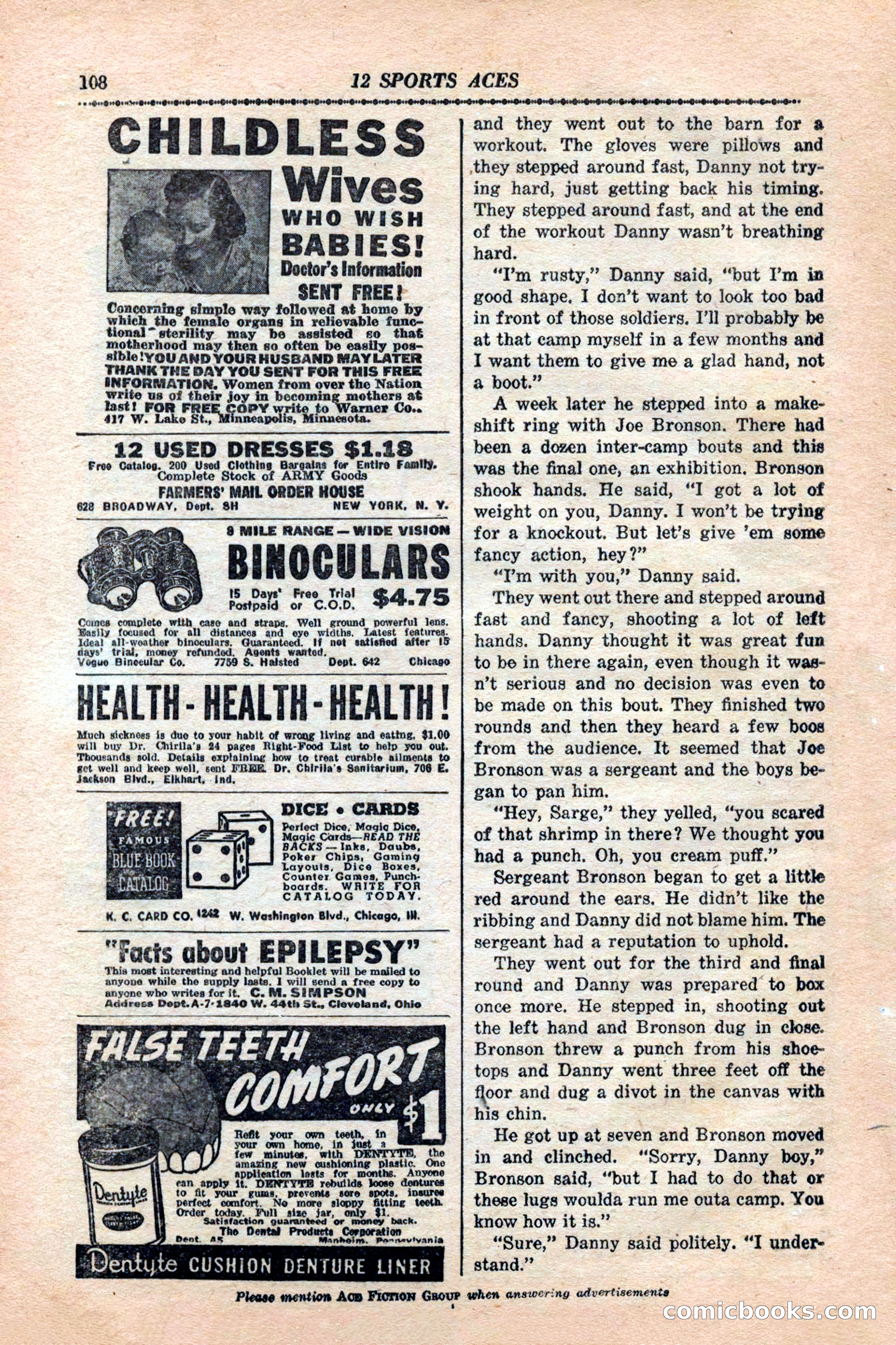
# Page 108 of 12 Sports Aces This page contains story prose from a boxing narrative titled "Childless Wives Who Wish Babies!" (the actual story appears to be about boxing, not the advertisement headline). The visible text describes Danny, a boxer, training in a barn and then competing in an exhibition match against Sergeant Joe Bronson at an inter-camp event. After two rounds of friendly sparring, soldiers in the audience begin heckling Bronson, which angers him. In the third round, Bronson throws a powerful punch that sends Danny flying backward. The page is also crowded with period advertisements for dentures, binoculars, dresses, and health products typical of early pulp magazines.
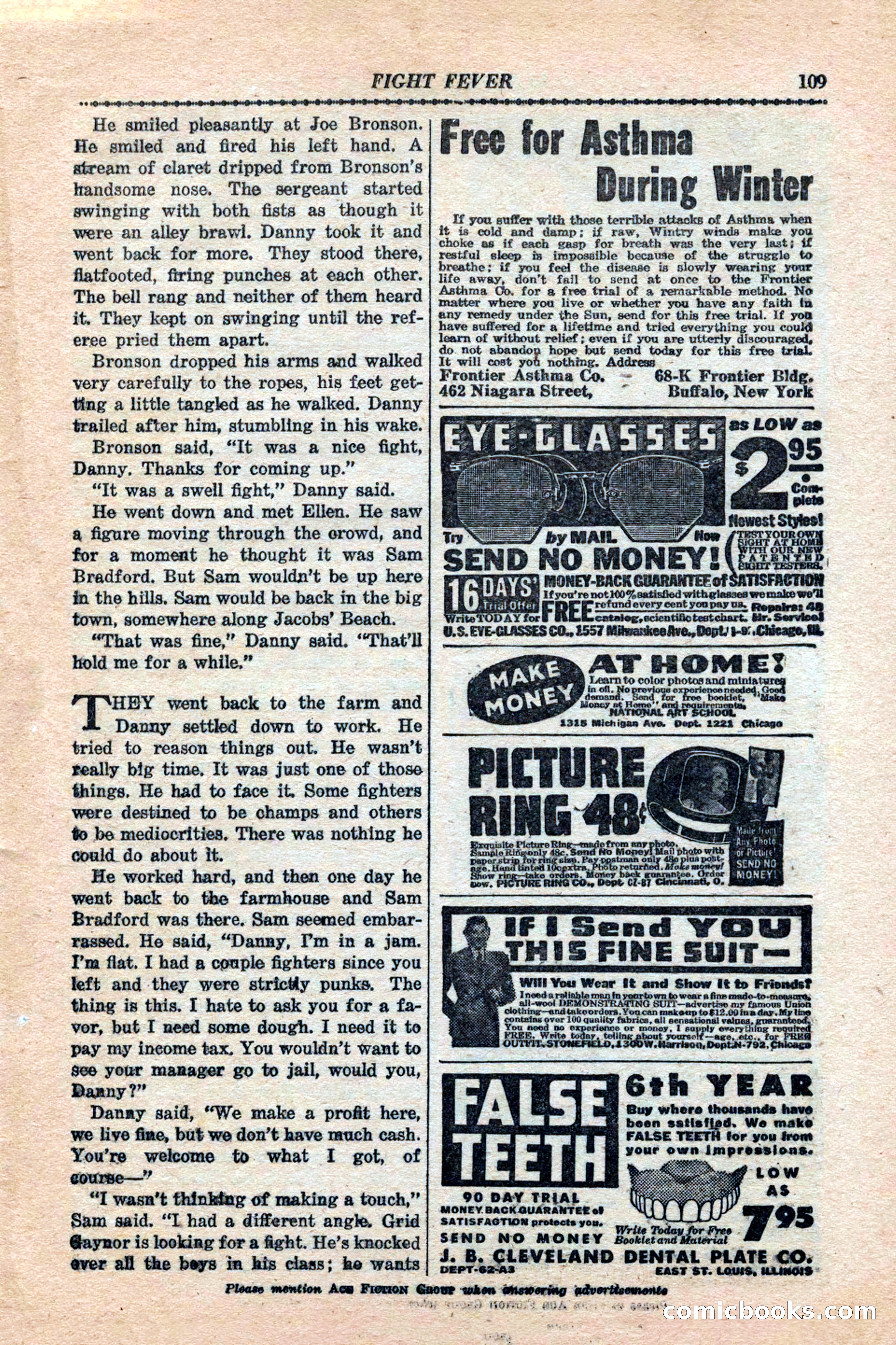
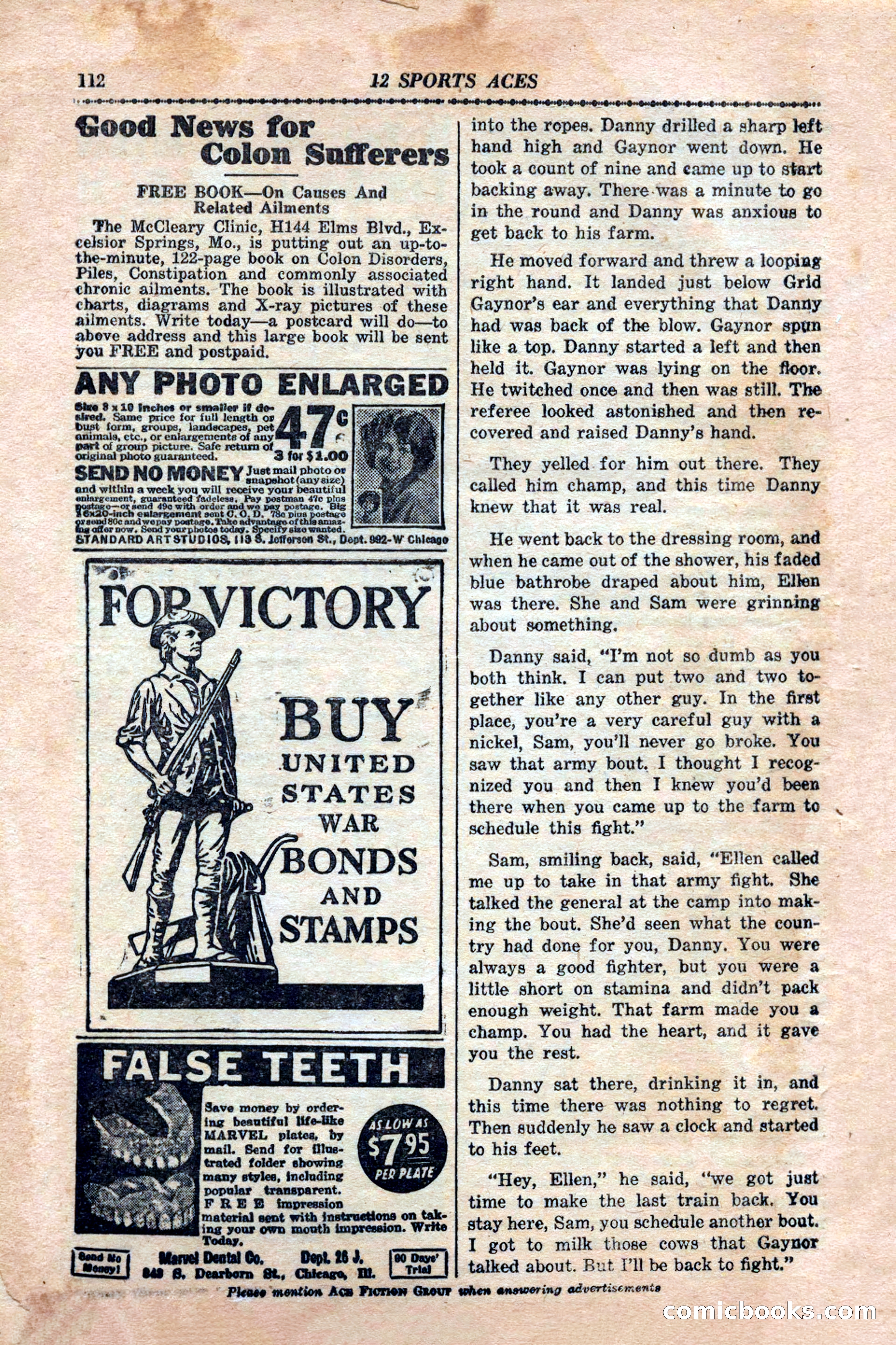
This page shows story prose from a pulp fiction magazine titled "Fight Fever." The narrative describes a boxing match between Danny and Joe Bronson, followed by Danny's return to farm life. Sam Bradford, Danny's manager, later arrives seeking money to pay income taxes and proposes that Danny fight someone named Grid Gaynor. The right side of the page is dominated by vintage advertisements for mail-order products including asthma remedies, eyeglasses, false teeth, and clothing.
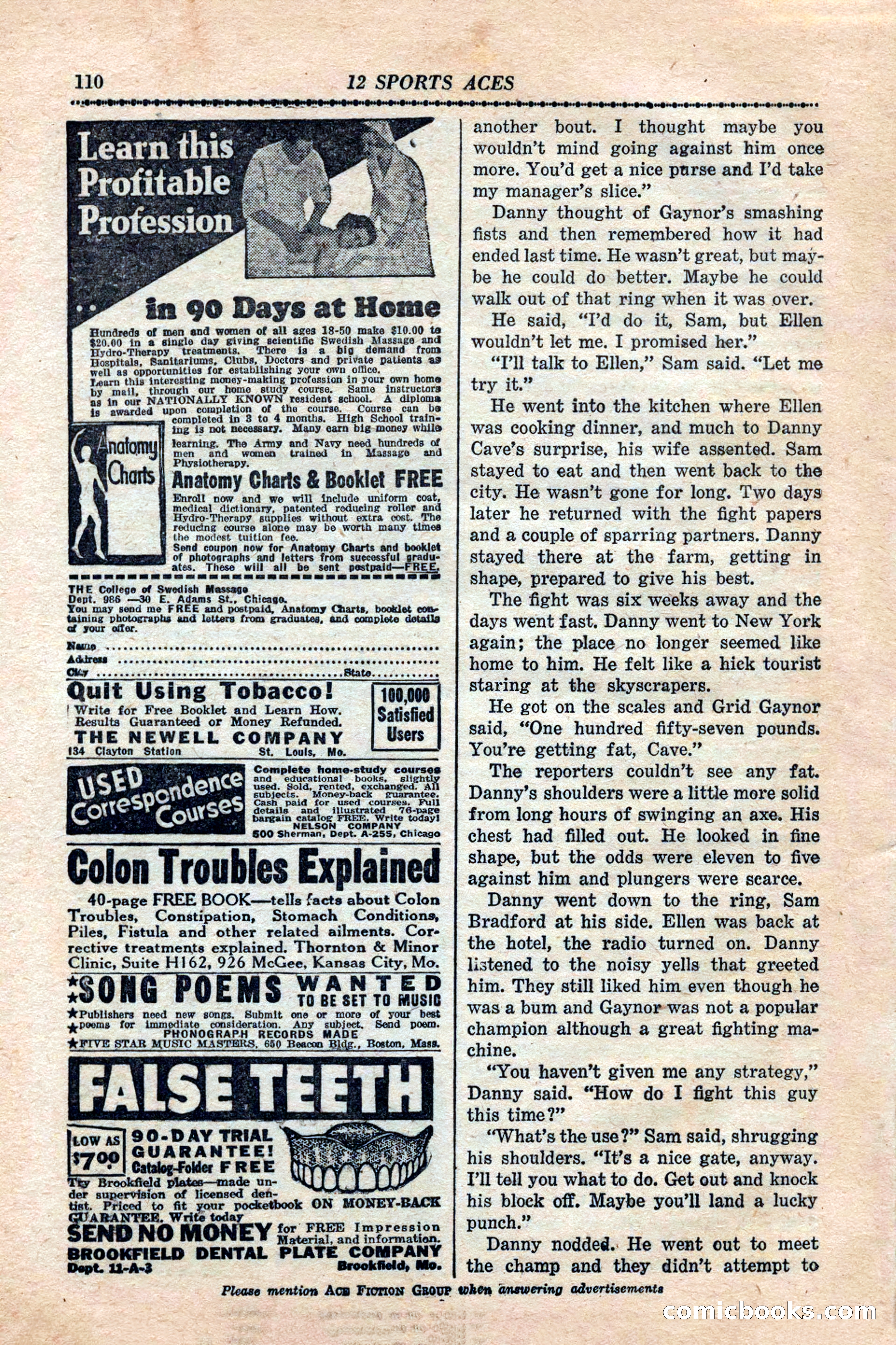
# Page Content Description This page from a pulp-fiction magazine combines story prose with period advertising. The right column contains narrative text from what appears to be a boxing story titled "12 Sports Aces" (visible at page top). The prose describes a boxer named Danny Cave being offered another fight against an opponent named Gaynor, discussing it with his wife Ellen and manager Sam, then training at a farm before weighing in at 157 pounds. The left side is dominated by vintage advertisements for correspondence courses, massage training, false teeth, and other mail-order services typical of early-20th-century pulp magazines.
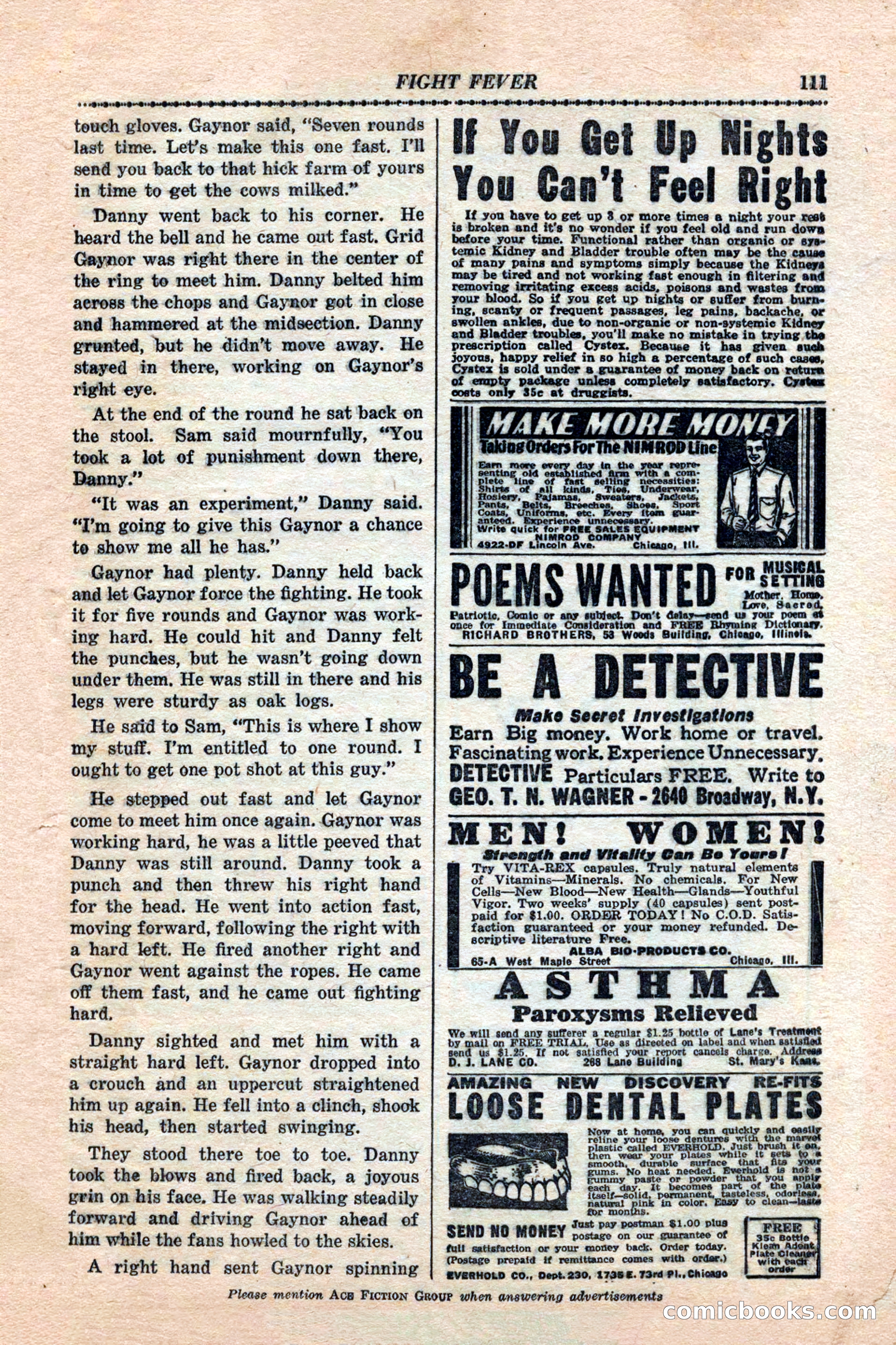
# Page Analysis: "Fight Fever" This page contains story prose from a pulp-fiction boxing narrative titled "Fight Fever." The left column describes an intense boxing match between Danny and Grid Gaynor, detailing their fifth and sixth rounds of fighting. The right side is dominated by period advertisements for various mail-order products and services, including kidney treatments, poetry submissions, detective work opportunities, vitamins, and dental plates. The story text occupies roughly the left half of the page, while the right half is almost entirely advertisements typical of early 20th-century pulp magazines.
# Page 112: "12 Sports Aces" — Story Prose with Advertisements This page contains the conclusion of a boxing story alongside period advertisements. The narrative follows Danny, a farm-based boxer who has just defeated Grid Gaynor in a championship bout. After his victory, Danny learns from his friend Sam and girlfriend Ellen that they orchestrated the fight to build Danny's stamina and confidence through farm labor. The story ends with Danny rushing to catch a train back to his farm, promising to return for future fights. The page is flanked by vintage advertisements for medical treatments, photo enlargement services, war bonds, and false teeth.
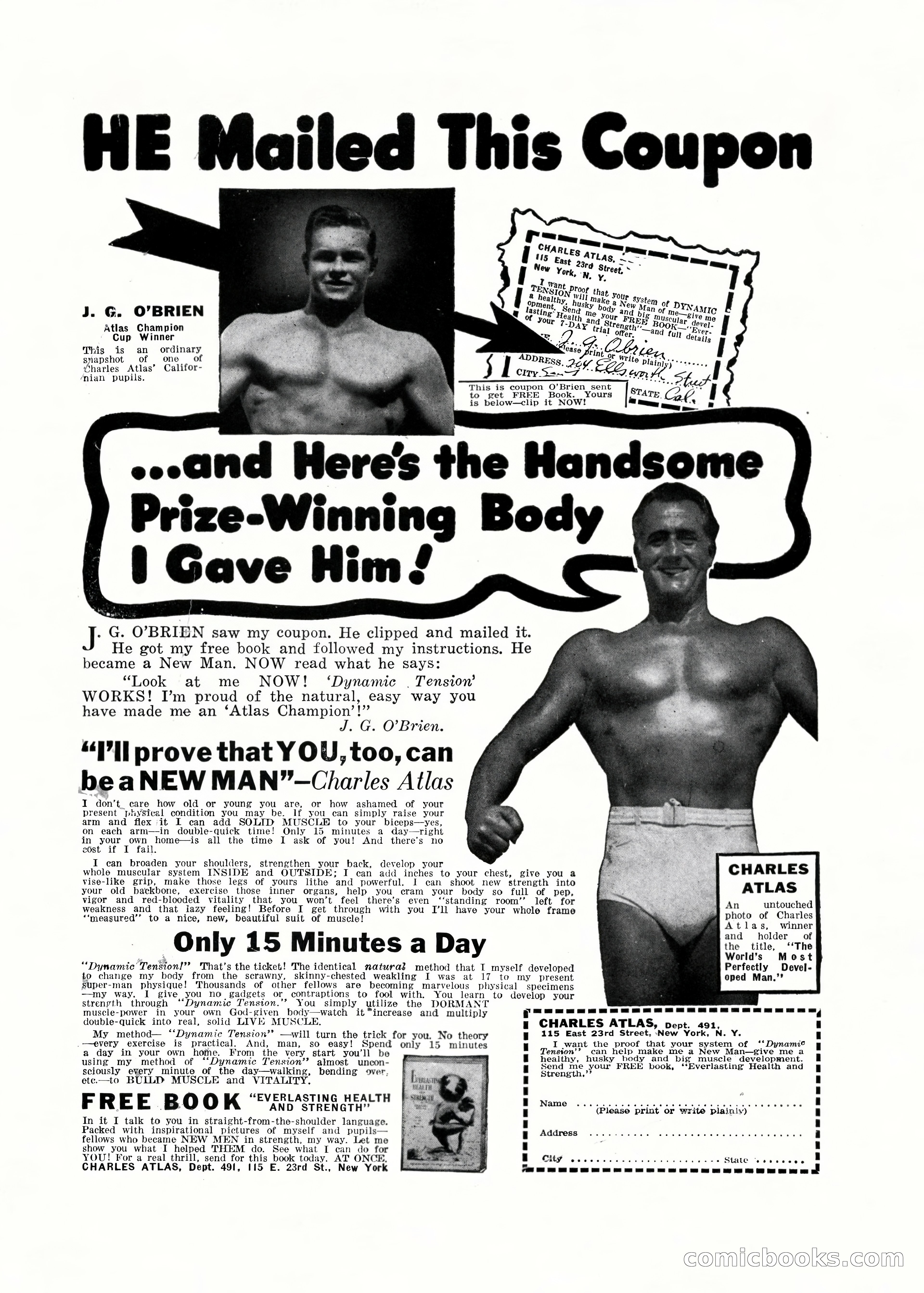
# Analysis This page is primarily **advertising**, specifically a mail-order fitness promotion. The visible content shows Charles Atlas, an "untouched Atlas Champion Cup Winner," promoting his "Dynamic Tension" exercise method through testimonial from a supposed client, J. G. O'Brien. The advertisement claims that 15 minutes daily of this natural muscle-building system can transform a weak body into an "Atlas Champion" physique. A coupon and mail-in form are included for readers to request a free book titled "Everlasting Health and Strength." The page mixes before-and-after imagery with detailed marketing copy emphasizing quick, equipment-free results achievable at home.
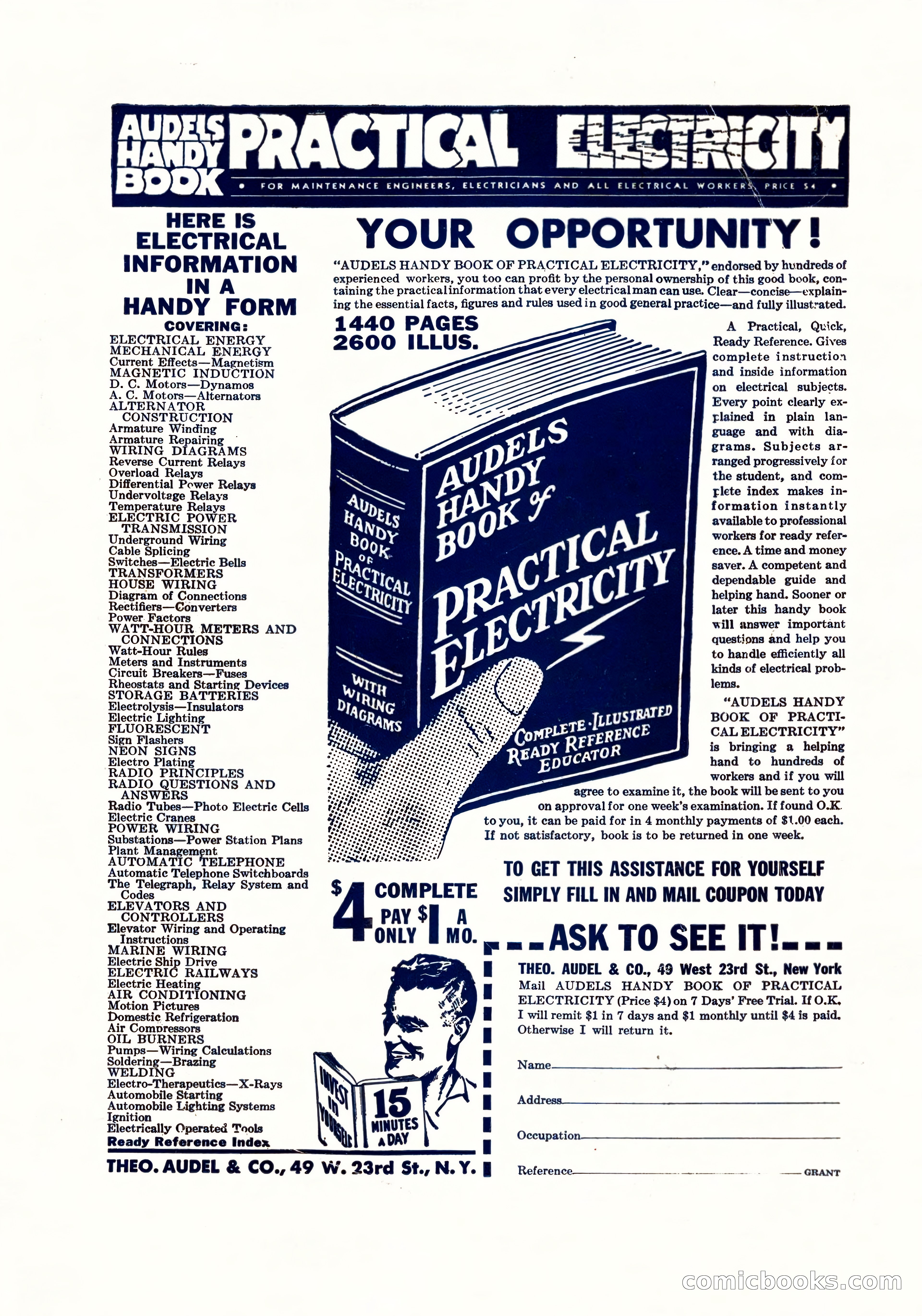
This is an advertisement page, not a story or illustration. It promotes "Audels Handy Book of Practical Electricity," a 1,440-page technical reference manual with 2,600 illustrations covering electrical topics from motors and wiring to power transmission and appliances. The page lists the book's contents, describes its practical value for electrical workers, and includes a coupon offering the $4 book on a seven-day free trial with monthly payment options.