
Pulp Fiction, 1943 · page 83 of 116
12 Sports Aces, January 1943 — page 83: what you’re looking at
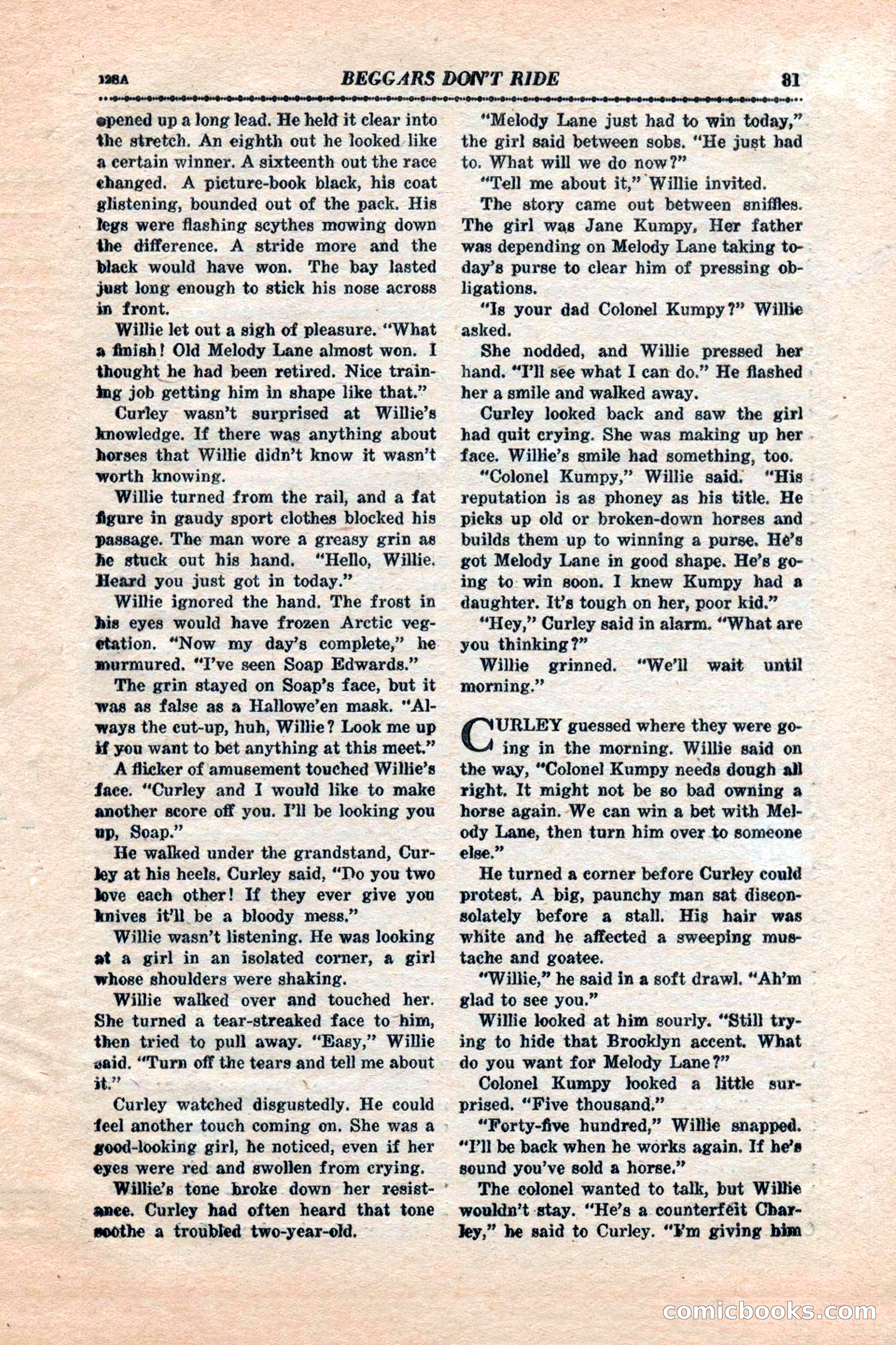
A restored page from Pulp Fiction, 1943. Page through the whole issue in the reader above.
📄 Transcribed text from this page (OCR, searchable)
Machine-transcribed from the original scan — historical spelling and the odd misread are preserved.
128A epened up a long lead. He held it clear into the stretch. An eighth out he looked like a certain winner. A sixteenth out the race ehanged. A pieture-book black, his coat glistening, bounded out of the pack. His . legs were flashing scythes mowing down the difference. A stride more and the black would have won. The bay lasted just long enough to stick his nose across in front. Willie let out a sigh of pleasure. “What a fmish! Old Melody Lane almost won. I thought he had been retired. Nice train- ing job getting him in shape like that.” Curley wasn’t surprised at Willie’s knowledge. If there was anything about horses that Willie didn’t know it wasn’t worth knowing. Willie turned from the rail, and a fat figure in gaudy sport clothes blocked his passage. The man wore a greasy grin as he stuck out his hand. “Hello, Willie. Heard you just got in today.” Willie ignored the hand. The frost in his eyes would have frozen Arctic veg- etation. “Now my day’s complete,” he murmured. “I’ve seen Soap Edwards.” The grin stayed on Soap’s face, but it was as false as a Hallowe’en mask. “Al- ways the cut-up, huh, Willie? Look me up if you want to bet anything at this meet.” A flicker of amusement touched Willie’s face. “Curley and I would like to make another score off you. Pll be looking you up, Soap.” He walked under the grandstand, Cur- key at his heels. Curley said, “Do you two love each other! If they ever give you knives it'll be a bloody mess,” Willie wasn’t listening. He was looking at a girl in an isolated corner, a girl whose shoulders were shaking. Willie walked over and touched her. She turned a tear-streaked face to him, then tried to pull away. “Basy,’” Willie said. “Turn off the tears and tell me about aged eee \ Curley watched disgustedly. He could feel another touch coming on. She was a > good-looking girl, he noticed, even if her eyes were red and swollen from crying. Willie’s tone broke down her resist- ° _gnee. Curley had often heard that tone gpoothe a troubled two-year-old. BEGGARS DON'T RIDE 31 “Melody Lane just had to win today,” the girl said between sobs. ‘““He just had to. What will we do now?” “Tell me about it,” Willie invited. The story came out between sniffles. The girl was Jane Kumpy, Her father was depending on Melody Lane taking to- day’s purse to clear him of pressing ob- ligations, “Is your dad Colonel Kumpy?” Willie asked. She nodded, and Willie pressed her hand. “T'll see what I can do.” He flashed : her a smile and walked away. Curley looked back and saw the girl had quit crying. She was making up her . face. Willie’s smile had something, too. “Colonel Kumpy,” Willie said. reputation is as phoney as his title. He picks up old or broken-down horses and . builds them up to winning a purse. Heée’s got Melody Lane in good shape. He’s go- ing to win soon. I knew Kumpy had a daughter. It’s tough on her, poor kid.” “Hey,” Curley said in alarm. ‘“‘What are you thinking?” Willie grinned. morning.” URLEY guessed where they were go- ing in the morning. Willie said on the way, “Colonel Kumpy needs dough all right, It might not be so bad owning a _ horse again. We can win a bet with Mel- ody Lane, then turn him over to someone else.” He turned a corner before Curley could protest, A big, paunchy man sat diseon- solately before a stall. His hair was white and he affected a sweeping mus- tache and goatee. “Willie,” he said in a soft drawl. “Ah’m _ glad to see you.” Willie looked at him sourly. “Still try- ing to hide that Brooklyn accent. What do you want for Melody Lane?” Colonel Kumpy looked a little sur- prised. “Five thousand.” “Forty-five hundred,” Willie snapped. - “Pll be back when he works again. If he’s sound you’ve sold a horse.” The colonel wanted to talk, but Willie — _ wouldn’t stay. ‘“‘He’s a counterféit Char- ley,” he said to Curley. “Fm giving bim — “His - “We'll wait until | EOPMICGLOOO© Sj (E@ in