
Pulp Fiction, 1943 · page 82 of 116
12 Sports Aces, January 1943 — page 82: what you’re looking at
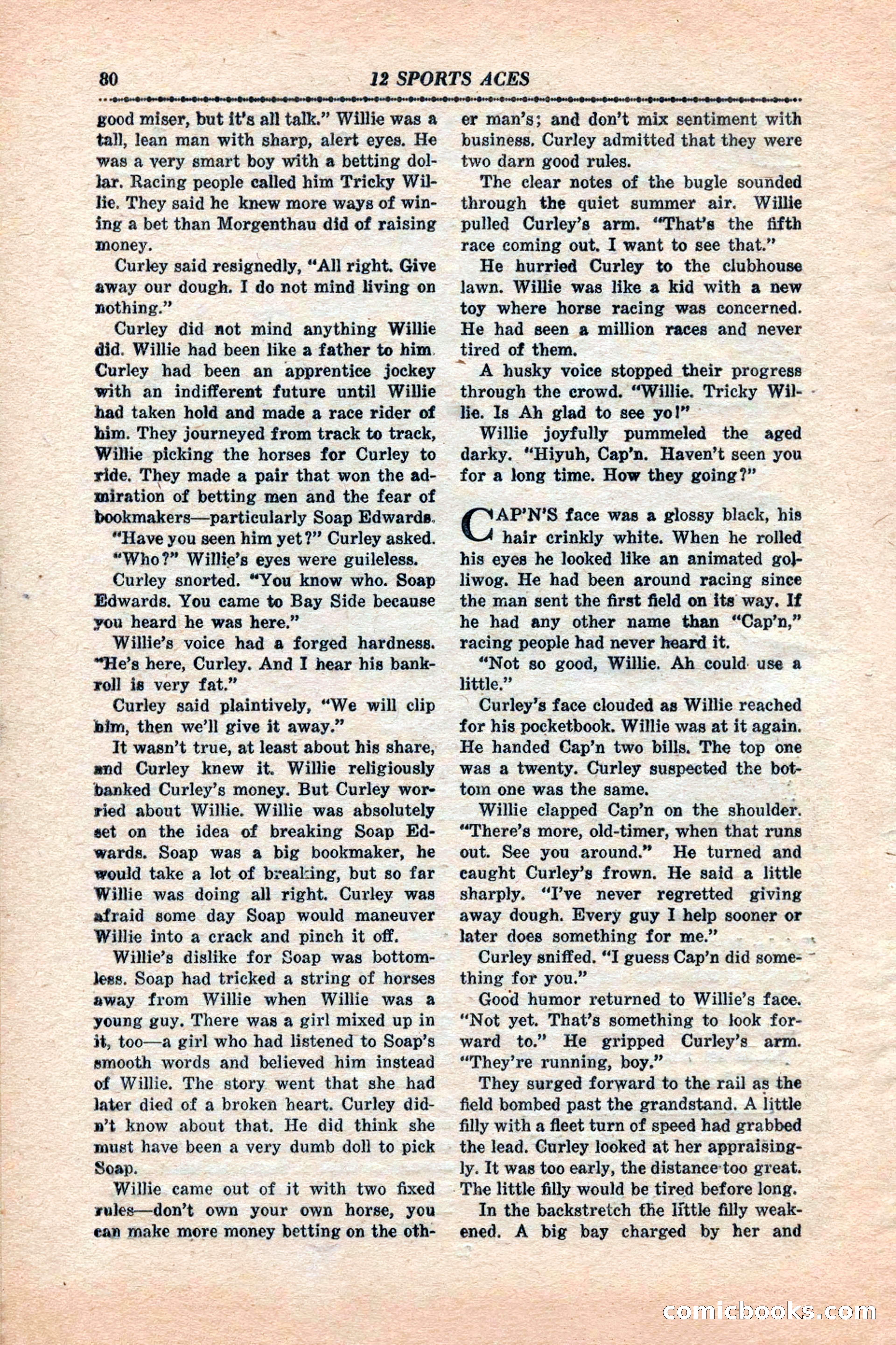
A restored page from Pulp Fiction, 1943. Page through the whole issue in the reader above.
📄 Transcribed text from this page (OCR, searchable)
Machine-transcribed from the original scan — historical spelling and the odd misread are preserved.
80 12 SPORTS ACES good miser, but it’s all talk.” Willie was a tall, lean man with sharp, alert eyes. He was a very smart boy with a betting dol- lar. Racing people called him Tricky Wil- lie. They said he knew more ways of win- ing a bet than Morgenthau did of raising money. Curley said resignedly, “All right. Give away our dough. I do not mind living on nothing.” Curley did not mind anything Willie did. Willie had been like a father to him. Curley had been an apprentice jockey with an indifferent future until Willie had taken hold and made a race rider of him. They journeyed from track to track, Willie picking the horses for Curley to ride. They made a pair that won the ad- miration of betting men and the fear of bookmakers—particularly Soap Edwards. “Have you seen him yet?” Curley asked. “Who?” Willie’s eyes were guileless. Curley snorted. “You know who. Soap Edwards. You came to Bay Side because you heard he was here.” Willie’s voice had a forged hardness. “He’s here, Curley. And I hear his bank- roll is very fat.” Curley said plaintively, “We will clip bim, then we’ll give it away.” It wasn’t true, at least about his share, and Curley knew it. Willie religiously banked Curley’s money. But Curley wor- ried about Willie. Willie was absolutely set on the idea of breaking Soap Ed- wards. Soap was a big bookmaker, he would take a lot of brealing, but so far Willie was doing all right. Curley was afraid some day Soap would maneuver Willie into a crack and pinch it off. Willie’s dislike for Soap was bottom- less. Soap had tricked a string of horses away from Willie when Willie was a young guy. There was a girl mixed up in it, too—a girl who had listened to Soap’s smooth words and believed him instead of Willie. The story went that she had later died of a broken heart. Curley did- n't know about that. He did think she must have been a very dumb doll to pick Soap. Willie came out of it with two fixed yules—don’t own your own horse, you ean make more money betting on the oth- er man’s; and don’t mix sentiment with business, Curley admitted that they were two darn good rules. The clear notes of the bugle sounded through the quiet summer air. Willie pulled Curley’s arm. “That’s the fifth race coming out. I want to see that.” He hurried Curley to the clubhouse lawn. Willie was like a kid with a new toy where horse racing was concerned. He had seen a million races and never tired of them, A husky voice stopped their progress through the crowd. “Willie. Tricky Wil- - lie. Is Ah glad to see yo!” Willie joyfully pummeled the aged darky. “Hiyuh, Cap’n. Haven’t seen you for a long time. How they going?” AP’N'S face was a glossy black, his hair crinkly white. When he rolled his eyes he looked like an animated go}- liwog. He had been around racing since the man sent the first field on its way. If he had any other name than “Cap’n,” racing people had never heard it. “Not so good, Willie. Ah could use a little.” Curley’s face clouded as Willie reached for his pocketbook. Willie was at it again. He handed Cap’n two bills. The top one was a twenty. Curley suspected the bot- tom one was the same. Willie clapped Cap’n on the shoulder. “There’s more, old-timer, when that runs out. See you around.” He turned and caught Curley’s frown. He said a little sharply. “I’ve never regretted giving away dough. Every guy I help sooner or later does something for me.” Curley ren “T guess Cap’n did some- thing for you.” Good humor returned to Willie’s face. “Not yet. That’s something to look for- ward to.” He gripped Curley’s arm. “They’re running, boy.” They surged forward to the rail as the field bombed past the grandstand. A little filly with a fleet turn of speed had grabbed the lead. Curley looked at her appraising- ly. It was too early, the distance'too great. -The little filly would be tired before long. In the backstretch the little filly weak- ened. A big bay charged by her and -comichbooks (E@)