
Pulp Fiction, 1943 · page 85 of 116
12 Sports Aces, January 1943 — page 85: what you’re looking at
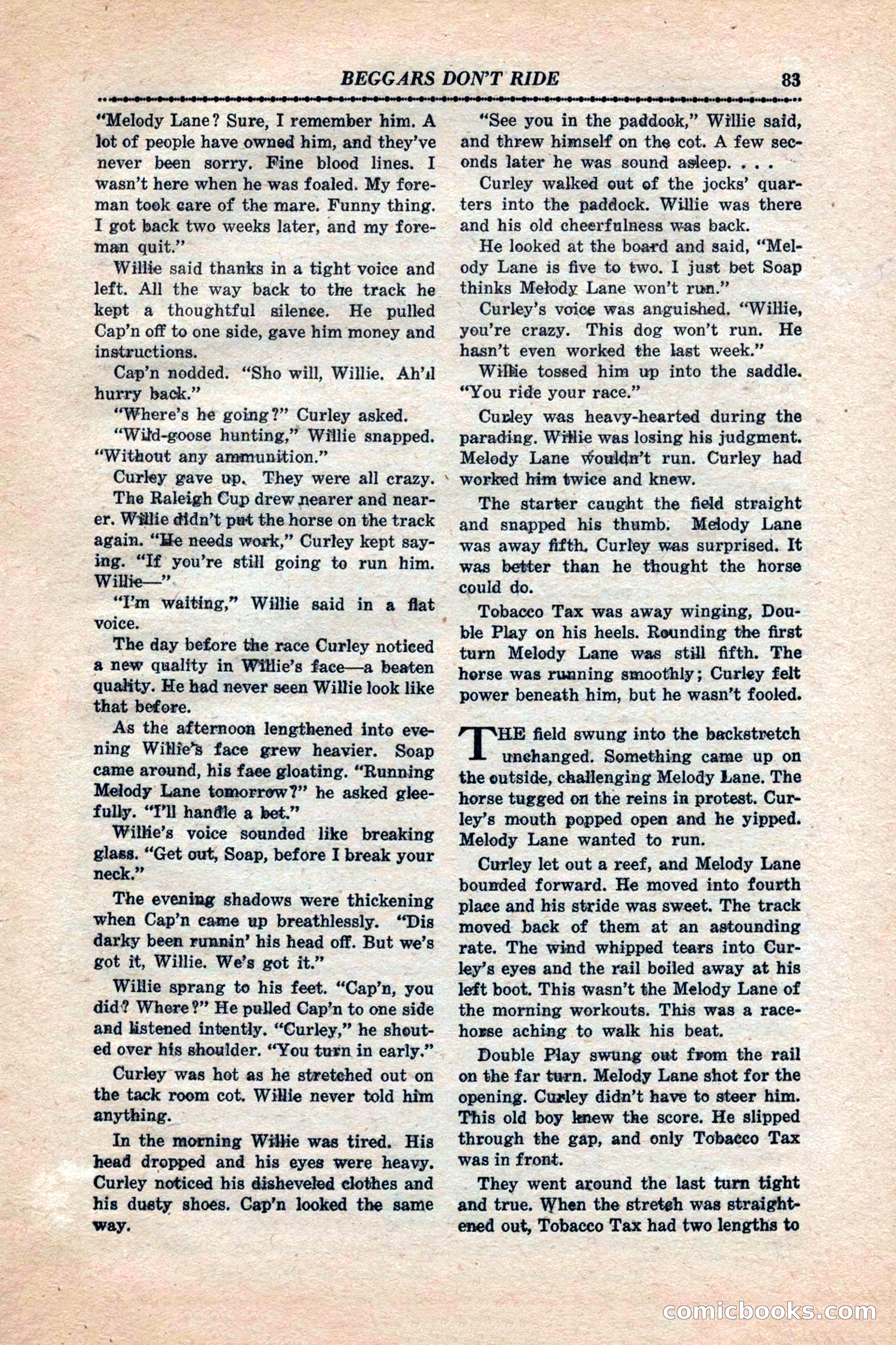
A restored page from Pulp Fiction, 1943. Page through the whole issue in the reader above.
📄 Transcribed text from this page (OCR, searchable)
Machine-transcribed from the original scan — historical spelling and the odd misread are preserved.
BEGGARS DON’T RIDE | 83 00 oes Greer er Qe Ger braGor Gun Por Serer Por Gee Per G eG reer heres Oreo er er Oreo Ser G rr Serre Sor Ore Sor Ou Ow Orr rrSre Gen Gerber SerGer Gu Ger Srr Gere Ber Ore ber OreGerGrePerGerGereees “Melody Lane? Sure, I remember him. A lot of people have owned him, and they’ve never been sorry. Fine blood lines. I wasn’t here when he was foaled. My fore- man took eare of the mare. Funny thing. I got back two weeks later, and my fore- man quit.” Willie said thanks in a tight voice and left. All the way back to the track he kept a thoughtful silenee. He pulled Cap’n off to one side, gave him money and instructions. 3 Cap’n nodded. “Sho will, Willie. Ah’sl hurry back.” “Where’s he going?” Curley asked. “Wild-goose hunting,” Willie snapped. “Without any ammunition.” Curley gave up. They were all crazy. ° The Raleigh Cup drew nearer and near- er. Willie didn’t put the horse on the track again. “He needs work,” Curley kept say- ing. “If you’re still going to run him. Willie—” voice. The day before the race Curley noticed a new quality in Witlie’s face—a beaten quality. He had never seen Willie look like that before. As the afternoon lengthened into eve- ning WiHie’s face grew heavier. Soap came around, his faee gloating. “Running Melody Lane tomorrew?” he asked glee- fully. “T’ll handle a bet.” Willie’s voice sounded like breaking glass. “Get out, Soap, before I break your neck,” 3 The evening shadows were thickening when Cap’n came up breathlessly. “Dis darky been runnin’ his head off. But we’s got it, Willie. We’s got it.” Willie sprang to his feet. “Cap’n, you did? Where?” He pulled Cap’n to one side and listened intently. “Curley,” he shout- ed over his shoulder. “You turn in early.” Curley was hot as he stretehed out on the tack room cot. Willie never told him anything. In the morning Wilke was tired. His head dropped and his eyes were heavy. Curley noticed his disheveled clothes and his dusty shoes. Cap’n looked the same way. “lm waiting,” Willie said in a flat “See you in the paddock,” Willie said, and threw himself on the cot. A few sec- onds later he was sound asleep... . Curley walked out of the jocks’ quar- ters into the paddock. Willie was there and his old cheerfulness was back. He looked at the board and said, “Mel- ody Lane is five to two. I just bet Soap thinks Melody Lane won’t run.” Curley’s voice was anguished. “Willie, you’re crazy. This dog won’t run. He hasn’t even worked the last week.” Willie tossed him up into the saddle. “You ride your race.” Curley was heavy-hearted during the parading. Witlie was losing his judgment. Melody Lane wouldn’t run. Curley had worked him twice and knew. The starter caught the field straight and snapped his thumb. Melody Lane was away fifth, Curley was surprised. It was better than he thought the horse could do. Tobaceo Tax was away winging, Dou- ble Play on his heels. Rounding the first turn Melody Lane was still fifth. The horse was running smoothly; Curley felt power beneath him, but he wasn’t fooled. HE field swung into the backstretch unchanged. Something came up on the outside, challenging Melody Lane. The horse tugged on the reins in protest. Cur- ley’s mouth popped open and he yipped. - Melody Lane wanted to run. Curley let out a reef, and Melody Lane bounded forward. He moved into fourth plaee and his stride was sweet. The track moved back of them at an astounding rate. The wind whipped tears into Cur- ley’s eyes and the rail boiled away at his left boot. This wasn’t the Melody Lane of the morning workouts. This was a race- horse aching to walk his beat. _ Double Play swung out from the rail on the far turn. Melody Lane shot for the opening. Curley didn’t have to steer him. This old boy knew the score. He slipped through the gap, and only Tobacco Tax was in front. They went around the last turn tight and true. When the stretgh was straight- ened out, Tobacco Tax had two lengths to -CoOnnicboolks (E@)