
Pulp Fiction, 1943 · page 103 of 116
12 Sports Aces, January 1943 — page 103: what you’re looking at
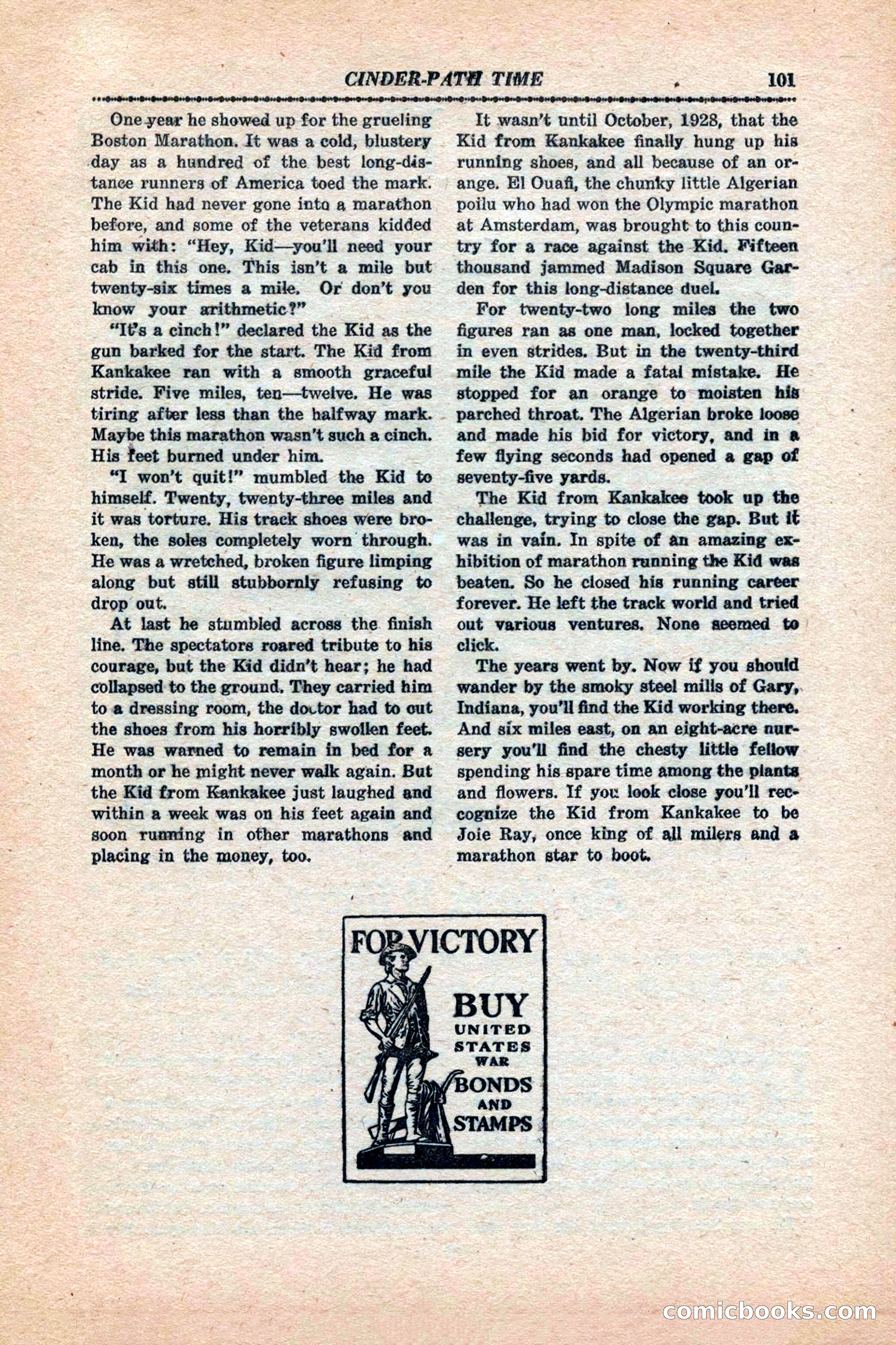
A restored page from Pulp Fiction, 1943. Page through the whole issue in the reader above.
📄 Transcribed text from this page (OCR, searchable)
Machine-transcribed from the original scan — historical spelling and the odd misread are preserved.
CINDER-PATH TIME 3 , FO Ose eres De 5 De Bebe BHD DE REND: DADO Dee Bee W DD BD HOO Dee De DOG 4 BG AOD nD OOH Bere er Ot ben] He Dee ere Berar ee One-year he showed up for the grueling Boston Marathon, It was a cold, blustery day as a hundred of the best long-dis- tanee runners of America toed the mark. The Kid had never gone inta a marathon before, and some of the veterans kidded him with: “Hey, Kid—you’ll need your cab in this one. This isn’t a mile but twenty-six times a mile, Or don’t you know your arithmetic?” “It?s a cinch!” declared the Kid as the gun barked for the start. The Kid from Kankakee ran with a smooth graceful stride. Five miles, ten—twelve. He was tiring after less than the halfway mark. - Maybe this marathon wasn’t such a cinch. His feet burned under him. “I won’t quit!” mumbled the Kid te himself. Twenty, twenty-three miles and it was torture. His track shoes were bro- ken, the soles completely worn through. He was a wretched, broken figure limping along but still stubbornly refusing to drop out. 7 : At last he stumbled across the finish line. The spectators roared tribute to his courage, but the Kid didn’t hear; he had collapsed to the ground, They carried him to a dressing room, the doctor had to cut the shoes from his horribly swollen feet. He was warned to remain in bed for a month or he might never walk again. But the Kid from Kankakee just laughed and within a week was on his feet again and goon rumving in other marathons and placing in the money, too. 101 It wasn’t until October, 1928, that the Kid from Kankakee finally hung up his running shoes, and all because of an or- ange. E] Ouafi, the chunky little Algerian poilu who had won the Olympic marathon at Amsterdam, was brought to this coun- try for a race against the Kid. Fifteen thousand jammed Madison Square Gar- den for this long-distance duel. For twenty-two long miles the two figures ran as one man, locked together in even strides. But in the twenty-third mile the Kid made a fatal mistake. He stopped for an orange to moisten his parched throat. The Algerian broke loose and made his bid for victory, and in a few flying seconds had opened a gap of seventy-five yards. The Kid from Kankakee took up the challenge, trying to close the gap. But it was in vain. In spite of an amazing ex- hibition of marathon running the Kid was beaten. So he closed his running career forever. He left the track world and tried out various ventures. None seemed to click. The years went by. Now if you should wander by the smoky steel mills of Gary,. Indiana, you'll find the Kid working there. And six miles east, on an eight-acre nur- sery you'll find the chesty little fellow spending his spare time among the plants and flowers. If you look ciose you'll rec- cognize the Kid from Kankakee to be Joie Ray, once king of all milers and a marathon star to boot, —GOMmIGDOOKS Eo!