
Pulp Fiction, 1943 · page 48 of 116
12 Sports Aces, January 1943 — page 48: what you’re looking at
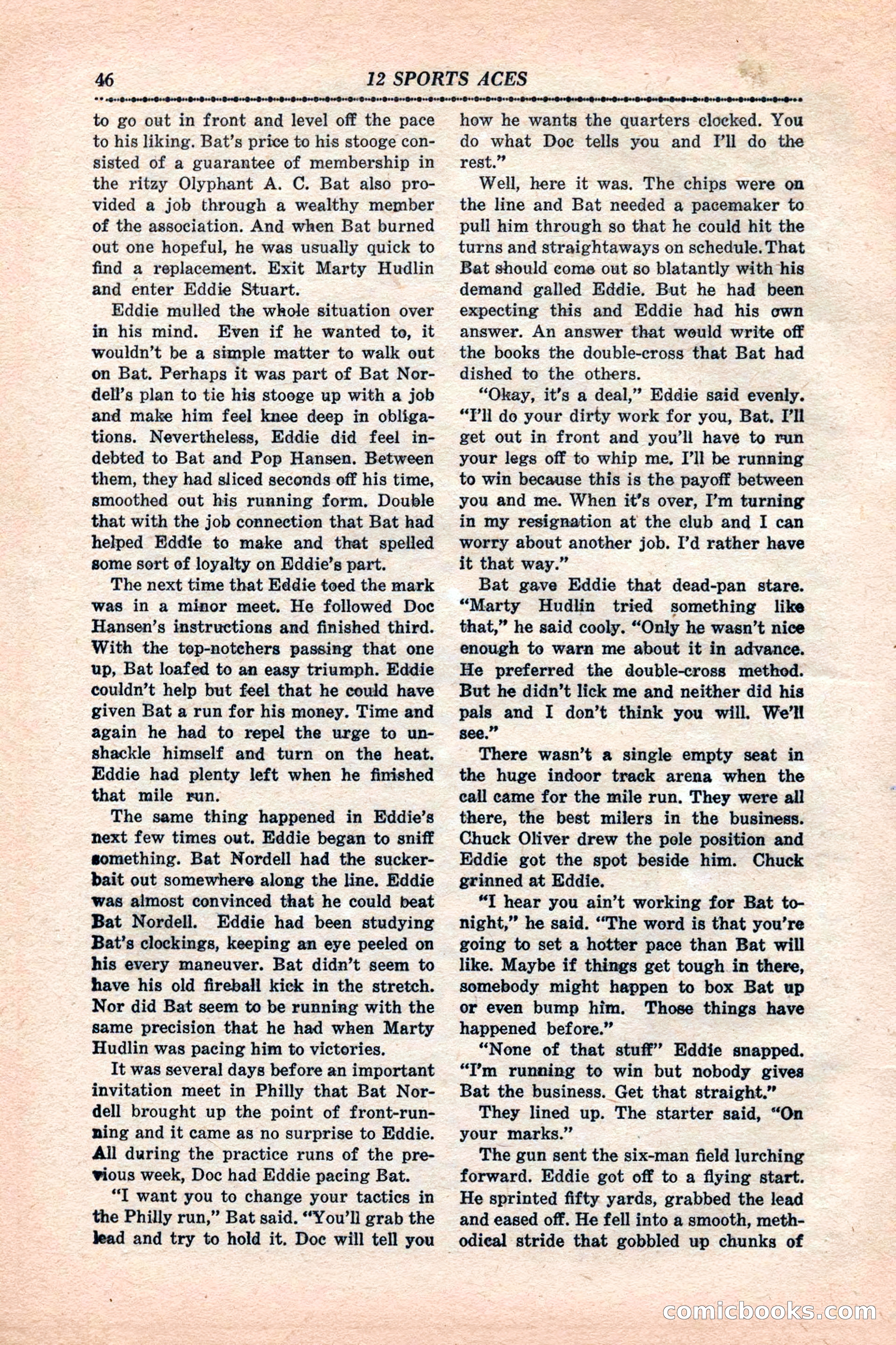
A restored page from Pulp Fiction, 1943. Page through the whole issue in the reader above.
📄 Transcribed text from this page (OCR, searchable)
Machine-transcribed from the original scan — historical spelling and the odd misread are preserved.
46 12 SPORTS ACES to go out in front and level off the pace to his liking. Bat’s price to his stooge con- sisted of a guarantee of membership in the ritzy Olyphant A. C. Bat also pro- vided a job through a wealthy member of the association. And when Bat burned out one hopeful, he was usually quick to find a replacement. Exit Marty Hudlin and enter Eddie Stuart. Eddie mulled the wkole situation over in his mind. Even if he wanted to, it wouldn’t be a simple matter to walk out on Bat. Perhaps it was part of Bat Nor- dell’s plan to tie his stooge up with a job and make him feel knee deep in obliga- tions. Nevertheless, Eddie did feel in- debted to Bat and Pop Hansen. Between them, they had sliced seconds off his time, smoothed out his running form. Double that with the job connection that Bat had helped Eddie to make and that spelled some sort of loyalty on Eddie’s part. The next time that Eddie toed the mark was in a minor meet. He followed Doc Hansen’s instructions and finished third. With the top-notehers passing that one up, Bat loafed to an easy triumph. Eddie couldn’t help but feel that he could have given Bat a run for his money. Time and again he had to repel the urge to un- shackle himself and turn on the heat. Eddie had plenty left when he finished that mile run. The same thing happened in Eddie’s next few times out. Eddie began to sniff something. Bat Nordell had the sucker- bait out somewhere along the line. Eddie was almost convinced that he could beat Bat Nordell. Eddie had been studying Bat’s clockings, keeping an eye peeled on his every maneuver. Bat didn’t seem to have his old fireball kick in the stretch. Nor did Bat seem to be running with the same precision that he had when Marty Hudlin was pacing him to victories. It was several days before an important invitation meet in Philly that Bat Nor- dell brought up the point of front-run- ning and it came as no surprise to Eddie. All during the practice runs of the pre- vious week, Doc had Eddie pacing Bat. “IT want you to change your tactics in the Philly run,” Bat said. “You’ll grab the lead and try to hold it. Doc will tell you 910 Gre Soro P er Ber Geo Ger Serer Ger Ore GrsG er Ger Gor Gee Gen hor Gor Hor Gor Geo Her Sor Hor Gor Orr Oo Ger Ser Or Grr Ger GorGoo es how he wants the quarters clocked. You do what Doe tells you and I'll do the rest.” Well, here it was. The chips were on the line and Bat needed a pacemaker to pull him through so that he could hit the turns and straightaways on schedule. That Bat should come out so blatantly with his demand galled Eddie. But he had been expecting this and Eddie had his own answer. An answer that weuld write off the books the double-cross that Bat had dished to the others. “Okay, it’s a deal,” Eddie said evenly. “ll do your dirty work for you, Bat. I’ll get out in front and you'll have to run your legs off to whip me, I'll be running to win because this is the payoff between you and me. When it’s over, I’m turning in my resignation at the club and I can worry about another job. I’d rather have it that way.” . Bat gave Eddie that dead-pan stare. “Marty Hudlin tried something like that,” he said cooly. “Only he wasn’t nice enough to warn me about it in advance. He preferred the double-cross method. But he didn’t lick me and neither did his pals and I don’t think you will. We'll see.” There wasn’t a single empty seat in the huge indoor track arena when the call came for the mile run. They were all there, the best milers in the business. Chuck Oliver drew the pele position and Eddie got the spot beside him. Chuck grinned at Eddie. “I hear you ain’t working for Bat to- night,” he said. “The word is that you’re going to set a hotter pace than Bat will like. Maybe if things get tough in there, somebody might happen to box Bat up or even bump him. Those things have happened before.” “None of that stuff” Eddie snapped. “I’m running to win but nobody gives Bat the business. Get that straight.” They lined up. The starter said, “On your marks.” . The gun sent the six-man field lurching forward. Eddie got off to a flying start. He sprinted fifty yards, grabbed the lead and eased off. He fell into a smooth, meth- _odieal stride that gobbled up chunks of COMMEMIOOKS (E@)