
Pulp Fiction, 1943 · page 69 of 116
12 Sports Aces, January 1943 — page 69: what you’re looking at
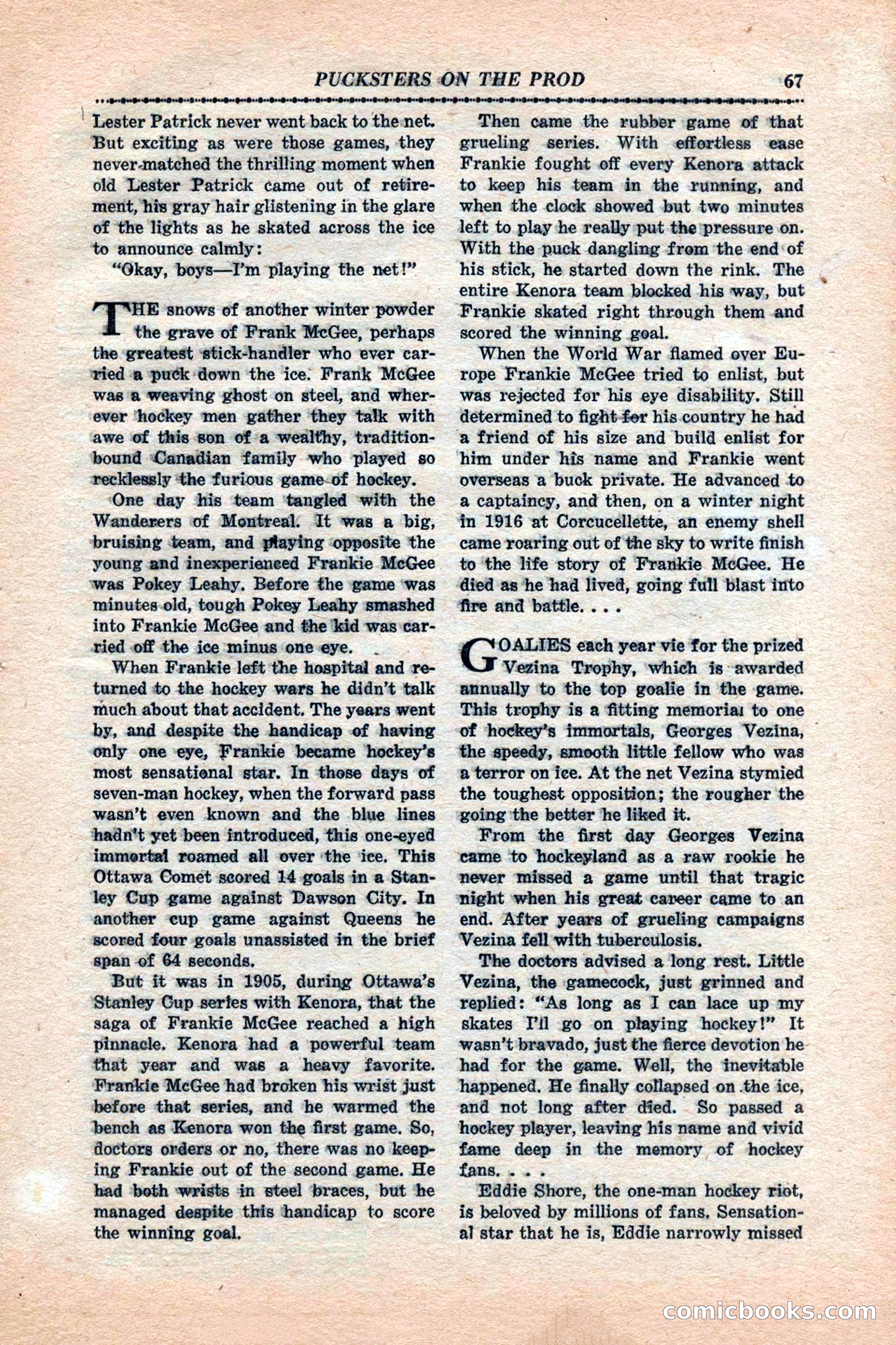
A restored page from Pulp Fiction, 1943. Page through the whole issue in the reader above.
📄 Transcribed text from this page (OCR, searchable)
Machine-transcribed from the original scan — historical spelling and the odd misread are preserved.
— PUCKSTERS ON THE PROD Lester Patrick never went back to the:net. — But exciting as were those games, they never-matched the thrilling moment when old Lester Patrick came out of retire- ment, his gray hair glistening in the glare of the lights as he skated across the ice to announce calmly: “Okay, boys—I’m playing the net!” . 1E snows of another winter powder & the grave of Frank McGee, perhaps the greatest ‘stick-handler who ever car- ‘ried ‘a puck down the ice: Frank McGee was a weaving ghost on steel, and wher- ever ‘hockey ‘men gather they talk with awe of this son of a wealthy, tradition- bound Canadian family who played so recklessly ‘the furious game-of hockey. ‘Qne day his team ‘tangled ‘with the Wanderers of Montreal. It was a big, bruising team, and playing oppesite the young and inexperienced Frankie McGee was Pokey Leahy. Before the game ‘was minutes-old, tough Pokey Leahy smashed into Frankie McGee and the kid was car- vied off the ice minus one eye. _ When Frankie left the hospital and re- turned ‘to the hockey wars he didn’t talk much about that accident. The years went by, and despite the handicap of having only one eye, Frankie became hockey’s most sensational star. In those days of seven-man hockey, when the forward pass wasn’t even known and the blue lines hadn't yet been introduced, this one-eyed immortal roamed all over ‘the ‘ice. This Ottawa Comet scored 14 goals in a Stan- ley Cup game against Dawson City. In another cup game against Queens he - scored four goals unassisted in the brief span of 64 seconds, But it was in 1905, during Ottawa’s Stanley Gup serfes with Kenora, that the saga of Frankie McGee reached a high pinnacle, Kenora had a powerful ‘team fhat year and was a heavy favorite. Frankie McGee had broken his wrist just before that series, and he warmed the bench as Kenora won the first game. So, doctors orders or no, there was no keep- ing Frankie out of the second game. He managed despite this handicap to score the winning goal, 67 Then came the rubber game of ‘that grueling series. With effortless ease Frankie fought off every Kenora attack to keep his team in the running, and when the clock showed but two minutes left to play he really put the 'pressure on. With the puck dangling frem ‘the end ‘of his stick, he started down the rink. The entire Kenora team blocked his ‘way, but Frankie skated right through them and scored the winning geal. When the World War flamed over Eu- rope Frankie McGee tried to enlist, but was rejected for his eye disability. Still determined to fight-fer his.country he had ‘a friend of his size and build enlist for him under his name and Frankie went overseas a buck private. He advanced to a captaincy, and then, on a winter night in 1916 at Corcucellette, an enemy shell came roaring out of the sky to write finish to the life story of Frankie McGee. He died as ‘he had lived, going full blast into fire and battle. ... ‘OALIES each year vie for the prized 2 Vezina Trophy, which is awarded annually to the top goalie in the game. This trophy is a fitting memoriai to one of ‘hockey’s immortals, Georges Vezina, | the speedy, smooth little fellow who was a terror on ice. At the net Vezina stymied the toughest opposition; the rougher the going ‘the better he liked it. From the first day Georges Vezina came to hockeyland as a raw rookie he never Missed a game until that tragic night when his great career came to an end. After years of grueling campaigns Vezina fell with tuberculosis, The doctors advised a long rest. Little Vezina, the gamecock, just grinned and replied: “As long as I can lace up my skates Til go on playing hockey!” It wasn’t bravado, just the fierce devotion he had for the game. Well, the inevitable happened, He finally collapsed on .the ice, and not long after died. So passed a hockey player, leaving his name and vivid fame deep in the memory of hockey fons... Eddie Shore, the one-man hockey riot, is beloved by millions of fans, Sensation- al star that he is, Eddie narrowly missed GEomicbook (E@)