comicbooks.com Join Free

A complete, restored issue of Pulp Fiction from 1928 — all 68 pages of painted-cover fiction magazines that launched science fiction, horror, and hardboiled crime, free to page through at comicbooks.com.

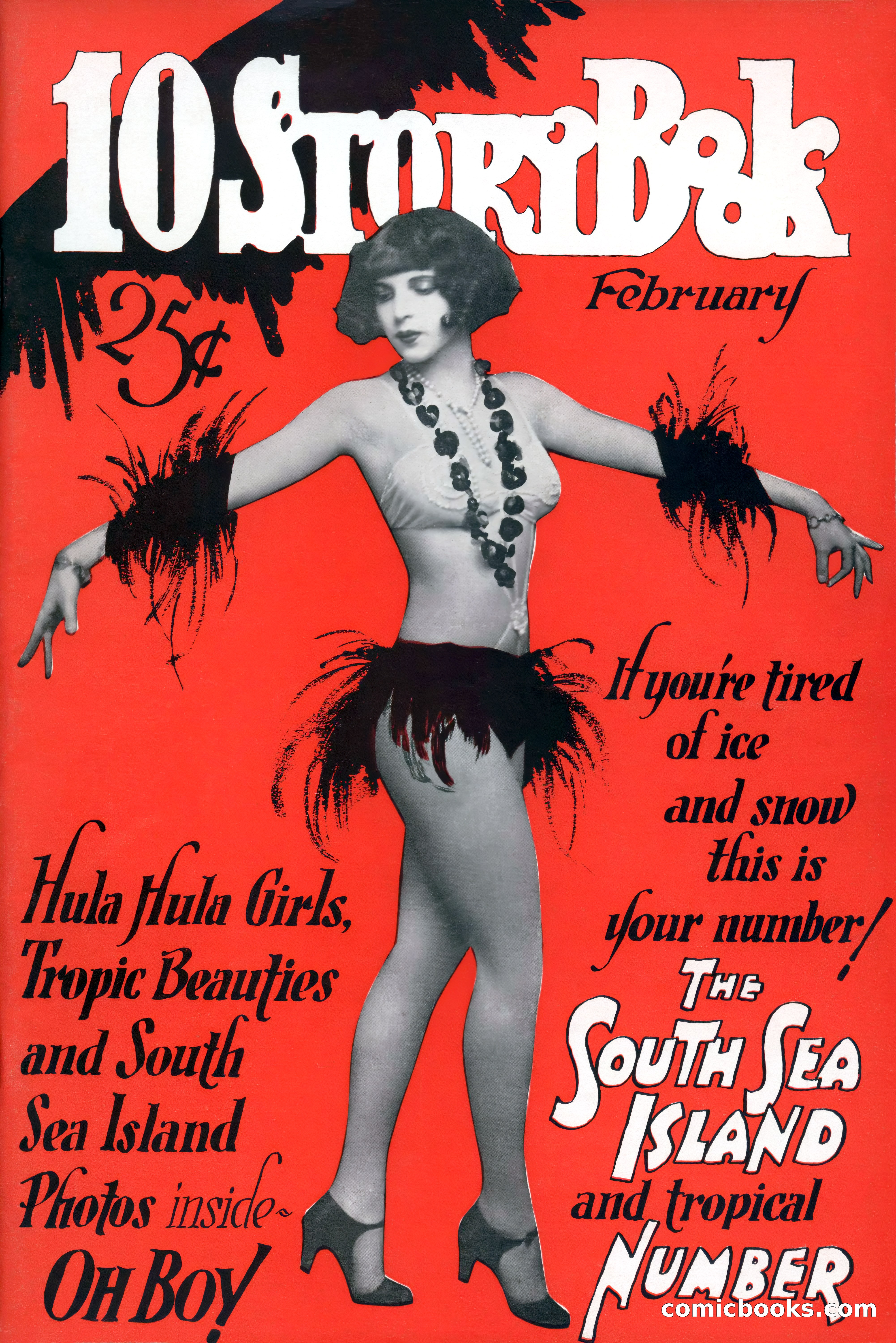
On the cover: This is a cover of a pulp magazine titled "10 Stories" (February issue, priced at 25¢). The cover features a black-and-white photograph of a woman in a hula skirt costume against a bright red background. The visible text advertises the magazine's contents: "Hula Hula Girls, Tropic Beauties and South Sea Island Photos inside," and promotes "The South Sea Island and tropical Number," with a tagline promising "If you're tired of ice and snow this is your number!" The cover emphasizes exotic, tropical-themed content appealing to readers seeking escapist entertainment.

🖼️ Every page has a plain-English note on what you’re looking at — the figures, the references, the point of the satire.

← Back to Pulp Fiction All exhibitions

HomeExhibitionPulp FictionRead

A complete issue · 68 pages · 1928

10-Story Book, February 1928
1928 · Free to read

10-Story Book, February 1928 — page 1 of 68
1 / 68
What you’re looking at · open this page on its own ↗

This is a cover of a pulp magazine titled "10 Stories" (February issue, priced at 25¢). The cover features a black-and-white photograph of a woman in a hula skirt costume against a bright red background. The visible text advertises the magazine's contents: "Hula Hula Girls, Tropic Beauties and South Sea Island Photos inside," and promotes "The South Sea Island and tropical Number," with a tagline promising "If you're tired of ice and snow this is your number!" The cover emphasizes exotic, tropical-themed content appealing to readers seeking escapist entertainment.

10-Story Book, February 1928 — page 2 of 68
2 / 68
What you’re looking at · open this page on its own ↗

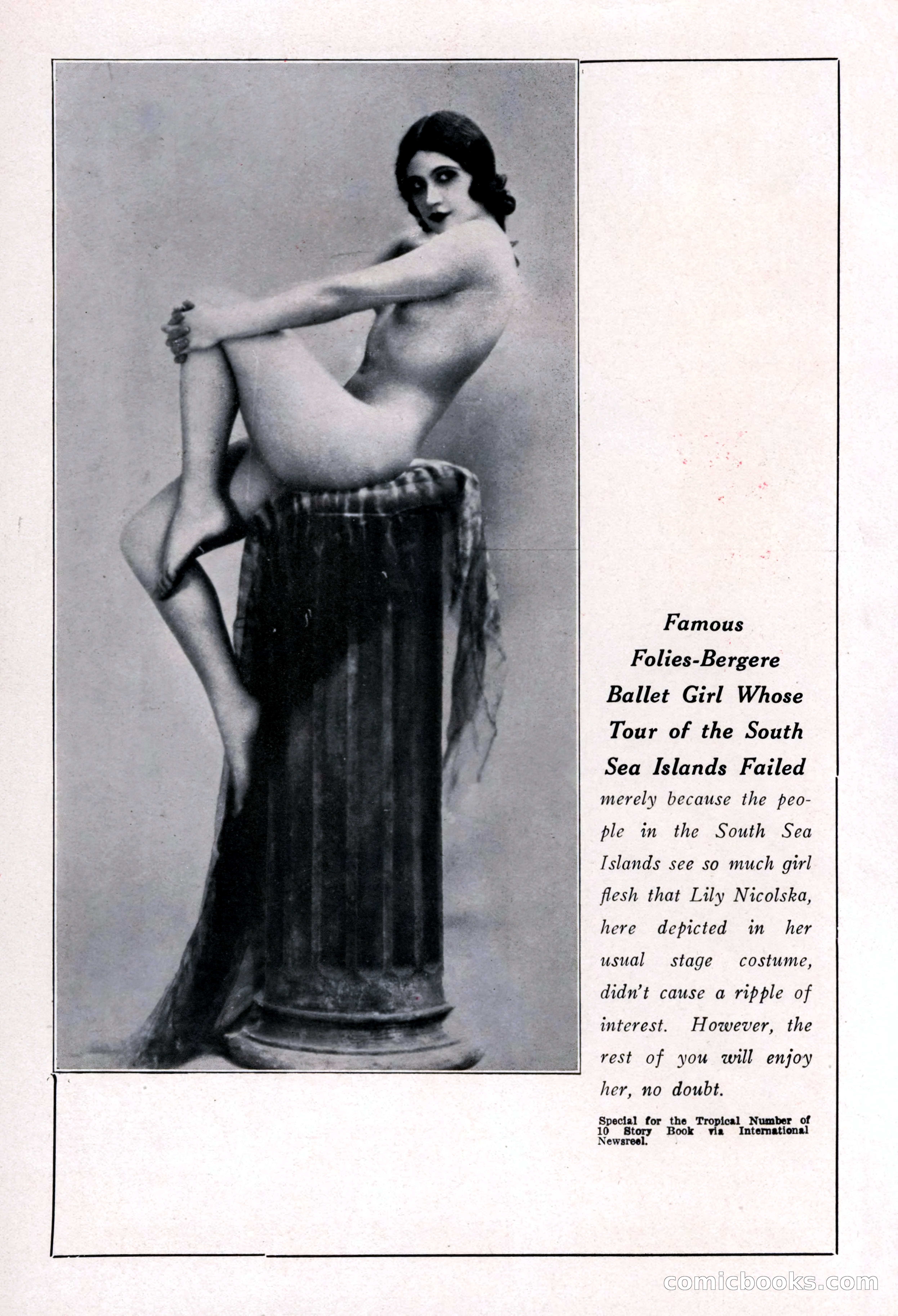
This page is an illustrated advertisement or promotional feature from an early-20th-century pulp magazine. It displays a black-and-white photograph of a woman in minimal stage costume posed next to a draped fabric column, identified as Lily Nicolska, a Folies-Bergère ballet dancer. The accompanying text humorously claims her tour of the South Sea Islands failed because the local population was unimpressed by her appearance, though it suggests "the rest of you will enjoy her." The caption indicates this is a special feature related to an International Newsreel story.

10-Story Book, February 1928 — page 3 of 68
3 / 68
What you’re looking at · open this page on its own ↗

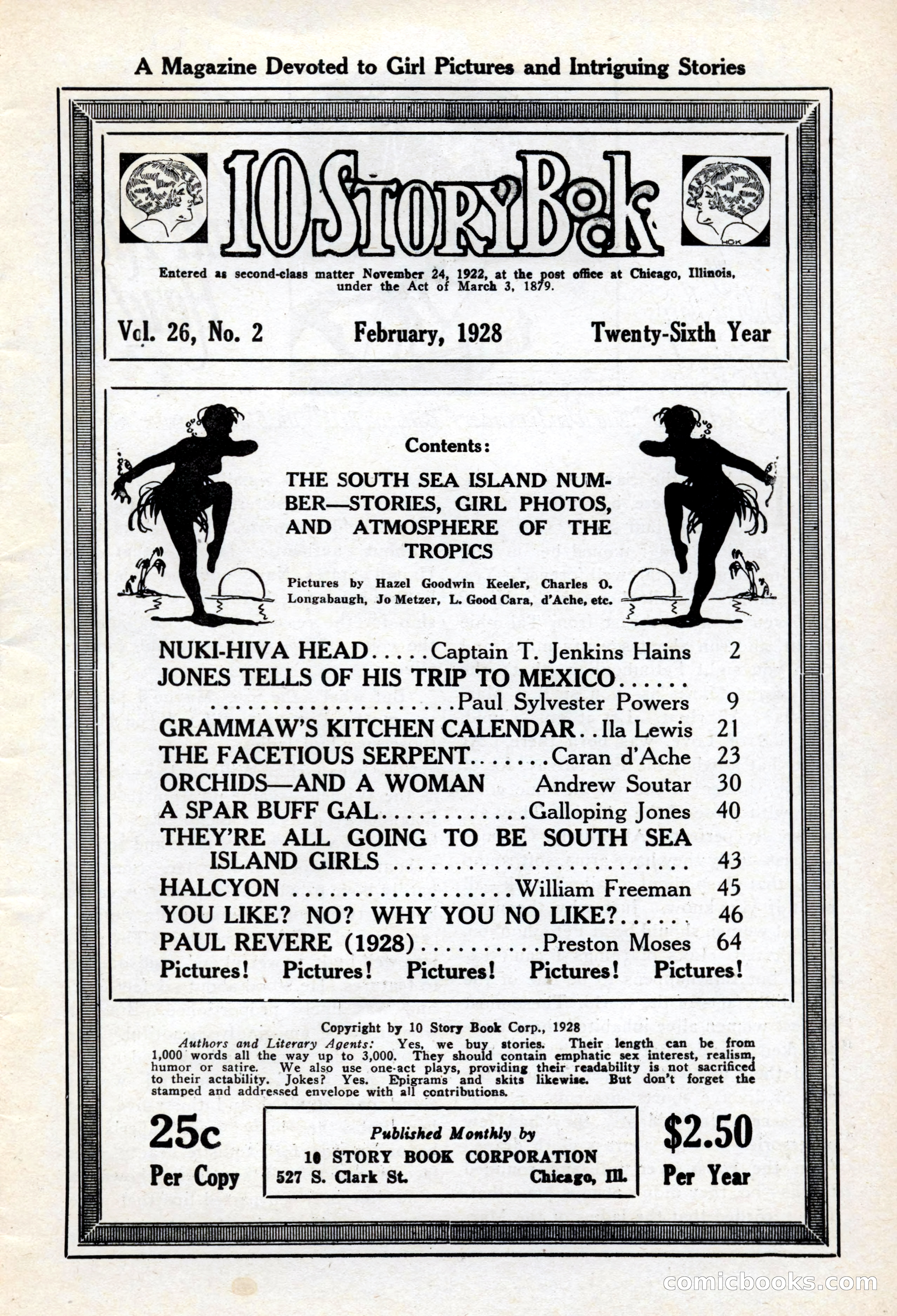
# 10 Story Book Magazine - February 1928 Contents Page This is a **contents page** from *10 Story Book*, a pulp magazine devoted to stories and photographs featuring women. The February 1928 issue (Volume 26, No. 2) features a "South Sea Island Number" with tropical-themed stories and girl photographs by various credited photographers. The page lists approximately a dozen stories with page numbers, including pieces by Captain T. Jenkins Hains, Paul Sylvester Powers, and others, alongside editorial information about the magazine's submission guidelines and pricing (25 cents per copy). The decorative illustrations show silhouetted figures in tropical poses.

10-Story Book, February 1928 — page 4 of 68
4 / 68
What you’re looking at · open this page on its own ↗

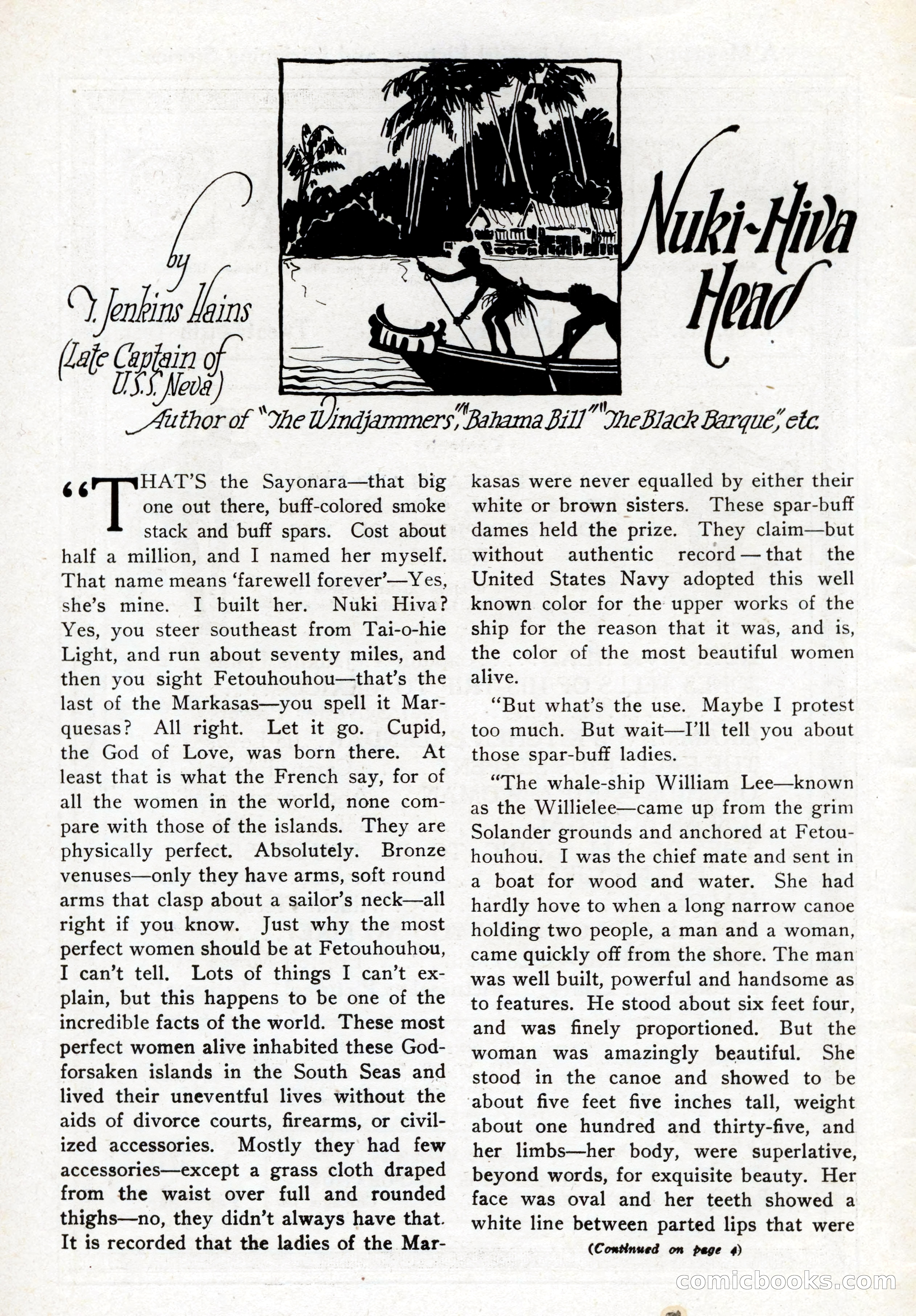
# Analysis This is a **story prose page** from a pulp fiction magazine, specifically the opening section of a short story titled "Nuki Hiva Head" by C. Jenkins Hains (identified as a former U.S. Navy captain and author of similar adventure tales). The visible text presents a first-person narrative about the narrator's ship, the Sayonara, and describes a journey to the Marquesas Islands in the South Seas. The story romanticizes the physical beauty of island women, then begins recounting an anecdote about an encounter between the narrator (as chief mate aboard the whale-ship William Lee) and two islanders—a handsome man and an exceptionally beautiful woman who arrive in a canoe. The passage concludes mid-narrative with "(Continued on page 4)."

10-Story Book, February 1928 — page 5 of 68
5 / 68
What you’re looking at · open this page on its own ↗

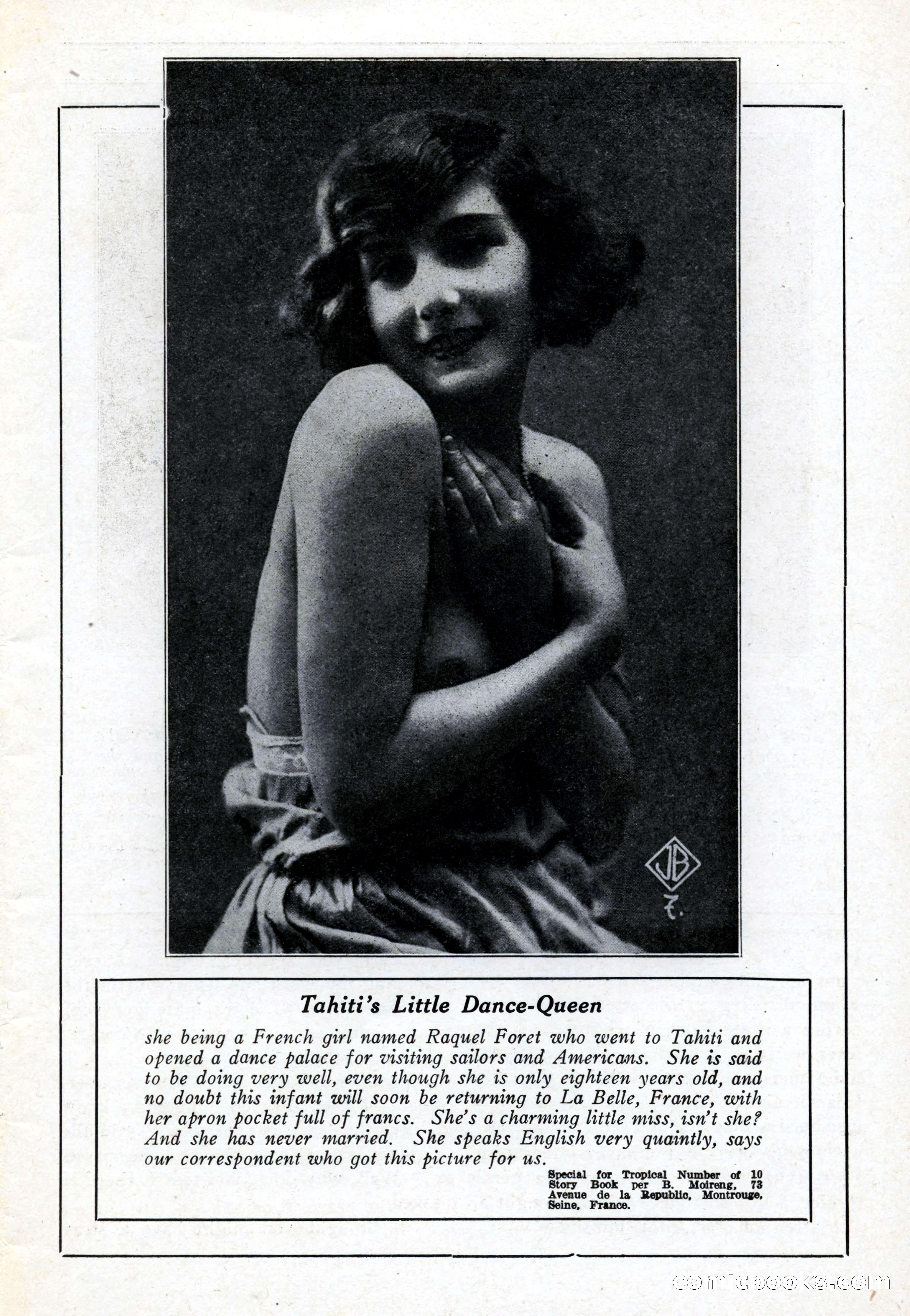
# Page Analysis This page is an illustration with accompanying text from a pulp magazine's "Tropical Number." It features a black-and-white photograph of a young woman identified as Raquel Foret, a French girl who reportedly opened a dance palace in Tahiti catering to sailors and Americans. The caption claims she is eighteen years old, speaks English with a distinctive accent, has never married, and is accumulating wealth to eventually return to France. The image credit indicates the photograph came from a correspondent in Montrouge, France.

10-Story Book, February 1928 — page 6 of 68
6 / 68
What you’re looking at · open this page on its own ↗

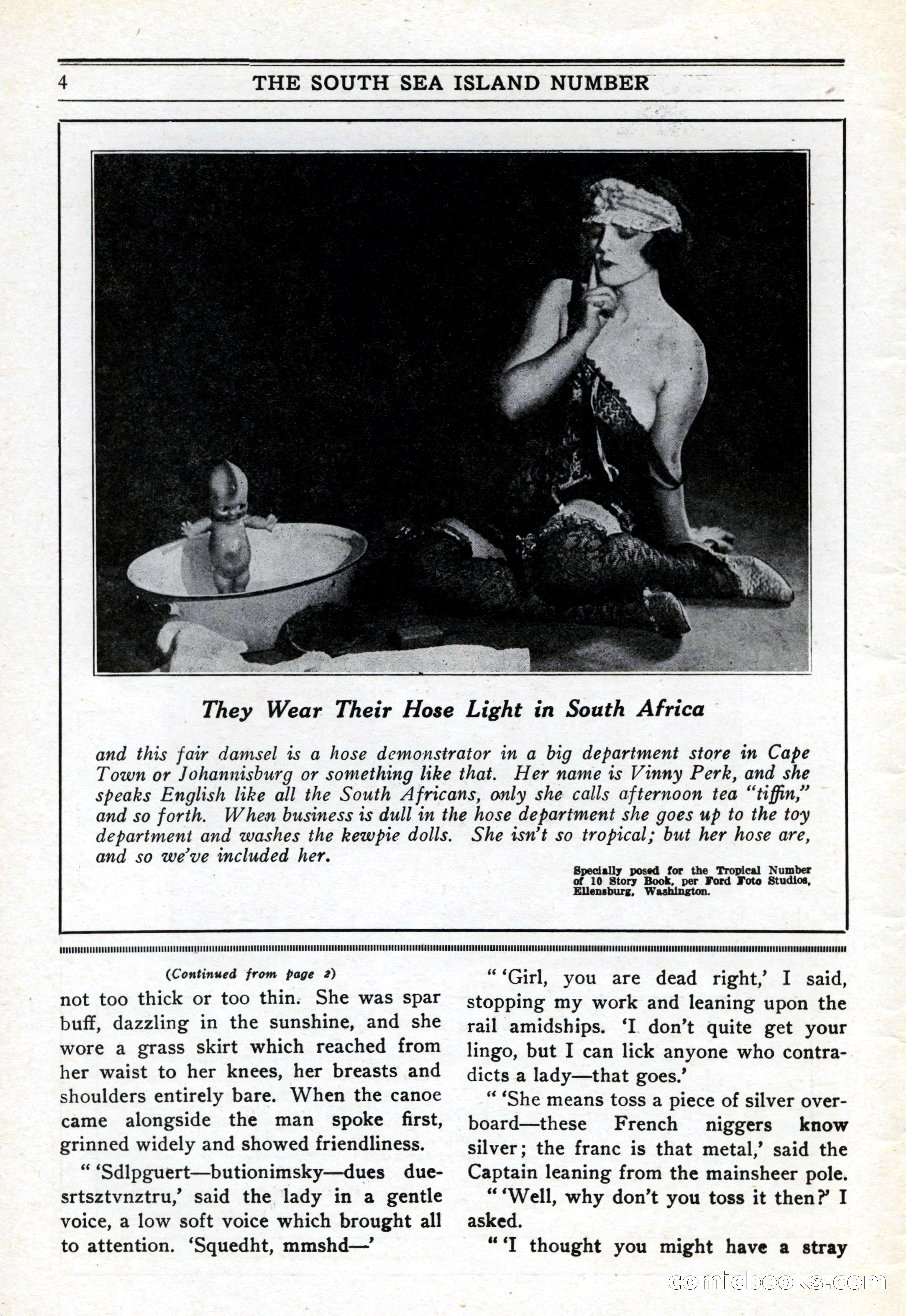
# Page Analysis This page from *The South Sea Island Number* contains a photograph with caption at the top, followed by story prose below. The photograph shows a woman in costume posed with tropical props for a hose-company advertisement. The caption explains she is a department-store hosiery demonstrator named Vinny Perk from South Africa. The prose section continues a narrative (from page 2) involving a canoe encounter and dialogue between sailors and a local woman, including period-typical colonial-era language and racial terminology reflecting the pulp magazine's era.

10-Story Book, February 1928 — page 7 of 68
7 / 68
What you’re looking at · open this page on its own ↗

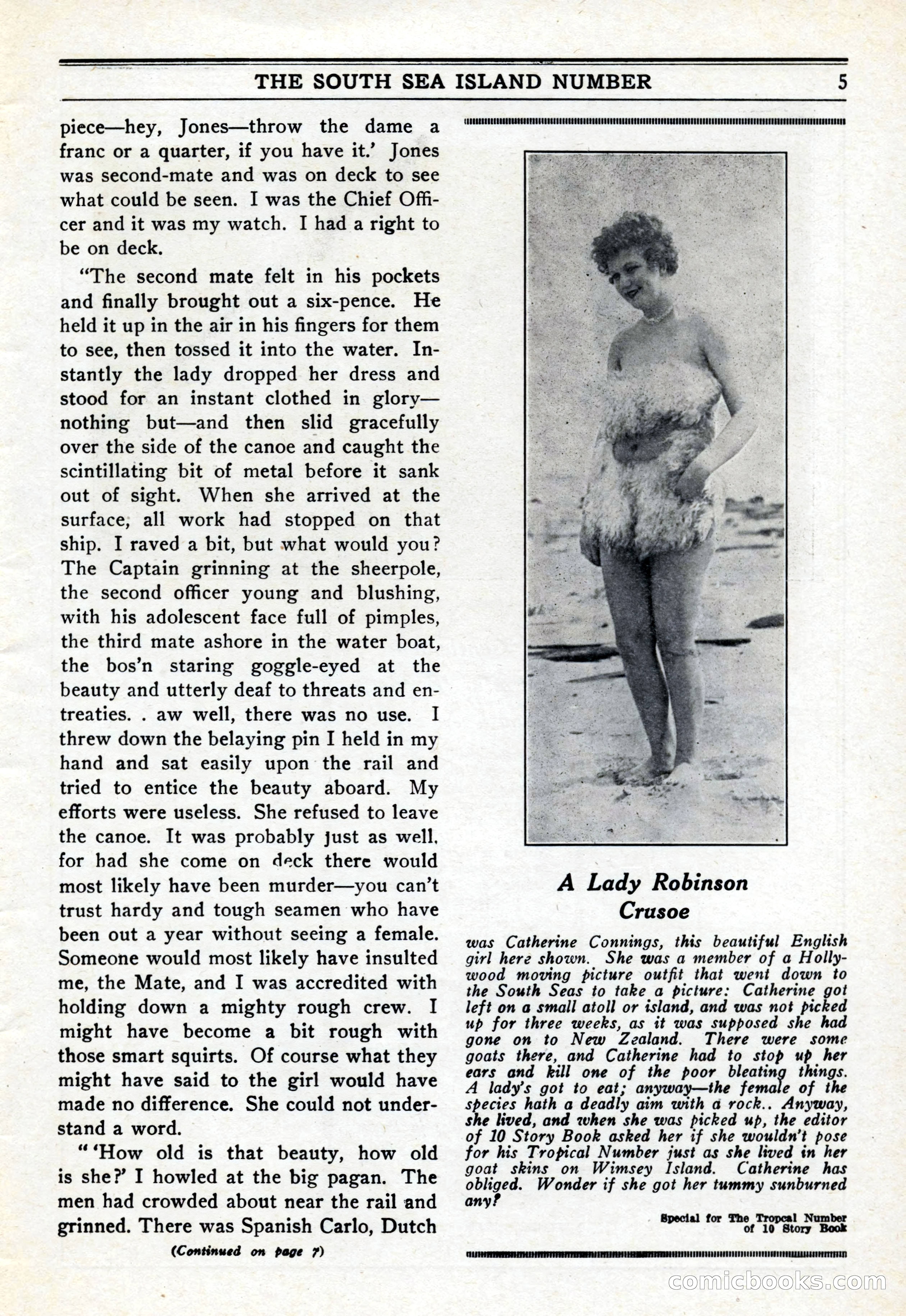
# Page Analysis This page from *The South Sea Island Number* contains narrative prose from a pulp fiction story alongside a photograph. The text describes a ship's officer recounting an encounter with an indigenous woman who dives for a coin thrown by the second mate. The accompanying image shows a woman identified as "A Lady Robinson Crusoe"—Catherine Connings, an English actress from a Hollywood film crew who was stranded on a South Pacific atoll. The caption explains she survived by hunting goats and was photographed in her makeshift island clothing for this special *Tropical Number* edition of the magazine.

10-Story Book, February 1928 — page 8 of 68
8 / 68
What you’re looking at · open this page on its own ↗

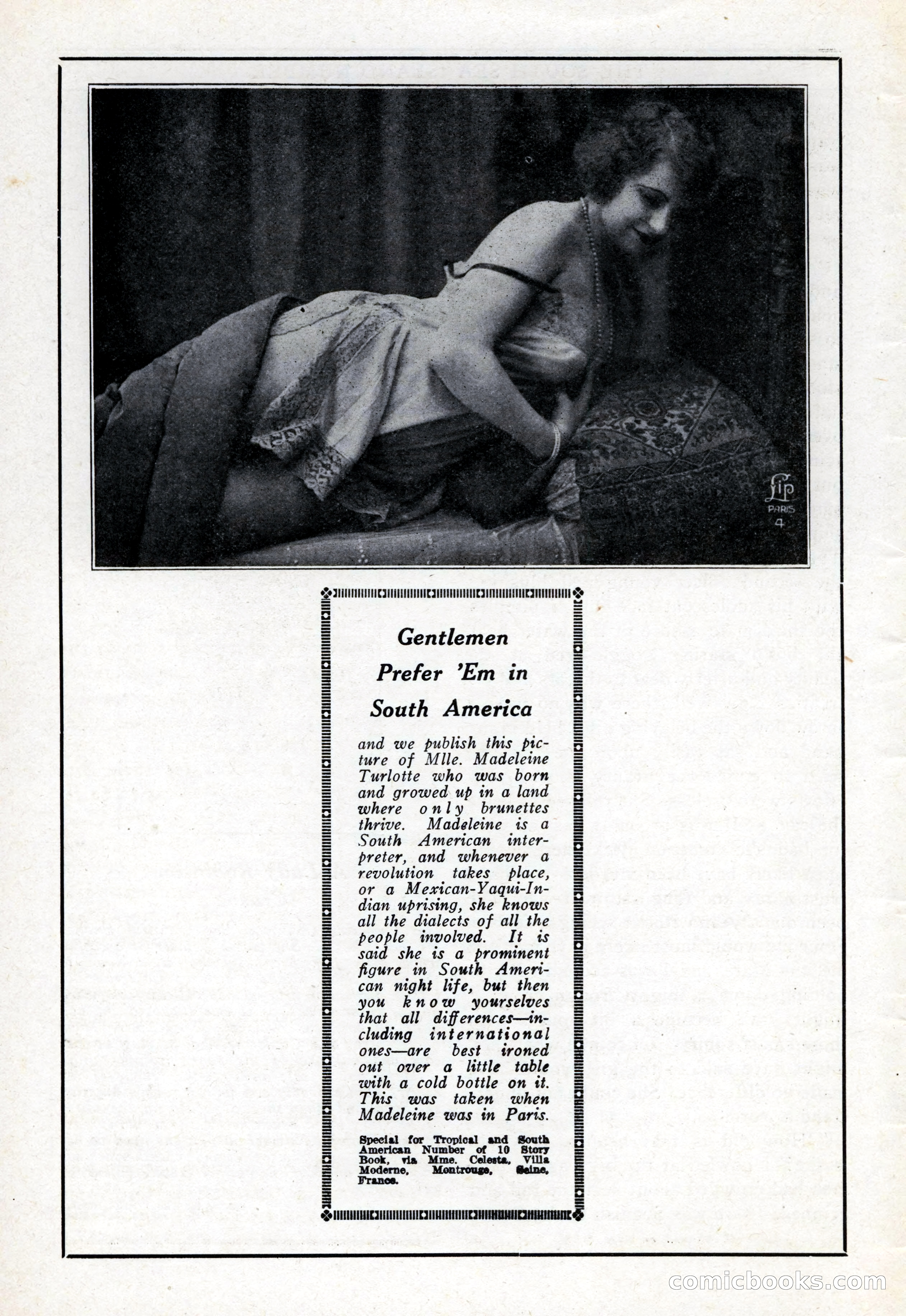
# Page Analysis This is an **illustrated page** from a pulp magazine, featuring a photograph of a woman in a reclining pose alongside accompanying text. The text introduces "Mlle. Madeleine Turlotte," described as a South American interpreter who speaks multiple dialects and is allegedly a prominent figure in South American nightlife. The page caption, titled "Gentlemen Prefer 'Em in South America," uses this figure as a framing device to humorously suggest that international disputes are best resolved over drinks. The photograph was apparently taken while Turlotte was in Paris. The page appears designed as promotional material for a "Tropical and South American Number" of 10 Story Book magazine.

10-Story Book, February 1928 — page 9 of 68
9 / 68
What you’re looking at · open this page on its own ↗

# Page Description This page contains story prose from a pulp fiction magazine, appearing to be a continuation of a sea adventure narrative (marked "Continued from page 5"). The text describes a tense negotiation scene aboard a whaling ship, where the narrator attempts to prevent crew members from purchasing a woman from an island man, using escalating intimidation including a belaying pin. The second section shifts to commentary from crew members about the narrator's moral stance regarding sailor conduct and romantic entanglements aboard the vessel. The narrative appears aimed at adult readers and emphasizes maritime adventure and masculine conflict.

10-Story Book, February 1928 — page 10 of 68
10 / 68
What you’re looking at · open this page on its own ↗

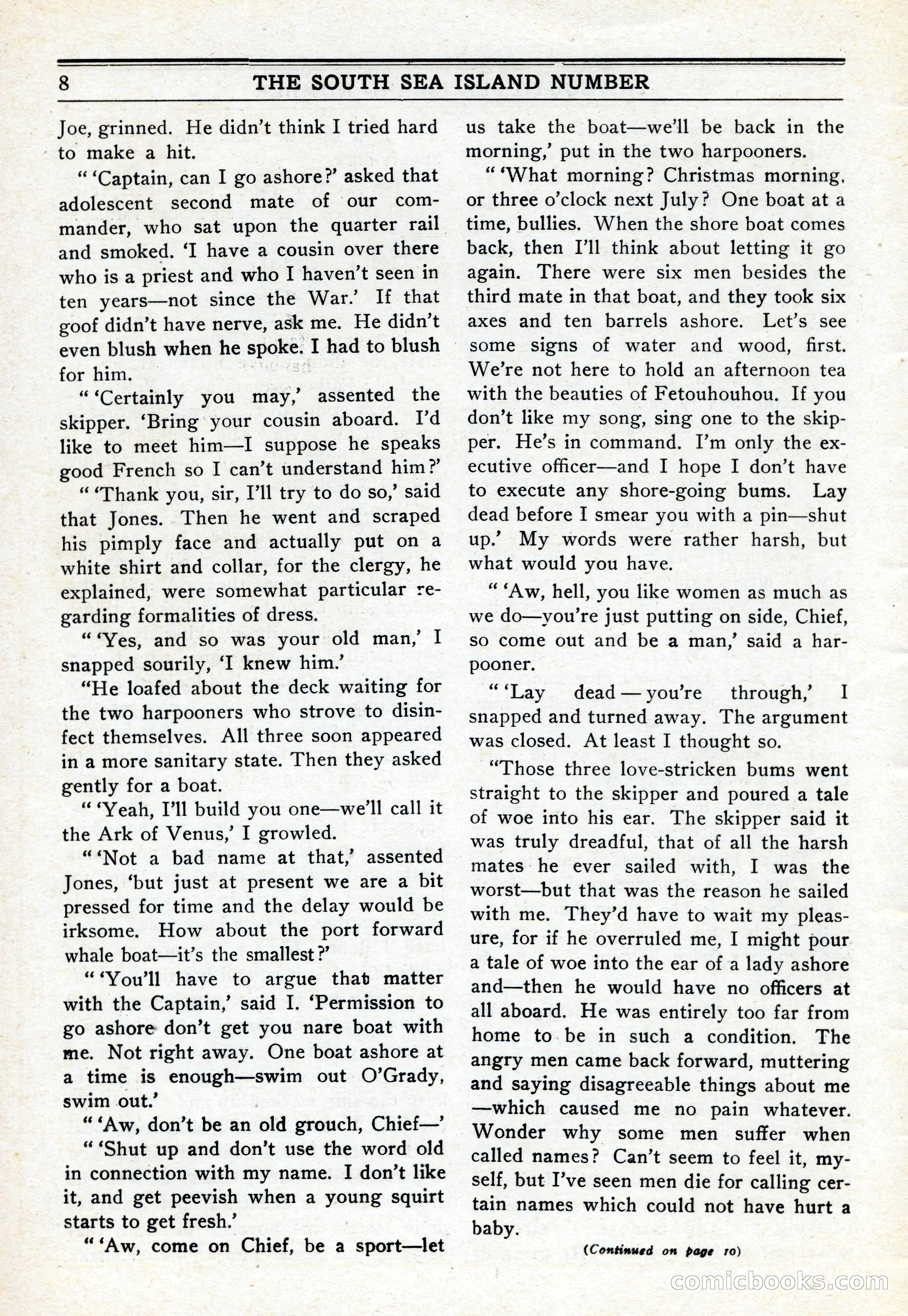
# Page 8: Story Prose from "The South Sea Island Number" This page contains prose fiction from a story appearing in what the masthead identifies as "The South Sea Island Number" of a pulp magazine. The narrative depicts a conflict between a ship's captain and crew members over shore leave during a whaling expedition. A junior officer requests permission to go ashore, but the captain refuses and dismisses the officer harshly. When disgruntled sailors complain to the captain, he responds dismissively. The narrator reflects on the incident and observes that some men are affected deeply by insults, though the narrator claims not to be bothered by the crew's complaints about him. The text is typical hardboiled pulp dialogue and internal monologue.

10-Story Book, February 1928 — page 11 of 68
11 / 68
10-Story Book, February 1928 — page 12 of 68
12 / 68
What you’re looking at · open this page on its own ↗

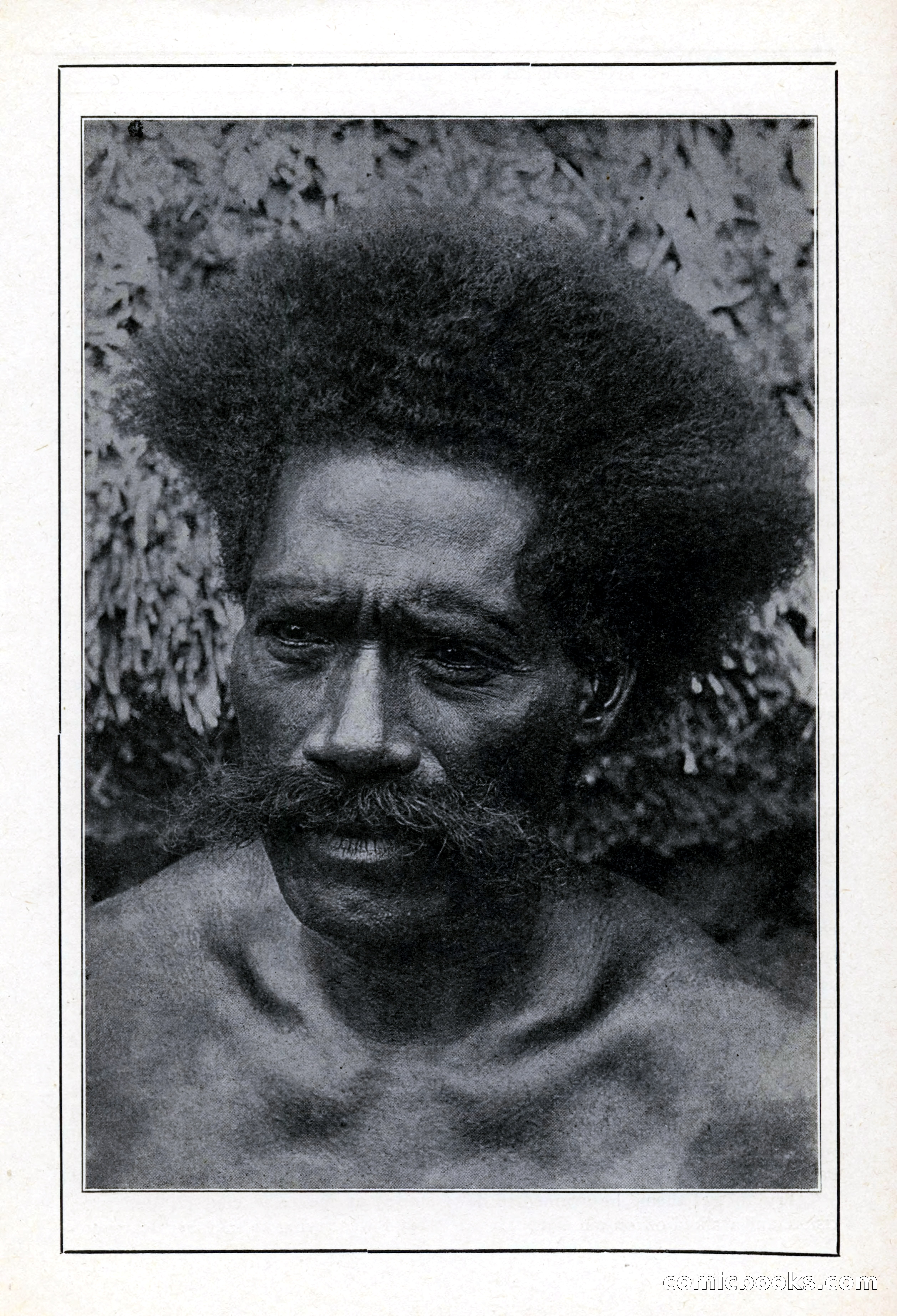
# Page Analysis This is a text page (page 10) from *The South Sea Island Number* of what appears to be a pulp magazine. The page contains two story sections: a continuation of narrative prose about a ship's captain contemplating young men seeking fortune and a "perfect woman," and a new section titled "Here's a Remarkable Camera Study" that describes a photograph of a native Fijian man, humorously questioning whether he practices cannibalism. The page includes typical pulp-magazine styling with italicized promotional text and continues the main narrative at the bottom about the narrator discovering the ship deserted.

10-Story Book, February 1928 — page 13 of 68
13 / 68
What you’re looking at · open this page on its own ↗

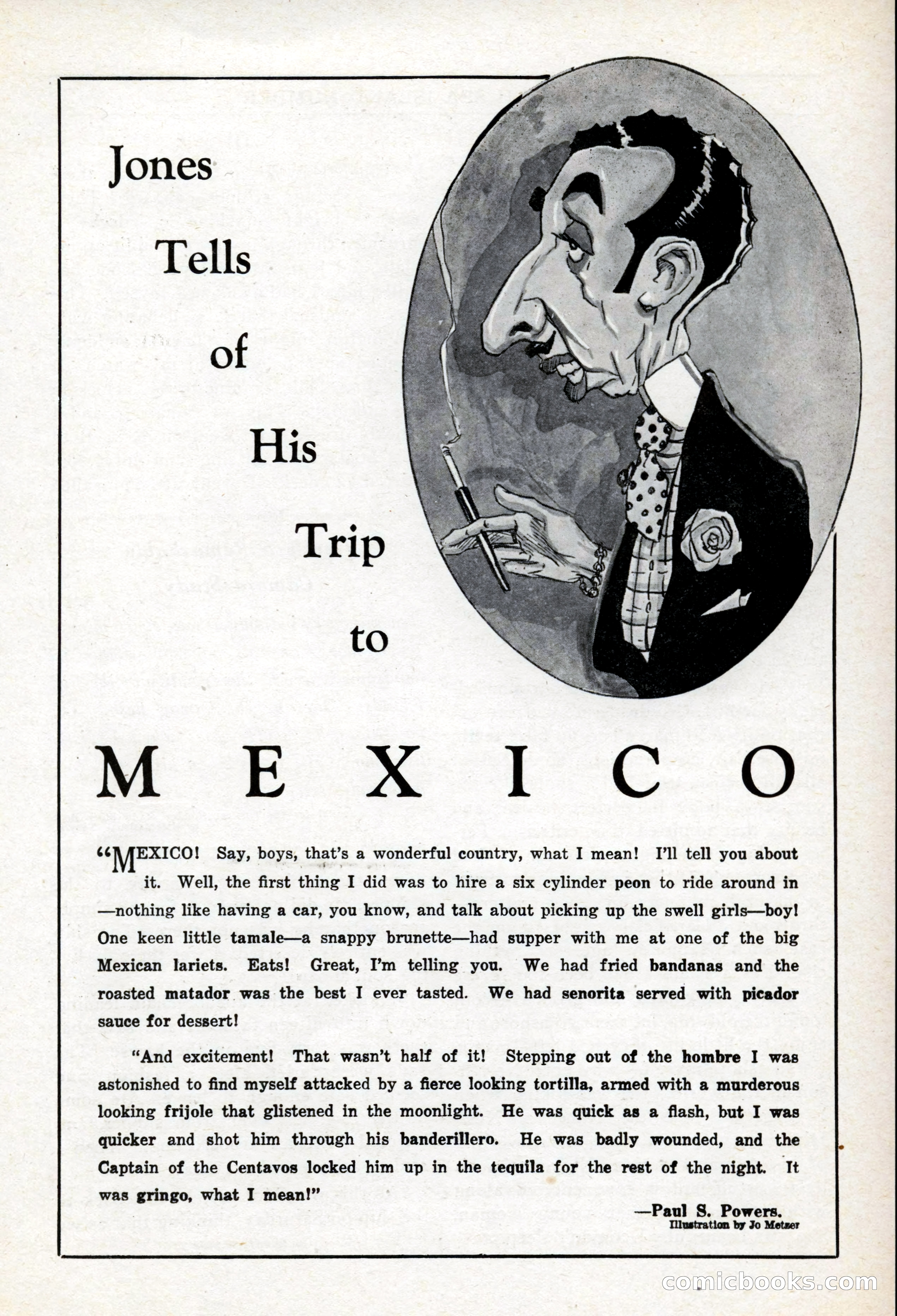
This is a black and white portrait photograph, likely from the early 20th century, showing a man with distinctive facial hair (beard and mustache) and voluminous dark hair, positioned against a textured background. The image appears to be a frontispiece or author photograph typical of pulp magazine publications from that era. However, the OCR text is corrupted and unreadable ("GOMIGIOOKSAEOM"), so the specific identity of the subject or any accompanying caption cannot be determined from the visible text. The photograph's professional quality and placement suggest it may introduce a story or author within the publication.

10-Story Book, February 1928 — page 14 of 68
14 / 68
What you’re looking at · open this page on its own ↗

# Page 12: Story Prose from "The South Sea Island Number" This page contains printed story prose from what appears to be a narrative about a ship captain's encounter in a South Sea island setting. The text depicts a conflict between the narrator and a second mate named Jones over the mate's refusal to return to the ship, as Jones has married a local woman and wishes to remain on the island. The passage includes dialogue in which Jones defends his decision to stay and raise a family rather than continue working at sea, while the narrator expresses frustration at losing crew members. The text is densely printed in two columns with no illustrations visible on this page.

10-Story Book, February 1928 — page 15 of 68
15 / 68
What you’re looking at · open this page on its own ↗

# Page Analysis This is story prose from what appears to be a pulp fiction magazine (page 13, titled "THE SOUTH SEA ISLAND NUMBER"). The text consists of a first-person narrative divided into sections, with "IV" marking a new chapter break. The visible story describes a narrator's romantic and social adventures on a South Sea island. He encounters local women, attempts to locate beautiful women living on the shore, and experiences the island's culture. The narrative then shifts to discussing the death of a ship's captain from disease and the narrator's subsequent frustrations attempting to convince island men to abandon their peaceful lifestyle. The final section mentions hearing news of a whaling ship (the Saragossa) arriving at a nearby location. The prose is literary rather than illustrated—no images accompany the text on this page.

10-Story Book, February 1928 — page 16 of 68
16 / 68
What you’re looking at · open this page on its own ↗

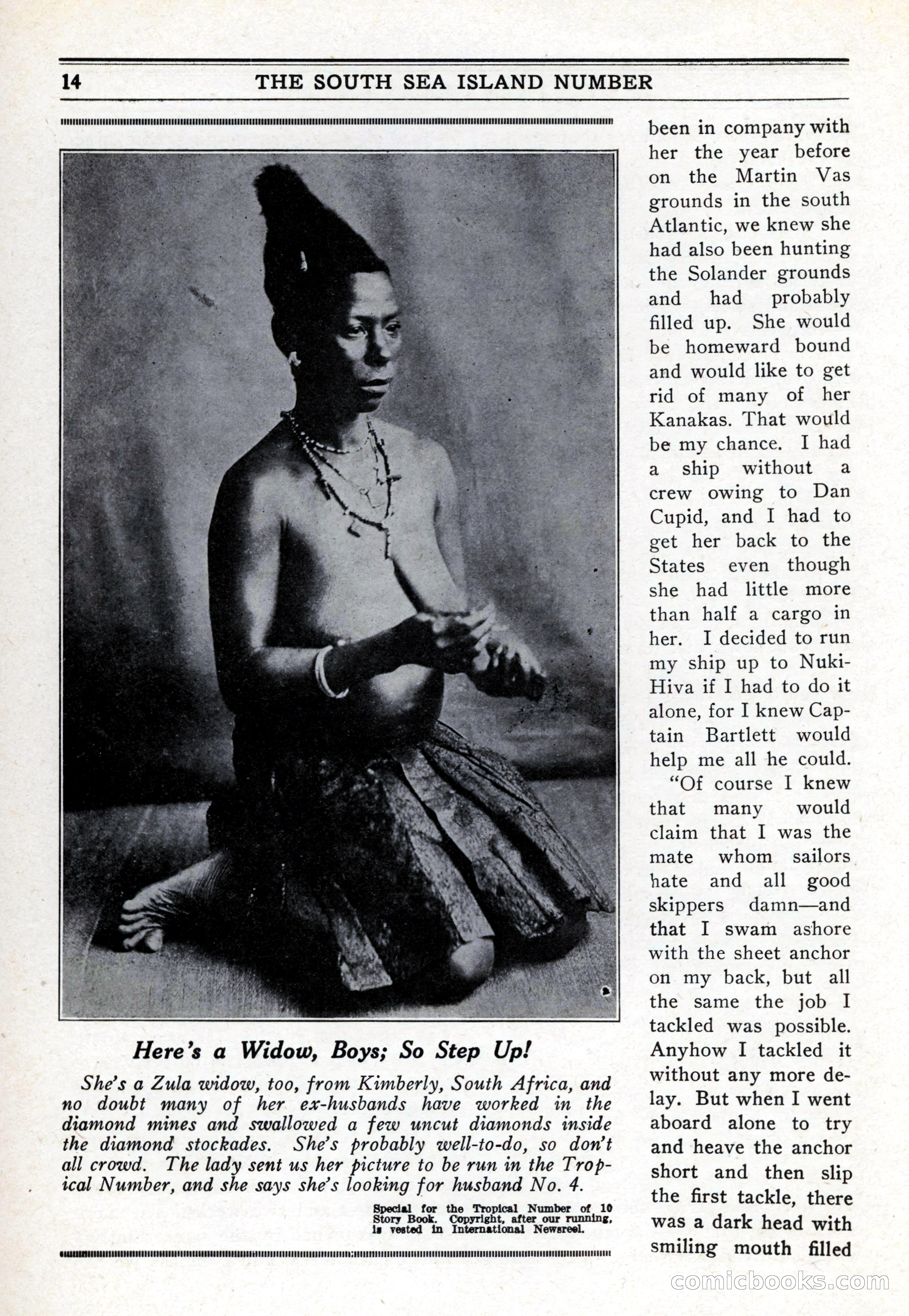
This is page 14 from a pulp magazine called "The South Sea Island Number." The page features a black-and-white photograph of a woman identified as a Zulu widow from Kimberly, South Africa, accompanied by a sensationalized caption claiming she is "looking for husband No. 4" and joking about her ex-husbands' involvement in diamond mining. Below the photo is narrative prose describing a ship captain's plans to transport this woman homeward while dealing with crew and cargo matters. The writing adopts a casual, period-typical tone that is deeply problematic by modern standards, treating the subject with exoticizing stereotypes common to early-20th-century pulp fiction.

10-Story Book, February 1928 — page 17 of 68
17 / 68
What you’re looking at · open this page on its own ↗

# Page Analysis This is a page of story prose (page 15) from "The South Sea Island Number" of a pulp magazine. The text describes a narrator's maritime adventure aboard a sailing vessel called the Willee. The passage details nautical operations including anchoring, sail adjustments, and crew activities, with romantic interludes involving a female companion. The narrator discusses sailing techniques, the ship's specifications (six hundred tons, eighteen feet draft), and various sailing maneuvers undertaken while navigating the ocean. The writing style suggests an adventure or romance narrative set in tropical or South Pacific waters, typical of early-20th-century pulp fiction.

10-Story Book, February 1928 — page 18 of 68
18 / 68
What you’re looking at · open this page on its own ↗

# Page 16: Story Prose from "The South Sea Island Number" This page contains story prose, specifically two sections (labeled IV and V) of what appears to be a maritime adventure narrative. The text describes a narrator's solo sailing of the ship *Willilee* to Port Tai-o-hie, where he encounters the port Commander, who questions him in French about his remarkable solo voyage around the world with only a Kanaka wife as crew. The Commander expresses amazement at such an feat, then inquires about the narrator's crew, leading to a discussion about the mate having taken the ship *Saragossa* around Cape Horn. The passage emphasizes themes of seafaring skill and adventure in tropical locations.

10-Story Book, February 1928 — page 19 of 68
19 / 68
What you’re looking at · open this page on its own ↗

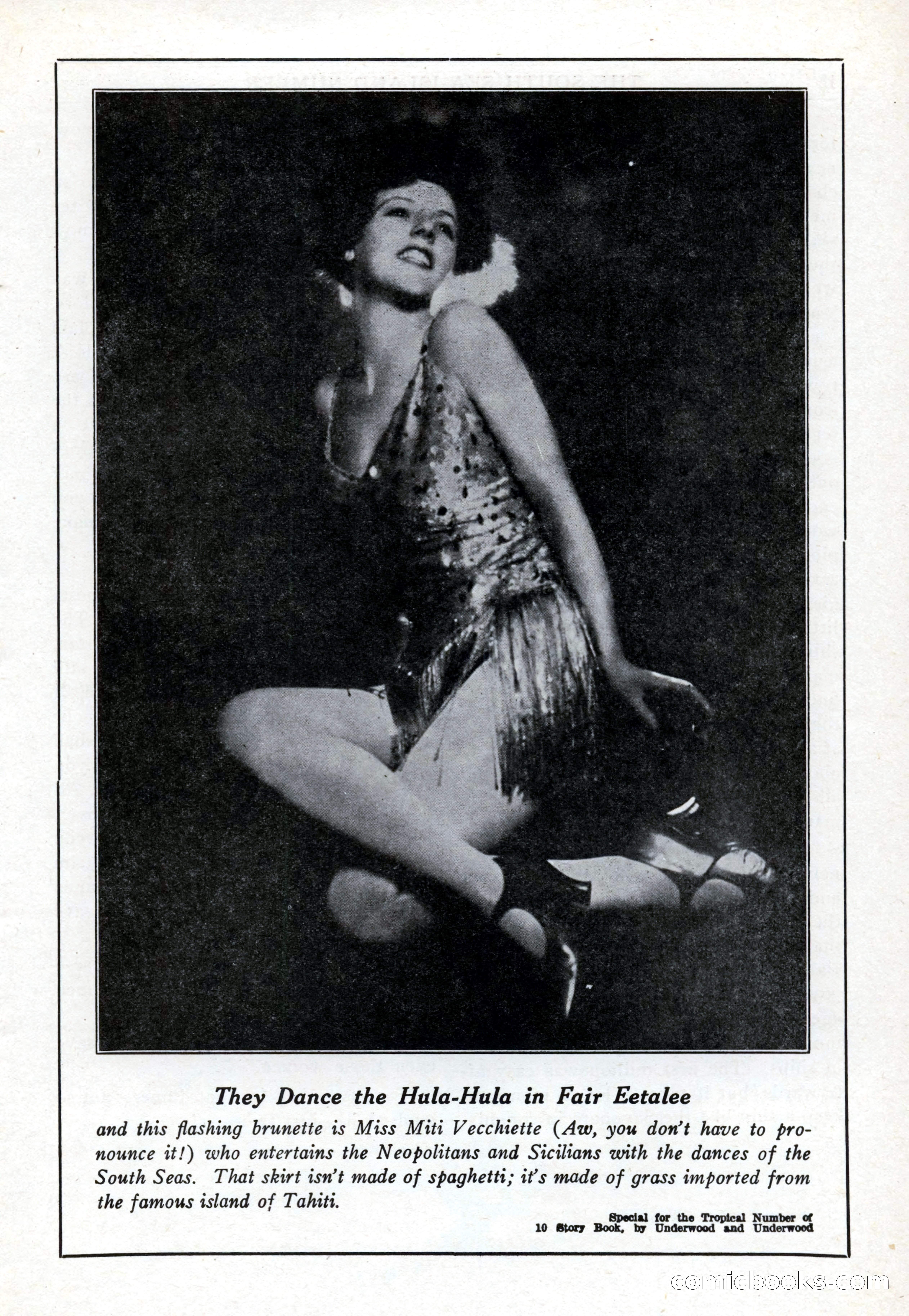
# Page Description This is an illustrated page from an early-20th-century pulp magazine featuring a black-and-white photograph of a dancer in a sequined Hawaiian-style costume performing the hula. The caption identifies her as Miss Miti Vecchiette, described as a performer who entertains audiences with dances of the South Seas. The text notes her grass skirt is authentically made from imported material from Tahiti, not synthetic fibers. The page appears to be part of a story or feature titled "They Dance the Hula-Hula in Fair Eetalee" (likely "Etalee" or similar). The credit line indicates this is a special feature for the Tropical Number of the magazine by Underwood and Underwood photographers.

10-Story Book, February 1928 — page 20 of 68
20 / 68
What you’re looking at · open this page on its own ↗

# Page Analysis This is a **text-only story page** (page 18) from a pulp magazine titled "The South Sea Island Number." The visible prose continues a narrative about a seafaring character recounting his life story to an audience. The speaker describes his maritime origins, his marriage to Maggie Clancy, and his subsequent financial success in railroads and banking, crediting his initial wealth to profits from early ship voyages. The page concludes with dialogue between the narrator (addressed as "Commodore") and a ship's Chaplain debating morality and salvation, with the Chaplain offering to save souls of the Commodore's dinner guests. The text is clearly mid-narrative, continuing from page 16.

10-Story Book, February 1928 — page 21 of 68
21 / 68
What you’re looking at · open this page on its own ↗

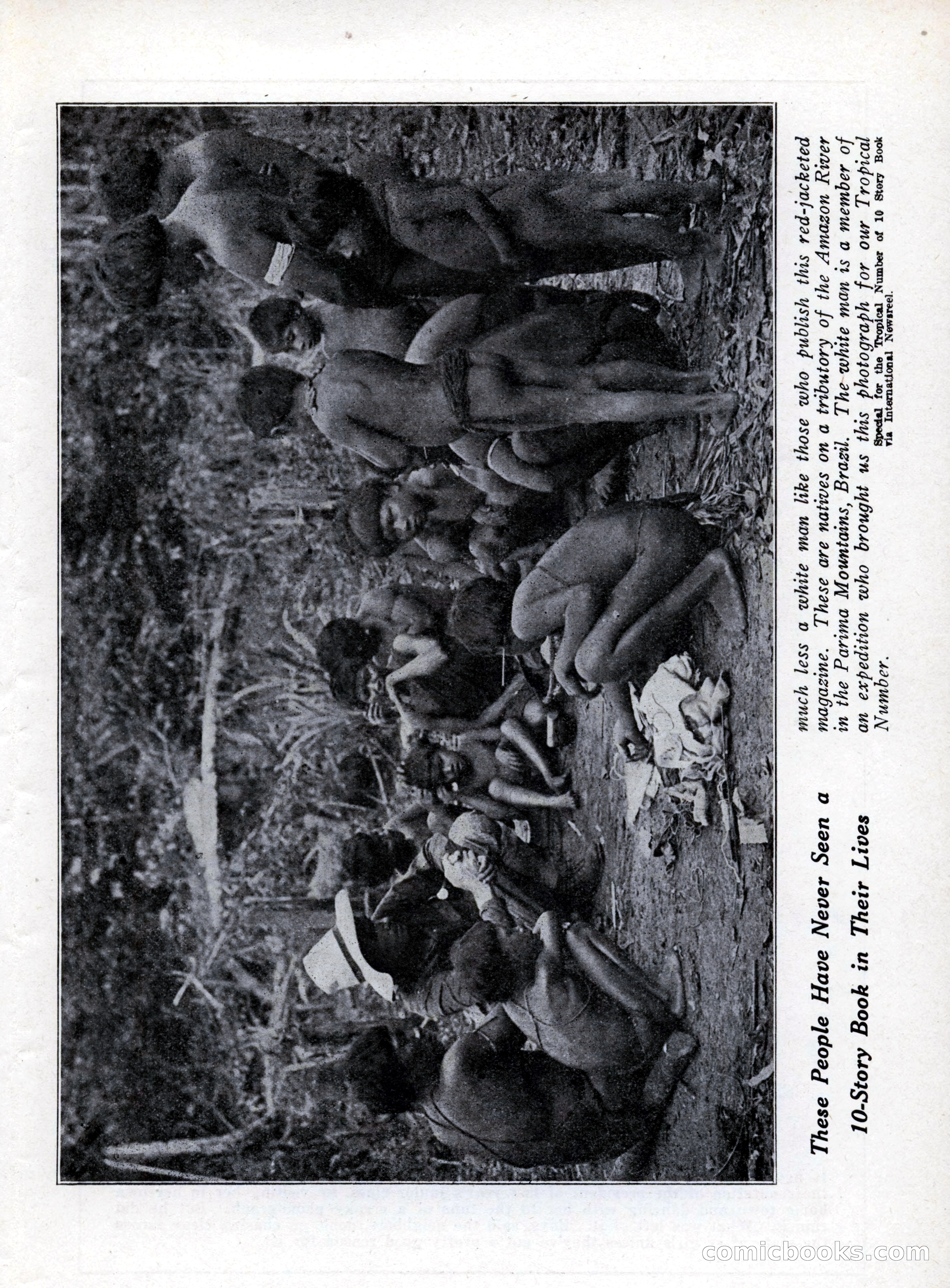
# Page Description This is an interior illustration accompanying a 10-story book titled "These People Have Never Seen a 10-Story Book in Their Lives." The black-and-white photograph shows a group of people (appearing to be from a rural or underdeveloped area) gathered around what seems to be a publication, examining it with curiosity. The caption indicates these individuals have never before encountered a 10-story book, suggesting the image documents a moment of discovery or introduction to published literature. The photo serves as documentary-style illustration for what appears to be a story about cultural exposure or the introduction of modern reading materials to unfamiliar populations.

10-Story Book, February 1928 — page 22 of 68
22 / 68
What you’re looking at · open this page on its own ↗

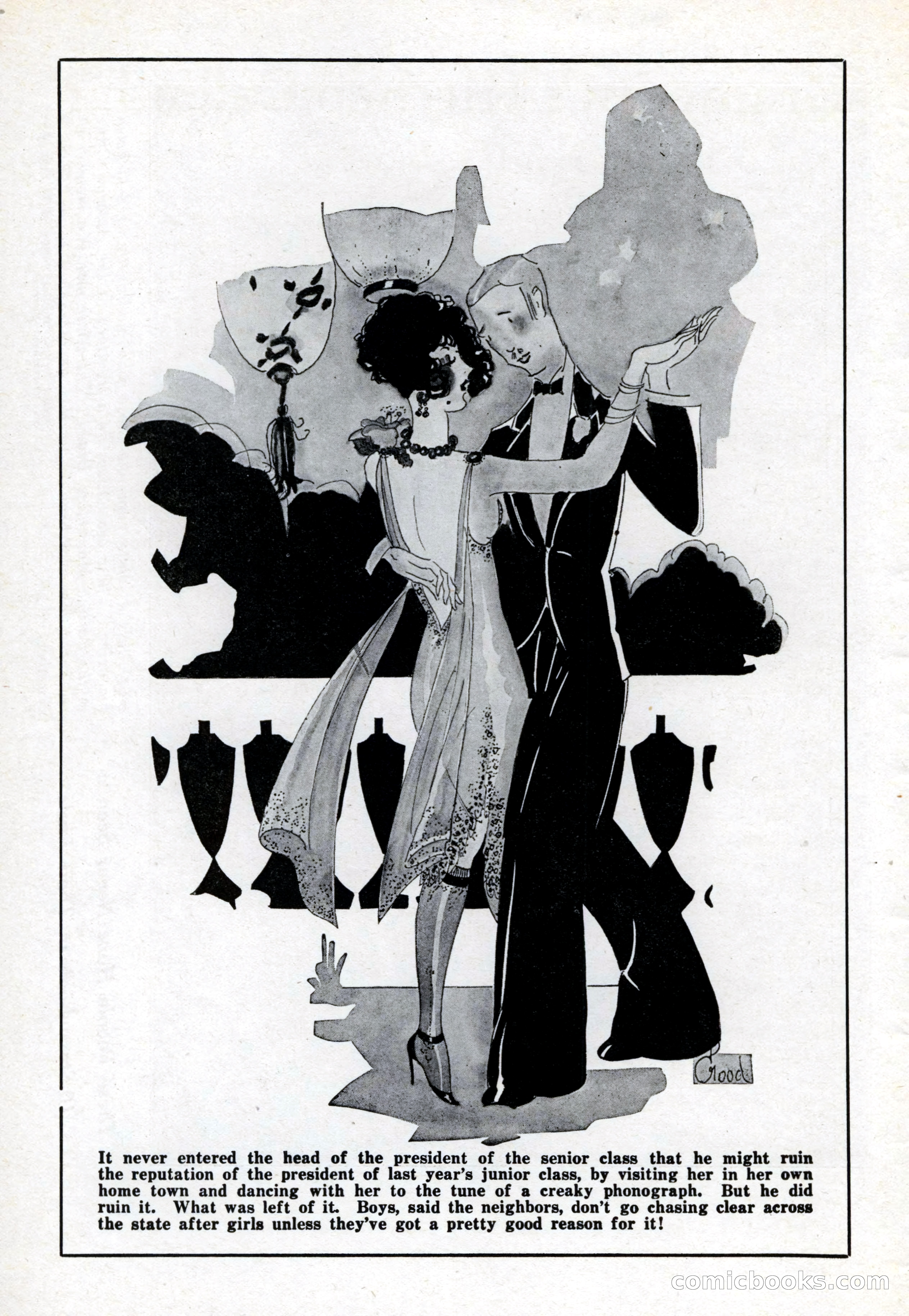
# Analysis This is an **illustration** (not a cover) from an early-20th-century pulp magazine. The image shows a stylized Art Deco-era drawing signed "Clodd" depicting a woman in an evening gown surrounded by silhouettes of men in formal wear, with decorative masks and bottles visible. The caption describes a social scandal: a senior class president who visited the previous junior class president in her hometown and danced with her, sparking gossip among neighbors. The text warns boys against "chasing clear across the state after girls unless they've got a pretty good reason for it." The passage appears to address teenage social propriety and dating etiquette, likely from a youth-oriented or advice column section.

10-Story Book, February 1928 — page 23 of 68
23 / 68
What you’re looking at · open this page on its own ↗

# Page Analysis This page contains story prose from "Grammaw's Kitchen Calendar" by Ila Lewis. The text is presented in two columns with a large decorative initial letter "M." The story depicts a conflict between a young girl named Marvel and her grandmother, who uses a kitchen calendar to predict people's fates. Marvel wants to join her uncle Paul Weber's Wild West Show by performing acrobatic tricks (hanging by her feet), but Paul insists only boys can participate. Grammaw warns Marvel that she'll come to a bad end, while Marvel argues that wearing pants and performing tricks doesn't make someone a boy. The passage shows their dispute over gender roles and Marvel's determination to join the show.

10-Story Book, February 1928 — page 24 of 68
24 / 68
What you’re looking at · open this page on its own ↗

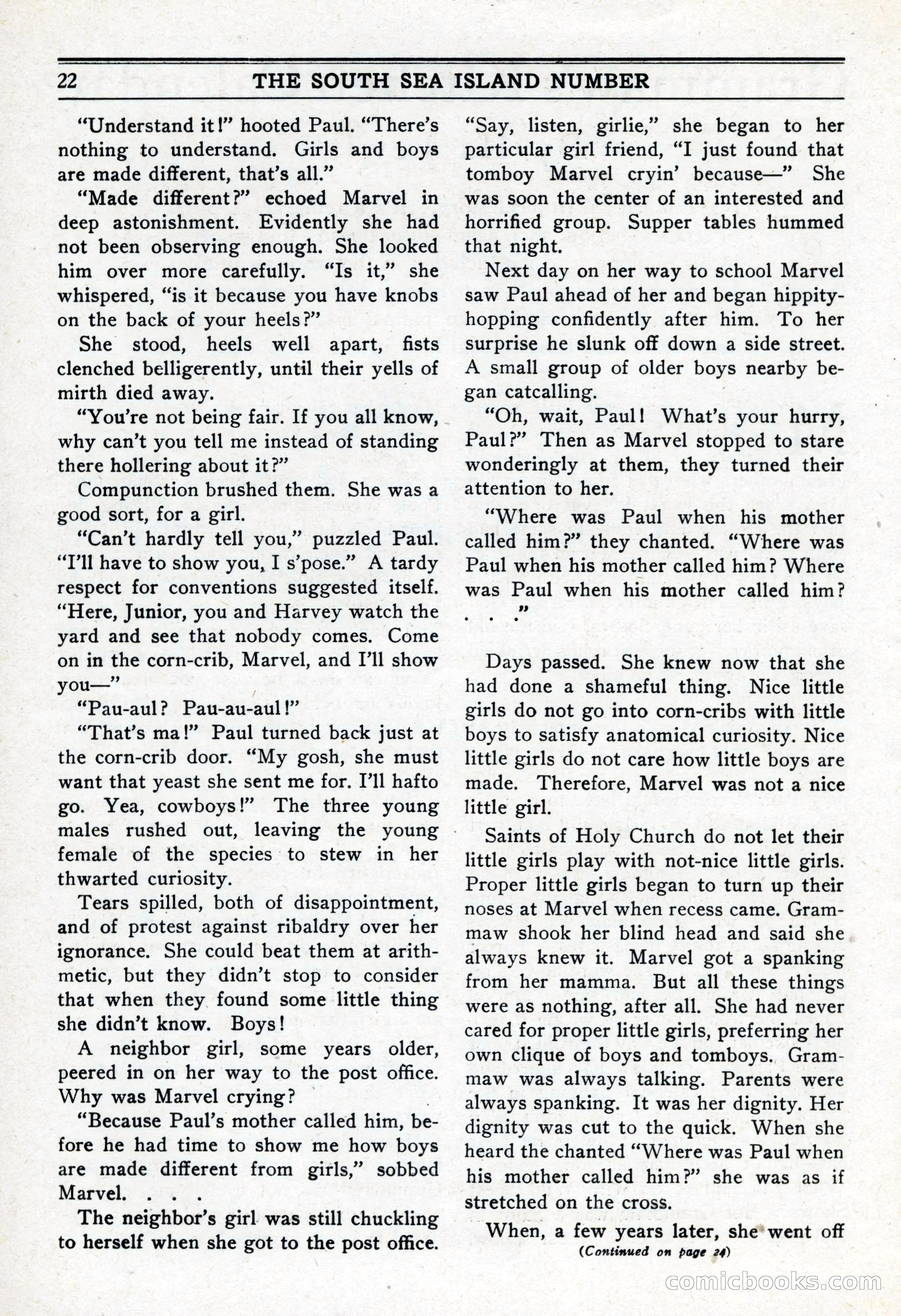
# Page Analysis This is a story prose page (page 22) from "The South Sea Island Number" of a pulp magazine. The text depicts a childhood incident where a curious girl named Marvel attempts to follow a boy named Paul to satisfy her anatomical curiosity, but is intercepted and scolded by an older girl named Compunction. The passage then reflects on how Marvel later becomes ostracized by proper girls and instead associates with boys and tomboys, while her grandmother disapproves of her unladylike behavior. The narrative concludes with mention of events occurring "a few years later" (continued on the next page).

10-Story Book, February 1928 — page 25 of 68
25 / 68
What you’re looking at · open this page on its own ↗

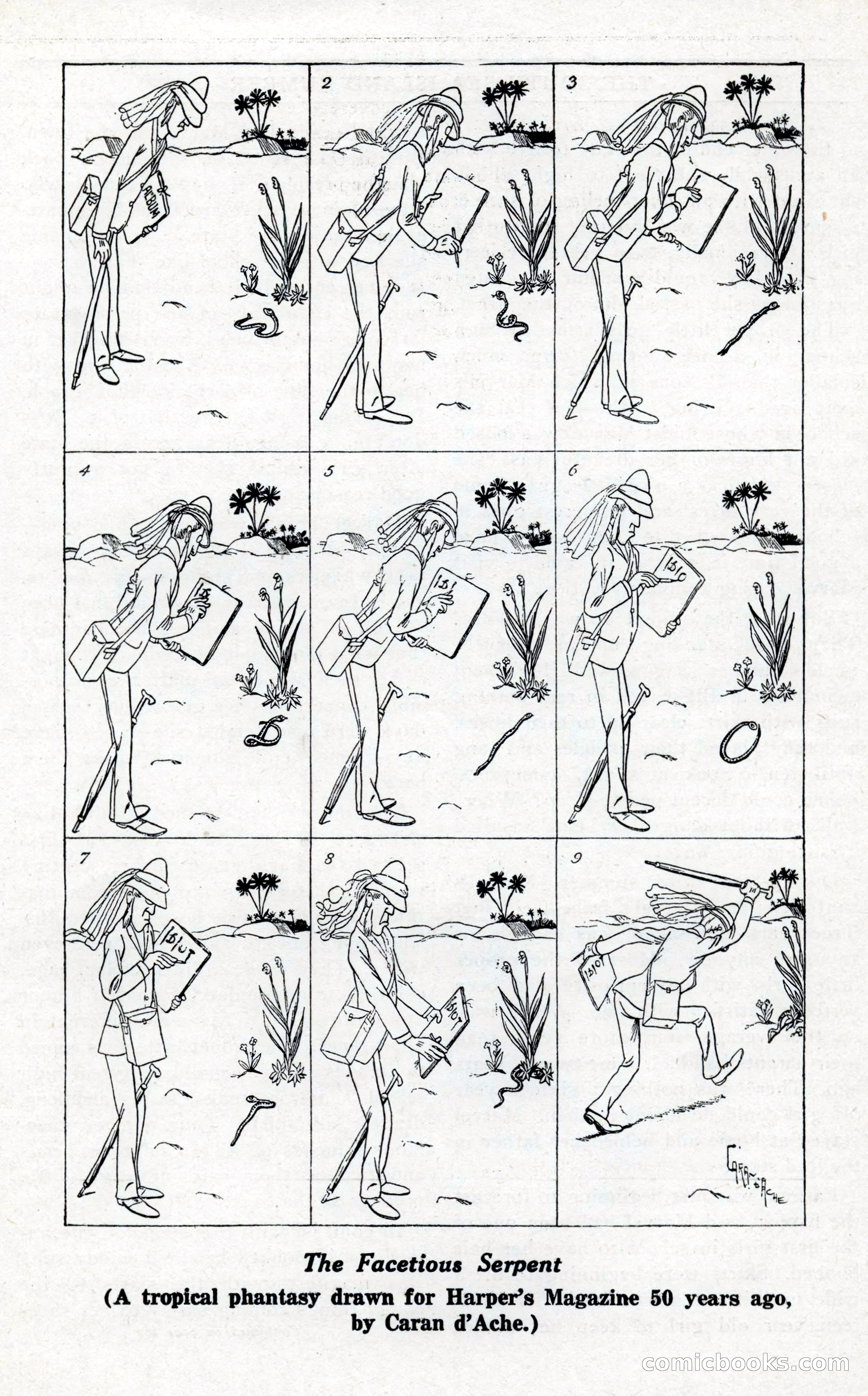
This is an illustrated comic strip titled "The Facetious Serpent," credited to artist Caran d'Ache and noted as "A tropical phantasy drawn for Harper's Magazine 50 years ago." The nine-panel sequence depicts a woman in a tropical setting with a clipboard encountering what appears to be a snake. The narrative progresses through her interactions with the serpent—examining it, attempting to capture or study it, and eventually fleeing in alarm. The humor appears visual and slapstick in nature, showing the woman's escalating reactions across the panels, culminating in her running away. This is a reprinted vintage illustration rather than contemporary pulp fiction content.

10-Story Book, February 1928 — page 26 of 68
26 / 68
What you’re looking at · open this page on its own ↗

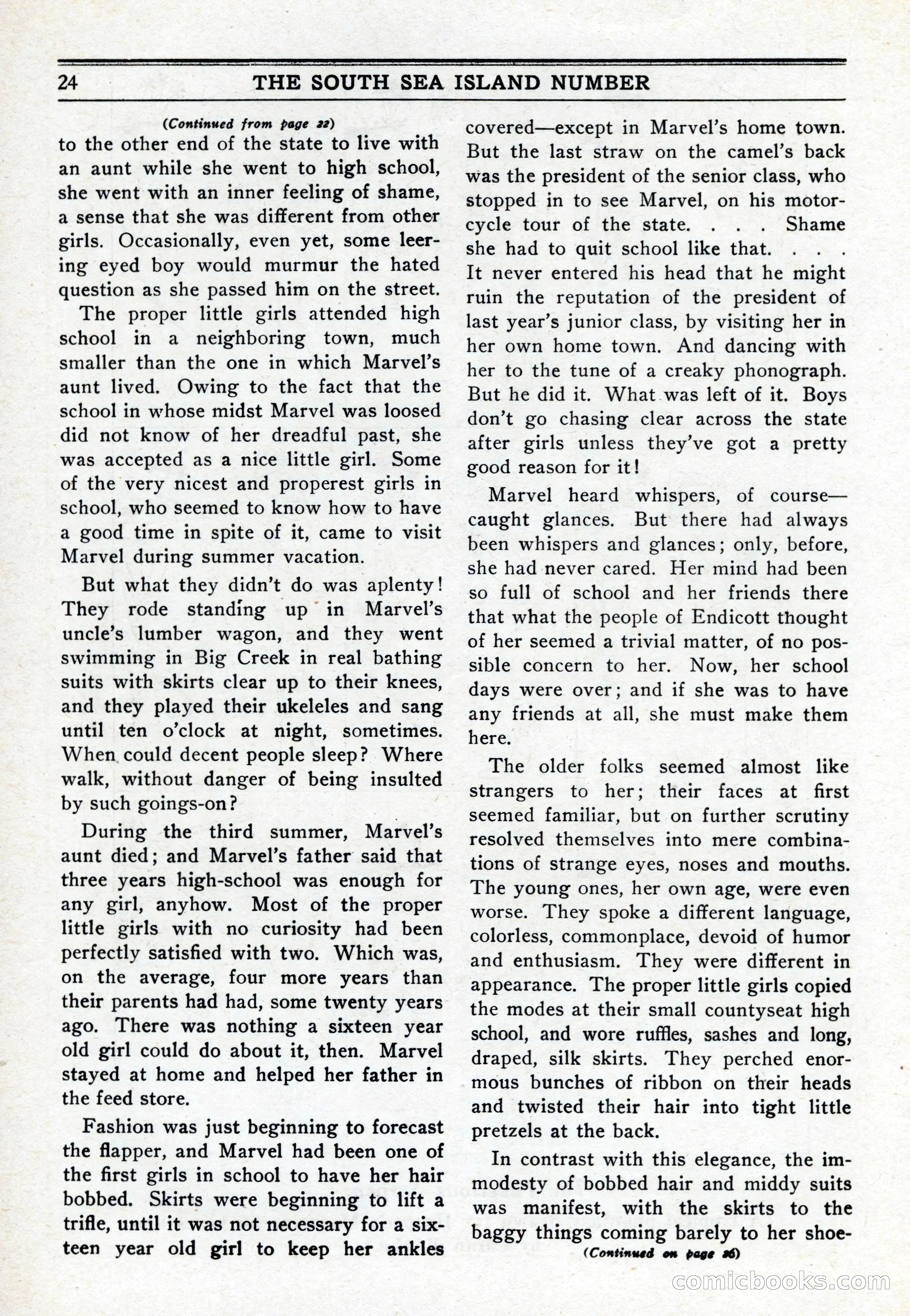
# Analysis of Page 24 This is a **story prose page** from *The South Sea Island Number*, continuing a narrative from page 22. The visible text depicts a young woman named Marvel navigating social challenges in her small hometown after attending high school in a larger city. The passage describes her estrangement from local "proper little girls" who attended a smaller county school, her summer visits from schoolmates, her father's decision to end her education after three years, and her subsequent difficulty readjusting to her home community. The text emphasizes the cultural and behavioral differences between Marvel and the conventional young women of her town, including contrasts in fashion, mannerisms, and social sophistication.

10-Story Book, February 1928 — page 27 of 68
27 / 68
What you’re looking at · open this page on its own ↗

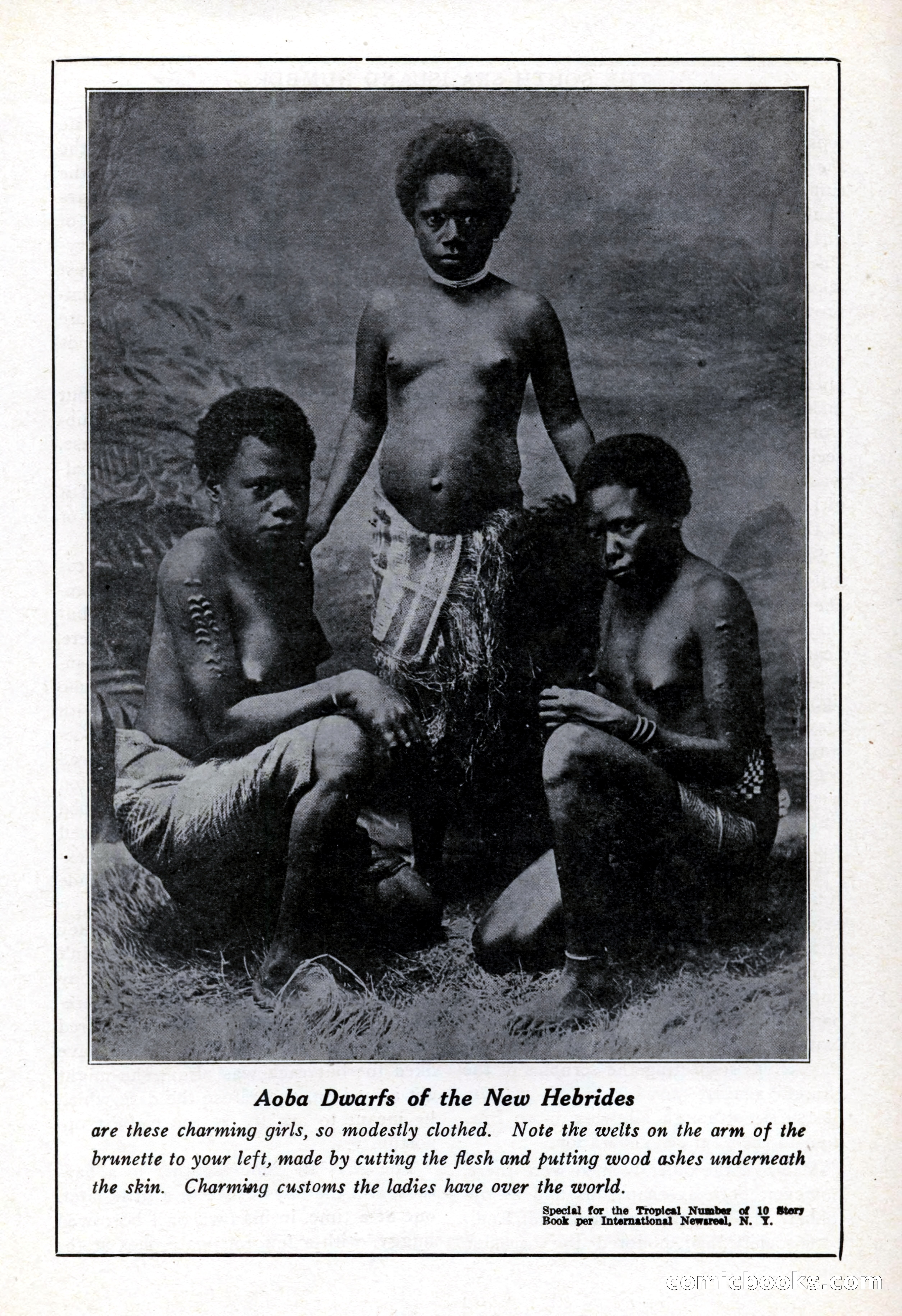
This is an illustrated page from an early-20th-century pulp magazine featuring a photograph labeled "Aoba Dwarfs of the New Hebrides." The image shows four individuals, and the caption describes them as "charming girls, so modestly clothed," while noting specific body modifications—scarification welts on one person's arm created by cutting flesh and placing wood ash underneath the skin. The text characterizes these as "charming customs the ladies have over the world." The caption credits the material as "Special for the Tropical Number of 19 Story Book per International Newsreel, N.Y." This appears to be anthropological or travel-themed content typical of pulp magazines' sensationalized coverage of non-Western cultures.

10-Story Book, February 1928 — page 28 of 68
28 / 68
What you’re looking at · open this page on its own ↗

This is a page of story prose from "The South Sea Island Number" pulp magazine, continuing a narrative from page 24. The text describes a young woman named Marvel and her social position in a small town called Endicott. The passage details her reputation, her choice of clothing (a white taffeta dress without sleeves for a junior-senior reception), and how local boys react to her presence at a social gathering. The narrative explores themes of small-town social hierarchies, propriety, and teenage social dynamics, with particular attention to class distinctions marked by the prominence of wealthy families and their wives in the community.

10-Story Book, February 1928 — page 29 of 68
29 / 68
What you’re looking at · open this page on its own ↗

# Page Analysis This is a prose story page from what appears to be a pulp magazine titled "The South Sea Island Number" (page 27). The text describes a young woman named Marvel who is embarrassed by unwanted romantic attention at a social gathering. The passage details a kissing game called "Postoffice" that she's pressured into playing, and shows her discomfort with being repeatedly selected by boys while other girls watch. A woman named Mrs. Juggles attempts to intervene on Marvel's behalf, concerned about the girl's reputation and the repeated summons. The narrative captures early-20th-century social dynamics and attitudes toward unmarried young women's behavior in courtship contexts.

10-Story Book, February 1928 — page 30 of 68
30 / 68
What you’re looking at · open this page on its own ↗

# Page Analysis This is an interior story page from *The South Sea Island Number* of a pulp magazine. It features a black-and-white photograph labeled "Ladies, Believe It or Not" showing three indigenous women from Malekula, New Hebrides, with a caption describing one woman as seeking a husband and another as a wealthy widow with unusual possessions (polished skulls used for trade). The right side contains story prose describing a scene where a character abandons a female companion, promising to take her home but breaking that promise. A bulky figure chases after her, and dialogue reveals tension between characters, including mention of "the Juggles boy" and someone called Butch. The narrative continues with a buggy departing and a horse later cropping grass by a roadside.

10-Story Book, February 1928 — page 31 of 68
31 / 68
What you’re looking at · open this page on its own ↗

# Page 29: Story Prose from "The South Sea Island Number" This page contains prose fiction text in a two-column layout, with a small illustration at the bottom. The narrative appears to involve a young woman in distress—possibly a girl in a dark setting—and a boy referred to as the "Juggles boy." The text depicts an emotional scene with dialogue, including the girl's prayer ("Daddy . . . come quick") and the boy's mocking response. The passage references her reputation, family abandonment, and a grandmother who condemned her as a "bad girl." The final illustration shows a silhouetted figure in a dynamic pose. The text's tone suggests this is a dramatic or possibly melodramatic story centered on social judgment and a young woman's circumstances.

10-Story Book, February 1928 — page 32 of 68
32 / 68
What you’re looking at · open this page on its own ↗

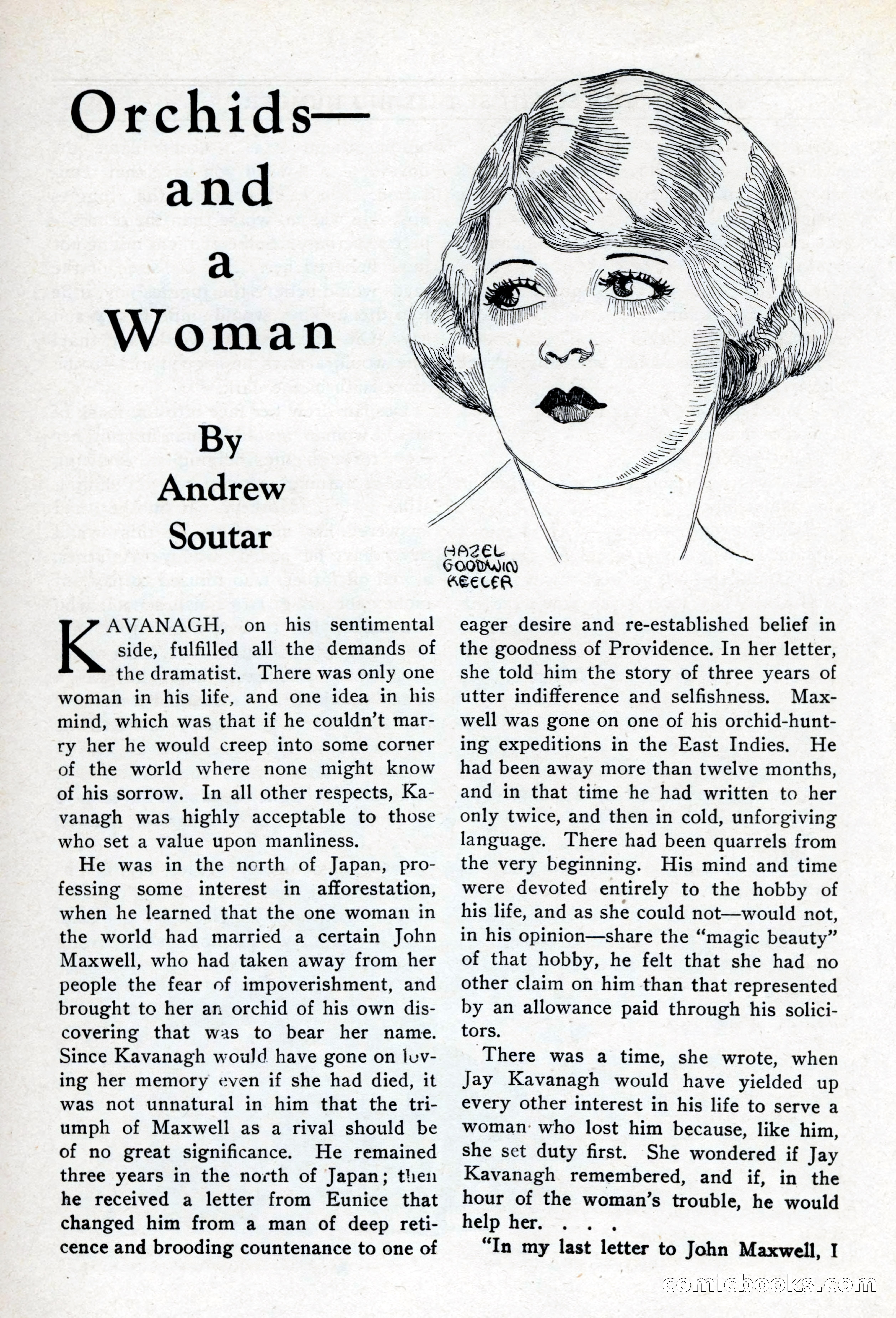
# "Orchids and a Woman" by Andrew Soutar This is a story opening page from an early-20th-century pulp magazine. It features a portrait illustration of a woman's face in ink, credited to "Hazel Goodwin Keller," and the beginning of prose fiction. The visible text introduces a character named Kavanagh, a dramatist in northern Japan, who learns that the only woman he loved has married John Maxwell and received an orchid bearing her name. The story describes Kavanagh's three years of brooding in Japan and his receipt of a letter from a woman named Eunice that changes his emotional state, prompting reflection on duty, love, and potential reconciliation.

10-Story Book, February 1928 — page 33 of 68
33 / 68
What you’re looking at · open this page on its own ↗

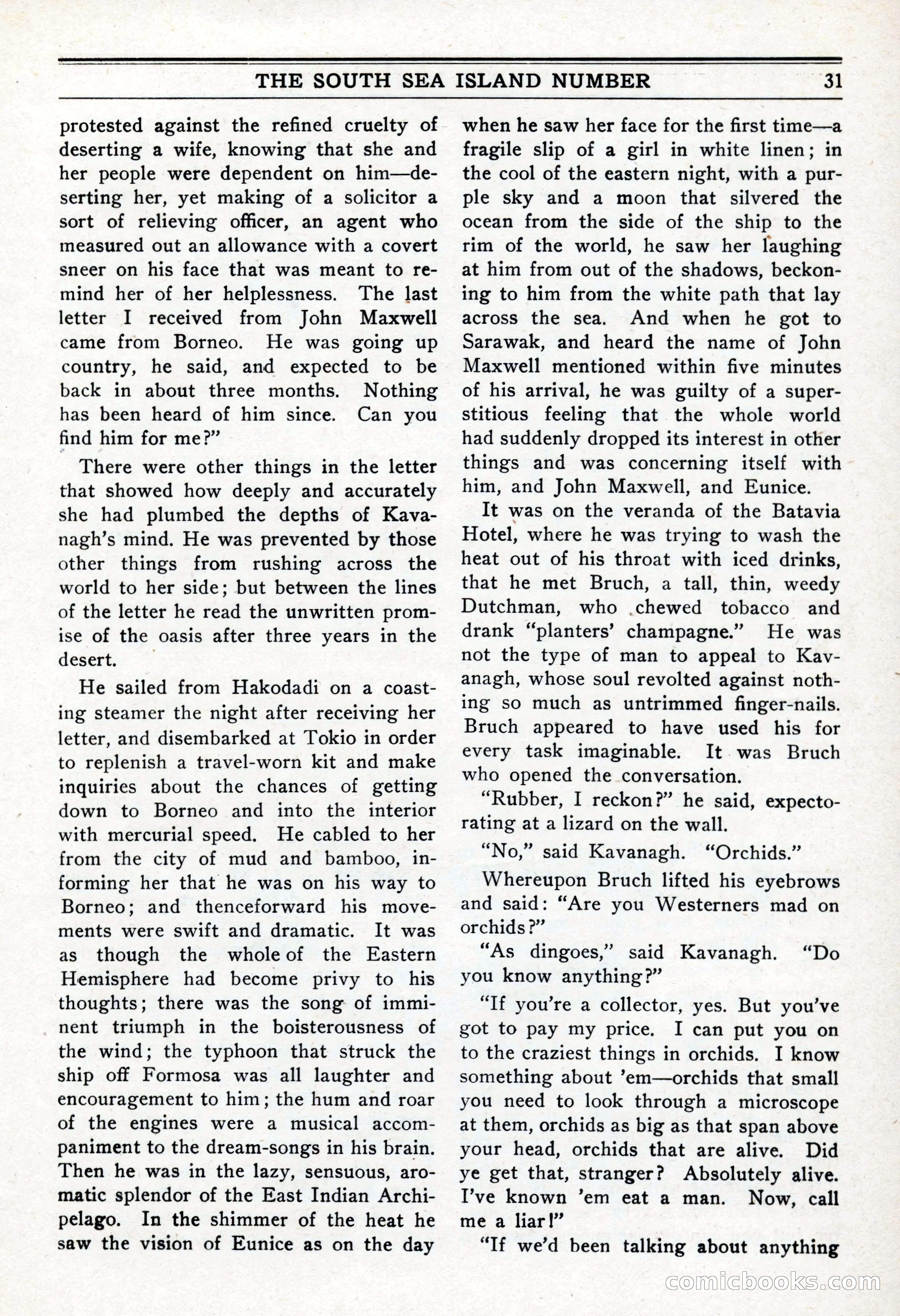
# Page 31: Story Prose This page contains prose fiction text from what appears to be "The South Sea Island Number" (visible in the header). The narrative follows a character's journey from Japan to Borneo in search of a woman named Eunice, after receiving a letter from John Maxwell. The visible text describes the protagonist's arrival in Sarawak and his subsequent meeting with a Dutchman named Bruch at the Batavia Hotel, where they discuss orchids. The passage emphasizes the protagonist's emotional investment in locating Eunice and his disdain for Bruch's refined mannerisms. No illustrations are present on this page.

10-Story Book, February 1928 — page 34 of 68
34 / 68
What you’re looking at · open this page on its own ↗

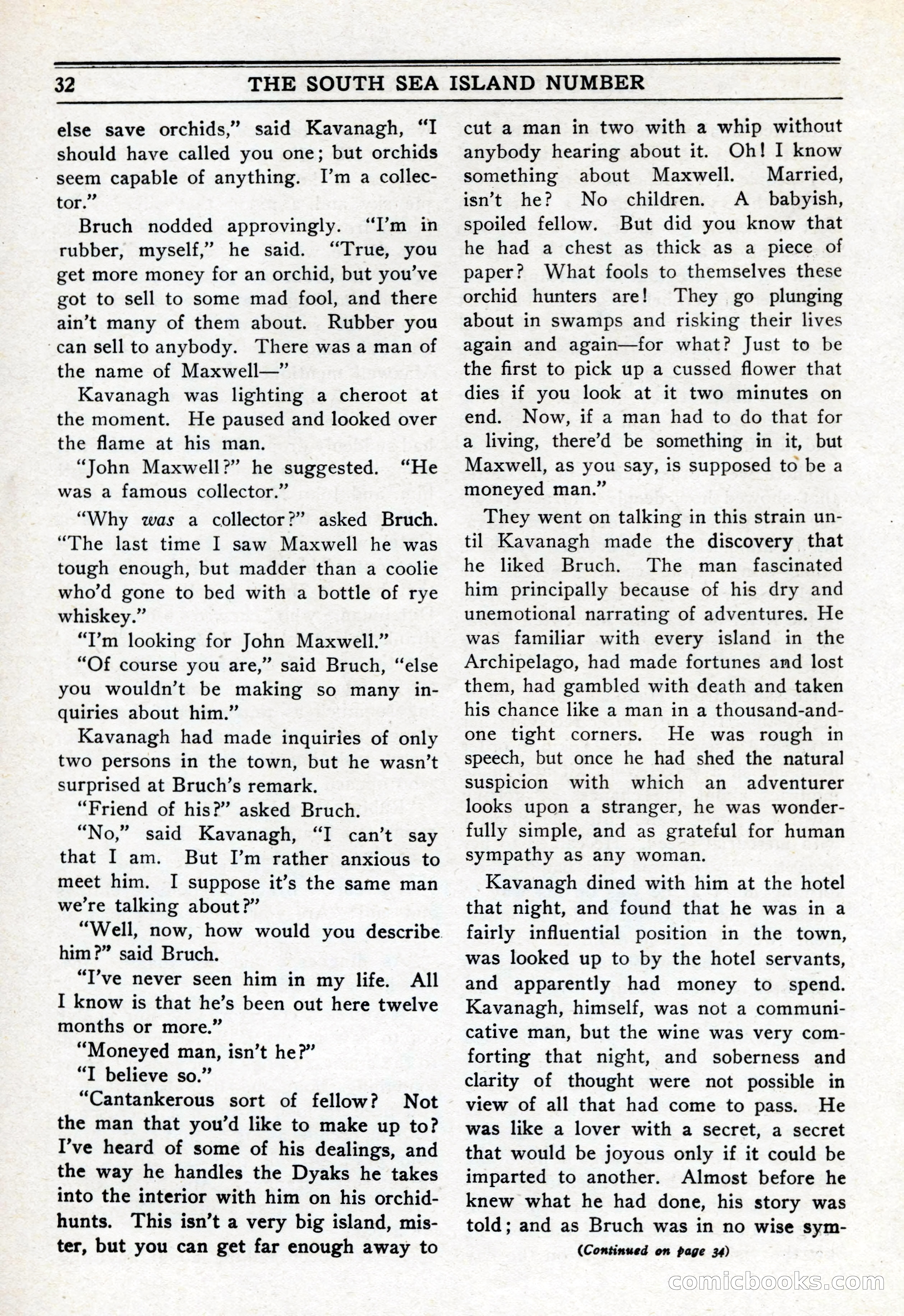
This is a text page from a pulp magazine titled "The South Sea Island Number." The page contains prose narrative (page 32) featuring dialogue between characters named Kavanagh and Bruch discussing a man named John Maxwell, who appears to be a collector of orchids. The conversation reveals Maxwell is wealthy, somewhat foolish in his pursuits, and dangerous in his business dealings with local people. Kavanagh is searching for Maxwell and eventually dines with him at a hotel, discovering Maxwell holds an influential position in town and possesses considerable money. The narrative suggests Maxwell harbors a significant secret. No illustrations appear on this page—it is entirely typeset text continuing a story.

10-Story Book, February 1928 — page 35 of 68
35 / 68
What you’re looking at · open this page on its own ↗

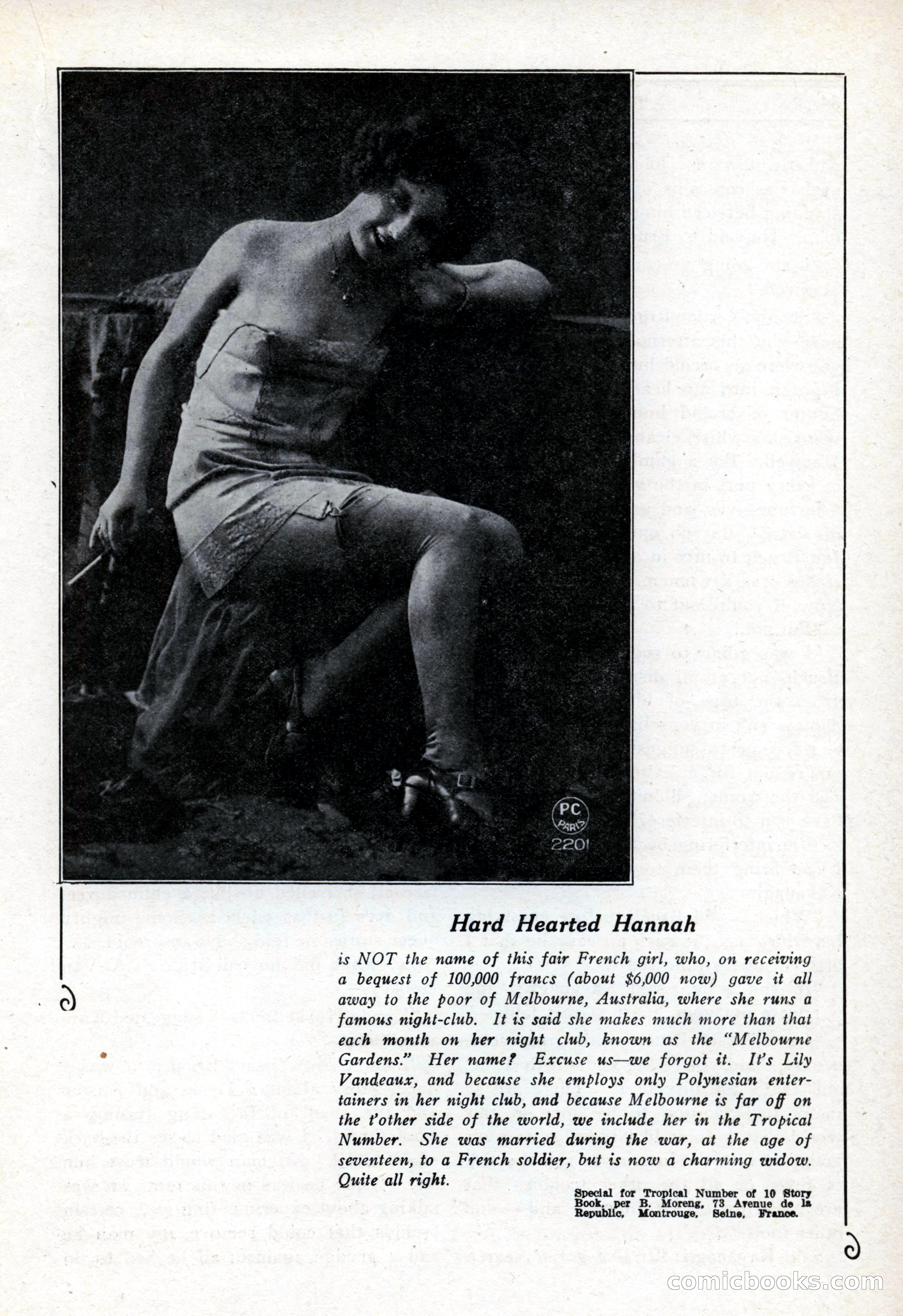
# Page Description This is an illustrated story page featuring a black-and-white photograph of a woman in period clothing, accompanied by a caption and explanatory text below. The heading reads "Hard Hearted Hannah," though the text clarifies this is NOT actually the subject's name. The visible text describes a French woman who received a bequest of 100,000 francs and donated it to the poor of Melbourne, Australia, where she runs a nightclub called the "Melbourne Gardens." Her actual name is given as Lily Vandeaux. The text notes she was widowed during wartime and is included in what appears to be a "Tropical Number" of a pulp magazine. The caption credits the image to a French publication.

10-Story Book, February 1928 — page 36 of 68
36 / 68
What you’re looking at · open this page on its own ↗

# Page 34: Story Prose from "The South Sea Island Number" This page contains printed story prose in two columns. The text depicts a conversation between characters named Kavanagh and Bruch, apparently set in a tropical hotel. Kavanagh expresses his intention to search inland for someone named John Maxwell, whom he believes can be reconciled with a woman. Bruch discourages this plan, warning against interfering in another man's life. The dialogue references orchid hunting, gambling, and mentions a character named Maxwell who allegedly experimented with poisonous orchids. The passage appears part of an adventure or mystery narrative set in an exotic colonial location.

10-Story Book, February 1928 — page 37 of 68
37 / 68
What you’re looking at · open this page on its own ↗

This is a page of story prose from "The South Sea Island Number" (page 35). The text describes a conversation between two men, Kavanagh and Bruch, where Bruch offers to help Kavanagh travel inland toward the Barito River to search for orchids. The narrative then shifts to recount a strange incident in Kavanagh's hotel room—he experiences a sickening odor and a scarlet film over his eyes before collapsing. A hotel proprietor assists him and moves him to another room. The passage concludes by noting that Kavanagh's subsequent journey inland took nearly a month, during which he traveled largely alone.

10-Story Book, February 1928 — page 38 of 68
38 / 68
What you’re looking at · open this page on its own ↗

This page contains story prose from "The South Sea Island Number" (visible in the header). The text describes Kavanagh discovering an abandoned bungalow and finding a sick man named John Maxwell inside. After providing medical care with quinine, Kavanagh explores the deteriorating compound, which contains various items suggesting someone has abandoned a life there—guns, fishing equipment, and paraphernalia from a hunter. When Kavanagh returns to check on Maxwell, the man appears gravely ill and makes a cryptic comment about "whites clearing" something, before telling Kavanagh not to talk. The narrative focuses on themes of isolation, illness, and mystery in a remote tropical setting.

10-Story Book, February 1928 — page 39 of 68
39 / 68
What you’re looking at · open this page on its own ↗

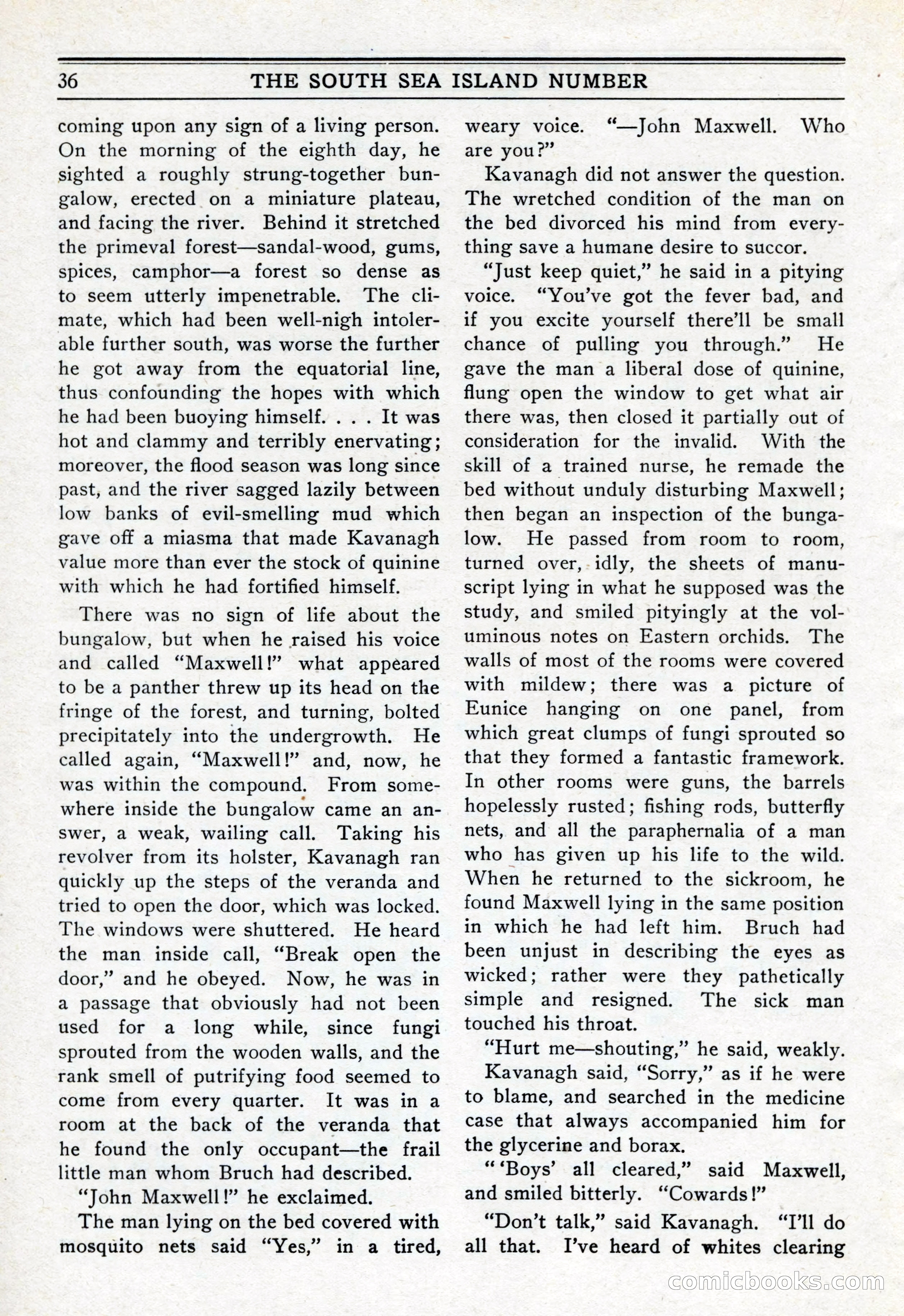
# Page Analysis This page contains a black-and-white photograph labeled "Another Rare Camera Study," accompanied by descriptive text. The image shows an elderly man from New Guinea wearing large ear ornaments. The caption claims he is a native of New Guinea and states that until two years prior, his diet consisted of human flesh. The accompanying story prose discusses a character named Kavanagh caring for a sick man on an island, mentioning the man's wallet and plans to find food and water. The text appears sensationalistic in tone, typical of early pulp magazine content mixing photography with adventure fiction.

10-Story Book, February 1928 — page 40 of 68
40 / 68
What you’re looking at · open this page on its own ↗

# Page 38: Story Prose from "The South Sea Island Number" This page contains continuous narrative prose from what appears to be a short story. The text describes a scene where a character named Kavanagh tends to a dying man named Maxwell. Maxwell, gravely ill with fever, becomes delirious and speaks of people named Eunice and Bruch. The passage reveals that Kavanagh found a wallet containing a letter from someone named Eunice expressing regret about past misunderstandings. The narrative concludes with Maxwell's death at dawn, after he makes Kavanagh swear to cremate rather than bury him, fearing animals might disturb his remains. The story appears to be set in a tropical location.

10-Story Book, February 1928 — page 41 of 68
41 / 68
What you’re looking at · open this page on its own ↗

# Page 39: Story Prose from "The South Sea Island Number" This page contains story prose printed in two columns. The narrative follows Jay Kavanagh's journey to Sarawak to fulfill a dying man's wish, and his subsequent reunion with a woman named Eunice. The text describes Kavanagh's travels, his meeting with Jan Bruch at a hotel in Batavia, and a tense confrontation in Eunice's room where Bruch demands to know Kavanagh's business. The passage appears to be from an adventure or romance story set in colonial Southeast Asia, focusing on emotional conflict and personal stakes involving the three characters.

10-Story Book, February 1928 — page 42 of 68
42 / 68
What you’re looking at · open this page on its own ↗

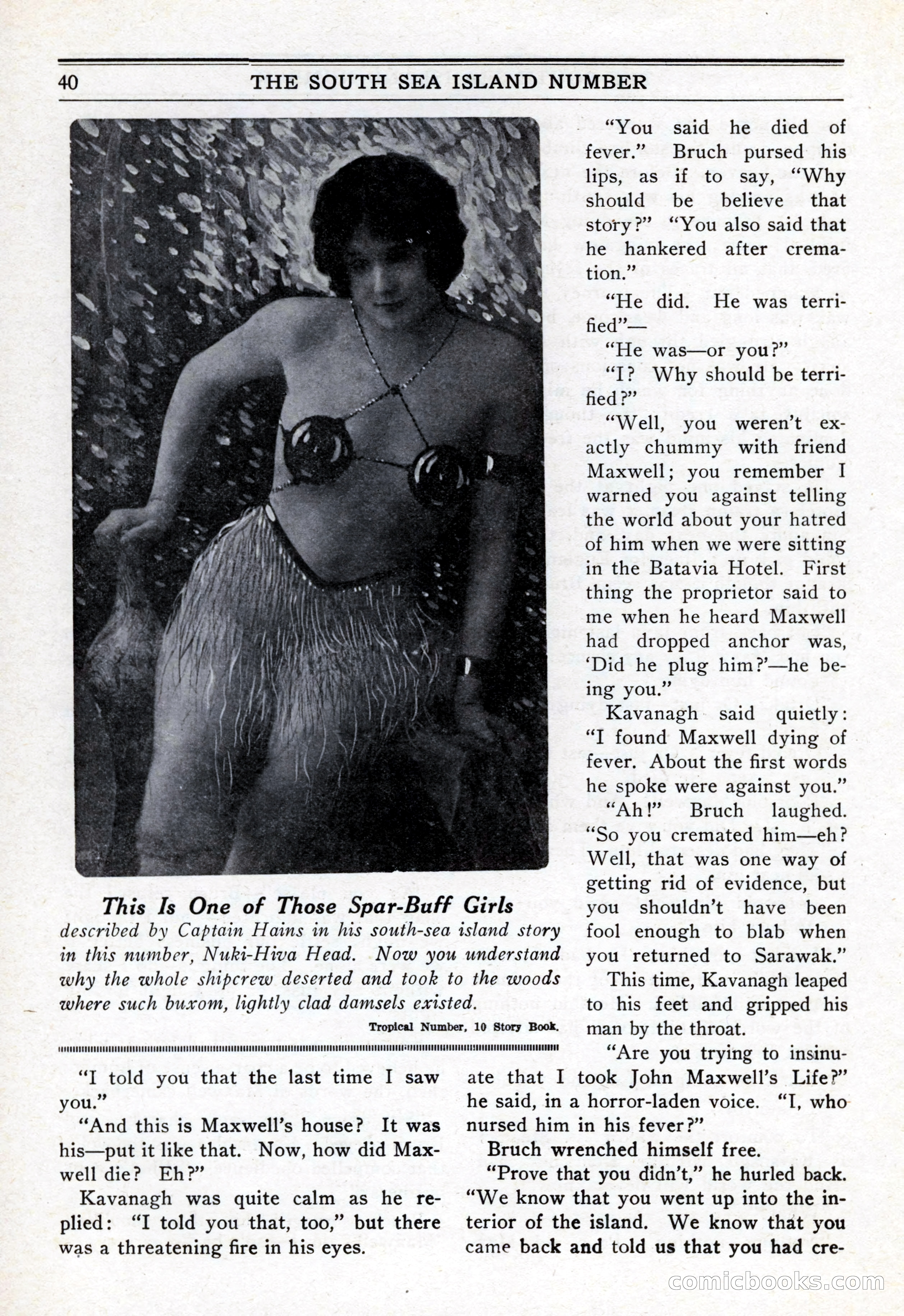
# Page 40: Story Prose with Illustration This page contains story prose from a piece titled "Nuki-Hiva Head" by Captain Hains (visible in the caption). The illustration shows a woman in traditional Pacific Islander dress against a textured background, captioned as "one of those Spar-Buff Girls" referenced in Hains's south-sea island story. The accompanying text depicts a confrontation between characters named Bruch and Kavanagh, who are arguing about Maxwell's death. Kavanagh claims Maxwell died of fever and spoke against Bruch; Bruch counters that Kavanagh cremated Maxwell to destroy evidence. The dialogue grows increasingly hostile, culminating in a physical altercation.

10-Story Book, February 1928 — page 43 of 68
43 / 68
What you’re looking at · open this page on its own ↗

# Page 41 of "The South Sea Island Number" This page contains story prose with no illustrations. The text depicts a tense confrontation between characters named Bruch, Eunice, and Kavanagh. Eunice presents Bruch with the address of a solicitor handling Maxwell's estate, implying blackmail is possible. Bruch responds by challenging Kavanagh and dismissing the threat. The narrative then shifts to Kavanagh, who reveals to Eunice that he found Maxwell's body and recovered a wallet containing a letter addressed to Eunice—apparently a personal message Maxwell left for her before his death. The passage deals with themes of accusation, evidence, and hidden correspondence in what appears to be a mystery or adventure story.

10-Story Book, February 1928 — page 44 of 68
44 / 68
What you’re looking at · open this page on its own ↗

# Page 42 of *The South Sea Island Number* This page contains story prose—specifically the continuation of a mystery narrative. The visible text depicts a confrontation in which a character named Eunice discovers a photograph of someone claiming to be "John Maxwell," which contradicts earlier testimony. Kavanagh and Bruch, apparently investigators, rush to a solicitor's office to uncover the truth about a man who died in a bungalow. The passage reveals that the deceased was actually an acquaintance of a character involved in an orchid-hunting expedition, and that a monthly allowance of one hundred pounds was being sent to a Sarawak bank to cover his expenses—an arrangement described as "quite usual among travellers." The narrative continues on page 44.

10-Story Book, February 1928 — page 45 of 68
45 / 68
What you’re looking at · open this page on its own ↗

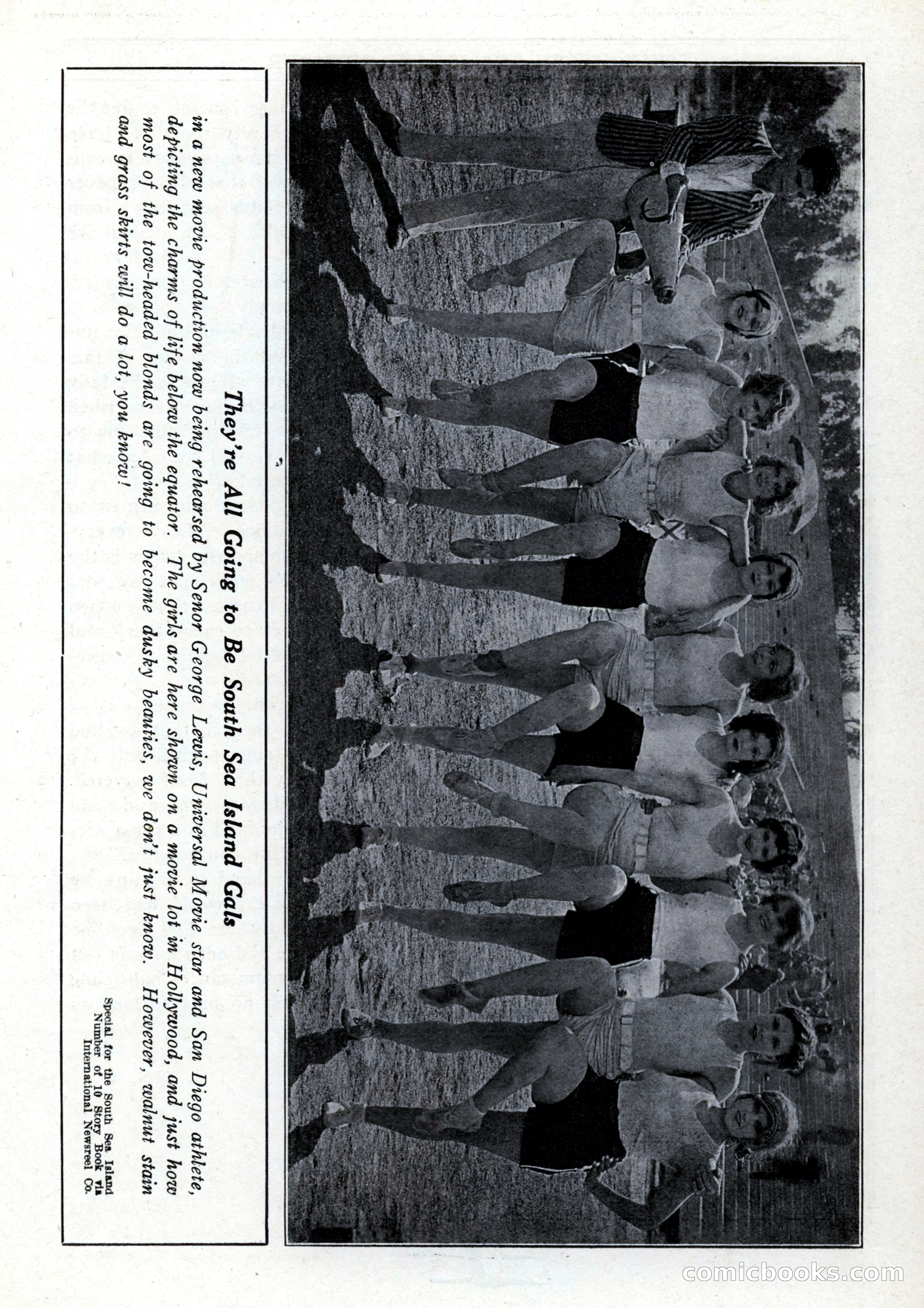
# Page Analysis This page contains an interior illustration accompanying a story titled "They're All Going to Be South Sea Island Girls." The black-and-white photograph shows approximately a dozen young women posed outdoors in a line, wearing light clothing appropriate to a tropical setting. The caption and accompanying text (visible on the left side) describe a production scenario involving these women, their arrival at a location, and references to "South Sea Island Girls" and "Hollywood" production elements. The text appears to discuss how these women were selected or assembled for some kind of entertainment or theatrical production, though the exact nature remains somewhat unclear from the visible portions.

10-Story Book, February 1928 — page 46 of 68
46 / 68
What you’re looking at · open this page on its own ↗

# Page Description This page contains story prose from "The South Sea Island Number" (page 44). The text depicts a dramatic confrontation in which a solicitor named Mr. Jamieson confronts a character named Bruch about signing a document related to John Maxwell's death and an allowance scheme. The passage involves accusations of conspiracy and fraud. It concludes with Eunice and Kavanagh departing in a cab, where Kavanagh reassures Eunice of his innocence despite circumstances that appeared damning. A small decorative illustration of a figure appears at the bottom of the page.

10-Story Book, February 1928 — page 47 of 68
47 / 68
What you’re looking at · open this page on its own ↗

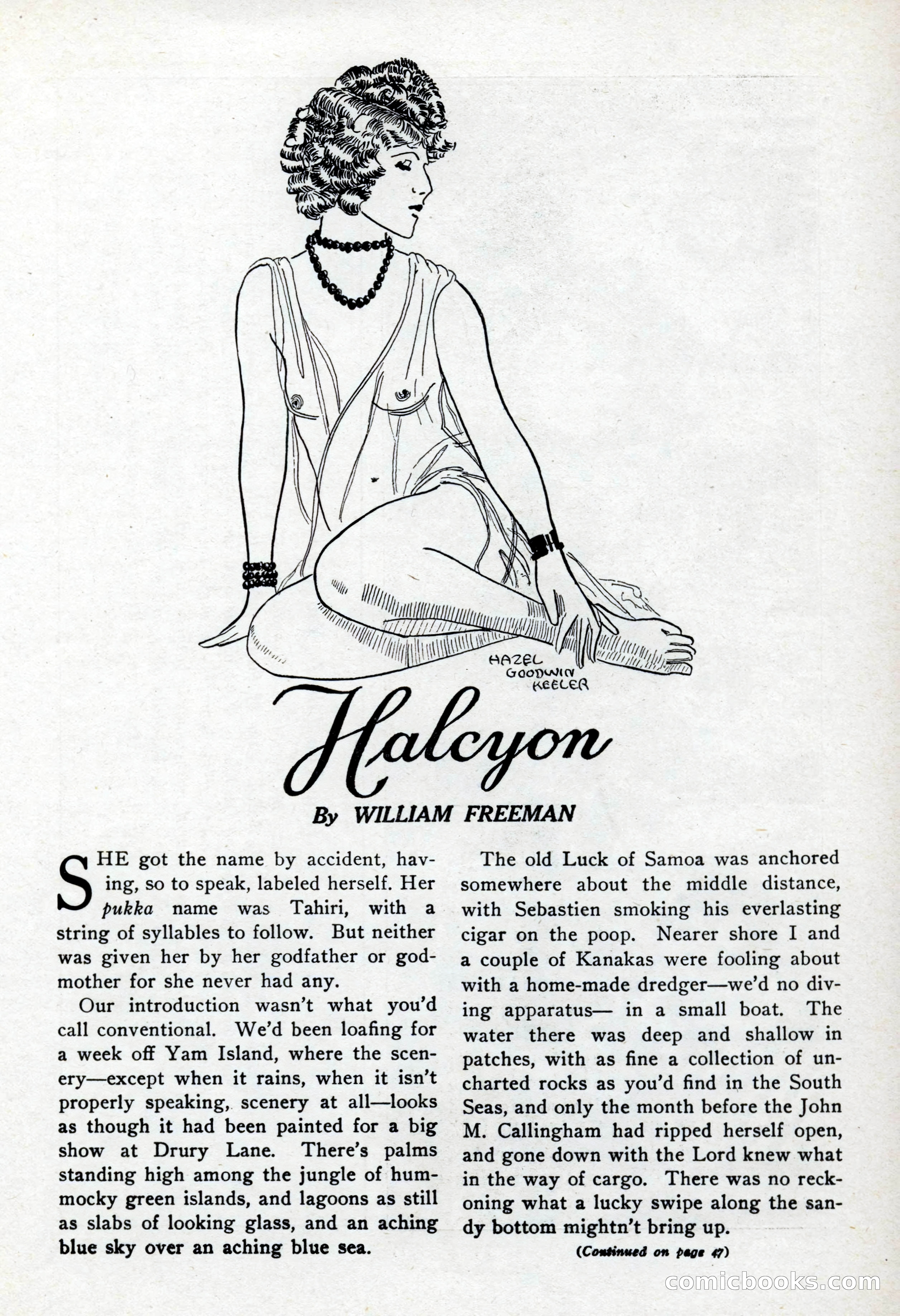
# Analysis This page displays the opening of a short story titled "Halcyon" by William Freeman. It features an illustration at the top—a line drawing of a seated woman in 1920s-style dress with wavy hair and beaded necklaces, credited to artist Hazel Goodman Keeler. The prose begins by introducing a female character whose birth name was Tahiri but who acquired the name "Halcyon" by accident. The visible text describes a setting in Yam Island and mentions a ship called the Luck of Samoa anchored offshore, with details about the tropical scenery and maritime activity nearby. The story appears to be adventure or tropical fiction set in the South Seas.

10-Story Book, February 1928 — page 48 of 68
48 / 68
What you’re looking at · open this page on its own ↗

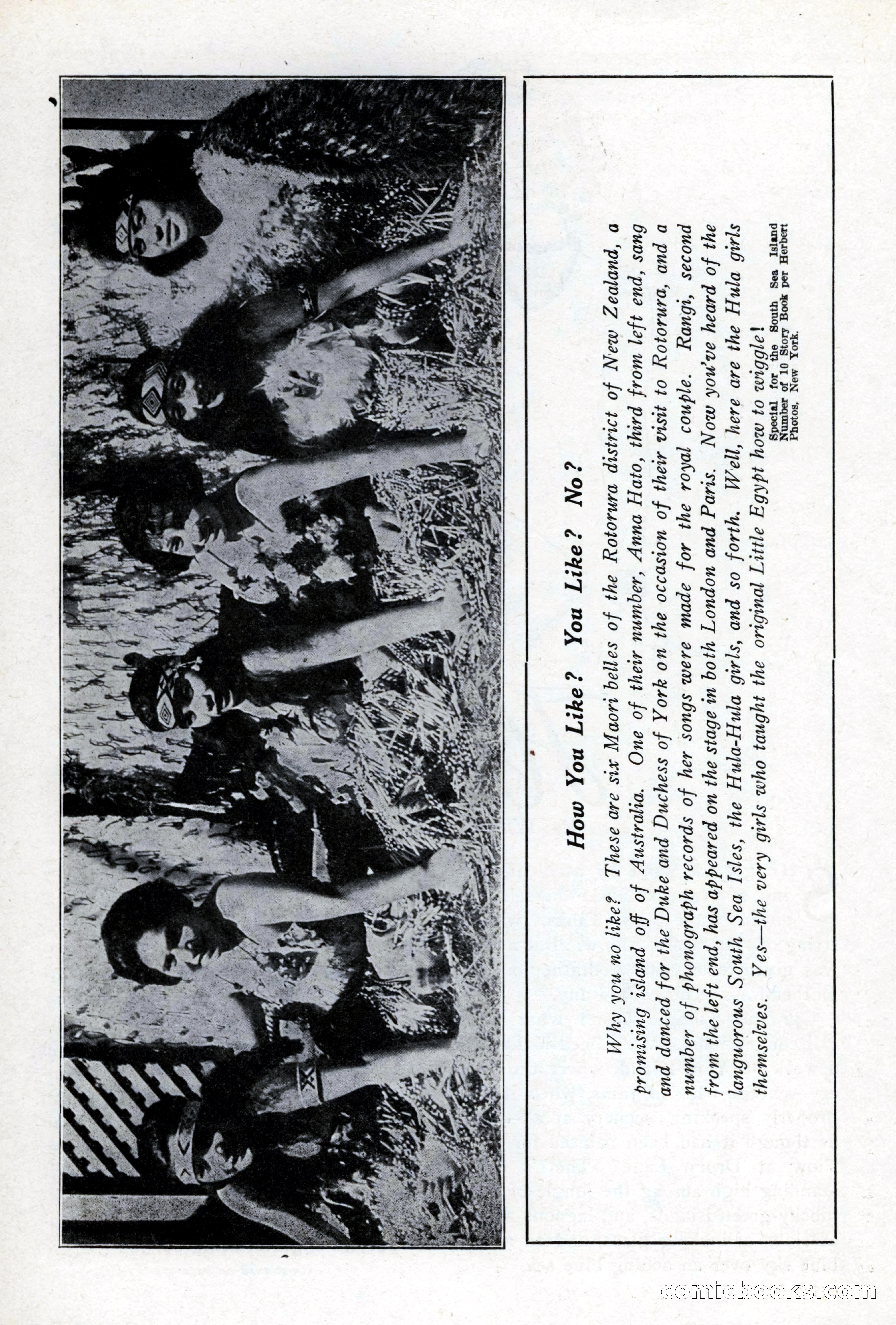
# Page Description This is an interior illustration page from a pulp magazine, featuring a black-and-white photograph positioned sideways (rotated 90 degrees). The image shows what appears to be five people lying on the ground in a row. The accompanying text poses a question: "How You Like? You Like No?" It then asks readers whether they would like hearing about Maori bulls of the Rotorua district in New Zealand, and mentions details about the Duchess of York visiting to record her songs, with references to the Maori people and the Fijian Islands. The text appears to be promoting or introducing a story or article related to Oceania and indigenous cultures, though the exact narrative context remains unclear from this page alone.

10-Story Book, February 1928 — page 49 of 68
49 / 68
What you’re looking at · open this page on its own ↗

# Page 47 of "The South Sea Island Number" This page contains story prose—the continuation of a narrative adventure tale. The visible text describes a dramatic scene where the narrator and crew rescue a young girl from a shark attack in the ocean near their ship. After pulling her aboard, they discover she is a half-caste woman who claims to be a trader's daughter. The passage details her appearance, the crew's reaction, and subsequent conversation as she dries off and explains her background. The tone is pulp adventure fiction typical of early-20th-century serialized stories, focusing on action, exotic settings, and colorful character descriptions.

10-Story Book, February 1928 — page 50 of 68
50 / 68
What you’re looking at · open this page on its own ↗

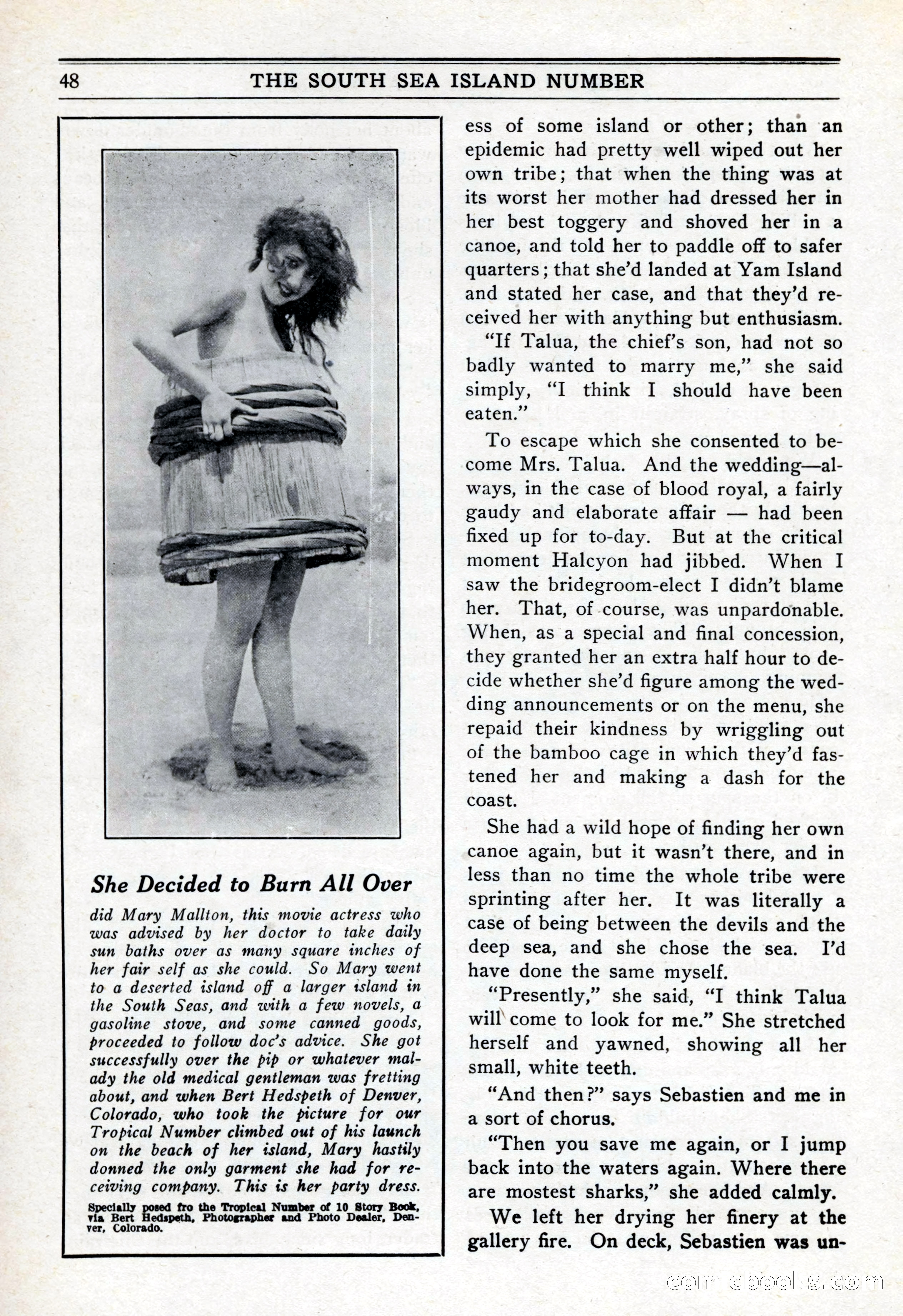
This is page 48 from "The South Sea Island Number" of a pulp magazine. It contains a black-and-white photograph on the left showing actress Mary Mallon in minimal clothing, with a caption explaining she took sun baths on a deserted South Seas island for a film and followed medical advice about sun exposure. The right side features prose narrative describing a character named Halcyon who was forced into marriage with Chief Talua's son but escaped by canoe, choosing the sea over her fate. The story mentions she hopes Talua will search for her, and ends with dialogue about sharks and a character named Sebastian. The text appears to be adventure fiction set in the South Seas.

10-Story Book, February 1928 — page 51 of 68
51 / 68
What you’re looking at · open this page on its own ↗

This page contains story prose from "The South Sea Island Number" (page 49). The text depicts a tense encounter between European colonists and indigenous people approaching by canoe. The narrator discusses a young woman of mixed race, describes Sebastian's anxious reaction to the arriving group, and recounts Talua's speech claiming ownership of the woman (Halcyon) as his property. Sebastian denies inviting her aboard the ship and attempts to deflect responsibility. The passage concludes with the narrator dismissing Sebastian's explanation as unconvincing. The prose appears to be from an adventure or colonial-era narrative, likely from an early-20th-century pulp magazine.

10-Story Book, February 1928 — page 52 of 68
52 / 68
What you’re looking at · open this page on its own ↗

# Page 50 of "The South Sea Island Number" This is a prose story page with no illustrations. The text describes a tense encounter between the narrator and indigenous characters, particularly a woman named Halcyon and a man named Talua, aboard what appears to be a ship. The narrator recounts how Halcyon intervenes in a conflict, cleans herself up, and then announces plans for a marriage feast—claiming she has chosen the narrator as her husband before the tribe's men. The passage explores cross-cultural dynamics and the narrator's confusion about native marriage customs, suggesting this is likely an adventure or colonial-era narrative from an early-20th-century pulp magazine.

10-Story Book, February 1928 — page 53 of 68
53 / 68
What you’re looking at · open this page on its own ↗

# Page 51 of "The South Sea Island Number" This page contains story prose from what appears to be a serialized narrative. The visible text describes a tense social encounter aboard a schooner in the South Seas, where a narrator and a character named Sebastien have conflicting views about a woman named Halcyon. Sebastien makes an insulting speech questioning Halcyon's status and propriety, which the narrator finds distasteful. The scene then shifts to an intimate moment where Halcyon and the narrator share a meal and conversation, with Halcyon firmly asserting the legitimacy of their marriage while Sebastien watches disapprovingly. The passage focuses on interpersonal dynamics and romantic tension.

10-Story Book, February 1928 — page 54 of 68
54 / 68
What you’re looking at · open this page on its own ↗

This page contains story prose from "The South Sea Island Number" (visible in the header). The text depicts an intimate dialogue between a newly married couple on a ship. The narrator, a man, has offered his cabin to his bride and is heading to his own quarters when she questions why they must separate. Their conversation becomes emotionally charged as she expresses fear of losing him and he reassures her of his devotion. The passage explores themes of marriage, duty, and romantic tension in what appears to be an early-20th-century adventure or romance narrative set at sea.

10-Story Book, February 1928 — page 55 of 68
55 / 68
What you’re looking at · open this page on its own ↗

# Page Analysis This page contains story prose from what appears to be "The South Sea Island Number" (visible in the header). The text depicts a dramatic scene aboard a ship where the narrator confronts his companion Sebastien about a woman, later describing a violent confrontation with crew members. The passage includes dialogue and action sequences involving conflicts over a woman left behind on an island, a fight that results in someone being thrown overboard, and attempts to restore order among the crew. The narrative tone is first-person, describing events that occurred "the week after" an initial incident, written in early-20th-century adventure-fiction style with period language.

10-Story Book, February 1928 — page 56 of 68
56 / 68
What you’re looking at · open this page on its own ↗

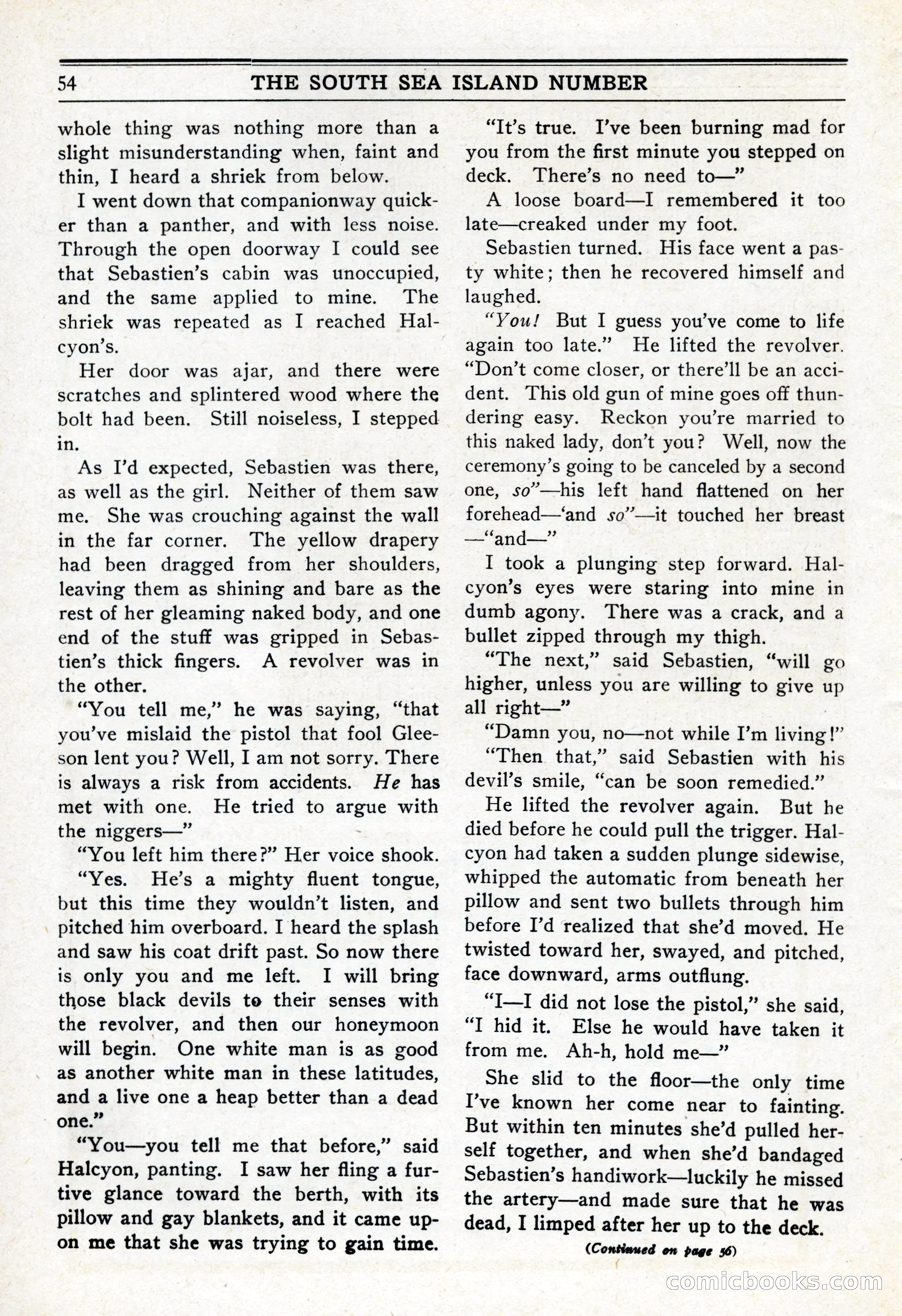
# Page 54: Story Prose This page contains story prose from "The South Sea Island Number," a pulp fiction tale. The narrative depicts a dramatic and violent confrontation in what appears to be a ship's cabin. A man named Sebastien holds a woman (Halcyon) at gunpoint, threatening to shoot her during what was meant to be their wedding ceremony. The passage describes intense action: Halcyon retrieves a hidden automatic weapon and shoots Sebastien before he can fire at her again. The narrator, an unnamed observer, then pursues Halcyon onto the ship's deck as she attempts to escape. The writing emphasizes danger, betrayal, and maritime adventure typical of early pulp fiction.

10-Story Book, February 1928 — page 57 of 68
57 / 68
What you’re looking at · open this page on its own ↗

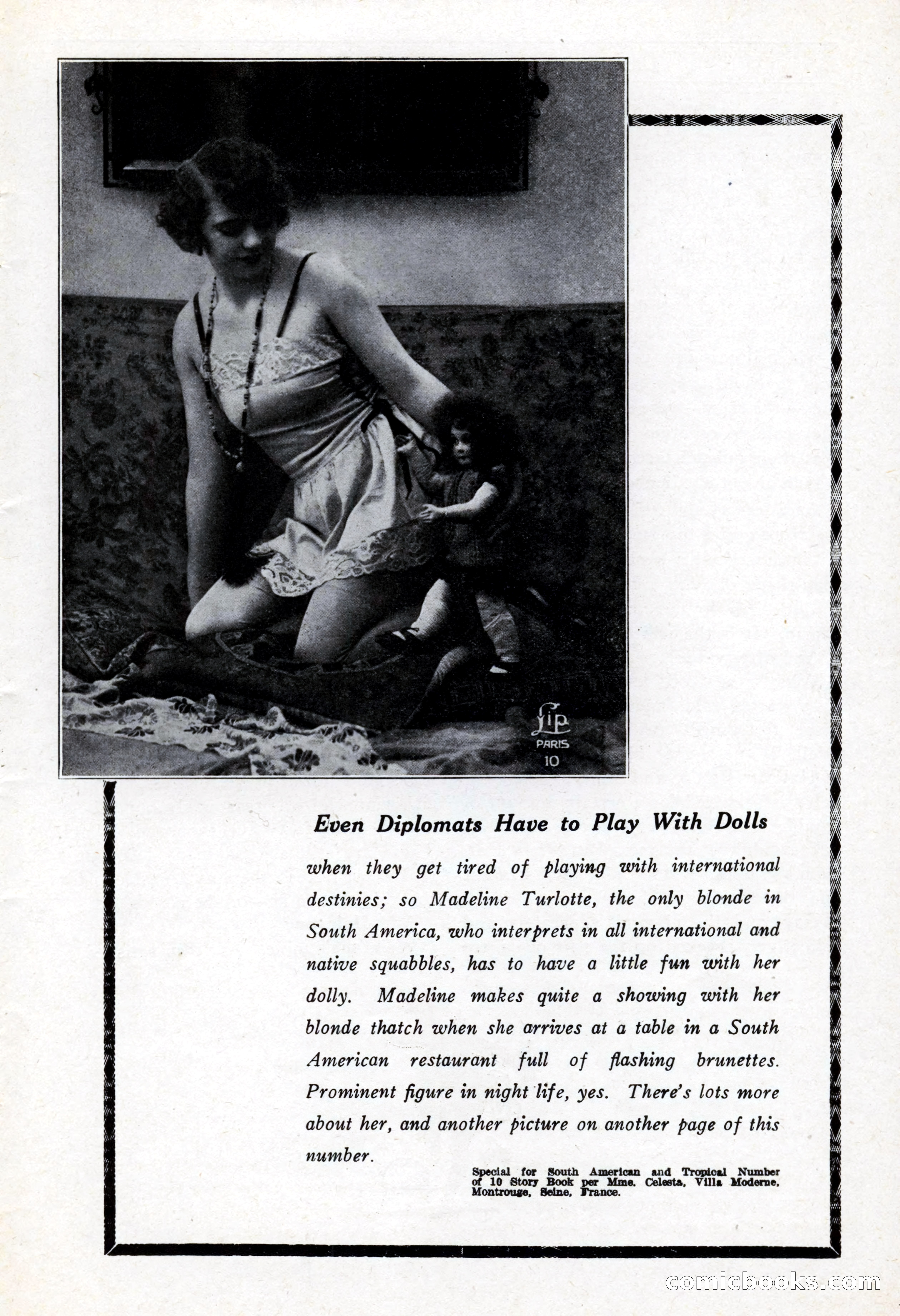
# Page Description This page contains a black-and-white photograph with accompanying text. The image shows a woman in 1920s-style undergarments playing with a doll. The text below identifies the subject as Madeline Turlotte, described as "the only blonde in South America" who works as an interpreter for international diplomatic matters. The caption humorously suggests that diplomats relax by playing with dolls when tired of international affairs, and notes that Turlotte makes an impression at South American restaurants. The text indicates this is part of a larger feature with additional photographs elsewhere in the publication. The page appears to be from a sensationalist pulp magazine targeting South American and tropical audiences.

10-Story Book, February 1928 — page 58 of 68
58 / 68
What you’re looking at · open this page on its own ↗

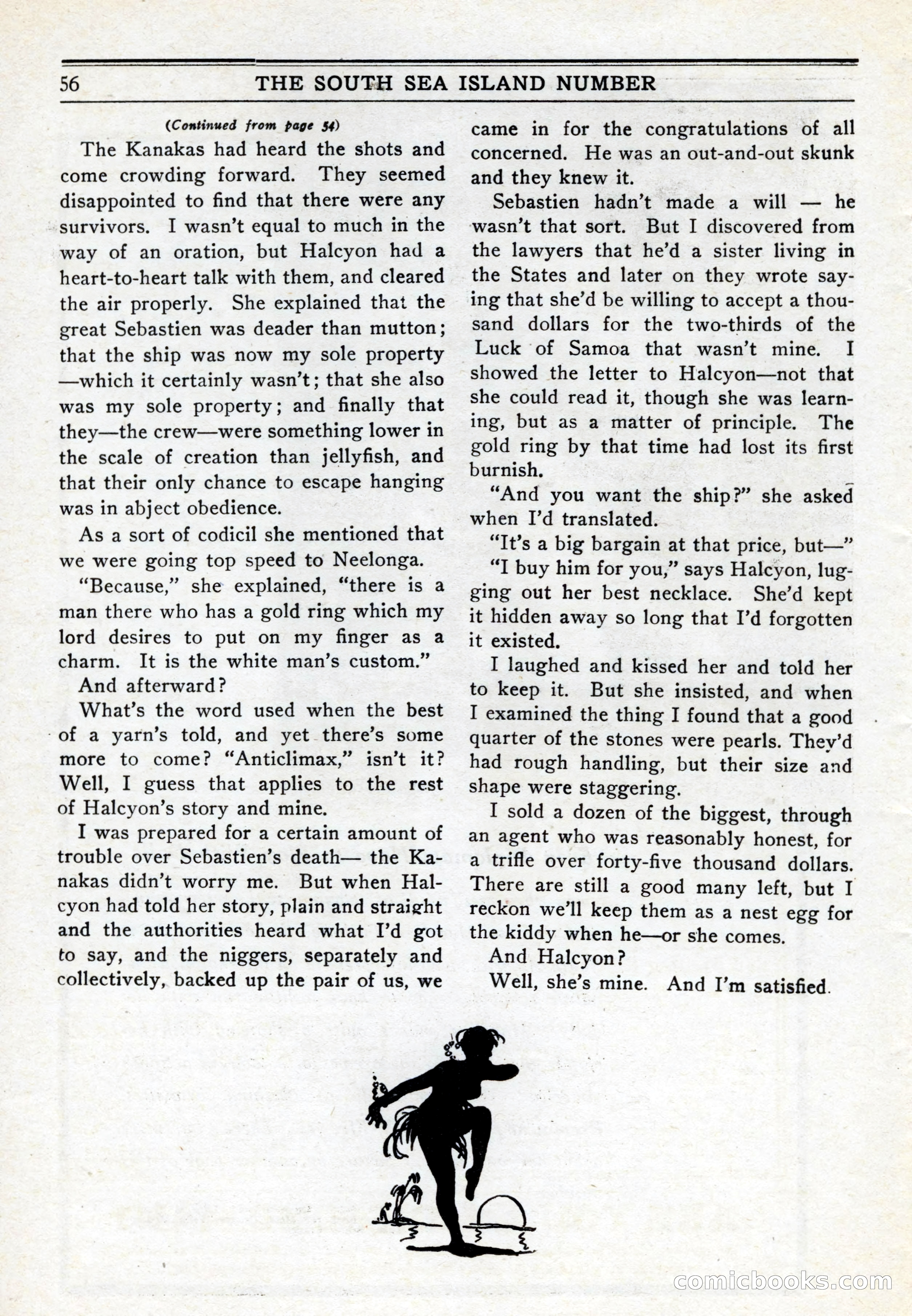
This page contains story prose from "The South Sea Island Number" of what appears to be an early-20th-century pulp magazine. The text describes the narrator's resolution of a conflict involving Sebastian's death and the disposition of a ship, as well as the narrator's acquisition of valuable pearls from a gold ring. The narrative involves characters named Halcyon and the Kanakas, and concludes with the narrator's satisfaction regarding Halcyon becoming "mine." At the bottom is a small black silhouette illustration of a figure in dynamic pose. The page number is 56, indicating this is a continuation from an earlier page.

10-Story Book, February 1928 — page 59 of 68
59 / 68
What you’re looking at · open this page on its own ↗

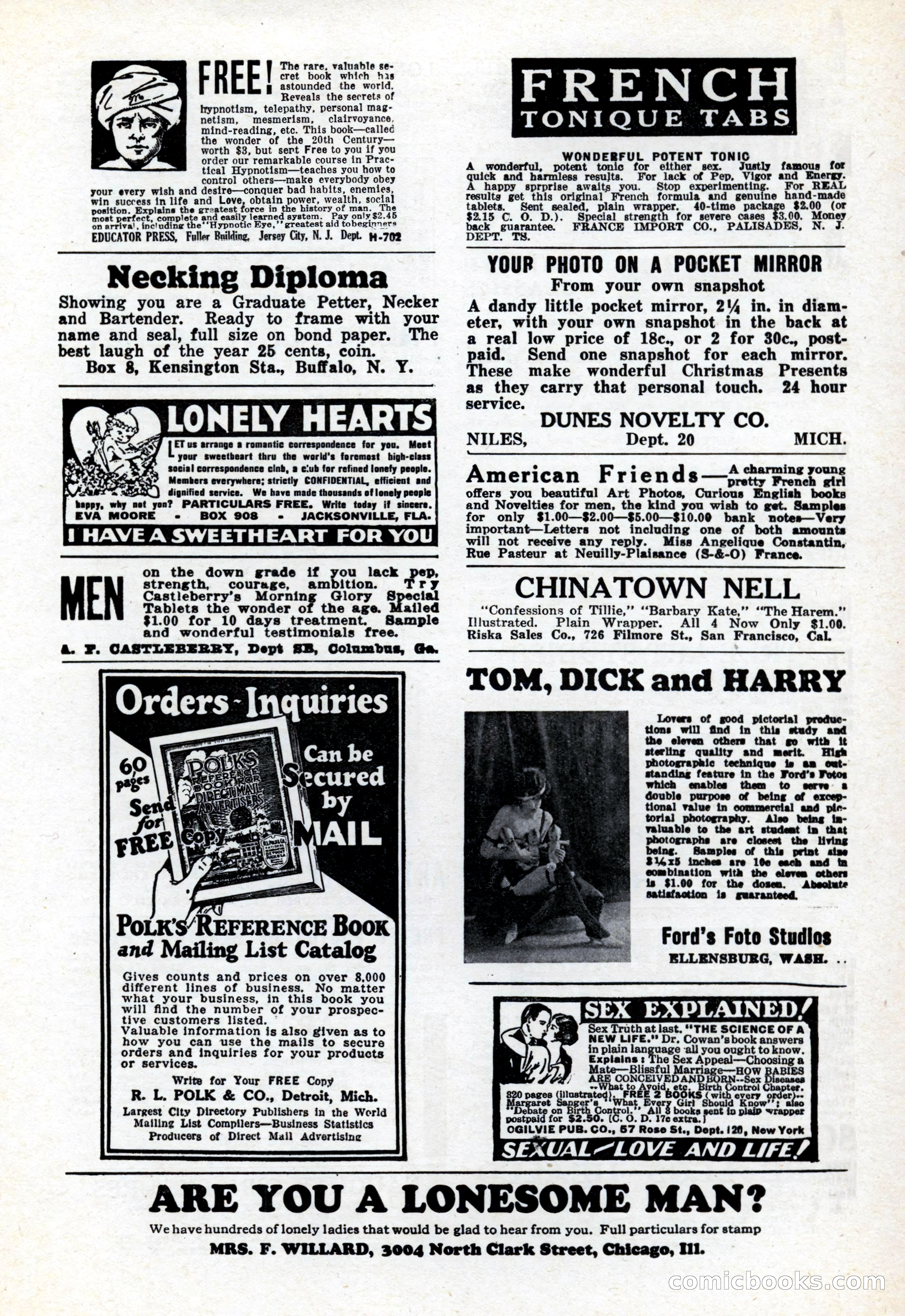
# Page Description This is an **advertisement page** from an early-20th-century pulp magazine, containing multiple classified-style ads and promotional materials rather than story content or illustrations. The page features various mail-order advertisements, including offers for: a "Necking Diploma," French tonic tablets, pocket mirrors with photo customization, a lonely hearts/pen-pal service, men's health treatments, and photography services. There is one photograph showing what appears to be a scene from "Tom, Dick and Harry" produced by Ford's Foto Studios in Ellensburg, Washington. The advertisements reflect typical pulp-era commerce, promising romance, health remedies, and novelty items through mail order. The bottom includes a dating service advertisement.

10-Story Book, February 1928 — page 60 of 68
60 / 68
What you’re looking at · open this page on its own ↗

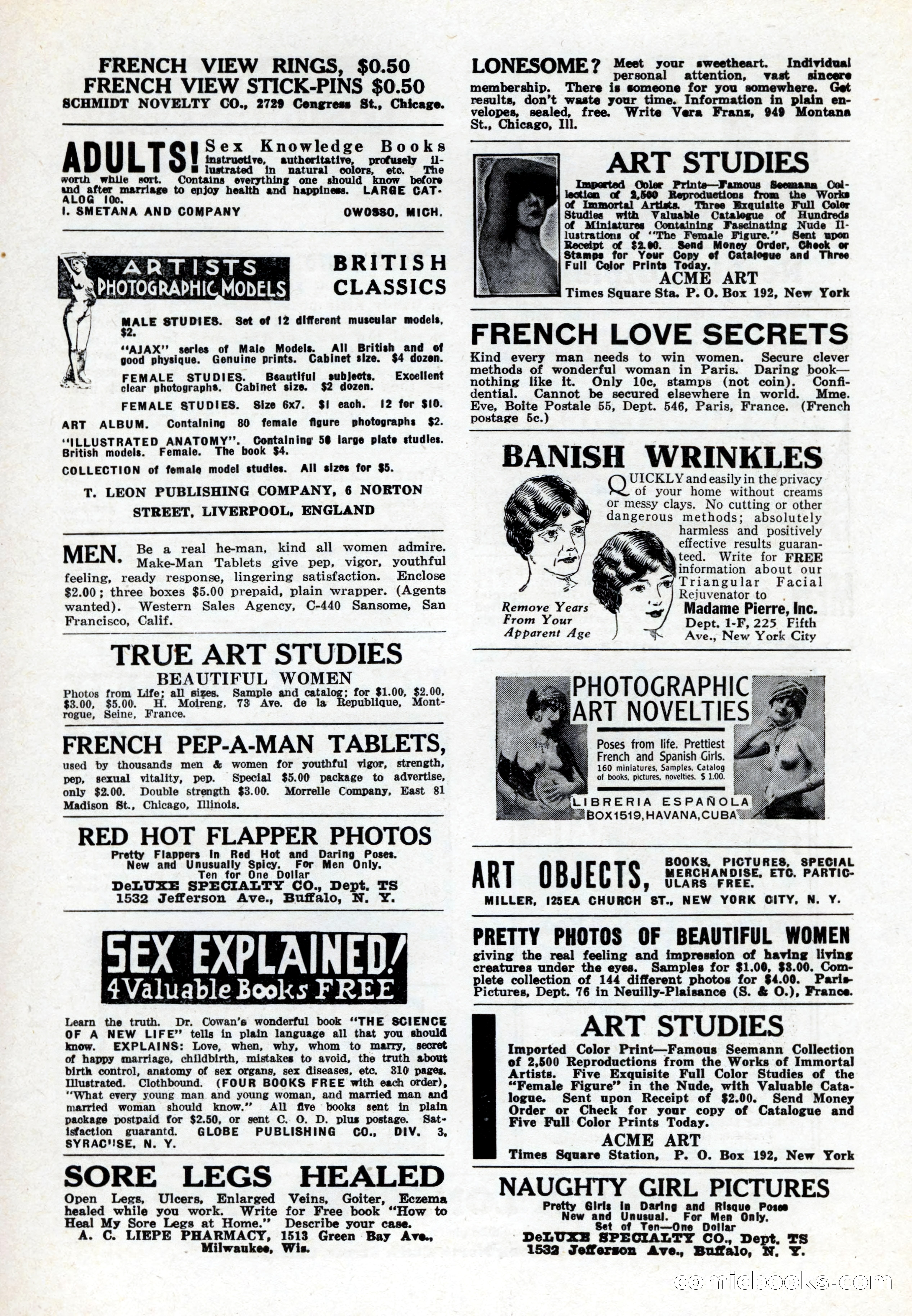
This page is entirely composed of classified advertisements rather than story content or illustrations. The ads promote various mail-order products and services typical of early 20th-century pulp magazines, including art photography collections, anatomy studies, instructional books on sexual topics, beauty treatments (such as wrinkle removal), photographs of women, and remedies for physical ailments. Most ads feature suggestive or explicit imagery related to nude or semi-nude figures, appealing to male readers. Companies advertised include T. Leon Publishing Company, Acme Art, and various other suppliers. The page demonstrates the commercial side of pulp magazines, where sexually-themed mail-order products formed a significant revenue stream alongside fiction content.

10-Story Book, February 1928 — page 61 of 68
61 / 68
What you’re looking at · open this page on its own ↗

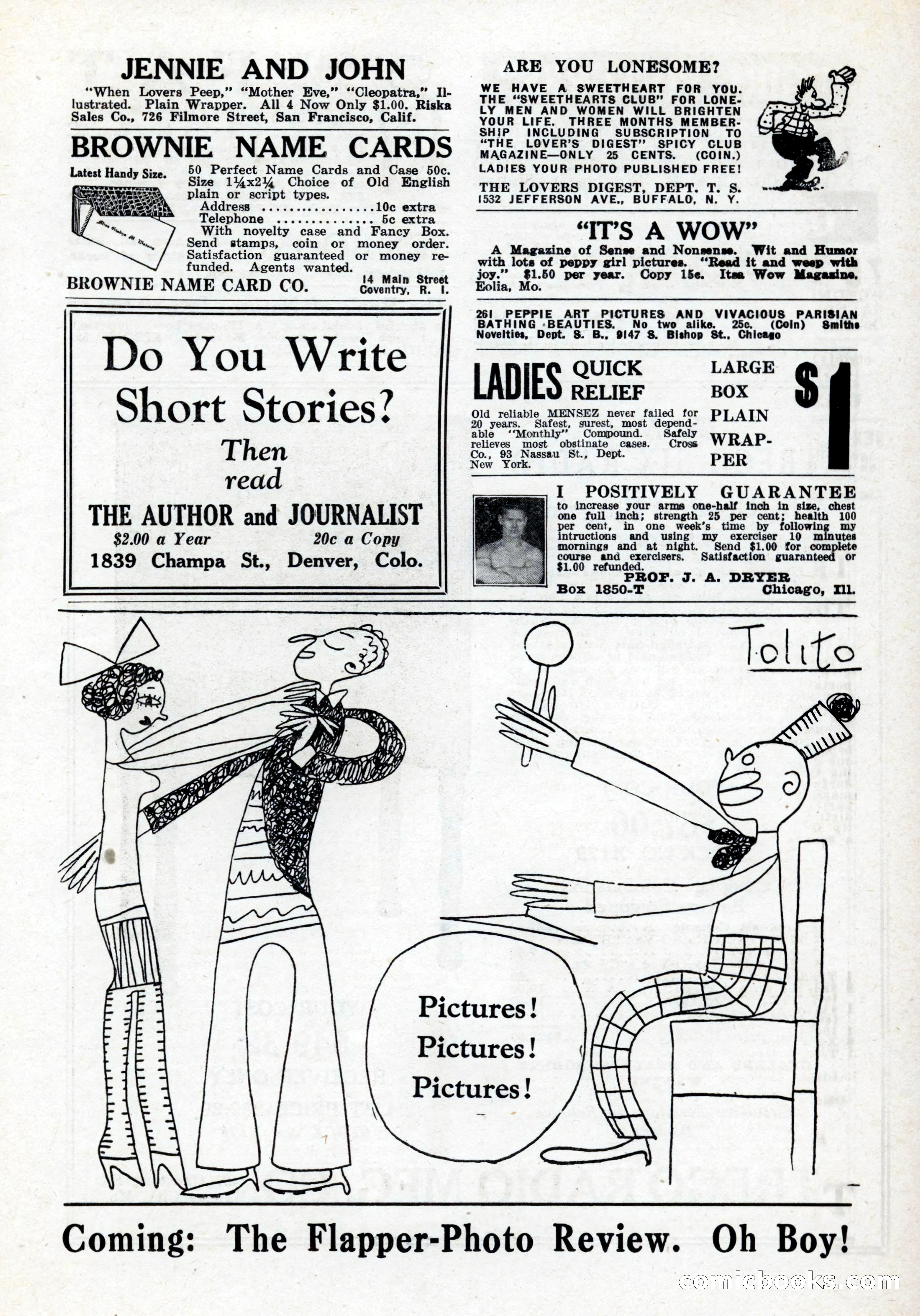
# Page Description This is an **advertising and classified page** from an early-20th-century pulp magazine. The page contains numerous small advertisements and classified listings, including offers for brownie name cards, short story writing guides, magazines for lonely readers, physical fitness programs, and art pictures. Visual elements include decorative illustrations: a cartoon of two figures in playful poses on the left side and a simple line drawing labeled "Tolito" on the right showing stick-figure-like characters. At the bottom, text promises "Coming: The Flapper-Photo Review. Oh Boy!" The page is primarily commercial rather than editorial content.

10-Story Book, February 1928 — page 62 of 68
62 / 68
What you’re looking at · open this page on its own ↗

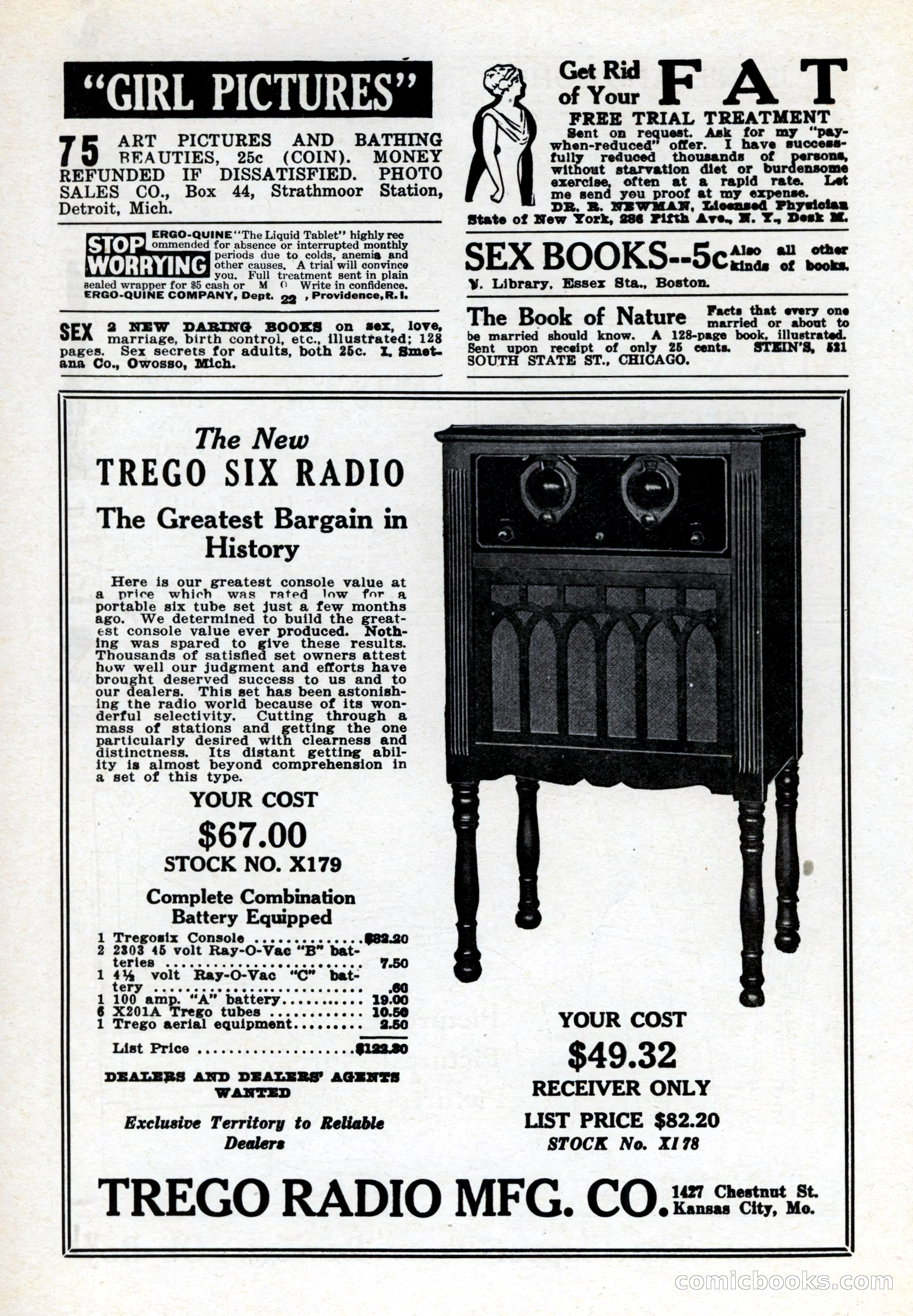
# Page Analysis This is an **advertising page** from an early-20th-century pulp magazine, not story content. The page features multiple advertisements, primarily for the Trego Six Radio console ($67.00 complete with batteries, or $49.32 for receiver only), manufactured by Trego Radio Mfg. Co. in Kansas City, Missouri. Surrounding the main radio advertisement are smaller ads for various mail-order products: "Girl Pictures" art prints, weight-loss treatments, sex education books, and other mail-order items typical of pulp-era classified advertising. The layout emphasizes the radio's cabinet design in a period-appropriate wooden console style.

10-Story Book, February 1928 — page 63 of 68
63 / 68
What you’re looking at · open this page on its own ↗

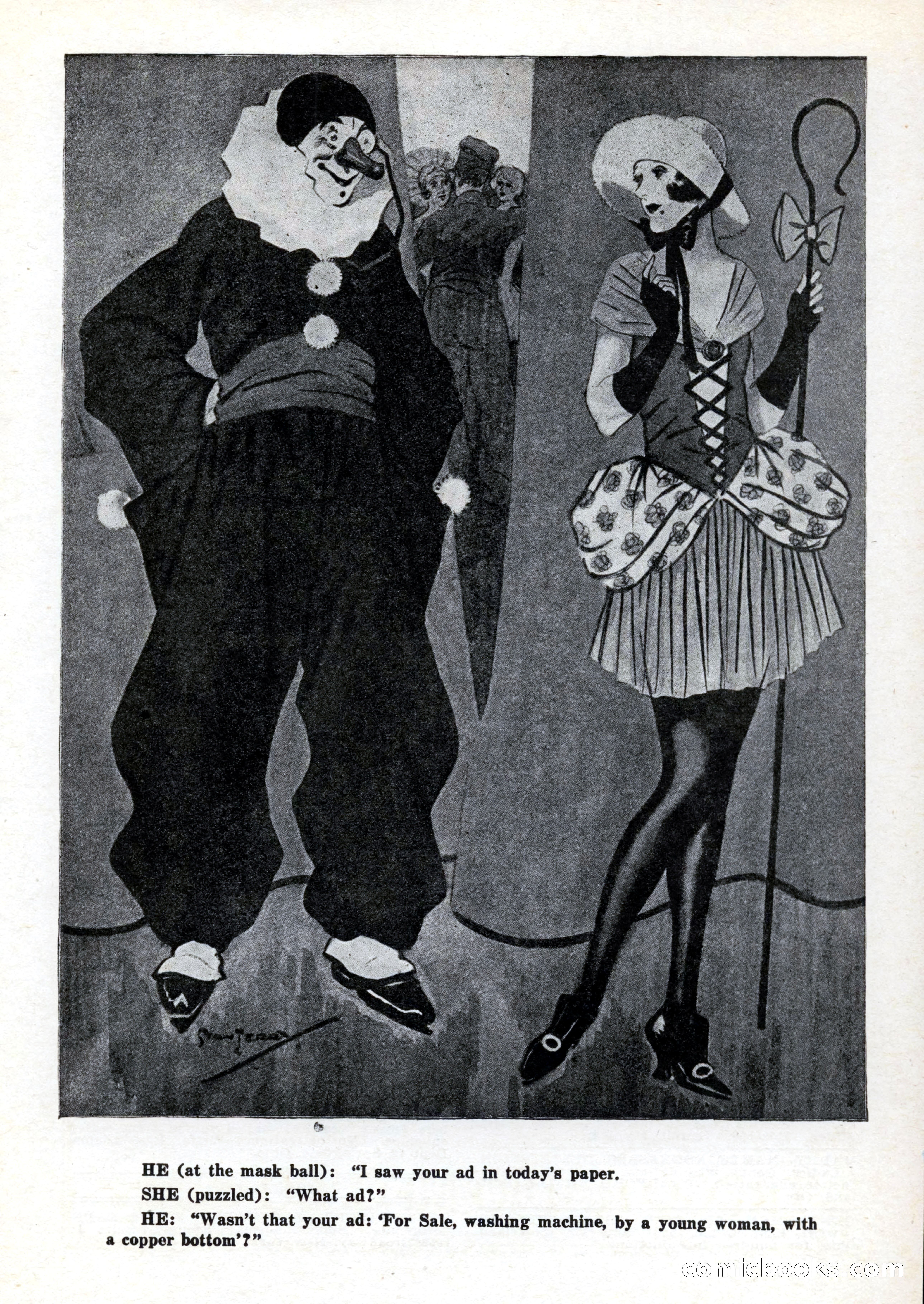
This is an illustration from a pulp magazine featuring two costumed figures at what appears to be a masquerade ball. The image shows a man in a clown costume with baggy pants confronting a woman in a harlequin outfit. Below the illustration is a brief dialogue: the man mentions seeing the woman's newspaper advertisement for a washing machine for sale, but she claims not to have placed such an ad. The man then quotes back what he believes was her ad: "For Sale, washing machine, by a young woman, with a copper bottom?" The humor appears to derive from the double entendre of the phrase "copper bottom."

10-Story Book, February 1928 — page 64 of 68
64 / 68
What you’re looking at · open this page on its own ↗

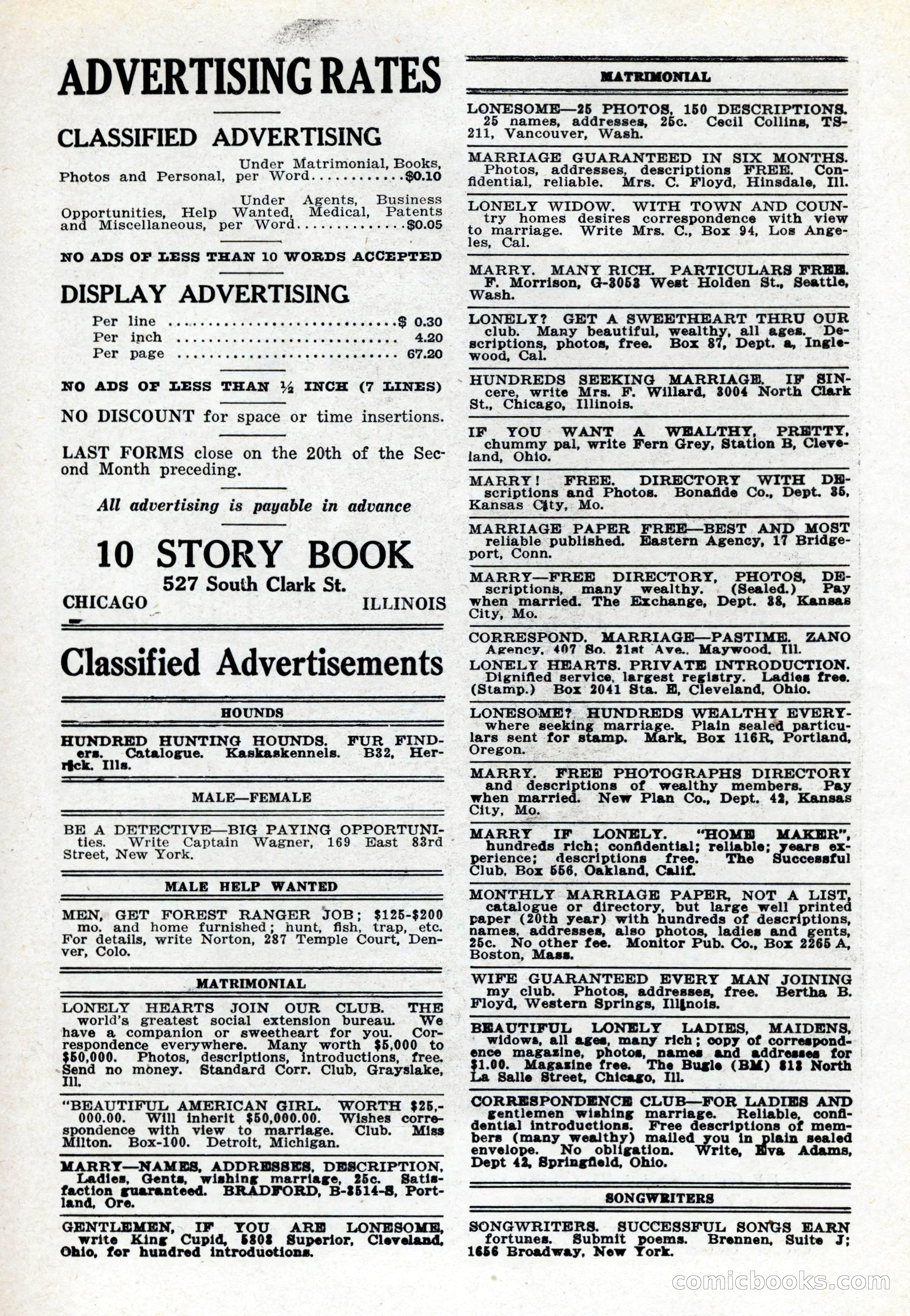
# Page Description This page is primarily advertising content from a pulp magazine. It displays the "Advertising Rates" section and classified advertisements for the publication "10 Story Book" (Chicago, Illinois). The page contains two main sections: the magazine's advertising rate card at the top, listing costs for classified and display advertising, followed by numerous classified personal advertisements. These ads cover multiple categories including "Hounds," "Male-Female," "Male Help Wanted," "Matrimonial," and "Songwriters." The matrimonial section dominates, featuring numerous marriage-related advertisements from individuals and services offering to help lonely people find partners, with promises of photographs, directories, and confidential introductions. This appears to be a standard advertising page from an early 20th-century pulp magazine.

10-Story Book, February 1928 — page 65 of 68
65 / 68
What you’re looking at · open this page on its own ↗

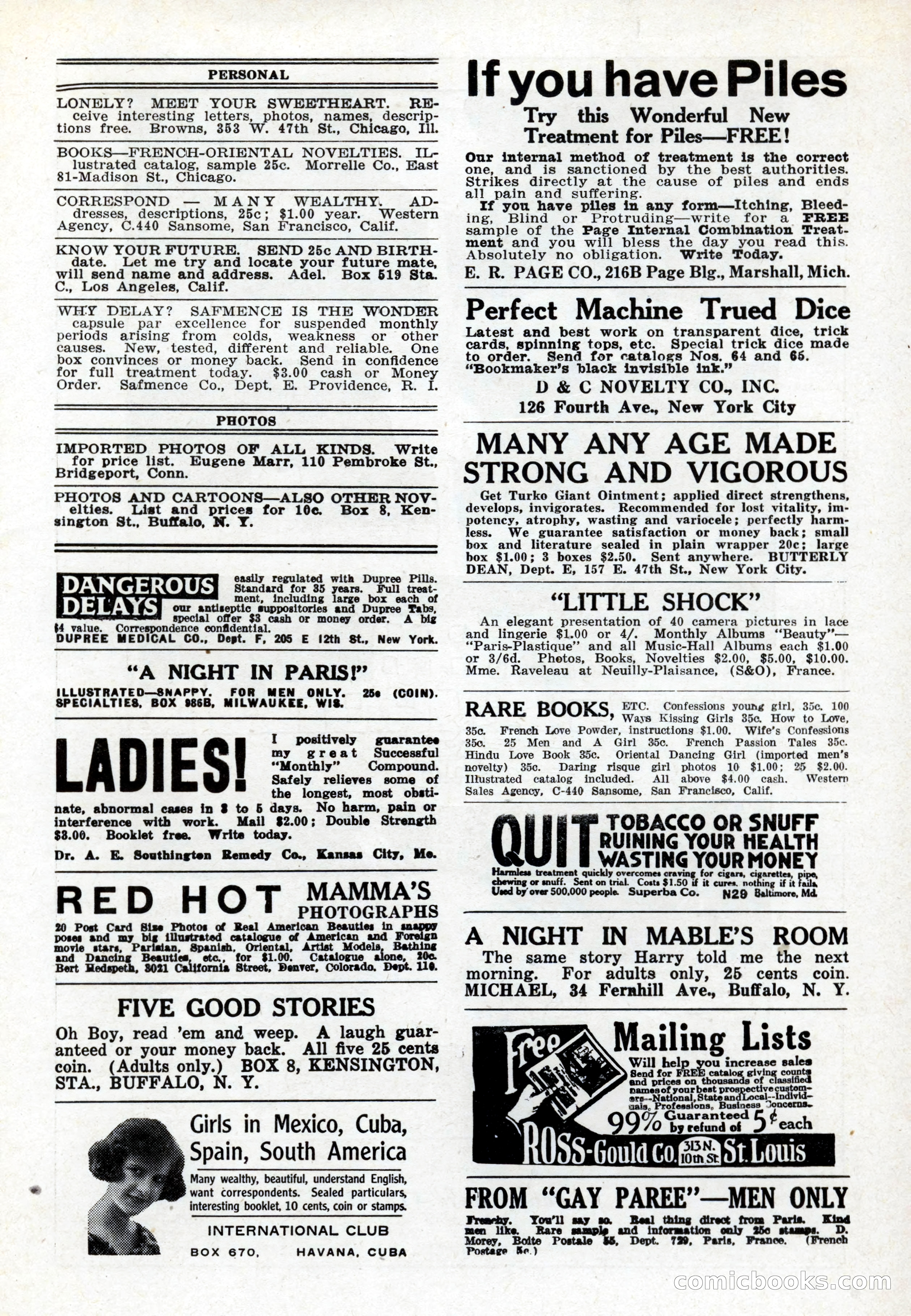
This page is primarily a collection of small classified advertisements and personal notices, typical of pulp magazine back matter. The ads cover various products and services: remedies for ailments (piles treatment, hair loss), novelty items (trick dice, photographs), correspondence clubs for meeting romantic partners, and books or photographs of suggestive content. There is one illustrated advertisement featuring a photograph of a woman's face for an "International Club" based in Havana, Cuba, advertising correspondence with "wealthy, beautiful" women. The page shows no story prose, illustrations, or cover material—it is entirely composed of densely-packed, small-print classified advertisements characteristic of early pulp magazine monetization.

10-Story Book, February 1928 — page 66 of 68
66 / 68
What you’re looking at · open this page on its own ↗

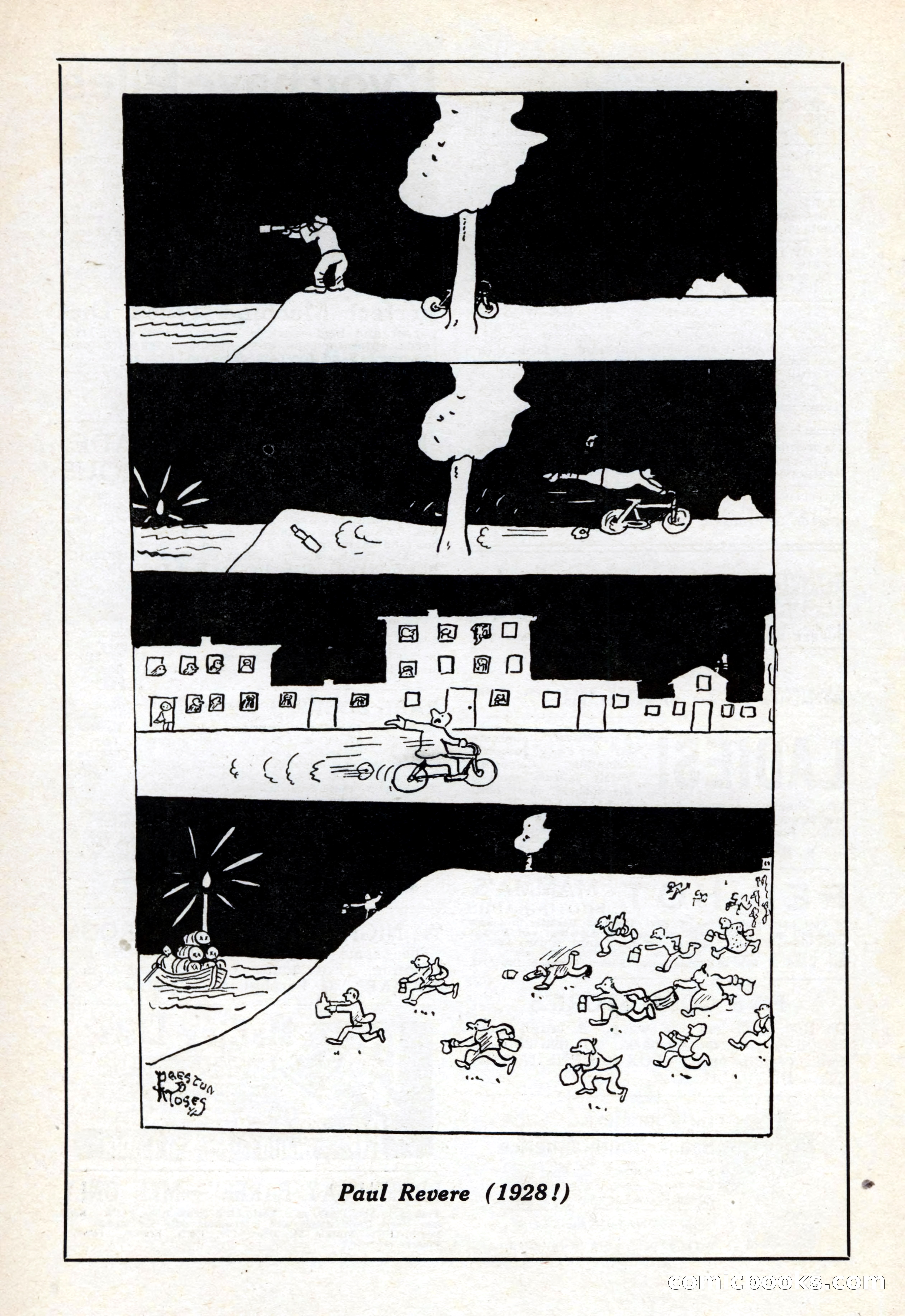
# Analysis of Page This is a **comic strip illustration** credited to "Paul Revere (1928!)" at the bottom. The four-panel sequence depicts a satirical narrative showing the progression from a solitary figure with a telescope observing the night sky, to encounters with increasingly chaotic scenes—a person on a motorcycle, buildings in a town, and finally a large crowd of running figures fleeing toward an explosion or bright light on the horizon. The strip appears to be science fiction satire, likely warning about or humorously depicting some form of invasion, disaster, or apocalyptic event spreading from observation to mass panic. The style and subject matter are typical of early pulp science fiction commentary.

10-Story Book, February 1928 — page 67 of 68
67 / 68
What you’re looking at · open this page on its own ↗

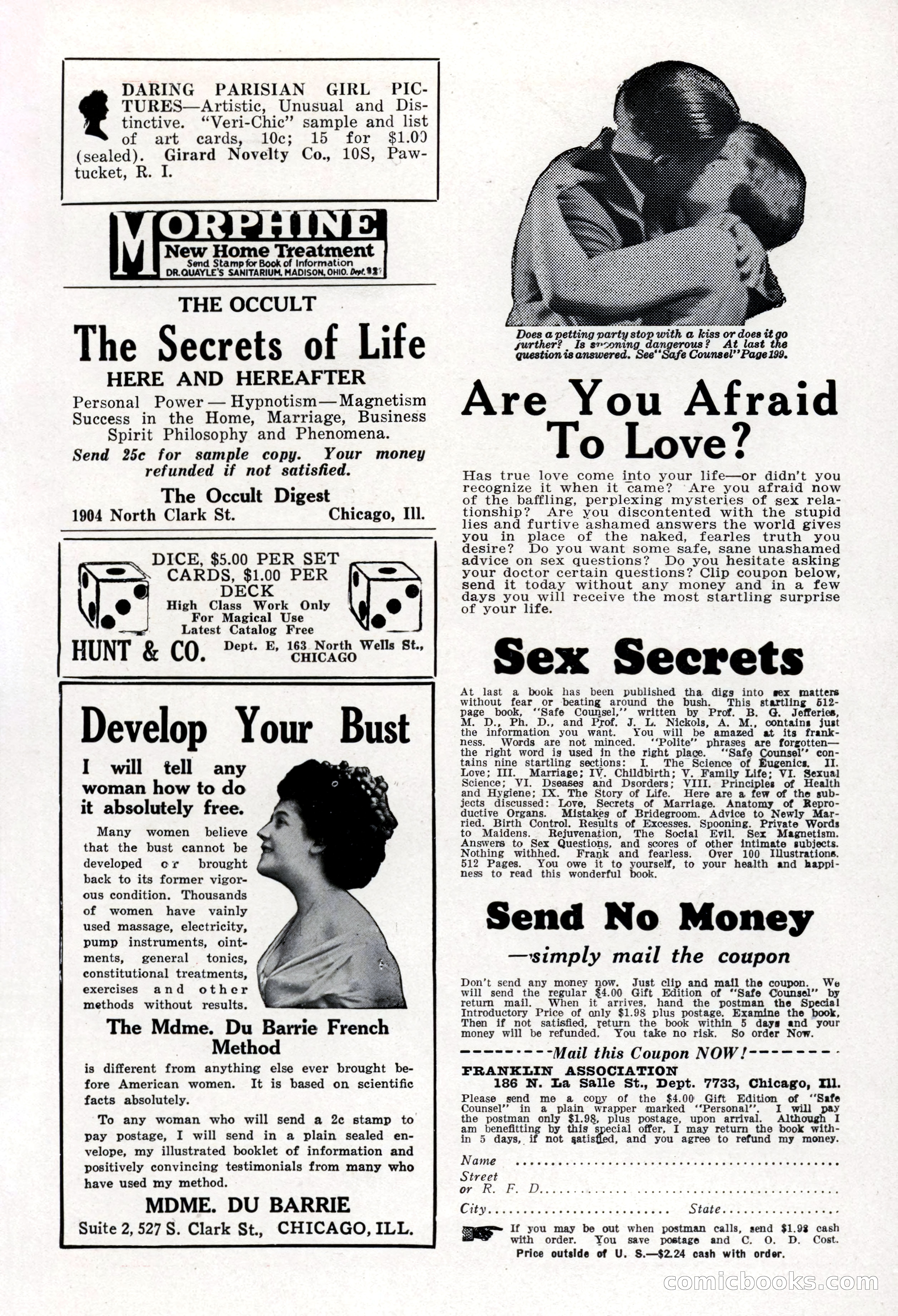
This is an advertising page from an early-20th-century pulp magazine. It contains multiple advertisements for mail-order products and services, including offers for occult knowledge ("The Secrets of Life"), dice for magical use, bust-development methods, and a book titled "Sex Secrets" promising frank information on intimate matters. The page features a photograph of a woman and several text-based advertisements from Chicago businesses. The ads employ sensational language typical of the era, promising personal improvement, medical advice, and esoteric knowledge through mail-order correspondence. No story content or editorial material appears on this page—it is entirely devoted to classified and display advertising.

10-Story Book, February 1928 — page 68 of 68
68 / 68
What you’re looking at · open this page on its own ↗

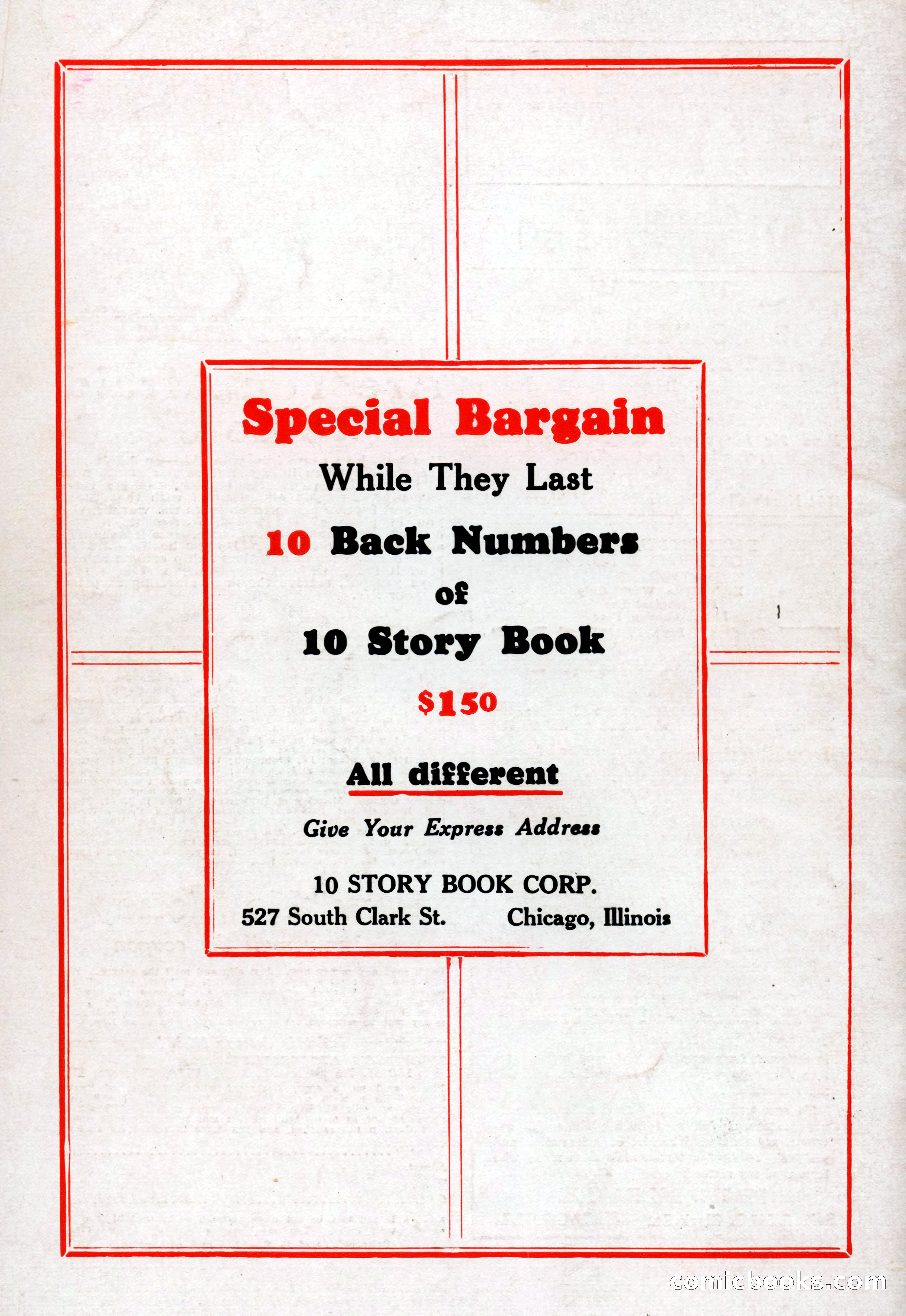
This is an advertisement page from a pulp magazine. The ad promotes a special bargain offer from the 10 Story Book Corporation in Chicago, Illinois, selling ten back issues of their "10 Story Book" publication for $1.50. The advertisement emphasizes that all issues are different and instructs interested customers to provide their express address when ordering. The page itself is mostly blank white space with a red border frame containing the centered advertisement text, typical of mid-century pulp magazine promotional material.

Browse this issue page by page

Each page has its own page — the cartoon, who’s in it, and what the satire means.

  1. Page 1 This is a cover of a pulp magazine titled "10 Stories" (February issue, priced at 25¢). The cover features a black-and-white photograph of a woman in a hula ski…
  2. Page 2 This page is an illustrated advertisement or promotional feature from an early-20th-century pulp magazine. It displays a black-and-white photograph of a woman i…
  3. Page 3 # 10 Story Book Magazine - February 1928 Contents Page This is a **contents page** from *10 Story Book*, a pulp magazine devoted to stories and photographs feat…
  4. Page 4 # Analysis This is a **story prose page** from a pulp fiction magazine, specifically the opening section of a short story titled "Nuki Hiva Head" by C. Jenkins …
  5. Page 5 # Page Analysis This page is an illustration with accompanying text from a pulp magazine's "Tropical Number." It features a black-and-white photograph of a youn…
  6. Page 6 # Page Analysis This page from *The South Sea Island Number* contains a photograph with caption at the top, followed by story prose below. The photograph shows …
  7. Page 7 # Page Analysis This page from *The South Sea Island Number* contains narrative prose from a pulp fiction story alongside a photograph. The text describes a shi…
  8. Page 8 # Page Analysis This is an **illustrated page** from a pulp magazine, featuring a photograph of a woman in a reclining pose alongside accompanying text. The tex…
  9. Page 9 # Page Description This page contains story prose from a pulp fiction magazine, appearing to be a continuation of a sea adventure narrative (marked "Continued f…
  10. Page 10 # Page 8: Story Prose from "The South Sea Island Number" This page contains prose fiction from a story appearing in what the masthead identifies as "The South S…
  11. Page 11 View this page →
  12. Page 12 # Page Analysis This is a text page (page 10) from *The South Sea Island Number* of what appears to be a pulp magazine. The page contains two story sections: a …
  13. Page 13 This is a black and white portrait photograph, likely from the early 20th century, showing a man with distinctive facial hair (beard and mustache) and voluminou…
  14. Page 14 # Page 12: Story Prose from "The South Sea Island Number" This page contains printed story prose from what appears to be a narrative about a ship captain's enco…
  15. Page 15 # Page Analysis This is story prose from what appears to be a pulp fiction magazine (page 13, titled "THE SOUTH SEA ISLAND NUMBER"). The text consists of a firs…
  16. Page 16 This is page 14 from a pulp magazine called "The South Sea Island Number." The page features a black-and-white photograph of a woman identified as a Zulu widow …
  17. Page 17 # Page Analysis This is a page of story prose (page 15) from "The South Sea Island Number" of a pulp magazine. The text describes a narrator's maritime adventur…
  18. Page 18 # Page 16: Story Prose from "The South Sea Island Number" This page contains story prose, specifically two sections (labeled IV and V) of what appears to be a m…
  19. Page 19 # Page Description This is an illustrated page from an early-20th-century pulp magazine featuring a black-and-white photograph of a dancer in a sequined Hawaiia…
  20. Page 20 # Page Analysis This is a **text-only story page** (page 18) from a pulp magazine titled "The South Sea Island Number." The visible prose continues a narrative …
  21. Page 21 # Page Description This is an interior illustration accompanying a 10-story book titled "These People Have Never Seen a 10-Story Book in Their Lives." The black…
  22. Page 22 # Analysis This is an **illustration** (not a cover) from an early-20th-century pulp magazine. The image shows a stylized Art Deco-era drawing signed "Clodd" de…
  23. Page 23 # Page Analysis This page contains story prose from "Grammaw's Kitchen Calendar" by Ila Lewis. The text is presented in two columns with a large decorative init…
  24. Page 24 # Page Analysis This is a story prose page (page 22) from "The South Sea Island Number" of a pulp magazine. The text depicts a childhood incident where a curiou…
  25. Page 25 This is an illustrated comic strip titled "The Facetious Serpent," credited to artist Caran d'Ache and noted as "A tropical phantasy drawn for Harper's Magazine…
  26. Page 26 # Analysis of Page 24 This is a **story prose page** from *The South Sea Island Number*, continuing a narrative from page 22. The visible text depicts a young w…
  27. Page 27 This is an illustrated page from an early-20th-century pulp magazine featuring a photograph labeled "Aoba Dwarfs of the New Hebrides." The image shows four indi…
  28. Page 28 This is a page of story prose from "The South Sea Island Number" pulp magazine, continuing a narrative from page 24. The text describes a young woman named Marv…
  29. Page 29 # Page Analysis This is a prose story page from what appears to be a pulp magazine titled "The South Sea Island Number" (page 27). The text describes a young wo…
  30. Page 30 # Page Analysis This is an interior story page from *The South Sea Island Number* of a pulp magazine. It features a black-and-white photograph labeled "Ladies, …
  31. Page 31 # Page 29: Story Prose from "The South Sea Island Number" This page contains prose fiction text in a two-column layout, with a small illustration at the bottom.…
  32. Page 32 # "Orchids and a Woman" by Andrew Soutar This is a story opening page from an early-20th-century pulp magazine. It features a portrait illustration of a woman's…
  33. Page 33 # Page 31: Story Prose This page contains prose fiction text from what appears to be "The South Sea Island Number" (visible in the header). The narrative follow…
  34. Page 34 This is a text page from a pulp magazine titled "The South Sea Island Number." The page contains prose narrative (page 32) featuring dialogue between characters…
  35. Page 35 # Page Description This is an illustrated story page featuring a black-and-white photograph of a woman in period clothing, accompanied by a caption and explanat…
  36. Page 36 # Page 34: Story Prose from "The South Sea Island Number" This page contains printed story prose in two columns. The text depicts a conversation between charact…
  37. Page 37 This is a page of story prose from "The South Sea Island Number" (page 35). The text describes a conversation between two men, Kavanagh and Bruch, where Bruch o…
  38. Page 38 This page contains story prose from "The South Sea Island Number" (visible in the header). The text describes Kavanagh discovering an abandoned bungalow and fin…
  39. Page 39 # Page Analysis This page contains a black-and-white photograph labeled "Another Rare Camera Study," accompanied by descriptive text. The image shows an elderly…
  40. Page 40 # Page 38: Story Prose from "The South Sea Island Number" This page contains continuous narrative prose from what appears to be a short story. The text describe…
  41. Page 41 # Page 39: Story Prose from "The South Sea Island Number" This page contains story prose printed in two columns. The narrative follows Jay Kavanagh's journey to…
  42. Page 42 # Page 40: Story Prose with Illustration This page contains story prose from a piece titled "Nuki-Hiva Head" by Captain Hains (visible in the caption). The illu…
  43. Page 43 # Page 41 of "The South Sea Island Number" This page contains story prose with no illustrations. The text depicts a tense confrontation between characters named…
  44. Page 44 # Page 42 of *The South Sea Island Number* This page contains story prose—specifically the continuation of a mystery narrative. The visible text depicts a confr…
  45. Page 45 # Page Analysis This page contains an interior illustration accompanying a story titled "They're All Going to Be South Sea Island Girls." The black-and-white ph…
  46. Page 46 # Page Description This page contains story prose from "The South Sea Island Number" (page 44). The text depicts a dramatic confrontation in which a solicitor n…
  47. Page 47 # Analysis This page displays the opening of a short story titled "Halcyon" by William Freeman. It features an illustration at the top—a line drawing of a seate…
  48. Page 48 # Page Description This is an interior illustration page from a pulp magazine, featuring a black-and-white photograph positioned sideways (rotated 90 degrees). …
  49. Page 49 # Page 47 of "The South Sea Island Number" This page contains story prose—the continuation of a narrative adventure tale. The visible text describes a dramatic …
  50. Page 50 This is page 48 from "The South Sea Island Number" of a pulp magazine. It contains a black-and-white photograph on the left showing actress Mary Mallon in minim…
  51. Page 51 This page contains story prose from "The South Sea Island Number" (page 49). The text depicts a tense encounter between European colonists and indigenous people…
  52. Page 52 # Page 50 of "The South Sea Island Number" This is a prose story page with no illustrations. The text describes a tense encounter between the narrator and indig…
  53. Page 53 # Page 51 of "The South Sea Island Number" This page contains story prose from what appears to be a serialized narrative. The visible text describes a tense soc…
  54. Page 54 This page contains story prose from "The South Sea Island Number" (visible in the header). The text depicts an intimate dialogue between a newly married couple …
  55. Page 55 # Page Analysis This page contains story prose from what appears to be "The South Sea Island Number" (visible in the header). The text depicts a dramatic scene …
  56. Page 56 # Page 54: Story Prose This page contains story prose from "The South Sea Island Number," a pulp fiction tale. The narrative depicts a dramatic and violent conf…
  57. Page 57 # Page Description This page contains a black-and-white photograph with accompanying text. The image shows a woman in 1920s-style undergarments playing with a d…
  58. Page 58 This page contains story prose from "The South Sea Island Number" of what appears to be an early-20th-century pulp magazine. The text describes the narrator's r…
  59. Page 59 # Page Description This is an **advertisement page** from an early-20th-century pulp magazine, containing multiple classified-style ads and promotional material…
  60. Page 60 This page is entirely composed of classified advertisements rather than story content or illustrations. The ads promote various mail-order products and services…
  61. Page 61 # Page Description This is an **advertising and classified page** from an early-20th-century pulp magazine. The page contains numerous small advertisements and …
  62. Page 62 # Page Analysis This is an **advertising page** from an early-20th-century pulp magazine, not story content. The page features multiple advertisements, primaril…
  63. Page 63 This is an illustration from a pulp magazine featuring two costumed figures at what appears to be a masquerade ball. The image shows a man in a clown costume wi…
  64. Page 64 # Page Description This page is primarily advertising content from a pulp magazine. It displays the "Advertising Rates" section and classified advertisements fo…
  65. Page 65 This page is primarily a collection of small classified advertisements and personal notices, typical of pulp magazine back matter. The ads cover various product…
  66. Page 66 # Analysis of Page This is a **comic strip illustration** credited to "Paul Revere (1928!)" at the bottom. The four-panel sequence depicts a satirical narrative…
  67. Page 67 This is an advertising page from an early-20th-century pulp magazine. It contains multiple advertisements for mail-order products and services, including offers…
  68. Page 68 This is an advertisement page from a pulp magazine. The ad promotes a special bargain offer from the 10 Story Book Corporation in Chicago, Illinois, selling ten…