
Pulp Fiction, 1928 · page 52 of 68
10-Story Book, February 1928 — page 52: what you’re looking at
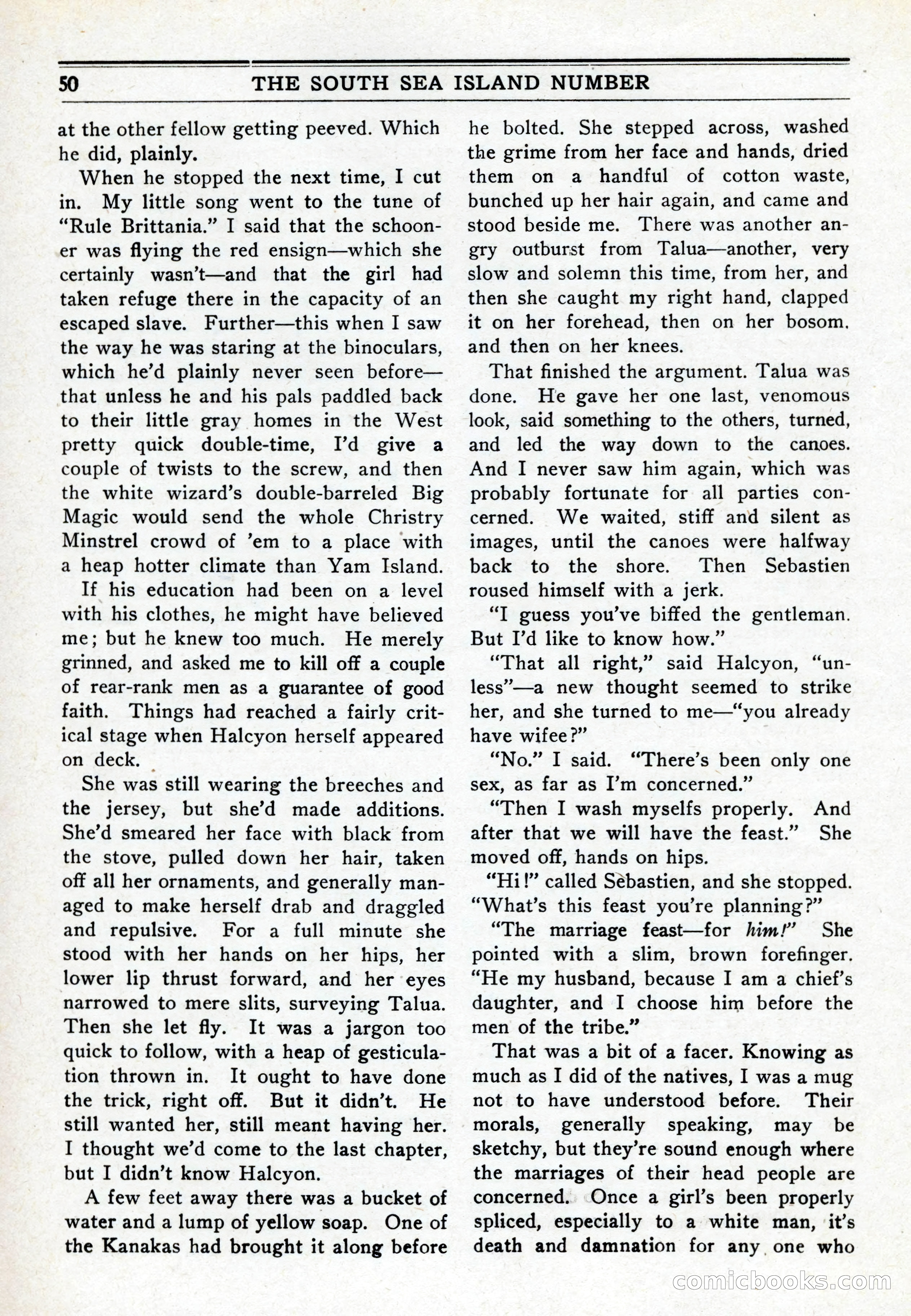
A restored page from Pulp Fiction, 1928. Page through the whole issue in the reader above.
📄 Transcribed text from this page (OCR, searchable)
Machine-transcribed from the original scan — historical spelling and the odd misread are preserved.
50 THE SOUTH SEA ISLAND NUMBER at the other fellow getting peeved. Which he did, plainly. When he stopped the next time, I cut in. My little song went to the tune of “Rule Brittania.” I said that the schoon- er was flying the red ensign—which she certainly wasn’t—and that the girl had taken refuge there in the capacity of an escaped slave. Further—this when I saw the way he was staring at the binoculars, which he’d plainly never seen before— that unless he and his pals paddled back to their little gray homes in the West pretty quick double-time, I’d give a couple of twists to the screw, and then the white wizard’s double-barreled Big Magic would send the whole Christry Minstrel crowd of ’em to a place with a heap hotter climate than Yam Island. If his education had been on a level with his clothes, he might have believed me; but he knew too much. He merely grinned, and asked me to kill off a couple of rear-rank men as a guarantee of good faith. Things had reached a fairly crit- ical stage when Halcyon herself appeared on deck. | She was still wearing the breeches and the jersey, but she’d made additions. She’d smeared her face with black from the stove, pulled down her hair, taken off all her ornaments, and generally man- aged to make herself drab and draggled and repulsive. For a full minute she stood with her hands on her hips, her lower lip thrust forward, and her eyes narrowed to mere slits, surveying Talua. Then she let fly. It was a jargon too quick to follow, with a heap of gesticula- tion thrown in. It ought to have done the trick, right off. But it didn’t. He still wanted her, still meant having her. I thought we’d come to the last chapter, but I didn’t know Halcyon. A few feet away there was a bucket of water and a lump of yellow soap. One of the Kanakas had brought it along before he bolted. She stepped across, washed the grime from her face and hands, dried them on a handful of cotton waste, bunched up her hair again, and came and stood beside me. There was another an- gry outburst from Talua—another, very slow and solemn this time, from her, and then she caught my right hand, clapped it on her forehead, then on her bosom, and then on her knees. That finished the argument. Talua was done. He gave her one last, venomous look, said something to the others, turned, and led the way down to the canoes. And I never saw him again, which was probably fortunate for all parties con- cerned. We waited, stiff and silent as images, until the canoes were halfway back to the shore. Then Sebastien roused himself with a jerk. “I guess you’ve biffed the gentleman. But I’d like to know how.” “That all right,” said Halcyon, “un- less’—a new thought seemed to strike her, and she turned to me—“you already have wifee?” “No.” I said. “There’s been only one sex, aS far as I’m concerned.” “Then I wash myselfs properly. And after that we will have the feast.” She moved off, hands on hips. “Hi!” called Sébastien, and she stopped. “What’s this feast you’re planning?” “The marriage feast—for him!’ She pointed with a slim, brown forefinger. “He my husband, because I am a chief’s daughter, and I choose him before the men of the tribe.” That was a bit of a facer. Knowing as much as I did of the natives, I was a mug not to have understood before. Their morals, generally speaking, may be sketchy, but they’re sound enough where the marriages of their head people are concerned. Once a girl’s been properly spliced, especially to a white man, it’s death and damnation for any. one who COMICNOOKS.CO mn