
Pulp Fiction, 1928 · page 31 of 68
10-Story Book, February 1928 — page 31: what you’re looking at
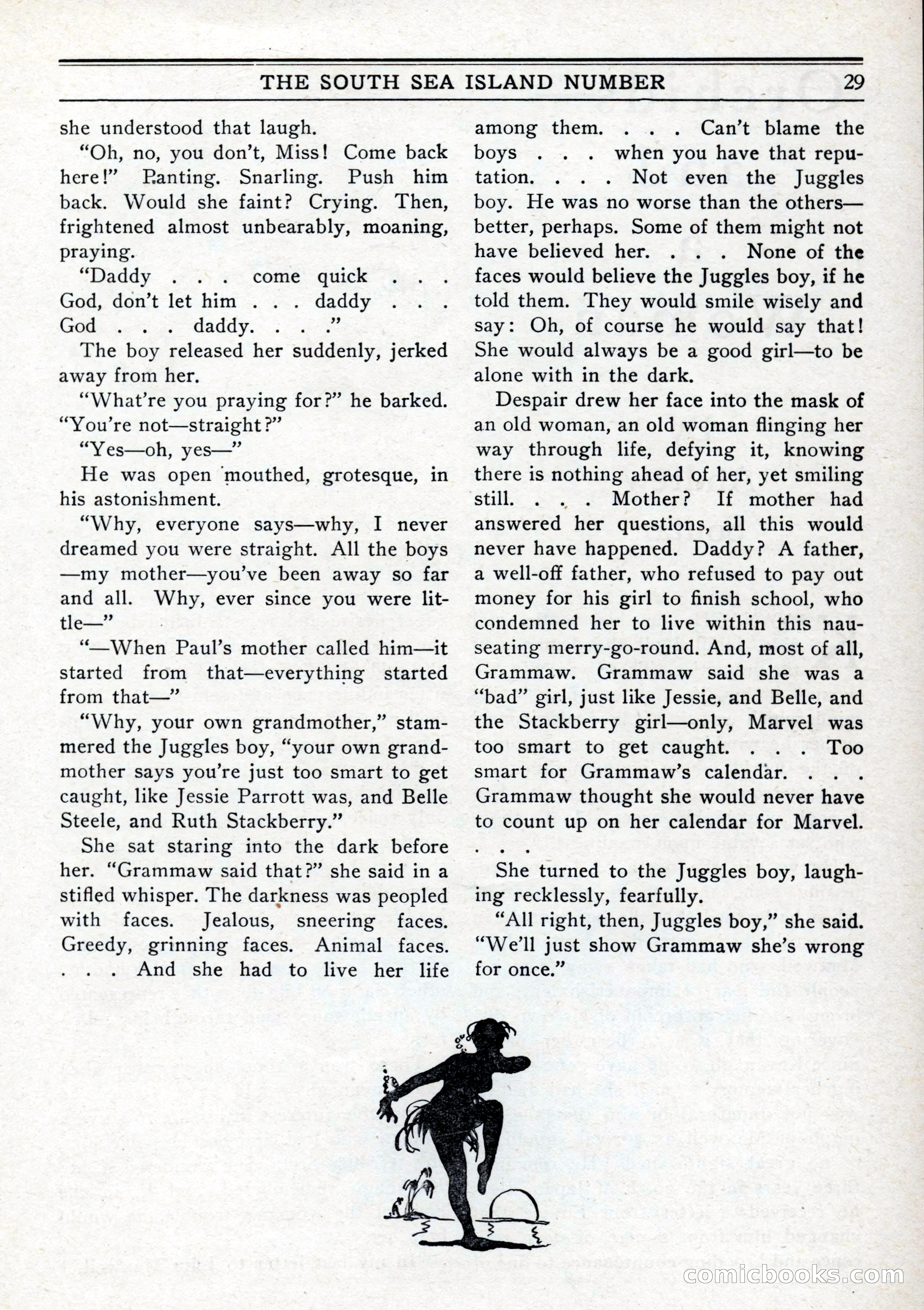
A restored page from Pulp Fiction, 1928. Page through the whole issue in the reader above.
📄 Transcribed text from this page (OCR, searchable)
Machine-transcribed from the original scan — historical spelling and the odd misread are preserved.
THE SOUTH SEA ISLAND NUMBER 7 29 she understood that laugh. “Oh, no, you don’t, Miss! Come back here!” Panting. Snarling. Push him back. Would she faint? Crying. Then, frightened almost unbearably, moaning, praying. “Daddy come quick God, don’t let him . .. daddy God Gadty.- 2 ey The boy released her suddenly, jerked away from her. “What’re you praying for?” he barked. “You’re not—straight ?” “Yes—oh, yes—”’ He was open mouthed, grotesque, in his astonishment. “Why, everyone says—why, I never dreamed you were straight. All the boys —my mother—you’ve been away so far and all. Why, ever since you were lit- tle—” “When Paul’s mother called him—it started from that—everything started from that—” “Why, your own grandmother,” stam- mered the Juggles boy, “your own grand- mother says you're just too smart to get caught, like Jessie Parrott was, and Belle Steele, and Ruth Stackberry.” She sat staring into the dark before her. “Grammaw said that?” she said ina stifled whisper. The darkness was peopled with faces. Jealous, sneering faces. Greedy, grinning faces. Animal faces. And she had to live her life b Can’t blame the boys when you have that repu- tation. Not even the Juggles boy. He was no worse than the others— better, perhaps. Some of them might not have believed her. None of the faces would believe the Juggles boy, if he told them. They would smile wisely and say: Oh, of course he would say that! She would always be a good girl—to be alone with in the dark. Despair drew her face into the mask of an old woman, an old woman flinging her way through life, defying it, knowing there is nothing ahead of her, yet smiling still. Mother? If mother had answered her questions, all this would never have happened. Daddy? A father, a well-off father, who refused to pay out money for his girl to finish school, who condemned her to live within this nau- seating merry-go-round. And, most of all, Grammaw. Grammaw said she was a “bad” girl, just like Jessie, and Belle, and the Stackberry girl—only, Marvel was too smart to get caught. Too smart for Grammaw’s calendar. ; Grammaw thought she would never have to count up on her calendar for Marvel. among them. She turned to the Juggles boy, laugh- ing recklessly, fearfully. “All right, then, Juggles boy,” she said. “We'll just show Grammaw she’s wrong for once.” Connicloookks (S(O)