
Pulp Fiction, 1928 · page 46 of 68
10-Story Book, February 1928 — page 46: what you’re looking at
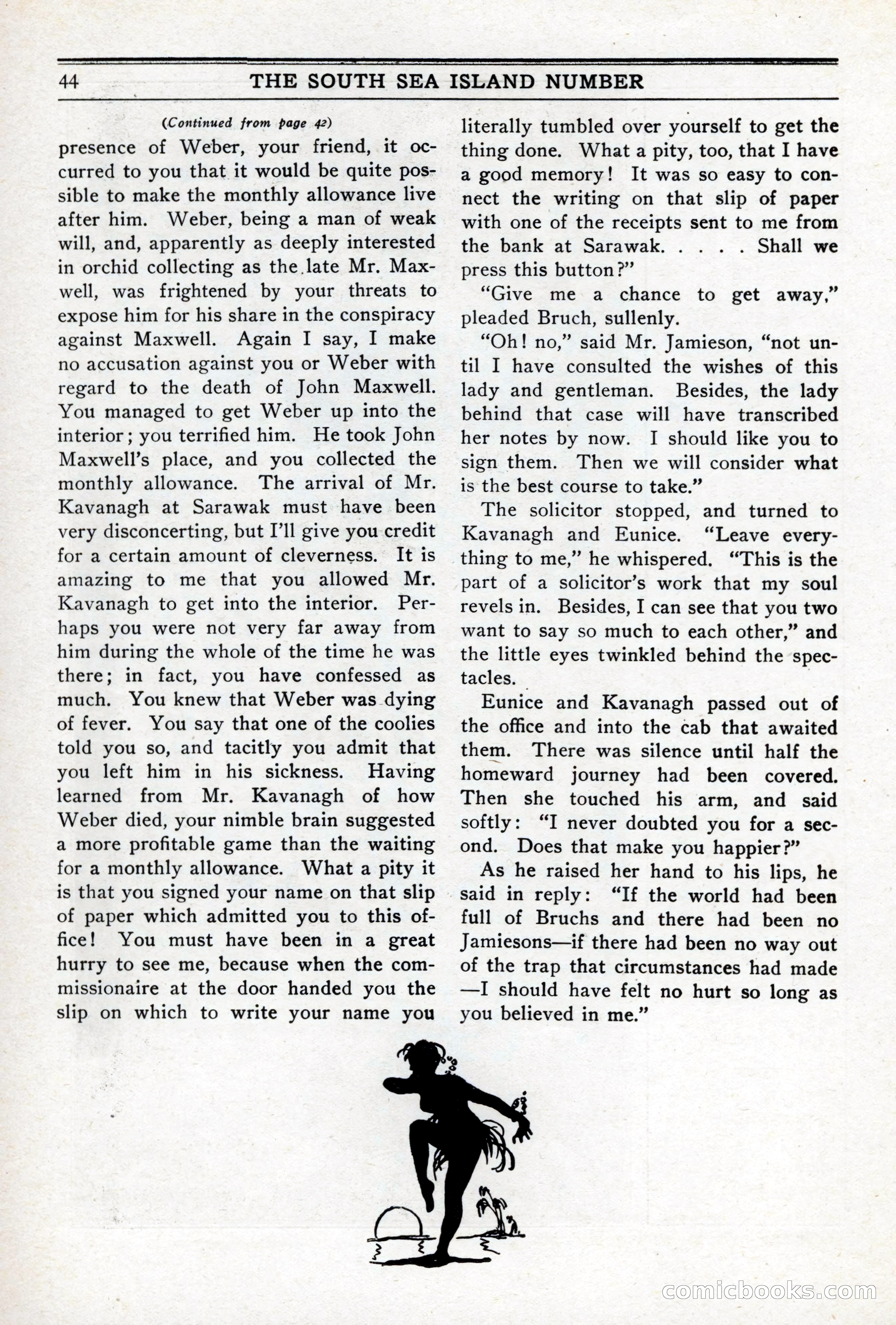
A restored page from Pulp Fiction, 1928. Page through the whole issue in the reader above.
📄 Transcribed text from this page (OCR, searchable)
Machine-transcribed from the original scan — historical spelling and the odd misread are preserved.
a __ 44 3 THE SOUTH SEA ISLAND NUMBER (Continued from page 42) presence of Weber, your friend, it oc- curred to you that it would be quite pos- sible to make the monthly allowance live after him. Weber, being a man of weak will, and, apparently as deeply interested in orchid collecting as the late Mr. Max- well, was frightened by your threats to expose him for his share in the conspiracy against Maxwell. Again I say, I make no accusation against you or Weber with regard to the death of John Maxwell. You managed to get Weber up into the interior; you terrified him. He took John Maxwell’s place, and you collected the monthly allowance. The arrival of Mr. Kavanagh at Sarawak must have been very disconcerting, but I’ll give you credit for a certain amount of cleverness. It is amazing to me that you allowed Mr. Kavanagh to get into the interior. Per- haps you were not very far away from him during the whole of the time he was there; in fact, you have confessed as much. You knew that Weber was dying of fever. You say that one of the coolies told you so, and tacitly you admit that you left him in his sickness. Having learned from Mr. Kavanagh of how Weber died, your nimble brain suggested a more profitable game than the waiting for a monthly allowance. What a pity it is that you signed your name on that slip of paper which admitted you to this of- fice! You must have been in a great hurry to see me, because when the com- missionaire at the door handed you the slip on which to write your name you literally tumbled over yourself to get the thing done. What a pity, too, that I have a good memory! It was so easy to con- nect the writing on that slip of paper with one of the receipts sent to me from the bank at Sarawak. . . Shall we press this button?” “Give me a chance to get away,” pleaded Bruch, sullenly. “Oh! no,” said Mr. Jamieson, “not un- til I have consulted the wishes of this lady and gentleman. Besides, the lady behind that case will have transcribed her notes by now. I should like you to sign them. Then we will consider what is the best course to take.” The solicitor stopped, and turned to Kavanagh and Eunice. “Leave every- thing to me,” he whispered. “This is the part of a solicitor’s work that my soul revels in. Besides, I can see that you two want to say so much to each other,” and the little eyes twinkled behind the spec- tacles. Eunice and Kavanagh passed out of the office and into the cab that awaited them. There was silence until half the homeward journey had been covered. Then she touched his arm, and said softly: “I never doubted you for a sec- ond. Does that make you happier?” As he raised her hand to his lips, he said in reply: “If the world had been full of Bruchs and there had been no Jamiesons—if there had been no way out of the trap that circumstances had made —I should have felt no hurt so long as you believed in me.” cConniclooolkks (C@)