
Pulp Fiction, 1928 · page 32 of 68
10-Story Book, February 1928 — page 32: what you’re looking at
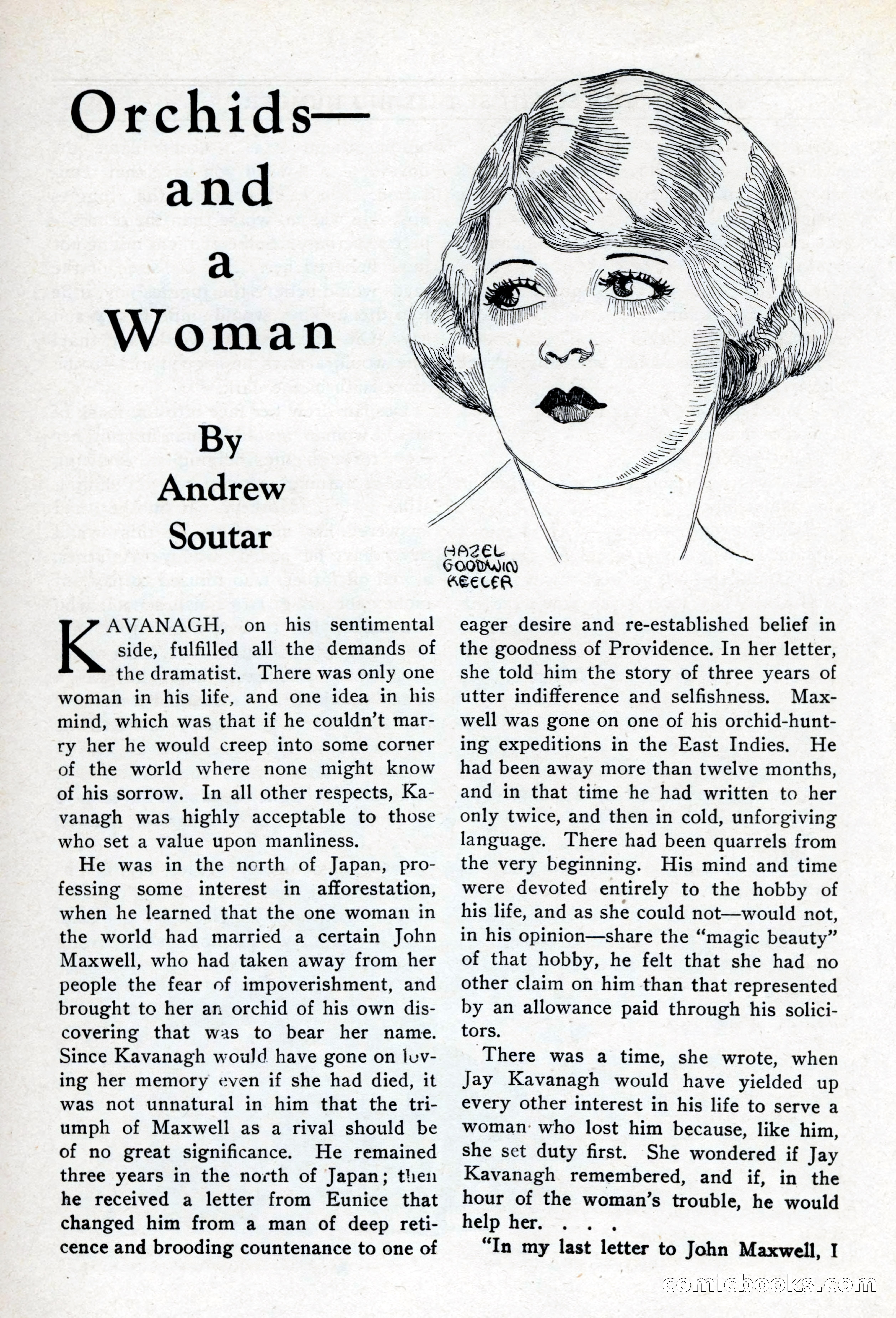
A restored page from Pulp Fiction, 1928. Page through the whole issue in the reader above.
📄 Transcribed text from this page (OCR, searchable)
Machine-transcribed from the original scan — historical spelling and the odd misread are preserved.
Orchids— and a By Andrew Soutar RBAZEL COODWIA AEECER AVANAGH, on his’ sentimental K side, fulfilled all the demands of the dramatist. There was only one woman in his life, and one idea in his mind, which was that if he couldn’t mar- ry her he would creep into some corner of the world where none might know of his sorrow. In all other respects, Ka- vanagh was highly acceptable to those who set a value upon manliness. He was in the north of Japan, pro- fessing some interest in afforestation, when he learned that the one woman in the world had married a certain John Maxwell, who had taken away from her people the fear of impoverishment, and brought to her an orchid of his own dis- covering that was to bear her name. Since Kavanagh would have gone on luv- ing her memory even if she had died, it was not unnatural in him that the tri- umph of Maxwell as a rival should be of no great significance. He remained three years in the north of Japan; then he received a letter from Eunice that changed him from a man of deep reti- cence and brooding countenance to one of eager desire and re-established belief in the goodness of Providence. In her letter, she told him the story of three years of utter indifference and selfishness. Max- well was gone on one of his orchid-hunt- ing expeditions in the East Indies. He had been away more than twelve months, and in that time he had written to her only twice, and then in cold, unforgiving language. There had been quarrels from the very beginning. His mind and time were devoted entirely to the hobby of his life, and as she could not—would not, in his opinion—share the “magic beauty” of that hobby, he felt that she had no other claim on him than that represented by an allowance paid through his solici- tors. There was a time, she wrote, when Jay Kavanagh would have yielded up every other interest in his life to serve a woman: who lost him because, like him, she set duty first. She wondered if Jay Kavanagh remembered, and if, in the hour of the woman’s trouble, he would help her. “In my last letter to John Maxwell, I CORNICE OOO SS (©)