
Pulp Fiction, 1928 · page 4 of 68
10-Story Book, February 1928 — page 4: what you’re looking at
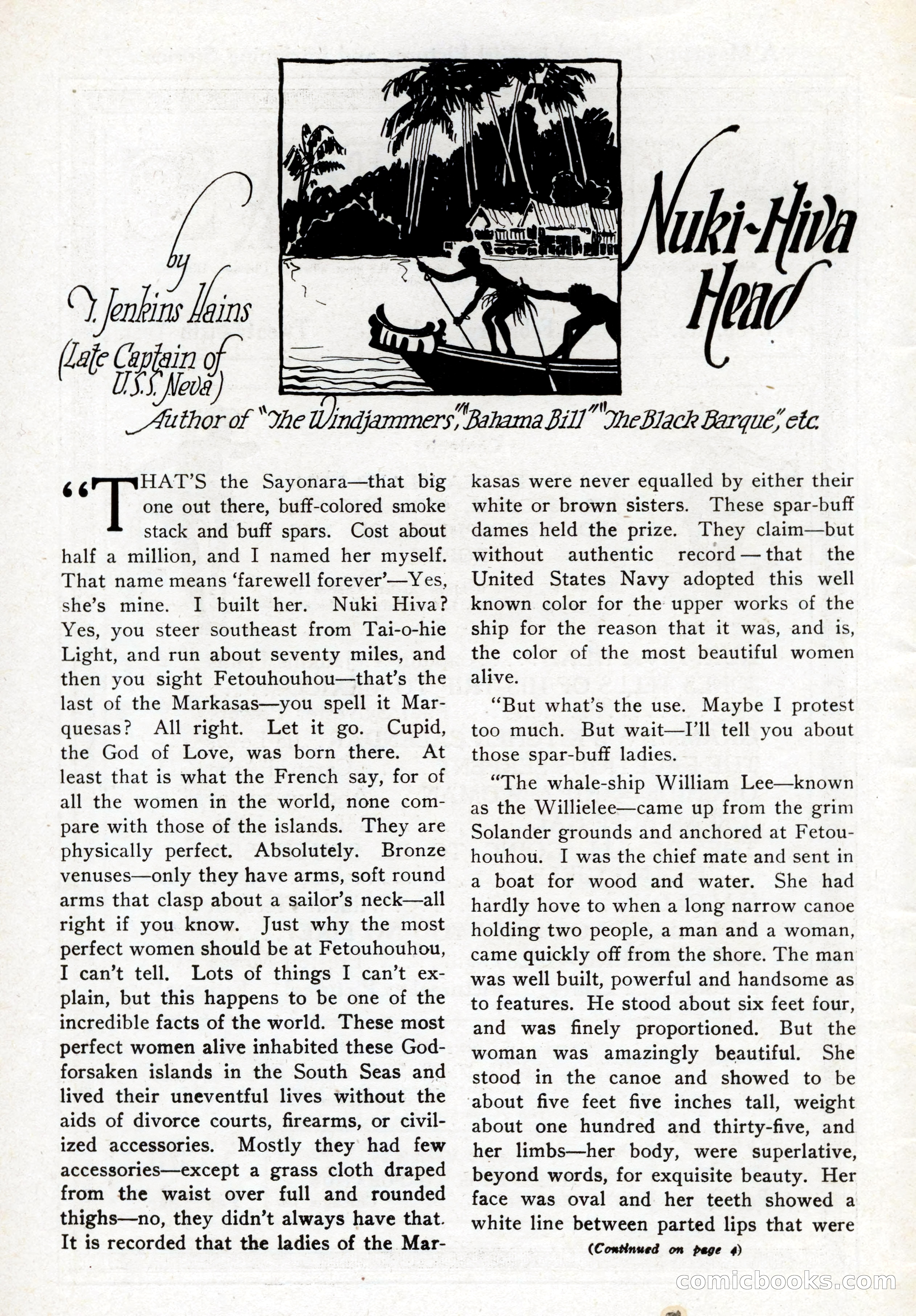
A restored page from Pulp Fiction, 1928. Page through the whole issue in the reader above.
📄 Transcribed text from this page (OCR, searchable)
Machine-transcribed from the original scan — historical spelling and the odd misread are preserved.
0 fie bin bi. Cap iia of eva ) a ee. rndjammers, Oy nae the Sayonara—that big one out there, buff-colored smoke stack and buff spars. Cost about half a million, and I named her myself. That name means ‘farewell forever’—Yes, she’s mine. I built her. Nuki Hiva? Yes, you steer southeast from Tai-o-hie Light, and run about seventy miles, and then you sight Fetouhouhou—that’s the last of the Markasas—you spell it Mar- quesas? All right. Let it go. Cupid, the God of Love, was born there. At least that is what the French say, for of all the women in the world, none com- pare with those of the islands. They are physically perfect. Absolutely. Bronze venuses—only they have arms, soft round arms that clasp about a sailor’s neck—all right if you know. Just why the most perfect women should be at Fetouhouhou, I can’t tell. Lots of things I can’t ex- plain, but this happens to be one of the incredible facts of the world. These most perfect women alive inhabited these God- forsaken islands in the South Seas and lived their uneventful lives without the aids of divorce courts, firearms, or civil- ized accessories. Mostly they had few accessories—except a grass cloth draped from the waist over full and rounded thighs—no, they didn’t always have that. It is recorded that the ladies of the Mar- AL "Bahama Bill” the Black Barque’ etc kasas were never equalled by either their white or brown sisters. These spar-buff dames held the prize. They claim—but without authentic record—that_ the United States Navy adopted this well known color for the upper works of the ship for the reason that it was, and is, the color of the most beautiful women alive. “But what’s the use. Maybe I protest too much. But wait—l’ll tell you about those spar-buff ladies. “The whale-ship William Lee—known as the Willielee—came up from the grim Solander grounds and anchored at Fetou- houhou. I was the chief mate and sent in a boat for wood and water. She had hardly hove to when a long narrow canoe holding two people, a man and a woman, came quickly off from the shore. The man was well built, powerful and handsome as to features. He stood about six feet four, and was finely proportioned. But the woman was amazingly beautiful. She stood in the canoe and showed to be about five feet five inches tall, weight about one hundred and thirty-five, and her limbs—her body, were superlative, beyond words, for exquisite beauty. Her face was oval and her teeth showed a white line between parted lips that were (Continued on page 4) COLAN eClooolkkKS. com a