
Pulp Fiction, 1928 · page 51 of 68
10-Story Book, February 1928 — page 51: what you’re looking at
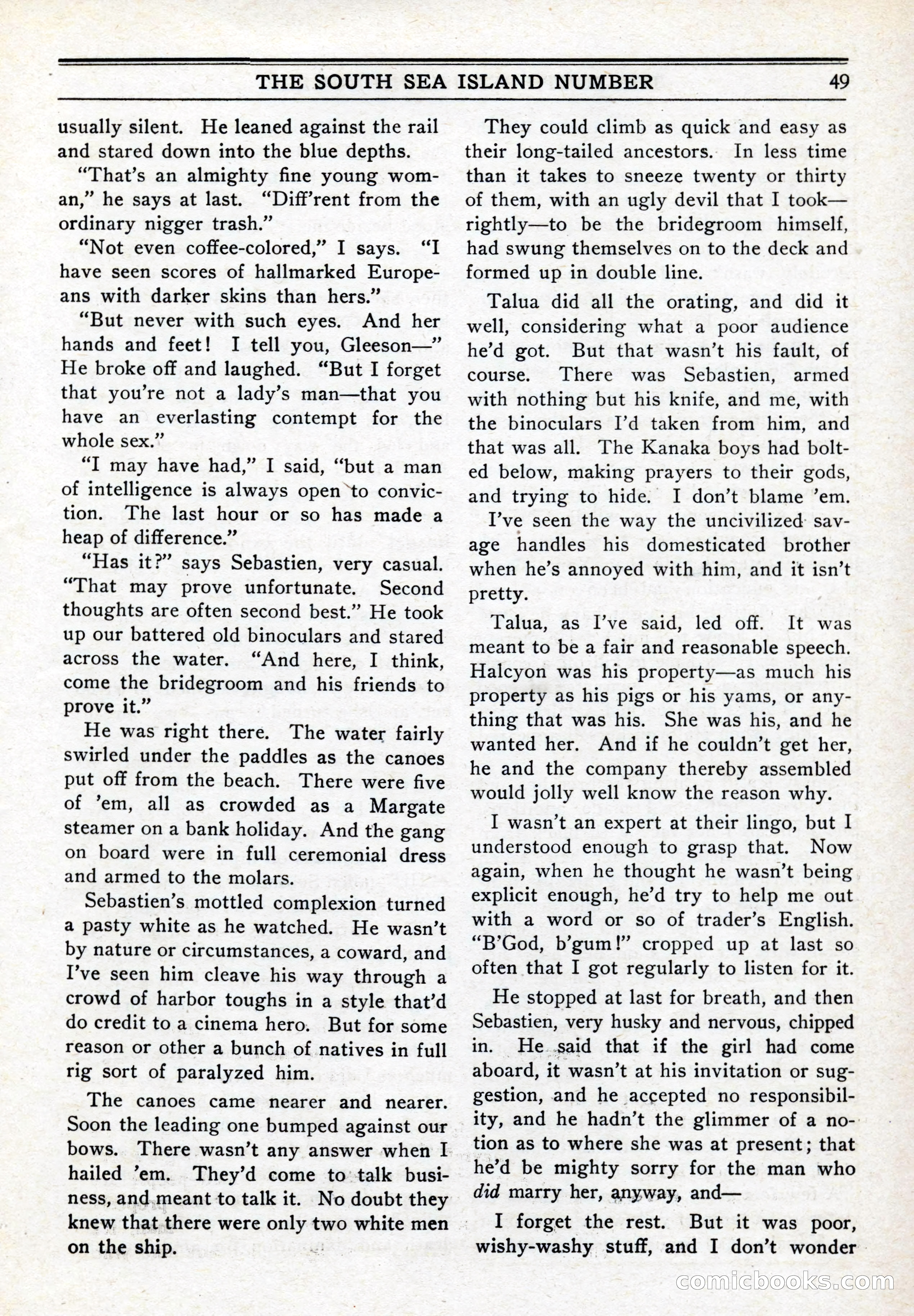
A restored page from Pulp Fiction, 1928. Page through the whole issue in the reader above.
📄 Transcribed text from this page (OCR, searchable)
Machine-transcribed from the original scan — historical spelling and the odd misread are preserved.
THE SOUTH SEA ISLAND NUMBER 49 usually silent. He leaned against the rail and stared down into the blue depths. “That’s an almighty fine young wom- an,” he says at last. “Diff’rent from the ordinary nigger trash.” “Not even coffee-colored,” I says. “I have seen scores of hallmarked Europe- ans with darker skins than hers.” “But never with such eyes. And her hands and feet! I tell you, Gleeson—” He broke off and laughed. “But I forget that you’re not a lady’s man—that you have an everlasting contempt for the whole sex.” “I may have had,” I said, “but a man of intelligence is always open to convic- tion. The last hour or so has made a heap of difference.” “Has it?” says Sebastien, very casual. “That may prove unfortunate. Second thoughts are often second best.” He took up our battered old binoculars and stared across the water. “And here, I think, come the bridegroom and his friends to prove it.” He was right there. The water fairly swirled under the paddles as the canoes put off from the beach. There were five of ’em, all as crowded as a Margate steamer on a bank holiday. And the gang on board were in full ceremonial dress and armed to the molars. Sebastien’s mottled complexion turned a pasty white as he watched. He wasn’t by nature or circumstances, a coward, and I’ve seen him cleave his way through a crowd of harbor toughs in a style that’d do credit to a cinema hero. But for some reason or other a bunch of natives in full rig sort of paralyzed him. The canoes came nearer and nearer. Soon the leading one bumped against our bows. There wasn’t any answer when I hailed ’em. They’d come to talk busi- ness, and.meant to talk it. No doubt they knew that there were only two white men on the ship. They could climb as quick and easy as their long-tailed ancestors. In less time than it takes to sneeze twenty or thirty of them, with an ugly devil that I took— rightly—to be the bridegroom himself, had swung themselves on to the deck and formed up in double line. Talua did all the orating, and did it well, considering what a poor audience he’d got. But that wasn’t his fault, of course. There was Sebastien, armed with nothing but his knife, and me, with the binoculars I’d taken from him, and that was all. The Kanaka boys had bolt- ed below, making prayers to their gods, and trying to hide. I don’t blame ’em. I’ve seen the way the uncivilized: sav- age handles his domesticated brother when he’s annoyed with him, and it isn’t pretty. Talua, as I’ve said, led off. It was meant to be a fair and reasonable speech. Halcyon was his property—as much his property as his pigs or his yams, or any- thing that was his. She was his, and he wanted her. And if he couldn’t get her, he and the company thereby assembled would jolly well know the reason why. I wasn’t an expert at their lingo, but I understood enough to grasp that. Now again, when he thought he wasn’t being explicit enough, he’d try to help me out with a word or so of trader’s English. “B’God, b’gum!” cropped up at last so often that I got regularly to listen for it. He stopped at last for breath, and then Sebastien, very husky and nervous, chipped in. He said that if the girl had come aboard, it wasn’t at his invitation or sug- gestion, and he accepted no responsibil- ity, and he hadn’t the glimmer of a no-. tion as to where she was at present; that he’d be mighty sorry for the man who did marry her, anyway, and— I forget the rest. But it was poor, wishy-washy stuff, and I don’t wonder ECOMICOOO KS, ECO im