
Pulp Fiction, 1928 · page 44 of 68
10-Story Book, February 1928 — page 44: what you’re looking at
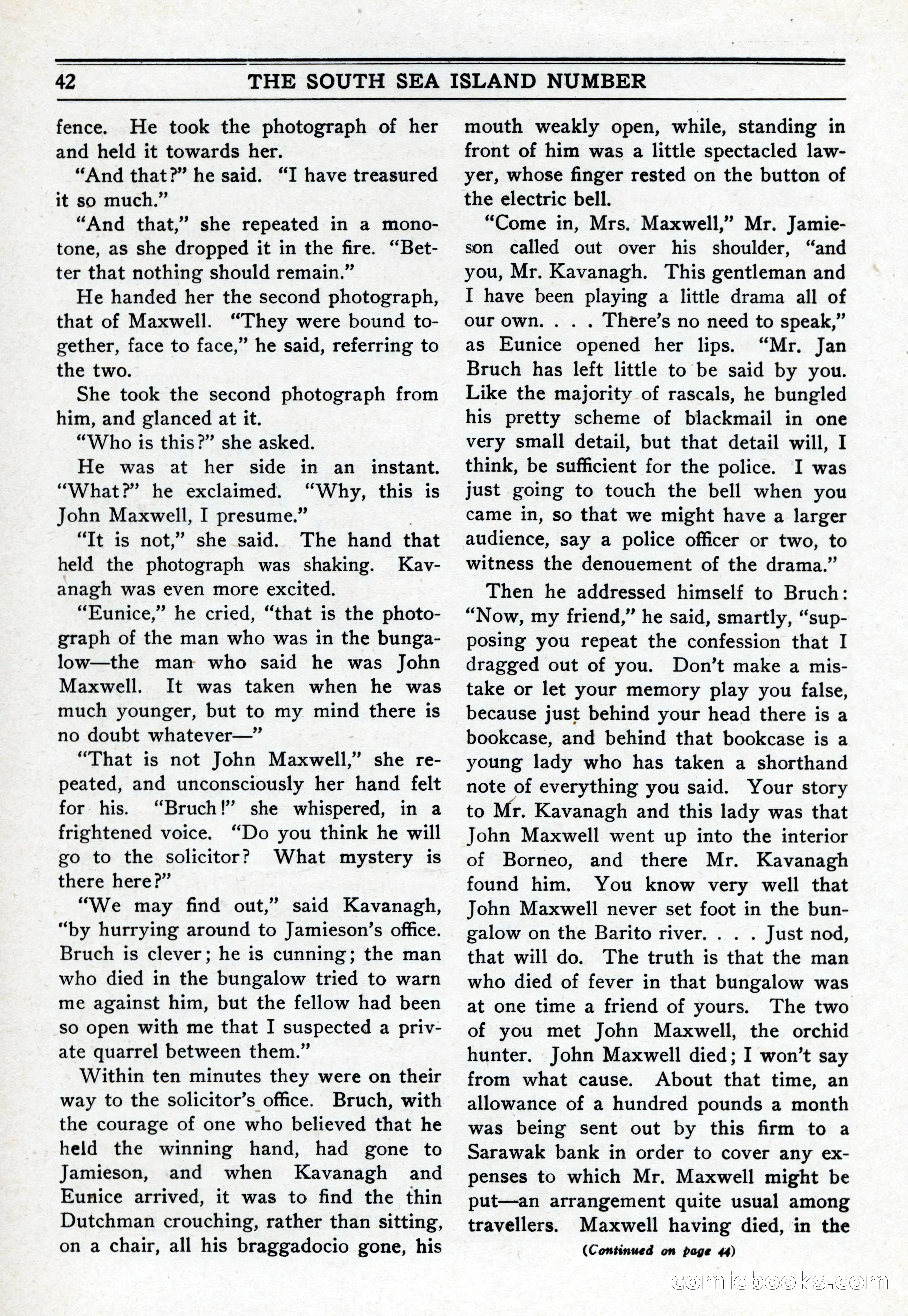
A restored page from Pulp Fiction, 1928. Page through the whole issue in the reader above.
📄 Transcribed text from this page (OCR, searchable)
Machine-transcribed from the original scan — historical spelling and the odd misread are preserved.
42 THE SOUTH SEA ISLAND NUMBER fence. He took the photograph of her and held it towards her. “And that?” he said. “I have treasured it so much.” “And that,’ she repeated in a mono- tone, as she dropped it in the fire. “Bet- ter that nothing should remain.” He handed her the second photograph, that of Maxwell. “They were bound to- gether, face to face,” he said, referring to the two. She took the second photograph from him, and glanced at it. “Who is this?” she asked. He was at her side in an instant. “What?” he exclaimed. “Why, this is John Maxwell, I presume.” | “It is not,” she said. The hand that held the photograph was shaking. Kav- anagh was even more excited. “Eunice,” he cried, “that is the photo- graph of the man who was in the bunga- low—the man who said he was John Maxwell. It was taken when he was much younger, but to my mind there is no doubt whatever—” “That is not John Maxwell,” she re- peated, and unconsciously her hand felt for his. “Bruch!’’ she whispered, in a frightened voice. “Do you think he will go to the solicitor? What mystery is there here?” “We may find out,” said Kavanagh, “by hurrying around to Jamieson’s office. Bruch is clever; he is cunning; the man who died in the bungalow tried to warn me against him, but the fellow had been so open with me that I suspected a priv- ate quarrel between them.” Within ten minutes they were on their way to the solicitor’s office. Bruch, with the courage of one who believed that he held the winning hand, had gone to Jamieson, and when Kavanagh and Eunice arrived, it was to find the thin Dutchman crouching, rather than sitting, on a chair, all his braggadocio gone, his mouth weakly open, while, standing in front of him was a little spectacled law- yer, whose finger rested on the button of the electric bell. “Come in, Mrs. Maxwell,” Mr. Jamie- son called out over his shoulder, “and you, Mr. Kavanagh. This gentleman and I have been playing a little drama all of our own. . . . [here’s no need to speak,” as Eunice opened her lips. “Mr, Jan Bruch has left little to be said by you. Like the majority of rascals, he bungled his pretty scheme of blackmail in one very small detail, but that detail will, I think, be sufficient for the police. I was just going to touch the bell when you came in, so that we might have a larger audience, say a police officer or two, to witness the denouement of the drama.” Then he addressed himself to Bruch: “Now, my friend,” he said, smartly, “sup- posing you repeat the confession that I dragged out of you. Don’t make a mis- take or let your memory play you false, because just behind your head there is a bookcase, and behind that bookcase is a young lady who has taken a shorthand note of everything you said. Your story to Mr. Kavanagh and this lady was that John Maxwell went up into the interior of Borneo, and there Mr. Kavanagh found him. You know very well that John Maxwell never set foot in the bun- galow on the Barito river. . . . Just nod, that will do. The truth is that the man who died of fever in that bungalow was at one time a friend of yours. The two of you met John Maxwell, the orchid hunter. John Maxwell died; I won’t say from what cause. About that time, an allowance of a hundred pounds a month was being sent out by this firm to a Sarawak bank in order to cover any ex- penses to which Mr. Maxwell might be put—an arrangement quite usual among travellers. Maxwell having died, in the (Continued on page 44) COMICEOOOKS CO mn