
A complete issue · 18 pages · 1879
Puck — November 26, 1879
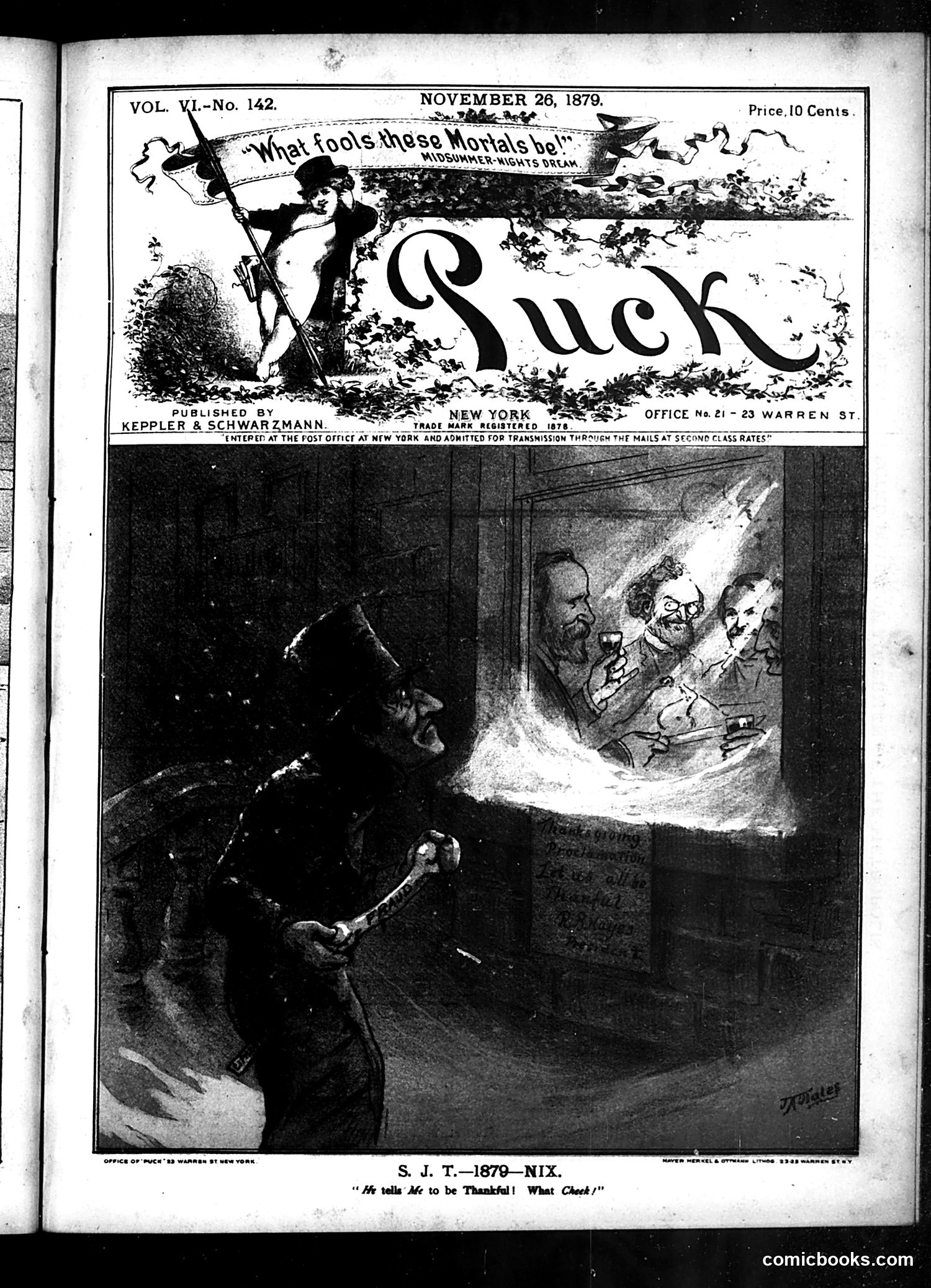
This Puck cover features a political cartoon titled "He tells Me to be Thankful! What Cheek!" The image shows a figure (likely representing a working person or laborer) being confronted by what appear to be wealthy or powerful men emerging from a window or doorway. The shadowy figure holds what looks like a tool or implement, while the men inside appear to be mocking or taunting him. The satire critiques class tensions and labor conditions of the Gilded Age. The "fools these Mortals be!" header (quoting Shakespeare) suggests mockery of ordinary people being told to be grateful despite harsh circumstances. The cartoon likely attacks wealthy industrialists or politicians who dismiss workers' grievances while maintaining comfortable positions themselves—a common Puck theme during this economically turbulent period.
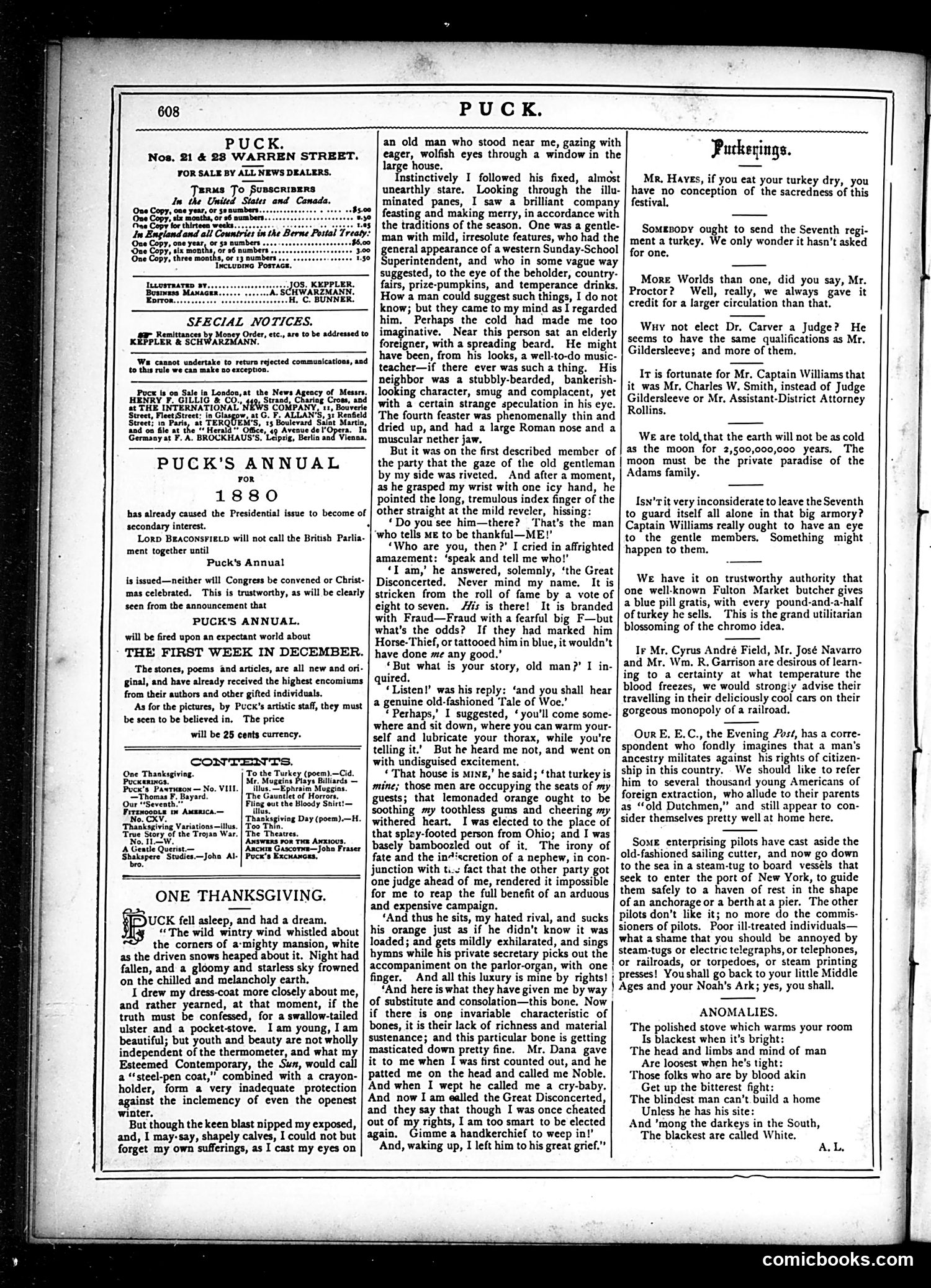
This page is primarily **text content rather than political cartoon**. It contains: 1. **"One Thanksgiving"** — A humorous short story about an old man gazing out a window, observing wealthy people at a Christmas party. The narrative voice follows his gaze through illuminated panes, describing a genteel gathering with decorations and holiday cheer. 2. **"Puckerings"** — A column of brief satirical commentary on contemporary topics, including references to turkey dinners, elections, judges, and social observations about Fulton Market butchers and pilot regulations. 3. **"Anomalies"** — Brief witty observations contrasting opposites (e.g., "The polished stove which warms your room / Is blackest when it's bright"). The page lacks identifiable political figures or specific dated events. It represents **Puck's satirical humor through wordplay and social commentary** rather than visual caricature.
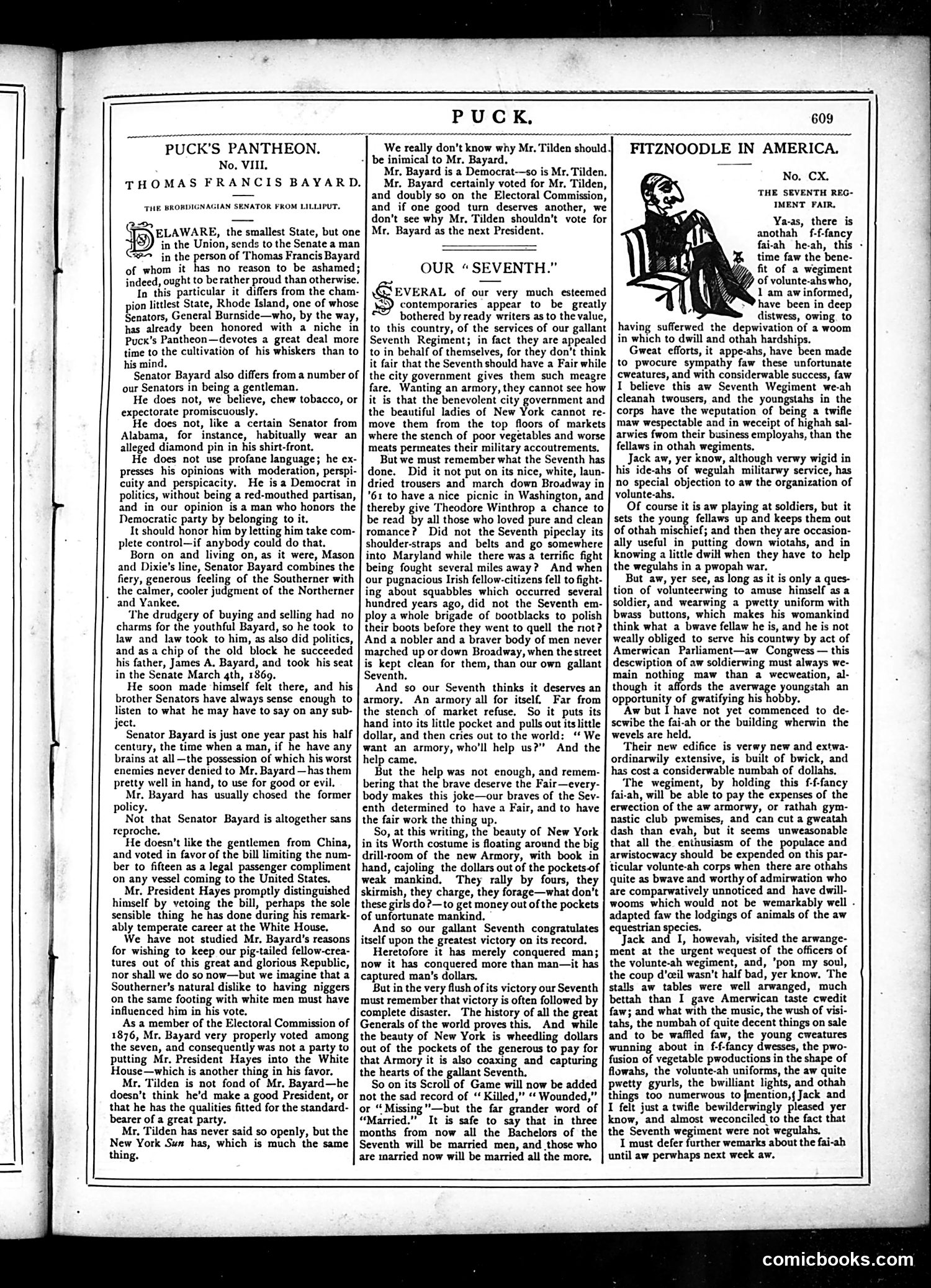
This page contains two distinct pieces: **"Puck's Pantheon No. VIII: Thomas Francis Bayard"** (left column) is a biographical profile praising Delaware Senator Bayard as honorable, principled, and Democratic. It contrasts him favorably with other politicians, noting he doesn't use profane language, chew tobacco, or engage in corrupt practices—positioning him as an exemplary statesman worthy of Democratic Party leadership. **"Fitznoodle in America No. CX"** (right) appears to be a serialized humor column featuring a character experiencing American military life and civic institutions. The piece satirizes volunteer soldiers, their uniforms, and bureaucratic inefficiency, with gentle mockery of American military organization and governmental processes. Both pieces reflect Puck's Democratic editorial stance of the period.
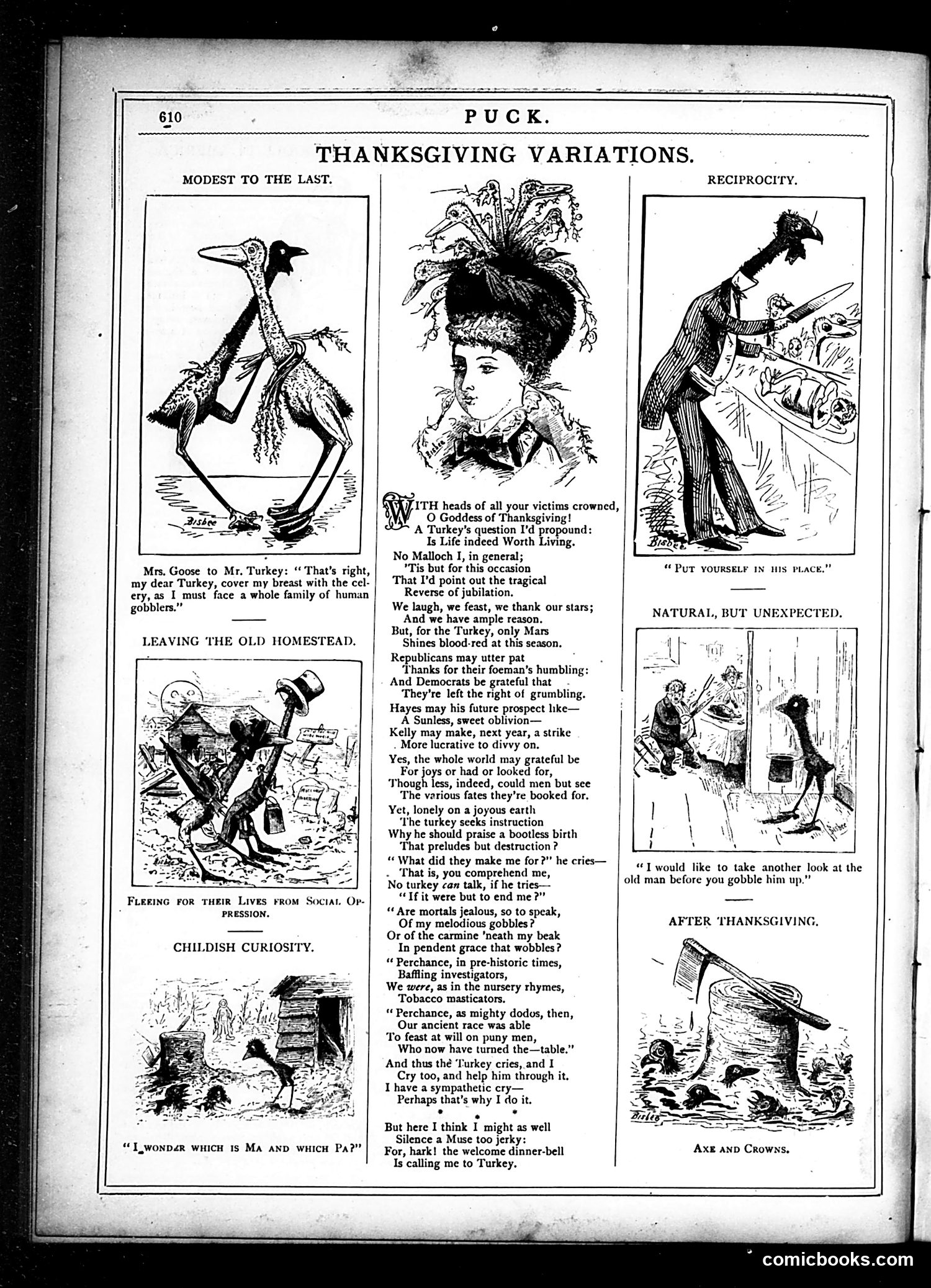
This page satirizes Thanksgiving through multiple cartoons with political undertones: **"Modest to the Last"** depicts a skeletal turkey, mocking pretense of humility. **"Reciprocity"** shows a man carving a turkey at a buffet, captioned "Put yourself in his place"—likely satirizing political rhetoric about empathy or fair treatment. **"Leaving the Old Homestead"** portrays turkeys fleeing with possessions, referencing migration or social upheaval, possibly related to labor movements or rural-to-urban shifts. **The center poem** extensively mocks turkeys sacrificed for Thanksgiving while commenting on contemporary politics—mentioning Republicans, Democrats, and figures like Hayes and Kelly, suggesting the holiday's commercialization amid political division. **"Natural, But Unexpected"** and **"After Thanksgiving"** complete the darkly humorous cycle about turkey mortality and human consumption.
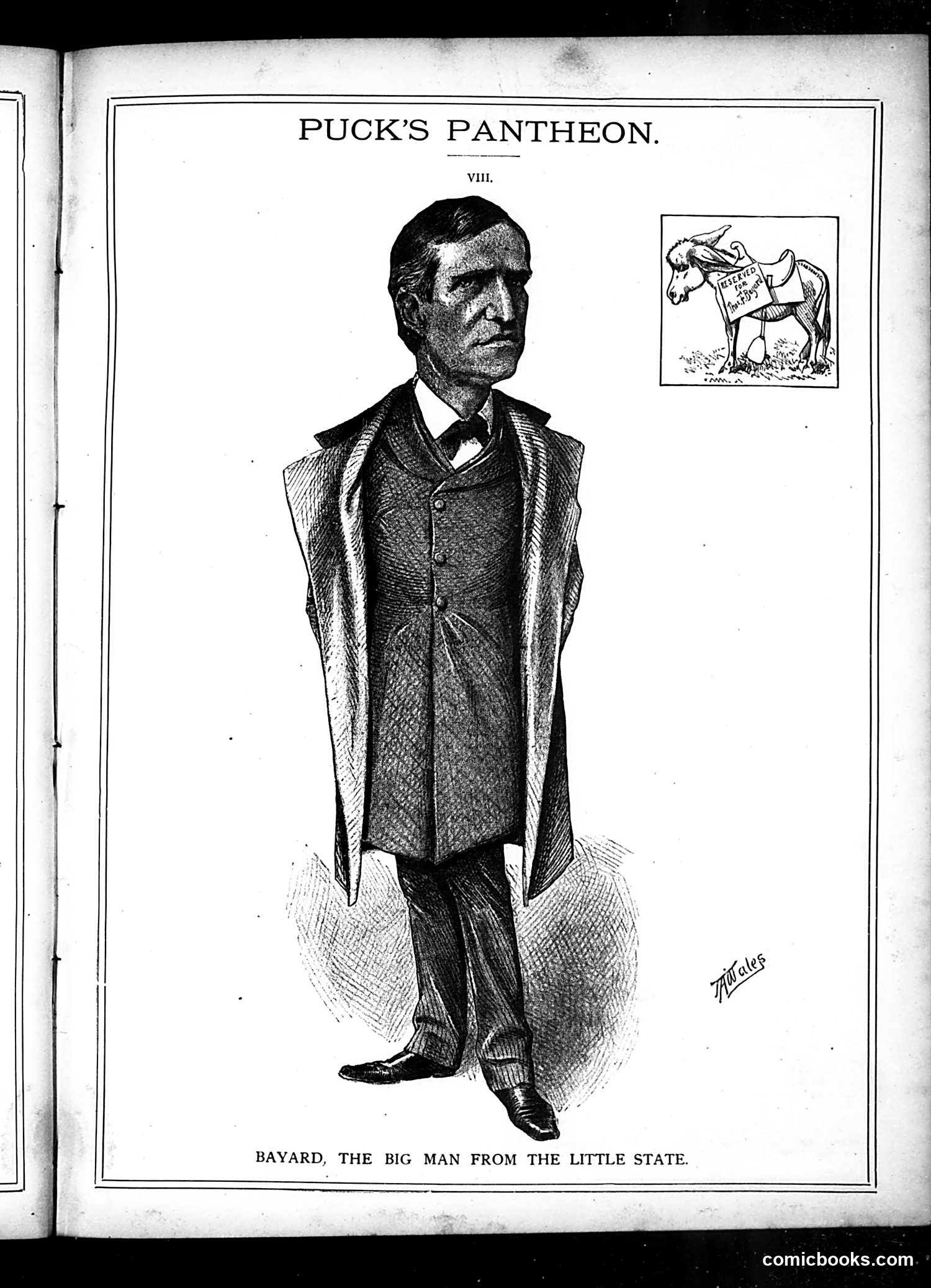
This page depicts a prominent political figure identified as "Bayard" from a small state (likely Delaware, based on the "Little State" reference). The full-length portrait shows a well-dressed man in formal 19th-century attire with a cape or cloak. A small inset illustration in the upper right depicts a donkey, suggesting Democratic party affiliation (the donkey being the Democratic symbol). The satirical point appears to celebrate or mock this figure's stature or importance—calling him "the big man" despite representing a small state suggests either genuine admiration for his outsized political influence or ironic commentary on his pretensions to national prominence. Without additional context, the specific political event or controversy referenced remains unclear.
This page contains three distinct sections: two literary articles and one satirical piece titled "A Gentle Ouerfist." The main satire, "A Gentle Ouerfist," appears to mock an unnamed character planning violence in New York. The author humorously catalogs weapons (25 revolvers, borrowed Gatling guns, a short-gun, a razor, a bull-gun) while claiming peaceful intentions. This reads as satire of either anarchist threats or bombastic political rhetoric popular in the 1880s-90s era. The other sections—"The True Story of the Trojan War" and "Shakspere Studies"—are humorous retellings of classical literature, offering parody rather than political commentary. Without identifying specific individuals or dated events in the visible illustrations, the page primarily offers literary satire rather than direct political cartooning.
This page contains three distinct pieces: 1. **"To the Turkey"** (poem): A patriotic celebration of American freedom and strength, using turkey as a national symbol. 2. **"Mr. Muggins Plays Billiards for the Championship of Gowanus"** (main cartoon): Shows a man playing billiards. The accompanying text is Muggins' humorous first-person account of a championship match where he narrowly loses to opponent Joe. The narrative emphasizes the social prestige of billiards among working-class men and Muggins' competitive frustration over a marginal defeat. 3. **"The Gauntlet of Horrors"** (right column): A serious editorial about urban charitable institutions caring for disease and affliction, advocating for civic responsibility and proper treatment of the unfortunate. 4. **"Fling Out the Bloody Shirt"** (illustration): An engraving depicting what appears to be Civil War-era political imagery.
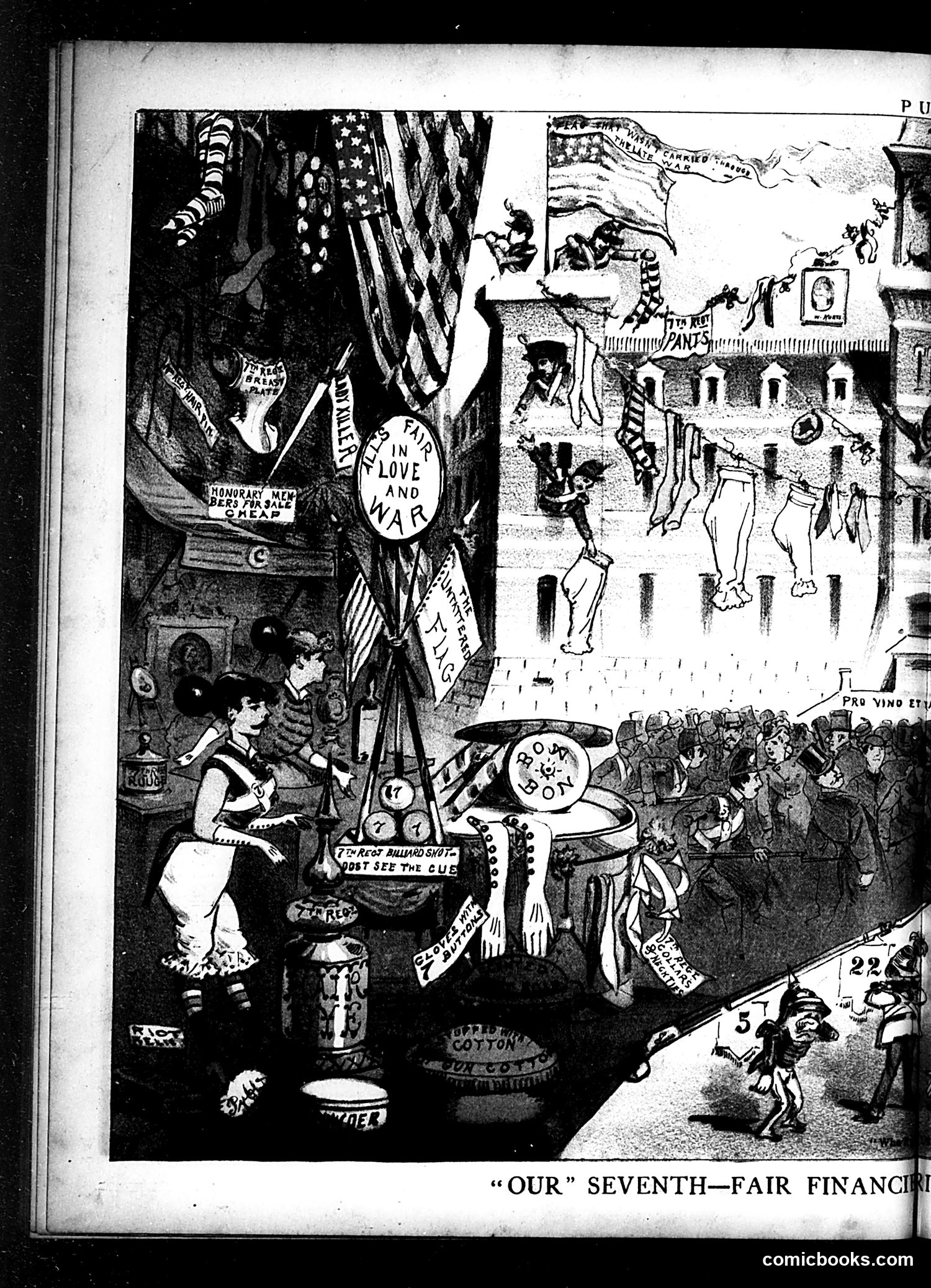
This Puck satirical cartoon depicts a chaotic fair or carnival scene labeled "Fair Financing." The left side shows a woman (likely representing the American public or a specific demographic) interacting with carnival games and attractions, while the right panel reveals the fair's interior with numerous figures engaged in various activities. The title "Fair Financing" suggests satire about financial practices or government spending presented deceptively as entertainment. The carnival setting implies legitimate activities are actually schemes or games of chance. Various labeled elements reference contemporary political or economic concerns, though specific identifications are unclear from the image alone. The overall message appears to criticize how financial dealings or public funds are misrepresented to the public as beneficial or fair when they may actually be exploitative.
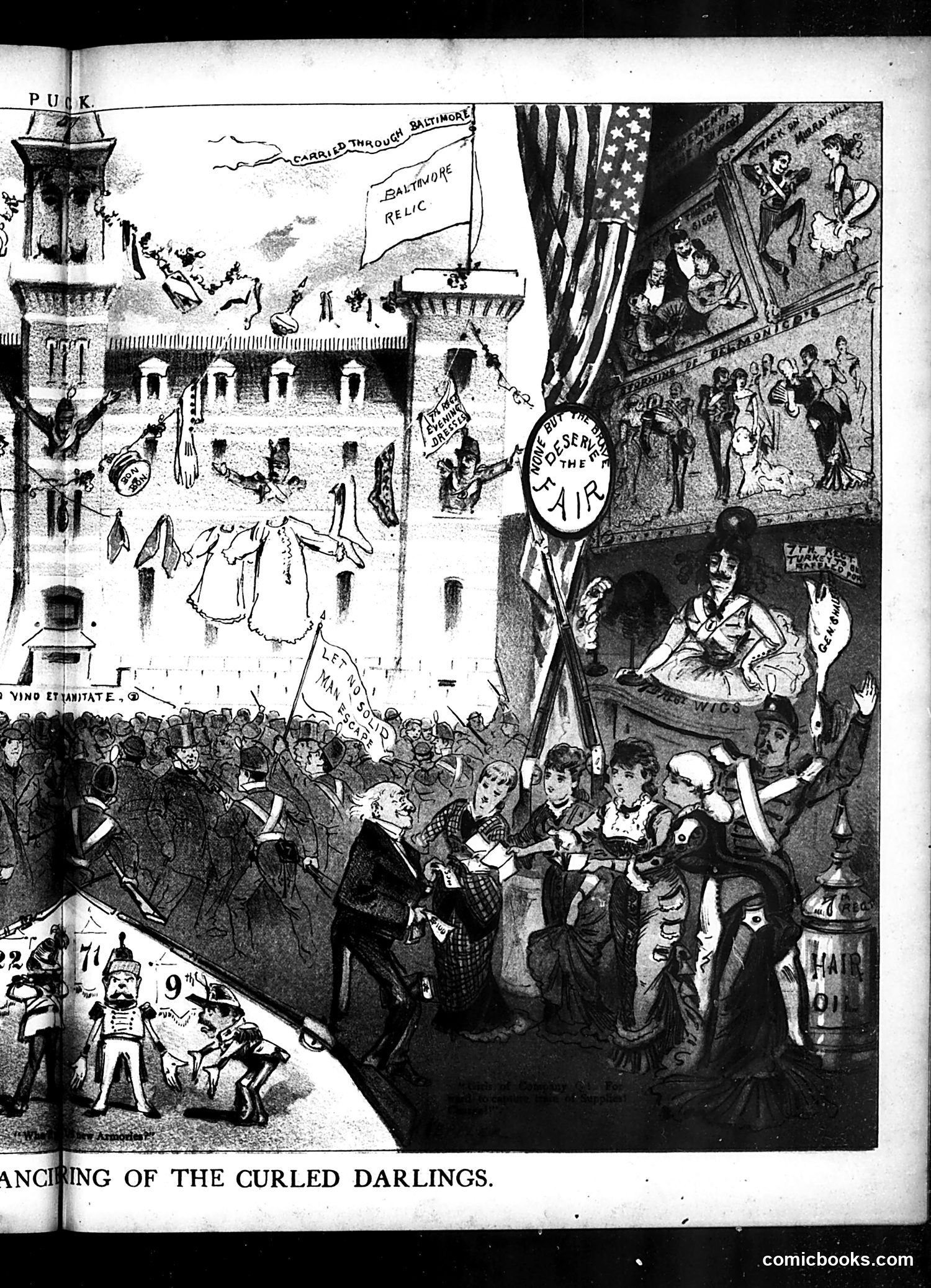
This satirical cartoon depicts a public gathering or celebration at what appears to be a fortified building or castle. The left panel shows a tower with crowds below, while the right panel displays an ornate interior scene with flags and wealthy figures. The caption "Lanciring of the Curled Darlings" suggests mockery of aristocratic or upper-class society members—"curled darlings" likely referring to fashionable, well-groomed elite. The Puck magazine satire appears to ridicule an ostentatious public event, possibly poking fun at wealthy individuals' pretentious celebrations or civic ceremonies. Specific political figures are unclear from the image alone, though the prominent flags and formal setting suggest this comments on contemporary social gatherings or pageantry among Baltimore's (note: "Carried Through Baltimore" text) wealthy class.
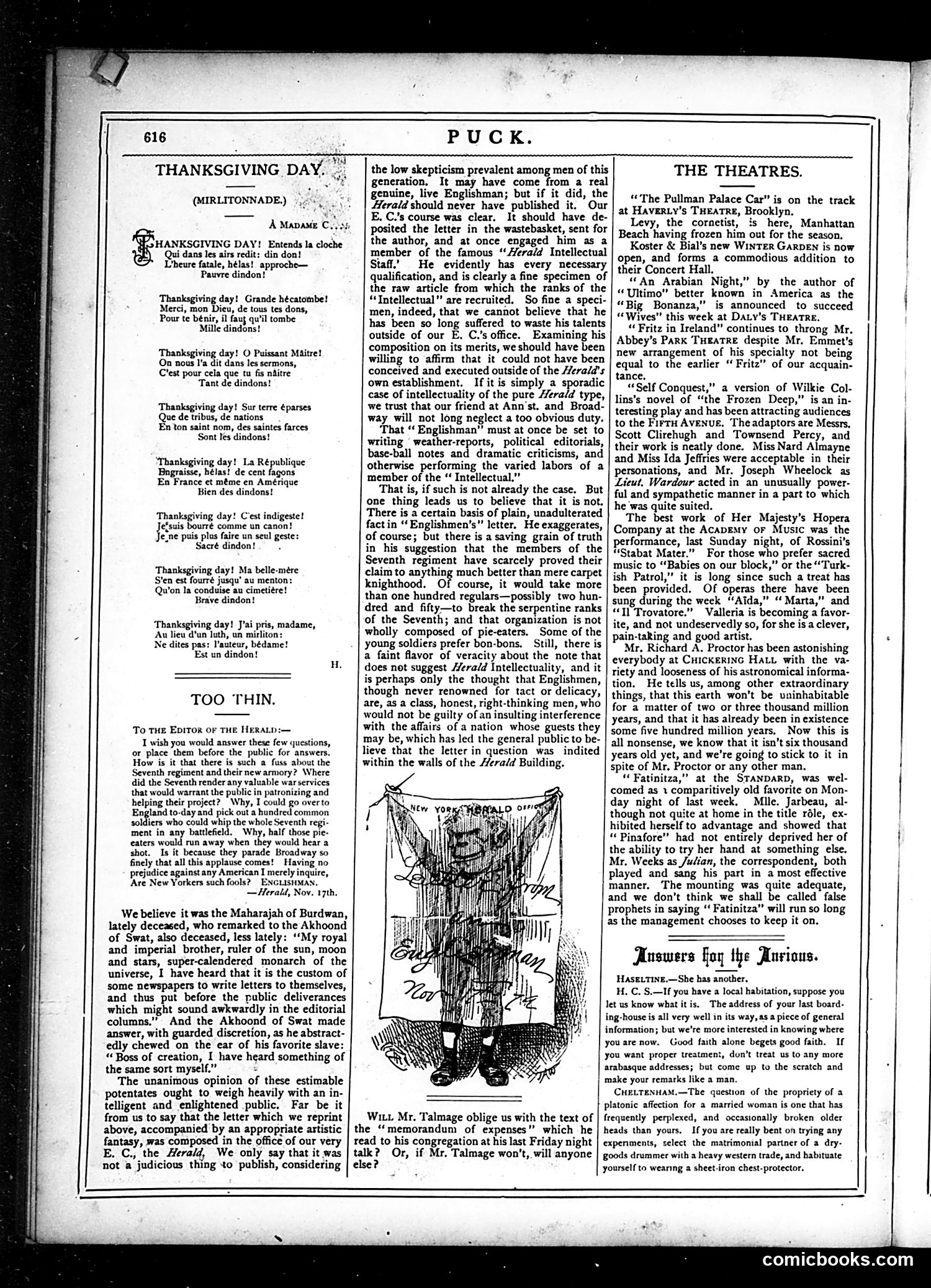
This page contains several sections rather than a unified cartoon. The main illustrated content shows **"Too Thin"** — a satirical drawing of an emaciated figure representing the **Herald newspaper's "Intellectual Staff."** The accompanying letter-to-editor debate concerns whether the Herald published a letter criticizing its own intellectual department. The satire suggests the Herald's intellectual writers are so self-important yet ineffective that they deserve ridicule. The skeletal cartoon emphasizes this critique through exaggeration. The right column, **"The Theatres,"** reviews current Broadway productions including works at the Pullman Palace Car, Hawaiian Theatre, and Abbey's Park Theatre. Below that, **"Answers for the Curious"** provides brief Q&A responses on various social matters. This appears to be a typical Puck page mixing political satire with entertainment coverage and reader correspondence.
This page from *Puck* magazine presents **"Archie Gascoyne: A Romance of Skye,"** a serialized story by John Fraser written expressly for the publication. The page is primarily **text-based fiction rather than a political cartoon**. The narrative concerns a Scottish mining venture that collapsed financially, ruining shareholders. The story satirizes **Victorian-era financial fraud and speculation**, particularly how wealthy industrialists and MPs manipulated poor investors into purchasing worthless mining stocks. References include Sir Alexander Gascoyne and other English capitalists who profited while ordinary citizens lost their savings. The satire critiques **late-19th-century corporate malfeasance and the vulnerability of working-class investors** to schemes promoted by unscrupulous businessmen.
This page from Puck contains no political cartoon, but rather the continuation of a serialized fiction story titled "The City of Gold." The narrative follows a character named Archie who travels to Silver City, Colorado—described as a booming mining town full of saloons, gambling halls, theaters, and other vices. The story satirizes the rapid, chaotic development of Western boomtowns during the gold rush era, contrasting the town's newfound luxury and enterprise with its moral emptiness. References to gambling dens, disreputable establishments, and the crude society reflect period concerns about Western lawlessness and commercialism. The page ends with a "[To be continued]" note, indicating this is mid-narrative. No specific political figures or detailed satire are evident on this particular page.
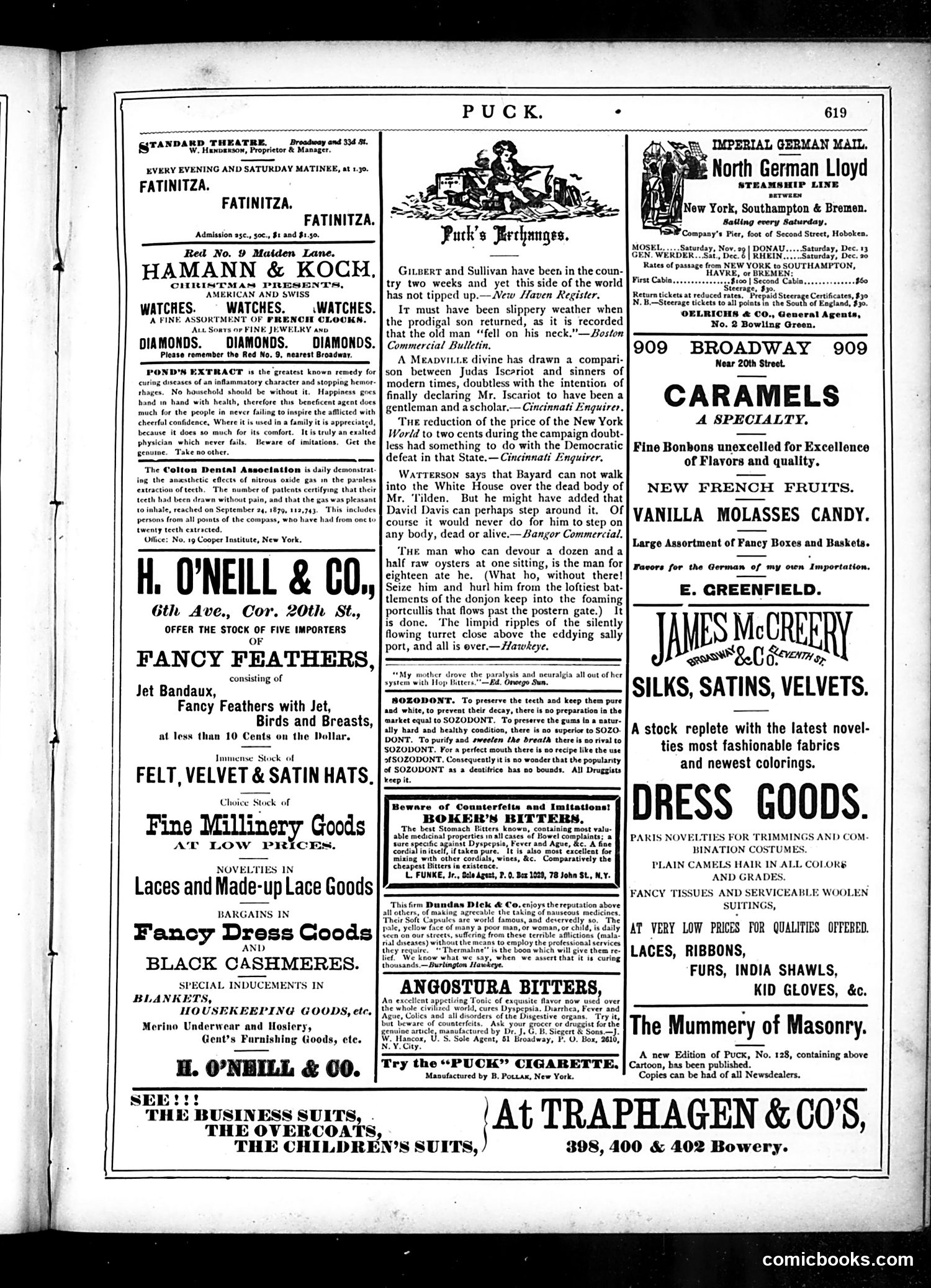
This page is **primarily advertising**, not political satire. The bulk of the content consists of commercial ads for the period—theaters (Fatinitza), watches, diamonds, feathers, millinery, dress goods, and candy. The only satirical content is the section titled **"Puck's Jottings"**—brief humorous observations about current events. These include jokes about: - Gilbert and Sullivan's recent visit to America - A diving accident at the White House - Raw oyster consumption - A comment on "SOZODONT" toothpaste's popularity The cartoonish header illustration shows cherubs or putti in a classical style, typical of Puck's decorative mastheads. Without clear political caricatures or identifiable figures, this appears to be a lighter issue focused on general social humor and commercial content rather than pointed political satire.
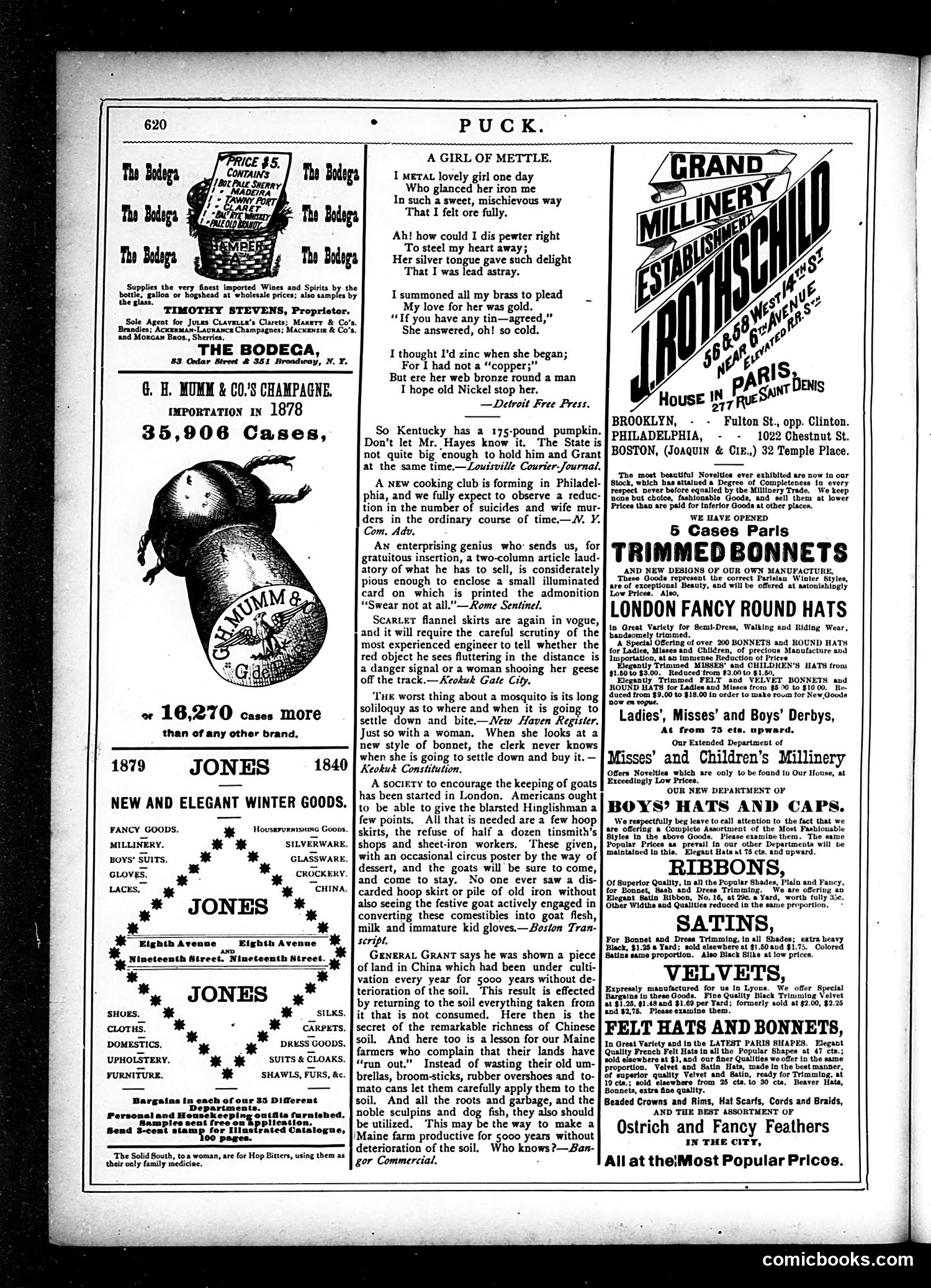
This page is predominantly **advertising and commercial content** rather than political satire. The visible elements include: **Main advertisements:** - G.H. Mumm & Co.'s champagne (promoting 35,906 cases sold) - Jones department store (winter goods, fancy goods, millinery, shoes, silks) - Grand Millinery/Brothers Schuh (Paris fashion hats) - Various millinery and fashion retailers **Editorial content:** - "A Girl of Mettle" — a short romantic poem about a flirtatious metal girl - Several brief humorous news items about pumpkins, cooking clubs, and goat-keeping The page reflects **late 19th-century commercial culture** rather than political cartooning. It showcases typical Puck-era advertising alongside light, gossipy social commentary. The satire is minimal and localized to brief anecdotes rather than sustained political critique.
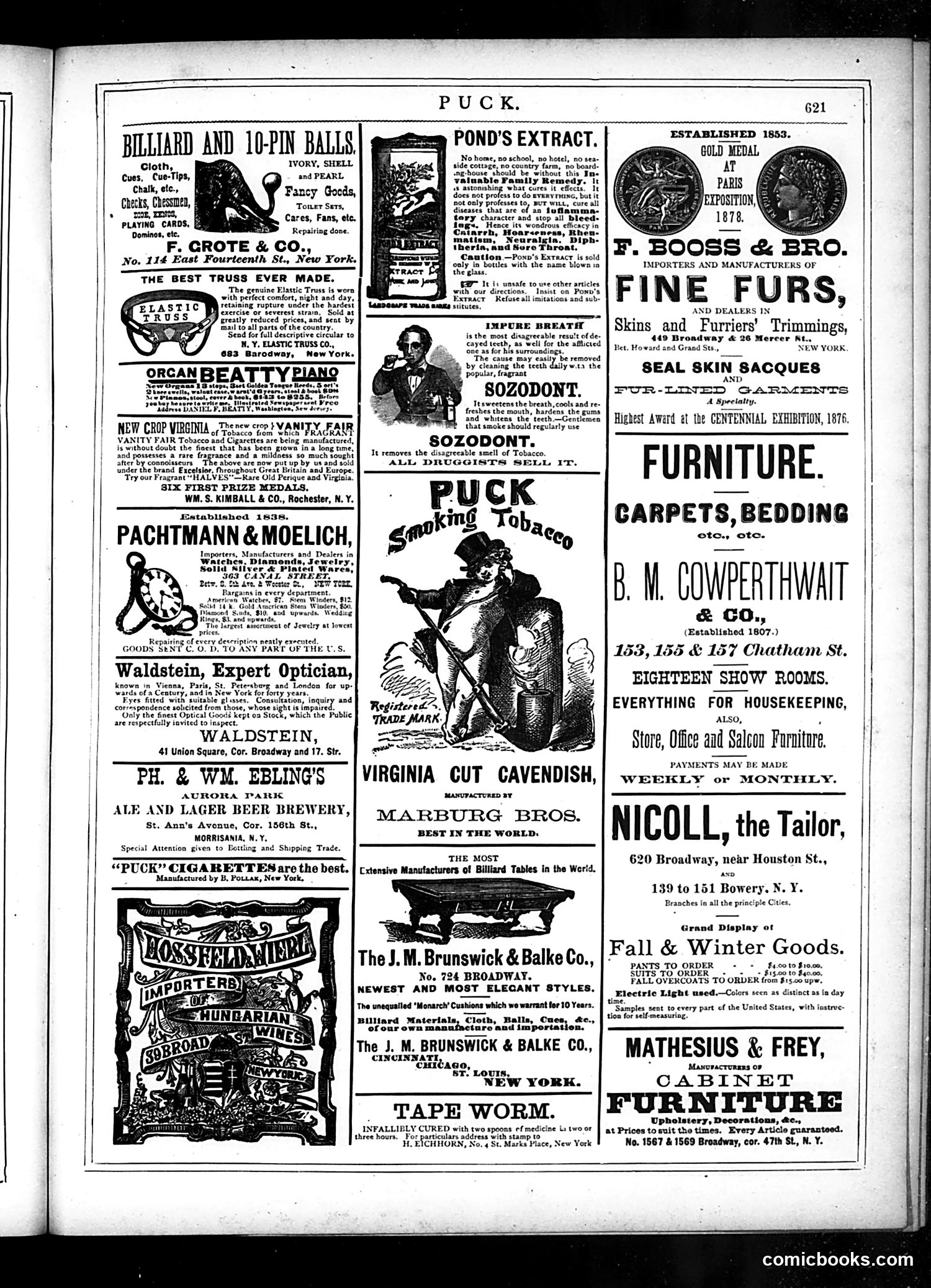
This page from *Puck* magazine (established 1855) is predominantly commercial advertising rather than satirical content. The page features numerous product advertisements including: - Billiard and 10-pin ball equipment - Pond's Extract (patent medicine) - Fine furs and trimmings - Furniture and carpets - Tobacco products - Beer and ale - Tailor services - Patent medicines (Sozodont toothpaste, Tapeworm remedy) The only illustration with potential satirical intent is a central image of a character labeled "Puck" smoking tobacco—this appears to be branding rather than political commentary. The page demonstrates how 19th-century magazines supported themselves through extensive paid advertising, often filling entire sections with commercial content.
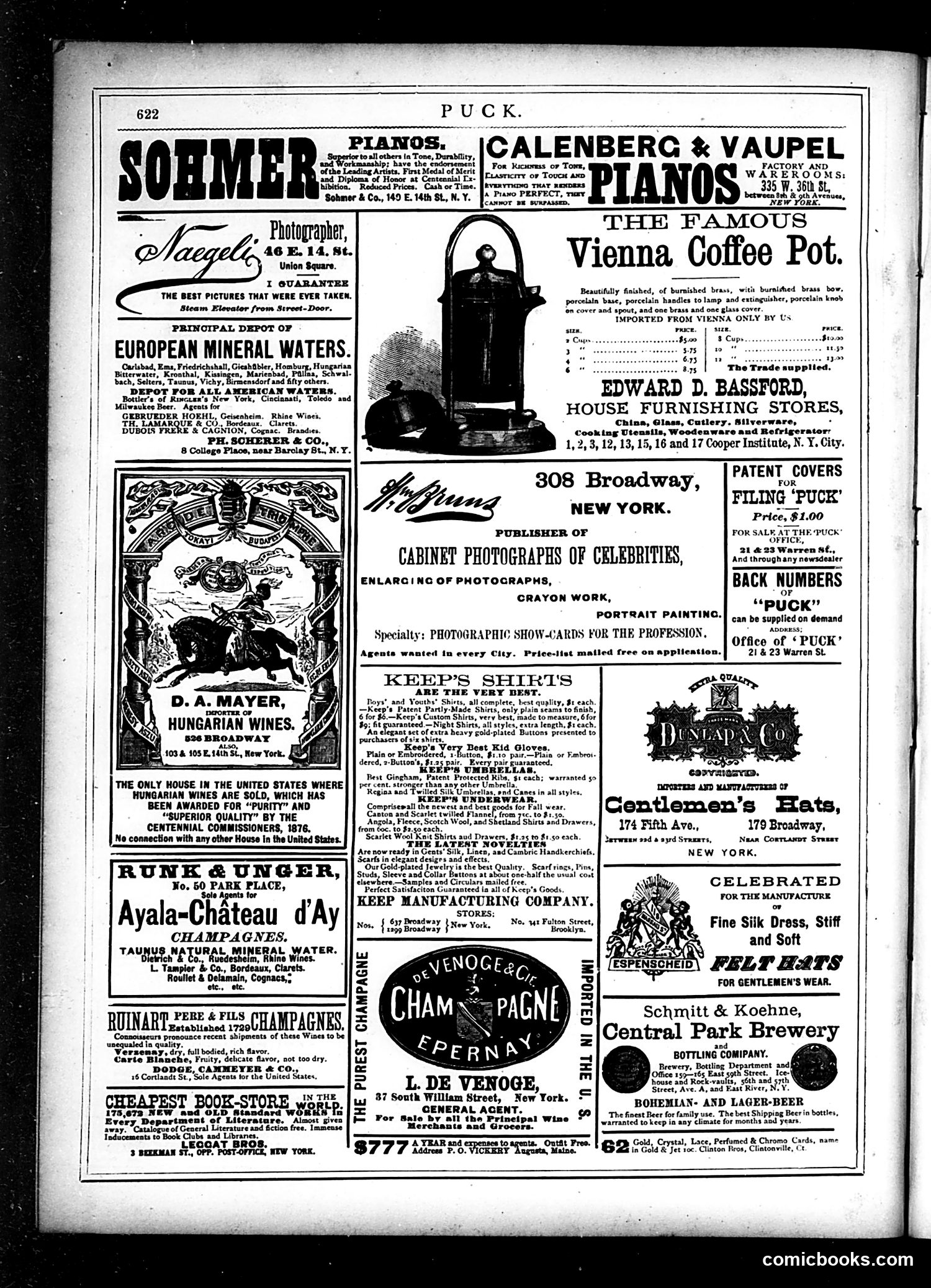
This page is primarily **advertising**, not editorial content or satire. It contains numerous commercial advertisements for late 19th/early 20th-century products and services, including: - Piano manufacturers (Sohmer, Calenberg & Vaupel) - A Vienna Coffee Pot (housewares) - Champagne brands (Ayala-Château d'Ay, Ruinart Père & Fils) - Clothing and accessories (Keep's Shirts, Dunlap hats, felt hats) - Photography services and supplies - Mineral water and beverages - A book store The only notable illustration is D.A. Mayer's decorative Hungarian wines advertisement featuring classical imagery. The page represents Puck's revenue model: advertising subsidized the satirical magazine. No significant political cartoon or social satire is present on this particular page.
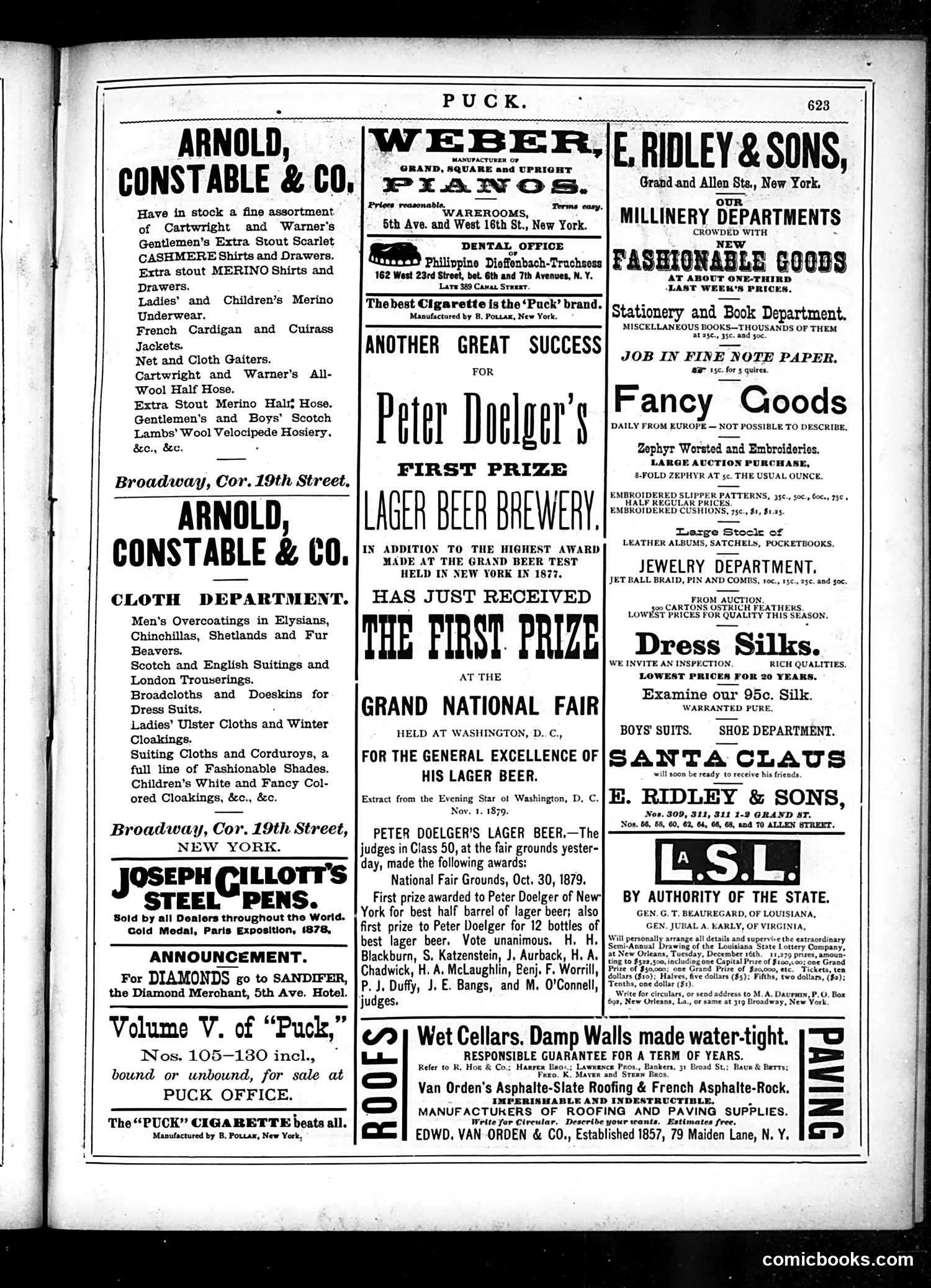
This page is primarily **advertising**, not editorial content or cartoons. It consists of commercial notices for New York City businesses from November 1879, including: - Clothing retailers (Arnold, Constable & Co.) - A beer brewery (Peter Doelger's Lager Beer) - Department stores (E. Ridley & Sons) - Steel pens (Joseph Gillott's) - Various luxury goods The only substantive non-advertising content is an **announcement** about Peter Doelger's lager beer winning "First Prize" at the Grand National Fair in Washington, D.C., with a quote from the Evening Star newspaper listing judges' names. The page represents Puck's revenue model—combining satirical editorial content with paid advertisements from prominent merchants. No political satire or cartoons are visible on this particular page.
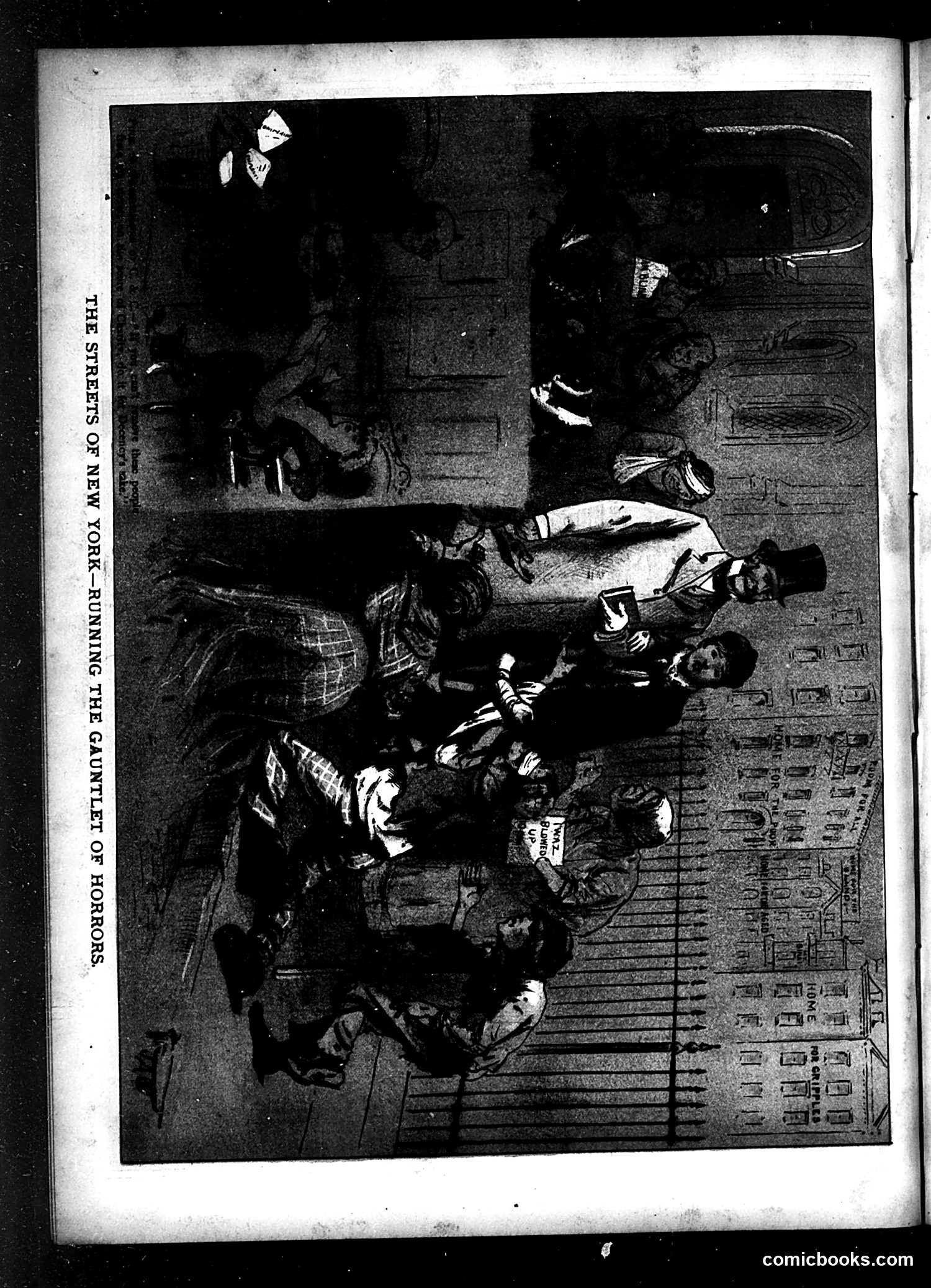
This appears to be a satirical scene depicting street life in New York City. The image shows several figures on an urban street, rendered in the exaggerated style typical of Puck's social commentary. The caption suggests the cartoon critiques how New Yorkers navigate public spaces while encountering various solicitations or demands—possibly panhandlers, street vendors, or other urban hustlers. The "gauntlet of honors" likely refers ironically to the constant stream of people trying to extract money or attention from pedestrians. The rough black-and-white illustration style and crowded street composition emphasize the chaos and unpredictability of urban life, a common theme in Puck's social satire of daily American experience. Without clearer detail visibility, the specific figures and their identities remain unclear.