
Puck, 1879-11-26 · page 3 of 18
Puck — November 26, 1879 — page 3: what you’re looking at
What you’re looking at
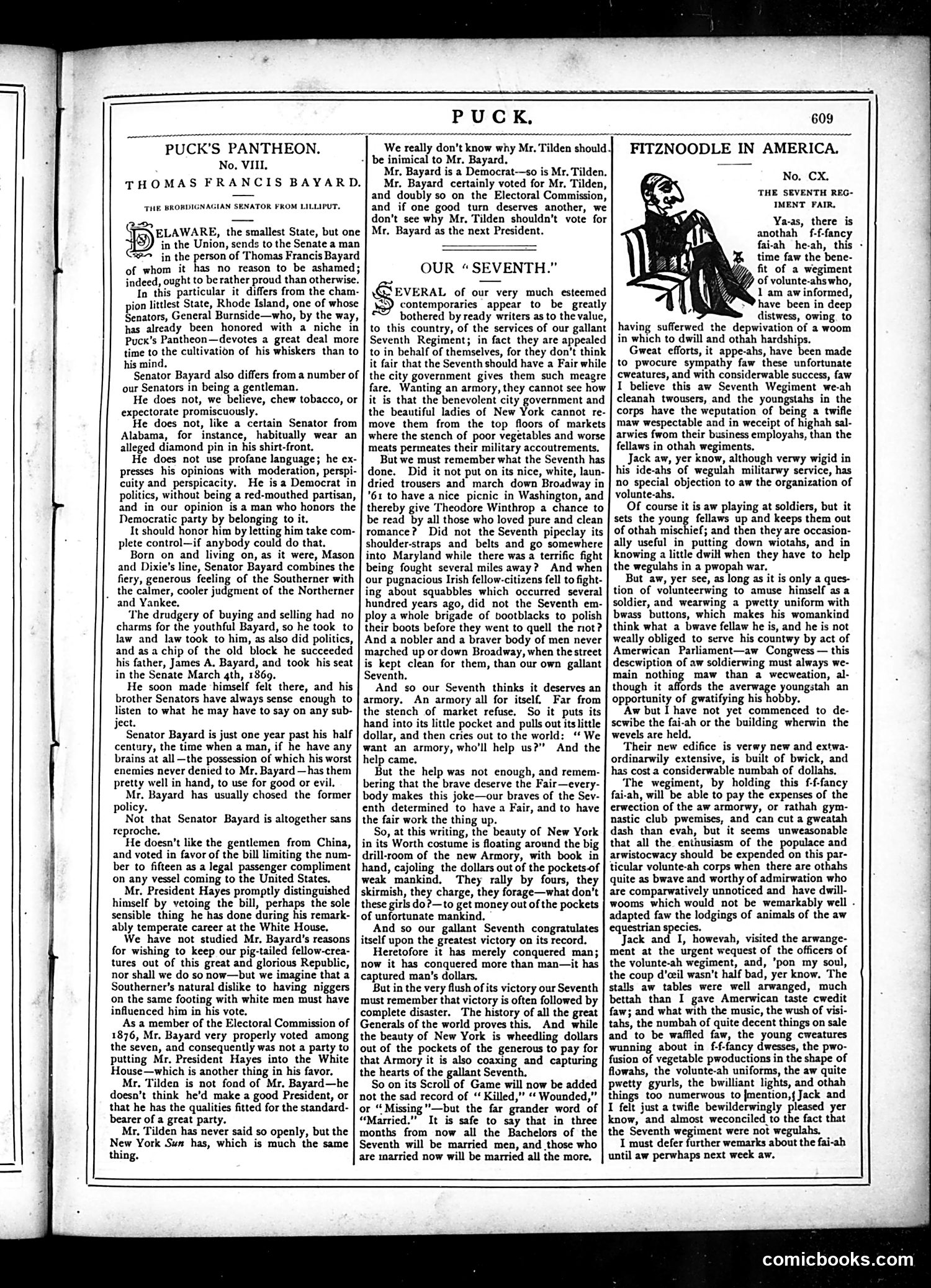
This page contains two distinct pieces: **"Puck's Pantheon No. VIII: Thomas Francis Bayard"** (left column) is a biographical profile praising Delaware Senator Bayard as honorable, principled, and Democratic. It contrasts him favorably with other politicians, noting he doesn't use profane language, chew tobacco, or engage in corrupt practices—positioning him as an exemplary statesman worthy of Democratic Party leadership. **"Fitznoodle in America No. CX"** (right) appears to be a serialized humor column featuring a character experiencing American military life and civic institutions. The piece satirizes volunteer soldiers, their uniforms, and bureaucratic inefficiency, with gentle mockery of American military organization and governmental processes. Both pieces reflect Puck's Democratic editorial stance of the period.
📄 Transcribed text from this page (OCR, searchable)
Machine-transcribed from the original scan — historical spelling and the odd misread are preserved.
PUCK, 609 No, VIII. TOR FROM LILLIPUT, ‘THE BRORDIGNAGIAN indeed, ought to be rather proud than otherwise. In this particular it differs from the cham- pion littlest State, Rhode Island, one of whose Senators, General Burnside—who, by the way, has already been honored with a niche in time to the cultivation of his whiskers than to his mind. our Senators in being a gentleman. He does not, we believe, chew tobacco, or expectorate promiscuously. He does not, like a certain Senator from Alabama, for instance, habitually wear an alleged diamond pin in his shirt-front. He does not use profane language; he ex- presses his opinions with moderation, perspi- cuity and perspicacity, He is a Democrat in politics, without being a red-mouthed partisan, and in our opinion is a man who honors the Democratic party by belonging to it. It should honor him by letting him take com- plete control—if anybody could do that. Born on and living on, as it were, Mason and Dixie's line, Senator Bayard combines the fiery, generous feeling of the Southerner with _ the calmer, cooler judgment of the Northerner and Yankee, ‘The drudgery of buying and selling had no charms for the youthful Bayard, so he took to law and law took to him, as also did politics, and as a chip of the old block he succeeded his father, James A. Bayard, and took his seat in the Senate March 4th, 1869. He soon made himself felt there, and his brother Senators have always sense enough to listen to what he may have to say on any sub- ject. Senator Bayard is just one year past his half century, the time when a man, if he have any brains ‘at all —the possession of which his worst enemies never denied to Mr. Bayard —has them pretty well in hand, to use for good or evil. Mr. Bayard has usually chosed the former policy. Not that Senator Bayard is altogether sans | reproche. He doesn’t like the gentlemen from China, and voted in favor of the bill limiting the num- ber to fifteen as a legal passenger compliment i on any vessel coming to the United States. ; Mr. President Hayes promptly distinguished himself by vetoing the bill, perhaps the sole sensible thing he has done during his remark- ably temperate career at the White House, We have not studied Mr, Bayard’s reasons for wishing to keep our pig-tailed fellow-crea- tures out of this great and glorious Republic, nor shall we do so now—but we imagine that a Southerner’s natural dislike to having niggers on the same footing with white men must have influenced him in his vote. As a member of the Electoral Commission of 1876, Mr. Bayard very properly voted among the seven, and consequently was not a party to putting Mr. President Hayes into the White House—which is another thing in his favor. Mr. Tilden is not fond of Mr. Bayard—he doesn’t think he'd make a good President, or that he has the qualities fitted for the standard- bearer of a great party. Mr, Tilden has never said so openly, but the New York Sua has, which is much the same thing. THOMAS FRANCIS BAYARD. GS ELAWARE, the smallest State, but one d in the Union, sends to the Senate a man > in the person of Thomas Francis Bayard of whom it has no reason to be ashamed; Puck's Pantheon—devotes a great deal more Senator Bayard also differs from a number of We really don’t know why Mr. Tilden should -| be inimical to Mr. Bayard, Mr. Bayard is a Democrat—so is Mr. Tilden. Mr. Bayard certainly voted for Mr. Ti and doubly so on the Electoral Commission, and if one good turn deserves another, we don't see why Mr. Tilden shouldn't vote for Mr. Bayard as the next President. § contemporaries appear to be greatly bothered by ready writers as to the value, to this country, of the services of our gallant Seventh Regiment; in fact they are appealed to in behalf of themselves, for they don’t think it fair that the Seventh should have a Fair while the city government gives them such meagre fare. Wanting an armory, they cannot see how it is that the benevolent city government and the beautiful ladies of New York cannot re- move them from the top floors of markets where the stench of poor vegetables and worse meats permeates their military accoutrements. But we must remember what the Seventh has done. Did it not put on its nice, white, laun- dried trousers and march down Broadway in "61 to have a nice picnic in Washington, and thereby give Theodore Winthrop a chance to be read by all those who loved pure and clean romance? Did not the Seventh pipeclay its shoulder-straps and belts and go somewhere into Maryland while there was a terrific fight being fought several miles away? And when our pugnacious Irish fellow-citizens fell to fight- ing about squabbles which occurred several hundred years ago, did not the Seventh em- ploy a whole brigade of bootblacks to polish their boots before they went to quell the not? And a nobler and a braver body of men never magched up or down Broadway, when the street is kept clean for them, than our own gallant Seventh. And so our Seventh thinks it deserves an armory. An armory all for itself, Far from the stench of market refuse. So it puts its hand into its little pocket and pulls out its little dollar, and then cries out to the world: “ We want an armory, who'll help us?” And the help came, But the help was not enough, and remem- bering that the brave deserve the Fair—every- body makes this joke—our braves of the Sev- enth determined to have a Fair, and to have the fair work the thing up. So, at this writing, the beauty of New York in its Worth costume is floating around the drill-room of the new Armory, with book in hand, cajoling the dollars out of the pocketsof weak mankind, They rally by fours, they skirmish, they charge, they forage—what don’t these girls do?—to get money out of the pockets of unfortunate mankind. And so our gallant Seventh congratulates itself upon the greatest victory on its record. Heretofore it has merely conquered man; now it has conquered more than man—it has captured man's dollars. But in the very flush of its victory our Seventh must remember that victory is often followed by complete disaster. The history of all the great Generals of the world proves this, And while the beauty of New York is wheedling dollars out of the pockets of the generous to pay for that Armory it is also coaxing and capturing the hearts of the gallant Seventh. So on its Scroll of Game will now be added not the sad record of “ Killed,” ‘‘ Wounded,” or “ Missing”’—but the far grander word of “Married.” It is safe to say that in three months from now all the Bachelors of the Seventh will be married men, and those who are married now will be married all the more, OUR “SEVENTH.” VVERAL of our very much esteemed FITZNOODLE IN AMERICA. No. CX. THE SEVENTH REG- IMENT FAIR, Ya-as, there is anothah -f-fancy fai-ah he-ah, this - time faw the bene- fit of a wegiment @ of volunte-ahswho, 1 am aw informed, have been in deep distwess, owing. to having sufferwed the depwivation of a woom in which to dwill and othah hardships. Gweat efforts, it appe-ahs, have been made to pwocure sympathy faw these unfortunate cweatures, and with considerwable success, faw I believe this aw Seventh Wegiment we-ah cleanah twousers, and the youngstahs in the corps have the weputation of being a twifle maw wespectable and in weceipt of highah sal- arwies fwom their business employahs, than the fellaws in othah wegiments. Jack aw, yer know, although verwy wigid in his ide-ahs ‘of wegulah militarwy service, has no special objection to aw the organization of volunte-ahs. Of course it is aw playing at soldiers, but it sets the young fellaws up and keeps them out of othah mi: Fief; id then they are occasion- ally useful putting down wiotahs, and in knowing a little dwill when they have to help the wegulahs in a pwopah war, But aw, yer see, as long as it is only a ques- tion of volunteerwing to amuse himself as a soldier, and wearwing a pwetty uniform with bwass buttons, which makes his womankind think what a bwave fellaw he is, and he is not weally obliged to serve his countwy by act of Amerwican Parliament—aw Congwess — this descwiption of aw soldierwing must always we- main nothing maw than a wecweation, al- though it affords the averwage youngstah an opportunity of gwatifying his hobby. ‘Aw but I have not yet commenced to de- scwibe the fai-ah or the building wherwin the wevels are held. Their new edifice is verwy new and extwa- ordinarwily extensive, is built of bwick, and has cost a considerwable numbah of dollahs. The wegiment, by holding this f-f-fancy fai-ah, will be able to pay the expenses of the erwection of the aw armorwy, or rathah gym- nastic club pwemises, and can cut a gweatah dash than evah, but it seems unweasonable that all the enthusiasm of the populace and arwistocwacy should be expended on this par- ticular volunte-ah corps when there are othahs quite as bwave and worthy of admirwation who are comparwatively unnoticed and have dwill- wooms which would not be wemarkably well . adapted faw the lodgings of animals of the aw equestrian species. Jack and I, howevah, visited the arwange- ment at the urgent wequest of the officers of the volunte-ah wegiment, and, ‘pon my soul, the coup d’ceil wasn't half bad, yer know. ‘The stalls aw tables were well arwanged, much bettah than I gave Amerwican taste cwedit faw; and what with the music, the wush of visi- tahs, the numbah of quite decent things on sale and to be waffled faw, the young cweatures wunning about in f-f-fancy dwesses, the pwo- fusion of vegetable pwoductions in the shape of flowahs, the volunte-ah uniforms, the aw quite pwetty gyurls, the bwilliant lights, and othah things too numerwous to |mention,{ Jack and I felt just a twifle bewilderwingly pleased yer know, and almost weconciled to the fact that the Seventh wegiment were not we; I must defer further wemarks about the fai-ah until aw perwhaps next week aw. ~e comicbooks.com